Proceedings of the 22nd Conference on Computational Natural Language Learning (CoNLL 2018), pages 292–301 292
Comparing Models of Associative Meaning: An Empirical Investigation of
Reference in Simple Language Games
Judy Hanwen Shen Matthias Hofer Bjarke Felbo Roger Levy Massachusetts Institute of Technology
77 Massachusetts Avenue Cambridge, MA 02139
{judyshen, mhofer, felbo, rplevy}@mit.edu
Abstract
Simple reference games (Wittgenstein,1953) are of central theoretical and empirical im-portance in the study of situated language use. Although language provides rich, com-positional truth-conditional semantics to fa-cilitate reference, speakers and listeners may sometimes lack the overall lexical and cog-nitive resources to guarantee successful ref-erence through these means alone. However, language also has rich associational structures that can serve as a further resource for achiev-ing successful reference. Here we investigate this use of associational information in a set-ting where only associational information is available: a simplified version of the popu-lar game Codenames. Using optimal experi-ment design techniques, we compare a range of models varying in the type of associative information deployed and in level of prag-matic sophistication against human behavior. In this setting we find that listeners’ behav-ior reflects direct bigram collocational associ-ations more strongly than word-embedding or semantic knowledge graph-based associations and that there is little evidence for pragmat-ically sophisticated behavior by either speak-ers or listenspeak-ers of the type that might be pre-dicted by recursive-reasoning models such as the Rational Speech Acts theory. These results shed light on the nature of the lexical resources that speakers and listeners can bring to bear in achieving reference through associative mean-ing alone.
1 Introduction
In his 1953 book Philosophical Investigations, Wittgenstein makes the argument for studying simple reference games to learn about the nature of language (Wittgenstein, 1953). Various ap-plications of this idea in different fields, includ-ing linclud-inguistics (Pietarinen, 2007), cognitive sci-ence (Frank and Goodman, 2012), artificial
in-telligence (Lazaridou et al.,2016), and behavior-based robotics (Steels, 1997) have validated this fundamental insight and demonstrated the theo-retical and empirical importance of studying lan-guage learning and use in simplified contexts. Here we describe a novel framework that uses a simple reference game to study the semantic re-sourcesspeakers and listeners use to facilitate ref-erence. In particular, placing strong constraints on word choice and modes of interaction allows us to better isolate specific aspects that contribute to-wards the complexity of natural language seman-tics. Language provides a multitude of different resources for its users to cooperatively achieve reference. In particular, language provides truth-conditional semantic structures. These informa-tion structures are characterized in terms of their logical truth conditions and can be precisely stated using formal logic. Across many cases, however, successful reference cannot be guaranteed through these means alone. Another possible source of se-mantic information areassociative resources(e.g. the meaning associations of ‘nurse’ with ‘female nurse’ rather than ‘male nurse’). The question of how to best formally characterize these rich asso-ciative structures to adequately account for our lin-guistic abilities is still largely unresolved.
listener. The models correspond to qualitatively different sources of information, including collo-cations, distributional similarity across contexts, topic similarity, or common-sense conceptual re-latedness.
In the closest predecessor to our work, Xu and Kemp (2010) used observational data from the television game Password, where the goal is to guess a target word on an associated cue word freely generated, to model whether speaker and listener alignment based on their differential re-liance on forward vs backward word associations (estimated using the experimental norms of Nel-son et al., 2004). They found that similar mix-tures of forward and backward associations best explained both speaker and hearer behaviors, sug-gesting game participants are well calibrated and cooperative with another, but did not investigate the nature of the lexical knowledge accounting for the associations underlying participant behavior.
In this paper, we construct a simplified refer-ence game involving word associations where con-strained sets of potential reference clues words and reference target words are provided. We construct a variety of different semantic association mea-sures and conduct a series of experiments to test which source of information humans use. Further-more, we combine these measures with the RSA framework to derive predictions about pragmatic behavior on the task.
2 Experimental methods
We create a simplified version of the board game Codenames (Chv´atil,2015) where the objective is for a speaker to select a clue word that allows a listener to correctly identify a set of target words. Subjects play one scenario per turn. A scenario consists of a set ofcodenamesdrawn from a list of 50 common nouns, two of which aretargetswhile the remaining nouns arenon-targets. While both listeners and speakers always see the set of code-names, only the speaker knows which nouns are targets and non-targets (see Figure1A, the listener views three identical black and white cards). We refer to any combination of two nouns as a noun pair. Each scenario also contains a set of clues
drawn from 100 descriptive adjectives. Through-out the paper, we will interchangeably refer to co-denames as nouns and to clues as adjectives. A
configuration is a scenario that additionally in-cludes anindex, either indicating the target noun
pair (speaker configuration) or the adjective that was provided to the listener (listener configura-tion). Thus, while scenarios are just lists of adjec-tives and nouns, there are #codenames2 possible speaker configurations and #clues possible lis-tener configurations. Speakers and lislis-teners partic-ipated in separate versions of the experiment, but were told that they would be teamed up with an-other player to increase engagement with the task. Subjects were either in the speaker role or in the listener role. On each trial, depending on their role, they were either given a speaker configura-tion or a listener configuraconfigura-tion, that is, a scenario plus corresponding index. The speaker’s task is to select a single adjective to best communicate the target noun pair without including any non-target nouns. For the listener task, participants are given an adjective and asked to select the two nouns that the adjective most likely refers to. To quantify the difficulty of a particular configuration for partici-pants, we additionally asked them to rate how con-fident they were in their answer on a scale from1
(least confident) to 5 (most confident). We con-ducted four experiments for which we recruited a total of1460subjects on Amazon’s Mechanical Turk platform. Each subject completed 20 differ-ent configurations, lasting approximately 7−10
minutes and were paid a fixed amount of$0.60for their participation. We make all data and analysis code available1.
2.1 Modeling word choice
Following previous work on linguistic reasoning as Bayesian inference, subjects’ choices for a given configuration are modeled using the Ratio-nal Speech Acts (RSA) model. In the model, a pragmatic listenerL1 reasons recursively about a
pragmatic speaker S1 that in turn reasons about
a literal listenerL0. Referents are noun pairs, p,
and utterances are adjectives,a. We assume a uni-form prior over possible adjectives and over pos-sible noun pairs. Communication costs are set to
0. Assuming that adjectives are chosen in propor-tion to the degree of semantic associapropor-tion between a noun pair and an adjective, denoted assp,a, we obtain the set of simplified equations shown in Ta-ble1. Experiments 1-3 in the following sections will usePL0(p|a)andPS0(p|a)while Experiment
4 compares the two aforementioned literal agents
1https://github.com/heyyjudes/
Listener Speaker
PL0(p|a)∝sp,a PS0(a|p)∝sp,a PS1(a|p)∝[PL0(p|a)]
α
PL1(p|a)∝[PS0(a|p)]
α PL1(p|a)∝PS1(a|p) PS1(a|p)∝PL1(p|a)
Table 1: RSA equations for constructing literal and pragmatic models from semantic metrics.
with the pragmatic versions using PL1(p|a) and PS1(p|a).
2.2 Modeling semantic association strength
Our primary interest is understanding how peo-ple reason about the semantic relatedness of arbi-trary noun–adjective pairings, formally expressed as different semantic association metricssp,a. Un-like in previous applications of RSA, where an ut-terance is either true of a particular referent or not, the relation between nouns and adjectives in the present setting is one of associative strength: an adjective can fit a noun to different degrees (Perea and Rosa, 2002).2 Here we consider four differ-ent types of models to quantify the semantic re-latednesssn,abetween a nounnand an adjective
a. This measure is extended to cover noun pairs
p = {n1, n2} by product aggregation: sp,a =
sn1,a·sn2,a.
2.2.1 Bigram semantic association
The first metric we consider is derived from the bigram co-occurrence counts of noun–adjective pairs zn,a, describing how relevant an adjective
a ∈ A is for a nounn ∈ N. We create one set of these relationships using Google Ngram prob-abilities averaged across the years 1990 to 2000 (Michel et al., 2011). A comparison set is ob-tained from a real-world corpus containing 30B messages from Twitter. The semantic association is computed as:
sn,a=
P(a|n)
P(a) (1)
Eqn.1captures how often an adjective occurs with a noun while normalizing for the frequency of the adjectives.
2
The adjective ‘dirty’, for instance, is more strongly as-sociated with the noun ‘pig’ than with the noun ‘slate’. In contrast, ‘slate’ is more strongly associated with the adjec-tive’s antonym ‘clean’, likely owing the widespread colloca-tion ‘clean slate’.
2.2.2 Vector embedding cosine distance
Global Vectors for Word Representation (GloVe) (Pennington et al., 2014) and skip-gram model trained vectors (Word2Vec) provide vector rep-resentations for words that encompass semantic and linguistic similarity. We examine the Twit-ter GloVe set (d = 200), the Wiki-GigaWord GloVe set of (d = 200) (Pennington et al.,
2014), and Google News Word2Vec vectors (d = 300) (Mikolov et al., 2013). To calculate noun– adjective similarities, we compute cosine distance between each noun–adjective pair’s vector embed-dings.
2.2.3 ConceptNet5 similarity
ConceptNet combines knowledge from a vari-ety of sources, including Wiktionary3, Verbosity (Von Ahn et al., 2006), and WordNet (Miller,
1995), to create a comprehensive network of common-sense relationships with crowd-sourced human ratings (Speer and Havasi,2013). Knowl-edge about words is represented as a semantic graph and relatedness of concepts are edges in this graph. We use these relatedness scores to con-struct noun–adjective associations.
2.2.4 Topic Modeling (LDA)
Topic models assume that words in a document are generated from a mixture of topics, defined as probability distributions over the lexicon. We train a Latent Dirichlet Allocation (LDA) model (Blei, Ng & Jordan, 2002) on the RCV1 news corpus (Rose et al., 2002, 804k documents). A noun–adjective similarity metric was obtained by computing the Euclidean distance between each word’s respective distribution over topicsz.
2.3 Quantile normalization and correlations
between metrics
Across these seven different semantic association metrics, distributions of scores varies from Gaus-sian (GloVe, Word2Vec, ConceptNet5) to expo-nential (Bigram). To standardize scores across the set of 50 nouns and 100adjectives, we used quantile normalization into a standard uniform distribution. Since metrics derived from similar model classes (e.g. vector representations) were highly correlated (Figure 1), we picked a subset of association metrics that derive from qualita-tively different model classes with the constraint of being trained on similar corpora (e.g. news
HPSW\ LQVDQH URXJK
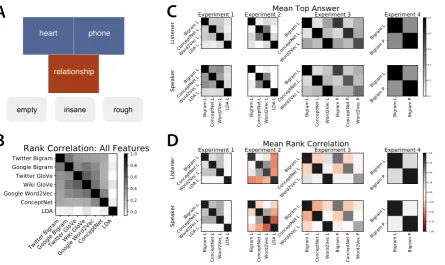
[image:4.595.79.525.60.325.2]Figure 1: A.Example of an experimental display in the speaker condition. The choice is between three adjectives (gray) to best communicate the (blue) target words while avoiding the (red) non-target words.
B.Rank correlation between semantic association scores on the entire set of 5,000 noun–adjective pairs that all experiments draw from. C.Each cell shows the mean top answer matches between model pairs for the configurations used in a particular experiment (speaker and listener side). D. Here each cell shows the mean Spearman’s correlation coefficient between model pairs for the configurations used in a particular experiment (speaker and listener side).
and books) whenever possible. This resulted in a choice of four measures,Bigram(Googe Ngram),
Word2Vec(Google News),ConceptNet (Concept-Net5), andLDA, as candidate semantic models of human word choices.4 Unless otherwise noted,
we will use ‘Bigram’ and ‘Word2Vec’ to refer to those metrics based on Google Ngram and Google News, respectively.
2.4 Optimal Experimental Design
Despite focusing on a relatively small set of nouns and adjectives, the space of possible experimental configurations is still too large to allow exhaustive search. Furthermore, the model rank correlations displayed in Figure1suggest that naively picking configurations could result in strongly correlated predictions. To generate experimental configura-tions that are highly informative with respect to discriminating between different semantic associ-ation metrics, we employed Bayesian optimal
ex-4LDA was excluded in the final two rounds of
experi-ments. With the current training regime, its success in fit-ting human responses was substantially smaller than the other three semantic association measures we chose.
perimental design (OED) techniques (Cavagnaro et al.,2010).
d∗ = arg max
c∈D
U(c) (2)
U(c) =X
y
u(y, c)P(y|c) (3)
Assuming that a particular response y is recorded (a choice of noun pair or adjective), the utility of an experimental configurationc,u(y, c), is proportional to the mutual information between the distributions over models M before and af-ter obtaining datum y. Since response y has not yet been observed, we compute the expectation ofu(y, c) with respect toy to obtain the desired (global) utility of the configurationU(c). Assum-ing a uniform prior distribution over models M, the equations simplify in the following way. Op-timal designs were computed using Monte Carlo methods for sampling-based stochastic optimiza-tion (M¨uller,2005).
Answer:
empty Answer: insane Answer: rough
Clue (Adjective) Answer
0.0 0.2 0.4 0.6 0.8 1.0
Answer probability
Target Codenames: heart, phone Non-Target Codenames: relationship
Bigram Conceptnet Word2Vec Human
empty insane rough
heart phone
relationship
Codenames (nouns)
Bigram
empty insane rough
Conceptnet
empty insane rough
Word2Vec
0.0 0.2 0.4 0.6 0.8 1.0
Clues (adjectives)
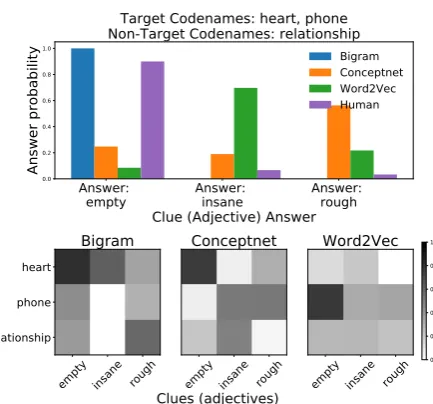
Figure 2: This example speaker configuration shows how different clues are preferred by dif-ferent models: ‘empty’ most often co-occurs with ‘heart’ and ‘phone’ and is thus favored by the Bi-gram model. ConceptNet assigns a high associa-tion score to ‘heart’ and ‘empty’ but the adjective ‘rough’ fits the noun pair better overall when using product aggregation. Similarly, since ‘insane’ ap-pears most often in the context windows for both ‘heart’ and ‘phone’, it is the top prediction for Word2Vec. We also show human data for the con-figuration, which shows a strong preference for the adjective preferred by the Bigram model.
that model predictions diverge strongly, with each semantic measure predicting a different response and little distributional overlap. The accompany-ing matrices illustrate how the different models ar-rive at those predictions.
2.5 Scoring
To evaluate how well a particular model accounts for human responses we use two performance scores: For each configuration, we count when a model’s top prediction matches the most frequent response given by participants and refer to this score astop answer. When normalized by the to-tal number of responses, chance performance is at
1/#answers. To additionally take into account in-formation beyond the most probable answer, we computed the Spearman’srank correlation coeffi-cient between model predictions, sorted by proba-bility, and subjects’ choices, sorted by frequency. Chance performance is zero for this measure.
Top answer Rank correlation
Mean SEM Mean SEM
Listener
Bigram 0.416 ±0.056 0.384 ±0.037 ConceptNet 0.208 ±0.046 0.196 ±0.046 Word2Vec 0.247 ±0.055 0.253 ±0.037 LDA 0.052 ±0.050 -0.053 ±0.045
Speaker
[image:5.595.311.522.61.184.2]Bigram 0.418 ±0.055 0.516 ±0.033 ConceptNet 0.405 ±0.055 0.346 ±0.045 Word2Vec 0.278 ±0.050 0.279 ±0.043 LDA 0.089 ±0.032 0.055 ±0.045
Table 2: Comparison of semantic association mea-sures in matching human responses in Experiment 1 (No OED). Chance performance is 0.1 (listener) and 0.125 (speaker) for top answer and 0 for rank correlation.
3 Results
3.1 Experiment 1: Comparing semantic
metrics using heuristic designs
In this experiment, configurations on each trial consisted of five nouns and eight adjectives. Sub-jects completed the task either in the speaker or in the listener condition. OED was not used for this first experiment, instead words were chosen according to heuristic criteria, detailed in the sup-plementary material. We did not collect confi-dence scores for this experiment. Using the lit-eral speaker and listener equations from Table 1
in combination with different semantic associa-tion metrics, we derived probabilistic predicassocia-tions for each configuration. Predictions were scored against human responses using the two perfor-mance scores outlined above. We also explored fits of pragmatic versions of the models to the data but found that they were qualitatively similar.5
Table 2 shows that, while all models except LDA perform above chance, the Bigram metric performs best on both the listener task and the speaker task. While the difference on the lis-tener side is large, differences between Bigram and ConceptNet on the speaker side are substan-tially smaller. To gain insights into why the results for Bigram and ConceptNet were so similar we directly evaluated the models’ predictions against each other, quantifying how often they make the same top prediction (1C), or how rank correlated their predictions are on average (1C). The bottom left matrix in Figure1C shows that the measure’s
5Full pragmatic model fits for all experiments are reported
[image:5.595.72.289.68.270.2]similarity on top answer and rank correlation on the speaker task might in part stem from their over-lapping predictions. This highlights a basic design issue: The experimental designs we picked might not allow us to fully distinguish the different mod-els by capitalizing on the differences they make in their predictions.
3.2 Experiment 2: Comparing semantic
metrics using OED
To remedy this shortcoming and obtain better dis-criminability on the speaker side, we utilized op-timal experiment design techniques (Section 2.4) to overcome the limitations associated with Ex-periment 1. The procedure was run for the four designated models (Bigram, Word2Vec, Concept-Net and LDA), separately for the listener and the speaker side, for100,000sampling iterations. We reduced the number of nouns and adjectives to three and four, respectively, significantly decreas-ing search complexity. Since some high utility configurations differed only by one or two words, and some words generally occurred much more frequently than others, we eliminated tions that differed from higher utility configura-tions in less than two words and by limiting the total occurrence of a word across configurations to20. This reduced the top500configurations for each down to119speaker and137listener config-urations. Results from prior experiments show that the difficulty of a configuration, which is not ex-plicitly operationalized and incorporated into our search process, may significantly impact response quality. To ensure that the selected configura-tions generate meaningful responses from human participants, we ran a preliminary experiment on the filtered configurations and only admitted those configurations to the main experiment whose con-fidence rating was above mean (58speaker and67
listener configurations).
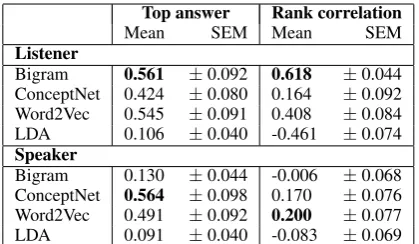
Model fits were again calculated using the lit-eral speaker and listener equations in section2.1. Table 3 summarizes how well the four semantic association measures fit human responses. For the listener task, the Bigram association metric scores marginally higher than Word2Vec in top answer but strongly outperforms other models in rank correlation. While ConceptNet (top answer) and Word2Vec (rank correlation) win on the speaker side, surprisingly, Bigram performs considerably worse than in experiment 1. In terms of task
diffi-Top answer Rank correlation
Mean SEM Mean SEM
Listener
Bigram 0.561 ±0.092 0.618 ±0.044 ConceptNet 0.424 ±0.080 0.164 ±0.092 Word2Vec 0.545 ±0.091 0.408 ±0.084 LDA 0.106 ±0.040 -0.461 ±0.074
Speaker
[image:6.595.312.522.61.183.2]Bigram 0.130 ±0.044 -0.006 ±0.068 ConceptNet 0.564 ±0.098 0.170 ±0.076 Word2Vec 0.491 ±0.092 0.200 ±0.077 LDA 0.091 ±0.040 -0.083 ±0.069
Table 3: Comparison of semantic association mea-sures to human data from Experiment 2 (separate speaker and listener OED). Chance performance is 0.33 (listener) and 0.25 (speaker) for top answer and 0 for rank correlation.
culty, speakers judged the task to be more difficult than listeners (t= 8.27,p <0.001).
The surprisingly low performance of the Bi-gram model could be due to data sparsity that was systematically exploited by OED. On average, 45% of the Bigram values for the noun–adjective associations used in the experiment, which are used to compute model predictions, were effec-tively zero (i.e. zero counts are quantile normal-ized to 1e−7). This level of sparsity is much higher than both the total set of Bigram associa-tions (17%) as well as in subsequent speaker con-figurations (30%). In contrast, on the listener side, the percentage of values with near zero probabil-ity is similar between this set of configurations and those in later experiments. To further explore the data sparsity hypothesis, we computed model fits using bigram associations derived from the Twitter corpus, where only 5% of speaker configurations are sparse. This raises the fit of the Bigram model to human data to0.37, even though the Twitter and Google Bigram features are highly correlated.
Top answer Rank Correlation
Mean SEM Mean SEM
Listener
Bigram 0.586 ±0.072 0.496 ±0.056 ConceptNet 0.207 ±0.043 -0.050 ±0.063 Word2Vec 0.441 ±0.063 0.242 ±0.064
Speaker
[image:7.595.75.285.61.166.2]Bigram 0.505 ±0.047 0.280 ±0.062 ConceptNet 0.290 ±0.051 -0.061 ±0.066 Word2Vec 0.383 ±0.059 0.041 ±0.069
Table 4: Comparison of semantic association mea-sures to human data from Experiment 3 (joint speaker-listener OED). Chance performance is 0.33 (listener and speaker) for top answer and 0 for rank correlation.
3.3 Experiment 3: Comparing listeners and
speakers on the same scenarios
To further investigate potential asymmetries be-tween the speaker and the listener condition, we modified the design optimization procedure to jointly optimize the geometric mean of all speaker and listener configurations for the same scenario. Our intention was to collect data for all possible configurations of a scenario so that we could have listeners and speakers engage with the identical words. We then applied the same filtering proce-dure to reduce our set to120scenarios (760unique configurations). Here we restrict ourselves to three adjectives, matching the number of choices on the speaker side and minimizing differences in task difficulty. Due to its weak performance in the pre-vious experiments, we eliminated LDA from the comparison set for subsequent experiments.
Table 4 summarizes how well the remaining three semantic association measures fit human re-sponses. In contrast to Experiment 2, and in line with the results from Experiment 1, we find that Bigram associations perform best in both the lis-tener and speaker condition. This difference is more pronounced for the Rank correlation mea-sure, where other models perform at chance with the exception of Word2Vec in the listener task. Based on this result, it appears likely that the dif-ference in Experiment 2 was driven by choice of scenario configurations. When adding the con-straint of finding scenarios that are jointly in-formative in discriminating between models on the speaker side and on the listener side, Bigram robustly outperforms other semantic association measures. While reducing the number of adjec-tives from 4 to 3 did not result in a significant
de-Top answer Rank Correlation
Mean SEM Mean SEM
Listener(Bigram)
Literal 0.744 ±0.079 0.551 ±0.053 Pra.α= 0.1 0.470 ±0.046 0.159 ±0.063 Pra.α= 1.0 0.521 ±0.046 0.184 ±0.065 Pra.α= 5.0 0.547 ±0.046 0.242 ±0.065
Speaker(Bigram)
Literal 0.652 ±0.074 0.378 ±0.057 Pra.α= 0.1 0.478 ±0.046 0.069 ±0.068 Pra.α= 1.0 0.496 ±0.046 0.105 ±0.066 Pra.α= 5.0 0.496 ±0.046 0.144 ±0.066
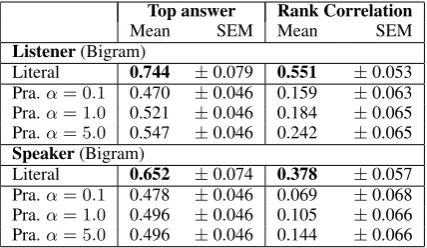
Table 5: Comparison of pragmatic RSA models in predicting human responses in Experiment 4. Chance performance is 0.33 (listener and speaker) for top answer and 0 for rank correlation.
crease in difficulty, as measured by mean confi-dence, the difference in difficulty between speaker and listener task (t = 9.38,p < 0.0001) still re-mains significant.
3.4 Experiment 4: Comparing literal and
pragmatic models
Since correlation matrices from the stimuli in Ex-periment 3 (Figure1), which was only optimized to elicit differences between the semantic associ-ation metrics, shows that the literal models’ pre-dictions are highly correlated with their pragmatic counterparts, we ran another design optimization iteration to find configurations for which literal and pragmatic models strongly disagree. We re-stricted ourselves to the Bigram semantic associ-ation metric because it was the highest perform-ing model in nine out of twelve cases (across the speaker/listener sides of three experiments, on two performance scores). Again, we jointly optimized over speaker and listener configurations, using the literal version of the model and the correspond-ing pragmatic model with α = 1from applying the RSA equations in Table 2.1. After filtering for overlap and limiting word co-occurrence as in the previous experiments, we select the highest
60 utility scenarios later reduced to 40 by high-est mean confidence. In the experiment, we again tested each scenario in all its six configurations.
[image:7.595.310.524.62.186.2]mar-Answer:
wedding history wedding performanceAnswer: history performanceAnswer:
Codename (Noun) Pair Answer
0.0 0.2 0.4 0.6 0.8 1.0
Answer probability
Model Prediction
Clue given: dying Other clues: violent , sleepy
Bigram Literal Bigram Pragmatic Human
wedding historywedding performanceperformancehistory
dying
violent
sleepy
Clues (adjectives)
s
p, awedding historywedding performanceperformancehistory
L
0wedding historywedding performanceperformancehistory
S
1wedding historywedding performanceperformancehistory
L
10.0 0.2 0.4 0.6 0.8 1.0
[image:8.595.324.508.62.105.2]Codename (noun) pairs answers
Figure 3: Representative model predictions and RSA probability matrices (α= 1) from a configu-ration that illustrates the consequences of repeated re-normalization on model predictions.
gin across both performance scores and experi-mental conditions. As before, speakers judged the task to be more difficult than listeners (t = 6.56,
p <0.0001).
This stark difference between pragmatic and lit-eral models is surprising. Figure 3 illustrates a common pattern that helps to better interpret this behavior. The literal model’s predictions are more categorical and best reflect the probabilities from the original association values after aggregation. Through the recursive reasoning from RSA, small differences in raw probabilities, which might be non-obvious to humans, are magnified to sway top pragmatic model prediction. For example, ‘history’ and ‘performance’ are initially the best choice for the given adjective ‘dying’ (see top row of matrices in Figure3), the pair is an even bet-ter choice for the adjective ‘violent’. The non-obvious advantage that ‘dying’ has over ‘violent’ for the pair ‘wedding’ and ‘performance’ is be-comes dominant in the S1 normalization where
this pair becomes the best pair for the clue ‘dy-ing’.6
3.5 Evaluating Human Performance
For experiments 1, 3, and 4, where we obtained data on matching speaker and listener scenarios,
6We replicated the findings with ConceptNet to find the
same pattern of pragmatic reasoning over-emphasizing small differences between semantic measures which leads to poor pragmatic model performance.
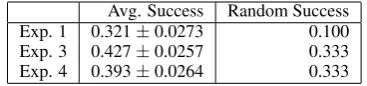
[image:8.595.73.288.65.253.2]Avg. Success Random Success Exp. 1 0.321±0.0273 0.100 Exp. 3 0.427±0.0257 0.333 Exp. 4 0.393±0.0264 0.333
Table 6: Summary of average success on speakers and listeners in human data.
we can quantify the average one-shot success that would hold if a randomly selected speaker and lis-tener were drawn from our experimental popula-tion and played together. For a given scenarioG, adjective clue a, speaker noun pair configuration
c, listener choiceL, and speaker choiceS, the av-erage success probability:
X
a∈S
P(L=c|a, G)P(S =a|G) (4)
where we use relative frequency to estimate the first term from our listener data and the second term from our speaker data. This average success is summarized in table 6. This shows that even though OED (section2.4) may create scenarios of a wide range of difficulties, our results as seen in Tables4 and5show that our models still predict human behavior well in these difficult scenarios.
4 Discussion
In a series of experiments, we investigated how as-sociative information is recruited to resolve refer-ence in language games when truth-conditional in-formation is not available. Experiments 1-3 com-pared different computational models of seman-tics. We found that subjects’ word choices were predominantly best described using a simple bi-gram model, derived from Google Nbi-grams. Ex-periment 4 contrasted a literal and several prag-matic versions of the winning Bigram model and found that the literal version best fit human an-swers. Furthermore, despite providing speakers and listeners with the same number of alternatives to choose from, speakers consistently judged their side of the game to be harder.
to exploiting cases of data sparsity (where mod-els strongly predict that a noun–adjective pair does not go together) that lead to a suboptimal choice of configurations. In future extensions of this work, taking into account uncertainty in the estimates se-mantic associations within the OED process could address these concerns.
With the exception of Experiment 2, our data in-dicate that both speaker and listener behavior are both best predicted by bigram statistics. Experi-ment 4 further shows that both speaker and listener behavior are best accounted for by models without a recursive pragmatic inference component. These results are consistent with the conclusion of Xu and Kemp (2010) that speakers and listeners are wellcalibratedto one another, bringing to bear the same lexical resource and applying it using similar principles.
Although our experiments do not provide sup-port for RSA as a good model of pragmatic be-havior for the scenarios that most sharply distin-guish level-0 and level-1 RSA models, this does not rule out the possibility that participants are not engaged in any pragmatic behavior at all. In our Experiment 4, optimal experiment design drew us to cases where pragmatic agents can transform a ‘least-bad’ fit between a clue and target word pair to a ‘best’ fit, through repeated renormalization of speaker and listener probability distributions. This transformation may simply be a more arbi-trary overriding of direct associative fit than hu-mans are prepared to consider. Furthermore, there may be other types of pragmatic behavior that hu-mans engage in for this task that we did not repre-sent in our model space.
It is possible that, since participants in our ex-periments spent 20 −30 seconds on each ques-tion, their responses are based on first instinct while pragmatic decisions may require careful, more time-consuming reasoning. We only col-lected confidence ratings from participants and did not ask for their reasoning behind the answers given, thus limiting the interpretability of our find-ings. Another limitation is that the use of prag-matic devices in the current setup might require people to have repeated interactions so that they can align their resources more effectively. One in-teresting future direction of study that would make use of an interactive game design could investi-gate how people coordinate their reference strate-gies across repeated interactions.
There are scenarios that none of the models pre-dict correctly. This could suggest other sources of semantic information that we did not incorporate in our study. Besides competing hypotheses about the nature of the semantic knowledge deployed during the task, we suggest that the metrics could alternatively describe complementary sources of information people might draw on when play-ing the game. Another direction of future work could focus on combining a mixture of different semantic models in explaining human choices and should focus on factors that will likely bring out pragmatic reasoning in participants.
5 Conclusion
We model speaker and listener behavior through a simplified version of the gameCodenamesand do not find strong evidence for the sophisticated prag-matic behavior of the type predicted by RSA-like models (Experiment 4). This suggests that there are limits on strong scalar inference in one-shot associative settings. Furthermore, we find that bigram lexical statistics (Google Bigrams) were the strongest predictors of human behavior in our task, especially for listeners. This finding suggests that direct co-occurrence statistics are particularly salient in associative settings such as ours. This result may be a consequence of our restricting co-denames and clues to be nouns and adjectives re-spectively or may hold more generally. Finally, our data suggest a potential discrepancy between the information sources relied upon by speakers and listeners: In some experiments (Experiment 2), different models performed best on the speaker and on the listener side where we would intu-itively expect that successful communication re-quires that speakers and listeners semantic knowl-edge be aligned. In addition, even when control-ling for the number of choices per trial, mean an-swer confidence in the listener condition is sig-nificantly higher, suggesting that the speaker task is intrinsically harder. Future research further ex-ploring inference in language game settings could investigate repeated rounds of interaction, or even one-shot interaction in richer referential domains.
Acknowledgments
References
Daniel R Cavagnaro, Jay I Myung, Mark A Pitt, and Janne V Kujala. 2010. Adaptive design opti-mization: A mutual information-based approach to model discrimination in cognitive science. Neural Computation, 22(4):887–905.
Vladim´ır Chv´atil. 2015. Codenames.
Michael C Frank and Noah D Goodman. 2012. Pre-dicting pragmatic reasoning in language games. Sci-ence, 336(6084):998–998.
Angeliki Lazaridou, Alexander Peysakhovich, and Marco Baroni. 2016. Multi-agent cooperation and the emergence of (natural) language. arXiv preprint arXiv:1612.07182.
Jean-Baptiste Michel, Yuan Kui Shen, Aviva Presser Aiden, Adrian Veres, Matthew K Gray, Joseph P Pickett, Dale Hoiberg, Dan Clancy, Peter Norvig, Jon Orwant, Steven Pinker, Martin A. Nowak, and Erez Lieberman Aiden. 2011. Quantitative analysis of culture using millions of digitized books. Sci-ence, 331(6014):176–182.
Tomas Mikolov, Ilya Sutskever, Kai Chen, Greg S Cor-rado, and Jeff Dean. 2013. Distributed representa-tions of words and phrases and their compositional-ity. InAdvances in Neural Information Processing Systems, pages 3111–3119.
George A Miller. 1995. Wordnet: a lexical database for English. Communications of the ACM, 38(11):39– 41.
Peter M¨uller. 2005. Simulation based optimal design. Handbook of Statistics, 25:509–518.
Douglas L Nelson, Cathy L McEvoy, and Thomas A Schreiber. 2004. The university of south florida free association, rhyme, and word fragment norms. Be-havior Research Methods, Instruments, & Comput-ers, 36(3):402–407.
Jeffrey Pennington, Richard Socher, and Christopher Manning. 2014. GloVe: Global vectors for word representation. In Proceedings of the 2014 Con-ference on Empirical Methods in Natural Language Processing (EMNLP), pages 1532–1543.
Manuel Perea and Eva Rosa. 2002. The effects of asso-ciative and semantic priming in the lexical decision task. Psychological Research, 66(3):180–194.
Ahti-Veikko Pietarinen. 2007. Game theory and lin-guistic meaning. Brill.
Tony Rose, Mark Stevenson, and Miles Whitehead. 2002. The Reuters corpus volume 1: from yester-day’s news to tomorrow’s language resources. In LREC, volume 2, pages 827–832. Las Palmas.
Robert Speer and Catherine Havasi. 2013. Conceptnet 5: A large semantic network for relational knowl-edge. InThe Peoples Web Meets NLP, pages 161– 176. Springer.
Luc Steels. 1997. The synthetic modeling of language origins. Evolution of Communication, 1(1):1–34.
Luis Von Ahn, Mihir Kedia, and Manuel Blum. 2006. Verbosity: a game for collecting common-sense facts. InProceedings of the CHI Conference on Hu-man Factors in Computing Systems, pages 75–78. ACM.
Ludwig Wittgenstein. 1953. Philosophical Investiga-tions. London: Macmillan.