Online Mentoring System
Shivani Thakare1, Indrasen Mane2, Shubham Pawar3, Sudhir Jadhav4 , Prof. Abhilasha Kulkarni5
1,2,3,4
Student, 5Professor, Dept. Of Computer Engineering Marathwada Mitra Mandal's College of Engineering, Karvenagar, Pune
Abstract: Technology has gained importance in all stages of education yet educators have been unable to figure out which of the many available technological tools best fit their classroom practices. Google Classroom is one such tool that is free of cost and has gained popularity within a short span of time. The main purpose of the study is to assess teachers’ perception on the effectiveness of online mentoring system. In this study, the active support to help college students transferring to the professional world through mentoring was considered, and the needs analysis and system implementation were performed to find an effective way to support such service by implementing this as an online system.
Keywords: e-Mentoring, Student, Relationship, Marks, OMS, Mentoring, Feedback, Efficiently, Performance, Admin, Guidance, Implementing, Problems, Solution, Faculty.
I. INTRODUCTION
E-Mentoring uses electronic medium to transfer knowledge and skills from mentor to student. It primarily focuses on student and faculty relationship. Online Mentoring System is a Client-Server model, which acts as an Interface between Mentor and student. OMS strives to reduce the work load of students in entering their details and at the same time enable the Mentors to assess their students more efficiently. E-Mentoring is fundamentally developed to improve the performance of students by assisting mentors to understand the problems of students more effectively and easily.
Using technology in classroom teaching is a new and successful trend in academia. In English Language Teaching (ELT), teachers are leaning towards technology worldwide. Using different technological tools like Computer, Speaker, Microphone, Multimedia projector and Internet has changed the traditional chalk-duster based classroom into a modern ICT based classroom.
This e-mentoring system can also be referred as Online Mentoring System (OMS). It is effective, fast and also time saving system of mentoring. It primarily focuses on improving the mentoring process between the faculty and student in the college scenario. This system mainly enables the mentors to concentrate effectively on each and every student assigned to them.
A. What is E-mentoring?
Mentoring refers to all the processes by which one affects the other individually in a short or long term, and regularly or irregularly by a certain relationship. Mentoring is also a talent development tool that can improve the competency of human resources, reduce the breakaway of them and even develop the individual career in the form of informal learning. A mentor may play a role of a guide, counselor, role model or friend, and transfer not only simple knowledge and skills, but also wisdom about various ways to live within an organization via a naturally formed mentorship.
Mentoring can be classified into the following types according to the relationship between a mentor and a mentee, and the scope of application:
One-on-one (1:1) mentoring. Peer mentoring.
Group mentoring. Face-to-face mentoring. E-mentoring.
B. Advantages
E-mentoring has numerous advantages. A few of them are mentioned below:
1) User Friendly: It is very easy to use.“E-mentoring Systems” design purposefully simplifies the instructional interface and options used for delivering and tracking assignments.
teachers’ and students’ parts.
Time saving: Google Classroom saves time both in teachers’ and students’ parts.
Time saving: Google Classroom saves time both in teachers’ and students’ parts.
II. LITERATURE REVIEW
Manoela Silva, et al. [2] discusses the potential of Google class in education by proposing an application, the Glassist, aiming at helping teacher’s management tasks. The application allows teachers to create individual portfolios for students, manage their information and share it with peers. The tool uses Augmented Reality to recognize students face and display relevant information about them.
SirichaiHemrungrote et al.[3] explains a self-developed e-learning system which can solve the pose challenges for improvements to be made in teaching and learning the quality of this course. The main aim of the Google Classroom is to enhance the students’ self-directed learning (SDL) cognitive skills.
José Manuel et al. [4] gives a standard Learning Management Systems (LMS) platform that intrinsically collaborative with every Google app and offers embedded features that promote collaboration and exchange of information. The students and academic staff working is a highly collaborative, flipped classroom context, will find it much easier to adapt to the new reality of MOOCs (massive open online course).
PrasaraJakkaew et al.[5] gives the use unified theory of acceptance and use of technology 2 (UTAUT2) model to explore factors that determine the deployment of Google Classroom in a course of Introduction to Information Technology at Mae FahLuang University, Chiang Rai, Thailand. The system can determine performance expectancy, effort expectancy, and social influence of the students' behavioral intention which determine students' use of Google Classroom.
YanawutChaiyo et al.[6] shows the results from investigating the effect of using Kahoot, Quizizz, and Google Forms in the classroom on how the students’ perception of concentration, engagement, enjoyment, perceived learning, motivation, and satisfaction. The results show that students learned something from doing the quiz via Kahoot, Quizizz, and Google Forms. But, there are significant differences in concentration, engagement, enjoyment, motivation, and satisfaction. Kahoot and Quizizz have presented a lot of positives over Google forms when used in the classroom.
A. Virtual Reality Classroom Applications
In [7] the active support to help college students transferring to the professional world through mentoring was considered, and the needs analysis and system implementation were performed to find an effective way to support such service by implementing this as an online system.
R U V N Satish et al.[8] propose an Online Mentoring System (OMS) that uses asynchronous, electronic communications to establish and support the relationship between mentor and the student using virtual mode. This paper focuses on improving the mentoring process between the faculty and student in the college scene.
KrisawanPrasertsith, PenjiraKanthawongs and Tan Limpachote, 2016.
With today’s technologies, we can expand on the power of visuals to include experiential learning using VR applications to promote understanding and to scaffold prior knowledge. Technology tools continue to enhance the ways teachers promote understanding of new concepts. (J. Michael & Jodi Pilgresm, 2016) Google Inc. had played major roles in business as well as academic worlds. Google Apps for Education has been offered to universities around the world. Although large cloud service providers like Google do not encrypt all their stored electronic data and correlate identifiable data across accounts, Google Drive has been one of a key feature of Google for teachers and students in higher educational institutions.
B. Teaching – efficiency
Liu & Chuang (2016) conducted an action research in Taiwan in which they used Google classroom with the integration of peer tutor mechanism for 6thgrade students. Students held a positive perception regarding the use of Google Classroom. The learning objectives were also achieved. Martínez-Monés et al. (2017) called for an integration of learning analytics with Google classroom as they believed that this is a major limitation of the emerging tool.
III. SYSTEM ARCHITECTURE
Electronic learning is a technology that plays an important role in modern education and training. Such a system bridge the gap between student and teachers. For such a system there is no need for the students or teachers to be physically available at the same time. Figure gives the architecture of the proposed system.
Figure: - System Architecture
The whole system contains one admin under which many mentors and each mentor has set of students allocated by admin and at the same time, the mentor is wittingly taking the students for giving valuable counseling for the advancement of the student in an academic institute.
A. Users Registration:
For the use of the system, the students and mentors need to register themselves to the system. Admin is the only entity which has the option to create and login credentials to both the users (students and mentors) and monitors over the operations performed by them. The whole system is controlled by the admin.
B. Assignment Uploading by the Mentors
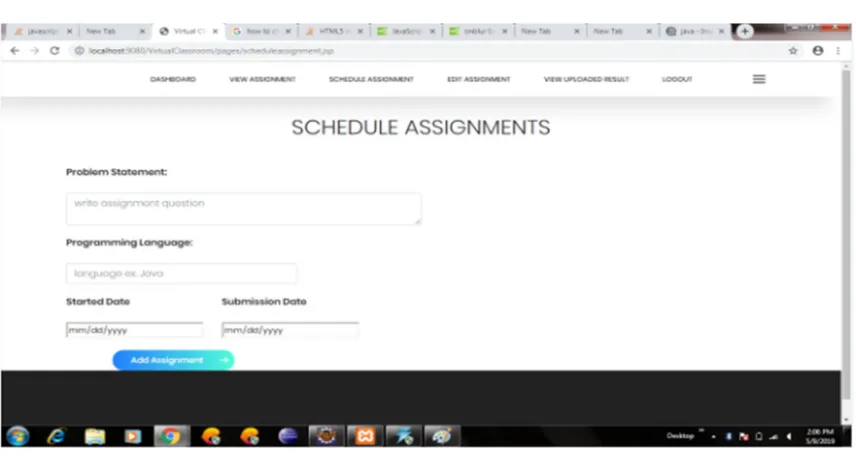
The mentors are intermediary between the admin and the student of the system. Mentors also provided the login credentials by admin to login and check the information of the students and do analyses each and every student assigned to him for mentoring then schedule his assessment. The mentor can also view the assignments uploaded by the students and check the plagiarism for checking duplicate content.
C. Plagiarism Checking
The main task of mentors is to check the plagiarism of the submitted code. The code is copied from any other source.
D. Student Users
execute it and submit it to the mentor for evaluation.
This is proved to be a simple online and efficient method for doubt clearing of the students which can increase the knowledge level of the student.
IV. EXPERIMENTAL RESULTS
[image:4.612.111.516.187.418.2]For the use of the system admin, student and lectures have to register themselves to the system with the details given in the below figure.
Figure 2: Registration
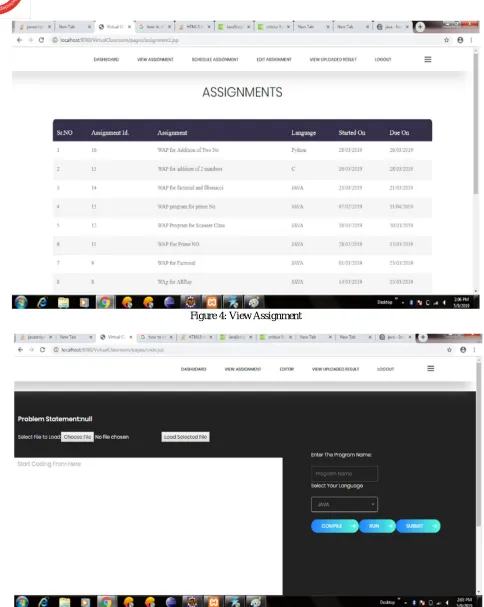
[image:4.612.101.529.441.669.2]Figure 4: View Assignment
Figure 5: Compile Assignment
Figure6: Edit Assignment
V. CONCLUSION
We have presented an online mentoring system which can help both mentors and students to perform fast and time saving task. Here admin is person that can monitor all the activities done by the users as he is the only person who creates login accounts for each user. Mentor can manage the student and give the assignment with the specific date. He can view the assignment uploaded by the students and can check the originality of the assignment.
Students can execute the assignment and upload so that mentor can evaluate the performance of students.Such a system can saves time and paper and makes it easy to create classes, distribute assignments, communicate, and stay organized.
REFERENCES
[1] Dan Budny, Cheryl A. Paul, Luis Bon University of Pittsburgh, Engineering Student Services Center, B74A Benedum Hall, Pittsburgh, PA 15261"The Impact Peer Mentoring Can have on Freshman Students",36th ASEE/IEEE Frontiers in Education Conference.
[2] Manoela Silva, Daniel Freitas, EdvarNeto, CaioLins, Veronica Teichrieb,Jo˜ao Marcelo Teixeira,"Glassist: Using Augmented Reality on Google Glass as an Aid to Classroom Management", 2014 IEEE.
[3] SirichaiHemrungrote, PrasaraJakkaew,SomphongAssawaboonmee,"Deployment of Google Classroom to Enhance SDL Cognitive Skills: A Case Study of Introduction to Information Technology Course",2017 IEEE.
[4] José Manuel Martins Ferreira"Flipped classrooms: From concept to reality using Google Apps",2014 11th International Conference on Remote Engineering and Virtual Instrumentation (REV).
[5] PrasaraJakkaew,SirichaiHemrungrote,"The Use of UTAUT2 Model for Understanding Student Perceptions Using Google Classroom: A Case Study of Introduction to Information Technology Course",2017 IEEE.
[6] YanawutChaiyo,RanchanaNokham,"The Effect of Kahoot, Quizizz and Google forms on the Student's Perception in the Classrooms Response System",IEEE 2017.
[7] Juhyun Jeon1, Jaeeung Lee2"Implementation of Mentoring System in College For Smooth Transition to Work",Proceedings of 2015 International Conference on Interactive Collaborative Learning (ICL).