Experimental Investigation for Optimization of
Wire-EDM Parameters during Machining of EN-8
Mohd Ammar1, Mohd Faizan Hasan2, Syed Asghar Husain Rizvi3
1, 2, 3
Mechanical Engineering Department, Integral University
Abstract: In recent decades, many attempts were done on Wire EDM technology in order to satisfy various manufacturing requirements, especially in the precision mould and die industry. Wire EDM efficiency and productivity have been improved through progress in different aspects of WEDM such as quality, accuracy, and precision. The current research focuses on elucidating the influence of major WEDM parameters on MRR and Surface Roughness while machining EN-8 using brass wire. The result shows that the MRR is mainly influenced by peak current while the surface roughness is influenced majorly by pulse on time.
Keywords: Wire-EDM, MRR, Surface Roughness, EN-8
I. INTRODUCTION
Several researches were done on early WEDM to modify its cutting speed and overall capabilities. In recent decades, many attempts were done on Wire EDM technology in order to satisfy various manufacturing requirements, especially in the precision mold and die industry. Wire EDM efficiency and productivity have been improved through progress in different aspects of WEDM such as quality, accuracy, and precision. It can machine anything that is electrically conductive regardless of the hardness, from relatively common materials such as tool steel, aluminium, copper, and graphite, to exotic space-age alloys including hastalloy, waspalloy, inconel, titanium, carbide, polycrystalline diamond compacts and conductive ceramics. The wire does not touch the work piece, so there is no physical pressure imparted on the work piece compared to grinding wheels and milling cutters.
Manoj Malik et al [1] conducted experiments on Tungsten Carbide Ceramic with graphite as electrode and concluded that peak current is the most significant factor affecting MRR and EWR while pulse duty factor is the least affecting factor. Further they concluded that the pulse on time is most significant factor that affects the surface roughness of the material while duty factor affect is least. K. Kumar et al [2] carried out experiments to determine the significant machining parameters for performance measures material removal rate and surface roughness in the WEDM process. Factors like speed, feed, Time on and Time off have been found to play a significant role for MRR and surface roughness. H. Singh et al [3] by their study concluded that wire feed (WF) and wire tension (WT) have no effect on the material removal rate, pulse on time parameter has direct effect on the material removal rate, as we increase the pulse on time the material removal rate also increases. When the pulse off time is increased the material removal rate decreases while when peak current is increased the material removal rate increases and the Material removal rate decreases with increase in the servo voltage.
Liao et al [4] performed an experimental study using SKD11 alloy steel as the workpiece material and established mathematical models relating the machine performance like MRR, SR and gap width with various machining parameters and then determined the optimal parametric settings for WEDM process applying feasible-direction method of non-linear programming.
Spedding and Wang [5] attempted to optimize the process parametric combinations by modeling the process using artificial neural networks (ANN) and characterizing the WEDM machined surface through time series techniques. A feed-forward back-propagation neural network based on a central composite rotatable experimental design is developed to model the machining process. Optimal parametric combinations are selected for the process. The periodic component of the surface texture is identified and an autoregressive model is used to describe its stochastic component. Scott et al [6] developed mathematical models to predict material removal rate and surface finish while machining D-2 tool steel at different machining conditions. It was found that there is no single combination of levels of the different factors that can be optimal under all circumstances. Lin and Lin [7] reported a new approach for the optimization of the electrical discharge machining (EDM) process with multiple performance characteristics based on the orthogonal array with the grey relational analysis.
and Karunamoorthy [9] described the multi objective optimization of the WEDM process using parametric design of Taguchi methodology. The effect of various machining parameters such as pulse on time, wire tension, delay time, wire feed speed, and ignition current intensity has been studied in machining of heat-treated tool steel. It was identified that the pulse on time and ignition current intensity has influence more than the other parameters.
Anoop Mathew Kurian et al [10] studied Surface Roughness of Stainless Steel 15-5 PH. The parameter pulse duration was found to be the most effective on the surface roughness followed by the discharge current. The least affecting parameter was found to be wire speed. The contribution of pulse duration, discharge current and wire speed were 64.92 %, 18.83 % and 0.36 % respectively. Least
surface roughness was obtained at 40 μsec pulse duration, 1 A current and 150 mm/min wire speed. Baljit Singh et al [11] carried a
study on Titanium alloy using molybdenum alloy. Pulse on time (Ton) is the most significant influencing machining parameter
having direct effect on metal removal rate (MRR) in the machining of Ti alloy and maximum MRR was obtained at Ton 120 µsec. Pulse off Time (Toff) is the second most significant influencing machining parameter and optimal value of Toff was found at 55 µsec
for maximum MRR. It was also concluded that for rough and high-speed cutting (for higher MRR), the optimal wire feed rate of Molybdenum wire was 15 m/min for Ti alloy work-piece. They also concluded that for rough and high-speed machining, the optimal value of servo voltage is 80 volts.
II. DESIGN OF EXPERIMENT AND EXPERIMENTATION
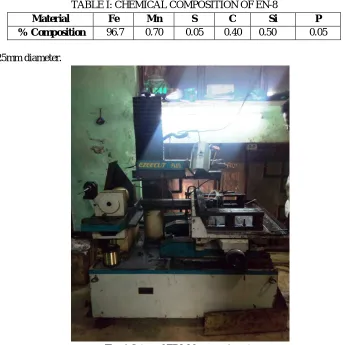
[image:2.612.132.475.312.657.2]Machine: Electronica Ezeecut Plus Wire-EDM machine available at Dilawar Engineering Works, Lucknow. Workpiece: EN-8.
TABLE I: CHEMICAL COMPOSITION OF EN-8
Material Fe Mn S C Si P
% Composition 96.7 0.70 0.05 0.40 0.50 0.05
Tool: Brass wire of 0.25mm diameter.
Fig. 1 Setup of EDM for experiments
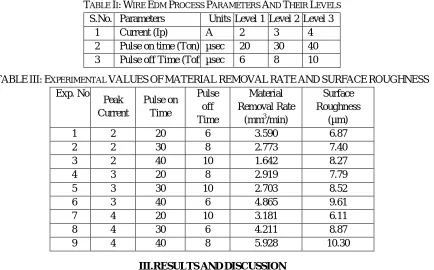
TABLE II:WIRE EDM PROCESS PARAMETERS AND THEIR LEVELS
S.No. Parameters Units Level 1 Level 2 Level 3
1 Current (Ip) A 2 3 4
2 Pulse on time (Ton) µsec 20 30 40
3 Pulse off Time (Toff)µsec 6 8 10
TABLEIII:EXPERIMENTAL VALUESOFMATERIALREMOVALRATEANDSURFACEROUGHNESS
Exp. No Peak Current Pulse on Time Pulse off Time Material Removal Rate
(mm3/min)
Surface Roughness
(µm)
1 2 20 6 3.590 6.87
2 2 30 8 2.773 7.40
3 2 40 10 1.642 8.27
4 3 20 8 2.919 7.79
5 3 30 10 2.703 8.52
6 3 40 6 4.865 9.61
7 4 20 10 3.181 6.11
8 4 30 6 4.211 8.87
9 4 40 8 5.928 10.30
III.RESULTS AND DISCUSSION
A. Material Removal Rate
The rate of material removed from the surface of workpiece is analysed by initially noting the weight of work specimen before and after machining. Further the machining time is noted for each specimen.
The following table IV shows the response table for SN ratio of material removal rate. It shows that the pulse off time is the most influential factor for material removal rate as it has rank 1. Peak current is the second most dominating Wire-EDM parameter and pulse on time is the least influencing parameter.
TABLE IV: RESPONSE TABLE FOR SN RATIO OF MRR
Level Peak Current Pulse on time Pulse off Time
1 8.089 10.153 12.444
2 10.561 9.995 11.207
3 12.666 11.169 7.665
Delta 4.576 1.175 4.779
Rank 2 3 1
[image:3.612.94.528.78.348.2]ANOVA was performed and is tabulated in table V. ANOVA reveals that the major influencing parameter for material removal rate are peak current and pulse off time with a contribution of 38.28% and 39.94% respectively while the pulse on time has least influence on material removal rate and imparts a contribution of only 13.61%.
TABLE V: ANOVA FOR MRR
Source DOF SS Adj MS F Value Contribution
Current 2 4.715 2.358 2.35 38.28%
Pulse on Time 2 1.676 0.838 0.84 13.61%
Pulse off Time 2 4.919 2.460 2.45 39.94%
Error 2 2.006 1.003 8.17%
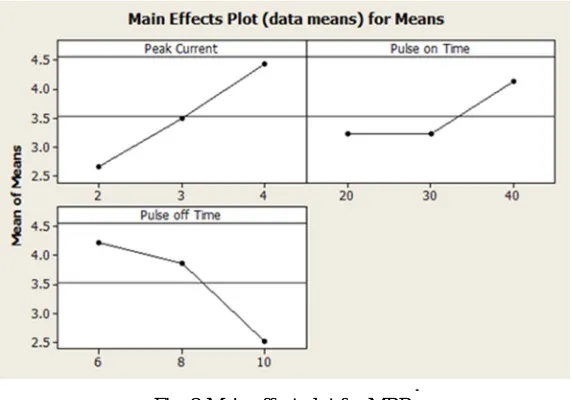
Fig. 2 Main effect plot for MRR
The figure 2 it is clear that as we increase the current, the MRR tends to increase at a high rate than pulse on time. The peak current is the most significant factor for MRR. MRR initially remains constant with increase in pulse on time but with further increase in pulse on time will increase the MRR. The discharge energy is higher at higher levels of pulse on time thus we get higher material removal rate. For lower pulse on time, the discharge energy is insufficient thus the material removal rate is low. Higher the current, intensity of spark is increased and thus metal removal rate increases. In the case of pulse off time, the reverse trend is followed and the MRR tends to decrease with it. This is due to increase in pulse off time result unfavorable break down of dielectric and large amount of debris between the working gap which decreases the material removal rate.
B. Surface Roughness
The surface roughness is the performance measure that determines the quality of the surface produced by machining. To assess the surface roughness, Mitutoyo surface roughness tester was used.
The following table VI shows the response table for SN ratio of surface roughness. It clears that the most dominating parameter for surface roughness is pulse on time followed by peak current and lastly by pulse off time.
TABLE VI: RESPONSE TABLE FOR SN RATIO OF SURFACE ROUGHNESS
Level Peak Current Pulse on time Pulse off Time
1 -17.49 -16.76 -18.45
2 -18.70 -18.32 -18.49
3 -18.31 -19.42 -17.56
Delta 1.21 2.66 0.93
Rank 2 1 3
[image:4.612.170.456.77.277.2]ANOVA was performed and is tabulated in table VII. ANOVA reveals that the major influencing parameter for Surface Roughness is pulse on time with a contribution of 66.00% while peak current and pulse off time has negligible influence as compared to pulse on time on surface roughness and imparts a contribution of only 15.46 and 10.18% respectively.
TABLE VII: ANOVA FOR SURFACE ROUGHNESS
Source DOF SS Adj MS F Value Contribution
Peak Current 2 2.1491 1.0745 1.85 15.46%
Pulse on Time 2 9.1734 4.5867 7.89 66.00%
Pulse off Time 2 1.4145 0.7072 1.22 10.18%
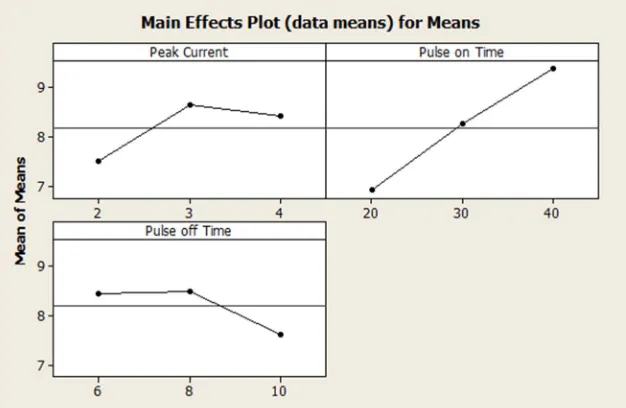
Fig. 3 Main effect plot for Surface Roughness
The above graph shows the effect of input parameters on surface roughness. By increasing the current the surface roughness increases and the surface finish starts to degrade. With further increase in Ip, the surface roughness starts decreasing. As current increases, the spark intensity increases and hence the surface degrades more. The minimum surface roughness is seen at 2A. With increase in pulse on time the surface roughness increases at a higher pace as compared to current. Pulse on time is the most
dominating parameter and has a contribution of 66.00%. The minimum surface roughness was seen at 20 μsec Ton. As the pulse off
time increases the surface roughness decreases. With a very high pulse off time, we will get good surface finish. Lowest surface roughness is obtained at 6 µsec Toff.
IV.CONCLUSIONS
This experimental study described the optimization of input machining parameters in Wire-Electrical Discharge Machining of EN-8 using L9 orthogonal array of Taguchi method. Factors like Current, pulse on time (Ton) and pulse off time (Toff) and their interactions have been found to play significant role in WEDM operation for maximization of MRR and minimization of Surface Roughness. Following conclusions are made from the investigationexperimental study:
A. Pulse off time is the major influencing parameter for MRR followed by Peak current while pulse on time has least effect on it. B. The contribution of peak current and pulse off time are 38.28% and 39.94% respectively.
C. Discharge energy plays a vital role in effecting the rate of material removal from the work-piece.
D. Pulse on time is observed to majorly influence the surface roughness of EN-8 while peak current and pulse duty factor have negligible influence as compared to it.
E. The contribution of pulse on time towards surface roughness is 66.00%. F. Surface degrades as the levels of parameter are increased.
G. The minimum surface roughness was seen at 20 μsec Ton.
H. With a very high pulse off time, we will get good surface finish. Lowest surface roughness is obtained at 6 µsec Toff.
REFERENCES
[1] Manoj Malik, Rakesh Kumar Yadav, Nitesh Kumar, Deepak Sharma, Manoj “Optimization Of Process Parameters Of Wire Edm Using Zinc-Coated Brass Wire”; International Journal of Advanced Technology & Engineering Research (IJATER) ISSN No: 2250-3536 Volume 2, Issue 4, July 2012. [2] K. Kumar, R. Ravikumar “Modeling and Optimization of Wire EDM Process”; International Journal of Modern Engineering Research (IJMER) Vol. 3, Issue.
3, May.-June. 2013 pp-1645-1648 ; ISSN: 2249-6645.
[3] H. Singh, R. Garg, “Effects of process parameters on material removal rate in WEDM”; Journal of Achievements in Materials and Manufacturing Engineering VOLUME 32 ISSUE 1 January 2009.
[4] Liao,Y.S., Huang, J.T., Chen, Y.H. (2004), “ A study to achieve a fine surface finish in Wire-EDM” , Journal of Materials Processing Technology, 149,165– 171.
[6] Scott, D., Boyina, S., Rajurkar, K.P. (1991), “Analysis and optimization of Parameter Combination in Wire Electrical Discharge Machining”, International Journal of Production Research, 29, 2189-2207.
[7] Lin, H.C.,Lin, K.M., Chen, Y.S., Chu, C.L. (2005) ,“The wire electro-discharge machining characteristics of Fe–30Mn–6Si and Fe–30Mn–6Si–5Cr shape memory alloys”, Journal of Materials Processing Technology, 161, 435–439.
[8] Miller, S. F., Chen, C.K., Shih, A. J., Qu, J. (2005), “Investigation of wire electrical discharge machining of thin cross-sections and compliant mechanisms”, International Journal of Machine Tools & Manufacture, 45, 1717–1725.
[9] Ramakrishnan, R. and Karunamoorthy, L. (2006), “Multi response optimization of wire EDM operations using robust design of experiments”, International Journal of Advanced Manufacturing Technology, 29, 105–112.
[10] Anoop Mathew Kurian, Dr. Binu C.Yeldose, Ernest Markose Mathew, “Effect of Wire EDM Parameters on Surface Roughness of Stainless Steel 15-5 PH”, International Journal of Engineering and Innovative Technology (IJEIT) Volume 4, Issue 2, August 2014.