Abstract — This research is intended to enhance the original Overall Equipment Effectiveness (OEE). Calculating plant/equipment OEE can be very helpful for monitoring trends (such as whether a given plant is improving OEE over time) or as a rough measure of where a given plant lies in the OEE benchmarking spectrum. OEE concept in TPM implementation truly reduces manufacturing complex problems into simple, intuitive presentation of information. It helps to systematically improve the process with easy-to-obtain measurements. The OEE is the process, which is acquired to specify an equivalent weight setting of every single element, even if, each concerning losses are totally different. Hence, the study proposes a weighted graph approach, to identify dissimilarity in weighting each OEE element. The proposed concept is used to find the OEE for the plant, as well as to set the target for the plant and the area to focus for their improvement.
Index Terms— TPM, effectiveness, weighted signed graph, OEE, performance improvement.
I. INTRODUCTION
N the highly competitive manufacturing environment prevailing at the global level, plants of any country or region should be benchmarked and maintained at world-class level. Failing to do that, a plant may be exposed to various difficulties. The results of implementation of Total Productive Maintenance (TPM) program increased plant efficiency and productivity significantly by means of eliminating the major losses. The important goal of TPM is the total elimination of all six major losses, including breakdowns, equipment setup & adjustment losses, idling & minor stoppages, reduced speed, defects & rework, spills, process upset conditions, startup and yield losses. The proposed algorithm gives the mathematical approach for computing the plant effectiveness, i.e. Overall Equipment Effectiveness (OEE). Measurement is an important requirement for continuous improvement processes. It is necessary to establish appropriate matrices for measurement purposes. Measurement is an important requirement for continuous improvement processes.
M. Maran, is with Department of Mechanical Engineering in Velammal college of Technology – Madurai - India. Currently is doing research in TPM and its assessment Methodology. (e-mail: [email protected]).
G. Manikandan, completed his Ph.D from Anna University, Chennai, India. he is with Department of Mechanical Engineering in Velammal college of Technology – Madurai - India. Currently working in TQM and its applications. (e-mail: [email protected]).
K.Thiagarajan completed his Ph.D from University of Mysore, Mysore, India. Currently working in the Department of Mathematics, Velammal college of Technology, Madurai, India. Currently he is working on web mining through automata, set theory and Fuzzy Logic. His area of specialization is coloring of graphs and DNA Computing. (e-mail: [email protected]).
It is necessary to establish appropriate matrices for measurement purposes. From a generic perspective, TPM can be defined in terms of OEE, which in-turn can be considered combination of the operation maintenance, equipment management, and available resources. The goal of TPM is to maximize equipment effectiveness, and OEE is used as a measure.
OEE measurement is an effective way of analyzing the efficiency of a single machine or an integrated manufacturing system. OEE incorporates availability performance rate and quality rate and gives results. In other words, OEE addresses all losses caused by the equipment, not being available when needed due to breakdowns or set-up and adjustment losses, not running at the optimum rate due to reduced speed or idling and minor stoppage Losses and not producing first quality output due to defects and rework or start-up losses. A key objective of TPM is cost efficiency; maximizing Overall Equipment Effectiveness through the elimination or minimization of all these six losses by means of weighted signed graph method.
The proposed work optimizes the six losses associated with the OEE by weighted signed graph approach. The methodology of using signed graph for the betterment of the TPM implementing organizations and other industries is discussed. Finally, this approach gives them the direction to work-on and fix their targets and OEE can be calculated as follows,
Overall Equipment Effectiveness (OEE) = A X PR X Q, Where,
A - Availability of the machine. Availability is proportion of time a machine is actually available to out of time it should be available
P- Performance Rate i.e., P=RE X SR
RE - Rate efficiency is actual average cycle time which is slower than design cycle time because of jams, etc. Output is reduced because of jams.
SR - Speed Rate is actual cycle time which is slower than design cycle time; machine output is reduced because it is running at a reduced speed.
Q - Quality rate, is percentage of good parts out of total production, sometimes called yield.
In other words, OEE can be expressed as
OEE = Utilization (Availability) × Rate Loss (Performance) × Yield (Quality)
All these figures are usually expressed in percentage and higher OEE translates into higher equipment efficiency from the equipment. Surprisingly, the OEE of most equipments ranges from 40%-60%, whereas the benchmark is 85%, world class [8]. As such, OEE has become the accepted
Overall Equipment Effectiveness Measurement
By Weighted Approach Method
M. Maran, G. Manikandan, and K.Thiagarajan
indicator to assess, how plants/factories actually manage their most expensive asset, the equipment, to produce saleable goods, with minimum losses and wastes.
The OEE is not that which gives one magic number; it gives three numbers other than OEE, which are all useful individually as the situation changes from day to day. In addition, it helps to visualize performance in simple terms - a very practical simplification. The OEE is probably the most important tool in continuous improvement program in manufacturing industry. Through the Pareto analysis the operators can observe, where they lose most of the production (The 6 Major Losses as mentioned in above).
Significant improvement can be evident within a short period by means of eliminating the six equipment losses with result of enhanced maintenance activities and equipment management
Increasingly, companies working in process manufacturing environments are discovering a surprisingly effective framework from which to tackle the continuous improvement challenge: the “Six Big Losses” approach. Developed in the 1970’s by the Japan Institute of Plant Maintenance (JIPM), the Six Big Losses framework enables manufacturers to examine their efficiency problem with an unprecedented level of granularity According to JIPM, the OEE is based on three main aspects; each element concerns with different losses as shown in the table 1.
II. OVER VIEW OF THE PAPER
Section I presents Introduction, Section II presents weighted graph method of OEE, Section III deals with flow diagram of the proposed scheme, Section IV presents ratings for the factors of OEE & estimated results as well as experimental results and Section V presents concurrent application for industry. Finally Section VI presents opportunity for further enrichment.
III. OEE-WEIGHTED APPROACH
In proposed system, OEE is considered as a signed graph, where each factors BD, SA, MI, RS, RL & SL are assigned with weight ratings based on the loss percentage. Signed weight (++, +-, -+, --) is attached to each factors of
MI, RS, RL & SL ratings A, P & Q are calculated. Similarly based on A, P & Q ratings OEE is estimated.
WEIGHTED RATING FOR A, P & Q
In a weighted graph, A1, A2, A3 and A4 are considered as the loss ratings, where A1< A2< A3< A4. (i.e., A1 is the lowest loss level rating and A4 is the highest loss level rating) [7].The ratings for the basic six parameters differ from one another based on user. In the subsequent ranking scheme, more weightage is given for BD i.e., up to 10% loss, where as other parameters have less weightage of 2 to 3%.
1. BD - Breakdown (in %): a. A1 = 0 to ≤ 1
b. A2 = > 1 to ≤ 5 c. A3 = > 5 to ≤ 10 d. A4 = > 10
2. SA - Setup adjustment (in %): a. A1 = 0 to ≤ 0.5
b. A2 = > 0.5 to ≤ 1 c. A3 = > 1 to ≤ 2 d. A4 = > 2
3. MI - Minor / Idling stoppages (in %): a. A1 = 0 to ≤ 1
b. A2 = > 1 to ≤ 2 c. A3 = > 2 to ≤ 3 d. A4 = > 3
4. RS - Reduced speed (in %): a. A1 = 0 to ≤ 1
b. A2 = > 1 to ≤ 2 c. A3 = > 2 to ≤ 3 d. A4 = > 3
5. RL - Reject / Rework losses (in %): a. A1 = 0 to ≤ 0.5
b. A2 = > 0.5 to ≤ 1 c. A3 = > 1 to ≤ 2 d. A4 = > 2
6. SL - Start-up losses (in %): a. A1 = 0 to ≤ 0.5
b. A2 = > 0.5 to ≤ 1 c. A3 = > 1 to ≤ 2 d. A4 = > 2
IV. PROGRAM DEPENDENCE GRAPH
a) In the following program dependence graph, stage 1 calculation of availability with the inputs BD & SA with constrain limit shown in Fig. 1.1 & 1.2.
b) In stage 2, calculation of performance with the inputs of MI & RS with constrain limit shown in the fig 2.1
& 2.2.
c) In stage 3, calculation of quality with the inputs of RL & SL with constrain limit shown in the fig3.1 & Performance
Aspects Relating Losses
1. Availability Rate (A)
Equipment failure /breakdown losses
Set-up and adjustment losses
2. Performance Efficiency (P)
Idling and minor stoppage losses
Reduced speed losses 3. Quality Rate
(Q)
Defect and rework losses
STAGE 1 (Fig 1.1):
(Fig 1.2):
STAGE 1 - Calculation of Availability (Input BD & SA)
STAGE 3 - Calculation of Quality (Input RL & SL)
STAGE 2 - Calculation of Performance (Input MI & RS)
OEE = Pi x Qi x Ri x Si x Ti x Ui
Determination of OEE Range
4 3 2 1
6 5 Start
END
Yes
No IF 0 < BD ≤ 1.0
IF 1.0 < BD ≤ 5.0
P1
1
P2
1
IF 5.0 < BD ≤ 10.0
P3
1
P4 1
No
Yes
No
Yes
IF 0 < SA ≤ 0.5
IF 0.5 < SA ≤ 1.0
Q1
2
Q2
2
IF 1.0 < SA ≤ 2.0
Q3
2
Q4 2
No
Yes
No
Yes
No
STAGE 2 (Fig 2.1):
(Fig 2.2):
STAGE 3 (Fig 3.1):
(Fig 3.2):
IF 0 < MI ≤ 1.0
IF 1.0 < MI ≤ 2.0
R1
3
R2
3
IF 2.0 < MI ≤ 3.0
R3
3
R4 3
No
Yes
No
Yes
No
Yes
IF 0 < RS ≤ 1.0
IF 1.0 < RS ≤ 2.0
S1
4
S2
4
IF 2.0 < RS ≤ 3.0
S3
4
S4 4
No
Yes
No
Yes
No
Yes
IF 0 < RL ≤ 0.5
IF 0.5 < RL ≤ 1.0
T1
5
T2
5 IF
1.0 < RL ≤ 2.0
T3
5
T4 5
IF 0 < SL ≤ 0.5
IF 0.5 < SL ≤ 1.0
U1
6
U2
6
IF 1.0 < SL ≤ 2.0
U3
6
U4 6
No
Yes
No
Yes
No
SIGNEDGRAPHMETHODFOROEE TABLE 2
AVAILABILITY RATING BASED ON BREAKDOWN AND SETUP ADJUSTMENT
BREAKDOWN (BD)
SETUP ADJUSTMENT
(SA) AVILABILITY (A)
+ + +
+ _ +
_ + _
_ _ _
[image:5.595.298.562.102.281.2]
TABLE 3
PERFORMANCE RATING BASED ON IDLING, MINIOR STOPPAGES AND REDUCED SPEED
IDLING & MINIOR STOPPAGES (IM)
REDUCED SPEED (RS)
PERFORMANCE (P)
+ + +
+ _ +
_ + _
_ _ _
[image:5.595.149.544.119.775.2]
TABLE 4
QUALITY RATING BASED ON DEFECT / REWORK AND STRAT-UP LOSSES
DEFECT /
REWORK (DR) STRAT-UP LOSSES (SL) QUALITY (Q)
+ + + + _ + _ + _ _ _ _
TABLE 5
OEE RATING BASED ON AVILABILITY, PERFORMANCE
& QULITY RATINGS
AVAILABILITY (A)
PERFORMANCE (P)
QUALITY
(Q) OEE
+ + + ++
+ + _ +_
+ _ + +_
_ + + +_
+ _ _ +-*
_ + _ -+
_ _ + -+
_ _ _ --
* Availability is having major impact on the OEE. In most of circumstances, A (+) ranking gives better OEE, in spite of both P (-) & Q (-) ratings
[image:5.595.298.557.366.767.2]
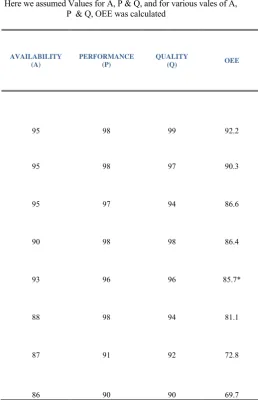
TABLE 6
EXPRIMENTAL RESULTS
Here we assumed Values for A, P & Q, and for various vales of A, P & Q, OEE was calculated
AVAILABILITY (A)
PERFORMANCE (P)
QUALITY
(Q) OEE
95 98 99 92.2
95 98 97 90.3
95 97 94 86.6
90 98 98 86.4
93 96 96 85.7*
88 98 94 81.1
87 91 92 72.8
[image:5.595.40.275.575.727.2]VI.
REAL TIME APPLICATIONO.E.E. data collection, analysis and reporting provide the principal basis for improving equipment effectiveness by eliminating the major equipment-related losses. The weighted OEE method is presented and the analytical hierarchy process has been applied for setting the weight of all the factors namely BD, SA, MI, RS, RL & SL. The potential of the proposed method can be applied for new as well as existing industries. OEE data very quickly leads to root-cause identification and elimination of losses. Overall Equipment Effectiveness continues to gain acceptance as an effective method to measure production floor performance. Capturing reliable production floor information is critical for producing reliable OEE focused progress of the plant or equipment. It will be optimal tool for plants implementing TPM.
This weighted approach and OEE results will be benchmarking tool to gauge manufacturing system, especially maintenance management system. OEE helps manufacturer to improve productivity and get better visibility into their operations and also allow them to take sound management decisions.
VII. CONCLUSION AND FUTURE WORKS
We may apply this methodology through algorithmic approach to get computational work, the values of OEE categorized through fuzzy logic method on A, P & Q to get optimization.
No manual data collection or manual compilation for OEE calculations is the first step in improving both the accuracy of OEE reports as wells as reducing the cost to produce the reports through neural network.The utility of artificial neural network models lies in fact that, they can be used to infer for future purposes.
VIII. LIST OF ACRONYMS
TPM Total Productive Maintenance OEE Overall Equipment Effectiveness PE Plant Effectiveness
A Availability P Performance Rate Q Quality Rate
JIPM Japan Institute of Plant Maintenance BD Break-Down
SA Setup Adjustment MI Minor / Idling stoppages RS Reduced Speed RL Reject / Rework Losses
ACKNOWLEDGEMENT
The authors would like to thank Dr. Ponnammal Natarajan, Former Director of Research, Anna University, and Chennai, India. Currently Advisor, (Research and Development), Rajalakshmi Engineering College, for her intuitive ideas and fruitful discussions with respect to the paper’s contribution.
REFERENCES
[1] B. Dal, P. Tugwell and R. Greatbanks (2000), “Overall equipment effectiveness as a measure of operational improvement”, International Journal of Operations & Production Management, vol. 20, no. 12, pp. 1488–1520. [2] Bin Yu, Munindar P.Singh, An Evidential model for
distributed reputation Management, AAMAS'02, July 15-19,2002, Bologna, Italy.
[3] B. Yu and M. P. Singh. Trust and reputation management in a small- world network. In Proceedings of the 4th International Conference on MultiAgent Systems, pages 449-450, 2000. [4] B.Yu and M.P.Singh. A social Mechanism of reputation
management in electronic communities. In proceedings of the 4th International Workshop on Cooperative Information Agents, 2000.
[5] F.Harary Addision-Wesley, Reading "Graph Theory", Mass, (1969).
[6] K.Thiagarajan, A.Raghunathan, Ponnammal Natarajan, G.Poonkuzhali and Prashant Ranjan (2009), “Weighted Graph Approach for Trust Reputation Management”, World Academy of Science, Engineering and Technology 56 – 2009.
[7] Lungberg.O (1998), Mearsument of overall equipment effectiveness as a basic for TPM activities. International Journal of operation. And production management. 18 (5) 495-507.
[8] M. Lesshammar (1999)., “Evaluation and improvement of manufacturing performance measurement systems – the role of OEE”, International Journal of Operations and Production Management, vol. 19, no. 1, pp. 55-78.
[9] S. Nakajima (1988) “Introduction to TPM”, Productivity Press,Cambridge, MA.
[10]S.P.Srinivasan, P.Malliga, K.Thiagarajan, An Algorithmic Graphical approach for Ground level logistics management of Jatropha seed distribution.,Ultra Scientist of Physical Sciences, Vol. 20, No:3,(M)(2008), Page(s): 605-612.
[11]Venkatesh, J. (2005), An Introduction to Total Productive Maintenance (TPM), The Plant Maintenance Resource Center, pp 2-3 and 15-27.
[12]Wireman, T., 1990. World Class Maintenance Management.
Industrial Press, New York.