Abstract—This paper presents an application of Bee Colony Optimization (BCO) for production and resource sequencing and scheduling of make-pack problem. The goal is to reduce the makespan while satisfying the restrictions on the capacity of production resources, dependent production requirement, production changeover and the process transfer condition. The BCO is applied to the realistic-sized case study data with 59 bulk formulas and 203 final productions along with 4 types of resources; premix tank, mix tank, storage tank and packing line. The results show that BCO could be used to obtain a better makespan of the realistic-sized problem under acceptable run time.
Index Terms—make-pack problem, scheduling, heuristics, Bee Colony Optimization
I. INTRODUCTION
N this paper, an improved bee colony optimization algorithm is proposed to solve a typical make-pack problem in a consumption processing plant of the process industry. The make-pack problem deals with short-term scheduling planning to achieve minimum makespan which would reduce waiting time and changeover time. The thorough literature review will be performed to understand the make-pack problem structure and determine the solution methodology accordingly. In this study, bee colony optimization is chosen to solve make-pack problem. The results will be compared by the solution quality and time. For large-scale problem, case studies will be created in order to test the performance of the algorithm. A computer
Manuscript received January 6, 2012. This research was supported by Coordinating Center for Thai Government Science and Technology Scholarship Students, Ministry of Science and Technology and National Science and Technology Development Agency, Faculty of Engineering, Thammasat University, Thailand Research Fund, and National Research University Project of Thailand, Office of the Higher Education Commission.
W. Wongthatsanekorn is an Assistant Professor, the Industrial Statistics and Operational Research Unit (ISO-RU), Department of Industrial Engineering, Faculty of Engineering, Thammasat University, 12120, THAILAND. Phone: (662)564-3002-9; Fax: (662)564-3017; E-mail:
B. Phruksaphanrat is an Assistant Professor, ISO-RU, Department of IndustrialEngineering, Faculty of Engineering, Thammasat University, 12120, THAILAND.; E-mail: [email protected]
*R. Sangkhasuk, is a master student, ISO-RU, Department of Industrial Engineering, Faculty of Engineering, Thammasat University, 12120, THAILAND. E-mail: [email protected].
experiment is also performed to achieve the optimal makespan for make-pack problem using bee colony optimization.
II. STATEMENT OF PROBLEM
For manufacturers of consumer goods industry, the typical flow of the process starts from mixing (making) process. Then, the produced mixture is transferred to storage tanks. After certain periods, this stored mixture is moved to packinglines. The resulted final products in various formats are then ready to be shipped to the customer [4]. This production process is called make-pack process, where planner finds it very difficult to perform short-term scheduling. There are 4 restrictions: restriction in production resource capacity, restriction in dependent production requirement, restriction in process changeover, and restriction in process transfer. If there are not much demand quantities for the product, the problem is not complicated because the problem size is small. However, the size of the realistic problem is very large and it is the reason why it is difficult to apply a typical mathematical programming approach. In this study, the data of the case study is obtained from [4]. The details are as follows:
A. A variety of products
This case study contains a production of 203 final products or stock keeping unit (SKU). These products contain 59 bulk formulas. Each, bulk formula can be packed into more than one type of final container or final product.
B. Demand of products
Given data of the demand is presented in weekly bucket and in proportional of batch instead of individual unit. Since the batch size is different, the actual demand is converted into batch of bulk formula for simplicity. It is assumed that one week of production planning has 10,080 minutes without a break.
C. Resource production
Production planner must be informed of the restrictions on the production resources which include type, quantity and capacity of the resources in production. The resources cannot be assigned with certainty a priori and production cannot exceed its capacity. The resources consist of premix tank. There are 3 tanks which maximum capacity equal to 1 batch and processing pattern is individual. For main mix tank, there are 6 tanks with maximum capacity equal to 1
Applying Bee Colony Optimization Heuristic
for Make-Pack Problem in Process
Manufacturing
W. Wongthatsanekorn, B. Phruksaphanrat, and R.Sangkhasuk*
I
batch and processing pattern is individual. For storage tank, there are 6 tanks with maximum capacity equal to 1 batch and 74 tanks which maximum capacity equal to 0.5 batch and processing pattern is individual. Lastly, for packing line, there are 7 lines with maximum capacity is 0.5 batch and processing pattern is continuous. Table I shows a summary of resource in production.
D. Resource production
When there is a switch in production, change over time is taken into account in this study. This is mainly because each product has different characteristics. Change over time is non-value added to the manufacturer so this research attempts to minimize the change over time. There are three characteristics of change over as follows:
1) Wash out family (W/O): It is a process that depends on the product family as shown in Table II. Wash out happens with premix tank, main-mix tank, storage tank and packing line. If the value of any combination in Table II is 1, the wash out is required when there is a change in product family for mixing and packing process. On the other hand, if the value is 0, there is no wash out. The process can continue. For example, changing from production family F-1 to production family F2 requires a wash out of 47 minutes while changing from product family F-5 to F-1 does not require a changeover.
2) Packing change over (C/O): It is a process to switch between package types in packing line process. Packing changeover time is defined in Table III.
3) Combined Wash out & Packing Change over (Combined W/O & C/O): It is process to switch between wash out family and package types in packing line process. Combined Wash out & Packing Change over time is defined in Table III.
E. Work flow
Production planner must be informed of the restrictions on the production resources which include type, quantity and capacity of the resources in production. The resources cannot be assigned with certainty a priori and production cannot exceed its capacity. The resources consist of premix tank. There are 3 tanks which maximum capacity equal to 1
F. Production time
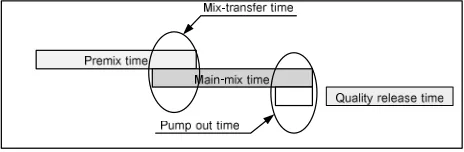
Production time consists of premix time, transfer time, main-mix time, pump out time, quality release time, and packing line time which is shown in Fig. 2 and each process time of bulk formula shows in Bulk Intermediates sheetof [4].
G. Production
Production planner must know volume of each bulk formula that is converted from the summation of final product demand. From above work flow, process of this problem can be shown in Fig. 3 as follow:
Step 1: Materials are sent to premix tank 1 (PM-1). If resource capacity is less than bulk volume, higher volume will have to wait. Premix process then starts production at time “a” and finishes production at time “b” and the premix is transferred to main-mix process at time “b-c”. Then, PM-1 starts production at time “c” and finishes at time “d” and transfers to main-mix process at time “d-e”. Then, the process of wash out family is added for 47 minutes
TABLEI
THE QUANTITY AND RESOURCE CAPACITY IN PRODUCTION
Symbol Type of
Resource Quantity
Capacity
(Batch) Processing
PM Premix tank 3 1 Individual
MM Main mix tank 6 1 Individual
ST Storage tank 6 74
1 0.5
Individual Individual
PL Packing line 7 0.5 Continuous
TABLEIII
WASH OUT FAMILY RELATIONSHIP FOR PACKING
Type PL-1 PL-2 PL-3 PL-4 PL-5 PL-6 PL-7
W/O time 90 87 90 93 85 85 90
C/O time 27 35 33 40 30 35 40
Combined W/O
& C/O time 105 97 106 110 95 95 108 W/O time 90 87 90 93 85 85 90
TABLEII
WASH OUT FAMILY RELATIONSHIP FOR MIXING AND PACKING
To F-1
To F-2
To F-3
To F-4
To F-5
To F-6
To F-7
From F-1 0 1 1 1 1 1 1
From F-2 0 0 1 1 1 1 1
From F-3 1 1 0 1 1 1 1
From F-4 0 0 1 0 1 1 1
From F-5 0 0 1 1 0 1 1
From F-6 1 1 1 1 1 0 1
From F-7 1 1 1 1 1 1 0
[image:2.612.311.537.57.128.2]* Premix tank wash out time is 47 minutes * main mix tank wash out time is 47 minutes * F=Wash out Family
Fig. 1. Work flow of this problem
[image:2.612.70.293.159.253.2] [image:2.612.313.545.490.566.2]Step 2: Task from PM-1 is transferred to main-mix tank 1 (MM-1) at time “b-c”. Main-mix processes starts production at time “c” and finishes production at time “d” and the main-mix is pumped out to intermediate process at time “d-e”. Then, task from PM-1 is transferred to main-mix tank 2 (MM-2) at time “d-e”. MM-2 starts production at time “e” finishes production at time “h” and pumps out to intermediate process at time “h-i”. Then, the process of wash out family is added for 47minutes.
Step 3: Task from MM-1 is pumped out of storage tank 1 (ST-1) at time “f-g”. Intermediate processes starts production at time “g” and finishes production at time “i” and the stored materials are sent to packing process. Then, task from MM-2 is pumped out storage tank 2 (ST-2) at time “h-i”. ST-2 starts production at time “i” and finishes production at time “j”. Then, the process of wash out family is added for 20minutes.
Step 4: Task fromST-1 is sent to packing line 1 (PL-1). Packing process starts production of final product at time “i” and finishes production at time “j”. Then, task fromST-2 is sent to packing line 1 (PL-1). PL-1 switch between package types which it is added to packing change over time at time “j-k”. Pl-1 starts production of new final product at time “k” and finish production at time “l”. Then, the process of wash out family is added at “l-m”.
III. BEE COLONY OPTIMIZATION APPROACH
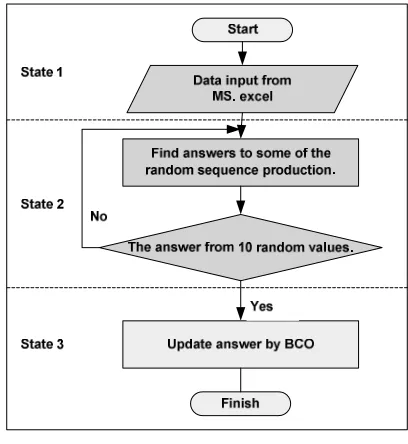
The goal of this research is to find the optimal production plan, resource sequencing and scheduling of make-pack problem by reducing non-productive time which is waiting time and change over time. Restrictions of this problem consists of 4 main constraints; restriction in production resource capacity, restriction in dependent production requirement, restriction in process changeover, and restriction in process transfer. The solution is a computer program developed by the flowchart shown in Fig.4.
A. State 1: Input database
This state is input database from Microsoft excel which can see in [4].
1. Each individual resource capacity (Equipment sheet) 2. The relationship of premix tank and main-mix tank (Making Systems sheet)
3. Processing time and wash out family of each bulk formula (Bulk Intermediates sheet)
4. The relationship of main-mix tank and each bulk formula (Bulk Production sheet)
5. The relationship of switching wash out family (Bulk Wash Outs sheet)
6. Weekly demand and the relationship of final product and each bulk formula which uses the first week (Demands sheet)
7. The relationship of packing time and each final product (Pack Times sheet)
8. The relationship of change over time of each packing line (Packing WO & CO).
This database allows editing and managing complex data to easy.
B. State 2: Initial solution
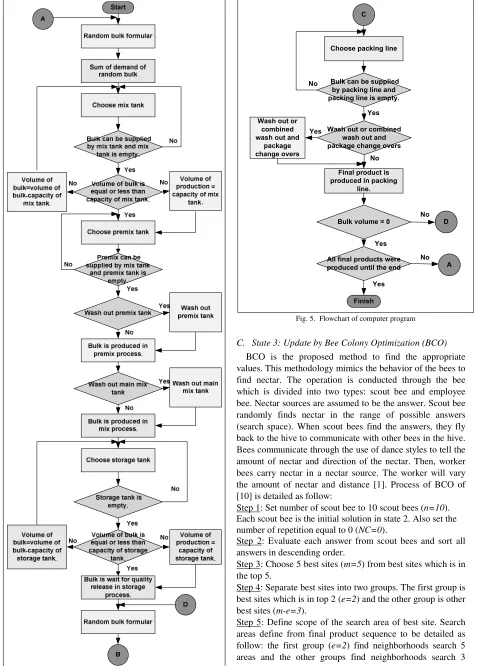
[image:3.612.74.540.52.209.2]The process of seeking answers by random production from database of state 1. Results of this state are 10 initial solutions. Process of this state is shown in Fig. 5.
[image:3.612.336.540.433.655.2]Fig. 4. Flowchart of computer program
Fig. 3. Process time of bulk formula
C. State 3: Update by Bee Colony Optimization (BCO)
BCO is the proposed method to find the appropriate values. This methodology mimics the behavior of the bees to find nectar. The operation is conducted through the bee which is divided into two types: scout bee and employee bee. Nectar sources are assumed to be the answer. Scout bee randomly finds nectar in the range of possible answers (search space). When scout bees find the answers, they fly back to the hive to communicate with other bees in the hive. Bees communicate through the use of dance styles to tell the amount of nectar and direction of the nectar. Then, worker bees carry nectar in a nectar source. The worker will vary the amount of nectar and distance [1]. Process of BCO of [10] is detailed as follow:
Step 1: Set number of scout bee to 10 scout bees (n=10). Each scout bee is the initial solution in state 2. Also set the number of repetition equal to 0 (NC=0).
Step 2: Evaluate each answer from scout bees and sort all answers in descending order.
Step 3: Choose 5 best sites (m=5) from best sites which is in the top 5.
Step 4: Separate best sites into two groups. The first group is best sites which is in top 2 (e=2) and the other group is other best sites (m-e=3).
Step 5: Define scope of the search area of best site. Search areas define from final product sequence to be detailed as follow: the first group (e=2) find neighborhoods search 5 areas and the other groups find neighborhoods search 3 areas.
Step 6: Give worker bees find around best site m. Choose packing line
Bulk can be supplied by packing line and packing line is empty.
Final product is produced in packing
line.
All final products were produced until the end
Finish
A Yes
No
Bulk volume = 0
No
Yes
Yes
No C
D Wash out or combined
wash out and package change overs Wash out or
combined wash out and
package change overs
[image:4.612.76.555.51.717.2]No Yes
Fig. 5. Flowchart of computer program
Step 7: Evaluate of the best site from worker bees in each source and choose the best answer to each source.
Step 8: Check the stop condition. If the conditions are satisfied, the search is stopped. On the other hand, the number of repeat increase (NC=NC+1).
Step 9: Set number of scout bee’s to n-m=5 and find a new answer and return to step 2 (Repeat process until the best answer).
IV. EXPERIMENTSTUDY
This purpose of this study is to assist the planner in performing the production schedule for make-pack problem in the industry. The computer code is programmed using C# language and run on a computer with processor Intel core i5, CPU 2.3GHz, and Ram 4 GB. Outputs are production time and processing time. There are 2 case studies as follow:
A. Small case with 10 product
This shows a small problem with 10 final products. These products contain 2 bulk formulas. The following setting is used; number of scout bee to 10 scout bees (n=10), number of sites selected out of n visited sites to 5 sites (m=5), number of bees recruited for best 2 sites –use 5 neighboring bees in neighboring answers, recruited for the other selected sites (m-e) –use 3 neighboring bees in neighboring answers, and number of repetition (NC) equal to 50. BCO is performed 10 times to evaluate the overall performance.
Table IV shows the results of 10 tests. The results consists of makespan in unit of minute and CPU time of computer in unit of second, the mean of makespan, best answer, deviation of the best on average of makespan, and the mean of CPU time, best CPU time, deviation of the best on average of CPU time.
The results show that the best makespan and the mean of makespan for every test problems are 1,447.56 minutes. The mean CPU time is 5.91 seconds. Hence, BCO can solve small problem very effectively.
B. Large case
This experiment consists of the actual 203 final products. These products contain 59 bulk formulas. The following setting is used; number of scout bee to 10 scout bees (n=10),
number of sites selected out of n visited sites to 5 sites
(m=5), number of bees recruited for best 2 sites –use 5 neighboring bees in neighboring answers, Recruited for the other selected sites (m-e) –use 3 neighboring bees in neighboring answers, and number of repetition (NC) equal to 300. BCO is performed 10 times to evaluate the overall performance.
The results in Table V and Fig. 6 show that for larger problem the best answer from BCO varies because BCO is a probabilistic method. However, mean of the best answer in every test deviates from the overall minimum make span of 7,283.00 minutes by just 37.12 minutes or 0.5%. This number is considered very small and it shows that the proposed BCO could perform effectively. However, the run time increases tremendously from the small case. The average run time is now 1,078.10 seconds or around 18 minutes.
Table VI and Fig. 7 show the best makespan for different NC. For the first 50 iterations, the best answer is improved very quickly but the optimal answer couldn’t be obtained until 250th iteration.
V.CONCLUSION
This paper presents a heuristic approach based on bee colony optimization (BCO) for solving make-pack problem. The purpose of this research is to solve make-pack problem where production demand must be completed before its due date under 4 main constraints. They are number and capacity
TABLEIV RESULTS OF TEST 10 PRODUCTS
Test No. Minimum Makespan (Minutes)
CPU Times (Seconds)
1 1,447.56 4.46
2 1,447.56 6.83
3 1,447.56 5.79
4 1,447.56 6.48
5 1,447.56 4.10
6 1,447.56 4.42
7 1,447.56 7.64
8 1,447.56 6.32
9 1,447.56 7.82
10 1,447.56 5.25
Mean 1,447.56 5.91
Best answer 1,447.56 4.10
Mean deviation from
best 0 1.811
TABLEV RESULTS OF TEST 203 PRODUCTS
Test No. Minimum Makespan (Minutes)
CPU Times (Seconds)
1 7,330.29 1,095.04
2 7,323.28 1,098.17
3 7,310.47 1,074.07
4 7,329.11 1,057.94
5 7,283.00 1,066.69
6 7,323.28 1,098.17
7 7,378.10 1,062.59
8 7,330.32 1,059.33
9 7,296.88 1,069.63
10 7,296.46 1,099.36
Mean 7,320.12 1,078.10
Best answer 7,283.00 1,057.94
Mean deviation from
best 37.12 20.16
Fig. 6. Makespan of 203 product production
[image:5.612.311.537.255.586.2] [image:5.612.69.295.444.623.2]of production resources constraints, the use of resources in the production of each product constraints, production resources in the production of each product constraints, and transfers between production resources constraints. The results from the experiments show that BCO can find the same minimum makespan (1,447.56 minutes) in every test. The average run time is only 6 seconds. Thus, BCO can perform very well. For the actual size with 203 products, the results show that the minimum makespan in every test is not the same but the difference is very small. The mean of the best answer in every test deviates from the overall minimum make span of 7,283.00 minutes by just 37.12 minutes or 0.5% which is less than demand times. The best result at NC=300 is improved from 8,389.51 at NC=1 to 7,280 or 14 percent. The average run time is about 18 minutes. This concludes that BCO can be applied to solve realistic sized problem and improve the overall makespan under the reasonable run time.
REFERENCE
[1] S. Camazine and J. Sneyd, "A model of collective nectar source selection by honey bees: Self-organization through simple rules," Journal of Theoretical Biology, vol. 149, pp. 547-571, 1991. [2] P. M. Castro, et al., "Optimal short-term scheduling of large-scale
multistage batch plants," Industrial and Engineering Chemistry Research, vol. 48, pp. 11002-11016, 2009.
[3] Y. He and C. W. Hui, "Genetic algorithm for large-size multi-stage batch plant scheduling," Chemical Engineering Science, vol. 62, pp. 1504-1523, 2007.
[4] S. J. Honkomp, et al., "The curse of reality - Why process scheduling optimization problems are difficult in practice," Computers and Chemical Engineering, vol. 24, pp. 323-328, 2000.
[5] I. A. Karimi and C. M. McDonald, "Planning and Scheduling of Parallel Semicontinuous Processes. 2. Short-Term Scheduling," Industrial and Engineering Chemistry Research, vol. 36, pp. 2701-2714, 1997.
[6] Y. Marinakis, et al., "A Hybrid discrete artificial bee colony-GRASP algorithm for clustering," 2009, pp. 548-553.
[7] C. A. Méndez, et al., "State-of-the-art review of optimization methods for short-term scheduling of batch processes," Computers and Chemical Engineering, vol. 30, pp. 913-946, 2006.
[8] Q. K. Pan, et al., "A discrete artificial bee colony algorithm for the lot-streaming flow shop scheduling problem," Information Sciences, 2010.
[9] L. Tang and X. Wang, "An Improved Particle Swarm Optimization Algorithm for the Hybrid Flowshop Scheduling to Minimize Total Weighted Completion Time in Process Industry," IEEE Transactions on Control Systems Technology, 2009.
[10] L. P. Wong, et al., "Bee colony optimization algorithm with big valley landscape exploitation for job shop scheduling problems," 2008.
[11] S. Zhixiong and L. Tieke, "Genetic algorithm for minimizing the makespan in hybrid flow shop scheduling problem," Wuhan, 2009. [12] L. Zou, et al., "Application of distributed parallel algorithm for long
[image:6.612.69.296.57.289.2]term crude oil scheduling," Huagong Xuebao/CIESC Journal, vol. 60, pp. 2003-2009, 2009.
Fig. 7. Makespan of 203 product production TABLEVI
BEST MAKESPAN FOR ALL ITERATIONS
NC Makespan (minutes)
1 8,389.51
50 7,463.76
100 7,427.95
150 7,320.37
200 7,320.37
250 7,280.00