Cross-Layer Enhanced Adaptive Reservation
Terry H. S. Chu, Kent S. F. Cheng, and Henry C. B. Chan
Abstract – This paper presents a Cross-Layer Enhanced Adaptive Reservation (CLEAR) protocol. CLEAR supports heterogeneous packet transmissions over a wireless channel with multi-packet reception. Reservations are assigned using a genetic algorithm based on the quality of service requirement and channel condition. In other words, heterogeneous packets are mixed effectively using intelligent computing. CLEAR also supports cross-layer operations. Basically, when the channel condition becomes bad, the upper layer(s) can respond accordingly to reduce the effect and energy consumption. Furthermore, reservations are changed adaptively using a genetic algorithm based on the new channel condition. To evaluate the performance of CLEAR under the consideration of energy and quality, we employ a performance metric called the energy quality index (EQI). Simulation results are presented to demonstrate the effectiveness of the CLEAR protocol based on the traditional packet loss ratio (PLR) as well as the EQI.
Keywords – cross-layer, multiple access protocols, multi-packet reception, reservation protocols, energy efficient protocols
I. INTRODUCTION
In recent years, there has been considerable interest in designing wireless communications/access protocols based on a cross-layer model [1], which allows different layers to collaborate or interact with each other to enhance overall system performance. For example, a general cross-layer framework was proposed in [2] for determining a preferred set of parameters or services so that the overall system performance can be maximized while satisfying certain constraints/requirements. Most studies have investigated specific interactions between two or more layers (e.g., see [1]): the physical layer and the link layer, the transport layer and the link/physical layer, and the application layer and the link/physical layer. In the first case (i.e., the physical layer and the link layer), a representative example is opportunistic scheduling [3], which selects preferred terminals to be served using their channel conditions and possibly other physical layer information. In the second case (i.e., the interaction between the transport and link/physical layer(s)), the transport layer can enhance its performance using information from lower layers. For example, [4] presented a cross-layer method to enhance the Transmission Control Protocol (TCP) throughput using physical/link layer information. In the third case (i.e., the interaction between the application layer and link/physical layer(s)), for example, a cross-layer method was proposed in [5] to support an MPEG4 video communications using a layered encoding mechanism so that the link layer can select packets to be dropped if necessary or better schedule the packet transmissions. Another application-driven cross-layer example was presented in [6] to support a wireless video
streaming service. With the aim of enhancing video quality, the cross-layer information can be employed to determine various operation parameters (see [5] for details). Other more recent examples of cross-layer design or protocols include enhancing the performance of multicode code division multiple access (CDMA) networks using cross-layer optimization [7], allocating resources effectively for cellular-relaying networks based on a cross-layer model [8], developing a cross-layer scheduling policy through a joint AMC/ARQ mechanism [9], and optimizing the performance of streaming video over fading wireless networks using a cross-layer approach [10].
Contributing to this important area of research, we present a cross-layer enhanced adaptive reservation protocol for supporting heterogeneous packet transmissions over a multi- packet reception (MPR) channel. Compared to other works related to MPR channels (e.g., [11][12]), our work provides new contributions in several aspects. First, we study the use of a genetic algorithm (GA) (i.e., an intelligent computing algorithm) for supporting heterogeneous packet transmissions over an MPR channel. Second, we combine cross-layer operations with the GA-based reservation scheme to enhance system performance. To the best of our knowledge, relatively little work has been done on cross-layer reservation protocols using intelligent computing, so this paper should provide new insights. Third, we evaluate the CLEAR protocol based on the packet loss ratio as well as energy quality considerations using an energy quality index (EQI). Note that in recent years there has also been considerable interest in green communications and/or cross-layer-based energy efficient protocols [13][14]. Our work also seeks to make contributions to this important area.
The rest of the paper is organized as follows. Section II introduces the system model and protocol for CLEAR. Section III presents the slot allocation or reservation schemes. Section IV presents the simulation results. Section V concludes the paper.
II. SYSTEM MODEL AND PROTOCOL
In this section, we introduce the system model and protocol for CLEAR. Part of our work can be viewed as an extension of the work in [12]. The system consists of one base station serving many terminals over a time division multiplexing-based wireless channel with MPR capability. Our focus is on the uplink channel and the reservation mechanism. We consider that the channel is framed and each frame has 20 time slots. Each time slot can support MPR. Basically, if i packets have been sent simultaneously at a time slot, the probability that j packets will be successfully transmitted is defined by the MPR channel model as . Note that the MPR model is a generic model for different transmission mechanisms such as This work has been supported by The Hong Kong Polytechnic
University under account number G-U758.
Terry H. S. Chu and Henry C. B. Chan are with the Department of Computing, The Hong Kong Polytechnic University, Hong Kong (e-mail: {cshschu, cshchan}@comp.polyu.edu.hk).
CDMA. In fact, by setting and = 0 where i > 1 and j > 0, the MPR channel becomes the traditional time division multiplexing-based channel. It is also possible to model different situations (e.g., the capture effect). We can also extend the aforementioned MPR model to heterogeneous packet transmissions. Assume that there are two types of voice packets (H and L packets), which can tolerate different numbers of bit errors. Define and as the number of H and L packets transmitted at a time slot respectively. We can then set up two inter-related MPR channel matrixes for the heterogeneous packets. Basically, given and , we define and as the probability that and packets
are successfully transmitted, respectively. Following the CDMA model in [12] and considering both good and bad channels with a spreading factor of S = 7 and signal-to-noise ratio (SNR) of 10 dB and 4 dB, respectively, the bit error probability of a packet is found to be:
(1) where Q is the tail probability of the Gaussian distribution. As an example, we assume that the H and L packets can tolerate = 38 error bits and = 27 error bits, respectively. Assuming that a packet has M = 511 bits, the probability that an H / L packet can be successfully received is:
(2)
Hence, it can be found that for the MPR channel, we have:
& (3)
for H and L packets. Note that this is just one example of the MPR channel model. Other MPR channel matrixes can also be used (i.e., our analysis can also be applied to other MPR channel matrixes).
Each voice station alternates between active and idle states based on the well-known bi-state Markov model (e.g., see [12]). The model can also be extended to support multimedia traffic in general. We assume that each voice station can communicate with the base station through a signaling channel. For example, a voice station can convey information about its state (e.g., active or idle) to the base station and the base station can also notify the voice station about the channel condition. In general, other control information can also be conveyed through the signaling channel. At the beginning of each frame, the base station can determine the number of active voice stations and the packet requirements through the signaling channel. Based on this information, it then allocates the slots using a slot allocation (or reservation) mechanism. If an active station cannot get a slot, the voice packet will be discarded. For CLEAR, we assume that slots are assigned based on a genetic algorithm (GA) (i.e., an intelligent computing algorithm). Details will be given in the next section. Of course, other reservation mechanisms can also be employed. Note that there is no requirement to run the time-consuming genetic algorithm
in real time. The solutions for different cases can be pre-calculated and saved. Having determined the slot allocation, the base station then conveys the slot assignments to the voice stations through the signaling channel, so that the voice stations can send the packets accordingly through the assigned slots. Recall that multiple packets can be transmitted through a slot.
Based on the bi-state Markov model and assuming that there are type H stations and type L stations, we can use two binomial distributions (with a voice activity factor of 0.4) to determine the probability that there are h H packets and l L packets to be transmitted in a frame. Let and be the assumed SNR and actual SNR, respectively. Denote as the PLR when there are h H packets and l L packets to be transmitted in a frame. Note that this function can be found by the GA based on the channel matrix to be explained in the next section. Based on the above, the expected PLR can be found to be:
(4) To maintain acceptable voice quality, it is desirable to keep the overall PLR to within 1%.
To enhance system performance, CLEAR supports cross-layer operations. Basically, when a channel becomes bad, the link layer informs the upper layer(s) to take appropriate actions through the signaling channel. As an example, we assume that when a channel becomes bad, the packet generation rate is reduced by half. The base station also mixes packets using a GA based on the new channel condition. By doing so, not only can the PLR be enhanced, but the energy consumption may also be reduced.
To quantify the performance based on considerations of both energy and quality of service (i.e., the PLR in this case), we employ an Energy Quality Index (EQI) inspired by [15] and similar works. Basically, EQI reflects the energy consumed for each successfully transmitted packet, as shown in the following equation:
(5)
an example, unless otherwise specified, we set the aforementioned parameters as follows. When the cross-layer operation is not employed, we set = 1 and e = 1. When the cross-layer operation is employed, we set = 0.75 and e = 0.5. Note that when the channel varies between good and bad states and the cross-layer operation is employed, the overall EQI is computed based on the respective percentages. Note that the EQI can also be employed to evaluate other situations in general.
III. RESERVATION SCHEMES
[image:3.612.53.291.207.362.2]In this section, we present the GA-based reservation scheme and other simple reservation schemes.
Fig. 1. GA-based reservation scheme
Inspired by the evolution of living beings, genetic algorithms are intelligent computing methods for finding solutions to optimization problems. In essence, feasible solutions are represented as “chromosomes.” They can be mixed/combined to generate better or new chromosomes through a crossover process. Occasionally, a mutation process can be employed to introduce changes so that better chromosomes could possibly be generated over the long term. After many generations of crossover operations, the hope is that a close-to-optimal solution can be obtained. In this paper, a GA-based reservation scheme is employed. Fig. 2 gives an example. Initially, random solutions are generated (i.e., to mix the H and L packets in each slot). For each solution, the corresponding frame functions like a chromosome. Chromosomes (i.e., frames) are selected for the crossover process based on their fitness values. In our case, 1/PLR represents the fitness value of a chromosome (i.e., chromosomes with a lower PLR have a higher fitness value). In the selection process, 20 chromosomes are selected through a random process based on their fitness values (i.e., chromosomes with a higher fitness value have a higher probability of being selected). Note that a chromosome may be selected more than once. After selecting 20 chromosomes (or 10 pairs), each pair of chromosomes is mixed in the crossover process. Suppose that two parent chromosomes, X1 and X2, have been selected. Basically, in the crossover process 90% of X1 is mixed with 10% of X2 to produce X3 and 90% of X2 is mixed with 10% of X1 to produce X4. Note that some H and L packets may be removed to maintain the desired number of packets after the crossover operation. The two best chromosomes from among X1, X2, X3, and X4 will survive. For the mutation process, some H packets are replaced with L
packets with a pre-defined mutation probability. The above steps are repeated 500 times (i.e., 500 generations). Initially, there are 20 chromosomes and the mutation probability is 0.1. The PLR can be found based on the channel model and channel condition. Basically, if there are h H packets and l L packets, we can find the slot allocations based on the GA-based reservation scheme using the channel model and the channel condition (i.e., with the assumed SNR). Having found the slot allocation, the aforementioned can also be found based on the channel model and the actual SNR. The slot allocation (GA-based) solution can also be stored so that the base station can convey the reservation to the stations. In other words, the GA-based slot allocation can be pre-calculated to facilitate implementation.
For the purpose of comparison, we consider three non-GA-based reservation schemes: First-High-Then-Low (FHTL), First-Low-Then-High (FLTH), and Round-Robin (RR). In all of the schemes, packets are filled in a time slot provided that the expected packet loss ratio is less than 1% based on the channel matrix. For FHTL and FLTH, H and L packets respectively are filled in first. RR fills in H and L packets alternatively (i.e., on a round-robin basis). Similar to the GA-based reservation scheme, the PLR can also be computed GA-based on the channel model and channel condition.
IV. SIMULATION RESULTS
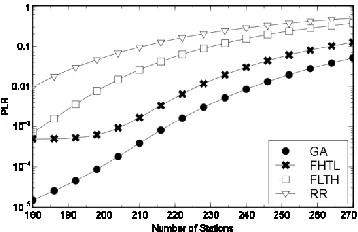
[image:3.612.353.532.499.615.2]We have evaluated the performance of the proposed CLEAR protocol based on simulations using the aforementioned system model. We first compare the effectiveness of the reservation schemes under different channel conditions. Fig. 2 shows the PLR when the channel condition is good. It can be seen that the GA achieves the best performance because it can mix H and L packets more intelligently. With the GA, about 250 stations can be supported while maintaining the PLR target of 1%. FHTL performs better than FLTH. Based on the simulation parameters, it can be computed that each slot can support a maximum of 6 H packets and 5 L packets, so it is better to fill a slot with H packets first. RR delivers the worst performance.
Fig. 2. The PLR when the channel condition is good
was found in the case of simulation, they both support a similar number of packets per slot.
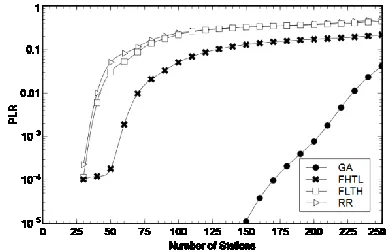
Fig. 3. The PLR when the channel condition is bad
In practice, a channel fluctuates between good and bad states. Here, we assume that a channel is in a good state 50% of the time. Fig. 4 shows the PLR when the channel fluctuates between good and bad states under this assumption. Again, it can be seen that the GA clearly outperforms the other schemes because it can better adapt to the change in channel conditions (i.e., packets can be mixed adaptively when the channel condition is changed).
[image:4.612.73.269.306.432.2]Fig. 4. The PLR when the channel condition varies between good and bad In Fig. 4, we assume that the base station can know and hence react to the channel condition perfectly. In Fig. 5, we assume the worst-case scenario, which is that when the channel condition is varied the base station always assumes that the channel condition is good. Fig. 5 shows that the performance of the GA degrades significantly because of the incorrect information to mix the packets. However, the GA can still perform better than the other schemes.
Fig. 5. The PLR when the channel condition varies between good and bad, but the base station assumes that the channel condition is always good
Next, we evaluate the EQI (i.e., taking into consideration both energy and quality). Fig. 7 shows the EQI when the channel quality is good. Recall that EQI reflects the number of packets
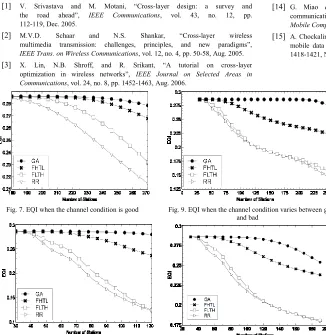
sent successfully with respect to the energy used. Fig. 7 shows that the EQI for the GA can be maintained at a steady value for up to 250 stations. The EQI for other schemes drops more dramatically, indicating that they are less effective in terms of energy and quality. Fig. 8 shows the EQI when the channel condition is bad. It shows that the EQI for other schemes (i.e., other than the GA) drops even more dramatically, especially for FLTH and RR. Fig. 9 and Fig. 10 show the EQI when the channel varies between good and bad states based on the aforementioned assumptions. Fig. 9 assumes that the base station knows the correct channel condition, whereas Fig. 10 assumes that it always allocates slots based on good channel conditions (i.e., even when the channel condition is bad). It can be seen that the EQI for the GA can be maintained at a more stable value, indicating that it is more effective based on the consideration of energy quality.
Last, but not least, we evaluate the performance of cross-layer operations for the GA-based reservation scheme. Again, we assume that the channel condition varies between good and bad states, based on the previous assumption. When the channel condition is bad, the link layer informs the upper layer that it should generate packets at a lower rate. Here, we assume that the packet generation rate decreases by 50% when the channel condition is bad. Fig. 6 shows the PLR for the cross-layer approach in comparison with the non-cross-cross-layer approach. It can be seen that the cross-layer scheme can outperform the non-cross-layer scheme. Recall that about 250 stations can be supported if we assume that the channel condition is always good. When the channel varies between good and bad states and the cross-layer scheme is not used, the PLR drops significantly to 0.1, which provides a very unacceptable quality of service. However, if the cross-layer operation is used, the PLR can be maintained at below 0.01. Although the voice quality will likely still be affected during a bad channel condition, the impact will be greatly reduced.
[image:4.612.347.538.449.569.2]generated to reduce the packet loss ratio, and energy consumption is also reduced. Fig. 12 shows the EQI for different parameters. For example, when = 1 and = 0.1 (i.e., voice quality is almost unaffected by decreasing the packet generation rate by 50%, and it takes relatively less energy to generate and send voice packets), the EQI is between 0.3 and 0.4 (i.e., about 0.3-0.4 packets are sent per unit of energy). However, when = 0.5 and = 10 (i.e., voice quality is degraded by 50% and significantly more energy is consumed to generate and send packets), the EQI decreases significantly to around 0.05 (i.e., 0.05 packets are sent per unit of energy).
V. CONCLUSIONS
In conclusion, we have proposed a CLEAR protocol for supporting heterogeneous packet transmissions over a wireless channel with MPR capability. CLEAR assigns reservations based on a genetic algorithm, allowing heterogeneous packets to be mixed effectively to reduce packet losses. CLEAR also supports cross-layer operations based on the channel condition to enhance performance. We have evaluated the CLEAR protocol using simulations based on the PLR and also the EQI (i.e., taking into consideration both energy and quality). The simulation results show that the CLEAR protocol can provide a promising performance under different situations.
REFERENCES
[1] V. Srivastava and M. Motani, “Cross-layer design: a survey and the road ahead”, IEEE Communications, vol. 43, no. 12, pp. 112-119, Dec. 2005.
[2] M.V.D. Schaar and N.S. Shankar, “Cross-layer wireless multimedia transmission: challenges, principles, and new paradigms”,
IEEE Trans. on Wireless Communications, vol. 12, no. 4, pp. 50-58, Aug. 2005. [3] X. Lin, N.B. Shroff, and R. Srikant, “A tutorial on cross-layer
optimization in wireless networks”, IEEE Journal on Selected Areas in Communications, vol. 24, no. 8, pp. 1452-1463, Aug. 2006.
[4] A.L. Toledo, Xiaodong Wang, and B. Lu, “A cross-layer TCP modelling framework for MIMO wireless systems”, IEEE Trans. on Wireless Communications, vol. 5, no. 4, pp. 920-929, Apr. 2006.
[5] H. Jiang, W. Zhuang, and X. Shen, “Cross-layer design for resource allocation in 3G wireless networks and beyond”, IEEE Communications, vol. 43, no. 12, pp. 120-126, Dec. 2005.
[6] S. Khan, Y. Peng, E. Steinbach, M. Sgroi, and W. Kellerer, “Application-driven cross-layer optimization for video streaming over wireless networks”, IEEE Communications, vol.44, no.1, pp. 122-130, Jan. 2006. [7] H. Chen, H.C.B. Chan, and V.C.M. Leung, “Cross-layer optimization for
multimedia transport over multicode CDMA networks”, IEEE Trans. on Mobile Computing, vol. 10, no. 6, pp. 810-820, Jun. 2011.
[8] B. Timus, P. Soldati, J. Zander, and D. Kim, “Cross-layer resource allocation model for cellular-relaying network performance evaluation”, IEEE Trans. on Vehicular Technology, vol. 60, no. 6, pp. 2765-2776, July 2011.
[9] M. Poggioni, L. Rugini, and P. Banelli, “QoS analysis of a scheduling policy for heterogeneous users employing AMC jointly with ARQ”, IEEE Trans. on Communications, vol. 58, pp. 2639-2652, Sept. 2010.
[10] H. Zhang, Y. Zheng, M.A. Khojastepour, and S. Rangarajan, “Cross layer optimization for streaming scalable video over fading wireless networks”, IEEE Journal on Selected Areas in Communications, vol. 28, no. 3, pp. 344–353, Apr. 2010.
[11] J.B. Seo and V.C.M. Leung, “Design and analysis of cross-layer contention resolution algorithms for multi-packet reception slotted ALOHA systems”, IEEE Trans. on Wireless Communications, vol. 10, pp. 825-833, Mar. 2011.
[12] H. Chen, F. Yu, H. Chan, and V. Leung, “A novel multiple access scheme over multi-packet reception channels for wireless multimedia networks”, IEEE Trans. on Communications, vol. 6, no. 4, pp. 1501-1511, Apr. 2006.
[13] G. Auer et al., “Cellular energy efficiency evaluation framework”, in Proc. Vehicular Tech. Conf., Budapest, Hungary, May 2011.
[14] G. Miao et al., “Cross-layer optimization for energy-efficient wireless communications: a survey”, Wiley Journal of Wireless Communications and Mobile Computing, vol. 9, pp. 529–42, Apr. 2009.
[image:5.612.43.369.347.682.2][15] A. Chockalingam and M. Zorzi, “Energy efficiency of media access protocols for mobile data networks”, IEEE Trans. on Communications, vol. 46, no. 11, pp. 1418-1421, Nov. 1998.
Fig. 7. EQI when the channel condition is good
Fig. 8. EQI when the channel condition is bad
[image:5.612.377.562.434.710.2]Fig. 9. EQI when the channel condition varies between good and bad
Fig. 10. EQI when the channel condition varies between good and bad, but the base station assumes that the channel
condition is always good
Fig. 11. EQI for the cross-layer operation compared with other operations