Abstract—The Next generation mobile communication system called as 4G is expected to include heterogeneous wireless networks that will offer high data rate multimedia services to end users. In present wireless systems the capability of broader coverage is available but has the limitation of bandwidth and network cost. The proposed Seamless Media Independent Resilience Triggering (SMIRT) framework will provide decision based on soft-handover for Heterogeneous Networks like Wi-Fi, WiMAX and LTE. It will provide seamless roaming across the heterogeneous networks through the media independent handover framework without user intervention. This framework will be simulated by using NS3 and evaluate the increased performances like throughput, QoS, coverage and decreased performances like packet loss and delay.
Index Terms—WiFi, WiMAX, UMTS, Long Term Evolution (LTE), Vertical Handover Decision (VHD), CAC, SMIRT, Quality of Service (QoS), Bandwidth (BW).
I. INTRODUCTION
ulti-access seamless mobility solution enables mobile operators to tie their networks, such as wireless LANs and GPRS, together. Mobile users can then move freely from one network to another without having to reconnect, change settings or lose connection at any point. Users need to stay connected while moving between networks of different access technologies. This is not easy when it comes to data sessions because during intersystem handovers, eg. 2G↔3G the data session is terminated and resumed after the mobile station has camped on the target cell [2].
Future generation networks are envisioned to be a combination of diverse but complimentary access technologies, like General Packet Radio Service (GPRS), Wideband Code Division Multiple Access (WCDMA), Long
Manuscript received January 08, 2012; revised January 28, 2012. P.Vetrivelan received B.E. degree from Madras University and M.E. degree from Anna University Chennai. Currently he is a full time faculty in Computer Science and Engineering Department at Rajalakshmi Engineering College & Ph.D. Research Scholar, Anna University Chennai. His research interests are seamless mobility in Heterogeneous 3G-4G Wireless Networks, Wireless Sensor Networks and MANETS (e-mail: [email protected]).
P.Narayanasamy received M.E. degree in 1982 and Ph.D. degree in 1990 all from Anna University. He had served several responsibilities like Director for Acamic Courses and Faculty Development Programmes. He has also served as Head of CSE / IST Departments, CEG Campus, Anna University Chennai. His research interests are Mobile Computing, Ad Hoc Networks, Wireless Sensor Networks and Grid Computing (e-mail: [email protected]).
Term Evolution (LTE), Wireless Local Area Network (WLAN), etc. Mobile devices with multiple access interfaces are reaching the market, enabling users to gain access to all of these networks. These devices are setting a requirement for multi-access mobility to enable users to benefit from different technologies. As multimode terminal moves across a heterogeneous network, the choice of a particular network should be cost efficient and provide good quality of end-user experience (QoE).
Conceptually, a typical NGWN architecture can be viewed as many overlapping wireless access domains and is called a wireless overlay network. The main goal of an NGWN is to allow subscribers to profit services anytime and anywhere, which is known as always best connected. Hence, current trends in communication network evolution are directed toward the all-IP principle to hide heterogeneities and achieve convergence of various networks [1].
The remainder of this paper is organized as follows: Section II offers an overview of multi-access technologies integration issues and the basic concepts related to horizontal and vertical handoffs. Then, the interworking of between cellular networks and between cellular and non-cellular networks is described in Section III. The handoff management module and the vertical handoff decision scheme are presented in Section IV. The SMIRT and CAC Algorithms were explained in Section V and VI deals about performance evaluation. Finally, concluding remarks and future work are stated in Section VII.
II. MULTI-ACCESS TECHNOLOGIES INTEGRATION ISSUES
The integration of these heterogeneous technologies mainly 3G and IEEE in order to combine the advantages of each of them; the high coverage of 3G and the high bandwidth of IEEE. This will build what is named 4G network. In this integrated network a new concept is introduced aka ABC (Always Best Connected) where many issues have to be addressed mainly mobility management, QoS, security, integration level, and business model. In this paper we address the mobility management issue and we propose a business model for 4G networks.
The “whenever and wherever concept” could be obtained by integrating different communication technologies, the advantages of every type of network can be valorized optimally: the advantage of the large coverage area of GSM/UMTS and Satellite networks is combined with the extended bandwidth and reduced cost of WiFi, WiMax or Ethernet LAN networks [8].
M
SMIRT with Call Admission Control (CAC)
Based Vertical Handover Decision for Seamless
Mobility in Multi-Access 4G Heterogeneous
Wireless Overlay Networks
In homogeneous wireless networks, handoff decisions are typically driven by metrics that are strictly related to received signal strength (RSS) quality and resource availability. However, in an NGWN, RSSs from different networks do not share the same meaning since each network is composed of its specific features [4]; thus, they cannot be directly compared. Hence, handoff decisions with signal strength as the sole criterion may be inefficient or impractical in an NGWN. More complex metrics combining a higher number of parameters such as monetary costs, bandwidth, power consumption, network conditions, and user preferences must be defined [1].
III. INTERWORKING WLAN, WiMAX AND UMTS/LTE NETWORKS
The interworking technology focuses on mobility between cellular networks and mobility between cellular networks and non-cellular networks (IEEE networks). Cellular networks cover 2G/3G/HSPA/LTE networks being defined by 3GPP and non-cellular network cover WLANs networks (e.g. 802.11b and 802.11g) and WiMAX (IEEE 802.16). The 3GPP (Third Generation Partnership Project) and 3GPP2 standardization groups specifies the functional requirements placed on the 3GPP system for interworking WLAN with the 3GPP system.
A. Mobility between cellular and non-cellular networks
There has been a huge development in wireless communication technologies such as GPRS, EGPRS, WCDMA, HSPA and WLAN. Currently Mobile wireless technologies such as GPRS, EGPRS, WCDMA, and HSPA provide users high mobility but with low rates, i.e. 12kbit/s, 200kbit/s, 2Mbit/s, 3.6 Mbit/s respectively while WLAN systems offer higher bandwidth such as 11Mbit/s, 54Mbit/s and more but the mobility is low. One observation was a requirement to utilize the benefits of both technologies and combine them together to address new generation technology that covers the increasing user demand and this could be achieved through interworking between UMTS and WLAN technologies [5].
B. Media Independent Handoff Framework (MIHF)
The MIHF framework which is used to perform Vertical handover in Heterogeneous Wireless Networks like WLAN, WiMAX and UMTS or/LTE. It has the following signals.
Media Independent Event Service (MIES)
Media Independent Information Service (MIIS)
Media Independent Command Service (MICS) Using IEEE 802.21 MIHF each MN can perform handover without service interruption.
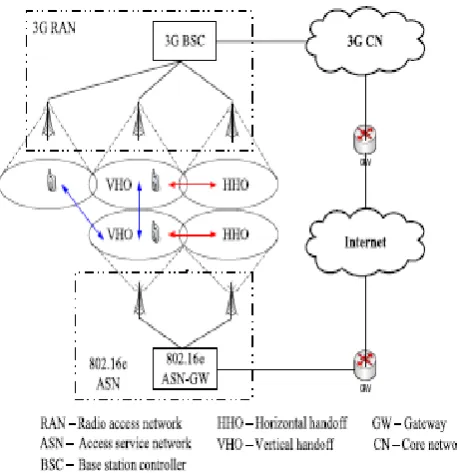
IV. HANDOFF MANAGEMENT SYSTEM In heterogeneous wireless networks, handoff can be separated into two parts: horizontal handoff (HHO) and Vertical Handoff (VHO). A horizontal handoff is made between different access points within the same link-layer technology such as when transferring a connection from one
BS to another or from one AP to another. A vertical handoff is a handoff between access networks with different link-layer technologies, which will involve the transfer of a connection between a BS and an AP. Vertical and Horizontal Handover parameters were tabulated in Table I. The factors of 3G-4G Access Technologies were tabulated in Table II.
During the handoff decision phase, the mobile device determines which network it should connect to. During the handoff execution phase, connections need to be rerouted from the existing network to the new network in a seamless manner. During the VHO procedure, the handoff decision is the most important step that affects mobile host’s communication. An incorrect handoff decision may degrade the QoS of traffic and even break off current communication [7].
Handoff algorithms in heterogeneous wireless networks should support both HHO and VHO and can trigger HHO or VHO based on the network condition. What should be noted is that, because of the uncertainty of the network distribution and the randomness of mobile host’s mobility, it is impossible to forecast the type of the next handoff in advance. Thus, handoff algorithms in heterogeneous wireless networks must make the appropriate handoff decision based on the network metrics in a related short time scale.
TABLEI
VERTICALANDHORIZONTALHANDOVERS
Parameters Horizontal Handover Vertical Handover
Access Technology
Not Changed Changed
QoS Parameters
Not Changed May be Changed
IP Address Changed Changed
Network Interface
Not Changed May be Changed
Network Connection
Single Connection More than one Connection
TABLEII 3G-4GACCESS TECHNOLOGIES
Factors WLAN WiMAX UMTS
Peak Data Rate
802.11a, g=54 Mbps 802.11b=11 Mbps
DL=70 Mbps UL=70 Mbps
DL=2 Mbps UL=2 Mbps
Bandwidth 20 MHz 5-6 GHz 5 MHz
Multiple Access
CSMA / CA OFDM / OFDMA
CDMA
Coverage 300 meters 16 Km Wider Area
Fig. 1. Handoff Management System
[image:3.595.53.282.410.647.2]The Handoff Management System modules were shown in fig. 1. The basic idea of handoff is to make use of network bandwidth and also to provide improvised QoS to real-time applications. Some of these modules collect the link-layer and network-layer information useful for handoff management, and other modules use this information to decide on the appropriate time to initiate handoff and execute the handoff procedures.
Fig. 2. Basic Horizontal and Vertical Handoff
The basic Horizontal and Vertical Handoff scenarios are shown in fig. 2. Handoff metrics are the values that are measured to give an indication of whether or not a handoff is needed. In the traditional handoffs, such as policy-based vertical handoff algorithms, only Received Signal Strength (RSS) and channel availability are considered, however, this RSS comparisons are not sufficient to make a vertical handoff decision, as they do not take into account the mobile user’s option, which mainly consist of application options,
including monetary cost, network conditions, mobile node conditions, user preferences etc.
A. Modules of Handoff management system
The basic idea of handoff is to make use of network bandwidth and also to provide improvised QoS to real-time applications. The modules collect the link-layer and network-layer information useful for handoff management, and other modules use this information to decide on the appropriate time to initiate handoff and execute the handoff procedures.
When the handoff management system starts, it will call the network environment detection module and traffic measurement module, respectively. The network environment detection module will try learning about the available access networks and their performance. For example, it will try finding out how many WLANs are currently available, their signal strengths, their availability, etc. At the same time, the traffic measurement module will judge the type of current applications and their QoS requirements.
If there are multiple network choices, and the current access network cannot satisfy the QoS requirements of the existing applications, the handoff decision module will be started. It will determine the destination network based on the staying time of the MH in the candidate networks and these networks’ QoS estimation, including RSS, channel utilization, link delay/jitter, etc. Based on the output of the handoff decision algorithm, the system will choose to enter the VHO routine or the HHO routine or keep the current connection.
B. Vertical Handoff Decision scheme
Handoff metrics are the values that are measured to give an indication of whether or not a handoff is needed. In the traditional handoffs, such as policy-based vertical handoff algorithms, only Received Signal Strength (RSS) and channel availability are considered, however, this RSS comparisons are not sufficient to make a vertical handoff decision, as they do not take into account the mobile user’s option, which mainly consist of application options, including monetary cost, network conditions, mobile node conditions, user preferences etc.
V. SMIRT AND CALL ADMISSION CONTROL (CAC) ALGORITHMS
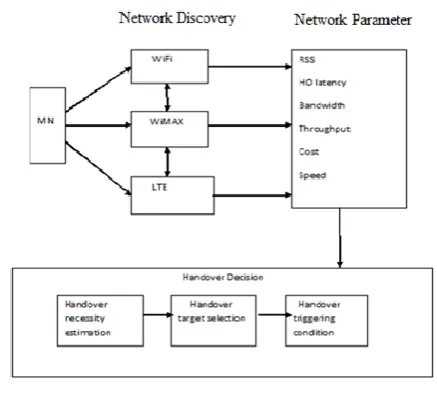
The dual-mode mobile stations (MSs) which roam between wireless local area network (WLAN) and cellular networks. The act of transitioning from WLAN to cellular is commonly referred to as a vertical handoff (VHO). The Seamless Media Independent Resilience Triggering (SMIRT) framework is developed to achieve Vertical Handover Decision (VHD) in Heterogeneous 4G Wireless Overlay Networks. The Fig.1 shows the SMIRT architecture for VHD.
A. SMIRT Framework
Fig. 3. SMIRT Architecture.
The SMIRT framework helps to do Handover for Heterogeneous Networks and has the following modules and was shown in fig. 3.
Network Discovery -> MT searches for reachable wireless networks.
Handover Decision:
Handover necessity estimation -> It determines whether a handover is necessary to an available network.
Handover target selection -> It chooses the “best” network among the available network based on a set of criteria.
Handover triggering condition -> It determines the right moment to initiate a handover out of the currently connected network.
SMIRT Algorithm
Step 1: Discover the available networks based on RSS.
Step 2: Calculate quality of network i, Qi=W1*Bi + W2*(1/Di) + W3*(1/Ci) + W4*Ti Where Bi -> Bandwidth, Di -> Delay, Ci -> Cost, Ti-> Throughput
Step 3: Select the network with highest Qi Step 4: Trigger the handover
Step 5: Perform make-before-break connection Vertical Handover Decision – Parameters
Decision Processing Delay Handover Blocking Rate Packet Loss
Transmission Delay
B. Call Admission Control (CAC) Model
The adaptive bandwidth allocation (ABA) algorithm is utilized to adapt calls whenever there is an insufficient bandwidth for call admission. The algorithm will be
[image:4.595.305.544.109.252.2]triggered whenever there is a call arrival acceptance event or a service departure event. In this work, our objectives are to minimize NCBP, HCDP and to efficiently utilize the system resources.
Fig. 4. QoS-Adaptive System Architecture.
Fig. 4. shows the QoS-Adaptive system architecture for multimedia service in heterogeneous wireless networks. The main objective of the proposed framework for adapting new calls in a way that decreases NCBP while at the same time preserving the priority of handoff calls which translates into minimum HCDP. Thus, the idea is to find a way to describe the state of the cell at any given time so that allows the system to decide whether it should adapt for the new calls or not. Notice that the system will always adapt for the handoff calls.
During call setup, a mobile terminal (MN) running a user multimedia service defines its requirements in a traffic profile. This profile consists of the connection type (new or handoff) and the bandwidth requirements. The traffic profile is then sent to a connection admission controller which implements the call admission control (CAC) algorithm to determine the acceptance or rejection of a call based on traffic type, number of ongoing calls and the amount of available bandwidth in the system. Then CAC decides whether an incoming call is accepted in a cell or not.
Adaptive Bandwidth Allocation (ABA) algorithm performs two main procedures: reduction and expansion. The reduction procedure is activated when an accepted arriving call (new or handoff) arrives to an overloaded cell. On the other hand, the expansion procedure is activated when there is an outgoing handoff call or a call completion in the given cell. The process flows for procedures, reduction and expansion.
The QoS-Adaptation framework process is demonstrated in fig.5. The process flow is given below:
1. Mobile terminal defines its requirements in the traffic profile (new / handoff call, BW-requirement and traffic).
2. CAC accept the arrival call (new / handoff), the system attempts to allocate maximum bandwidth (bn) for this call. Thus, if the available bandwidth is larger than or equal to brequested, the arrival call will be assigned a BW between bn and brequested. Otherwise adaptive BW allocation algorithm to be invoked.
M N
Accept call Traffic type
Drop the Call No
Yes
Is Sufficient BW? CALL
ADMISSION CONTROL ALGORITHM
(checks for Sufficient BW)
New
(or) Hand
off call
BWReduction Procedure &Calculate α
BW Expansion procedure
Call type
Bw -reqd
Yes
Accept the call No
Insufficient BW
Outgoing/ serviced Call
β
New call
ADAPTIVE BANDWIDTH ALLOCATION ALGORITHM
MAXIMUM BAND- WIDTH UTILIZA- TION ALGORI-
Fig. 5. QoS-Adaptive multi-access seamless mobility framework flow-chart
3. ABA checks for the call type (new / handoff call). If new call, then BW reduction procedure is to be executed. Else, BW expansion procedure to be called for handoff calls
.
4. (a) BW Reduction procedure: Calls with the largest assigned bandwidth in the cell are reduced to have lower bandwidth not less than the minimum bandwidth (i.e., b1 ). If the saved bandwidth is larger than or equal to brequested , the arrival call will be assigned a bandwidth between brequested and bn. Otherwise, we just assign the saved bandwidth to the call (minimum is b1 ). If all above tests fail, then block/drop arrival call.
The BWallocated is calculated as per equation (1). ….. (1) Where is the number of current users that are allocated level i and bi is the BW allocated for level i users. The adaptability ratio (α) can be calculated as per equation (2) as follows:
..… (2) Take fixed adaptability ratio (β) value to 0.5. 5. (b) BW Expansion procedure: As a call leaves the
cell, whether outgoing handoff call or a call completion, the total available bandwidth increases. The system will invoke the expansion procedure to increase the bandwidth for one or more of the degraded calls to brequested, starting from most degraded calls in the cell. Expansion procedure stops when there is available BW or every call in the cell has a
BW larger than or equal to brequested.
6. Maximum BW utilization algorithm to be used after adapting the BW in order to provide less blocking / dropping the calls in both new / handoff calls.
VI. PERFORMANCE EVALUATION
The WiMAX Network with Adaptive Call Admission Control (CAC) for optimal sharing of bandwidths among the
ongoing or handoff calls. The performance Metrics new call blocking probability (NCBP) and handoff call blocking probability (HCBP) are considered for performance evaluation.
Numerical Results
The following are the description of the simulation profile in Network Simulator-2 (NS-2) as follows:
Application traffic - CBR (rts / nrts) Mobility Models – Random Walk Routing Protocol – AODV Radio Range - 250 m Cell diameter - 1 km Maximum speed -10 km/hr Minimum speed - 60 km/hr Simulation time -100 seconds Number of nodes -16 Node position: x, y, and z
Data connections Area - 1000 m × 1000 m Mobility: Constant speed mobility model The two set of experiments are explored for the comprehensive performance on system behaviour. In the first set, take fixed β value; while in second set vary this value.
1) Fixed β value: For every new call, adaptability ratio (α) is calculated. The Value α is larger than or equal to β, then BW adaptation algorithm is invoked to accommodate the call in the cell. If α < β, then block the new call.
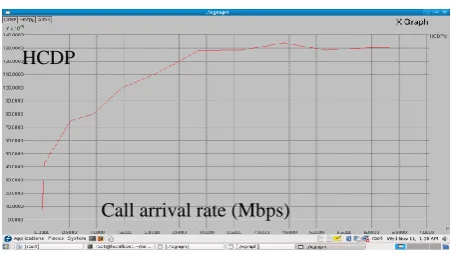
The performance metrics new call blocking probability (NCBP) and handoff call dropping probability (HCDP) was computed using equation (3 - a & b).
NCBP, Pb = Number of handoffs lost [o,t] / Total Number of handoffs [0,t]
……… (3a) HCDP, Pd = Number of accepted calls lost [o,t] / Total Number of accepted calls [0,t]
……… (3b)
Fig. 6. HCDP vs Call arrival rate.
The QoS-Adaptive framework introduces lesser delay when compared to existing work. Also the packet
Call Type?
Sufficient bandwidt
h
bandwi dth?
Calculate Adaptability ratio( α)þ
Accept the call
Bandwidth Adaptation Algorithm Block new call
Block new call NO
YES
NO
Handoff Call
α < β
α > β New Call
Maximum Bandwidth Utilization algorithm
Less block / drop calls
Minimum
brequested Sufficient
bandwidt h? Bandwidth Adaptation Algorithm
Drop handoff call YES
NO Maximum Bandwidth
Utilization algorithm
Less block / drop calls
Minimum brequested
Accept the call Arrival Call
Sufficient BW? Accept the call YES
HCDP
[image:5.595.322.548.591.718.2]loss is reduced in considerable amount which in turn increases the throughput.
[image:6.595.66.292.180.324.2]The performance metrics are new call blocking probability (NCBP), handoff call blocking probability (HCBP) and utilization of bandwidth. The bandwidth utilization (λ) is the ratio between the bandwidth used by completely serviced calls and the total bandwidth capacity. The performance metrics HDCP and Bandwidth shown in fig. 6 and fig. 7 respectively.
Fig. 7. Bandwidth-Utilization vs Call arrival rate.
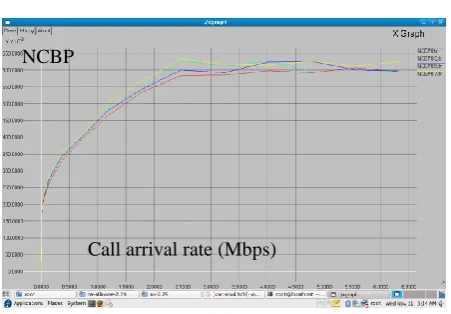
2) Different values of β: In fig. 8, the second set experiment take different values of fixed-adaptability ratio (β) with values 0, 0.3, 0.5 & 0.7 and carried out the experiments. The performance metric new call blocking probability (NCBP) was measured and plotted the graph with respect to arrival rate of the call. The NCBP decreases with lower values of β and therefore shows the advantages of adaptability for new calls blocking probability.
Fig. 8. NCBP for different β values.
In both the set of experiments WiMAX horizontal handoff execution was done. The Adaptive BW allocation algorithm reduces the blocking / dropping the calls certainly. Hence this enhances the bandwidth-utilization.
VII. CONCLUSION AND FUTURE WORK
The system interworking and mobility management for 4G/NGWNs are crucial. The RSS based handover is very stringent in heterogeneous interworking environment. Hence forth all-IP next generation networks were proposed. The
handoff module with both mobility detection and predictive databases trigger the handoff process in right time. The different metrics bandwidth, cost, packet error rate, end-to-end delay and power consumption are considered. Handoff management issues in WLAN and in WLAN-WiMAX/UMTS/B3G were analyzed. The QoS-Adaptive framework was validated to have seamless support in WiMAX networks.
In future, all-IP principle to be followed to validate the proposed framework in heterogeneous wireless networks. Also defining the optimal β value which will suit for real-time 4G wireless networks.
ACKNOWLEDGMENT
The authors would like to thank the anonymous reviewers for their valuable comments and suggestions to improve the presentation of this paper. The authors extend the sincere thanks to Rajalakshmi Engineering College for funding registration amount and the constant support.
REFERENCES
[1] C. Makaya and S. Pierre, “An Architecture for Seamless Mobility Support in IP-Based Next-Generation Wireless Networks,” IEEE
Trans. Vehicular Technology., Vol. 57, no. 2, pp. 1209-1225, March
2008.
[2] L. Bhebhe, “Multi-Access Mobility in Heterogeneous Wireless Networks Today and Tomorrow,” in poc. IEEE Conf. on Wirelss &
Mobile Comp., pp. 165-171, 2008.
[3] V. S. Azhari, M. Smadi, and T. D. Todd, “Fast Client-Based Connection Recovery for Soft WLAN-to-Cellular Vertical Handoff,”
IEEE Trans. Vehicular Technology., vol. 57, no. 2, pp. 1089-1102, March 2008.
[4] B. Chang and J. Chen, “Cross-Layer-Based Adaptive Vertical Handoff With Predictive RSS in Heterogeneous Wireless Networks,”
IEEE Trans. Vehicular Technology., vol. 57, no. 6, pp. 3679-3692, Nov. 2008.
[5] M.Liu, Z. Li, and E. Dutkiewicz, “Performance Analysis and Optimization of Handoff Algorithms in Heterogeneous Wireless Networks,” IEEE Trans. Mobile Comp., vol. 7, no. 7, pp. 846-857, July 2008.
[6] S. Hussain, Z.Hamid, and N. S. Khattak, “Mobility Management Challenges and Issues in 4G Heterogeneous Networks,” in poc. Conf.
on IIASN, May 2006.
[7] M. Sanabani, S. Shamala, M. Othman and J. Desa,
“Adaptive Call Admission Control for Prioritized Adaptive services in Wireless/Mobile multimedia Cellular Networks,” IJCSNS
International Journal of Computer Science and Network Security,
VOL.6 No.3B, pp. 114-124, March 2006.
[8] I. Szekely et.al., “Optimization of GSM-UMTS Core Network for IP Convergence in 4G through Mobile IPv6,”.
[9] F. Zou, X. Jiang, and Z. Lin, “IEEE 802.20 Based Broadband Railroad Digital Network –The Infrastructure for M-Commerce on the Train”.
[10] X. Guan et.al., “Enhanced Application-Driven Vertical Handoff Decision Scheme for 4G Wireless Networks,” in poc. IEEE Conf, pp. 1771-1774, 2007.
[11] Nidal Nasser, “Service Adaptability in Multimedia wireless
Networks,” IEEE Trans on Multimedia, Vol.11, No.4, June 2009. [12] N.Mohan and T.Ravichandran, “An Efficient Multiclass Call
Admission Control and Adaptive Scheduling for WCDMA Wireless Network,” European Journal of Scientific Research, Vol.33, No.4, 2009.
[13] Mario Gerla Lokesh Bajaj, Mineo Takai, Rajat Ahuja, Rajive Bagrodia. GloMoSim: A Scalable NetworkSimulation Environment. University of California, 13, 1999.
[14] Johann M´arquez-Barja, Carlos T. Calafate, Juan-Carlos Cano and Pietro Manzoni, “Performance trade-offs of a IEEE 802.21-based vertical handover decision algorithm under different,” IEEE
International Symposium on Network Computing and Applications,
pp. 294-297, 2011. Call arrival rate (Mbps)
NCBP
Bandwidth-utilization (λ)
[image:6.595.64.290.471.628.2]