Performance Evaluation of Multi Rate,
Multichannel Algorithm in Wireless Multimedia
Mesh Network
Vidya A. Chougule1, Prof. Dr. Mrs. S. V. Sankpal
1
Research Scholar, 2Professor, Electronics Engg. Dept., D. Y. Patil College of Engg. & Tech. Kolhapur, Maharashtra, India
Abstract: The channel occupation and according to its bandwidth adjustment of the data communication rate can be seen wireless mesh network. Based on transmission opportunity exploration in multi hop wireless mesh network, the performance improvement is possible. This can be achieved by using multiple rates (MR) and multiple channels (MC). In this paper the characteristics of transmissions for different rates is shown which uses two approaches parallel low-rate transmissions (PLT) and Alternative Rate transmissions (ART). Using this approaches, we have explored the advantages of multi rate multichannel scenarios. This approach is then used to implement in wireless mesh network for streaming type services and performance evaluation is done. The performance evaluation using parameters like throughput, end to end delay jitter and packet delivery ratio is done along with comparison with existing normal protocol architecture.
Keywords: multiple rates, Wireless multicasting, multiple Channels.
I. INTRODUCTION
In a goup of multimedia receivers of wireless mesh networks (WMN) have shown efficient resource utilization in multicast connections scenario. The current technique constitutes sharing of the same spectrum for streaming the packets. There is always competition amongst devices to occupy the channel due to sharing platform. There is always at least one hop distance for parallel data delivery. In such cases there is performance degradation for multimedia traffics. The interference is suppressed with the help of orthogonal channel for different radio interfaces. Due to limited availability for optimum performance of orthogonal channels their limitations while allocating channels to streaming services with sufficient bandwidth. Hence there is a need to extend the performance with efficient utilization of orthogonal channels with a specific strategy.There is much complexity in multimedia multicast applications and hence large levels of interference. The main cause of this problem is because of an adaptive change in different transmission coverage ranges which may include interference.
II. LİTERATURE SURVEY
Er. Navneet Kaur, Er. Gurjot Singh in “Runtime Optimization of 802.11 based Wireless Mesh Network by Radio Multi-Channel" introduced that. The existing method works on single-radio single-channel (SR-SC) design thereby sharing one basic channel. In this engineering, the system continues from low limit and throughput because of successive back offs and collision impacts. Consequently Single-Radio Multi-Channels (SR-MC) had been intended to upgrade the WMNs execution. In SR-MC, there is switching between channels in a progressive manner concerning load in the system along with at least one chance-based data trade of in typical time frame. In such a system, allocation of time frame for communication is achieved by tight time synchronization amongst devices. However in a multi-hop WMNs it is hard to accomplish such synchronization among hubs. A satisfactory answer for decrease the high inactivity and at the same time upgrade throughput and diminish end-to-end delay of WMNs is to utilize Multi-Radio Multi-Channel (MR-MC) engineering. In MR-MC WMNs design, various interchanges can happen in the meantime, and diverse channels doled out to connecting connections can convey information packets without impedance. In the wake of authorizing SR-MC WMNs and MR-MC WMNs in Qualnet test system, results are assessed in view of parameters such as throughput and end-to-end delay. Results demonstrate the critical distinction between these two situations. MR-MC WMN gives the better result as contrast with the SR-MC WMN. MR-MC WMN is considerably more suitable for the calamity administration in the broadband web application. But in present eon scalability is also a major factor for the optimization of the network so in this paper effect of scalability on SR-MC and MR-MC wireless mesh networks is optimized.[1]
also constant approximation bounds for MCMF irrespective of numof channels. As per protocol interferene model in 802.11 standard, the approximation bounds are set to 20 maximum in general and 8 maximum when there is uniform interference radius. The radius considered int his strategy is c times the communication radius. Also if total number of channels are bound by a constant in both multiflow and multichannel cases polynomial approximation scheme is used [2].
Wanqing Tu in et al [3], have shown multiple channels scenarios in wireless mesh networks which show automatic channel based transmission rate adoption. The technique based on channel occupying strategy, multiple rates and multiple channel allocation for performance improvement in terms of transmission coverage in multicast network scenarios. High throughput is achieved by using multichannel multi rate multicast algorithm which controls the link. NS2 based simulation results show the improved multicast quality of LC-MRMC in much larger wireless areas as compared to current studies.[3]
Shreeshankar Bodas, Sanjay Shakkottai, Lei Ying, and R. Srikant in “Scheduling in Multi-Channel Wireless Networks: Rate Function Optimality in the Small-Buffer Regime" discussed the problem of designing scheduling algorithms for a multichannel (e.g., orthogonal frequency division multiplexing based) wireless downlink network. The classic Max Weight algorithm degrades the users delay based performance in such systems. As a solution to this challenge authors have shown alternate method which uses iterated longest queues first (iLQF). The iLQF based algorithms are evaluated using different system configurations. For wide deviation settings capability the pullup iLQF algorithm is used. The results obtained in these type of settings show optimal results for the problem and is shown to result in mostly positive value of the rate function for variety of combinations of the basic system model.[4] Salah A. Alabady et al [4], have given in their paper a new paradigm of wireless broadband Internet access. This is achieved by providing a service with high data rate, which shows scalability and self-healing abilities at lowest cost. Due to interference and channel quality variations it is challenging to achieve performance in terms of better throughput in multicast applications of WMN. A cross layer methodology is shown to overcome on this challenge. The maximum multi cast throughput is achieved in effective manner by using network coding. Bandwidth utilization along with optimum usages improved multicast throughput are the benefits of using this strategy. Authors have addressed variety of techniques by reviewing them with the fundamental concept types of medium access control (MAC) layer, routing protocols, cross-layer and network coding for
wireless mesh networks.[5]
III. METHODOLOGY OF ANALYSIS AND EXISTING RESULTS:
1) Throughput: Throughput for different scenarios are calculated and it can be calculated as, ratio of total number of packets received successfully to total time taken to reach all packets to receiver.
2) Packet Delivery Ratio: Packet delivery ratio is defined as the ratio of total number of packets successfully received to total number of packets sent. Mathematically, it can be defined as: PDR= S1÷ S2 Where, S1 is the sum of data packets received by the each destination and S2 is the sum of data packets generated by the each source.
3) End-to-end Delay: End-to-end delay is the time it takes for a packet to be transmitted from the source node to the destination .In order to calculate this, we take the time for the last packet (l packet time), subtract the current packet time (time sent) then divide the total by the difference between the current numbers of packets received by the last number of packets received.
4) Jitter: Jitter is the variation in the delay of the received packets. Although packets are usually sent at a consistent rate, yet delay between packets may be forced to vary due to congestions and limitations of queuing mechanisms.
IV. RESULTS OF THROUGHPUT
[image:2.612.193.420.606.730.2]A. Throughput For Existing Protocol
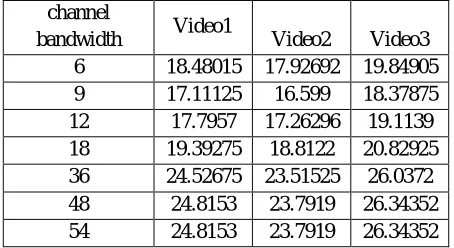
Table I: Throughput of existing protocol channel
Figure 1: throughput analysis of existing method
[image:3.612.197.417.307.654.2]B. Throughput For Proposed Protocol
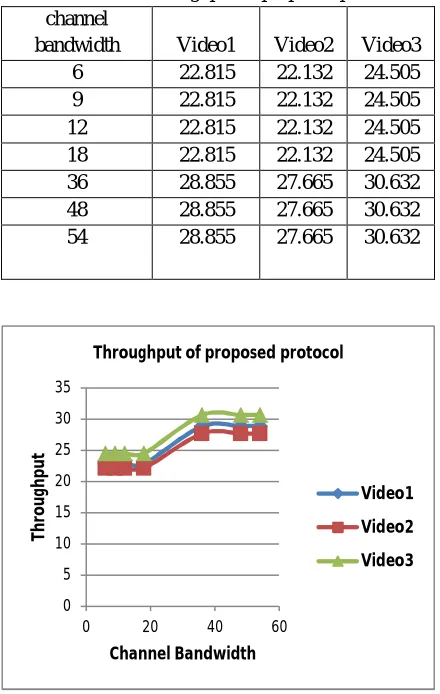
Table II: Throughput of proposed protocol channel
bandwidth Video1 Video2 Video3 6 22.815 22.132 24.505 9 22.815 22.132 24.505 12 22.815 22.132 24.505 18 22.815 22.132 24.505 36 28.855 27.665 30.632 48 28.855 27.665 30.632 54 28.855 27.665 30.632
Figure 2: throughput analysis of proposed method
C. Analysis of Throughput
In proposed system throughput increases for all types of videos compared to existing system. The throughput increases due to multiple channels are available for communication and hence streaming of data is faster compared to single channel based existing system.
0 5 10 15 20 25 30
0 20 40 60
Th
ro
u
gh
p
u
t
Channel Bandwidth
Throughput for Existing Protocol
Video1
Video2
Video3
0 5 10 15 20 25 30 35
0 20 40 60
T
h
ro
u
gh
p
u
t
Channel Bandwidth
Throughput of proposed protocol
Video1
Video2
1) Results of Packet Delivery Ratio (PDR) a) PDR For Existing Protocol
Table III: PDR of existing protocol channel
bandwidth Video1 Video2 Video2
6 0.783147 0.812515 0.832094
9 0.783147 0.812515 0.832094
12 0.783147 0.812515 0.832094
18 0.783147 0.841883 0.832094
36 0.803634 0.839834 0.847073
48 0.843453 0.861553 0.847073
[image:4.612.194.419.483.706.2]54 0.857933 0.872413 0.847073
Figure 3: PDR analysis of existing method
b) PDR for Proposed Protocol
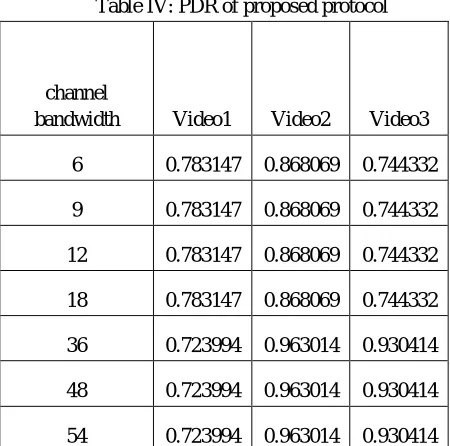
Table IV: PDR of proposed protocol
channel
bandwidth Video1 Video2 Video3
6 0.783147 0.868069 0.744332
9 0.783147 0.868069 0.744332
12 0.783147 0.868069 0.744332
18 0.783147 0.868069 0.744332
36 0.723994 0.963014 0.930414
48 0.723994 0.963014 0.930414
54 0.723994 0.963014 0.930414
0.76 0.78 0.8 0.82 0.84 0.86 0.88
0 20 40 60
P
ac
ke
t
D
e
live
ry
R
at
io
Channel Bandwidth
Packet Delivery Ratio of existing protocol
Video1
Video2
[image:4.612.195.418.483.709.2]Figure 4: PDR analysis of proposed method
c) Analysis of Packet Delivery Ratio: The packet delivery ratio in proposed system increases as maximum number of successfully delivered due to availability of multiple channels with high bandwidth. The streaming of packets is feasible for all video data with maximum success of delivery compared to existing system.
2) Results of End To End Delay
[image:5.612.176.436.347.719.2]a) End To End Delay For Existing Protocol
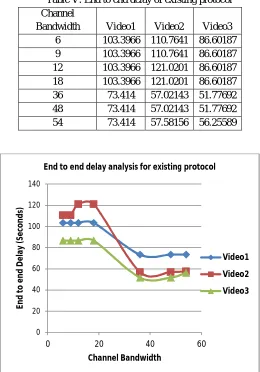
Table V: End to end delay of existing protocol Channel
Bandwidth Video1 Video2 Video3 6 103.3966 110.7641 86.60187 9 103.3966 110.7641 86.60187 12 103.3966 121.0201 86.60187 18 103.3966 121.0201 86.60187 36 73.414 57.02143 51.77692 48 73.414 57.02143 51.77692 54 73.414 57.58156 56.25589
Figure 5: End to end delay analysis of existing method
0 0.2 0.4 0.6 0.8 1 1.2
0 20 40 60
P
ac
ke
t
D
e
live
ry
R
a
ti
o
Channel Bandwidth Packet Delivery Ratio of proposed protocol
Video1
Video2
Video3
0 20 40 60 80 100 120 140
0 20 40 60
E
n
d
t
o
e
n
d
D
e
la
y
(Se
co
n
d
s)
Channel Bandwidth
End to end delay analysis for existing protocol
Video1
Video2
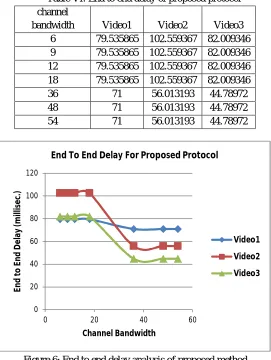
b) End To End Delay For Proposed Protocol
Table VI: End to end delay of proposed protocol channel
bandwidth Video1 Video2 Video3 6 79.535865 102.559367 82.009346 9 79.535865 102.559367 82.009346 12 79.535865 102.559367 82.009346 18 79.535865 102.559367 82.009346
36 71 56.013193 44.78972
48 71 56.013193 44.78972
54 71 56.013193 44.78972
Figure 6: End to end delay analysis of proposed method
c) Analysis of End To End Delay: The end to end delay decreases in proposed system compared to existing due to multiple channels for communication and fastest delivery of packets. The end to end delay for streaming services are expected to be minimum and hence this system shows the optimum performance.
3) Results of Jitter
[image:6.612.181.429.550.714.2]a) Jitter For Existing System
Table VII: Jitter of existing protocol channel
bandwidth Video1 Video2 Video3 6 0.068598 0.066307 0.053474
9 0.064098 0.062653 0.050527
12 0.063947 0.06147 0.049573
18 0.058178 0.053275 0.042964
36 0.046827 0.052852 0.042623
48 0.040017 0.046274 0.037318
54 0.040411 0.04731 0.038154
0 20 40 60 80 100 120
0 20 40 60
E
n
d
t
o
E
n
d
D
e
la
y
(m
ill
is
e
c.
)
Channel Bandwidth
End To End Delay For Proposed Protocol
Video1
Video2
Figure 7: Jitter analysis of existing method
[image:7.612.189.424.265.595.2]b) Jitter For Proposed System
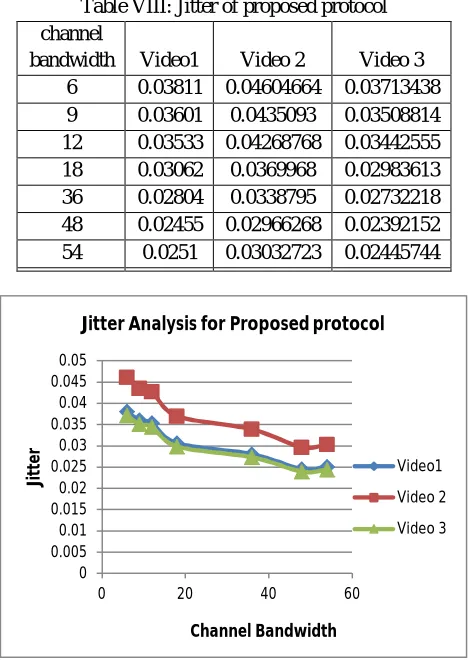
Table VIII: Jitter of proposed protocol channel
bandwidth Video1 Video 2 Video 3 6 0.03811 0.04604664 0.03713438 9 0.03601 0.0435093 0.03508814 12 0.03533 0.04268768 0.03442555 18 0.03062 0.0369968 0.02983613 36 0.02804 0.0338795 0.02732218 48 0.02455 0.02966268 0.02392152 54 0.0251 0.03032723 0.02445744
Figure 8: jitter analysis of proposed method
c) Analysis of Jitter: The jitter delay decreases in proposed system compared to existing due to multiple channels for communication and fastest delivery of packets. The jitter for streaming services are expected to be minimum to have sequential delivery of packets in high speed which provides better reassembly speed and reproduce the contents faster and hence this system shows the optimum performance.
V. CONCLUSION
The proposed multichannel system outperforms in terms of throughput, end to end delay, packet delivery ratio and jitter. The system is best suitable for the applications where streaming services are required. The results are satisfactory for different videos considered in experimentation.
0 0.01 0.02 0.03 0.04 0.05 0.06 0.07 0.08
0 20 40 60
Ji
tt
e
r
(m
ill
i s
e
co
n
d
s)
Channel Bandwidth
Jitter Analysis for existing protocol
Video1
Video2
Video3
0 0.005 0.01 0.015 0.02 0.025 0.03 0.035 0.04 0.045 0.05
0 20 40 60
Ji
tt
e
r
Channel Bandwidth
Jitter Analysis for Proposed protocol
Video1
Video 2
REFERENCES
[1] Er. Navneet Kaur, Er. Gurjot Singh in Runtime Optimization of 802.11 based Wireless Mesh Network by Multi-Radio Multi-Channel, Vol. 5, Issue 9, September 2016.
[2] S. Hon, K. Yeung, and K. Lui. Bandwidth-guaranteed Multicast in Multichannel Multi-interface Wireless Mesh Networks. In Proc. of IEEE ICC, pages 1-5, Germany, 2009.
[3] O. Karimi, J. Liu, and Z. Li. Multicast in Multi-channel Wireless Mesh Networks. In Proc. of IFIP Networking, pages 148-159, India, 2010.
[4] S. Bodas, S. Shakkottai, L. Ying, and R. Srikant. Scheduling for SmallDelay in Multi-rate Multi-channel Wireless Networks. In Proc. of IEEEINFOCOM, pages 1251-1259, China, 2011.
[5] Salah A. Alabady and M. F. M. Salleh in Overview of Wireless Mesh Networks. Journal of Communications Vol. 8, No. 9, Septem ber 2013.
[6] N. Lan, and N. Trang. Channel Assignment for Multicast in MultichannelMulti-raido Wireless Mesh Networks. (Wiley) Wireless Communicationsand Mobile Computing, vol.9, pages 557-571, 2008.
[7] T. Kim, G. Jakllari, S. Krishnamurthy, and M. Faloutsos. A UnifiedMetric for Routing and Rate Adaptation in Multi-rate Wireless MeshNetworks. In Proc. of IEEE MASS, pages 242-251, Spain, 2011.
[8] O. Karimi, J. Liu, and Z. Li. Multicast in Multi-channel Wireless MeshNetworks. In Proc. of IFIP Networking, pages 148-159, India, 2010. [9] J. Choi, J. Na, K. Park, and C. Kim. Adaptive Optimization of RateAdaptation Algorithms in Multi-Rate WLANS. In Proc. of IEEE ICNP.
[10] S. Bodas, S. Shakkottai, L. Ying, and R. Srikant. Scheduling for Small Delay in Multi-rate Multi-channel Wireless Networks. In Proc. of IEEEINFOCOM, pages 1251-1259, China, 2011.
[11] Chun Tung Chou, Archan Misra, and Junaid Qadir in Low-Latency Broadcast in Multi-rate Wireless Mesh Networks VOL. 24, NO. 11, NOVEMBER 2006. [12] Er. Navneet Kaur, Er. Gurjot Singh in Runtime Optimization of 802.11 based Wireless Mesh Network by Multi-Radio Multi-Channel, Vol. 5, Issue 9,