Efficient Cluster Head Selection Using Modified
Particle Swarm Optimization over MANET
C. Daniel Nesa Kumar
1, Viswapal Venugopal
2, Jincy Varghese
31Assistant professor, Department of MCA, 2, 3MCA Student, Hindusthan College of Arts and Science, Coimbatore
Abstract: A Mobile Ad-Hoc NETwork (MANET) is a wireless network, collection of mobile nodes that are dynamically and arbitrarily positioned in such a way that the contact among each other. These nodes do not make a fixed configuration since the nodes can go in any direction. These MANET nodes can converse along with other nodes in the radio range. In the existing system, Genetic Algorithm (GA) and Ad hoc On-Demand Distance Vector (AODV) routing approaches are introduced for energy efficiency. However these methods have issue with best Cluster Head (CH) node selection in larger network. Thus the overall performance is reduced significantly. To avoid the above mentioned drawbacks, in the proposed system, Modified Particle Swarm Optimization (MPSO) and Dynamic Source Routing (DSR) protocol is proposed. The proposed method contains three phases such as system model, CH selection using MPSO and routing. In the system model, nodes are connected to send and receive the packets. Energy model and mobility model are constructed to give efficient packet transmission over MANET. In second phase, the MPSO algorithm is focused to select the best CH node using fitness function. It is used to calculate the energy utilization through distance among nodes. In the third phase, the DSR protocol is used to produce efficient routing path over MANET. Thus the simulation results conclude that the proposed MPSO+DSR algorithm is better than the existing GA and AODV in terms of lower energy consumption, higher throughput, lower end to end delay, higher packet delivery ratio and higher network lifetime
Keywords: MANET, Genetic Algorithm (GA), Cluster Head (CH), Modified Particle Swarm Optimization (MPSO), Dynamic Source Routing (DSR) and routing path
I. INTRODUCTION
Section 2. The proposed methodology for modified PSO optimization algorithmand DSR routing protocol is detailed in Section 3. The experimental results and performance analysis discussion is provided in Section 4. Finally, the conclusions are summed up in Section 5.
II. LITERATURE SURVEY
Rajaram and Sugesh [6] presents energy aware ad hoc on demand multipath distance vector scheme for power utilization routing method. In power aware ad hoc on demand multipath distance vector, every node must sustain a power condition table in its place of the route cache on the ordinary on-demand protocols. It is mapped to a route passing this node, and records the equivalent power retained. It include the subsequent access of an item demand id, source id destination id, quantity of power taken, last process time, and route. However it has time complexity. Turgut et al [7] shows how genetic algorithms can be useful in enhancing the performance of clustering algorithms in mobile ad hoc networks. In particular, it optimizes the weighted clustering algorithm (WCA). The problem formulation along with the parameters is mapped to individual chromosomes as input to the genetic algorithmic technique. Encoding the individual chromosomes is an essential part of the mapping process; each chromosome contains information about the cluster heads and the members thereof, as obtained from the original WCA. Ali et al [8] introduced a multi-objective solution by using multi-objective particle swarm optimization(MOPSO) algorithm to optimize the number of clusters in an ad hoc network as well as energy dissipation in nodes in order to provide an energy-efficient solution and reduce the network traffic. In the proposed solution, inter-cluster and intra-cluster traffic is managed by the cluster-heads. The proposed algorithm takes into consideration the degree of nodes, transmission power, and battery power consumption of the mobile nodes. The main advantage of this method is that it provides a set of solutions at a time. These solutions are achieved through optimal Pareto front. Karadge and Sankpal [9] suggested Maximum Energy Level Ad Hoc Distance Vector (MEL-AODV) protocol chosen the power resourceful route through residual energy of each node involved in the path. The source wishes to transmit information packages to destination initiate the route request process. The route having the highest accumulated energy is selected as the best route and then the source sends the data packets through that path. Ahmed Abosamra et al [10] suggest executing a secured DSR routing protocol with the help of mobile agents. They used hybrid encryption method for examining the performance of DSR routing protocol. This technique contains symmetric key and public key encryption whereas the symmetric key is used for encryption (i.e. verification and permission) and public key is used for key exchange.
III. PROPOSED METHODOLOGY
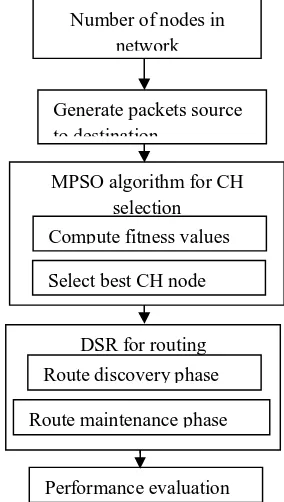
[image:2.595.234.376.484.735.2]In this research, MPSO+DSR algorithm is introduced to improve the energy efficiency by producing optimal CH node selection over MANET. The overall block diagram of the proposed system is shown in Fig 1.
Fig 1 Overall block diagram of the proposed system Generate packets source
to destination
MPSO algorithm for CH selection Number of nodes in
network
Compute fitness values
Select best CH node
DSR for routing
Route discovery phase
Route maintenance phase
A. System Model
The proposed system considers the network environment, which is structured with no central authority. The nodes placed on the network can send and receive packets via multiple indirect hops. Assume the MANET network along with N number of identical mobile nodes, n number of neighbour nodes, source node, destination node, links and routing path along with particular distance. There is a packet to be delivered via a source node to a destination node [11]. Intermediary nodes can be used as relay nodes. The aim is to discover the allocation of the packet delay, hop count, lifetime, throughput and the distribution of the energy at the time the message is delivered to the destination node. The CH selection and routing algorithm decides which of the nodes needs to be selected in a particular communication. Thus, routing algorithms play an important role in saving the energy of a communication system and the life of the nodes and thus of the whole network. The proposed scheme could be employed in any MANETs routing protocols to enforce cooperation among nodes. In this network, each and every nodes could function in licentious mode for neighbour observe, every links are bidirectional, and communication ranges of nodes are rather equal, the system is a multi-hop network, which means the information packets swapped among any two nodes and forwarded to other nodes
1) Energy Model: The preliminary energy of a node is represented as E0, which cannot be recharged when the packet transfer. The power loss is assumed as multipath fading and free space energy loss manner. In sender side, the degenerate power is calculated through the energy in radio electronics and energy amplifier. The power dissipation in jth node is expressed as
= ∗ + ∗ ∗ − ; − ≥ 0
∗ + ∗ ∗ − ; − < 0 (1)
0 = (2)
Where and is the power loss given through multipath fading model and free space
is the packet size
− is the distance between a normal node and a shortest routing path node.
Pe is the electronic power and it is described as,
= + (3)
Where and is sender and data aggregation power respectively
2) Mobility Model: The mobility model denotes the movement of the MANET nodes in the system depends on the location, rapidity and pace. This scheme discovers the implementation of the scheme in the network for information data communication. Consider n1 and n2 be two MANET nodes located at (a1, b1) and (a2, b2), respectively. At a time l = 1, both the nodes travels to a new position ( ,, ,) and ( ,, ,) such that the association of the nodes is within a particular place. The Euclidean distance among MANET node is given as
(0) = | − | + | − | (4)
The distance among the MANET nodes at any time l in the new positions is calculated as follows,
( ) = | − | + | − | (5)
Where ( , ) ( , ) are the new locations obtained via the nodes n1 and n2, respectively
B. CH Selection using MPSO Algorithm
which is identified via a vector = ( 1, 2, . . . , ), where D is the dimensionality of the search space. Particles move in the search space to search for the optimal solutions. Consequently, every particle has a velocity, which is represented as =
( 1, 2, . . . , ). During the movement, each particle updates its position and velocity according to its own experience and that
of its neighbors [13]. The best previous position of the particle is recorded as the personal best , and the best position obtained by the population thus far is called . Based on and , PSO searches for the optimal solutions by updating the velocity and the position of each particle according to the following equations:
= + (6)
= ∗ + 1∗ 1∗( − ) + 2∗ 2∗( − ) (7)
where t represents the tth iteration in the evolutionary procedure. ∈ denotes the dth dimension in the search space. w is inertia weight, which is to manage the force of the preceding velocities on the present velocity. c1 and c2 are acceleration constants. r1 and r2 are random values uniformly distributed in [0, 1]. and denote the elements of pbest and gbest in the dth dimension. The
velocity is limited by a predefined maximum velocity, , and ∈ [− , ]. The algorithm stops when a predefined
criterion is met, which could be a good fitness value or a predefined maximum number of iterations. The PSO algorithm is modified to allocate a best local guide to every particle via lower angular distance information data. The fitness function calculation is performed based on the nodes residual energy, bandwidth availability and delay time between the nodes. With the help of measured fitness value, the position and velocity of the node are updated.
( ) = + + + (8)
Where is lower energy consumption, is higher packet delivery ratio, is minimum delay time and is lower hop
counts
1) Algorithm 1: MPSO algorithm
Input : Number of particles, Acceleration factors c1, c2, Random number r1, r2 Output : best CH node
a) Step 1: Start
b) Step 2: Initialize the particles (i.e. mobile nodes) with random position and velocity c) Step 3: For each particle
d) Step 4: Compute fitness function using (8) e) Step 5: If (fitness value ≥pbest) then f) Step 6: Assign current value as local best
g) Step 7: Choose particle with best fitness value of all particles as global best
h) Step 8: Update particle position and velocity using (6) & (7) and choose best node as CH node i) Step 9: Go to step 4 while maximum iteration is attained
j) Step 10 End if k) Step 11: End for
l) Step 12: End
The above algorithm describes that the CH selection using MPSO significantly. Initially the particles are initialized along with arbitrary location and velocity in MANET. For every particle, fitness function value is computed through assuming the remaining energy, hop count, packet delivery ratio and delay time of mobile node. If the current fitness value is higher than the local best value then that is assumed as local best. After that, the particle which has the best fitness value among all particles is elected as global best. Then the node is considered as best CH node in the given network. Then the position and velocity is updated for all iteration. This process is performed continually until the maximum number of iteration is met. During all iteration, a node verifies their fitness value and fitness of their neighbors for choosing the optimized CH node over MANET. It is used for better energy efficiency and reduced the end to end delay considerably.
C. DSR Protocol
information is not exist in the route cache then it starts the route discovery procedure via sending the RREQ packets. The receiver side, on acceptance a RREQ packet, answers through transmitting a Route Reply (RREP) message reverse to the source via overturn the route information data stored in the RREQ Packet. On receiving the RREQ, any middle node can transmit the RREP back to the source node if it has the route to attain the destination node. During the route maintenance phase, the link breaks are dealt appears while any intermediate node which absorbs in the packet forwarding procedure moves out of the broadcast range of its upstream neighbour. Moreover the source node seeks an alternate path accessible or starts the route discovery process another time.
IV. SIMULATION SETTINGS
[image:5.595.194.403.276.383.2]In this section, the performance of the proposed MPSO-DSR method is evaluated and compared with existing methods such as GA and AODV. The experiments are conducted using NS-2 simulator. The existing and proposed methods are compared in terms of end to end delay, throughput, energy consumption, packet delivery ratio and network lifetime. The simulation settings are given in Table 1.
Table 1: Simulation Parameters
Parameter values
No. of Nodes 100
Area Size 1100 X 1100 m
Mac 802.11
Radio Range 250m
Simulation Time 60 sec
Packet Size 80 bytes
A. Performance Evaluation
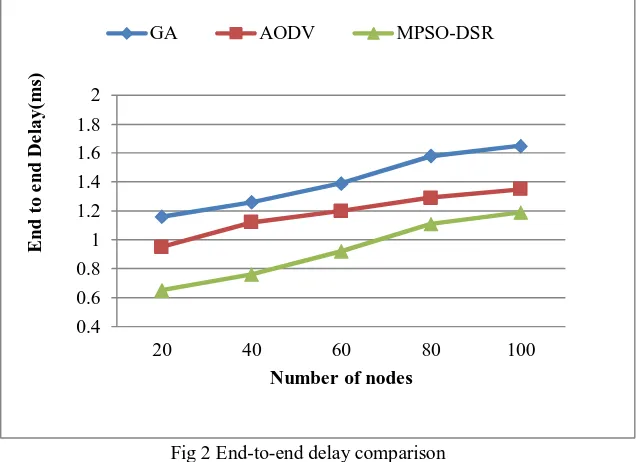
[image:5.595.144.462.434.665.2]1) End-To-End Delay: The standard period occupied through a packet to send from source to destination nodes over the system is called as end to end delay
Fig 2 End-to-end delay comparison
Fig 2 shows the comparison of end to end delay performance for proposed MPSO-DSR and existing GA and AODV approaches. In x axis, the number of nodes are taken and in y axis, the end to end delay metric is plotted. The nodes are varying from 20 to 100 and end to end delay (ms) is plotted for such nodes. From the graph it is clear that the proposed MPSO-DSR algorithm achieves less end to end delay than the existing GA and AODV algorithms.
0.4 0.6 0.8 1 1.2 1.4 1.6 1.8 2
20 40 60 80 100
E
n
d
t
o
e
n
d
D
e
la
y
(m
s)
Number of nodes
2) Throughput: The speed in which the information data is effectively sent across the system or communication links is called as throughput. It is estimated in bits per second (bit/s or bps). It is also indicated through units of packets processed in a given period.
Fig 3 Throughput comparison
Fig 3 shows the comparison of throughput performance for proposed MPSO-DSR and existing GA and AODV approaches. In x axis number of nodes are taken and in y axis throughput is taken. From the graph it is clear that the proposed MPSO-DSR algorithm provides higher throughput than existing methods of GA and AODV.
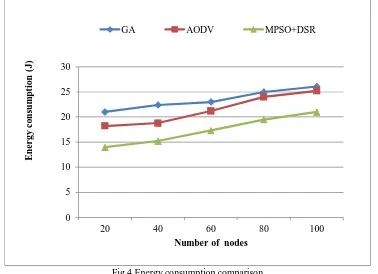
[image:6.595.128.506.429.703.2]3) Energy Consumption: It refers to the standard power required for sending and receiving functions of a packet to a node in the system during a given time slot
Fig 4 Energy consumption comparison
Fig 4 shows the comparison of energy consumption performance for proposed MPSO-DSR and existing GA and AODV approaches. In x axis number of nodes are taken and in y axis energy consumption is taken. From the graph it is clear that the proposed MPSO-DSR scheme provides better energy consumption than existing methods.
0 5 10 15 20 25 30
20 40 60 80 100
E
n
er
g
y
c
o
n
su
m
p
ti
o
n
(
J
)
Number of nodes
GA AODV MPSO+DSR
0 0.1 0.2 0.3 0.4 0.5 0.6 0.7 0.8 0.9 1
20 40 60 80 100
T
h
ro
u
g
h
p
u
t
Number of nodes
4) Network Lifetime: The system is called better when the proposed method provides higher network lifetime.
Fig 5 Network lifetime
Fig 5 provides the network lifetime for the given packet size. In x axis, the packet size is taken and in y axis the network lifetime is plotted. The existing system shows lower network performance whereas the proposed system shown higher performance. It is also observed that the proposed system increases the network lifetime by avoiding the repeated usage of nodes when the packet size increases. It proves that the MPSO-DSR algorithm provides a greater network lifetime compared to the other existing GA and AODV approaches.
V. CONCLUSION AND FUTURE WORK
In this work, proposed MPSO+DSR algorithm is used for finding best CH nodes and routing path over MANETs. To determine the optimal CH nodes MPSO algorithm generates best fitness values using objective function. When the number of nodes increased in the network, the energy efficiency is improved by using this algorithm. Also the MPSO algorithm focused to develop the optimal values for improving the energy efficiency and network lifetime. The result concludes that the proposed MPSO-DSR algorithm provides higher throughput, packet delivery ratio, network lifetime, and lower end to end delay, and energy consumption than the existing GA and AODV approaches. In future work, the hybrid optimized algorithm along with the multipath routing should be enhanced for detecting the attacks over larger network
REFERENCES
[1] El Defrawy, Karim, and Gene Tsudik. "Privacy-preserving location-based on-demand routing in MANETs." IEEE journal on selected areas in communications 29.10 (2011): 1926-1934.
[2] Mayadunna, Hansi, et al. "Improving trusted routing by identifying malicious nodes in a MANET using reinforcement learning." Advances in ICT for Emerging Regions (ICTer), 2017 Seventeenth International Conference on. IEEE, 2017.
[3] Kim, Jin-Man, and Jong-Wook Jang. "AODV based energy efficient routing protocol for maximum lifetime in MANET." Advanced Int'l Conference on Telecommunications and Int'l Conference on Internet and Web Applications and Services (AICT-ICIW'06). IEEE, 2006.
[4] Zhang,j.,Zhang,Q.,Li,B.,Luo,X.,Zhu,W. (2006),“Energy-Efficient Routing in Mobile Ad Hoc Networks: Mobility-Assisted Case”IEEE Transaction On Vehicular Technology,Vol. 55 Issue 1, pp. 369-379.
[5] Hussain, Khalid, et al. "Efficient cluster head selection algorithm for MANET." Journal of Computer Networks and communications 2013 (2013).
[6] Raja ram, A. Dr. and Sugesh, J. (2011),“Power Aware Routing for MANET Using Ondemand Multipath Routing Protocol”. IJCSI International Journal of Computer Science,Vol. 8 Issue 2, pp. 517-522
[7] Turgut, D, et al. "Optimizing clustering algorithm in mobile ad hoc networks using genetic algorithmic approach." Global Telecommunications Conference, 2002. GLOBECOM'02. IEEE. Vol. 1. IEEE, 2002.
[8] Ali, Hamid, Waseem Shahzad, and Farrukh Aslam Khan. "Energy-efficient clustering in mobile ad-hoc networks using multi-objective particle swarm optimization." Applied Soft Computing 12.7 (2012): 1913-1928.
[9] P.S.Karadge, Dr.S.V.Sankpal, “A Performance Comparison of Energy Efficient AODV Protocols In Mobile Ad Hoc Networks”, IJARCCE, vol.2, Issue 1, January 2012
[10] Ahmed Abosamra, Mohamed Hashem, Gamal Darwish, "Securing DSR with mobile agents in wireless ad hoc networks", Egyptian Informatics Journal (2011) 12, IEEE, pp. 29–36, 2011.
[11] Bai, Fan, et al. "Modeling path duration distributions in MANETs and their impact on reactive routing protocols." IEEE Journal on Selected Areas in Communications 22.7 (2004): 1357-1373.
[12] Venkanna, U., and R. Leela Velusamy. "TEA-CBRP: Distributed cluster head election in MANET by using AHP." Peer-to-Peer Networking and Applications 9.1 (2016): 159-170.
[13] Trivedi, Munesh Chandra, and Anupam Kumar Sharma. "QoS Improvement in MANET using particle swarm optimization algorithm." Proceedings of the International Congress on Information and Communication Technology. Springer, Singapore, 2016.
[14] Ashutosh Bhardwaj, “Secure Routing in DSR to Mitigate Black Hole Attack”, IEEE International Conference on Control, Instrumentation, Communication and Computational Technologies (ICCICCT), IEEE, pp. 985-989, 2014
0 10 20 30 40 50 60 70 80 90 100
20 40 60 80 100
N
et
w
o
rk
l
if
e
ti
m
e
(
se
c
)
Packet size (bytes)
[image:7.595.41.562.473.763.2]