CoNLL-SIGMORPHON 2017 Shared Task:
Universal Morphological Reinflection in 52 Languages
Ryan Cotterell1 and Christo Kirov1 and John Sylak-Glassman1 and
G´eraldine Walther2 and Ekaterina Vylomova3 and Patrick Xia1 and Manaal Faruqui4
andSandra K¨ubler5 and David Yarowsky1 and Jason Eisner1 and Mans Hulden6
Johns Hopkins University1 University of Zurich2 University of Melbourne3
Google4 Indiana University5 University of Colorado6
Abstract
The CoNLL-SIGMORPHON 2017 shared task on supervised morphological gener-ation required systems to be trained and tested in each of 52 typologically di-verse languages. In sub-task 1, submit-ted systems were asked to predict a spe-cific inflected form of a given lemma. In sub-task 2, systems were given a lemma and some of its specific inflected forms, and asked to complete the inflectional paradigm by predicting all of the remaing inflected forms. Both sub-tasks in-cluded high, medium, and low-resource conditions. Sub-task 1 received 24 system submissions, while sub-task 2 received 3 system submissions. Following the suc-cess of neural sequence-to-sequence mod-els in the SIGMORPHON 2016 shared task, all but one of the submissions in-cluded a neural component. The re-sults show that high performance can be achieved with small training datasets, so long as models have appropriate inductive bias or make use of additional unlabeled data or synthetic data. However, different biasing and data augmentation resulted in non-identical sets of inflected forms being predicted correctly, suggesting that there is room for future improvement.
1 Introduction
Morphology interacts with both syntax and phonology. As a result, explicitly modeling mor-phology has been shown to aid a number of tasks in human language technology (HLT), including machine translation (MT) (Dyer et al., 2008), speech recognition (Creutz et al., 2007), pars-ing (Seeker and C¸etinoˇglu, 2015), keyword
spot-ting (Narasimhan et al., 2014), and word embed-ding (Cotterell et al., 2016b). Dedicated systems for modeling morphological patterns and complex word forms have received less attention from the HLT community than tasks that target other levels of linguistic structure. Recently, however, there has been a surge of work in this area (Durrett and DeNero, 2013; Ahlberg et al., 2014; Nico-lai et al., 2015; Faruqui et al., 2016), represent-ing a renewed interest in morphology and the po-tential to use advances in machine learning to attack a fundamental problem in string-to-string transformations: the prediction of one morpho-logically complex word form from another. This increased interest in morphology as an indepen-dent set of problems within HLT arrives at a par-ticularly opportune time, as morphology is also undergoing a methodological renewal within the-oretical linguistics where it is moving towards increased interdisciplinary work and quantitative methodologies (Moscoso del Prado Mart´ın et al.,
2004;Milin et al., 2009;Ackerman et al., 2009;
Sagot and Walther,2011;Ackerman and Malouf,
2013;Baayen et al.,2013;Blevins, 2013;Pirrelli et al.,2015;Blevins,2016). Pushing the HLT re-search agenda forward in the domain of morphol-ogy promises to lead to mutually highly beneficial dialogue between the two fields.
Rich morphology is the norm among the lan-guages of the world. The linguistic typology database WALS shows that 80% of the world’s languages mark verb tense through morphology while 65% mark grammatical case (Haspelmath et al.,2005). The more limited inflectional system of English may help to explain the fact that mor-phology has received less attention in the compu-tational literature than it is arguably due.
The CoNLL-SIGMORPHON 2017 shared task worked to promote the development of robust sys-tems that can learn to perform cross-linguistically
Lang Lemma Inflection Inflected form
en hugspark V;PSTV;V.PTCP;PRS huggedsparking
es liberardescomponer V;IND;FUT;2;SGV;NEG;IMP;2;PL liberar´no descompong´as ais
[image:2.595.307.526.63.267.2]de aufbauen¨Arztin V;IND;PRS;2;SGN;DAT;PL baust auf¨Arztinnen
Table 1: Example training data from sub-task 1. Each train-ing example maps alemmaandinflectionto aninflected form, The inflection is a bundle ofmorphosyntactic features. Note that inflected forms (and lemmata) can encompass multiple words. In the test data, the last column (the inflected form) must be predicted by the system.
reliable morphological inflection and morpholog-ical paradigm cell filling using varying amounts of training data. We note that this is also the first CoNLL-hosted shared task to focus on mor-phology. The task itself featured training and development data from 52 languages represent-ing a range of language families. Many of the languages included were extremely low-resource, e.g., Quechua, Navajo, and Haida. The chosen languages also encompassed diverse morpholog-ical properties and inflection processes. Whenever possible, three data conditions were given for each language: low, medium, and high. In the inflec-tion sub-task, these corresponded to seeing 100 examples, 1,000 examples, and 10,000 examples respectively in the training data for almost all lan-guages. The results show that encoder-decoder re-current neural network models (RNNs) can per-form very well even with small training sets, if they are augmented with various mechanisms to cope with the low-resource setting. The shared task training, development, and test data are re-leased publicly.1
2 Task and Evaluation Details
This year’s shared task contained two sub-tasks, which represented slightly different learning sce-narios that might be faced by an HLT engineer or (roughly speaking) a human learner. Beyond man-ually vetted2 data for training, development and
test, monolingual corpus data (Wikipedia dumps) was also provided for both of the sub-tasks. Fig-ure1illustrates the two tasks and defines some ter-minology.
1https://github.com/sigmorphon/
conll2017
2Thanks to: I˜naki Alegria, Gerlof Bouma, Zygmunt
Fra-jzyngier, Chris Harvey, Ghazaleh Kazeminejad, Jordan Lach-ler, Luciana Marques, and Ruben Urizar.
Lemma Inflections Inflected forms Train
afrontar V;IND;PST;1;PL;IPFV afront´abamos afrontar V;SBJV;PST;3;PL;LGSPEC1 afrontaran afrontar V;NEG;IMP;2;PL no afront´eis afrontar V;NEG;IMP;3;SG no afronte afrontar V;COND;2;SG afrontar´ıas afrontar V;IND;FUT;3;SG afrontar´a afrontar V;SBJV;FUT;3;PL afrontaren
. . .
Test
revocar V;IND;PST;1;PL;IPFV revoc´abamos revocar V;SBJV;PST;3;PL;LGSPEC1 — revocar V;NEG;IMP;2;PL no revoqu´eis revocar V;NEG;IMP;3;SG — revocar V;COND;2;SG revocar´ıas revocar V;IND;FUT;3;SG — revocar V;SBJV;FUT;3;PL —
. . .
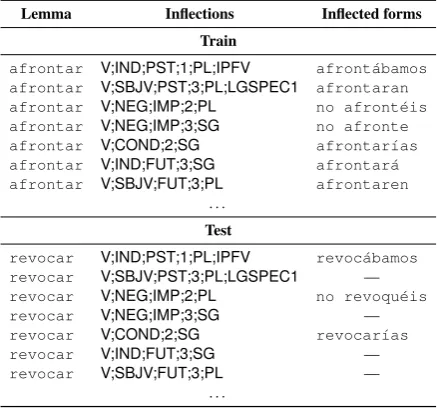
Table 2: Example training and test data from sub-task 2 in Spanish. At training time, the system is provided with complete paradigms, i.e., tables of all inflections for a given lemma, like the example at top. At test time, the system is asked to complete partially filled paradigms, like the example at bottom; note that the inflectional features for the missing paradigm cells are provided in the input.
The CoNLL-SIGMORPHON 2017 shared task is the second shared task in a series that began with the SIGMORPHON 2016 shared task on morpho-logical reinflection (Cotterell et al., 2016a). In contrast to 2016, it happens that both of the 2017 sub-tasks actually involve only inflection, not re-inflection.3 Nonetheless, we kept “reinflection” in
this year’s title to make it easier to refer to the se-ries of tasks.
2.1 Sub-Task 1: Inflected Form from Lemma
The first sub-task in Figure1required morpholog-ical generation with sparse training data, some-thing that can be practically useful for MT and other downstream tasks in NLP. Here, participants were given examples of inflected forms as shown in Table 1. Each test example asked them to produce some other inflected form when given a lemma and a bundle of morphosyntactic features.
The training data was sparse in the sense that it included only a few inflected forms from each lemma. That is, as in human L1 learning, the learner does not necessarily observe any complete paradigms in a language where the paradigms are
3Cotterell et al.(2016a) defined the term: “Systems
lemman form4 form7 form2 form3 form6 form8 lemma2 form1 form4 form7 form2 form3 form5 form6 form8 form1 form4 form7 lemman form1 form4 form7 form8 form4 lemma1 form1 form4 form7 lemmai guess3
Train Test Train
lemma1 form1 form4 form7 form2 form3 form5 form6 form8 lemmai form1 Test form3 form6 guess5 guess2 guess7
guess4guess8
… …
Sub-task 1
Sub-task 2
[image:3.595.132.465.60.228.2]lemma2
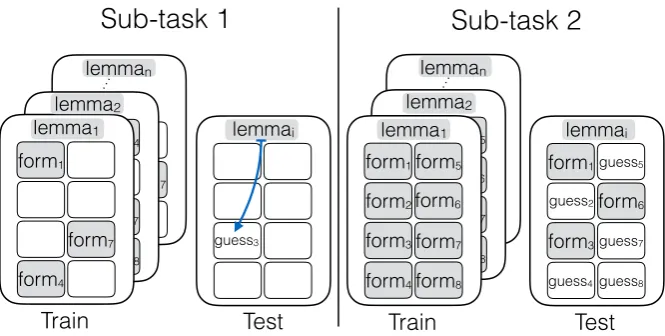
Figure 1: Overview of sub-tasks. Each large rectangle represents aparadigm, i.e., the full set of inflected forms for some lemma. Each small rectangle within the paradigm is acellthat is associated with a known morphological feature bundle, and lists a string that either is observed (shaded background) or must be predicted (white background). Sub-task 1 featured sparse training data and asked systems to inflect individual forms at test time. Sub-task 2 provides dense paradigms as training data and asks for full paradigm completion of unseen items.
large (e.g., dozens of inflected forms per lemma).4
Key points:
1. Our sub-task 1 is similar to sub-task 1 of the SIGMORPHON 2016 shared task (Cotterell et al.,2016a), but with structured inflectional tags (Sylak-Glassman et al., 2015a), learn-ing curve assessment, and many new typo-logically diverse languages, including low-resource languages.
2. The task is inflection: Given an input lemma and desired output tag, participants had to generate the correct output inflected form (a string).
3. The supervised training data consisted of in-dividual forms (Table 1) that were sparsely sampled from a large number of paradigms.
4. Forms that are empirically more frequent were more likely to appear in both training and test data (see§3for details).
5. Unannotated corpus data was also provided to participants.
6. Systems were evaluated after training on102, 103, and104 forms.
4Of course, human L1 learners do not get to observe
ex-plicit morphological feature bundles for the types that they observe. Rather, they analyze inflected tokens in context to discover both morphological features (includinginherent fea-tures such as noun gender (Arnon and Ramscar,2012)) and paradigmatic structure (number of forms per lemma, number of expressed featural contrasts such as tense, number, per-son. . . ).
2.2 Sub-Task 2: Paradigm Completion
The second sub-task in Figure 1 focused
on paradigm completion, also known as “the paradigm cell filling problem” (Ackerman et al.,
2009).
Here, participants were given a few complete inflectional paradigms as training data. At test time, partially filled paradigms, i.e. paradigms with significant gaps in them, were to be com-pleted by filling out the missing cells. Table 2
gives examples.
Thus, sub-task 2 requires predicting many in-flections of the same lemma. Recall that sub-task 1 also required the system to predict several in-flections of the same lemma (when they appear as separate examples in test data). However, in sub-task 2, one of our test-time evaluation met-rics (§2.3) is full-paradigm accuracy. Also, the sub-task 2 training data provides full paradigms, in contrast to sub-task 1 where it included only a few inflected forms per lemma. Finally, at test time, sub-task 2 presents each lemma along with some of its inflected forms, which is potentially helpful if the lemma had not appeared previously in training data.
Apart from the theoretical interest in this prob-lem (Ackerman and Malouf, 2013), this sub-task is grounded in the practical problem of extrapola-tion of basic resources for a language, where only a few complete paradigms may be available from a native speaker informant (Sylak-Glassman et al.,
example paradigms and generalize from them. Key points:
1. The training data consisted of complete paradigms.
2. Not all paradigms within a language have the same shape. A noun lemma will have a dif-ferent set of cells than a verb lemma does, and verbs of different classes (e.g., lexically per-fective vs. imperper-fective) may also have dif-ferent sets of cells.
3. The task was paradigm completion: given a sparsely populated paradigm, participants should generate the inflected forms (strings) for all missing cells.
4. The task simulates learning from compiled grammatical resources and inflection tables, or learning from a limited time with a native-language informant in a fieldwork scenario.
5. Three training sets were given, building up in size from only a few complete paradigms to a large number (dozens).
2.3 Evaluation
Each team participating in a given sub-task was asked to submit 156 versions of their system,
where each version was trained using a different training set (3training sizes×52languages) and
its corresponding development set. We evaluated each submitted system on its corresponding test set, i.e., the test set for its language.
We computed three evaluation metrics: (i) Overall 1-best test-set accuracy, i.e., is the pre-dicted paradigm cell correct? (ii) average Lev-enshtein distance, i.e., how badly does the pre-dicted form disagree with the answer? (iii) Full-paradigm accuracy, i.e.,is the complete paradigm correct? This final metric only truly makes sense in sub-task 2, where full paradigms are given for evaluation. For each sub-task, the three data conditions (low, medium, and high) resulted in a learning curve. For each system in each condi-tion, we report the average metrics across all 52 languages.
3 Data
3.1 Languages
The data for the shared task was highly multilin-gual, comprising 52 unique languages. Data for 47
of the languages came from the English edition of Wiktionary, a large multi-lingual crowd-sourced dictionary containing morphological paradigms for many lemmata.5 Data for Khaling, Kurmanji
Kurdish, and Sorani Kurdish was created as part of the Alexina project (Walther et al.,2013,2010;
Walther and Sagot,2010).6 Novel data for Haida,
a severely endangered North American language isolate, was prepared by Jordan Lachler (Univer-sity of Alberta). The Basque language data was extracted from a manually designed finite-state morphological analyzer (Alegria et al.,2009).
The shared task language set is genealogi-cally diverse, including languages from 10 guage stocks. Although the majority of the lan-guages are Indo-European, we also include two language isolates (Haida and Basque) along with languages from Athabaskan (Navajo), Kartvelian (Georgian), Quechua, Semitic (Arabic, Hebrew), Sino-Tibetan (Khaling), Turkic (Turkish), and Uralic (Estonian, Finnish, Hungarian, and North-ern Sami). The shared task language set is also diverse in terms of morphological structure, with languages which use primarily prefixes (Navajo), suffixes (Quechua and Turkish), and a mix, with Spanish exhibiting internal vowel variations along with suffixes and Georgian using both infixes and suffixes. The language set also exhibits features such as templatic morphology (Arabic, Hebrew), vowel harmony (Turkish, Finnish, Hungarian), and consonant harmony (Navajo) which require systems to learn non-local alternations. Finally, the resource level of the languages in the shared task set varies greatly, from major world languages (e.g. Arabic, English, French, Spanish, Russian) to languages with few speakers (e.g. Haida, Khal-ing).
3.2 Data Format
For each language, the basic data consists of triples of the form (lemma, feature bundle, in-flected form), as in Table1. The first feature in the bundle always specifies the core part of speech (e.g., verb). All features in the bundle are coded according to the UniMorph Schema, a cross-linguistically consistent universal morphological feature set (Sylak-Glassman et al.,2015a,b).
5https://en.wiktionary.org/(08-2016
snap-shot)
6https://gforge.inria.fr/projects/
3.3 Extraction from Wiktionary
For each of the 47 Wiktionary languages, Wik-tionary provides a number of tables, each of which specifies the full inflectional paradigm for a par-ticular lemma. These tables were initially ex-tracted via a multi-dimensional table parsing strat-egy (Kirov et al., 2016; Sylak-Glassman et al.,
2015a).
As noted in§2.2, different paradigms may have different shapes. To prepare the shared task data, each language’s parsed tables from Wiktionary were grouped according to their tabular structure and number of cells. Each group represents a dif-ferent type of paradigm (e.g., verb). We used only groups with a large number of lemmata, relative to the number of lemmata available for the lan-guage as a whole. For each group, we associated a feature bundle with each cell position in the table, by manually replacing the prose labels describ-ing grammatical features (e.g. “accusative case”) with UniMorph features (e.g.acc). This allowed us to extract triples as described in the previous section.
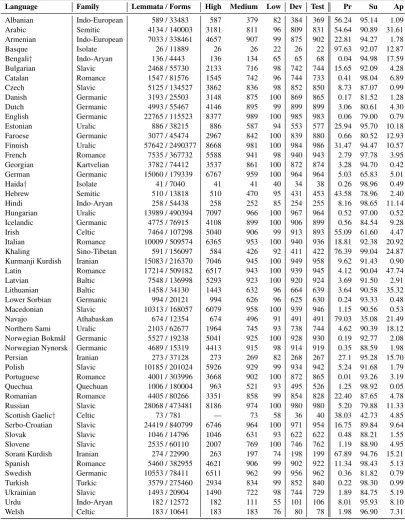
By applying this process across the 47 lan-guages, we constructed a large multilingual dataset that refines the parsed tables from previ-ous work. This dataset was sampled to create appropriately-sized data for the shared task, as de-scribed in§3.4.7 Full and sampled dataset sizes by
language are given in Table3.
Systematic syncretism is collapsed in Wik-tionary. For example, in English, feature bun-dles do not distinguish between different per-son/number forms of past tense verbs, because they are identical.8 Thus, the past-tense form
went appears only once in the table forgo, not six times, and gives rise to only one triple, whose feature bundle specifies past tense but not person and number.
3.4 Sampling the Train-Dev-Test Splits
From each language’s collection of paradigms, we sampled the training, development, and test sets as follows. These datasets can be
obtained from http://www.sigmorphon.
org/conll2017.
7Full, unsampled Wiktionary parses are made available at
unimorph.orgon a rolling basis.
8In this example, Wiktionary omits the single exception:
the lemmabe distinguishes between past tenses was and were.
Our first step was to construct probability distri-butions over the (lemma, feature bundle, inflected form) triples in our full dataset. For each triple, we counted how many tokens the inflected form has in the February 2017 dump of Wikipedia for that language. Note that this simple “string match” heuristic overestimates the count, since strings are ambiguous: not all of the counted tokens actually render that feature bundle.9
From these counts, we estimated a unigram distribution over triples, using Laplace smooth-ing (add-1 smoothsmooth-ing). We then sampled 12000 triples without replacement from this distribution. The first 100 were taken as the low-resource train-ing set for sub-task 1, the first 1000 as the medium-resource training set, and the first 10000 as the high-resource training set. Note that these training sets are nested, and that the highest-count triples tend to appear in the smaller training sets.
The final 2000 triples were randomly shuffled and then split in half to obtain development and test sets of 1000 forms each. The final shuffling was performed to ensure that the development set is similar to the test set. By contrast, the devel-opment and test sets tend to contain lower-count triples than the training set.10 In those languages
where we have less than 12000 total forms, we omit the high-resource training set (all languages have at least 3000 forms).
To sample the data for sub-task 2, we per-form a similar procedure. For each paradigm in our full dataset, we counted the number of tokens in Wikipedia that matched any of the inflected forms in the paradigm. From these counts, we estimated a unigram distribution over paradigms, using Laplace smoothing. We sam-pled 300 paradigms without replacement from this
9For example, in English, any token of the stringwalked
will be double-counted as both the past tense and the past participle of the lemmawalk. This problem holds for all regular English verbs. Similarly, when we are counting the present-tense tokenslay of the lemmalay, we will also include tokens of the stringlay that are actually the past tense oflie, or are actually the adjective or noun senses oflay. The alternative to double-counting each ambiguous token would have been to use EM to split the token’s count of 1 unequally among its possible analyses, in proportion to their estimated prior probabilities (Cotterell et al.,2015).
10This is a realistic setting, since supervised training is
distribution. The low-resource training sets con-tain the first 10 paradigms, the medium-resource training set contains the first 50, and high-resource training set contains the first 200. Again, these training sets are nested. Note that since differ-ent languages have paradigms of differdiffer-ent sizes, the actual number of training exemplars may dif-fer drastically.
With the same motivation as before, we shuffled the remaining 100 forms and took the first 50 as development and the next 50 as test. (In those lan-guages with fewer than 300 forms, we again omit-ted the high-resource training setting.) For each development or test paradigm, we chose about 1 5 of the slots to provide to the system as input along with the lemma, asking the system to predict the remaining 4
5. We determined which cells to keep by independently flipping a biased coin with prob-ability0.2for each cell.
Because of the count overestimates mentioned above, our sub-task 1 dataset overrepresents triples where the inflected form (the answer) is ambigu-ous, and our sub-task 2 dataset overrepresents paradigms that contain ambiguous inflected forms. The degree of ambiguity varied among languages: the average number of triples per inflected form string ranged from 1.00 in Sorani to 2.89 in Khal-ing, with an average of 1.43 across all languages. Despite this distortion of true unigram counts, we believe that our datasets captured a sufficiently broad sample of the feature combinations for ev-ery language.
4 Previous Work
Most recent work in inflection generation has fo-cused on sub-task 1, i.e., generating inflected forms from the lemma. Numerous, methodolog-ically diverse approaches have been published. We highlight a representative sample of recent work. Durrett and DeNero (2013) heuristically extracted transformation rules and trained a semi-Markov model (Sarawagi and Cohen, 2004) to learn when to apply them to the input. Nico-lai et al.(2015) trained a discriminative string-to-string monotonic transduction tool—DIRECTL+ (Jiampojamarn et al., 2008)—to generate inflec-tions. Ahlberg et al. (2014) reduced the prob-lem to multi-class classification, where they used finite-state techniques to first generalize inflec-tional patterns and then trained a feature-rich clas-sifier to choose the optimal such pattern to inflect
unseen words (Ahlberg et al.,2015). Finally, Mal-ouf (2016), Faruqui et al. (2016) and Kann and Sch¨utze(2016) proposed a neural-based sequence-to-sequence models (Sutskever et al.,2014), with
Kann and Sch¨utze making use of an attention mechanism (Bahdanau et al.,2015). Overall, the neural approaches have generally been found to be the most successful.
Some work has also focused on scenarios sim-ilar to sub-task 2. For example, Dreyer and Eisner (2009) modeled the distribution over the paradigms of a language as a Markov Random Field (MRF), where each cell is represented as a string-valued random variable. The MRF’s fac-tors are specified as weighted finite-state machines of the form given byDreyer et al.(2008). Build-ing upon this,Cotterell et al.(2015) proposed us-ing a Bayesian network where both lemmata (re-peated within a paradigm) and affixes (re(re-peated across paradigms) were encoded as string-valued random variables. That work required its finite-state transducers to take a more restricted form (Cotterell et al.,2014) for computational reasons. Finally, Kann et al. (2017a) proposed a multi-source sequence-to-sequence network, allowing a neural transducer to exploit multiple source forms simultaneously.
SIGMORPHON 2016 Shared Task. Last year,
the SIGMORPHON 2016 shared task (http:// sigmorphon.org/sharedtask) focused on 10 languages (including 2 surprise languages). As for the present 2017 task, most of the 2016 data was derived from Wiktionary. The 2016 shared task had submissions from 9 competing teams with members from 11 universities. As mentioned in§2.1, our sub-task 1 is an extension of sub-task 1 from 2016. The other sub-tasks in 2016 focused on the more general reinflection problem, where systems had to learn to map from any inflected form to any other with varying degrees of anno-tations. SeeCotterell et al.(2016a) for details.
5 The Baseline System
Language Family Lemmata/Forms High Medium Low Dev Test Pr Su Ap
[image:7.595.94.500.108.629.2]Albanian Indo-European 589 / 33483 587 379 82 384 369 56.24 95.14 1.09 Arabic Semitic 4134 / 140003 3181 811 96 809 831 54.64 90.89 31.61 Armenian Indo-European 7033 / 338461 4657 907 99 875 902 22.81 94.27 1.78 Basque Isolate 26 / 11889 26 26 22 26 22 97.63 92.07 12.87 Bengali† Indo-Aryan 136 / 4443 136 134 65 65 68 0.04 94.98 17.59 Bulgarian Slavic 2468 / 55730 2133 716 98 742 744 15.65 92.09 4.28 Catalan Romance 1547 / 81576 1545 742 96 744 733 0.41 98.04 6.89 Czech Slavic 5125 / 134527 3862 836 98 852 850 8.73 87.07 0.99 Danish Germanic 3193 / 25503 3148 875 100 869 865 0.17 81.52 1.28 Dutch Germanic 4993 / 55467 4146 895 99 899 899 3.06 80.61 4.30 English Germanic 22765 / 115523 8377 989 100 985 983 0.06 79.00 0.79 Estonian Uralic 886 / 38215 886 587 94 553 577 25.94 95.70 10.18 Faroese Germanic 3077 / 45474 2967 842 100 839 880 0.66 80.52 12.93 Finnish Uralic 57642 / 2490377 8668 981 100 984 986 31.47 94.47 10.57 French Romance 7535 / 367732 5588 941 98 940 943 2.79 97.78 3.95 Georgian Kartvelian 3782 / 74412 3537 861 100 872 874 3.28 94.70 0.42 German Germanic 15060 / 179339 6767 959 100 964 964 5.03 65.83 5.01 Haida† Isolate 41 / 7040 41 41 40 34 38 0.26 98.96 0.49 Hebrew Semitic 510 / 13818 510 470 95 431 453 43.58 78.96 2.40 Hindi Indo-Aryan 258 / 54438 258 252 85 254 255 8.16 98.65 11.14 Hungarian Uralic 13989 / 490394 7097 966 100 967 964 0.52 97.00 0.52 Icelandic Germanic 4775 / 76915 4108 899 100 906 899 0.56 84.54 9.28 Irish Celtic 7464 / 107298 5040 906 99 913 893 55.09 61.60 4.47 Italian Romance 10009 / 509574 6365 953 100 940 936 18.81 92.38 20.92 Khaling Sino-Tibetan 591 / 156097 584 426 92 411 422 76.39 99.04 24.87 Kurmanji Kurdish Iranian 15083 / 216370 7046 945 100 949 958 9.62 91.43 0.90 Latin Romance 17214 / 509182 6517 943 100 939 945 4.12 90.04 47.74 Latvian Baltic 7548 / 136998 5293 923 100 920 924 3.69 91.50 2.91 Lithuanian Baltic 1458 / 34130 1443 632 96 664 639 3.64 90.58 35.32 Lower Sorbian Germanic 994 / 20121 994 626 96 625 630 0.24 93.33 0.48 Macedonian Slavic 10313 / 168057 6079 958 100 939 946 1.15 90.56 0.53 Navajo Athabaskan 674 / 12354 674 496 91 491 491 79.03 35.08 21.49 Northern Sami Uralic 2103 / 62677 1964 745 93 738 744 4.62 90.39 18.12 Norwegian Bokm˚al Germanic 5527 / 19238 5041 925 100 928 930 0.19 92.77 2.08 Norwegian Nynorsk Germanic 4689 / 15319 4413 915 98 914 919 0.35 88.59 1.98 Persian Iranian 273 / 37128 273 269 82 268 267 27.1 95.28 15.70 Polish Slavic 10185 / 201024 5926 929 99 934 942 5.24 91.68 1.79 Portuguese Romance 4001 / 303996 3668 902 100 872 865 0.01 93.26 3.19 Quechua Quechuan 1006 / 180004 963 521 93 495 526 1.25 98.92 0.05 Romanian Romance 4405 / 80266 3351 858 99 854 828 22.40 87.65 4.78 Russian Slavic 28068 / 473481 8186 974 100 980 980 5.20 79.88 11.33 Scottish Gaelic† Celtic 73 / 781 — 73 58 36 40 38.03 42.73 4.85 Serbo-Croatian Slavic 24419 / 840799 6746 964 100 971 954 16.75 89.84 9.64 Slovak Slavic 1046 / 14796 1046 631 93 622 622 0.48 88.21 1.55 Slovene Slavic 2535 / 60110 2007 769 100 746 762 1.19 88.90 4.95 Sorani Kurdish Iranian 274 / 22990 263 197 74 198 199 67.89 94.76 15.21 Spanish Romance 5460 / 382955 4621 906 99 902 922 11.34 98.43 5.13 Swedish Germanic 10553 / 78411 6511 962 99 956 962 0.36 81.82 0.79 Turkish Turkic 3579 / 275460 2934 834 99 852 840 0.22 98.30 0.99 Ukrainian Slavic 1493 / 20904 1490 722 98 744 729 1.89 84.75 5.19 Urdu Indo-Aryan 182 / 12572 182 111 55 101 106 8.01 95.93 8.10 Welsh Celtic 183 / 10641 183 183 76 80 78 1.98 96.90 7.31
Language Name ADJ N V Albanian – 10-20 123 Arabic 40-48 12-36 61-115 Armenian 17-34 17-34 154-155
Basque – – 112-810
Bengali – 9-12 51 Bulgarian 30 4-8 –
Catalan – – 50-53
Czech 25-35 14 30
Danish – 6 8
Dutch 3-9 – 16
English – – 7
Estonian – 30 79
Faroese 17 8-16 12 Finnish 28 13-28 141
French – – 49
Georgian 19 19 –
German – 4-8 29
Haida – – 41-176
Hebrew – 30 23-28
Hindi – – 219
Hungarian – 17-34 – Icelandic – 8-16 28
Irish 13 7-13 65
Italian – – 47-51
Khaling – – 45-382 Kurmanji Kurdish 1-2 1-14 83 Latin 18-31 8-12 99 Latvian 20-24 7-14 49-50 Lithuanian 28-76 7-14 63 Lower Sorbian 33 18 21 Macedonian 16 5-11 20-29
Navajo – 8 6-50
Northern Sami 13 13 45-54 Norwegian Bokm˚al 2-5 1-3 3-9 Norwegian Nynorsk 1-5 1-3 8
Persian – – 140
Polish 28 7-14 47 Portuguese – – 74-76 Quechua 256 256 41 Romanian 8-16 5-6 37 Russian 26-30 6-14 15-16 Scottish Gaelic 12 – 8 Serbo-Croatian 1-43 2-14 63 Slovak 27 6-12 – Slovene 53 6-18 22 Sorani Kurdish 1-15 1-28 95-186
Spanish – – 70
Swedish 5-15 4-8 11 Turkish 72 12-108 120 Ukrainian 26 7-14 17-24
Urdu – 6 219
[image:8.595.74.263.73.690.2]Welsh – – 20-65
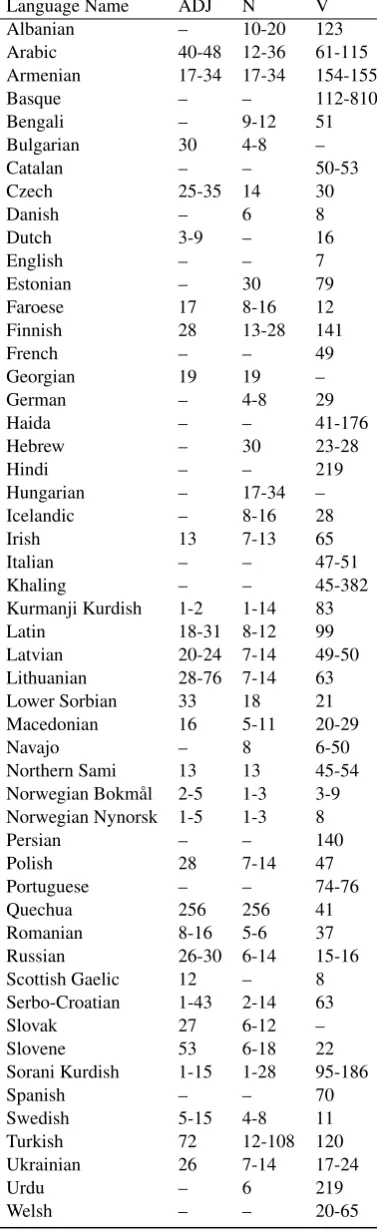
Table 4: Quantity of data available in sub-task 2. For each possible part of speech in each language, we present the range in the number of forms that comprise a paradigm as an indication of the difficulty of the task of forming a full paradigm. These ranges were computed using the data in the Train Medium condition.
shared task.
5.1 Alignment
For each (lemma, feature bundle, inflected form) triple in training data, the system initially aligns the lemma with the inflected form by finding the minimum-cost edit path. Costs are computed with a weighted scheme such that substitutions have a slightly higher cost (1.1) than insertions or dele-tions (1.0). For example, the German training data pair schielen-geschielt ‘to squint’ (going from the lemma to the past participle) is aligned as:
--schielen
geschielt-The system now assumes that each aligned pair can be broken up into a prefix, stem and a suffix, based on where the inputs or outputs have initial or trailing blanks after alignment. We assume that initial or trailing blanks in either input or output reflect boundaries between a prefix and a stem, or a stem and a suffix. This allows us to divide each training example into three parts. Using the exam-ple above, the pairs would be aligned as follows, after padding the edges with$-symbols:
prefix stem suffix
$ schiele n$
$ge schielt $
5.2 Inflection Rules
From this alignment, the system extracts a prefix-changing rule based on the prefix pairing, as well as a set of suffix-changing rules based on suf-fixes of the stem+suffix pairing. The example alignment above yields the eight extracted suffix-modifying rules
n$→$ ielen$→ielt$
en$→t$ hielen$→hielt$
len$→lt$ chielen$→chielt$ elen$→elt$ schielen$→schielt$
as well as the prefix-modifying rule$→$ge. Since these rules were obtained from the triple
(schielen, V;V.PTCP;PST, geschielt),
they are associated with a token of the feature bun-dleV;V.PTCP;PST.
5.3 Generation
Team Institute(s) System Description Paper
CLUZH University of Zurich Makarov et al.(2017)
CMU Carnegie Mellon University Zhou and Neubig(2017a)
CU University of Colorado Boulder Silfverberg et al.(2017)
EHU University of the Basque Country Alegria and Etxeberria(2016)∗
IIT (BHU) Birla Institute of Technology and Science / Sudhakar and Singh(2017) Indian Institute of Technology (BHU) Varanasi
ISI Indian Statistical Institute Chakrabarty and Garain(2017)
LMU Ludwig-Maximilian University of Munich Kann and Sch¨utze(2017)
SU-RUG Stockholm University / University of Groningen ¨Ostling and Bjerva(2017)
UA University of Alberta Nicolai et al.(2017)
UE-LMU University of Edinburgh / Bergmanis et al.(2017)
Ludwig-Maximilian University of Munich
UF University of Florida Zhu et al.(2017)
UTNII National Institute of Informatics / Senuma and Aizawa(2017)
[image:9.595.71.518.65.291.2]University of Tokyo
Table 5: The teams’ abbreviations as well as their members’ institutes and the accompanying system description paper are listed here. Note that in the main text the abbreviations are used with a integer index, indicating the specific submission. One team (marked∗), did not submit a system description.
training tokens of the precise feature bundle. There is no generalization across bundles that share features.
Specifically, the longest-matching suffix rule associated with the feature bundle is consulted and applied to the input form. Ties are broken by fre-quency, in favor of the rule that has occurred most often with this feature bundle. After this, the pre-fix rule that occurred most often with the bundle is likewise applied. That is, the prefix-matching rule has no longest-match preference, while the suffix-matching rule does.
For example, to inflect kaufen‘to buy’ with the featuresV;V.PTCP;PST, using the single ex-ample above as training data, we would find that the longest matching stored suffix-rule isen$ → t$, which would transform kaufen into an in-termediate formkauft, after which the most fre-quent prefix-rule, $ → $ge would produce the final outputgekauft. If no rules have been as-sociated with a particular feature bundle (as often happens in the low data condition), the inflected form is simply taken to be a copy of the lemma.
In sub-task 2, paradigm completion, the base-line system simply repeats the sub-task 1 method and generates all the missing forms independently from the lemma. It does not take advantage of the other forms that are presented in the partially filled paradigm.
In addition to the above, the baseline system
uses a heuristic to place a language into one of two categories: largely prefixing or largely suffix-ing. Some languages, such as Navajo, are largely prefixing and have more complex changes in the left periphery of the input rather than at the right. However, in the method described above, the op-eration of the prefix rules is more restricted than that of the suffix rules: prefix rules tend to per-form no change at all, or insert or delete a prefix. For largely prefixing languages, the method per-forms better when operating with reversed strings. Classifying a language into prefixing or suffixing is done by simply counting how often there is a prefix change vs. suffix change in going from the lemma form to the inflected form in the training data. Whenever a language is found to be largely prefixing, the system works with reversed strings throughout to allow more expressive changes in the left edge of the input.
6 System Descriptions
The CoNLL-SIGMORPHON 2017 shared task re-ceived submissions from 11 teams with members from 15 universities and institutes (Table5). Many of the teams submitted more than one system, yielding a total of 25 unique systems entered in-cluding the baseline system.
sub-Neural Hard Rerank Data+
baseline 7 3 7 7
CLUZH 3 3 7 7
CMU 3 7 7 3
CU 3 7 7 3
EHU 7 3 7 7
IIT (BHU) 3 7 7 3
ISI 3 7 3 7
LMU 3 7 7 3
SU-RUG 3 7 7 7
UA 3 3 3 3
UE-LMU 3 7 7 3
UF 3 7 7 7
[image:10.595.73.291.65.263.2]UTNII 3 7 7 7
Table 6: Features of the various submitted systems.
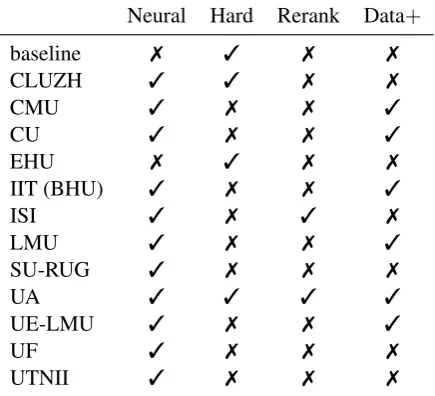
mitted architectures, we still observed large differ-ences in the individual performances. Rather than differences in architecture, a major difference this year was the various methods for supplying the neural network with auxiliary training data. For ease of presentation, we break down the systems into the features of their system (see Table6) and discuss the systems that had those features. In all cases, further details of the methods can be found in the system description papers, which are cited in Table5.
Neural Parameterization. All systems except
for the EHU team employed some form of a neu-ral network. Moreover, all teams except for SU-RUG, which employed a convolutional neural net-work, made use of some form of gated recurrent network—either a gated recurrent network (GRU) (Chung et al., 2014) or long short-term memory (LSTM) (Hochreiter and Schmidhuber,1997). In these neural models, a common strategy was to feed in the morphological tag of the form to be predicted along with the input into the network, where each subtag was its own symbol.
Hard Alignment versus Soft Attention.
An-other axis, along which the systems differ is the use of hard alignment, over soft attention. The neural attention mechanism was introduced in
Bahdanau et al.(2015) for neural machine transla-tion (NMT). In short, these mechanisms avoid the necessity of encoding the input word into a fixed length vector, by allowing the decoder to attend to different parts of the inputs. Just as in NMT, the attention mechanism has led to large gains in
mor-phological inflection. The CMU, CU, IIT (BHU), LMU, UE-LMU, UF and UTNII systems all em-ployed such mechanisms.
An alternative to soft attention is hard, mono-tonic alignment, i.e., a neural parameterization of a traditional finite-state transduction system. These systems enforce a monotonic alignment be-tween source and target forms. In the 2016 shared task (see Cotterell et al., 2016a, Table 6) such a system placed second (Aharoni et al.,2016), and this year’s winning system—CLUZH—was an ex-tension of that one. (See, also,Aharoni and Gold-berg(2017) for a further explication of the tech-nique andRastogi et al. (2016) for discussion of a related neural parameterization of a weighted finite-state machine.) Their system allows for ex-plicit biasing towards a copy action that appears useful in the low-resource setting. Despite its neu-ral parameterization, the CLUZH system is most closely related to the systems of UA and EHU, which train weighted finite-state transducers, al-beit with a log-linear parameterization.
Reranking. Reranking the output of a weaker
system was a tack taken by two systems: ISI and UA. The ISI system started with a heuristi-cally induced candidate set, using the edit tree ap-proach described by Chrupała et al. (2008), and then chose the best edit tree. This approach is effectively a neuralized version of the lemma-tizer proposed inM¨uller et al.(2015) and, indeed, was originally intended for that task (Chakrabarty et al.,2017). The UA team, following their 2016 submission, proposed a linear reranking on top of thek-best output of their transduction system.
Data Augmentation. Many teams made use of
auxiliary training data—unlabeled or synthetic forms. Some teams leveraged the provided Wikipedia corpora (see §3). The UE-LMU team used these unlabeled corpora to bias their meth-ods towards copying by transducing an unlabeled word to itself. The same team also explored a sim-ilar setup that instead learned to transducerandom
High Medium Low
UE-LMU-1 95.32/0.10 81.02/0.41 —/—
CLUZH-7 95.12/0.10 82.80/0.34 50.61/1.29
CLUZH-6 95.12/0.10 82.80/0.34 50.61/1.29
CLUZH-2 94.95/0.10 81.80/0.37 46.82/1.38
LMU-2 94.70/0.11 82.64/0.35 46.59/1.56
LMU-1 94.70/0.11 82.64/0.35 45.29/1.62
CLUZH-5 94.69/0.11 81.00/0.39 48.24/1.48
CLUZH-1 94.47/0.12 80.88/0.39 45.99/1.43
SU-RUG-1 93.56/0.14 —/— —/—
CU-1 92.97/0.17 77.60/0.50 45.74/1.62
UTNII-1 91.46/0.17 65.06/0.73 1.28/5.71
CLUZH-4 89.53/0.23 80.33/0.41 48.53/1.52
IIT(BHU)-1 89.38/0.22 50.73/1.69 13.88/4.54
CLUZH-3 89.10/0.24 79.57/0.44 47.95/1.55
UF-1 87.33/0.27 68.82/0.78 27.46/2.70
CMU-1† 86.56/0.28 68.00/0.86‡ —/—
ISI-1 74.01/0.78 54.47/1.39 26.00/2.43
EHU-1 64.38/0.72‡ 38.50/1.70‡ 3.50/3.23‡
UE-LMU-2† —/— 82.37/0.39 —/—
IIT(BHU)-2 —/— 55.46/1.78 14.27/4.33
UA-3† —/— —/— 57.70/1.34‡
UA-4† —/— —/— 57.52/1.36‡
UA-1 —/— —/— 54.22/1.66‡
UA-2 —/— —/— 42.85/2.23‡
baseline 77.81/0.50 64.70/0.90 37.90/2.15
oracle-fc 99.99/* 97.76/* 70.84/*
[image:11.595.305.534.63.169.2]oracle-e 98.25/* 92.10/* 64.56/*
Table 7: Sub-task 1 results: Per-form accuracy (in %age points) and average Levenshtein distance from the correct form (in characters), averaged across the 52 languages with all languages weighted equally. The columns represent the different training size conditions. Systems marked with† used external resources. Accuracies marked with ‡ indi-cate that the submission did not include all 52 languages and should not be compared to the other accuracies.
the UA team trained a tagger on the given train-ing examples, and then tagged the corpus with the goal to obtain additional instances, while the UE-LMU team used a series of unsupervised heuris-tics. The CU team—which did not make use of ex-ternal resources—hallucinated more training data by identifying suffix and prefix changes in the given training pairs and then using that informa-tion to create new artificial training pairs. The LMU submission also experimented with hand-written rules to artificially generate more data. It seems likely that the primary difference in the per-formance of the various neural systems lay in these strategies for the creation of new data to train the parameters, rather than in the neural architectures themselves.
7 Performance of the Systems
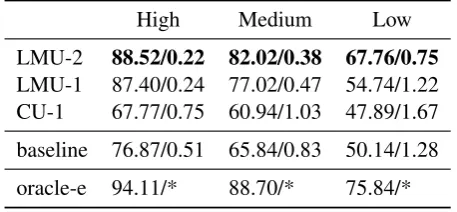
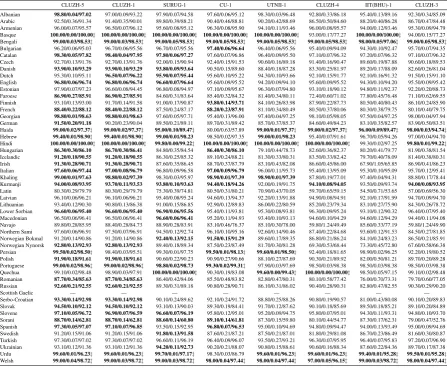
Relative system performance is described in Ta-bles7and8, which show the average per-language
High Medium Low
LMU-2 88.52/0.22 82.02/0.38 67.76/0.75
LMU-1 87.40/0.24 77.02/0.47 54.74/1.22
CU-1 67.77/0.75 60.94/1.03 47.89/1.67
baseline 76.87/0.51 65.84/0.83 50.14/1.28
[image:11.595.79.283.69.387.2]oracle-e 94.11/* 88.70/* 75.84/*
Table 8: Sub-task 2 results: Per-form accuracy (in %age points) and average Levenshtein distance from the correct form (in characters).
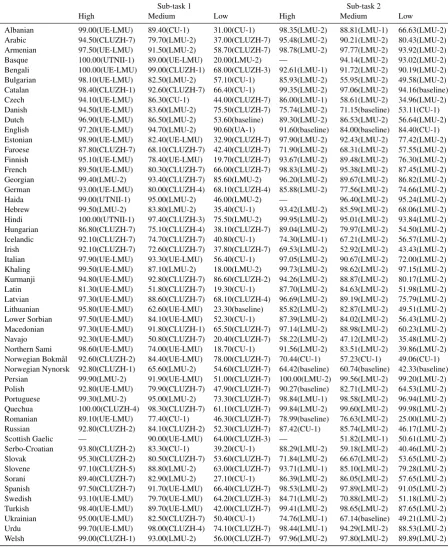
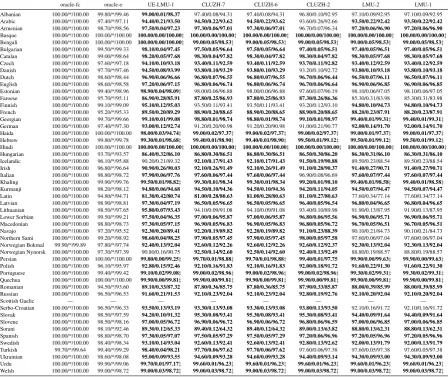
accuracy of each system by resource condition, for each of the sub-tasks. The table reflects the fact that some teams submitted more than one sys-tem (e.g. LMU-1 & LMU-2 in the table). Learn-ing curves for each language across conditions are shown in Table 9, which indicates the best per-form accuracy achieved by a submitted system. Full results can be found in AppendixA, including full-paradigm accuracy.
Three teams exploited external resources in some form: UA, CMU, and UE-LMU. In gen-eral, any relative performance gained was mini-mal. The CMU system was outranked by sev-eral systems that avoided external resource use in the High and Medium conditions in which it com-peted. UE-LMU only submitted a system that used additional resources in the Medium condi-tion, and saw gains of∼%1 compared to their ba-sic system, while it was still outranked overall by CLUZH. In the Low condition, UA saw gains of ∼%3 using external data. However, all UA sub-missions were limited to a small handful of lan-guages.
Sub-task 1 Sub-task 2 High Medium Low High Medium Low Albanian 99.00(UE-LMU) 89.40(CU-1) 31.00(CU-1) 98.35(LMU-2) 88.81(LMU-1) 66.63(LMU-2) Arabic 94.50(CLUZH-7) 79.70(LMU-2) 37.00(CLUZH-7) 95.48(LMU-2) 90.21(LMU-2) 80.43(LMU-2) Armenian 97.50(UE-LMU) 91.50(LMU-2) 58.70(CLUZH-7) 98.78(LMU-2) 97.77(LMU-2) 93.92(LMU-2) Basque 100.00(UTNII-1) 89.00(UE-LMU) 20.00(LMU-2) — 94.14(LMU-2) 93.02(LMU-2) Bengali 100.00(UE-LMU) 99.00(CLUZH-1) 68.00(CLUZH-3) 92.61(LMU-1) 91.72(LMU-2) 90.19(LMU-2) Bulgarian 98.10(UE-LMU) 82.50(LMU-2) 57.10(CU-1) 85.93(LMU-2) 55.95(LMU-2) 49.58(LMU-2) Catalan 98.40(CLUZH-1) 92.60(CLUZH-7) 66.40(CU-1) 99.35(LMU-2) 97.06(LMU-2) 94.16(baseline) Czech 94.10(UE-LMU) 86.30(CU-1) 44.00(CLUZH-7) 86.00(LMU-1) 58.61(LMU-2) 34.96(LMU-2) Danish 94.50(UE-LMU) 83.60(LMU-2) 75.50(CLUZH-7) 75.74(LMU-2) 71.15(baseline) 53.11(CU-1) Dutch 96.90(UE-LMU) 86.50(LMU-2) 53.60(baseline) 89.30(LMU-2) 86.53(LMU-2) 56.64(LMU-2) English 97.20(UE-LMU) 94.70(LMU-2) 90.60(UA-1) 91.60(baseline) 84.00(baseline) 84.40(CU-1) Estonian 98.90(UE-LMU) 82.40(UE-LMU) 32.90(CLUZH-7) 97.90(LMU-2) 92.43(LMU-2) 77.42(LMU-2) Faroese 87.80(CLUZH-7) 68.10(CLUZH-7) 42.40(CLUZH-7) 71.90(LMU-2) 68.31(LMU-2) 57.55(LMU-2) Finnish 95.10(UE-LMU) 78.40(UE-LMU) 19.70(CLUZH-7) 93.67(LMU-2) 89.48(LMU-2) 76.30(LMU-2) French 89.50(UE-LMU) 80.30(CLUZH-7) 66.00(CLUZH-7) 98.83(LMU-2) 95.38(LMU-2) 87.45(LMU-2) Georgian 99.40(LMU-2) 93.40(CLUZH-7) 85.60(LMU-2) 96.20(LMU-2) 89.67(LMU-2) 86.82(LMU-2) German 93.00(UE-LMU) 80.00(CLUZH-4) 68.10(CLUZH-4) 85.88(LMU-2) 77.56(LMU-2) 74.66(LMU-2) Haida 99.00(UTNII-1) 95.00(LMU-2) 46.00(LMU-2) — 96.40(LMU-2) 95.24(LMU-2) Hebrew 99.50(LMU-2) 83.80(LMU-2) 35.40(CU-1) 93.42(LMU-2) 85.59(LMU-2) 68.06(LMU-2) Hindi 100.00(UTNII-1) 97.40(CLUZH-3) 75.50(LMU-2) 99.95(LMU-2) 95.01(LMU-2) 93.84(LMU-2) Hungarian 86.80(CLUZH-7) 75.10(CLUZH-4) 38.10(CLUZH-7) 89.04(LMU-2) 79.97(LMU-2) 54.50(LMU-2) Icelandic 92.10(CLUZH-7) 74.70(CLUZH-7) 40.80(CU-1) 74.30(LMU-1) 67.21(LMU-2) 56.57(LMU-2) Irish 92.10(CLUZH-7) 72.60(CLUZH-7) 37.80(CLUZH-7) 69.53(LMU-2) 52.92(LMU-2) 43.43(LMU-2) Italian 97.90(UE-LMU) 93.30(UE-LMU) 56.40(CU-1) 97.05(LMU-2) 90.67(LMU-2) 72.00(LMU-2) Khaling 99.50(UE-LMU) 87.10(LMU-2) 18.00(LMU-2) 99.73(LMU-2) 98.62(LMU-2) 97.15(LMU-2) Kurmanji 94.80(UE-LMU) 92.80(CLUZH-7) 86.60(CLUZH-2) 94.26(LMU-2) 88.87(LMU-2) 80.17(LMU-2) Latin 81.30(UE-LMU) 51.80(CLUZH-7) 19.30(CU-1) 87.70(LMU-2) 84.63(LMU-2) 51.98(LMU-2) Latvian 97.30(UE-LMU) 88.60(CLUZH-7) 68.10(CLUZH-4) 96.69(LMU-2) 89.19(LMU-2) 75.79(LMU-2) Lithuanian 95.80(UE-LMU) 62.60(UE-LMU) 23.30(baseline) 85.82(LMU-2) 82.87(LMU-2) 49.51(LMU-2) Lower Sorbian 97.50(UE-LMU) 84.10(UE-LMU) 52.30(CU-1) 87.39(LMU-2) 84.02(LMU-2) 56.43(LMU-2) Macedonian 97.30(UE-LMU) 91.80(CLUZH-1) 65.50(CLUZH-7) 97.14(LMU-2) 88.98(LMU-2) 60.23(LMU-2) Navajo 92.30(UE-LMU) 50.80(CLUZH-7) 20.40(CLUZH-7) 58.22(LMU-2) 47.12(LMU-2) 35.48(LMU-2) Northern Sami 98.60(UE-LMU) 74.00(UE-LMU) 18.70(CU-1) 91.56(LMU-2) 83.51(LMU-2) 39.86(LMU-2) Norwegian Bokm˚al 92.60(CLUZH-2) 84.40(UE-LMU) 78.00(CLUZH-7) 70.44(CU-1) 57.23(CU-1) 49.06(CU-1) Norwegian Nynorsk 92.80(CLUZH-1) 65.60(LMU-2) 54.60(CLUZH-7) 64.42(baseline) 60.74(baseline) 42.33(baseline) Persian 99.90(LMU-2) 91.90(UE-LMU) 51.00(CLUZH-7) 100.00(LMU-2) 99.56(LMU-2) 99.20(LMU-2) Polish 92.80(UE-LMU) 79.90(CLUZH-7) 47.90(CLUZH-7) 90.27(baseline) 82.71(LMU-2) 64.53(LMU-2) Portuguese 99.30(LMU-2) 95.00(LMU-2) 73.30(CLUZH-7) 98.84(LMU-1) 98.58(LMU-2) 96.94(LMU-2) Quechua 100.00(CLUZH-4) 98.30(CLUZH-7) 61.10(CLUZH-7) 99.84(LMU-2) 99.60(LMU-2) 99.98(LMU-2) Romanian 89.10(UE-LMU) 77.40(CU-1) 46.30(CLUZH-7) 78.99(baseline) 76.63(LMU-2) 25.00(LMU-2) Russian 92.80(CLUZH-2) 84.10(CLUZH-2) 52.30(CLUZH-7) 87.42(CU-1) 85.74(LMU-2) 46.17(LMU-2) Scottish Gaelic — 90.00(UE-LMU) 64.00(CLUZH-3) — 51.82(LMU-1) 50.61(LMU-2) Serbo-Croatian 93.80(CLUZH-2) 83.30(CU-1) 39.20(CU-1) 88.29(LMU-2) 59.18(LMU-2) 40.46(LMU-2) Slovak 95.30(CLUZH-2) 80.50(CLUZH-7) 53.60(CLUZH-7) 71.84(LMU-2) 66.67(LMU-2) 53.65(LMU-2) Slovene 97.10(CLUZH-5) 88.80(LMU-2) 63.00(CLUZH-7) 93.71(LMU-1) 85.10(LMU-2) 79.28(LMU-2) Sorani 89.40(CLUZH-7) 82.90(LMU-2) 27.10(CU-1) 86.39(LMU-2) 86.05(LMU-2) 57.65(LMU-2) Spanish 97.50(CLUZH-7) 91.70(UE-LMU) 66.40(CLUZH-7) 98.53(LMU-2) 97.89(LMU-2) 91.05(LMU-2) Swedish 93.10(UE-LMU) 79.70(UE-LMU) 64.20(CLUZH-3) 84.71(LMU-2) 70.88(LMU-2) 51.18(LMU-2) Turkish 98.40(UE-LMU) 89.70(UE-LMU) 42.00(CLUZH-7) 99.41(LMU-2) 98.65(LMU-2) 87.65(LMU-2) Ukrainian 95.00(UE-LMU) 82.50(CLUZH-7) 50.40(CU-1) 74.76(LMU-1) 67.14(baseline) 49.21(LMU-2) Urdu 99.70(UE-LMU) 98.00(CLUZH-4) 74.10(CLUZH-7) 98.44(LMU-1) 94.29(LMU-2) 88.53(LMU-2) Welsh 99.00(CLUZH-1) 93.00(LMU-2) 56.00(CLUZH-7) 97.96(LMU-2) 97.80(LMU-2) 89.89(LMU-2)
90%). Languages with more complex systems, like Latin, proved more challenging (the best sys-tem achieved only 19% accuracy in the low con-dition). For these languages, it is possible that the relevant variation required to learn a best per-form inflectional pattern was simply not present in the limited training data, and that a language-specific learning bias was required.
Even though the top-ranked systems do well on their own, different systems may contain some amount of complementary information, so that an ensemble over multiple approaches has a chance to improve accuracy. We present an upper bound on the possible performance of such an ensemble. Table7and Table8include an “Ensemble Oracle” system (oracle-e) that gives the correct answer if
anyof the submitted systems is correct. The ora-cle performs significantly better than any one sys-tem in both the Medium (∼10%) and Low (∼15%) conditions. This suggests that the different strate-gies used by teams to “bias” their systems in an effort to make up for sparse data lead to substan-tially different generalization patterns.
For sub-task 1, we also present a second “Fea-ture Combination” Oracle (oracle-fc) that gives the correct answer for a given test triple iff its fea-ture bundle appeared in training (with any lemma). Thus, oracle-fc provides an upper bound on the performance of systems that treat a feature bundle such asV;SBJV;FUT;3;PLas atomic. In the low-data condition, this upper bound was only 71%, meaning that 29% of the test bundles had never been seen in training data. Nonetheless, systems should be able to make some accurate predictions on this 29% by decomposing each test bundle into individual morphological features such as FUT
(future) and PL (plural), and generalizing from training examples that involve those features. For example, a particular feature or sub-bundle might be realized as a particular affix. Several of the systems treated each individual feature as a sep-arate input to the recurrent network, in order to enable this type of generalization. In the medium data condition for some languages, these systems sometimes far surpassed oracle-fc. The most no-table example of this is Basque, where oracle-fc produced a 47% accuracy while six of the sub-mitted systems produced an accuracy of 85% or above. Basque is an extreme example with very large paradigms for the verbs that inflect in the lan-guage (only a few dozen common ones do). This
result demonstrates the ability of the neural sys-tems to generalize and correctly inflect according to unseen feature combinations.
8 Future Directions
As regards morphological inflection, there is a plethora of future directions to consider. First, one might consider morphological transductions over pronunciations, rather than spellings. This is more challenging in the many languages (in-cluding English) where the orthography does not reflect the phonological changes that accompany morphological processes such as affixation. Or-thography usually also does not reflect predictable allophonic distinctions in pronunciation ( Samp-son, 1985), which one might attempt to predict, such as the difference in aspiration of /t/ in English [thAp] (top) vs. [stAp] (stop).
A second future direction involves the effec-tive incorporation of external unannotated mono-lingual corpora into the state-of-the-art inflection or reinflection systems. The best systems in our competitiondid notmake use of external data and those that did make heavy use of such data, e.g., the CMU team, did not see much gain. The best way to use external corpora remains an open ques-tion; we surmise that they can be useful, especially in the lower-resource cases. A related line of in-quiry is the incorporation of cross-lingual infor-mation, whichKann et al. (2017b) did find to be helpful.
A third direction revolves around the efficient elicitation of morphological information (i.e., ac-tive learning). In the low-resource section, we asked our participants to find the best approach to generate new forms given existing morphological annotation. However, it remains an open question, which of the cells in a paradigm are best to collect annotation for in the first place. Likely, it is better to collectdiagnosticforms that are closer to princi-pal parts of the paradigm (Finkel and Stump,2007;
Ackerman et al., 2009;Montermini and Bonami,
and exploring possibly varying learning strategies associated with lexical items of various frequen-cies.
Finally, there is a wide variety of other tasks involving morphology. While some of these have had a shared task, e.g., the parsing of morphologically-rich languages (Tsarfaty et al.,
2010) and unsupervised morphological segmenta-tion (Kurimo et al., 2010), many have not, e.g., supervised morphological segmentation and mor-phological tagging. A key purpose of shared tasks in the NLP community is the preparation and release of standardized data sets for fair com-parison among methods. Future shared tasks in other areas of computational morphology would seem in order, giving the overall effectiveness of shared tasks in unifying research objectives in sub-fields of NLP, and as a starting point for possible cross-over with cognitively-grounded theoretical and quantitative linguistics.
9 Conclusion
The CoNLL-SIGMORPHON shared task pro-vided an evaluation on 52 languages, with large and small datasets, of systems for inflection and paradigm completion—two core tasks in compu-tational morphological learning. On sub-task 1 (inflection), 24 systems were submitted, while on sub-task 2 (paradigm completion), 3 systems were submitted. All but one of the systems used rather similar neural network models, popularized by the SIGMORPHON shared task in 2016.
The results reinforce the conclusions of the 2016 shared task that encoder-decoder architec-tures perform strongly when training data is plen-tiful, with exact-match accuracy on held-out forms surpassing 90% on many languages; we note there was a shortage of non-neural systems this year to compare with. In addition, and contrary to com-mon expectation, many participants showed that neural systems can do reasonably well even with small training datasets. A baseline sequence-to-sequence model achieves close to zero accuracy: e.g.,Silfverberg et al.(2017) reported that all the team’s neural models on the low data condition delivered accuracies in the 0-1% range without data augmentation, and other teams reported sim-ilar findings. However, with judicious applica-tion of biasing and data augmentaapplica-tion techniques, the best neural systems achieved over 50% exact-match prediction of inflected form strings on 100
examples, and 80% on 1,000 examples, as com-pared to 38% for a baseline system that learns sim-ple inflectional rules. It is hard to say whether these are “good” results in an absolute sense. An interesting experiment would be to pit the small-data systems against human linguists who do not know the languages, to see whether the systems are able to identify the predictive patterns that hu-mans discover (or miss).
An oracle ensembling of all systems shows that there is still much room for improvement, in par-ticular in low-resource settings. We have released the training, development, and test sets, and expect these datasets to provide a useful benchmark for future research into learning of inflectional mor-phology and string-to-string transduction.
Acknowledgements
The first author would like to acknowledge the support of an NDSEG fellowship. Google pro-vided support for the shared task in the form of an award. Several authors (CK, DY, JSG, MH) were supported in part by the Defense Advanced Research Projects Agency (DARPA) in the pro-gram Low Resource Languages for Emergent In-cidents (LORELEI) under contract No. HR0011-15-C-0113. Any opinions, findings and conclu-sions or recommendations expressed in this ma-terial are those of the authors and do not neces-sarily reflect the views of the Defense Advanced Research Projects Agency (DARPA).
References
Farrell Ackerman, James P. Blevins, and Robert Mal-ouf. 2009. Parts and wholes: Patterns of related-ness in complex mophological systems and why they matter. In James P. Blevins and Juliette Blevins, ed-itors, Analogy in grammar: Form and acquisition, pages 54–82. Oxford University Press, Oxford.
Farrell Ackerman and Robert Malouf. 2013. Morpho-logical organization: The low conditional entropy conjecture.Language, 89:429–464.
Roee Aharoni and Yoav Goldberg. 2017. Morphologi-cal inflection generation with hard monotonic atten-tion. InProceedings of the 55th Annual Meeting of the Association for Computational Linguistics (Vol-ume 1: Long Papers), Vancouver, Canada. Associa-tion for ComputaAssocia-tional Linguistics.
task for morphological reinflection. InProceedings of the 14th SIGMORPHON Workshop on Computa-tional Research in Phonetics, Phonology, and Mor-phology, pages 41–48, Berlin, Germany. Associa-tion for ComputaAssocia-tional Linguistics.
Malin Ahlberg, Markus Forsberg, and Mans Hulden. 2014. Semi-supervised learning of morphological paradigms and lexicons. InProceedings of the 14th Conference of the European Chapter of the Asso-ciation for Computational Linguistics, pages 569– 578, Gothenburg, Sweden. Association for Compu-tational Linguistics.
Malin Ahlberg, Markus Forsberg, and Mans Hulden. 2015. Paradigm classification in supervised learning of morphology. InHuman Language Technologies: The 2015 Annual Conference of the North American Chapter of the ACL, pages 1024–1029, Denver, CO. Association for Computational Linguistics.
I˜naki Alegria, Izaskun Etxeberria, Mans Hulden, and Montserrat Maritxalar. 2009. Porting Basque mor-phological grammars tofoma, an open-source tool. In International Workshop on Finite-State Methods and Natural Language Processing, pages 105–113. Springer.
I˜naki Alegria and Izaskun Etxeberria. 2016. EHU at the SIGMORPHON 2016 shared task. A sim-ple proposal: Grapheme-to-phoneme for inflection.
In Proceedings of the 2016 Meeting of
SIGMOR-PHON, Berlin, Germany. Association for Computa-tional Linguistics.
Inbal Arnon and Michael Ramscar. 2012. Granular-ity and the acquisition of grammatical gender: How order-of-acquisition affects what gets learned. Cog-nition, 122:292–305.
R. Harald Baayen, Peter Hendrix, and Michael Ram-scar. 2013. Sidestepping the combinatorial explo-sion: Towards a processing model based on discrim-inative learning. Language and Speech, 56(3):329– 34.
Dzmitry Bahdanau, Kyunghyun Cho, and Yoshua Ben-gio. 2015. Neural machine translation by jointly learning to align and translate. In Internationoal
Conference on Learning Representations, volume
abs/1409.0473.
Toms Bergmanis, Katharina Kann, Hinrich Sch¨utze, and Sharon Goldwater. 2017. Training data aug-mentation for low-resource morphological
inflec-tion. InProceedings of the CoNLL SIGMORPHON
2017 Shared Task: Universal Morphological Rein-flection, pages 31–39, Vancouver. Association for Computational Linguistics.
James Peter Blevins. 2013. The information-theoretic turn. Psihologija, 46(3):355–375.
James Peter Blevins. 2016. Word and Paradigm Mor-phology. Oxford University Press, Oxford.
Abhisek Chakrabarty and Utpal Garain. 2017. ISI at the SIGMORPHON 2017 shared task on morpho-logical reinflection. In Proceedings of the CoNLL SIGMORPHON 2017 Shared Task: Universal Mor-phological Reinflection, pages 66–70, Vancouver. Association for Computational Linguistics.
Abhisek Chakrabarty, Arun Onkar Pandit, and Utpal Garain. 2017. Context sensitive lemmatization us-ing two successive bidirectional gated recurrent net-works. In Proceedings of the 55th Annual Meet-ing of the Association for Computational LMeet-inguis- Linguis-tics (Volume 1: Long Papers), Vancouver, Canada. Association for Computational Linguistics.
Grzegorz Chrupała, Georgiana Dinu, and Josef van Genabith. 2008. Learning morphology with Mor-fette. In Proceedings of the Sixth International Conference on Language Resources and Evaluation
(LREC 2008), Marrakech, Morocco.
Junyoung Chung, C¸aglar G¨ulc¸ehre, Kyunghyun Cho, and Yoshua Bengio. 2014. Empirical evaluation of gated recurrent neural networks on sequence model-ing.CoRR, abs/1412.3555.
Ryan Cotterell, Christo Kirov, John Sylak-Glassman, David Yarowsky, Jason Eisner, and Mans Hulden. 2016a. The SIGMORPHON 2016 shared task— morphological reinflection. In Proceedings of the
2016 Meeting of SIGMORPHON, Berlin, Germany.
Association for Computational Linguistics.
Ryan Cotterell, Nanyun Peng, and Jason Eisner. 2014.
Stochastic contextual edit distance and probabilistic FSTs. InProceedings of the 52nd Annual Meeting of the Association for Computational Linguistics (Vol-ume 2: Short Papers), pages 625–630, Baltimore, Maryland. Association for Computational Linguis-tics.
Ryan Cotterell, Nanyun Peng, and Jason Eisner. 2015.Modeling word forms using latent underlying morphs and phonology.Transactions of the Associ-ation for ComputAssoci-ational Linguistics, 3:433–447.
Ryan Cotterell, Hinrich Sch¨utze, and Jason Eisner. 2016b. Morphological smoothing and extrapolation of word embeddings. InProceedings of the 54th An-nual Meeting of the Association for Computational Linguistics (Volume 1: Long Papers), pages 1651– 1660, Berlin, Germany. Association for Computa-tional Linguistics.
Ryan Cotterell, John Sylak-Glassman, and Christo Kirov. 2017. Neural graphical models over strings for principal parts morphological paradigm comple-tion. InProceedings of the 15th Conference of the European Chapter of the Association for Computa-tional Linguistics (Volume 2: Short Papers), pages 759–765, Valencia, Spain. Association for Compu-tational Linguistics.
Varjokallio, Ebru Arisoy, Murat Saraclar, and An-dreas Stolcke. 2007. Analysis of morph-based speech recognition and the modeling of out-of-vocabulary words across languages. In Human Language Technologies 2007: The Conference of the North American Chapter of the Association for Computational Linguistics; Proceedings of the Main Conference, pages 380–387. Association for Com-putational Linguistics.
Markus Dreyer and Jason Eisner. 2009. Graphical models over multiple strings. InProceedings of the 2009 Conference on Empirical Methods in Natural
Language Processing, pages 101–110, Singapore.
Association for Computational Linguistics.
Markus Dreyer, Jason Smith, and Jason Eisner. 2008.
Latent-variable modeling of string transductions with finite-state methods. In Proceedings of the 2008 Conference on Empirical Methods in Natural Language Processing, pages 1080–1089, Honolulu, Hawaii. Association for Computational Linguistics. Greg Durrett and John DeNero. 2013. Supervised
learning of complete morphological paradigms. In
Proceedings of the 2013 Conference of the North American Chapter of the Association for Computa-tional Linguistics: Human Language Technologies, pages 1185–1195, Atlanta, Georgia. Association for Computational Linguistics.
Christopher Dyer, Smaranda Muresan, and Philip Resnik. 2008. Generalizing word lattice transla-tion. In Proceedings of the 46th Annual Meeting of the Association for Computational Linguistics, pages 1012–1020, Columbus, Ohio. Association for Computational Linguistics.
Manaal Faruqui, Yulia Tsvetkov, Graham Neubig, and Chris Dyer. 2016. Morphological inflection genera-tion using character sequence to sequence learning. InProceedings of the 2016 Conference of the North American Chapter of the Association for Computa-tional Linguistics: Human Language Technologies, pages 634–643, San Diego, California. Association for Computational Linguistics.
Raphael Finkel and Gregory Stump. 2007. Princi-pal parts and morphological typology.Morphology, 17(1):39–75.
Martin Haspelmath, Matthew Dryer, David Gil, and Bernard Comrie. 2005. The world atlas of language structures (WALS).
Sepp Hochreiter and J¨urgen Schmidhuber. 1997.
Long short-term memory. Neural Computation, 9(8):1735–1780.
Sittichai Jiampojamarn, Colin Cherry, and Grzegorz Kondrak. 2008. Joint processing and discriminative training for letter-to-phoneme conversion. In Pro-ceedings of the 46th Annual Meeting of the Asso-ciation for Computational Linguistics, pages 905– 913, Columbus, Ohio. Association for Computa-tional Linguistics.
Katharina Kann, Ryan Cotterell, and Hinrich Sch¨utze. 2017a. Neural multi-source morphological reinflec-tion. InProceedings of the 15th Conference of the European Chapter of the Association for Computa-tional Linguistics (Volume 1: Long Papers), pages 514–524, Valencia, Spain. Association for Compu-tational Linguistics.
Katharina Kann, Ryan Cotterell, and Hinrich Sch¨utze. 2017b. One-shot neural cross-lingual transfer for paradigm completion. In Proceedings of the 55th Annual Meeting of the Association for Computa-tional Linguistics (Volume 1: Long Papers), Van-couver, Canada. Association for Computational Lin-guistics.
Katharina Kann and Hinrich Sch¨utze. 2016. Single-model encoder-decoder with explicit morphological representation for reinflection. InProceedings of the 54th Annual Meeting of the Association for Compu-tational Linguistics (Volume 2: Short Papers), pages 555–560, Berlin, Germany. Association for Compu-tational Linguistics.
Katharina Kann and Hinrich Sch¨utze. 2017.The LMU system for the CoNLL-SIGMORPHON 2017 shared task on universal morphological reinflection. In
Proceedings of the CoNLL SIGMORPHON 2017 Shared Task: Universal Morphological Reinflection, pages 40–48, Vancouver. Association for Computa-tional Linguistics.
Christo Kirov, John Sylak-Glassman, Roger Que, and David Yarowsky. 2016. Very-large scale pars-ing and normalization of Wiktionary morphological paradigms. In Proceedings of the Tenth Interna-tional Conference on Language Resources and
Eval-uation (LREC 2016), pages 3121–3126. European
Language Resources Association (ELRA).
Mikko Kurimo, Sami Virpioja, Ville Turunen, and Krista Lagus. 2010. Morpho challenge competition 2005–2010: Evaluations and results. In Proceed-ings of the 11th Meeting of the ACL Special Interest Group on Computational Morphology and Phonol-ogy, pages 87–95. Association for Computational Linguistics.
Ling Liu and Lingshuang Jack Mao. 2016. Morpholog-ical reinflection with conditional random fields and unsupervised features. InProceedings of the 2016
Meeting of SIGMORPHON, Berlin, Germany.
As-sociation for Computational Linguistics.
Peter Makarov, Tatiana Ruzsics, and Simon Clematide. 2017. Align and copy: UZH at SIGMORPHON 2017 shared task for morphological reinflection. In
Proceedings of the CoNLL SIGMORPHON 2017 Shared Task: Universal Morphological Reinflection, pages 49–57, Vancouver. Association for Computa-tional Linguistics.
Petar Milin, Victor Kuperman, Aleksandar Kosti´c, and R. Harald Baayen. 2009. Words and paradigms bit by bit: An information-theoretic approach to the processing of inflection and derivation. pages 214– 253. Oxford University Press, Oxford.
Fabio Montermini and Olivier Bonami. 2013. Stem spaces and predictibility in verbal inflection.Lingue e Linguaggio, 12:171–190.
Thomas M¨uller, Ryan Cotterell, Alexander Fraser, and Hinrich Sch¨utze. 2015. Joint lemmatization and morphological tagging with Lemming. In Proceed-ings of the 2015 Conference on Empirical Meth-ods in Natural Language Processing, pages 2268– 2274, Lisbon, Portugal. Association for Computa-tional Linguistics.
Karthik Narasimhan, Damianos Karakos, Richard Schwartz, Stavros Tsakalidis, and Regina Barzilay. 2014. Morphological segmentation for keyword spotting. InProceedings of the 2014 Conference on Empirical Methods in Natural Language Processing (EMNLP), pages 880–885, Doha, Qatar. Association for Computational Linguistics.
Garrett Nicolai, Colin Cherry, and Grzegorz Kondrak. 2015. Inflection generation as discriminative string transduction. In Proceedings of the 2015 Confer-ence of the North American Chapter of the Associ-ation for ComputAssoci-ational Linguistics: Human Lan-guage Technologies, pages 922–931, Denver, Col-orado. Association for Computational Linguistics.
Garrett Nicolai, Bradley Hauer, Mohammad Motallebi, Saeed Najafi, and Grzegorz Kondrak. 2017. If you can’t beat them, join them: The university of Alberta system description. In Proceedings of the CoNLL SIGMORPHON 2017 Shared Task: Universal Mor-phological Reinflection, pages 79–84, Vancouver. Association for Computational Linguistics.
Robert ¨Ostling and Johannes Bjerva. 2017. SU-RUG at the CoNLL-SIGMORPHON 2017 shared task: Morphological inflection with attentional sequence-to-sequence models. InProceedings of the CoNLL SIGMORPHON 2017 Shared Task: Universal Mor-phological Reinflection, pages 110–113, Vancouver. Association for Computational Linguistics.
Vito Pirrelli, Marcello Ferro, and Claudia Marzi. 2015.
Computational complexity of abstractive morphol-ogy. pages 141–166. Oxford University Press, Ox-ford.
Fermin Moscoso del Prado Mart´ın, Aleksandar Kosti´c, and R. Harald Baayen. 2004. Putting the bits to-gether: An information-theoretical perspective on morphological processing.Cognition, 94:1–18.
Pushpendre Rastogi, Ryan Cotterell, and Jason Eisner. 2016.Weighting finite-state transductions with neu-ral context. InProceedings of the 2016 Conference of the North American Chapter of the Association for Computational Linguistics: Human Language
Technologies, pages 623–633, San Diego, Califor-nia. Association for Computational Linguistics.
Benoˆıt Sagot and G´eraldine Walther. 2011. Non-canonical inflection : data, formalisation and com-plexity measures. In Systems and Frameworks in Computational Morphology, volume 100, pages 23– 45, Zurich, Switzerland. Springer.
Geoffrey Sampson. 1985.Writing Systems: A Linguis-tic Introduction. Stanford University Press.
Sunita Sarawagi and William W. Cohen. 2004. Semi-Markov conditional random fields for information extraction. InAdvances in Neural Information Pro-cessing Systems, pages 1185–1192.
Wolfgang Seeker and ¨Ozlem C¸etinoˇglu. 2015. A graph-based lattice dependency parser for joint morphological segmentation and syntactic analysis.
Transactions of the Association for Computational Linguistics, 3:359–373.
Hajime Senuma and Akiko Aizawa. 2017. Seq2seq for morphological reinflection: When deep learning fails. InProceedings of the CoNLL SIGMORPHON 2017 Shared Task: Universal Morphological Rein-flection, pages 100–109, Vancouver. Association for Computational Linguistics.
Scott Seyfarth, Farrell Ackerman, and Robert Malouf. 2014. Implicative organization facilitates morpho-logical learning. InProceedings of the Fortieth An-nual Meeting of the Berkeley Linguistics Society, pages 480–494.
Miikka Silfverberg, Adam Wiemerslage, Ling Liu, and Lingshuang Jack Mao. 2017. Data augmentation for morphological reinflection. In Proceedings of the CoNLL SIGMORPHON 2017 Shared Task: Univer-sal Morphological Reinflection, pages 90–99, Van-couver. Association for Computational Linguistics.
Akhilesh Sudhakar and Anil Kumar Singh. 2017. Ex-periments on morphological reinflection: CoNLL-2017 shared task. InProceedings of the CoNLL SIG-MORPHON 2017 Shared Task: Universal Morpho-logical Reinflection, pages 71–78, Vancouver. Asso-ciation for Computational Linguistics.
Ilya Sutskever, Oriol Vinyals, and Quoc V. Le. 2014.
Sequence to sequence learning with neural net-works. InAdvances in Neural Information Process-ing Systems, pages 3104–3112, Montreal, Quebec, Canada.
John Sylak-Glassman, Christo Kirov, Matt Post, Roger Que, and David Yarowsky. 2015a. A universal feature schema for rich morphological annotation and fine-grained cross-lingual part-of-speech tag-ging. In Cerstin Mahlow and Michael Piotrowski, editors, Proceedings of the 4th Workshop on Sys-tems and Frameworks for Computational
Morphol-ogy (SFCM), Communications in Computer and