Finding Arguments as Sequence Labeling in Discourse Parsing
Ziwei Fan, Zhenghua Li∗, Min Zhang Soochow University, Suzhou, China
[email protected], {zhli13,minzhang}@suda.edu.cn
Abstract
This paper describes our system for the CoNLL-2016 Shared Task on Shallow Discourse Parsing on English. We adopt a cascaded framework consisting of nine components, among which six are casted as sequence labeling tasks and the remain-ing three are treated as classification prob-lems. All our sequence labeling and clas-sification models are implemented based on linear models with averaged perceptron training. Our feature sets are mostly bor-rowed from previous works. The main fo-cus of our effort is to recall cases when Arg1 locates at sentences far before the connective phrase, with some yet limited success.
1 General Description
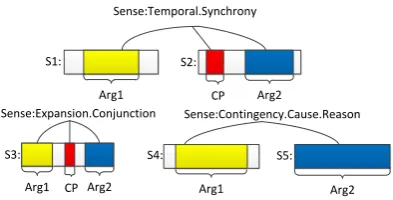
This paper descirbes our participating system for CoNLL-2016 discourse parsing shared task (Xue et al., 2016). We participate in the closed track, and due to the time limitation, we focus on En-glish. Given an document, which contains sev-eral paragraphs and each paragraph is composed of a few sentences, discourse parsing aims to identify explicit and non-explict discourse rela-tions, including explicit connnective phrases (CP), explicit/non-explicit arguments and senses. Figure 1 presents a graphical illustration of the task.
Following the official requirement, we use Sec-tion 2-21 of the PDTB 2.0 (Prasad et al., 2008; Prasad et al., 2014) as the training data, Section 22 as the development data, and Section 23 as the test data. A blind test is also used for evaluation. Table 1 presents the data statistics.
Due to the complexity of the task, our sys-tem follows previous practice and employs a
[image:1.595.319.516.242.342.2]cas-∗Correspondence author.
Figure 1: Illustration of discourse parsing.
[image:1.595.323.507.402.485.2]Train Dev Document 2000 100 Paragraph 17619 783 Sentence 38967 1675 Explicit relations 14722 680 Non-explicit relations 17813 756
Table 1: Data statistics of English.
caded framework and comprises 9 components, as shown in Figure 2. In the following, we will introduce each component in detail. The codes are released athttp://hlt.suda.edu.cn/ ˜zhlifor future research study.
2 Classification and Sequence Labeling Based on Linear Model
In this work, we implement our classification and sequence labeling models based on linear model due to its simplicity and good performance on va-riety of natural language processing tasks (Collins, 2002). Given an input instancexand a labely, a linear model defines the score of labelingxasy:
Score(x, y) =w·f(x, y)
Figure 2: Framework of our system.
wheref(.)is a feature vector constructed accord-ing to a hand-crafted feature template list andwis the corresponding feature weight vector.
The decoding task in the linear model is to find the maximum-scoring label:
ˆ
y= arg maxy Score(x, y)
To learn w, we use the standard online train-ing procedure, which use one instance for feature weight update at a time:
w(t+1)=w(t)+f(x, y∗)−f(x,yˆ)
where t is the global time of feature weight up-dates (i.e., the number of instances used for feature weight updates so far); yˆis the best label accord-ing to the current feature weights w(t); y∗ is the
gold-standard label. In this sense, online training is also known as decoding-based training, mean-ing that decodmean-ing is invoked durmean-ing trainmean-ing.
Following Collins (2002), after training, we use the averaged feature weightsPTt=1w(t)/T for
fi-nal evaluation, which is known asaveraged per-ceptron.
[image:2.595.318.519.71.196.2]For sequence labeling tasks, yis a sequence of labels instead of a single label. Besides many uni-gram features which only consider the label in the current position, as used in multi-class classifica-tion tasks, we also use label-transiclassifica-tion bigram fea-tures in our sequence labeling models. The train-ing procedure is nearly the same with the case of classification problems, except that a dynamic pro-gramming based decoding algorithm is need for exact search for the optimal label sequenceyˆ.
Figure 3: Example of a parse tree from which we extract features.
3 CP Identification
Given an input document, the first task is to ex-tract all connective phrases (CPs) (e.g., “so that”) in the document,1which we refer to asCP identi-fication. We directly adopt the method described in previous works (Wang and Lan, 2015; Kong et al., 2015), and take two steps for this task.
1. Candidate CP extraction. We extract all candidate CPs in the input document by ex-act matching with a phrase dictionary. If a string in a sentence exactly matchs a phrase in the dictionary, it then is considered as a candidate CP and will be verified in the sec-ond step. The dictionary is provided by the official organizer and contains 100 phrases.
2. CP classification. In this step, we use a sta-tistical classifier based on the linear model to check whether each candidate CP functions as a CP or not.
We directly borrow and merge the features pro-posed in Lin et al. (2014) and Pitler and Nenkova (2009), as listed in Table 2. We spent little time on feature engineering, since we found our model achieved similar accuracy to last year’s best sys-tem (Wang and Lan, 2015) using these features. On the dev data, our proposed CP identification method achieves 95.23% precison, 93.96% recall, and 94.59% F score. Figure 3 gives an example of the parse tree to better illustrate the features.
Lexical: word(CP),POS(CP),POS(prev1(CP)),POS(next1(CP)),
word(prev1(CP)) +word(CP),POS(prev1(CP)) +POS(CP),POS(prev1(CP)) +POS(first1(CP)),
word(CP) +word(next1(CP)),POS(CP) +POS(next1(CP)),POS(last1(CP)) +POS(next1(CP)) Syntactic: label(govern node(CP)),label(parent(govern node(CP))),
[image:3.595.337.497.244.315.2]label(l sib(govern node(CP))),label(r sib(govern node(CP))),path to root(govern node(CP)),
Table 2: Features for CP classification.word(p): word sequence of the given phrasep;POS(p): POS tag sequence ofp;prev1(p): the first previous position ofp;next1(p): the first next position ofp;first(p):
the first position ofp;last(p): the last position ofp;govern node(p): the highest node in the parse tree that coversp;parent(o): the parent node of the nodeo in the parse tree;l sib(o): the left sibling node ofo in the parse tree; r sib(o): the right sibling node ofo in the parse tree; path to root(o): the label sequence along the path from the nodeoto the root node in the parse tree.
Distance Train Dev 0 8880 447 1 4047 162
2 560 18
3 244 11
4 131 6
5 79 9
≥6 202 7
Table 3: Distribution of instances in terms of dis-tance between the sentence containing Arg1 and the sentence containing CP, where “0” means that Arg1 locates at the same sentence containing CP, “1” means that Arg1 is in the previous sentence of the sentence containing CP, and so on. We throw instances in which Arg1 or Arg2 locates at multi-ple sentences.
4 Explicit-Arg1 Sentence Locator: Sequence Labeling
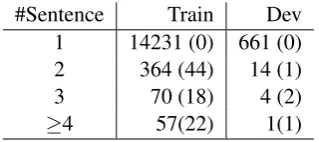
As far as we know, most previous participating systems last year assume that Arg1 lies in the same sentence or the previous sentence of CP. However, we find that there exist many cases that Arg1 lo-cates at longer-distance sentences from the CP. Ta-ble 3 shows data statistics regarding the sentence-level distance of Arg1 and CP.
We also find that there are cases that Arg1 lo-cates at more than one sentences, and the sen-tences may be discontinuous, as shown in Table 4. However, for simplicity, in this work we throw away training instances when Arg1 locates at more than one sentence.
For the Explicit-Arg1 sentence locator, we adopt a sequence labeling model and try to re-call cases of long-distance Arg1. The model starts from the sentence containing CP (with an index0),
#Sentence Train Dev 1 14231 (0) 661 (0) 2 364 (44) 14 (1) 3 70 (18) 4 (2)
[image:3.595.122.240.244.358.2]≥4 57(22) 1(1)
Table 4: Distribution of instances in terms of the number of sentences that one Arg1 locates at, where the numbers in parenthesis mean the case when the sentences are discontinuous.
and perform dynamic programming based search from right to left. For simplicity, we set the win-dow size to 6, meaning that the model considers at most six sentences, from the0thsentence contain-ing CP, to the5th sentence in front. For the fea-tures, we directly adopt those described in Lin et al. (2014), Pitler et al. (2009), Pitler and Nenkova (2009), and Knott (1996).
Especially, we design a three-tag label set in or-der to enforce the model to return exactly one sen-tence with Arg1.
1. Arg1 yes: the current sentence contains Arg1.
2. None yes: the current sentence does not con-tain Arg1, but some sentence in its right does contain Arg1.
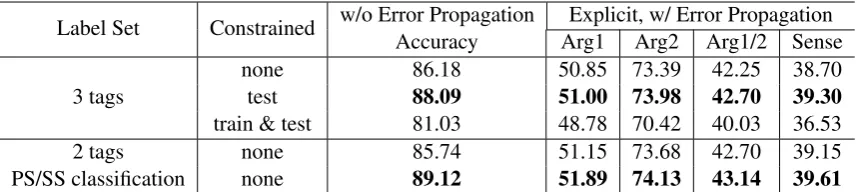
Label Set Constrained w/o Error PropagationAccuracy Arg1Explicit, w/ Error PropagationArg2 Arg1/2 Sense
3 tags nonetest 86.1888.09 50.85 73.3951.00 73.98 42.2542.70 38.7039.30
[image:4.595.85.514.62.158.2]train & test 81.03 48.78 70.42 40.03 36.53 2 tags none 85.74 51.15 73.68 42.70 39.15 PS/SS classification none 89.12 51.89 74.13 43.14 39.61
Table 5: Results of different Explicit-Arg1 sentence locators on dev data.
Label Set Constrained 0 1 Distance2 3 4 5
3 tags nonetest 424 (424) 256 (458 (445) 222 (154)162) 00 00 00 00 train & test 415 (409) 197 (131) 34 (5) 12 (3) 6 (0) 16 (3) 2 tags none 497 (444) 182 (139) 1 (0) 0 0 0 PS/SS classification none 445 (444) 235 (162) – – – –
Table 6: Result analysis of different Explicit-Arg1 sentence locators on dev data. We report the distribu-tion of the outputs of each model in terms of distance between the predicted sentence containing Arg1 and the sentence with CP, where numbers in parenthesis count correct prediction according to gold-standard answers.
As discussed in Section 2, our model is based on a linear model and uses online training to learn the feature weights. Moreover, online training is a decoding-based training procedure, meaning that a best result is found by the decoding procedure based on the current feature weights, and the result is then used for weight update. Therefore, we have three options for applying constrained decoding.
1. None: We do not use any constraints and apply post-processing to handle inconsistent outputs. When the model classifies multiple sentence intoArg1, we only keep the nearest sentence tagged as Arg1. If no sentence is tagged asArg1, we use the sentence contain-ing CP asArg1.
2. Test: We add constraints during the test phase. In the train phase, the optimal yˆ is directly used for feature weight update with-out post-processing. However, we may also post-processyˆso that it contains exactly one Arg1 label before feature update weight dur-ing traindur-ing, which we leave for future work. 3. Train & test: We add constraints during both
train and test phases.
For comparison, we also implement a model based on a two-tag label set of{Arg1,None}, in
which we cannot guarantee the output label se-quence always contains only one Arg1 through constrained decoding. Therefore, we post-process the results in the similar way to the case of the three-tag model with no constraint.
Table 5 reports the results both with and with-out error propagation. The “PS/SS classification” model is our re-implementation of the method de-scribed in Wang and Lan (2015) under our lin-ear model framework with only unigram features, which only considers the current and previous sen-tences of CP with a binary classifier. The three-tag model performs best with “test” constraints, and surprisingly worse with “train & test” constraints. Even though the “PS/SS classification” model is very simple, it is very competitive and achieves better results on the dev data than our proposed three-tag sequence labeling model. We will look into this issue in future.
re-sults that Arg1 locates at the sentence with CP or the previous sentence. We will look into this prob-lem in future.
5 Explicit-Arg1/2 Word Locator: Sequence Labeling
Data statistics show that for explicit relations, nearly all Arg2 locates at the the same sentence with CP. Therefore, based on the results of Arg1 sentence locator, we have two cases to handle: Arg1 and Arg2 locate at the same sentence with CP (SS), or Arg1 locates at a previous sentence of CP (PS). Then, we use three sequence label-ing models to locate the exact words of Arg1/2. All three models perform at the level of words, and each time assign a “Arg1/Arg2/None” tag to a word.
Many systems in CoNLL-2015 (Xue et al., 2015) evaluation also treat Arg1/2 word loca-tion as a sequence labeling problem, and uses conditional random filed (CRF) based models (Stepanov et al., 2015; Nguyen et al., 2015; Lalitha Devi et al., 2015) or recurrent neural net-works (RNN) (Wang et al., 2015).
5.1 Explicit: SS Arg1/2 Word Locator
For the SS case, the sequence labeling model per-forms decoding from left to right on the CP sen-tence, and classifies each word into four cate-gories: “Arg1/Arg2/None/CP”. The words inside the CP (given as input) are fixed to be “CP” be-fore decoding, and all other words are not allowed to be tagged as “CP” during decoding. For the fea-tures, we directly adopt those described in Lin et al. (2014), Pitler et al. (2009), Pitler and Nenkova (2009), Knott (1996), Kong et al. (2015). On the dev data, the model achieves an word-level accu-racy of 53.45% without error propagation.
5.2 Explicit: PS Arg1 Word locator
For the PS case, we first use a sequence labeling model to locate the words of Arg1. The model perform decoding from left to right on the sen-tence returned by the Explicit-Arg1 sensen-tence loca-tor, and classifies each word into two categories: “Arg1/None”. For the features, we directly adopt those described in Lin et al. (2014), Pitler et al. (2009), Knott (1996). On the dev data, the model achieves an word-level accuracy of 67.14% with-out error propagation.
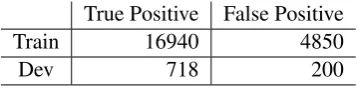
True Positive False Positive
Train 16940 4850
[image:5.595.327.506.62.107.2]Dev 718 200
Table 7: Distribution of adjacent sentences having non-explicit relation.
5.3 Explicit: PS Arg2 Word Locator
To locate the Arg2 words in the PS case, we use a sequence labeling model to perform decoding from left to right on the CP sentence, and classi-fies each word into two categories: “Arg2/None”. Please note that the words in CP always have a special tag “CP” when decoding. For the fea-tures, we directly adopt those described in Lin et al. (2014), Pitler et al. (2009), Wang and Lan (2015), Kong et al. (2015), Knott (1996). On the dev data, the model achieves an word-level accu-racy of 67.14% without error propagation.
6 Explicit Sense Classification
After obtaining the CP and the Arg1/2 words, we then use a linear model based classifier to classify the sense of each explicit relation. We directly adopt the features described in Lin et al. (2014). On the dev data, the model achieves an accuracy of 87.65% without error propagation.
7 Non-explicit Sense Classification
After processing the explicit relations, we then turn to the problem of non-explicit relation pars-ing. As suggested by the official organizer, if two adjacent sentences do not have explicit relation after previous processing, we consider them as a candidate sentence pair having non-explicit rela-tion. Please note that we only consider sentence pairs that are in the same paragraph.
Component Dev Test Blind test
P R F P R F P R F
All Arg1 extractor 57.31 62.40 59.75 53.43 56.86 55.09 41.85 53.89 47.11 All Arg2 extractor 70.06 76.27 73.03 67.30 71.62 69.40 57.73 74.33 64.99 All Arg1&Arg2 extractor 47.84 52.08 49.87 42.75 45.50 44.08 33.66 43.34 37.90 All Sense 32.72 30.47 31.56 27.47 25.84 26.63 24.49 18.94 21.36
Explicit Connectives 93.53 95.07 94.29 94.69 94.79 94.74 89.57 92.57 91.04 Explicit Arg1 extractor 50.59 51.42 51.00 44.96 45.01 44.99 41.19 42.57 41.86 Explicit Arg2 extractor 73.38 74.59 73.98 72.05 72.13 72.09 68.71 71.00 69.84 Explicit Arg1&Arg2 extractor 42.35 43.05 42.70 37.38 37.42 37.40 32.91 34.01 33.46 Explicit Sense 39.16 39.45 39.30 32.97 32.97 32.97 27.99 26.98 27.47 Non-Explicit Arg1 extractor 62.17 72.31 66.86 59.74 67.44 63.36 41.81 68.08 51.80 Non-Explicit Arg2 extractor 67.06 78.00 72.12 62.99 71.11 66.81 48.39 78.80 59.96 Non-Explicit Arg1&Arg2 extractor 52.78 61.38 56.76 47.64 53.78 50.52 34.30 55.86 42.50 Non-Explicit Sense 26.12 22.56 24.21 21.83 19.35 20.51 19.95 12.10 15.06
Table 8: Official results of our system on the dev, test, and blind test datasets. “All” means both explicit and non-explicit relations.
the dev data. We will look into this problem in future.
For the features, we directly adopt those de-scribed in Lin et al. (2014), Pitler et al. (2009), Rutherford and Xue (2014), Kong et al. (2015). On the dev data, the model achieves an accuracy of 34.04% without error propagation.
8 Non-explicit Arg1/2 Word Locator: Sequence Labeling
According to data statistics, if two adjacent sen-tences have non-explicit relation, Arg1 locates at the first sentence while Arg2 locates at the sec-ond sentence. Therefore, we use two separate se-quence labeling models to locate Arg1/2 words in the two sentences respectively. If the non-explicit sense is “EntRel”, we directly label the whole first sentence as Arg1 and the whole second sentence as Arg2, according to data statistics. For the features, we directly adopt those described in Lin et al. (2014), Pitler et al. (2009), Wang and Lan (2015), Kong et al. (2015). On the dev data, the two models achieve word-level accuracy of 68.14% on Arg1 and 75.82% on Arg2 without error propaga-tion.
9 Final Results
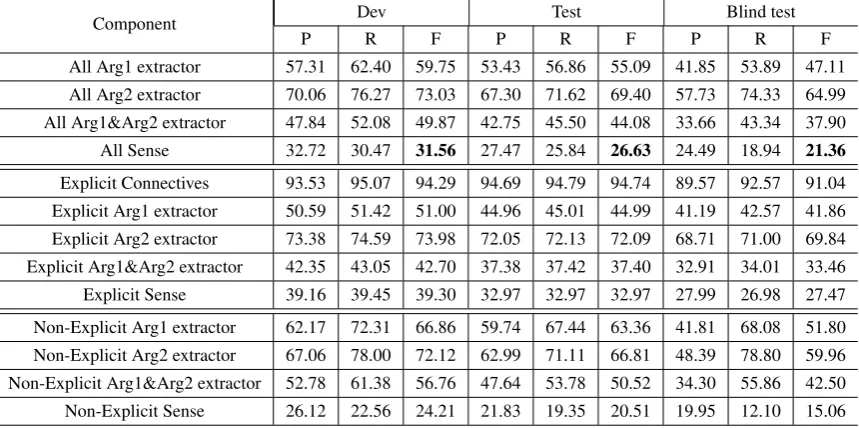
Table 8 shows the official results of our system on the dev, test and blind test datasets from the orga-nizers through the TIRA platform (Potthast et al., 2014). Our system ranks the 7th place among 14
Linear Maximum Entropy Explicit Sense 39.30 44.60 (+5.30) All Sense 31.56 32.81 (+1.25)
Table 9: Comparison of the linear model and the maximum entropy model on Explicit relations with error propagation on dev data.
systems in both test and blind test datasets in the closed track of CoNLL-2016 shared task on shal-low discourse parsing of English.
10 Explicit Sense Classification with a Maximum Entropy Model
After obtaining the evaluation results of all sys-tems, we find that our system achieves clearly lower performances on sense classifications than other systems. Therefore, we replace the linear classification model with a log-linear maximum entropy model in the Explicit sense classification task. We use AdaGrad for deciding the feature up-date step (Duchi et al., 2011). Table 9 shows the results. We can see that using maximum entropy leads to large improvement.
[image:6.595.81.516.60.276.2] [image:6.595.85.515.64.278.2]11 Conclusions and Future Work
So far, our approach is composed of too many components without any interaction. In the fu-ture, we would like to pursue two directions. First, we will try to design a more principled and uni-fied framework so that tasks at different levels can influence each other. Second, we plan to try other machine learning techniques such as neu-ral networks for better representing and modeling discourse-level information.
Acknowledgments
The authors would like to thank the anonymous reviewers for the helpful comments. In building our system, we use a lot of codes of two partic-ipating teams last year, and we are very grateful for their kind sharing (Kong et al., 2015; Wang and Lan, 2015). We also would like to thank the organizer of this shared task for their hard work, especially in data annotation and prepa-ration. This work was supported by National Natural Science Foundation of China (Grant No. 61502325, 61525205), and the Natural Science Foundation of the Jiangsu Higher Education Insti-tutions of China (No. 15KJB520031).
References
Michael Collins. 2002. Discriminative training meth-ods for hidden markov models: Theory and exper-iments with perceptron algorithms. InProceedings of EMNLP 2002, pages 1–8.
John Duchi, Elad Hazan, and Yoram Singer. 2011. Adaptive subgradient methods for online learning and stochastic optimization. Journal of Machine Learning Research, 12(Jul):2121–2159.
Alistair Knott. 1996. A data-driven methodology for motivating a set of coherence relations.
Fang Kong, Sheng Li, and Guodong Zhou. 2015. The sonlp-dp system in the conll-2015 shared task. In
Proceedings of the Nineteenth Conference on Com-putational Natural Language Learning - Shared Task, pages 32–36, Beijing, China, July. Association for Computational Linguistics.
Sobha Lalitha Devi, Sindhuja Gopalan, Lakshmi S, Pattabhi RK Rao, Vijay Sundar Ram, and Malarkodi C.S. 2015. A hybrid discourse relation parser in conll 2015. InProceedings of the Nineteenth Con-ference on Computational Natural Language Learn-ing - Shared Task, pages 50–55, Beijing, China, July. Association for Computational Linguistics.
Ziheng Lin, Hwee Tou Ng, and Min-Yen Kan. 2014. A pdtb-styled end-to-end discourse parser. Natural Language Engineering, 20(02):151–184.
Son Nguyen, Quoc Ho, and Minh Nguyen. 2015. Jaist: A two-phase machine learning approach for identi-fying discourse relations in newswire texts. In Pro-ceedings of the Nineteenth Conference on Compu-tational Natural Language Learning - Shared Task, pages 66–70, Beijing, China, July. Association for Computational Linguistics.
Emily Pitler and Ani Nenkova. 2009. Using syn-tax to disambiguate explicit discourse connectives in text. InProceedings of the ACL-IJCNLP 2009 Con-ference Short Papers, pages 13–16. Association for Computational Linguistics.
Emily Pitler, Annie Louis, and Ani Nenkova. 2009. Automatic sense prediction for implicit discourse re-lations in text. InProceedings of the Joint Confer-ence of the 47th Annual Meeting of the ACL and the 4th International Joint Conference on Natural Lan-guage Processing of the AFNLP: Volume 2-Volume 2, pages 683–691. Association for Computational Linguistics.
Martin Potthast, Tim Gollub, Francisco Rangel, Paolo Rosso, Efstathios Stamatatos, and Benno Stein. 2014. Improving the Reproducibility of PAN’s Shared Tasks: Plagiarism Detection, Author Iden-tification, and Author Profiling. In Evangelos Kanoulas, Mihai Lupu, Paul Clough, Mark Sander-son, Mark Hall, Allan Hanbury, and Elaine Toms, editors, Information Access Evaluation meets Mul-tilinguality, Multimodality, and Visualization. 5th International Conference of the CLEF Initiative (CLEF 14), pages 268–299.
Rashmi Prasad, Nikhil Dinesh, Alan Lee, Eleni Milt-sakaki, Livio Robaldo, Aravind K Joshi, and Bon-nie L Webber. 2008. The penn discourse treebank 2.0. InLREC. Citeseer.
Rashmi Prasad, Bonnie Webber, and Aravind Joshi. 2014. Reflections on the penn discourse treebank, comparable corpora, and complementary annota-tion. Computational Linguistics.
Attapol Rutherford and Nianwen Xue. 2014. Dis-covering implicit discourse relations through brown cluster pair representation and coreference patterns. InEACL, volume 645, page 2014.
Evgeny Stepanov, Giuseppe Riccardi, and Ali Orkan Bayer. 2015. The UniTN discourse parser in conll 2015 shared task: Token-level sequence labeling with argument-specific models. In Proceedings of the Nineteenth Conference on Computational Natu-ral Language Learning - Shared Task, pages 25–31, Beijing, China, July. Association for Computational Linguistics.
Nine-teenth Conference on Computational Natural Lan-guage Learning - Shared Task, pages 17–24, Bei-jing, China, July. Association for Computational Linguistics.
Longyue Wang, Chris Hokamp, Tsuyoshi Okita, Xi-aojun Zhang, and Qun Liu. 2015. The dcu dis-course parser for connective, argument identification and explicit sense classification. InProceedings of the Nineteenth Conference on Computational Natu-ral Language Learning - Shared Task, pages 89–94, Beijing, China, July. Association for Computational Linguistics.
Nianwen Xue, Hwee Tou Ng, Sameer Pradhan, Rashmi Prasad, Christopher Bryant, and Attapol Ruther-ford. 2015. The conll-2015 shared task on shal-low discourse parsing. InProceedings of the Nine-teenth Conference on Computational Natural Lan-guage Learning - Shared Task, pages 1–16, Beijing, China, July. Association for Computational Linguis-tics.