The CLaC Discourse Parser at CoNLL-2016
Majid Laali∗ Andre Cianflone∗ Leila Kosseim
Department of Computer Science and Software Engineering Concordia University, Montreal, Quebec, Canada
{Laali, Cianflone, Kosseim}@encs.concordia.ca
Abstract
This paper describes our submission (CLaC) to the CoNLL-2016 shared task on shallow discourse parsing. We used two complementary approaches for the task. A standard machine learning approach for the parsing of explicit relations, and a deep learning approach for non-explicit rela-tions. Overall, our parser achieves an F1
-score of 0.2106 on the identification of dis-course relations (0.3110 for explicit rela-tions and 0.1219 for non-explicit relarela-tions) on the blind CoNLL-2016 test set.
1 Introduction
Shallow discourse parsing is defined as the identi-fication of two discourse units, or discourse argu-ments, and labeling their relation. Although the topic of shallow discourse parsing has received much interest in the past few years (e.g. (Zhang et al., 2015; Weiss, 2015; Ji et al., 2015; Ruther-ford and Xue, 2014; Kong et al., 2014; Feng et al., 2014)), the performance of the state-of-the-art discourse parsers is not yet adequate to be used in other downstream Natural Language Process-ing applications. For example, the best parser submitted at CoNLL-2015 (Wang and Lan, 2015) achieved an F1 score of 0.2400 on the blind test
dataset.
For the CoNLL 2016 task of shallow discourse parsing, four types of discourse relations have to be annotated in texts (more details of the task can be found in (Xue et al., 2016)):
1. Explicit Discourse Relations: explicit dis-course relations are explicitly signalled within the text throughdiscourse connectives such asbecause, however, since,etc.
∗Both authors contributed equally
2. Implicit Discourse Relations: implicit dis-course relations are inferred by the reader and no discourse connective is used within the text to convey the relation. As a reader, implicit discourse relations can be inferred by inserting a discourse connective (called an implicit discourse connective) in the text that best expresses the inferred relation.
3. AltLex Discourse Relations: Similarly to im-plicit discourse relations, AltLex are not sig-nalled through the presence of discourse con-nectives in the text. However, the rela-tion is alternatively lexicalized by some non-connective expression, hence inserting an im-plicit discourse connectiveto express the in-ferred relation would lead to a redundancy.
4. EntRel Discourse Relations: EntRel course relations are defined between two dis-course arguments where only an entity-based coherence relation could be perceived.
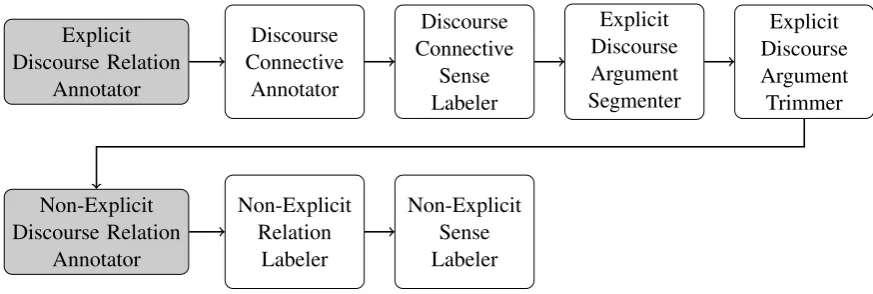
In this paper, we report on the development and results of our discourse parser for the CoNLL 2016 shared task. As shown in Figure 1, our parser, namedCLaC Discourse Parser, consists of two main components: the Explicit Discourse Re-lation Annotator and the Non-Explicit Discourse Relation Annotator .
The Explicit Discourse Relation Annotator is based on the parser that we submitted last year to CoNLL 2015 (Laali et al., 2015). For this year’s submission, we improved its components by (1) adding new features (see Section 2 for more de-tails), (2) using a sequence classifier instead of a multiclass classifier in the Discourse Argument Segmenter, and (3) defining a new component, the Discourse Argument Trimmer, to identify at-tributes and prune discourse arguments.
Explicit Discourse Relation
Annotator
Discourse Connective
Annotator
Discourse Connective
Sense Labeler
Explicit Discourse Argument Segmenter
Explicit Discourse Argument Trimmer
Non-Explicit Discourse Relation
Annotator
Non-Explicit Relation
Labeler
[image:2.595.79.516.61.208.2]Non-Explicit Sense Labeler
Figure 1: Pipeline of the CLaC Discourse Parser
Last year’s system did not address the annota-tion of non-explicit discourse relaannota-tions (i.e. im-plicit, AltLex and EntRel discourse relations). For this year, we therefore built this module from scratch. The Non-Explicit Discourse Relation An-notator first uses a binary Convolutional Neural Network (ConvNet) to detect whether a relation exists in a text devoid of a discourse connective, then uses a multiclass ConvNet to label the rela-tion.
2 Explicit Discourse Relation Annotator Figure 1 shows the pipeline of the CLaC parser. The top row in Figure 1 focuses on the Explicit Discourse Relation Annotator. This pipeline con-sists of four main components: (1) Discourse Connective Annotator, (2) Discourse Connective Sense Labeler, (3) Explicit Relation Argument Segmenterand (4)Discourse Argument Trimmer.
Modules 1, 2 and 3 are based on last year’s sys-tem (Laali et al., 2015) while module 4 has been newly developed to address a weak issue from last year.
2.1 Discourse Connective Annotator
The Discourse Connective Annotator annotates discourse connectives within a text. To label dis-course connectives, the annotator first searches the input texts for terms that match any of the 100 discourse connectives listed in the Penn Discourse Treebank (Prasad et al., 2008a). Inspired by (Pitler et al., 2009), a C4.5 decision tree binary classifier (Quinlan, 1993) is used to detect if each discourse connective is used in a discourse usage or not. In addition to the six features proposed by (Pitler et al., 2009), this year we also used four of the fea-tures proposed by (Lin et al., 2014). In total 10
features were used:
1. The discourse connective text in lowercase. 2. The categorization of the case of the
connec-tive:all lowercaseorinitial uppercase. 3. The highest node (called the SelfCat node)
in the parse tree that covers the connective words but nothing more.
4–6. The parent, the left sibling and the right sib-ling of theSelfCat.
7–10. The left and the right word of discourse con-nective and their parts of speech.
2.2 Discourse Connective Sense Labeler
Once discourse connectives have been classified as discourse usage or not, theDiscourse Connective Sense Labeler labels the discourse relation sig-nalled by the annotated discourse connectives with one of the 14 labels specified by the task. This component also uses a C4.5 decision tree classifier (Quinlan, 1993) with the same 10 features used by theDiscourse Connective Annotator(see Sec-tion 2.1).
2.3 Discourse Argument Segmenter
The goal of the Discourse Argument Segmenter is to detect the discourse argument boundaries. This module first assumes that both discourse ar-guments (i.e. ARG1 and ARG2) are located in the same sentence that contains the discourse connec-tive. If ARG1 is not found in the sentence, then the Discourse Argument Segmenter selects the imme-diately preceding sentence as ARG1.
first select all the constituents in the parse tree that are directly connected to one of the nodes in the path from the discourse connective to the root of the sentence and classify them into to one of three categories: part-of-ARG1,part-of-ARG2 or NON (i.e. not part of any discourse argument). Then, all constituents which are tagged as part of ARG1 or as part of ARG2 are merged to obtain the actual boundaries of ARG1 and ARG2.
Instead of using integer programming as pro-posed by Kong et al. (2014), we used a Con-ditional Random Field (CRF) in order to lever-age global information (i.e. information across all constituent candidates). CRFs have been pre-viously used for discourse argument identification (Ghosh et al., 2011) but at the token level. Kong et al. (2014)’s approach generates a sequence of con-stituents and therefore, CRFs can be applied at the constituent level.
We used the following categories of features for the CRF:
1. Discourse connective features:This category includes all 10 features used in the Discourse Connective Annotator (see Section 2.1). 2. Constituent features: Motivated by Kong et
al. (2014)’features, we defined the following five features:
(a) The constituents in the path from the current constituent to the SelfCat node in the parse tree.
(b) The length of the path between the cur-rent constituent and theSelfCatnode. (c) The context of the current constituent in
the parse tree. The context of a con-stituent is defined by its label, the label of its parent and the label of its left and right siblings in the parse tree.
(d) The position of the current constituent relative to theSelfCat node (i.e. left or right).
(e) The syntactic production rule of the cur-rent constituent.
3. Lexical features:This year, we also used lex-ical features including the head of the cur-rent constituent and four tokens that appear in the constituent boundary (the first token of the constituent and its previous token and the last token of the constituent and its following token).
2.4 Discourse Argument Trimmer
According to the PDTB manual (Prasad et al., 2008b), annotators should keep the span of two discourse arguments as small as possible and should remove any extra information that is not necessary for the discourse relation. Following this idea, the Discourse Argument Trimmer is a classifier that excludes any constituent from the discourse argument span that is not related to the discourse relations.
To do so, we developed a binary classifier that labels all the constituents and tokens in the an-notated discourse arguments with either part-of-ArgumentorNot-part-of-Argumentto exclude to-kens that are not part of the discourse argument. Once the classifier has labeled all the tokens and constituents, we remove from the discourse argu-ments all tokens that are labeled as Not-Part-of-Argument or part of a constituent with the Not-Part-of-Argumentlabel.
A C4.5 decision tree binary classifier was devel-oped using the following features:
1. The head of the constituent or the text of the token.
2. The label of the constituent in the syntax tree or the POS of token.
3. The position of the constituent/token (i.e whether it appears at the beginning, inside or at the end of the discourse argument).
4. The syntactic production rule of the con-stituent’s parent and grand parent or “null” for tokens.
5. The type of the argument (i.e. ARG1 or ARG2)
6. The node label/POS of the left and right sib-lings of the constituent/token in the syntactic tree.
3 Non-Explicit Discourse Relation Annotator
2014)), we wanted to investigate if similar net-works could be used to address the task of non-explicit discourse relation recognition.
The Non-Explicit Discourse Relation Annota-tor begins where the Explicit Discourse Relation Annotator ends. The Explicit Discourse Relation Annotator only analyzes texts which contain a dis-course connective; all other segments are sent to the Non-Explicit Discourse Relation Annotator.
Because these text segments may or may not contain a discourse relation, the Non-Explicit Dis-course Relation Annotator first sends each text segment to a binary ConvNet to identify which segments contain a discourse relations and which do not. The Non-Explicit Discourse Relation An-notator trims trailing discourse punctuation as per the shared task requirement. Only discourses with two consecutive arguments are considered as pos-sible non-explicit discourses. Non-discourse seg-ments are removed from the pipeline. Sense la-belling is then performed on the remaining seg-ments using a multiclass ConvNet.
3.1 Input
The two ConvNets have an identical setup. The input to the models are pretrained word embed-dings from the Google News set, as trained with Word2Vec1. Words not in the Google News set are
randomly initialized. Word embeddings are non-static, meaning that they are allowed to change during training.
Each input to the networks is composed of the two padded discourse arguments. ARG1 is padded to the length of the longest ARG1, and ARG2 is similarly padded to the length of the longest ARG2. Since the training set contains a few un-usually long arguments, we limited the argument size to the size of the 99.5th percentile. This
re-duced the length of ARG1 from 1000 to 60 words, and that of ARG2 from 400 to 61 words. This dra-matically decreased the model complexity with in-significant impact on performance. The two argu-ments are then concatenated to form a single input. Each word is then replaced with their embedded vector representation.
Letlbe the length of a single input (the number of words in the discourse plus padding, 121). Let
dbe the dimensionality of a word vector (300 for our pretrained embedding). Then the input to the networks, the matrix of discourse embedding, can
1https://code.google.com/archive/p/word2vec/
be denotedQ∈Rl×d.
3.2 Network
The network configuration is largely based on (Kim, 2014). We applied a narrow convolution over Q with height w (i.e. w words) and width
d(the entire word vector) defined as regionh ∈
Rd×w. We added a biasband applied a nonlinear functionf on the convolution to give us features
ci, whereiis the ith word in the discourse input.
This is shown in Formula 1.
ci=f(h·Qi:i+w−1+b) (1)
The nonlinear functionf in our case was the ex-ponential linear unit (ELU) (Clevert et al., 2016), indicated in Formula 2.
f(x) =
(
x ifx >0
α(exp(x)−1) ifx≤0 (2) Since the convolution is narrow, there are l −
w + 1 such features, giving us a feature map
c ∈ Rl−w+1. We applied max-over-time pooling
oncto extract the most “important” feature as in Formula 3.
y=max(c) (3)
We applied 128 feature maps and pooled each one of these. We repeated the entire process 3 times for w = 3,4 and 5, and concatenated them together. This gave us a final matrixM ∈
R3×128. We reshapedM to a flat vector and
ap-plied dropout as our regularization (Srivastava et al., 2014), giving us vectoru ∈ R384. u is fully
connected to a softmax output layer where loss is measured with cross-entropy. The network was trained in mini-batches and optimized with the Adamalgorithm (Kingma and Ba, 2015).
4 Results and Analysis
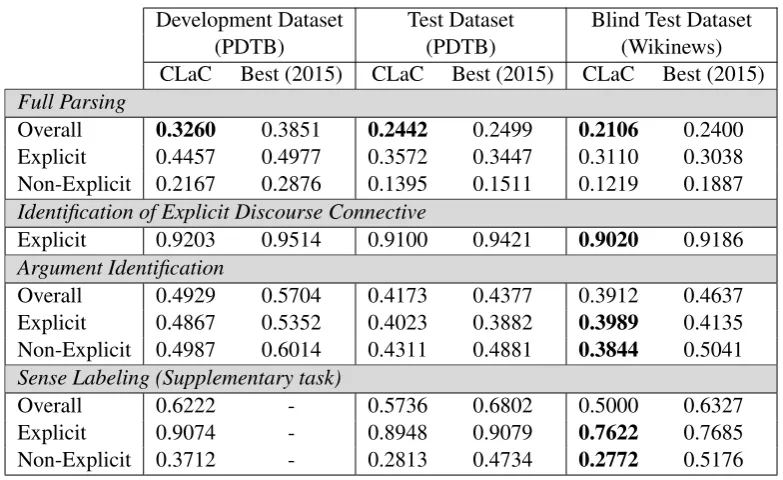
Table 1 shows the F1 scores of the CLaC
Dis-course Parser and the best parser at CoNLL 2015 (Wang and Lan, 2015) for different datasets. The overall F1 score of the CLaC parser is 0.2106
with the blind test dataset which is lower than the F1 score of the best parser at CoNLL 2015 (i.e.
0.2400). For explicit relations, the performance of our parser (F1=0.3110) is higher than the
per-formance of last year’s best parser (F1=0.3038);
however, for non-explicit relations there is gap be-tween the performance of our parser (F1=0.1219)
Development Dataset Test Dataset Blind Test Dataset
(PDTB) (PDTB) (Wikinews)
CLaC Best (2015) CLaC Best (2015) CLaC Best (2015) Full Parsing
Overall 0.3260 0.3851 0.2442 0.2499 0.2106 0.2400 Explicit 0.4457 0.4977 0.3572 0.3447 0.3110 0.3038 Non-Explicit 0.2167 0.2876 0.1395 0.1511 0.1219 0.1887 Identification of Explicit Discourse Connective
Explicit 0.9203 0.9514 0.9100 0.9421 0.9020 0.9186 Argument Identification
Overall 0.4929 0.5704 0.4173 0.4377 0.3912 0.4637 Explicit 0.4867 0.5352 0.4023 0.3882 0.3989 0.4135 Non-Explicit 0.4987 0.6014 0.4311 0.4881 0.3844 0.5041 Sense Labeling (Supplementary task)
[image:5.595.103.495.59.299.2]Overall 0.6222 - 0.5736 0.6802 0.5000 0.6327 Explicit 0.9074 - 0.8948 0.9079 0.7622 0.7685 Non-Explicit 0.3712 - 0.2813 0.4734 0.2772 0.5176
Table 1: F1-score of the CLaC Discourse Parser and the best parser of 2015 with Different Datasets.
[image:5.595.313.519.336.393.2]4.1 Explicit Discourse Relation Annotator
Table 1 shows that the argument segmentation component is the bottleneck of the Explicit Dis-course Relation Annotator. While the CLaC Discourse parser achieves competitive results in the identification of explicit discourse connectives (F1=0.9020) and labeling the sense signalled by
the discourse connectives (F1=0.7622) with the
blind test dataset, its performance is rather low (F1=0.3989) for the identification of the discourse
argument boundaries.
Our results show that the CLaC Discourse Parser has difficulty in detecting ARG1. As Table 2 shows, the precision and recall for the identification of ARG1 (i.e. P=0.4928 and R=0.4749) are significantly lower than for ARG2 (i.e. P=0.7194 and R=0.6932). ARG2 is syntac-tically bound to discourse connectives and there-fore, it is easier to detect its boundaries. More-over, as mentioned in Section 2.3, our approach does not account for arguments that appear in non-adjacent sentences. However, according to Prasad et al. (2008a), 9.02% of ARG1 in the PDTB do not appear in the sentence adjacent to the discourse connective.
The exact match of CoNLL is a strict evalua-tion measure for the argument identificaevalua-tion. For example, in Sentence (1), our parser did not detect the word ‘it’ (boxed) and therefore, accordingly to the exact match scoring schema, the boundaries of the discourse arguments are incorrect.
P R F1
Arg1 0.4928 0.4749 0.4837
Arg2 0.7194 0.6932 0.7061
Arg1 & Arg2 0.4065 0.3917 0.3989
Table 2: Results of the CLaC Discourse parser for the identification of discourse arguments with the blind test dataset (exact match).
(1) The law does allow the RTC to borrow from the Treasury up to $5 billion at any time. Moreover, it says the RTC’s total obligations may not exceed $50 billion, but that figure is derived after includ-ing notes and other debt, and subtract-ing from it the market value of the as-sets the RTC holds.2
Such cases where the CLaC parser misses the argument boundaries by only a few words (added or deleted) are frequent. For example, as Ta-ble 3 shows, if we evaluate the argument bound-aries with the partial match metric defined in the CoNLL evaluator, the performance increases sig-nificantly. The partial match metric accepts the argument boundaries if 70% of the tokens of the identified discourse arguments are correct. Using this metric, the F1 score of the identification of
ARG1 and ARG2 increases by 0.1917 and 0.0777 respectively.
2This example is taken from the CoNLL development
P R F1
Arg1 0.6740 0.6768 0.6754
Arg2 0.7695 0.7986 0.7838
[image:6.595.78.286.62.118.2]Arg1 & Arg2 0.6386 0.6667 0.6523
Table 3: Results of the CLaC Discourse parser for the identification of discourse argument with the blind test dataset (partial match).
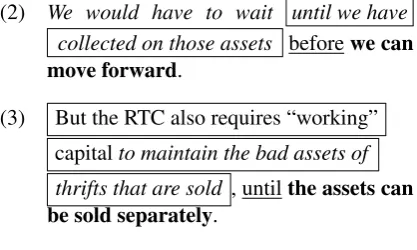
We also observed that the Explicit Discourse Argument Trimmer has a difficulty detecting what parts of the texts are related to discourse relations especially if multiple events appear in the text with a TEMPORAL discourse relation. For example, in Sentence (2) the parser identified the boxed words as ARG1 and missed required information. On the other hand in Sentence (3) the parser included ex-tra information in ARG1. This type of error ap-pears more frequently for ARG1 which explains why the partial match metric improves the identi-fication of ARG1 more than the identification of ARG2.
(2) We would have to wait until we have collected on those assets beforewe can move forward.
(3) But the RTC also requires “working” capitalto maintain the bad assets of thrifts that are sold , untilthe assets can be sold separately.
4.2 Non-Explicit Discourse Relation Annotator
Table 1 shows that for the task of non-explicit sense labelling the Non-Explicit Discourse Rela-tion Annotator achieves an F1-score of 0.2813 on
the test dataset and 0.2772 on the blind dataset, versus 0.3712 on the developement dataset. The similar performance on the test and blind datasets and the 10% difference with the development dataset suggest overfitting of our neural network.
For argument segmentation, just removing tailing punctuations from consecutive sentences achieves an F1-score of 0.3884. According to
Prasad et al. (2008a), non-explicit relations are present between successive pairs of sentences within paragraphs, but also intra-sententially be-tween complete clauses separated by a semicolon or a colon. Our simple argument segmentation heuristic ignores intra-sentential arguments. We
believe that this accounts for its poor performance on the identification of discourse arguments.
When looking more closely at the sense la-belling performance (data not shown), it seems that our network tends to overweight a few high prior probability senses, notably EntRel and Ex-pansion.Conjunction.EntRelis predicted for 46% of samples, whereas it only represents 29% of the development dataset. Expansion.Conjunction is predicted for 24% of samples, whereas it repre-sents only 17% of the development dataset.
We believe that one of the key issues for the Non-Explicit Discourse Relation Annotator is the size of the training set for non-explicit discourse. 17,813 samples is limited for a ConvNet, hence re-ducing the possible complexity of our model. The Non-Explicit Discourse Relation Annotator un-derperformed the best parser from CoNLL-2015 on sense labeling by 24.04% for the blind dataset, showing the advantage of non-neural network ma-chine learning techniques when training data is scarce.
5 Conclusion and Future Work
A major area of concern in our system is the ar-gument identification, both for explicit and non-explicit discourse relations. If we compare the re-sults of the Supplementary task and Full Parsing task in Table 1, we can see that the Full Parsing F1-scores are about half of the Supplementary task
F1-scores due to mis-identification of arguments.
It is necessary to consider cases where ARG1 appears in non-adjacent sentences to improve the identification of discourse arguments for explicit relations. We believe that by considering co-references in texts, we can expand our approach to address non-adjacent discourse arguments. Fur-thermore, it would be interesting to define new features by using ARG2 to detect what informa-tion can be added to or removed from ARG1. Fi-nally, we believe that new ways to identify dis-course arguments, such as Recurrent Neural Net-works (Long Short Term Memory), could enhance the performance of the argument identification. To improve the identification of discourse arguments for non-explicit relations, we plan to expand the Explicit Discourse Argument Trimmer for non-explicit relations.
[image:6.595.83.292.376.501.2]Acknowledgments
The authors would like to thank Sohail Hooda for his programming help and the anonymous review-ers for their comments on the paper. This work was financially supported by an NSERC Discov-ery Grant.
References
Djork-Arn´e Clevert, Thomas Unterthiner, and Sepp Hochreiter. 2016. Fast and accurate deep network learning by exponential linear units (elus). In Pro-ceeding of the 2016 International Conference on Learning Representation (ICLR 2016), San Juan, Puerto Rico, May.
Vanessa Wei Feng, Ziheng Lin, and Graeme Hirst. 2014. The Impact of Deep Hierarchical Dis-course Structures in the Evaluation of Text Coher-ence. InProceedings of the 25th International Con-ference on Computational Linguistics (COLING-2014), Dublin, Ireland.
Sucheta Ghosh, Richard Johansson, and Sara Tonelli. 2011. Shallow discourse parsing with conditional random fields. In Proceedings of the 5th Interna-tional Joint Conference on Natural Language Pro-cessing, pages 1071–1079, Chiang Mai, Thailand, November.
Yangfeng Ji, Gongbo Zhang, and Jacob Eisenstein. 2015. Closing the Gap: Domain Adaptation from Explicit to Implicit Discourse Relations. In Pro-ceedings of the 2015 Conference on Empirical Methods in Natural Language Processing (EMNLP 2015), pages 2219–2224, Lisbon, Portugal, Septem-ber.
Yoon Kim. 2014. Convolutional neural networks for sentence classification. In Proceedings of the 2014 Conference on Empirical Methods in Natural Language Processing (EMNLP 2014), pages 1746– 1751, Doha, Qatar, October.
Diederik Kingma and Jimmy Ba. 2015. Adam: A method for stochastic optimization. InProceeding of the 2015 International Conference on Learning Representation (ICLR 2015), San Diego, California. Fang Kong, Hwee Tou Ng, and Guodong Zhou. 2014. A Constituent-Based Approach to Argument Label-ing with Joint Inference in Discourse ParsLabel-ing. In
Proceedings of the 2014 Conference on Empirical Methods in Natural Language Processing (EMNLP 2014), pages 68–77, Doha, Qatar, October.
Majid Laali, Elnaz Davoodi, and Leila Kosseim. 2015. The CLaC Discourse Parser at CoNLL-2015. In
Proceedings of the Nineteenth Conference on Com-putational Natural Language Learning - Shared Task (CoNLL 2015), pages 56–60, Beijing, China, July.
Ziheng Lin, Hwee Tou Ng, and Min-Yen Kan. 2014. A PDTB-styled end-to-end discourse parser. Natural Language Engineering, 20(2):151–184.
Emily Pitler, Annie Louis, and Ani Nenkova. 2009. Automatic sense prediction for implicit discourse re-lations in text. InProceedings of 47th Annual Meet-ing of the Association for Computational LMeet-inguis- Linguis-tics and the 4th International Joint Conference on Natural Language Processing of the AFNLP (ACL-IJCNLP 2009), page 683–691, Suntec, Singapore, August.
Rashmi Prasad, Nikhil Dinesh, Alan Lee, Eleni Milt-sakaki, Livio Robaldo, Aravind K. Joshi, and Bon-nie L. Webber. 2008a. The Penn Discourse Tree-Bank 2.0. InProceedings of the Sixth International Conference on Language Resources and Evalua-tion (LREC’08), pages 28–30, Marrakech, Morocco, May.
Rashmi Prasad, Eleni Miltsakaki, Nikhil Dinesh, Alan Lee, Aravind Joshi, Livio Robaldo, and Bonnie L. Webber. 2008b. The Penn Discourse Treebank 2.0 annotation manual. Technical Report IRCS-08-01, Institute for Research in Cognitive Science, Univer-sity of Pennsylvania.
J. Ross Quinlan. 1993. C4.5: Programs for Machine Learning. Morgan Kaufmann Publishers Inc., San Francisco, CA, USA.
Attapol T. Rutherford and Nianwen Xue. 2014. Discovering Implicit Discourse Relations Through Brown Cluster Pair Representation and Coreference Patterns. InProceedings of the 14th Conference of the European Chapter of the Association for Compu-tational Linguistics (EACL 2014), pages 645–654, Gothenburg, Sweden, April.
Nitish Srivastava, Geoffrey Hinton, Alex Krizhevsky, Ilya Sutskever, and Ruslan Salakhutdinov. 2014. Dropout: A simple way to prevent neural networks from overfitting. The Journal of Machine Learning Research, 15(1):1929–1958.
Jianxiang Wang and Man Lan. 2015. A refined end-to-end discourse parser. InProceedings of the Nine-teenth Conference on Computational Natural Lan-guage Learning: Shared Task (CoNLL 2015), pages 17–24, Beijing, China, July.
Gregor Weiss. 2015. Learning representations for text-level discourse parsing. InProceedings of the ACL-IJCNLP 2015 Student Research Workshop, pages 16–21, Beijing, China, July.
Nianwen Xue, Hwee Tou Ng, Sameer Pradhan, Bon-nie Webber, Attapol Rutherford, Chuan Wang, and Hongmin Wang. 2016. The CoNLL-2016 shared task on multilingual shallow discourse parsing. In
Ye Zhang and Byron Wallace. 2016. A sensitiv-ity analysis of (and practitioners’ guide to) convo-lutional neural networks for sentence classification.
Computing Research Repository, abs/1510.03820. Biao Zhang, Jinsong Su, Deyi Xiong, Yaojie Lu, Hong