Collision Avoidance using Arduino
Anirudh Kodavatiganti
B. Tech (IV), Dept of Electronics & Communications, Chaitanya Bharathi Institute of Technology. Hyderabad, India.
Abstract: Ultrasonic sensors are effective stable as well accurate and is useful in large ranges. These can be used to measure distance, level, position etc. One of the major advantages of these sensor is that they are unaffected by surface, light, dust, vapor, nature of material. A parking sensor is designed using an Arduino and used to identify the distance of an obstacle. This sensor is used in this article as a collision avoidance system in the garage while parking. In this study, I calculated the car’s distance from the garage and displayed it using green, single red and double red LEDs. The color of lights indicated the distance between eh car and the obstacle
Keywords: Arduino, Ultrasonic, parking, LED
I. INTRODUCTION
Ultrasonic sensors have wide range of applications in many industries and provide an easy and accurate way in measuring distance between moving or stationary objects through non-contact technique without damage providing reliable readings. These distance measurement sensors connect with all common types of automation and telemetry equipment, machinery and processes in a wide range of industrial applications. Distance measurement sensors are used to control or indicate the position of objects as well to measure the dimensions of the objects. The echo time response of ultrasonic sensor detector is based on time of travel after trigger pulse to the surrounding objects is non-linear and depends on the reflectance characteristics of the object surface. These sensors are of low cost and precision to the micro meter.
II. THEORY OF OPERATION
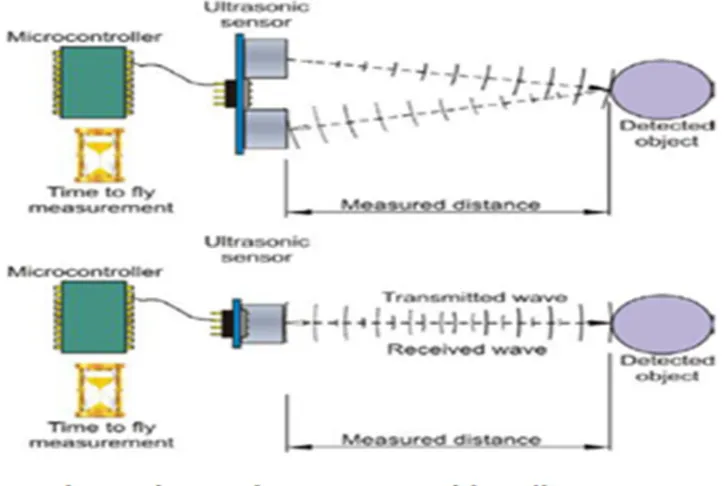
This application is based upon the reflection of sound waves which are defined as longitudinal pressure waves in a medium in which they are travelling. Objects can reflect waves producing echo if the dimensions of them are greater than the wavelength of the impinging sound wave. If the speed of sound in the given medium is found out and the time taken by the reflected wave tis measured then the distance between the source to the object can be calculated by using
= 2 × ÷
This principle is used in this application and the medium is air and ultrasonic waves are used. The speed of sound on the day of the is calculated by using the formula,
= 331.4 + 0.6 + % .ℎ
Where T in Celsius. In this data, the % RH is taken as 70 on the day when data is taken.
A single I/O pin is used to trigger ultrasonic waves (of frequency higher than 20kHz) and then “listen” for the echo return pulse. The sensor measures the time required for the echo return and returns this value to the microcontroller as a variable-width pulse via the same I/O pin. Ultrasonic sensors are generally used for anti-collision and rangefinder purposes by measuring the distance to an obstacle [M. Ishihara et al, 2009 .Few more areas where these sensors can be used are: security systems, parking assistant systems, interactive animated exhibits and robotic navigation.
III. HARDWARE
A. Arduino- Uno with ATmega 328 Microcontroller
B. Temperature Sensor
A temperature sensor is used to measure ambient temperature. It has three pins – a positive, a ground, and a signal and is a linear temperature sensor. A change in temperature of one degree centigrade is equal to a change of 10 millivolts at the sensor output. The TMP36 sensor has a nominal 750 mV at 25°C (about room temperature).
1) In this circuit, we have integrated the temperature sensor with Arduino Uno Method
2) In this work, distance of the object is measured by using ultrasonic sensor, temperature sensor and the micro controller.
3) The microcontroller initially collects data from temperature sensor and then using the formula given above, it calculates the speed of sound wave. Using the formula given above for distance, it calculates the distance between object and the sensor. The measured results are displayed in personal computer.
[image:2.612.120.482.461.704.2]This device can detect objects that are within a range of 1cm – 400cm and uses two digital pins to communicate the distance found. Ultrasonic Range Detection Sensor [ Y. B. Gandole et al, 2011], works by sending an ultrasound pulse at around 40 KHz, It then waits and listens for the pulse to echo back, calculating the time taken in microseconds. We can trigger a pulse as fast as 20 times a second and it can determine objects up to 4 metres away and as near as 1cm.
C. Applications in Industry
Ultrasonic distance sensors are used to detect the presence of targets and to measure the distance to targets in many automated factories and process plants. They can be used to sense the edge of material as part of a web guiding system and their uses will also include ultrasonic people detection and assisting in autonomous UAV navigation.
Ultrasonics are a great solution for clear object detection, clear label detection and for liquid level measurement, applications that photoelectrics struggle with because of target translucence. Target color and/or reflectivity don't affect ultrasonic sensors which can operate reliably in high-glare environments.
Ultrasound sensors are used in industries like paper & printing, metal working, textiles etc to detect the changes in diameter of wheel drums or reels as they are wound or unwound.
.
Ultrasonic sensors are used to measure the height of objects that are moving past the sensor with accuracy and reliable measurements. Surface finish, nature of material, and shapes do not affect the measurements. This application can be found in Automotive, Packaging and Distribution, Printing, Metal Working, Assembly
An ability of Ultrasonic sensors is to detect uneven surfaces and return accurate distance data. These sensors are used in many applications where the detection of the level of a fluid in a container is needed. Typical industries include: Food and Beverage, Chemical Water Treatment
In industries like agriculture, chemicals etc. these sensors will provide accurate and reliable results in detecting the changing levels of powders, grains and other semi fluid substances.
In industries like automotive and automation, ultrasonic sensors can be fixed to moving objects to provide collision protection. The sensor continuously relays proximity data to a controller. This can be used in parking system also to avoid collision of vehicle with pavement.
IV. CIRCUIT
A. In this project, we used ultrasound sensor to detect distance & the distance is displayed on the PC. We have used a breadboard and an active buzzer, connector leads to connect Arduino to laptop.
B. The connections done are as
1) Breadboards positive and negative lines
2) 5V to the positive line and one of the GND pins to the negative line.
3) The Vcc pin to positive line on the breadboard
4) GND to negative line on breadboard
5) Trig pin to pin 5 of Arduino
6) Echo pin to pin 6 of Arduino
7) For the active buzzer, negative pin to the ground line and the positive pin to pin 4 on the Arduino
8) The setup is placed on a table with a toy car and an obstacle
V. OBSERVATIONS
A. This sensor is placed at the rear of the car and sensor’s LEDs in front of the driver of the car
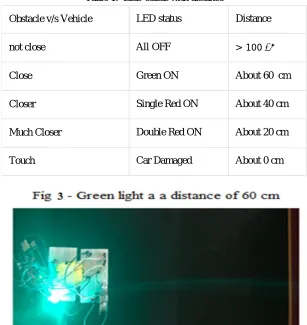
B. It is observed that when the toy car is at about a distance of 60 cm, the green LED glows showing a safe distance from the obstacle.
C. As the toy car moves closer to the wall, at about a distance of about 40 cm, a single red LED glows indicating a warning signal for the driver that he is nearing from the obstacle.
D. At a distance of less than 10 cm, both the red LEDs glow indicating a danger sign that the vehicle is too close to the obstacle.
[image:5.612.152.459.377.702.2]E. Photographs of the present project work are shown in fig 3 to 6 and tale 1.
Table 1: LED status with distance
Obstacle v/s Vehicle LED status Distance
not close All OFF > 100
Close Green ON About 60 cm
Closer Single Red ON About 40 cm
Much Closer Double Red ON About 20 cm
1) Advantages
a) It is a low-cost sensor and can be used in any conditions. This type of arrangements automatically calculates the speed of sound by taking into account the temperature on that day. Also, the accuracy can be up to the micro meter.
b) This low cost and efficient parking sensor can easily fit into any automobile application.
2) Conclusion
a) The system was able to detect objects within the sensing range and calculate the distance between the object and the sensor.
b) This device is capable to interact with other peripheral if used as a secondary device and can communicate with PC through it serial port.
c) It is a low cost and efficient solution for noncontact distance measurements.
d) The obstacle detecting sensor can be used effectively in many instances with improved accuracy.
3) Limitations
a) This device will work for smaller distances (less than 4m) with a restricted target angle and will create poor resolution for larger distances and for a larger angle.
b) For the parking sensor, the frequency and influence of ground is not considered. Also, the directivity as well directivity type of the sensor is not considered.
REFERENCES
[1] M. Ishihara, M. Shiina, S. Suzuki, “Evaluation of Method of Measuring Distance Between Object and Walls Using Ultrasonic Sensors”, Journal of Asian Electric Vehicles, Volume 7, Number 1, June 2009.