Improved Communication for Wi-MAX system
using MIMO
Shahnawaz Quraishi1, Prof. Mohit Panth2 1, 2
Mtech Scholar, Assistant Professor Mahakal Institute of Technology,Ujjain
Abstract: In recent years there has been increasing demand of high data rates on mobile communication networks because of broadband multimedia applications. To increase data rates over a radio link from few Kb/s to Mb/s with good quality-of-service (QoS), many issues related to wireless transmission occurs e.g. multipath reception, delay in a radio channel, fading, inter symbol interference (ISI) etc. Adaptive equalization is one of the solution to these issues but there are some problems in operating this equalization, particularly limitations of bandwidth, low-cost hardware and complexities at the receiver. Orthogonal Frequency Division Multiplexing (OFDM) is one of the promising applications, which reduces the multipath fading and makes complex equalizers unnecessary.
Keywords: OFDM, multiple-antena MIMO system,
I. INTRODUCTION
In the rapid growing field of wireless communication, there is a huge demand of higher rates with longer transmission range for new broadband applications. It was a big challenge for modern wireless communication networks to provide services like video, voice, data and mobility. [1].
Orthogonal Frequency Division Multiplexing (OFDM) is a transmission technique which ensures efficient utilization of the spectrum by allowing overlap of carriers. OFDM is a combination of modulation and multiplexing that is used in the transmission of information and data. Compared with the other wireless transmission techniques like Frequency Division Multiple Access (FDMA), Code Division Multiple Access (CDMA), OFDM has numerous advantages like high spectral density, its robustness to channel fading, its ability to overcome several radio impairment factors such as effect of AWGN, impulse noise, multipath fading, etc. Due to this it finds wide application in Digital Audio Broadcasting (DAB), Digital Video Broadcasting (DVB), and Wireless LAN. Most of the wireless LAN standards like IEEE 802.11a or IEEE 802.11g use the OFDM as the main multiplexing scheme for better use of spectrum. In fact in the 4G telecommunication system OFDMA is the backbone of it.
Error free transmission is one of the main aims in wireless communication. With the increase in multimedia applications, large amount of data is being transmitted over wireless communication. This requires error free transmission and it is achieved by deploying multiple antennas implemented on both stations i.e. base station and user terminal with proper modulation scheme and coding technique. The 4th generation of wireless communication can be attained by Multiple-Input Multiple-Output (MIMO) in combination with Orthogonal Frequency Division Multiplexing (OFDM).
MIMO schemes are highly considered to improve the range and performance of an overall system. Therefore, the uses of multiple antennas permit to transmit and receive simultaneously by eliminating the multipath effect. MIMO allows higher throughput, Antenna diversity gain and co-channel interference reduction. It also fulfills the requirement by offering high data rate through spatial multiplexing gain and improved link reliability by antenna diversity gain [1].
II. RELATED WORK
C. Tarhini, T. Chahed et al. In[1] proposed about Wireless technology is based on the specification of which IEEE-802.16 and 802.16e are Physical (PHY) layer specifications. The most recent WiMAX standard (802.16e) supports broadband applications to mobile terminals and laptops. IEEE-802.16 currently supports several multiple-antenna options including Space-Time Codes (STC), Multiple-Input Multiple-Output (MIMO) antenna systems and Adaptive Antenna Systems (AAS). Using Adaptive Modulation and Coding (AMC) we analyze the performance of OFDM physical layer in WiMAX based on the simulation results of Bit-Error-Rate (BER), and data throughput.
S. W. Lei and V. K. N. Lau et al. In[2] introduces STBC can achieve full transmit diversity allowing maximum likelihood decoding
algorithm based only on linear processing at the receiver. STBC was constructed byNt * p transmission matrix X, where Nt
transmit antenna. Let k be the input number of symbol to an encoder in each encoding operation. So the rate of Space time block code is a ratio between the number of input symbols and number of space time coded symbols.
B. Vucetic and J. Yuan et al. In[3] Spatial multiplexing is a transmission technique to transmit several different data bits called streams through an independent spatial channel to achieve the greater throughput. Typically there are four kinds of spatial multiplexing schemes V-BLAST, diagonal blast, horizontal blast and turbo blast.
J. Yuan et al. In[4] The new transmit diversity scheme was introduced by Alamouti known as Alamouti scheme. Alamouti scheme uses two transmit antenna and Nr receive antenna and can have a maximum diversity order of 2Nr. Alamouti scheme has the rate of unity i.e. full rate since it transmits two symbols after every two time periods. This scheme is efficient in all the applications where system capacity is limited by multipath fading.
III. PROBLEM DOMAIN
A. There Are Certain Factors Needs to be Considered When Developing And Designing Ofdm System.
1) Useful Symbol Information: There can be issue of the carrier offset and instability of OFDM symbol Number of carrier and subcarrier spacing to depend upon applications and requirements.
2) Number of Carriers: The number of subcarriers can be selected depend upon channel bandwidth, data rate, throughput and symbol duration. If carriers are N in the number then it will be reciprocal of symbol time duration.N =1/T.
3) Modulation Scheme: One of the main advantages of OFDM is that different modulation schemes can be applied to each sub-channel depend on sub-channel conditions like data rate, robustness, throughput and sub-channel bandwidth.
IV. PROPOSED SOLUTION
To understand and compare different modulation format efficiencies, it is important to understand the difference between bit rate and symbol rate. The signal bandwidth for the communication channel depends on the symbol rate or also known as bit rate. Bit rate is the sampling frequency multiplied by the number of bits per sample.
Bit rate
Symbol rate = --- Number of bit transmitted per symbol
A. Bit Error Rate (BER)
BER is a performance measurement that specifies the number of bit corrupted or destroyed asthey are transmitted from its source to its destination. Several factors that affect BER include bandwidth, SNR, transmission speed and transmission medium.
Number of bits with error
Bit Error Rate (BER) = --- Total number of bits transmitted
B. Signal to Noise Ratio (SNR)
SNR is defined as the ratio of a signal power to noise power and it is normally expressed inducible (dB). The mathematical expression of SNR is:
Signal power
SNR =10 log10
---Noise power
V. RESULT ANALYSIS
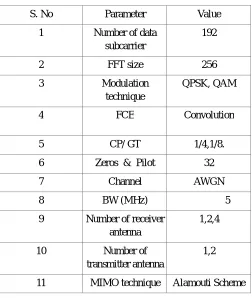
The WiMAX(802.16e) system is designed on the following parameter and then different modulation and channel schemes have been evaluated on test bench developed in the MATLAB. The result of the study is presented in the thesis in two different ways which is as follows.
At Multiple antenna system on particular modulation. At different modulation on particular type of Antenna system.
Table5.1: OFDM Parameter used in WiMAX System
S. No Parameter Value
1 Number of data
subcarrier
192
2 FFT size 256
3 Modulation
technique
QPSK, QAM
4 FCE Convolution
5 CP/ GT 1/4,1/8.
6 Zeros & Pilot 32
7 Channel AWGN
8 BW (MHz) 5
9 Number of receiver
antenna
1,2,4
10 Number of
transmitter antenna
1,2
11 MIMO technique Alamouti Scheme
[image:3.612.181.433.95.393.2]A. Simulation Result for Performance of BPSK by MISO, MIMO OFDM Channel.
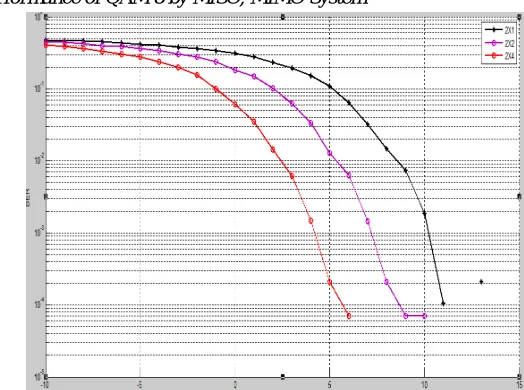
B. Simulation Result for Performance of BPSK by MISO, MIMO System
Figure-5.1(B): Performance of BPSK by MISO, MIMO System
[image:4.612.186.446.83.266.2] [image:4.612.180.432.303.489.2]C. Simulation Result for Performance of QPSK by MISO, MIMO
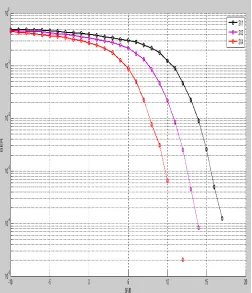
Figure : Performance of QPSK by MISO, MIMO
D. Simulation Result for Performance of QAM 8 by MISO, MIMO System
[image:4.612.168.430.523.718.2]E. Simulation Result for Performance of QAM16 by MISO, MIMO
Figure-5.4: Performance of QAM16 by MISO, MIMO
F. Simulation Result for Performance of QAM32 by MISO, MIMO
[image:5.612.181.433.423.716.2]G. Simulation Result for 2x1 MISO performances of fixed modulation.
Figure : 2x1 MISO performances of fixed modulation.
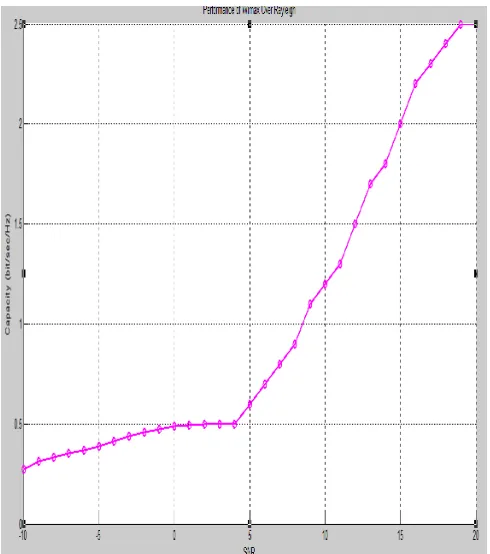
Figure : 2x1 MISO performances of capacity for the adaptive system
VI. CONCLUSION
handles the wide SNR range for BER value 0.0001. It is observed from the simulations results that by increasing the number of MIMO at the receiver side a better BER performance is achieved.
This project was basically concentrated on OFDM and the study of its performance in the mobile radio channel. However much work needs to be done to study the forward error correction schemes for OFDM. Also in our project we used a particular modulation technique irrespective of the type of data that is to be transmitted like BPSK, QPSK etc. However suitable techniques can be studied whereby different modulation schemes could be used for different types of data.
VII. FUTURE WORK
The main focus of this thesis is on performance analysis of different modulation schemes for MIMO-OFDM System using Wimax 802.16(e) system. Finally it could be concluded that OFDM promises to be a suitable technique for data communication in a mobile radio channel and is going to play a major role in wireless communication in the present and the future. Moreover, further work can also be done to enhance the capacity of the channel.
REFERENCES
[1] Martoyo, H.Sobher, F.Jondral, CDMA vs OFDM; A performance comparison in selective fading channels, IEEE 7th International Symposium on spread spectrum technology and application, Prague, Czech Republic, page 139, Sept. 2002.
[2] [2] C.Thorpe, OFDM Wireless Systems Simulation using SIMULINK®, International DSP Conference, Sttutgart, May,1998..
[3] [3] C. Eklund, R. B. Marks, K. L. Stanwood and S. Wang, “IEEE Standard 802.16: “A Technical Overview of the Wireless MAN Air Interface for Broadband Wireless access,” IEEE Commun. Mag., vol. 40, pp. 98-100, Jun 2002.
[4] [4]S.Popa, N.Drahgiciu and R.Reiz, “Fading Types in Wireless Communications Systems,” J. Elect. and Electron. Eng., vol. 1, pp. 232-237, 2008. [5] [5] L. Ahlin, J. Zander and B. Sliman, “Principles of Wireless Communication,”Denmark: Narayana Press, pp. 33-82, 2006.
[6] [6] R. Prasad, “Introductionin OFDM for Wireless Communications Systems,”London, United Kingdom: Artech House, pp. 11-14,2004.
[7] [7] S. B. Weinstein and P. M. Ebert, “Data Transmission by Frequency-Division Multiplexing Using the Discrete Fourier Transform,” IEEE Trans. Comm. Technol., vol. COM-19, pp. 628-634, Oct. 1971.
[8] [8] R. Prasad, “Basics of OFDM and Synchronization in OFDM for Wireless Comm. Systems,”London, United Kingdom: Artech House, 2004, pp. 117-122. [9] [9] M. Jain and M. M. Roja, “Comparison of OFDM with CDMA system in wireless Telecommunication for multipath delay spread,”The 1st IEEE/IFIP Int.
Conf. in Central Asia on Internet, Sep. 2005.