Development of Building Materials for Energy
Conservation - Future Perspective
Prof. S. K. Gupta1, Ar. D.S. Kushwaha2
1
Dean & Director, 2Assistant Professor, Architecture & Planning, Amity University Haryana
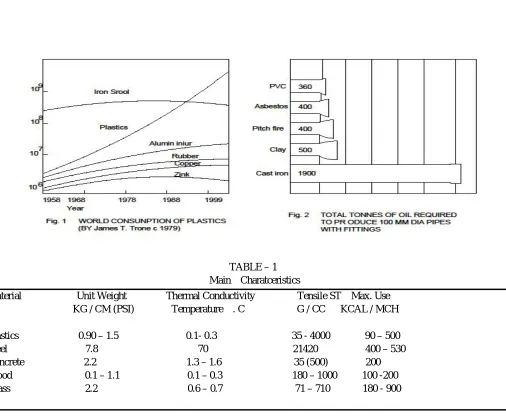
Synopsis: The shortage of conventional building materials calls for an urgent look to use alternative & less energy intensive materials. Plastic can play a very significant role in conserving energy then is required for the production of these materials. Plastics are relatively new materials but possess a good combination of physic-mechanical properties not exhibited generally by conventional building materials such as light weight, transparency, good electrical & thermal inflating property, low moisture absorption & high chemical resistance. According to one prediction the world consumption of plastics will be ten billion metric tons by 2015 AD & also that the world consumption of plastics would be higher than iron & steel by the year 2000 has been around 0.5 million tones about 20% of this goes into building industry application in various forms. Important properties of plastics in comparison with other building materials are given in Table – 1. Table – 2 gives observations of important plastics used in buildings. Table – 3 gives applications of plastics in buildings.
I. INTRODUCTION
Plastics differ from other materials used in the manufacture of end products, in as much as plastics require energy of process new materials & make finished goods & also use up energy sources (oil & natural gas) as new materials. Yet plastics are economical in the consumption of energy as a total quantity of energy required to manufacture plastic products is less than the total quantity of energy required to make same products using non-plastic materials. According to calculation if plastics were suddenly to cease existence overnight, the 30 years life expectancy of known oil reserves would be extended by only a matter of six months, bigger users of oil being heating & transport.In Australia 95% of oil is used for heating & transport with only 1.5% used for the production of plastics. The remaining 3.5 % is used by petro chemical industry to produce synthetic fibers for clothing & carpets, synthetic rubber, fertilizers etc. While other fuels or systems can be used for heating & transport, there is no adequate substitute for the use of petro chemicals in plastics industry. Although plastic products can be manufactured from ethanol (from sugar molasses) & acetylene, but processes involved are rather costlier & uneconomical. Thus, oil is a vital raw material for the plastic industry.
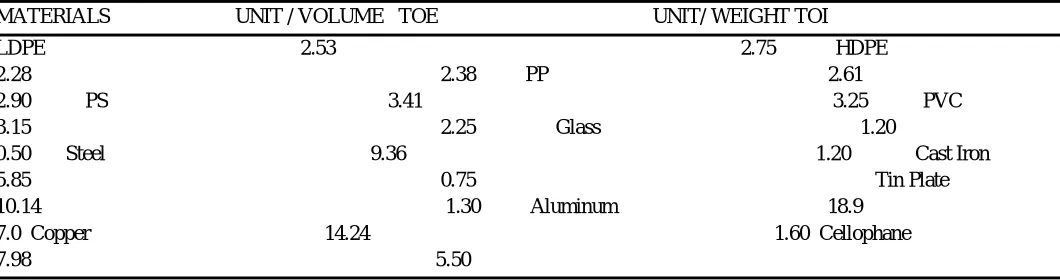
Plastic products save energy in all stages of their life-cycle. The quantum of energy used in the production processes in the plastics industry is less compared to the processing of other materials. Energy can also be saved during the service life of a plastic product because of its outstanding feature i.e. light weight. Some examples of energy saving through use of plastics are given in Table – 4. Thus 84.5% saving in energy was achieved in house hold fans. The total energy saving of 324 trillion BTSs in plastic pipes was equivalent of 56 million barrels of crude oil. By using plastic components as average will be increase its mileage by one mile per gallon of fuel. Similarly, Boeing 747 uses 4.5 tones of plastics as structural & non structural components & resulting saving in energy will be tremendous. To manufacture one million one-liter glass bottles 230 tones oil equivalent are required whereas 97 TOE are required to produce the same number of PVC bottles. In other words, a one liter of PVC bottle consumes only 43% of energy required to produce a glass bottle of the same size.
A. Energy Requirement of Plastics Vs Conventional Materials
B. Energy Conservation through use of plastic Pipes
Plastic pipes are considerably economical compared to metal pipes. During the last decade more than 1.6 lakh kilometers of plastic pipes were installed for water supply including plumbing & the economy achieved was of the order of 20% - 40% as against the use of metal pipes. The energy saving in production of plastic pipes is shown in Fig. 2. Total tones of oil required to produce a 1030 km of 100 mm. dia pipes with fittings is considerably lower than other conventional pipes. It can further be illustrated by comparing energy required for 01 km length of plastic pipe for water supply with other conventional pipes. Table – 6 shown comparative energy requirement for production of 01 km pipe for water supply. It is seen from the table that plastic pipes save 30% - 50% of energy if used in place of asbestos cement pipe & save 55% – 80% of energy if used in place of cast iron pipes. Hence plastic pipes when used as rain water pipes & sewage pipes, will affect considerably to save in energy.
C. Plastic pipes for House Plumbing
Plumbing system is another application of plastic pipes in buildings where we achieve considerable saving in energy. Use of PVC or CPVC system could save 40% - 55% of energy as shown in Table- 7. PVC pipes have already found a place for economically weaker sections of the country. PVC pipes however, cannot handle hot water very effectively, but CPVC could be used to handle hot water also. CPVC pipes have not been developed on lower rates.
D. Pumping Set for Irrigation
PVC pipe has emerged as the best available low-cost medium for water conveyance due to its excellent corrosion & better flow characteristic properties.
The GI & MU pipes get rusted & consequently lead to excessive wastage of energy in pumping the water. According to modified formulates developed from Hazen Williams formula the maximum discharge rate allowed in PVC / GI pipes are shown in Table – 8 for 8% frictional losses.
It is evident from the above table that the maximum allowable discharge rates in 75 mm & 110 mm OD PVC pipes are about 30% & 62.5% more as compared to its value for 75mm & 100 mm ID GI pipe respectively. Thus, considerable amount of energy could be saved in pumping the water if PVC pipes are adopted in place of GI pipes.
Field level experiments on farmers pump sets carried out at 150 sites during the last decay has indicated that when the under sized GI pipes attached with the pumping set were replaced by rigid pipes, the discharge rate of water was increased. From these experiments it was judged that the substitution of GI pipe by rigid PVC could lead to reduction in consumption of light duty oil (LDO) per unit useful work by about 20% depending upon the rte of flow, dia of GI pipe & condition of GI pipe. The average saving of IDO was found to be 278.5 litre / pump set per year.
E. Plastic Window Profiles
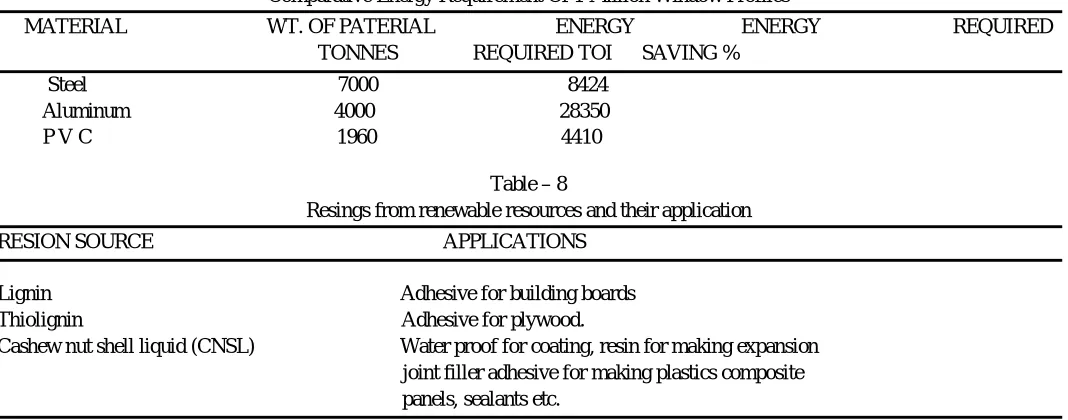
Besides plastic pipes, plastic window profiles are another significant application of plastics in buildings. These are used in place of steel frames. Plastic profiles could save 40% - 50% of energy if used in place of steel profiles. Aluminum requires even more energy than steel profiles. The energy requirement of one million window profiles of 01 sq. m. size has been compared with conventional materials in Table – 9.
F. Energy Conservation through Use of Plastics in HD Polypropylene Monofilament Manufacturing Unit
In high density monofilament manufacturing unit, the MS hot water bath thank is employed for quenching the filament to preserve a tougher molecular structure of similar crystallites & also cool then enough to allow them to wrap firmly without distortion around the rolls proceeding the orientation section.
The water is heated in the tank by electric immersion heater & the temperature is maintained at the orientation temperature of the filament. The heat is lost by the tank continuously. The energy can be saved by taking simple measures where heat is being lost by convection, radiation & evaporation.
I order to minimize heat losses; insulation & plastic film cover are used. The cost of these materials is negligible compared to the cost of energy saved.
G. Energy Conservation on through Use of Resins Developed from Natural Resources
Energy can further be saved through the use of resins developed from natural renewable resources.
The high cost, non-availabilities of synthetic resins & energy crises have induced studies on the development of resins based on renewable resources. By the way, this is also essential to save the world from pollution as some of these get produced as by- products of some essential goods e.g., paper, sugar & food industry wastes & must be put to use to avoid pollution caused by these. Tropical countries have a range of such products like lignin’s tannins & CNSL etc. as these have been used to produce a number of useful building materials.
A number of utility products have been developed fr4om naturally occurring materials & by-products of paper & sugar industries by different research organization in the country. The various materials taken for developing utility products & the application of the products is shown in Table – 10.
H. Solar Timber Seasoning Kiln
There is only one organization called CBRI has designed a solar seasoning kiln based on natural draught & solar heat collectors which has been commercially adopted & controlled drying of Timber Conventionally seasoning of wood is done in electrically or steamed heated chambers. The kiln not only eliminates completely use of any energy from coal, steam or electrical power, but reduces the seasoning time to about 40% to 50% for most of the commercial timbers.
II. RECOMMENDATIONS
[image:3.612.53.559.326.744.2]The plastic is used in different form from daily needs to the construction & furniture. Sometimes, plastic replaces the metal i.e. steel & aluminum particularly. It is used in doors & windows frames & shashes also. It gives finished & shining look whereas wood & steel do not give such finishes. It is used for photos & photo frames to have high glossary look. Slowly & slowly it takes over the other materials cheaper &good looking & well finished.
TABLE – 1 Main Charatceristics
Material Unit Weight Thermal Conductivity Tensile ST Max. Use . KG / CM (PSI) Temperature . C G / CC KCAL / MCH
Plastics 0.90 – 1.5 0.1- 0.3 35 - 4000 90 – 500
Steel 7.8 70 21420 400 – 530 Concrete 2.2 1.3 – 1.6 35 (500) 200
TABLE – 2
Main Plastics For Usage In Building
Name Of Plastics Abbraevitation Polyethene PE
[image:4.612.46.573.365.546.2]Polyvinylchloride PVC Polypropylene PP Polystyrene PS Polymethyl methacrylate PMMA Polyvinyl acetate PVA Melamine formaldehyde ME Urea formaldehyde UF Phenol formaldehyde PF Polyester PES Epoxy EP Polyurethane PU Acrylonitrile butadiene Styrene ABS Glass fiber reinforced polyester GRP __________________________________________________________________________________
Table – 3
Plastics vs building applications APPLICATIONS TYPES OF PLASTICS
Decorative laminate PF, UF, MF Flooring Materials PVC, PU, EP, PES, Glazing and Roof Lighting PMMA, GRP, Thermal in PU, PS
Lighting Fixtures and fittings PMMA, PVC, PS, PF Panels, Siding and wall covering GRP, PVC, PMMA, PS Electrical conduits PVC, PE
Pipes and fittings PVC, PF
Plumbing and Bath Fixtures GRP, PMMA, PS, ABS Resin Bonded Boards PF, UF, MF
Mater Vapour Barrier Films PE, PVC
[image:4.612.43.573.582.722.2]Building Hard wares PP, ABS, UF, PF
Table – 4
Energy requirement for production of materials
MATERIALS UNIT / VOLUME TOE UNIT/ WEIGHT TOI
LDPE 2.53 2.75 HDPE
2.28 2.38 PP 2.61 2.90 PS 3.41 3.25 PVC
3.15 2.25 Glass 1.20 0.50 Steel 9.36 1.20 Cast Iron
Table – 5
Pipes for the polimbing (for one million tenements)
MATERIAL ENERGY REQUIRED TO ENERGY SAVING %
[image:5.612.41.575.204.260.2]Cast Iron 22.800 -- PVC 10.600 53.5 CPVC 14.100 38.2
Table – 6
Comparison of maxium allowable discharge rates of pipes
PVC MAX. ALLOWABLE DISCHARGE RATE GTMAX. ALLOWABLE DISCHARGE RATE
LITRE / SEC LITRE / SEC 15 OD 10.26 75ID 7.87
110 OD 27.3 100 ID 16.78
Table – 7
Comparative Energy Requirement Of 1 Million Window Profiles
MATERIAL WT. OF PATERIAL ENERGY ENERGY REQUIRED TONNES REQUIRED TOI SAVING %
[image:5.612.42.576.292.502.2]Steel 7000 8424 Aluminum 4000 28350 P V C 1960 4410
Table – 8
Resings from renewable resources and their application
RESION SOURCE APPLICATIONS
Lignin Adhesive for building boards Thiolignin Adhesive for plywood.