TreeBank, Comparable Corpora,
and Complementary Annotation
Rashmi Prasad
∗University of Wisconsin–Milwaukee
Bonnie Webber
∗∗ University of EdinburghAravind Joshi
†University of Pennsylvania
The Penn Discourse Treebank (PDTB) was released to the public in 2008. It remains the largest manually annotated corpus of discourse relations to date. Its focus on discourse relations that are either lexically grounded in explicit discourse connectives or associated with sentential adjacency has not only facilitated its use in language technology and psycholinguistics but also has spawned the annotation of comparable corpora in other languages and genres.
Given this situation, this paper has four aims: (1) to provide a comprehensive introduction to the PDTB for those who are unfamiliar with it; (2) to correct some wrong (or perhaps inadvertent) assumptions about the PDTB and its annotation that may have weakened previous results or the performance of decision procedures induced from the data; (3) to explain variations seen in the annotation of comparable resources in other languages and genres, which should allow developers of future comparable resources to recognize whether the variations are relevant to them; and (4) to enumerate and explain relationships between PDTB annotation and comple-mentary annotation of other linguistic phenomena. The paper draws on work done by ourselves and others since the corpus was released.
1. Introduction
The Penn Discourse TreeBank, or PDTB (Prasad et al. 2008; PDTB-Group 2008) is the largest manually annotated resource of discourse relations. This annotation has been added to the million-wordWall Street Journalportion of the Penn Treebank (PTB) corpus
∗Department of Health Informatics and Administration, University of Wisconsin-Milwaukee, 2025 E. Newport Ave (NWQB), Milwaukee WI 53211. E-mail:[email protected].
∗∗School of Informatics, University of Edinburgh, 10 Crichton Street (IF4.29), Edinburgh UK EH8 9AB. E-mail:[email protected].
†Institute for Research in Cognitive Science, University of Pennsylvania, 3401 Walnut Street (Suite 400A), Philadelphia PA 19104-6228. E-mail:[email protected].
Submission received: 17 June 2013; revised submission received: 14 February 2014; accepted for publication: 18 April 2014.
(Marcus, Santorini, and Marcinkiewicz 1993), indicating relations between the events, facts, states, and propositions conveyed in the text—relations that are essential to its understanding. Some relations are signalled explicitly, as in Example (1), where the underlined phrase as a result signals a causal relation between the situation described in the first two sentences (calledArg1in the PDTB, formatted here initalics) and a situation described in the third sentence (called Arg2, formatted here inbold). Other relations lack an explicit signal, as in Example (2), where there is no explicit signal of the causal relation between the situation described in the first sentence and that described in the second. Nevertheless, there is no change in meaning if the relation is made explicit—for example, using the same phrase as a result (Martin 1992).
(1) Jewelry displays in department stores were often cluttered and uninspired. And the merchandise was, well, fake.
As a result,marketers of faux gems steadily lost space in department stores to more fashionable rivals—cosmetics makers. [wsj 0280]
(2) In July, the Environmental Protection Agency imposed a gradual ban on virtually all uses of asbestos. (implicit=as a result)By 1997, almost all remaining uses of cancer-causing asbestos will be outlawed. [wsj 0003]
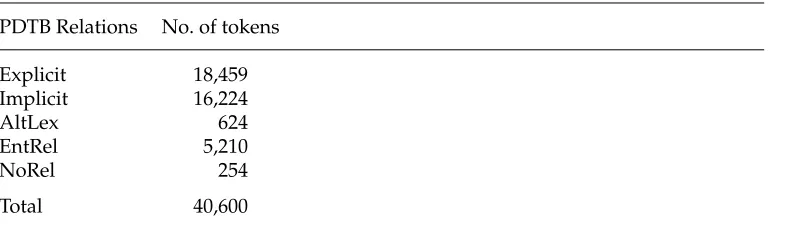
Over 18K explicitly signalled relations and over 16K implicit forms have been annotated in the PDTB 2.0 (cf. Section 3.2, Table 1), which was released in February 2008, through the Linguistic Data Consortium (LDC).1 Researchers since then, in both lan-guage technology and psycholinguistics, have begun to use the PDTB in their research, developing methods and tools for automatically annotating discourse relations (Wellner and Pustejovsky 2007; Elwell and Baldridge 2008; Pitler et al. 2008; Pitler and Nenkova 2009; Wellner 2009; Prasad et al. 2010a, 2011; Zhou et al. 2010; Ghosh et al. 2011a, 2011b, 2012; Lin, Ng, and Kan 2012; Ramesh et al. 2012), generating questions (Prasad and Joshi 2008; Agarwal, Shah, and Mannem 2011), ensuring an appropriate realization of discourse relations in the output of statistical machine translation (Meyer 2011; Meyer and Popescu-Belis 2012; Meyer and Webber 2013), and testing hypotheses about human discourse processing (Asr and Demberg 2012a, 2012b, 2013; Jiang 2013; Patterson and Kehler 2013). Other researchers have adapted the PDTB style of annotation to create comparable resources in other languages and genres (Section 4).
What then are the aims of this paper? First, for those researchers who are unaware of the PDTB, Section 2 of the paper lays out the key ideas behind the PDTB annotation methodology, and Section 3 describes the corpus in more detail than previous papers (Prasad et al. 2008; PDTB-Group 2008) and presents what we have learned since release of the corpus in 2008. Secondly, for those researchers who have used the PDTB, Section 3 aims to point out significant features of its annotation that have either been ignored or taken to beintrinsicwhen they are simplyaccidental. We hope that this will enable researchers to derive more from the corpus in the future and recognize the value of having it more completely annotated. Thirdly, annotation of comparable resources in other languages and genres has turned out to vary from PDTB annotation in ways that may be of interest to people contemplating the development of comparable resources in other languages and genres. Section 4 summarizes and explains the sources of this variation. Fourthly, Section 5 aims to show how PDTB annotation complements Time-Bank (Pustejovsky et al. 2003a) and PropTime-Bank (Palmer, Gildea, and Kingsbury 2005)
annotation over the same Penn TreeBank corpus. Section 6 closes with a summary of the key points.
Although extensive documentation can be found on the PDTB Web site, along with discussions of various aspects of PDTB annotation, there has not as yet been as comprehensive and quantified a discussion of issues as presented here, especially con-cerning comparable corpora and complementary annotation. Providing this discussion is a major goal of this paper. We ourselves will be addressing many of these issues in the next few years.
2. Key Ideas Underlying PDTB Annotation
Two key ideas underlie the methodology used in annotating the PDTB, setting it apart from other efforts to annotate discourse relations (e.g., Carlson, Marcu, and Okurowski 2001; Polanyi et al. 2004; Baldridge, Asher, and Hunter 2007). First, it makes no com-mitment to any kind of higher-level discourse structure over the discourse relations annotated between individual text spans. Thus, whiletheory-neutralitself with respect to higher-level discourse structure, the PDTB invites experimentation with approaches to high-level topic and functional structuring (Stede 2012; Webber, Egg, and Kordoni 2012) or to hierarchical structuring (Mann and Thompson 1988; Asher and Lascarides 2003), as a resource for research aimed at a “data-driven and emergent theory of discourse structure” (Bunt, Prasad, & Joshi 2012, page 61).
Secondly, the annotation of discourse relations is lexically grounded. Rather than asking annotators to directly classify the sense of relations, which is a difficult task (Stede 2008), annotators were asked to look at lexical items that can signal discourse relations, such as the expression As a result in Example (1). When they did signal discourse relations, their arguments and senses were then annotated. Annotators were also asked to look at adjacent sentences that lacked one of these explicit signals. Where they inferred a discourse relation, they first labeled it with a lexical item that could serve as its explicit signal (such asAs a resultin Example (2)), before going on to classify its sense. In both cases, this lexical grounding was aimed at making the annotation more reliable, but it can also serve as a feature in the automated identification of discourse relations mentioned in Section 1.
A more detailed introduction to the PDTB can be found in the PDTB-2.0 overview paper (Prasad et al. 2008) and the PDTB-2.0 annotation manual (PDTB-Group 2008). Other papers describe specific aspects of the annotation such as the senses used in annotating relations (Miltsakaki et al. 2008), alternative lexicalizations (Prasad, Joshi, and Webber 2010b), and attribution (Prasad et al. 2007).
3. Key Features of PDTB Annotation
Here we discuss four key aspects of PDTB annotation that have been partially ignored or misunderstood: Explicitly signalled discourse relations; implicit discourse relations; properties of the arguments to discourse relations; and several issues concerning the senses of discourse relations and their annotation. These discussions extend the descrip-tion of these features in the original PDTB overview paper and annotadescrip-tion manual.
3.1 Explicitly Signaled Discourse Relations
It is these signals that we discuss here, distinguishing between (1) the linguistic expres-sions that can explicitly signal a discourse relation; (2) the resource-limited subset of these expressions that were annotated as such in the PDTB; and (3) the consequences of this resource limit on annotation for using the PDTB.
We have taken the view that discourse relations hold between two and only two (possibly discontinuous) spans of text that can be interpreted as propositions, eventual-ities, beliefs, etc. (what Asher [1993] has calledabstract objects). As such, the spans are primarily one or more sentences or clauses, and the expressions that can signal relations between them come from four well-defined syntactic classes:
r
Subordinating conjunctions:because, although, when, if, as, etc.r
Coordinating conjunctions:and, but, so, nor, or (and paired versions of the latter — neither. . . nor, either. . . or)r
Prepositional phrases:as a result, in comparison, on the one hand. . . on the other hand, etc.r
Adverbs:then, however, instead, yet, likewise, subsequently, etc.These we have calleddiscourse connectives, orexplicit connectives.
During the pilot phase of PDTB annotation, we took as explicit signals of discourse relations, linguistic expressions suggested by previous researchers (Halliday and Hasan 1976; Martin 1992; Knott 1996; Forbes-Riley, Webber, and Joshi 2006). This set was then enlarged as new connectives were found in the WSJ corpus itself. Also identified during this phase were productive modifiers of explicit connectives such asapparently,at least partly, in large part, even, only, and so on, which were then annotated as connective modifiers.2
What were not taken to be discourse connectives were adverbialcue phrases, includ-ing sentence-initial Now(Example (3)), Well(Example (4)),So (Example (5)), and OK
(Example (6)), because they signal topic changes such as the beginning of a subtopic or a return to a previous topic (Hirschberg and Litman 1993), rather than relating particular discourse elements.
(3) Nowwhy, you have to ask yourself, would intelligent beings haul a bunch of rocks around the universe? [wsj 0550]
(4) Well, mankind can rest easier for now. [wsj 1272]
(5) So, OK kids, everybody on stage for “Carry On Trading.” [wsj 2402]
(6) When Mr. Jacobson walked into the office at 7:30 a.m. EDT, he announced: “OK, buckle up.” [wsj 1171]
We did not intend to annotate as discourse connectives pragmatic markers such as actually and in fact, which serve to signal the conversational role of the speaker’s matrix utterance—specifically, that it is “either aligned with or contrary to something previously said by another speaker, by the speaker on a previous occasion or to what people in general say” (Aijmer and Simon-Vandenbergen 2004). Butin factwas anno-tated in the PDTB as a discourse connective, whereasactually was not. Nevertheless,
2 We have not yet seen much use made of these modifiers, even though it is clear that they can, for example, be used to disambiguate connectives. (E.g.,alltokens of modifiedever sinceconvey a
this accidental annotation provides interesting information on what discourse relations
pragmatic markersare associated with, which seems worth further study.
Resources then limited which types of explicit linguistic signals of discourse re-lations were actually annotated as such. In particular, sentence-initial prepositional phrases with an overt deictic argument (e.g.,for that reason,by then) were not included in the set of explicit discourse connectives and hence not systematically annotated because it was felt this could be put off until deictic coreference was annotated more generally. The consequences of limitinga prioriwhat were taken as possible signals for a discourse relation3 meant that adjacent sentences lacking one of these expressions might contain a different sort of evidence for a discourse relation between them. The consequence for annotating implicit discourse relations is described in the next section.
3.2 Implicit Relations
The PDTB calls discourse relations that lack an explicit discourse connective between their argumentsimplicit discourse relations. Users of the PDTB thus need to under-stand (1) where and how implicit relations were annotated and (2) what was done in their absence.
As to the first point, the PDTB did not mandate unconstrained search for im-plicit discourse relations. Rather, annotators were asked to consider imim-plicit discourse relations only between adjacent sentences within a paragraph, in the absence of an explicit connective relating them. The procedure involved (1) identifying one or more connectives that could be inserted between the two sentences without changing the discourse relation(s) between them, and then (2) specifying the sense of those relations. This had several consequences, each of which is discussed further in this section:
1. A sentence might bear no relation to its left-adjacent neighbor, even though a wider search might find some earlier text to which it was related.
2. Paragraph-initial sentences were taken to have no left-adjacent neighbor and were thus not examined as an argument to a discourse relation unless they contained an explicit discourse connective.
3. Implicit discourse relations were not annotated within a sentence except between clauses connected by a semicolon.
4. There were cases where annotators could not insert a connective between sentences because to do so appeared redundant.
5. There were cases where annotators could not insert a connective between sentences because they did not infer a discourse relation between them. Rather, the later sentence simply provided more information about an
entitymentioned in the previous one.
6. Despite there being common patterns of multiple explicit connectives, annotators were not asked whether an implicit discourse relation might hold concurrently with a relation signalled with an explicit connective.
Table 1
Total relations annotated in the PDTB.
PDTB Relations No. of tokens
Explicit 18,459
Implicit 16,224
AltLex 624
EntRel 5,210
NoRel 254
Total 40,600
Point (1) has been addressed in the BioDRB (Prasad et al. 2011), which adheres to most of the PDTB annotation conventions but allows an implicit discourse relation to hold between non-adjacent sentences within the same paragraph (cf. Section 4.5). This has reduced the proportion of potential implicit relations that were markedNoRelfrom 1.15% in the PDTB (254/22141, cf. Table 1) to 0.9% (29/3223) in the BioDRB (Prasad et al. 2011). The same choice was made in the Hindi DRB (Kolachina et al. 2012).
Points (2) and (3) remain gaps in PDTB annotation that we plan to address in the future. Example (7) illustrates point (3): One could insert a connective such asafterwards
or thereafter before the free adjunct (i.e., afterwards returning . . .), making explicit the relation of temporal PRECEDENCE between the event expressed in the main clause and that in the free adjunct. (Arg1 and Arg2 are not indicated in italics and bold in Example (7) because free adjuncts have not yet been annotated in the PDTB.)
(7) He flew to Fort Bragg, N.C., in September of that year for a course in psychological operations, returning to the School of the Americas in Panama for a two-month course called “military intelligence for officers.” [wsj 2013]
In Section 5.2, we discuss how PropBank ArgM annotation can be used in addressing gaps in the annotation of sentence-internal implicit relations in the PDTB.
With respect to point (4), cases where inserting connectives seemedredundantwere taken to arise from the relation being signalled by an expression from outside the set of explicit connectives. These expressions were annotated asAlternative Lexicalizations
of evidence for discourse relations and theirArg1andArg2annotated accordingly. We have counted them underAltLexrelations in Table 1 rather than asImplicitdiscourse relations (also shown there). For example, in Example (8), inserting a connective like be-causebetween the sentences was felt to be redundant. Here,One reason iswas annotated as an alternative lexicalization of the causal relation between them (indicated inSMALL CAPITALSadjacent toArg2).
(8) Now, GM appears to be stepping up the pace of its factory consolidation to get in shape for the 1990s. (CONTINGENCY.CAUSE.REASON)One reason is mounting competition from new Japanese car plants in the U.S. that are pouring out more than one million vehicles a year at costs lower than GM can match. [wsj 2338]
such as quite the contrary, eventually, and thereafter(nearly 15% of alternative lexical-izations) meet all the criteria for explicit connectives, even though they had not been included earlier. Another 9% of expressions were found to be phrases such asWhat’s more(Example (9)), which suggests that the range of discourse connectives should be widened to include other syntactic classes.
(9) Marketers themselves are partly to blame:They’ve increased spending for coupons and other short-term promotions at the expense of image-building advertising. (EXPANSION.CONJUNCTION)What’s more, a flood of new products has given consumers a dizzying choice of brands, many of which are virtually carbon copies of one other. [wsj 1856]
AltLexexpressions are under-annotated in the PDTB because they were only an-notated when annotators found it redundant to insert an implicit connective between adjacent sentences. For example, whereas 15 tokens of that means were noticed and annotated as AltLex, another 18 in the corpus were not examined, such as the one followingandin Example (10).
(10) “I see a lot of evidence indicating a slower economy, andthat means my interest-rate outlook has a downward tilt,” said Garnett L. Keith Jr. . . . [wsj 1694]
As a result,AltLexexpressions cannot be exploited in machine learning—for example, for inducing a model of discourse relation annotation—because no individualAltLex
expression can be guaranteed to be fully annotated in the corpus.
Everyone who has attempted to annotate or catalogue discourse connectives has commented on the lack of a complete list of words and phrases serving this role (Versley 2010; Rysov´a 2012; Meyer and Webber 2013). Rather than provide annotators with an incomplete list of connectives and allowing them to identifyalternative lexicalizations
during annotation), one might consider giving them complete freedom as to what to annotate as grounding for discourse relations. Although such a process has its own problems (Section 4.1), expert annotators and good training may make it a plausible basis for effective discourse annotation.
As for point (5), if annotators were unable to insert a connective between sentences because they were not able to infer a discourse relation between them, they were asked to check whether the second sentence provided more information about one or more entities mentioned in the previous sentence, as in
(11) Pierre Vinken, 61 years old, will join the board as a nonexecutive director Nov. 29. Mr. Vinken is chairman of Elsevier N.V., the Dutch publishing group. [wsj 0001]
If it did, annotators were told to annotate the relation type asEntRel. EntRel captures entity-based coherence between sentences (Knott et al. 2001) realized either directly (i.e., via an anaphoric pronoun or NP in the second sentence) or indirectly (i.e., through abridging inference). Annotators were not asked to annotate their evidence for EntRel. Although it might be possible to use a resource such as the coreference annotation in OntoNotes (Weischedel et al. 2012) to recover what the annotators had in mind, in cases such as Example (12) theentity-based coherenceis less obvious.
Such cases would benefit from the entity or entities that ground this relation being an-notated explicitly, as well as provide valuable data for studies of entity-based coherence. Table 1 also notes the 254 cases where the annotators did not see either an Alter-native Lexicalization or an Entity-relation between adjacent sentences (within the same paragraph). These they annotated as NoRel.
Point (6) involves the possibility of an explicit connective or AltLex expression occurring concurrently with an implicit connective. That is, a recent unpublished pilot study carried out at the University of Edinburgh (Jiang 2013) used MTurk to show that readers presented with text containing a discourse adverbial also infer the sense asso-ciated with a conjunction (coordinating or subordinating), even when no conjunction is present in the text. The study involved 80 items taken from the freely availableCorpus of American English, each consisting of a clause, followed by a gap, followed by a clause containing one of four discourse adverbials (after all, in fact,in general, instead). Each HIT (Human Intelligence Task) consisted of one item and six conjunctions (and,because,
before,but,or,so, or none). The Turker was asked to insert into the gap, the conjunction (or none) that seemed most natural between the clauses.
For example, in Example (13), 50/52 Turkers inserted but into the gap, showing that they interpreted the relation between the clauses as being the same as if what was explicit was but instead:
(13) Logically, she should be dead. Instead, she feels fine, caring for her daughters and walking a pedometer-measured two miles a day.
In Example (14), 49/52 Turkers insertedsointo the gap, showing that they interpreted the relation as being the same as if what was explicit was so instead:
(14) He suspected he shouldn’t say that. Instead he lied.
Notice how different Example (13) would be if it were realized with so instead, or Example (14) with but instead: Neither is what the writer intended.
The effect was less strong in Example (15), where 33/52 Turkers chose because, showing that they interpreted the relation as being the same as because instead, whereas the other Turkers chose differently among the other options:
(15) If he’d expected her to be upset, he was disappointed. Instead, she laughed, clapping her hands.
Although it is not yet clear which discourse adverbials are compatible with one or more concurrent implicit relations, it is nevertheless likely that such discourse relations are under-annotated in the PDTB and should be addressed.
3.3 Arguments
The two arguments to discourse relations contribute to the senses of the relations taken to hold between them. The PDTB gives annotators two ways to restrict these arguments to only the material needed for these relations.
As already noted, it is the events, states, propositions, claims, etc., in a text that participate in discourse relations. In English, suchabstract entitiestend to be conveyed through sentences, clauses, nominalizations, and verb phrases. Hence, these are what can be annotated in the PDTB as arguments.4Also becausediscourse deictics(e.g.,this,
that,so) can refer back to such interpretations (Example (16)), as can particles such as
yes and no that function as responses to questions (Example (17)), these can also be annotated as arguments.
(16) Evaluations suggest that good ones are—especially soifthe effects on participants are counted. [wsj 2412]
(17) Underclass youth are a special concern. [Sup1Are such expenditures worthwhile, then]?Yes, iftargeted. [wsj 2412]
One way to limit arguments to only the minimal text needed for a given discourse relation (aminimality principle), was to allow annotators to specify that other text ap-pearedrelevant but not necessaryto that interpretation. Specifically, they could annotate asSup1, materialsupplementaryto Arg1, as in Example (17), where the preceding ques-tion was annotated as relevant to interpreting the quesques-tion response particle, and as
Sup2, material supplementary to Arg2, as in Example (18), where the material enclosed in square brackets was annotated as relevant but not necessary to interpreting the temporal relation expressed withthen.
(18) It acquired Thomas Edison’s microphone patentandthenimmediately sued the Bell Co.[Sup2claiming that the microphone invented by my grandfather, Emile Berliner, which had been sold to Bell for a princely $50,000, infringed upon Western Union’s Edison patent.] [wsj 0091]
Supplementary information (both Sup1 and Sup2) appears to have been under-annotated in the PDTB, mainly because annotaters were only invited, and not required, to check whether any text should be so annotated. This shows when one compares the number ofSup1 or Sup2annotations on explicit discourse relations, which were annotated first, with the number of such annotations on implicit discourse relations, which were annotated on a subsequent pass: 1,571 explicit relations were annotated with supplementary information, whereas only 126 implicit relations were, despite nearly equal numbers of both. Before considering the existence ofSup1orSup2 as a feature indicative of the likely use of an explicit connective to signal a discourse relation (Patterson and Kehler 2013), it must be assessed whether this is an accidental feature of the PDTB’s annotation or an intrinsic feature of the discourse relations themselves.
A second way of limiting arguments to only the minimal text needed to complete a given discourse relation involves the separate annotation ofattribution(Prasad et al. 2007). This allows the attribution holding between an agent and an abstract object to be included or excluded from the discourse relation as appropriate. For example, in Example (19), annotators could exclude the attribution phrase “said Howard Rubel, an analyst with C.J. Lawrence, Morgan Grenfell Inc. in New York” from Arg1, as unnec-essary for the discourse relation, while including the attribution phrase “Mr. Asman is also annoyed” as necessary for the discourse relation in Example (20).5
(19) Defense contractors “cannot continue to get contracts on that basis,”said Howard Rubel, an analyst with C.J. Lawrence, Morgan Grenfell Inc. in New York. (implicit=because)“The pain is too great.”[wsj 0673]
(20) Mr. Asman is also annoyed that Mr. Castro has resisted collaboration with U.S. officials, even thoughby his own account that collaboration has been devised essentially as a mechanism for acts directly hostile to the Cuban regime, such as facilitating defections. [wsj 1416]
Attribution differs from supplementary information in that, when its polarity is negative, it can interact with discourse relations. (Sup has no such interaction.) This can be seen by contrasting Example (21), where (negative)denyingis part ofArg2, and Example (22), where (negative)denyingis not part ofArg1, but is rather its attribution.
(21) The U.S. wants the removal of what it perceives as barriers to investment; (COMPARISON.CONTRAST)Japan denies there are real barriers. [wsj 0082] (22) Viacom deniesit’s using pressure tactics. (EXPANSION.RESTATEMENT.
SPECIFICATION) “We’re willing to negotiate,” says Dennis Gillespie, executive vice president of marketing. [wsj 0060]
In Example (21), thewantinginArg1is taken to contrast with thedenyinginArg2. But in Example (22), the negative polarity ofdenyingas the attribution ofArg1means that
being willing to negotiateis taken to further specifynotusing pressure tactics.
These techniques are concerned with excluding material unnecessary to concluding the existence of a particular discourse relation. There is no comparable attempt to ensure that spans annotated as arguments to discourse relations include all the features that motivate a given relation (Section 3.4). This can be seen with discourse relations associated with the connectiveinstead. ItsArg1must convey an alternative that does not hold (Webber 2013): In Example (23),Arg1conveys that “a price for the new shares has been set” is an alternative that does not hold.
(23) No price for the new shares has been set. Instead,the companies will leave it up to the marketplace to decide. [wsj 0018]
But the features that allow an argument to convey an alternative that does not hold may not be present in the argument itself. For example, the PDTB annotators agreed that the clause “to be any silver lining” wasArg1ofinsteadin Example (24), based on the minimality principle mentioned at the start of this section. But there is nothing in this argument that conveys that this alternative does not hold. That would requireArg1
to be “there isn’t likely to be any silver lining.” However, the annotators did not take such an argument to be minimal.
(24) In China, however, there isn’t likelyto be any silver liningbecause the economy remains guided primarily by the state.
Instead,China is likely to shell out ever-greater subsidies to its coddled state-run enterprises, which ate up $18 billion in bailouts last year. [wsj 1646]
Although in the majority of cases, minimal argument spans do contain all the features needed to license the annotated sense, this was not required by the PDTB guidelines. This point has been missed in efforts to use the PDTB in training automated sense recognition.
3.4 Senses and their Annotation
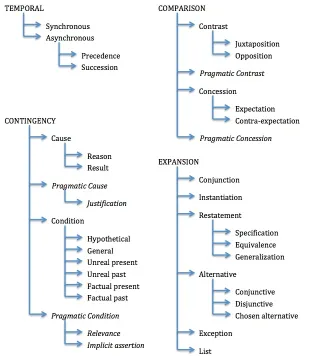
Figure 1
PDTB sense hierarchy.
individual annotator could not decide among its more specific senses or if (2) pairs of annotators disagreed as to a more specific sense.
Nevertheless, many researchers interested in inducing automated classifiers for explicit and/or implicit discourse relations have used the four top-level (level-1) sense classes for their research (e.g., Pitler et al. 2008; Pitler and Nenkova 2009; Zhou et al. 2010) because of the relatively large number of tokens in each class at this level of specificity (Table 2).
Our goal here is not to defend the hierarchy or its sense inventory, but rather to discuss three issues in sense labeling, which should help readers to better understand both the PDTB and the comparable corpora described in Section 4. The issues are: (1) senses found to be missing from the sense inventory; (2) disagreements between annotators; and (3) annotation of multiple concurrent discourse relations.
Table 2
Total explicit and implicit relations that fall under each level-1 sense.
level-1 PDTB Senses No. of explicits No. of implicits
CONTINGENCY 3,741 4,255
COMPARISON 5,589 2,503
EXPANSION 6,423 8,861
TEMPORAL 3,696 950
so that. Cases of the latter, as well as relations conveying the sense that one argument was the GOAL of the other, were simply annotated with the overloaded label CON
-TINGENCY.CAUSE.RESULT. The 34 cases of the subordinating conjunctionjust as, which can also signal SIMILARITY, were found on subsequent analysis of the corpus to be annotated as either TEMPORAL.SYNCHRONY(13 tokens) or EXPANSION.CONJUNCTION
(1 token), or to have been left unannotated (20 tokens).
Some of these and other missing senses have been added to the sense inventories used in annotating corpora comparable to the PDTB (Section 4.2). They should also be added to the PDTB, and senses known to be overloaded should be split appropriately. Although this will eliminate already noted sense gaps, the potential remains for addi-tional senses to be identified, and hence this remains a problem.
3.4.2 Disagreements Between Annotators.Sense annotation was done by two annotators. Disagreement at level-1 occurred when the two annotators picked senses that belonged at or under different level-1 classes. Disagreement at level-2 occurred when the an-notators picked senses within the same level-1 class but different level-2 classes (e.g., CONTRASTversus CONCESSION). Similarly, disagreement at level-3 occurred when the annotators picked different senses under the same level-2 sense class (e.g.,JUXTAPOSI -TIONversusOPPOSITION).
Adjudication for disagreement at level-1 was done manually, by a team of experts, and disagreements at level-2 or level-3 were handled through automatic back-off to the next higher level. For example, aJUXTAPOSITIONversusOPPOSITIONdisagreement would lead to a relation being automatically assigned their level-2 parent, namely, CONTRAST.
Annotation associated with automated back-off has contributed to there being only a level-1 sense annotation for 444 explicit and 257 implicit relations in the PDTB, almost all of which are either COMPARISON or EXPANSION. Although neither label is very informative, one might interpret such a label simply as under-specified with respect to its more specific level-2 daughters.
3.4.3 Multiple Concurrent Discourse Relations.Researchers using the PDTB for automated sense labeling of discourse relations have, by and large, assumed that its four level-1 senses (Figure 1) are disjoint. That is incorrect. Particular level-3 senses may be dis-joint because they are defined as each other’s inverse and hence can’t both hold— for example, REASONand RESULT, PRECEDENCEand SUCCESSION, EXPECTATIONand CONTRA-EXPECTATION. Other senses may be disjoint because their defining inferences contradict one another: for example, REASONrequiresArg2to precede or coincide with
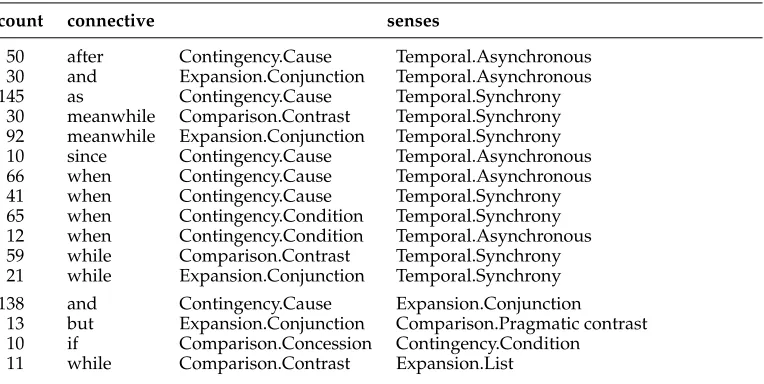
Table 3
Most common (≥10) pairs of level-2 sense labels on the 999 multiply-labeled explicit discourse relations. In pairs above the double line, one of the senses is temporal.
count connective senses
50 after Contingency.Cause Temporal.Asynchronous 30 and Expansion.Conjunction Temporal.Asynchronous
145 as Contingency.Cause Temporal.Synchrony
30 meanwhile Comparison.Contrast Temporal.Synchrony 92 meanwhile Expansion.Conjunction Temporal.Synchrony 10 since Contingency.Cause Temporal.Asynchronous 66 when Contingency.Cause Temporal.Asynchronous 41 when Contingency.Cause Temporal.Synchrony 65 when Contingency.Condition Temporal.Synchrony 12 when Contingency.Condition Temporal.Asynchronous 59 while Comparison.Contrast Temporal.Synchrony 21 while Expansion.Conjunction Temporal.Synchrony 138 and Contingency.Cause Expansion.Conjunction
13 but Expansion.Conjunction Comparison.Pragmatic contrast 10 if Comparison.Concession Contingency.Condition
11 while Comparison.Contrast Expansion.List
This is evident in the fact that annotators were allowed to assign up to two sense la-bels to each explicit or implicit connective, representing concurrent discourse relations. With explicit connectives, 999 of the 18,459 tokens (5.4%) were assigned two concurrent sense labels, with the most common pairs shown in Table 3.
Is 5.4% an accurate indicator of the frequency of multiple concurrent discourse rela-tions between two arguments when they are linked by an explicit discourse connective? Evidence for a higher figure comes from an early experiment with two connectives,
sinceandwhen(Miltsakaki et al. 2005). There, two annotators were given the option of labeling relations linked by one of these connectives in the WSJ corpus as eitherTEM
-PORALorCAUSALorTEMPORAL/CAUSAL, to indicate that both senses were conveyed. (The experiment was done on the 184 relations in the corpus headed bysinceand the first 100 relations headed bywhen, out of a total of 989.6) Those headed bysincewere annotatedTEMPORAL/CAUSAL21 times by one of the annotators (11.3%) and 16 times by the other (8.6%). Those headed bywhen were annotatedTEMPORAL/CAUSALeven more frequently: 22% by one annotator and 28% by the other.
Compare this with the counts for multiply-labeledsinceandwhenin Table 3: Only 10/184 tokens ofsince (5.4%) were annotated with both a TEMPORAL and a CAUSAL
sense, and only 184/989 tokens ofwhen(18.6%) were annotated with both some kind ofTEMPORALand some kind of CAUSALsense. In both cases, this is significantly less frequent than in the earlier experiment, suggesting that if annotators are not given explicit joint-sense options (such as TEMPORAL/CAUSALor more specific pairs) and only invited to use multiple concurrent sense labels if they take multiple discourse relations to hold, their use of multiple labels may be intermittent at best. This is a loss to both language technology and theoretical and psycholinguistic understanding of discourse relations, and a situation that deserves to be fixed.
In the case of implicit discourse relations, annotators could assign more than one sense label to a single implicit connective or they could insert more than one implicit connective, which were then individually sense-labeled. Both options indicated that concurrent discourse relations could be taken to hold between the specified arguments. Of the 16,224 implicit relations, 359 (2.2%) were annotated with a single implicit connec-tive with multiple senses, and 171 (1.1%) were annotated with two implicit connecconnec-tives, each taken to have a single sense. Both of these are very small numbers, so no hard conclusions can be drawn. Nevertheless, one might sample whether more of the implicit relations annotated with someCAUSALsense might be more accurately annotated with
someTEMPORALsense as well.
We close by noting that of the 171 cases annotated with two implicit connectives, with each assigned a single sense, over half (93/171 = 54.4%) involved a connective paired withfor example,for instance,orfor one thing(e.g.,since, for example;as, for instance;
because, for one thing); 13 more (7.5%) were paired within particularorspecifically(e.g.,in particular, because;specifically, because) and another 13 (7.5%) were paired within fact(e.g.,
although, in fact;so, in fact). All butin factare really connective modifiers (Section 3.1), even though they can also appear separately as connectives in their right. Such cases deserve further analysis, in connection with getting a better understanding of modified connectives, their prevalence, and their semantics.
4. Annotated Corpora Comparable to the PDTB
We noted in Section 1 that release of the PDTB has spawned similar efforts to annotate resources in other languages and genres following a lexically grounded approach to discourse relations. We also noted that these efforts vary in interesting ways from that of the PDTB. Here we describe both the nature and the sources of this variation, so that people contemplating development of comparable resources in additional languages and/or genres will recognize variation that is appropriate to their situation, while avoiding unnecessary variation that prevents inter-operability of these comparable corpora (Bunt, Prasad, and Joshi 2012).
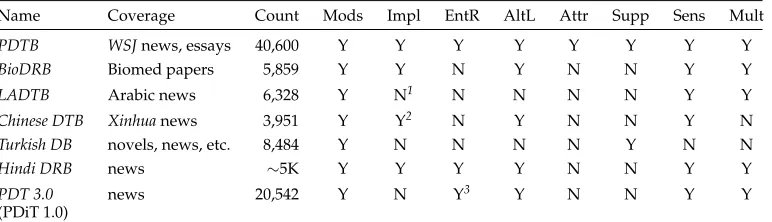
Table 4 identifies the corpora we will discuss and the extent of their current annotation: the BioDRB (Prasad et al. 2011), the Leeds Arabic Discourse TreeBank, or LADTB (Al-Saif and Markert 2010, 2011; Al-Saif 2012), the Chinese Discourse TreeBank (Xue 2005; Zhou and Xue 2012; Zhou and Xue (in press)), the Turkish Discourse Bank or TDB (Zeyrek et al. 2008, 2009; Aktas¸, Bozs¸ahin, and Zeyrek 2010; Zeyrek et al. 2010; Demirsahin et al. 2013; Zeyrek et al. 2013), the Hindi Discourse Relation Bank (Oza et al. 2009; Kolachina et al. 2012; Sharma et al. 2013), and the Prague Discourse TreeBank, or PDiT (Mladov´a, Zik´anov´a, and Hajiˇcov´a 2008; J´ınov´a, M´ırovsk ´y, and Pol´akov´a 2012; Rysov´a 2012; Pol´akov´a et al. 2013), now part of the Prague Dependency TreeBank, version 3.0, PDT 3.0 (Bejˇcek et al. 2013). (A comparable discourse treebank is being developed for French (Danlos et al. 2012), but it has not yet been released and the information needed to compare it to the other corpora in Table 4 is not available.)
Although these comparable corpora differ in ways to be discussed subsequently, they all adhere to the key ideas of PDTB annotation (Section 2) in being neutral to any discourse structure beyond the argument structure of individual discourse relations and in grounding discourse relations in lexical expressions. Where they annotate implicit discourse relations (Table 4), these comparable corpora follow the PDTB in annotating an inferred lexical grounding.
Table 4
Comparison of the PDTB and comparably annotated corpora.Countis the number of annotated relations;Coverageis the text genre(s) in the corpus;Mods=Yif connective modifiers are
annotated.Impl=Yif implicit connectives are annotated.EntR=Yif Entity Relations are
annotated.AltL=Yif Alternative Lexicalizations are annotated.Attr=Yif attribution is annotated.
Supp=Yif arguments can have supplementary text.Sens=Yif senses have been annotated.
Mult=Yif multiple sense relations can be annotated for a single connective.
Name Coverage Count Mods Impl EntR AltL Attr Supp Sens Mult
PDTB WSJnews, essays 40,600 Y Y Y Y Y Y Y Y
BioDRB Biomed papers 5,859 Y Y N Y N N Y Y
LADTB Arabic news 6,328 Y N1 N N N N Y Y
Chinese DTB Xinhuanews 3,951 Y Y2 N Y N N Y N
Turkish DB novels, news, etc. 8,484 Y N N N N Y N N
Hindi DRB news ∼5K Y Y Y Y N N Y Y
PDT 3.0 news 20,542 Y N Y3 Y N N Y Y (PDiT 1.0)
1∼70% of adjacent sentences in the LADTB are linked by an explicit connective, compared with∼12% in
the PDTB.
2In 20 randomly selected files, over 80% of DRels were found to be implicit, compared with around 54.5% in
the PDTB (Zhou and Xue 2012). 3Included in coreference annotation.
a possibly discontinuous text span. Although not every corpus annotates atttribution, where it is annotated, it is separate from the annotation of discourse relations.
4.1 Annotation Workflow
Because one purpose of this section is to inform people considering the development of similar resources in other languages and genres, we will briefly mention how workflow has varied in the development of comparable corpora and how it has affected annotator effort and inter-annotator agreement.
Workflow on the PDTB itself was based on the idea of using easier tasks to pave the way for more difficult ones. In practice, this meant separating the annotation of explicit and implicit relations, as explicits were perceived as easier to annotate. Explicit discourse relations were annotated one connective at a time throughout the corpus, before moving on to the next one on the list. The rationale for this was to improve the annotators’ ability to annotate a particular connective by focusing their attention on that connective. Subsequently, implicit discourse relations were annotated document by document, analyzing each pair of adjacent sentences within each paragraph, as described in Section 3.2. Later, senses were annotated for explicit and implicit discourse relations—explicits by connective, and implicits by document.
Arabic news texts is anAl-maSdarnoun, which is a tense-less expression of an event.7 Their frequency affected annotation workflow in the LADTB.
The LADTB used a workflow for annotating explicit discourse relations that in-volved highlighting for the annotators all potential discourse connectives (including word-initial clitics), based on a pre-compiled list. An annotator first read through the entire text to achieve an overall understanding, before stepping through the highlighted items one by one. In order to tell if a potential connective has a discourse function, the annotator would see whether it had arguments, including strings interpretable as al-maSdar nouns. Workflow thus involved simultaneous confirmation of potential discourse connectives and identification of their arguments. After that, the annotator would add the one or more senses that a relation expresses. If a potential connective did not express a discourse function, the annotator would note it and go on to the next highlighted item.
Workflow for the BioDRB (Prasad et al. 2011) was designed to address the difficulty perceived in annotating inter-sentential relations in scientific text. On encountering a new sentence, the annotator had to first mark its inter-sentential relation(s) with the prior discourse, and only then annotate any intra-sentential relations within it. In this way, annotators were made to first attend to relations that were harder to pin down, as they progressed in their sequential reading and annotation of the text.
Ongoing annotation of the Chinese Discourse TreeBank (Zhou and Xue 2012) fol-lows a fully sequential annotation strategy, largely for a language-specific reason—the customary writing style of Chinese, which often does not bother to distinguish the end of a sentence (marked with a full stop) from the end of a clause (marked with a
comma). This has two major consequences: No rigid distinction can be made between inter- and intra-sentential connectives, and annotators must consider implicit relations both between full-stop delimited sentences and comma-delimited clauses. (The latter have not been annotated in the current PDTB.) Annotating implicit relations between comma-delimited clauses results in many more implicit relations. Zhou and Xue (2012) report a 18–82% split in their data between explicit and implicit discourse relations, compared with a 46–54% split in the PDTB. As such, having a separate task to cover 18% of the data was disfavored.
Although the particular style of annotation should have no effect on the content of annotation, it can affect inter-annotator agreement. To this end, researchers developing the Hindi DRB (Oza et al. 2009; Kolachina et al. 2012) carried out a systematic study of three workflow strategies (Sharma et al. 2013). The first strategy modeled the task exactly as in PDTB. In the second, explicits and implicits were annotated in exactly the order in which they were encountered on a sequential reading of the text. The third strategy operated per text, with annotators first marking all of its explicit connectives, and then its implicit relations, before moving on to another text. The latter two strategies were designed to ensure that annotators were aware of the coherence and flow of the discourse when carrying out the task. Sharma’s findings show that better agreement is obtained when the annotators’ attention is held to the text, but with no clear preference for a fully sequential approach (as in the second strategy), or an approach that separated the tasks on a text-by-text basis (as in the third).
Although ultimately, the choice of workflow may be language- or genre-specific, as noted for Chinese, the final choice, then, should be driven by considerations of
annotation reliability, which seems to be enhanced by the annotators attending to the coherence and flow of the discourse. Interoperability among these resources is not an issue here, as long as whatever strategy is used yields highly consistent annotation.
4.2 Inventory and Organization of Senses
The senses of discourse relations used in the PDTB and the hierarchy in which they are organized (Miltsakaki et al. 2008) drew on both in-house experiments (Miltsakaki et al. 2004, 2005) and previous work on the semantics of discourse relations (Lakoff 1971; Moens and Steedman 1988; Sweetser 1990; Jayez and Rossari 1998; Kehler 2002), among others. Neither has been adopted without some change in the comparable corpora: Additional senses have been introduced, while other senses have been eliminated or modified; the sense hierarchy has been modified, and in one case, abandoned. For example, Oza et al. (2009) propose a more general and uniform treatment of those dis-course relations that arepragmatic, relating the speech act of one argument to either the content or speech act of the other. Al-Saif and Markert (2011) do the same. Almost every corpus includes at least one additional sense class, including SIMILARITY, PURPOSE,
BACKGROUND, and GRADATION, among others, motivated more by the genre of the texts being annotated than by their language.
Changes in the PDTB sense hierarchy have been either at its root or its leaves: The BioDRB has eliminated the four top-level classes, adopting a two-level hierarchy. The Prague Discourse TreeBank (Pol´akov´a et al. 2012) now part of the PDT 3.0 and the LADTB (Al-Saif and Markert 2011) have also adopted a two-level hierarchy, but they preserve the top-level classes, collapsing the second and third levels of annotation. The Chinese Discourse TreeBank (Zhou and Xue 2012) has eliminated the hierarchy entirely, using a flat classification of just twelve sense categories. Sense annotation has not yet begun on the Turkish Discourse Bank.
From the standpoint of interoperability, a shared assumption about the meaning and classification of discourse relation senses is of utmost importance, because conflicts in the assumed meaning of labels would preclude any kind of comparative studies of the annotated resources, both within and across languages and domains. With the growing number of variations in sense annotation schema, we believe it is critical to collect the insights and findings from these studies and to find common threads, since we believe there is much that is common between them. Indeed, some recent work has usefully provided a mapping between their classification schemes and the PDTB classification (Prasad et al. 2011; Zhou and Xue 2012).
4.3 Annotation of Explicit Connectives
An obvious way in which the corpora vary is in the choice of explicit connectives to be annotated. Because of the rich morphology of Turkish, explicit connectives in Turk-ish include morphological suffixes attached to verb roots and complex subordinators consisting of a connective and a nominalizing suffix. The former have not yet been annotated in the Turkish Discourse Bank (TDB), although the latter have been (Zeyrek et al. 2013). Counterparts of the latter, calledphrasal expressionsin the TDB, appear as
AltLexin the PDTB. As in the LADTB (Al-Saif 2012), nominalizations are commonly annotated as arguments in the TDB.
towards long sentences conjoined with coordinating conjunctions (Ostler 1987), with the equivalent ofand commonly found at the beginning of sentences and paragraphs (Al-Saif 2012). It was so common at the beginning of paragraphs in the newswire text annotated in the LADTB that all such tokens were simply assigned a CONJUNCTION
relation to the closest proposition, unless a clearer discourse relation was explicitly indicated.
4.4 Lexical Grounding for Implicit Discourse Relations
The approach used in lexically grounding implicit discourse relations seems to be language-specific. For English, the PDTB’s lexically grounded approach led to guide-lines for annotating implicit relations in which annotators were asked to identify one or more connectives that could be inserted between proposed arguments to express the discourse relation(s) they took to hold between them (cf. Section 3.2). This was meant to serve as explicit evidence for their decisions.
For the Chinese Discourse TreeBank, Zhou and Xue (2012) adopt a different strategy, effectively using paraphrase rather than insertion. This is because, in a majority of cases,
the wording rejects insertion of a connective even if it expresses the underlying discourse relation exactly (or sometimes, maybe the wording itself is the reason for not having a connective). (Zhou and Xue 2012, page 73)
This suggests that Chinese may use particular syntactic constructions to indicate intra-sentential discourse relations even more than English and German do (Meyer and Webber 2013). Thus, instead of having their annotatorsinsertexplicit connectives, Zhou and Xue (2012) have themparaphrasethe relation between proposed arguments in terms of explicit connectives that typically express each discourse relation. These prototypical connectives then serve as the lexical grounding for the relation.
Although this is the only case we are aware of that has used a different approach to lexically grounding implicit relations, it is something that corpus developers should keep in mind, especially when considering the annotation of discourse relations within sentences.
4.5 Locus of Implicit Relations
The corpora differ in where they look for implicit discourse relations. As noted in Section 3.2, implicit relations were only considered in the PDTB between adjacent sentences within the same paragraph. Although a sentence might have an implicit relation to a sentence further afield, we decided that it would add too much to an already costly effort to have annotators seek them out. With respect to implicit discourse relations within a single sentence, we are aware of having deliberately ignored (for lack of resources) discourse relations that we know are there.
Where to look for implicit discourse relations is, in part, language-specific. We have already noted (Section 4.1) that the structure of Chinese sentences is such that a much larger proportion of discourse relations in Chinese occur intra-sententially. Hence the greater need to look for them there.
BioDRB, implicit discourse relations have been sought more widely, allowing a sentence to be related to a non-adjacent sentence within the same paragraph.
4.6 Naming Convention for Arg1 and Arg2
One final way in which corpora comparable to the PDTB vary is with respect to the naming convention forArg1andArg2. In the PDTB, the choice follows syntactic criteria: With explicit discourse connectives,Arg2 is the argument syntactically bound to the connective, andArg1is the other argument. With implicit connectives,Arg1is the left-adjacent sentence, andArg2, the right-adjacent one.
Although the same convention is followed in the BioDRB and Turkish Discourse Bank, the Chinese Discourse TreeBank, the Prague Discourse TreeBank, and the Hindi Discourse Resource have followed a semantically driven convention, in which argu-ments that play the same semantic role have the same label. This then eliminates level-3 senses in the PDTB sense hierarchy (e.g., reason/result, expectation/contra-expectation, precedence/succession) whose only purpose is to reflect the different linear order of the arguments. Again, while these differences are admissible without impacting the annotation scheme in any major way, comparative studies using these corpora need to be sensitive to these differences. We note, however, that in an experiment using this strategy for the Hindi annotation, Kolachina et al. (2012) report poor agreement for arguments of relations, and speculate that it was harder for annotators to use the semantic labeling convention.
4.7 Summary
Discourse annotation efforts that have followed the PDTB in adopting a lexically grounded (or adjacency-based) approach to annotation nevertheless differ from the PDTB in ways discussed earlier. Still, it appears that none of these differences is so great as to affect their interoperability with the PDTB or each other, or their use in multi-lingual language technology or machine translation (Meyer 2011; Meyer and Popescu-Belis 2012; Meyer and Webber 2013).
5. Complementary Annotations
Some of the linguistic phenomena annotated in the PDTB have also been annotated in connection with other levels of linguistic annotation—in particular, the temporal annotation of the Wall Street Journal portion of the Penn Treebank corpus found in TimeBank 1.2 (Pustejovsky et al. 2003a) and the verb-argument annotation found in PropBank (Palmer, Gildea, and Kingsbury 2005). Here we describe how these annota-tions are related.
5.1 TimeML and TimeBank
The TimeML temporal/event annotation (Pustejovsky et al. 2003b) of texts from the Penn TreeBank forms part of the TimeBank 1.2 corpus (Pustejovsky et al. 2003a).
TimeML supports the annotation of events, time periods, and temporal relations, expressed either explicitly or implicitly in a text. The information that TimeML makes explicit includestemporal expressionssuch as the date 10/26/1989 (tagged asTIMEX3), temporal eventssuch as Nigel Lawson resigning as Chancellor of the Exchequer (tagged asEVENT),temporal signalssuch asafter,during, andin(tagged asSIGNAL), andtemporal relationsbetween pairs of temporal expressions or event instances, or between a tem-poral expression and an event instance (tagged as TLINK). The set oftemporal relations
comes from Allen (1984). When atemporal relationis explicitly indicated by atemporal signal, the signal is included in theTLINK. This enables a clear correspondence with the PDTB.
Atemporal eventis annotated on the head of the syntactic construction that expresses it—the verb, in the case of a clause, as in the annotation of resume and warrant in Example (25), where theSIGNALuntilis asserted to signal the temporal relation between
resumeandwarrant.
(25) He<EVENT>said</EVENT> <EVENT>construction</EVENT>wouldn’t
<EVENT>resume</EVENT> <SIGNAL>until</SIGNAL>market conditions
<EVENT>warrant</EVENT>it. [wsj 0610]
This corresponds to the PDTB annotation:
(26) He saidconstruction wouldn’t resumeuntil (TEMPORAL.ASYNCHRONOUS. PRECEDENCE)market conditions warrant it.
But TimeML also annotates events expressed as nominalizations (e.g.,construction
in Example (25)) and simple nouns (e.g.,taxin Example (27)).
(27) And while there was no profit this year from discontinued operations, last year they<EVENT>contributed</EVENT>$34 million,
<SIGNAL>before</SIGNAL><EVENT>tax</EVENT>. [wsj 0127]
Becausetemporal eventsare not limited to clauses, signals oftemporal relationsare not lim-ited to clausal coordinators or subordinators or discourse adverbials, but also include prepositions such asbeforein Example (27). This is not annotated in the PDTB.
TimeML also allows for the annotation of certain non-temporal relations between events, including conditional, evidential, non-evidential, and factive relations. These are tagged SLINK (for Subordination Link). As with temporal relations, when these non-temporal relations are indicated with a SIGNAL(such as if for a conditionalrelation), theSIGNALis included in theSLINK.
Although many of the same linguistic elements have been annotated in both the PDTB and TimeBank, the annotation itself can be quite different. The sim-plest difference relates to the sense of temporal relations: TimeML allows more specific relations between events than the PDTB’s three broad relations TEMPO -RAL.ASYNCHRONOUS.PRECEDENCE(before),TEMPORAL.ASYNCHRONOUS.SUCCESSION(after), andTEMPORAL.SYNCHRONY(same time). For example, TimeML annotators can indicate that one event is immediately before or immediately after another, although TimeBank annotators have not used this when annotating relations signalled bybeforeorafter.
relation—including temporal relations—that holds between abstract objects (mainly clausal or sentential interpretations) that are signaled by an explicit discourse connec-tive (or somealternative lexicalizationof a connective) or by the fact of sentence adjacency. In the latter case, either an implicit discourse relation will be inferred between them, or a relation involving some entity mentioned in the first sentence (EntRel), or no relation at all (NoRel). In all cases, something will be annotated.
In contrast, TimeML guidelines specify that if a temporal relation is explicitly sig-naled in the text, then events and/or time periods specified in different sentences may be linked through signals such aspreviously,earlier,at the same time,then,ormeanwhile. If no temporal relation is explicitly signaled, then temporal elements in different sentences are not linked, so there are noTLINKSin TimeBank corresponding to the PDTB’s 950 implicit temporal relations between adjacent sentences.
On the other hand, the TimeML guidelines allow a temporal relation to be in-ferred from discourse relations that are not primarily temporal. For example, some discourse relations annotated in the PDTB as causal (i.e.,CONTINGENCY.CAUSE.REASONor CONTINGENCY.CAUSE.RESULT) are annotated as temporal relations in TimeBank because both arguments express temporal events and because a cause event starts before its result. This is the case in Example (28), where TimeBank annotates theholdingevent as occurring before theadjustingevent, which has a negative polarity attribute.8 In the PDTB, only the explicitly signaled causal relation is annotated.
(28) Previously, Columbia didn’t have to adjust the book value of its junk-bond holdings to reflect declines in market prices, because (CONTINGENCY.CAUSE.REASON) it held the bonds as long-term investments. [wsj 1013]
However, not all relations annotated in the PDTB asCONTINGENCY.CAUSE.REASONhave a corresponding temporal annotation in TimeBank: Those corresponding to generic statements (e.g., Example (29)) do not, because generic statements are not taken to express temporal relations.
(29) It’s harder to sell stocks when the sell programs come inbecause (CONTINGENCY. CAUSE.REASON)some market makers don’t want to{take the orders}. [wsj 0585]
Finally, there is some correspondence between PDTB annotation and the non-temporal relations that TimeBank annotates asSLINK. What TimeBank annotates as a
conditionalSLINKoverlaps with the explicit discourse relations annotated in the PDTB as CONTINGENCY.CONDITION. Other types ofSLINK(modal,factive,evidential, andnegative evidential) are related to the properties ofAttributionin the PDTB (cf. Section 3.3; Prasad et al. 2007).
Enriching TimeBank relations based on annotation in the PDTB, and vice versa, would require a more detailed study of both the annotation frameworks and annotation practice in the two corpora. The same would go for using the annotation in one as a consistency check on the other. Nevertheless, both would potentially be of great value to delivering more usefully annotated resources.
a. ( (S
(SBAR-TMP:ARGM-TMP (IN Until) (S
(NP-SBJ-1 (DT the) (NN building) ) (VP (VBZ is)
(VP (VBN completed) (NP (-NONE- *-1) ))))) (, ,)
(NP-SBJ:ARG0 (NNP Exxon) ) (VP (MD:ARGM-MOD will)
(VP (VB rent) (NP:ARG1
(NP (NN part) ) (PP (IN of)
(NP (DT an) (VBG existing) (NN office) (NN tower) ))))) (. .) ))
b. Until (TEMPORAL.ASYNCHRONOUS.PRECEDENCE) the building is completed, Exxon will rent part of an existing office tower. [wsj 0784]
Figure 2
(a) PropBank annotation of the verbrent; (b) PDTB annotation of the sentence thatrentheads.
5.2 PropBank
More interesting is the relation between PDTB annotation of discourse relations and PropBank annotation (Palmer, Gildea, and Kingsbury 2005) of the sentence-internal ar-gument structure. PropBank provides, for each verb predicate in the Penn TreeBank, its sense and the semantic role of each of its arguments. An argument can be either required by the verb through its valency and assigned an index such as Arg0, Arg1, and so on, or accepted as a modifier (annotated with an ArgM label). ArgM arguments are further assigned functional tags such as MNR (manner), MOD (modal), TMP (temporal), CAU (causal), DIS (discourse), and so forth. For example, the PropBank annotation of one instance of the verbrentis shown in Figure 2a. Besides its subject and object (Arg0 and Arg1), the modal auxiliarywillis annotated as ArgM-MOD and the subordinate clause headed byuntilis annotated ArgM-TMP.
Many of the ArgM arguments in PropBank are either clauses or nominalizations that denote events. Many of these align with discourse relations in the PDTB. For example, the ArgM annotation of the subordinate clause in Figure 2a corresponds to Arg2of the PDTB annotation of the discourse relation associated withuntil(Figure 2b). We can quantify the extent and nature of this correspondence between the two annotation layers, and in doing so consider two related questions: (1) How many and to what extent are the intra-sentential relations in PDTB also accounted for by the dependencies annotated in PropBank, and (2) Are there gaps in the discourse-level annotation that can be identified from the PropBank layer? Our analysis here is in terms of the annotation in PropBank-1.9Although the scope of this annotation has been extended within the Ontonotes project (Weischedel et al. 2012), this does not affect our general points.
5.2.1 Correspondence of PDTB Intra-sentential Relations with PropBank. We first assess whether the intra-sentential relations in the PDTB can be fully accounted for by the verb-ArgM dependencies in PropBank in terms of quantity, content, and consistency. If so, annotating them again at the discourse level would have involved needless repetition.
There are 11,830 intra-sentential relations annotated in the PDTB, accounting for 28% of the discourse relations annotated in the corpus. Of these 11,830 relations (all of which are candidates for overlap with PropBank), 11,236 involve explicit connectives and 594 do not. The latter primarily hold between independent clauses separated by a semicolon. As the clauses so-linked are independent, neither being a modifier of the other, these relations are not covered in PropBank.
The other 11,236 intra-sentential relations include relations between clauses linked by an explicit coordinating conjunction (such as and and but). Like the semicolon-separated clauses, these are independent and so also outside the scope of PropBank. The set also includes relations between clauses in the same sentence signaled by a discourse adverbial. In PropBank, discourse adverbials are generally annotated as discourse-linking modifiers (ARGM-DIS), leaving unspecified what they link to. For example, in Example (30), the discourse adverbial instead conveys a relation between the two “throwing” propositions. While PropBank annotatesinsteadas ARGM-DIS of the main clausethrow, it does not explicitly linkinsteadto its other argument.
(30) When the champ has lost his stuff, the great mystery novelist wrote,when he can no longer throw the high hard one,he throws his heartinstead. [wsj 1649]
PropBank-1 did not annotate arguments to copula verbs, so subordinating clauses attached to these verbs were not covered. However, copula verbs have subsequently been included in extensions covering over 75% of PropBank-1 and released as part of Ontonotes-5.0, so these subordinating clauses are now marked as arguments.
Besides differing in terms of intra-sentential coverage, PropBank and the PDTB also differ in their semantics. Specifically, even those PropBank ArgM roles that are closest to discourse relations—ArgM-CAU (causal), ArgM-TMP (temporal), ArgM-PNC (pur-pose), ArgM-MNR (manner), and ArgM-ADV (adverbial)—differ from the semantics of PDTB senses in several ways.
r
Specificity: ARG-TMP is annotated where the PDTB annotates a more specific sense (Synchrony, Precedence, and Succession) of its top-level class TEMPORAL.r
Heterogeneity: Subordinate clauses that are labeled as ArgM-ADV correspond to the full range of PDTB senses.r
Multiplicity: The PDTB allows more than one sense label to be associated with a single discourse connective to indicate that multiple sense relations hold concurrently (e.g., a token ofsincemay be labeled with both a temporal and causal sense). In contrast, PropBank only permits a constituent to fill a single functional role. Nevertheless, the seven cases where subordinate clauses are annotated as causal (ArgM-CAU) in PropBank and some form of TEMPORALsense in the PDTB reveal additional cases of the earlier-mentioned under-annotation of multiple concurrent senses in the PDTB (Section 3.4.3).r
Coverage: The PDTB’s sense inventory currently lacks senses corresponding to PropBank’s ArgM-MNR and ArgM-PNC roles. This will be discussed in Section 5.2.2.annotation is tied directly to the syntactic trees in the PTB. Figure 3(b) shows the PropBank annotation of the verbsayover the PTB parse tree shown in Figure 3(a), with its initial when-clause parsed as a temporal modifier (ArgM-TMP) ofsay. In contrast, PDTB annotation has been done over the raw text, with discontinuous spans permitted as arguments. This allows attribution to be included or excluded from a discourse relation (Section 3.3). In this case, Figure 3(c) shows attribution is excluded: The tem-poral relation (SUCCESSION) is annotated betweenwinningandawarding, implying that Mr. Green’s winning of the verdict was followed by the judge giving him the additional award. Given the difference in annotation practice, the extent of such mismatches between PDTB and PropBank is expected to be the same as that between PDTB and PTB (Dinesh et al. 2005).
In this section, we have considered whether the intra-sentential relations in the PDTB (i.e., those with both arguments in the same sentence) can be fully accounted for by the verb-ArgM dependencies in PropBank. We have shown that the account is only partial, due in part to the significantly different goals of the two annotation projects and in part to differences in methodological choices. As such, even intra-sententially, a separate layer of discourse relation annotation is motivated.
(a) ( (S (SBAR-TMP
(WHADVP-1 (WRB When) ) (S
(NP-SBJ (NNP Mr.) (NNP Green) ) (VP (VBD won)
(NP (NP (DT a)
(ADJP ($ $) (CD 240,000) (-NONE- *U*) ) (NN verdict) )
(PP (IN in) (NP
(NP (DT a) (NN land) (NN condemnation) (NN case) ) (PP (IN against)
(NP (DT the) (NN state) ))))) (ADVP-TMP (-NONE- *T*-1) )
(PP-TMP (IN in)
(NP (NNP June) (CD 1983) ))))) (, ,)
(NP-SBJ (PRP he) ) (VP (VBZ says)
(SBAR (-NONE- 0) (S
(NP-SBJ (NNP Judge) (NNP O’Kicki) ) (VP
(ADVP (RB unexpectedly) ) (VBD awarded)
(NP (PRP him) )
(NP (DT an) (JJ additional) ($ $) (CD 100,000) (-NONE- *U*) ))))) (. .) ))
(b)rel=say; Arg0=he;
Arg1=”Judge O’Kicki unexpectedly awarded him an additional $100,000.”;
ArgM-TMP=”When Mr. Green won a $240,000 verdict in a land condemnation case against the state in June 1983”
(c) When (TEMPORAL.ASYNCHRONOUS.SUCCESSION)Mr. Green won a $240,000 verdict in a land condemnation case against the state in June 1983, he saysJudge O’Kicki unexpectedly awarded him an additional $100,000. [wsj 0267]
Figure 3