Int J Clin Exp Med 2019;12(6):6617-6635
www.ijcem.com /ISSN:1940-5901/IJCEM0090627
Original Article
Knowledge mapping visualization analysis
of Tai chi research published in web
of science over the past 20 years
Tingting Zhang1*, Ying Ye1*, Yangzhi Peng1, Runyuan Ren1, Manni Ye2, Qi Zhang1
1Basic Medical School, Chengdu University of Traditional Chinese Medicine, Chengdu 610075, China; 2Institute of
Education Sciences, Wuhan University, Wuhan 430072, China. *Equal contributors.
Received December 29, 2018; Accepted February 11, 2019; Epub June 15, 2019; Published June 30, 2019
Abstract: Objective: The aim of this study was to demonstrate state of the art trends concerning the worldwide use of Tai chi in prevention, treatment, and rehabilitation. Methods: Literature relating to Tai chi from 1999 to 2018 was retrieved from Web of Science Core Collection (WoSCC). CiteSpace was used to analyze authors, institutions, countries, keywords, cited references/authors/journals, core journals, active authors, foundation references, hot topics, and frontiers, according to time period. Results: A total of 794 references were obtained. The total number of publications increased before 2014 and decreased in the past 4 years. Journal articles were the only document
type included. The most productive countries and institutions in this field were the USA (334), Chinese University of Hongkong (38), and Harvard University (37), respectively. Evidence-Based Complementary and Alternative Medicine
(27) was the most productive journal. Journal of the American Geriatrics Society (497) was the most co-cited journal,
which reflected the nature of the research. The six hot topics of Tai chi included balance, musculoskeletal system,
chronic diseases, psychological well-being, research methods, and cost-effectiveness. Conclusion: This study pro-vides insight into Tai chi, containing valuable information for researchers in identifying new perspectives on poten-tial collaborators and cooperative institutions, hot topics, and research frontiers.
Keywords: Tai chi, knowledge mapping, visualization analysis, CiteSpace, hotpot
Introduction
“Cleanse your mind and concentrate on the slowness and evenness of your movements”. ---Tai chi, also known as Tai chi Chuan/quan or taijiquan, is a Chinese conditioning exercise. It is well known for its slow, harmonious, medi-tative, and “energetic” movements. It has been combined with a perspective of use based on
hand-fighting and traditional weapons, making
Tai chi a unique oriental corporal body practice. Tai chi is the late Qing Dynasty sum of martial, corporal, cosmogonic, religious, and historical
Chinese elements [1], reflecting oriental char -acteristics and wisdom. It uses TaiJi and
Yin-Yang as core ideas. It is also related to the five
elements and meridian and collateral theory in Traditional Chinese Medicine. Tai chi has health
care effects with physical fitness, integrating the function of self-cultivation, physical fitness,
and aggression confrontation.
In the past 20 years, because of its health
ben-efits, apparent safety, and low costs, Tai chi has
gradually gained popularity in both Eastern and Western countries, as a promising mind-body exercise.An increasing number of clinical stud-ies have documented the safety and health
benefits of Tai chi intervention [2]. Several sys -tematic reviews have examined available evi-dence from randomized controlled trails or non-randomized clinical trials on Tai chi concerning
a variety of specific diseases and health
con-ditions.
data-Analysis tool
CiteSpace was used to pe- rform bibliometric analys- is. Visualization knowledge maps consist of nodes and links. Nodes represent dif-ferent elements, like auth- ors, institutions, countries, and cited references. Links represent relationships of collaboration or co-citatio- ns. Colors of the nodes and lines represent different years. Centrality is usually regarded as a turning point
or pivotal point in a field,
representing the importa- base. This study aimed to analyze authors, in-
stitutions, countries, keywords, cited referenc-es/authors/journals, core journals, active au- thors, foundation references, hot topics, and frontiers, according to time period.
Materials and methods
Data source and search strategy
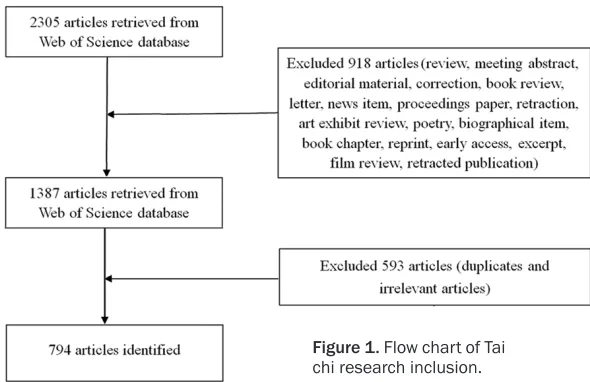
Literature retrieval was conducted online th- rough Science Citation Index-Expanded (SCI- E), Social Sciences Citation Index (SSCI), and Arts & Humanities Citation Index (A & HCI) of the Web of Science Core Collection (WoSCC) on September 14, 2018. Searches were conduct-ed on the same day, avoiding bias causconduct-ed by daily database updates. The time span ranged from 1999 to 2018. Data retrieval strategy [3]: Topic = (“tai chi”) OR = (“taichi”) OR = (“tai chi quan”) OR = (“taichichuan”) OR = (“tai ji”) OR = (“taiji”) OR = (“tai ji quan”) OR = (“taijiquan”) OR = (“tai chi quan”) OR = (“taichiquan”); Document type = article. Only original papers were includ-ed and there were no language or data catego-ry restrictions. A total of 1,387 references were ultimately obtained.
Study selection
To ensure the accuracy of retrieval results,
manual verification was necessary. Two authors
(PYZ and RRY) screened the titles and abstracts of the hits (browsed full texts when necessary). If there was uncertainty or discrepancies, a third author (YY) was consulted. After study selection, duplicate and irrelevant articles were removed. After repeated screening, a total of 794 references were obtained (Figure 1).
nce of nodes in a network [4, 5]. A key node is
defined as a node with an intermediary central -ity greater than or equal to 0.1 in the network. Parameters of CiteSpace included time slicing (1999-2018), years per slice (1), term source (all selection), node type (choose one at a ti- me), selection criteria (10/30/50), pruning (pa-
thfinder/minimum spanning tree/pruning the
merged network), and visualization (cluster vi- ew-static, show merged network).
Results and discussion
Analysis of publication output
The total number of publications increased
over the study period, with some fluctuations.
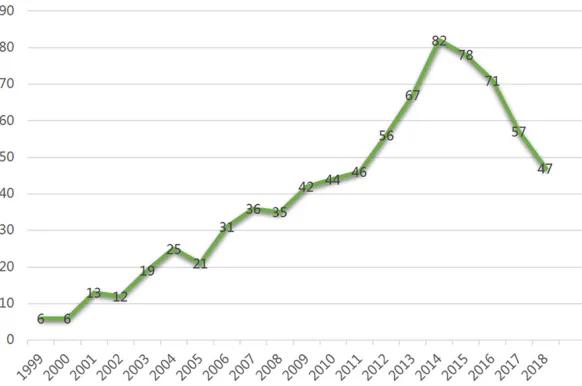
The number of publications by year is present-ed in Figure 2. Until 2000, there were few stud -ies on Tai chi. The period of 2000 to 2014 was a rapid development period. The overall trend raised from 6 articles in 2000 to 92 articles in 2014. Although the growth rate of publication output decreased in 2002, 2005, and 2008, the total number of publications showed a ris-ing trend durris-ing this period. After 2014, the number of original papers declined. There has been a decrease in the number of original stud-ies in the past 4 years.
Analysis of document type
There were 15 documents types identified in a
[image:2.612.89.384.69.260.2]total of references related to Tai chi. Only origi-nal articles were included to avoid duplicated and incomplete knowledge content. Selected journal articles (794) were all closely related to Tai chi research.
Visualization analysis of Tai chi
Knowledge maps can provide information
con-cerning core professional journals in the field.
Table 2 shows the top 5 scholarly journals that published articles related to Tai chi research. They were professional and core journals in this
field. Of these, the average impact factor (IF)
was 2.900. However, there were some articles published in high-IF journals, like New England Journal of Medicine (IF=79.258), Journal of Cli- nical Oncology (IF=23.303), Annals of Internal Medicine (IF=19.384), and Annals of the Rh- eumatic Diseases (IF=12.350). New England Journal of Medicine reported that Tai chi is an effective intervention in Parkinson’s disease
and fibromyalgia [6, 7], while the Journal of Clinical Oncology reported that Tai chi could improve insomnia symptoms in survivors of breast cancer [8]. These high-IF papers
repre-sent the high quality and major influence of Tai
chi research.
Next, this study selected the top 10 most cited journals from each year, generating a co-cited journal map using CiteSpace, resulting in 46 notes and 67 links (Figure 5). The top 10 co-cited journals are listed in Table 3. The average IF was 15.8509. The top 5, in terms of central-ity, were Arch Phys Med Rehab (0.87), Med SCI Sport Exer (0.67), Am J Occup Ther (0.63), J Am Geriatr Soc (0.53), and Phys Ther (0.52). The most co-cited journal was the Journal of the American Geriatrics Society, cited 497 times. It reported that Tai chi is an effective exercise in reducing incidence of falls [9], augmenting immune response [10], and improving cognitive
Analysis of countries and institutions
Generating an institution map using CiteSpace resulted in 103 notes and 95 links (Figure 3). The 794 publications were distributed among 103 research institutions. The top 10 institu-tions are listed in Table 1. The top 10
institu-tions, in terms of centrality, (≥0.1) were Hong Kong Polytechnic University (0.30), Harvard University (0.28), Fujian University of Traditional Chinese Medicine (0.28), Willamette University (0.17), Brigham & Women’s Hospital (0.15), University of Illinois (0.14), Shanghai University Of Sport (0.13), University of Sydney (0.13),
Harvard medical school (0.11), and Chinese
University of Hongkong (0.10). Publication and centrality analysis indicated that Harvard Uni-versity, Hong Kong Polytechnic UniUni-versity, and Chinese University of Hongkong were the core
research institutions. However, collaborations among them were not evident. The network map demonstrated few connections between institution nodes. Colleges and health research institutions are the main research forces of Tai
chi, with obvious scientific research
advanta-ges.
Generating a country map using CiteSpace resulted in 41 nodes and 81 links (Figure 4). The 794 references were contributed by 41 countries. According to the top 10 countries (Table 1) engaged in Tai chi research, the USA
contributed the most publications (334). They were followed by China (298) and Australia (60). The top 8 countries, in terms of centrality
[image:3.612.92.383.70.263.2](≥0.1), were China (0.38), USA (0.32), England
Figure 2. The number of Tai chi publications indexed from 1999 to 2018.
(0.26), Spain (0.26), Italy (0.17), Netherlands (0.16), Australia (0.11), and South Korea (0.10). Analysis, in te- rms of publication and cen-trality, indicated that China
and the USA were the main
research powers. Extensive collaborations were obser-
ved between China, USA,
Australia, England, Spain, and Canada. Apart from China, developed countries are the main forces in Tai chi research.
function [11]. However, this journal also pub-lished a randomized clinical trial with results showing that Tai chi was ineffective in fall pre-vention in elderly people living at home [12]. The Journal of the American Geriatrics Society and Archives of Physical Medicine and Re- habilitation have been identified as core jour
-nals in Tai chi research field, with objective and impartial attitudes. Published articles reflect the fundamentals of the research field.
Analysis of authors and co-cited authors
The top 30 most published authors from each year were selected, generating a co-author map using CiteSpace. This resulted in 193 notes and 364 links (Figure 6). The 794
publi-cations were mainly published by 193 research authors. Table 4 shows the top 10 authors that published articles related to Tai chi. They were
active and professional authors in this field. Of these authors, Wayne PM was ranked first. He
is from Osher Center for Integrative Medicine and Harvard Medical School. He is committed to studying the treatment of chronic heart fail-ure with Tai chi, as well as vestibular rehabilita-tion. There were some collaborations between
Wayne PM, Wolf SL, Yeh GY, and Davis RB, as
[image:4.612.97.500.71.318.2]well as between Wang CC, HARVEY WF, and PRICE LL, and between Li FZ and Harmer P. However, the centrality for such collaborations was less than 0.1, suggesting that collabora-tion between research authors was not yet enough.
Table 1. Top 10 prolific institutions and countries researching Tai chi
Ranking Publications Institution Ranking Publications Country
1 38 Chinese University of Hongkong 1 334 USA
2 37 Harvard University 2 298 China
3 25 The Hongkong Polytechnic University 3 60 Australia
4 25 Shanghai University Of Sport 4 44 Canada
5 19 Oregon Research Institute 5 31 South Korea
6 18 University of Sydney 6 24 England
7 16 Harvard Medical School 7 24 Japan
8 15 Brigham & Women’s Hospital 8 21 Germany
9 15 University of Hong Kong 9 12 Switzerland
[image:4.612.90.526.354.502.2]10 14 University of Illinois 10 12 Brazil
Visualization analysis of Tai chi
Table 2. Top 5 scholarly journals related to Tai chi research
Ranking Publications Journal IF (2018)
1 27 Evidence-Based Complementary and Alternative Medicine 2.064
2 26 Archives of Physical Medicine and Rehabilitation 3.077
3 20 American Journal of Chinese Medicine 3.120
4 18 Journal of the American Geriatrics Society 4.155
5 17 Complementary Therapies in Medicine 2.084
[image:5.612.92.519.376.458.2]Note: IF (impact factor) in category according to Journal Citation Reports (2017).
Figure 4. Map of countries researching Tai chi.
[image:5.612.94.444.489.726.2]that Wolf SL, Li FZ, and Wa- ng CC were “core strength” researchers. Their studies
showed an important influ
-ence on the field. Wolf SL is
the Professor and Director of Research, Department of Rehabilitation Medicine. He is committed to the st- udy of Tai chi, concerning The top 10 most cited authors were selected
from each year, generating a co-cited author map using CiteSpace. This resulted in 60 notes and 180 links (Figure 7). The top five co-cited
authors, in terms of co-citation counts and cen-trality, are listed in Table 5. Analysis revealed
[image:6.612.90.530.83.229.2]motor control, geriatrics, and stroke biofeed-back. Li FZ is from Oregon Research Institute, Eugene. He studied Tai chi in terms of physical activity, health promotion, and exercise inter-vention in preventing falls and injuries in the elderly. Wang CC is from Tufts Medical Center Table 3. Top 10 co-cited journals related to Tai chi research
Ranking Co-cited counts Co-cited journals IF (Q) 2018
1 497 Journal of the American Geriatrics Society 4.155
2 396 Archives of Physical Medicine and Rehabilitation 3.077
3 344 Medicine and Science in Sports and Exercise 4.291
4 279 Journals of Gerontology Series a-Biological Sciences and Medical Sciences 4.902
5 255 British Journal of Sports Medicine 7.867
6 220 Archives of Internal Medicine /
7 191 Journal of Alternative and Complementary Medicine 1.498
8 191 Jama-journal of the American Medical Association 47.661
9 187 Physical Therapy 2.587
10 178 New England Journal of Medicine 79.258
Note: Archives of Internal Medicine is not included in the latest JCR (Journal Citation Reports, 2017). IF (impact factor) in catego-ry according to Journal Citation Reports (2017). The data has been taken from the publication year to retrieved date (September 14, 2018).
Table 4. Top 10 active authors in Tai chi research
Ranking Publications Author Ranking Publications Author
1 24 Wayne PM 6 9 Davis RB
2 19 Li FZ 7 9 Wolf SL
3 14 Harmer P 8 8 Hui-Chan CWY
4 13 Tsang WWN 9 7 Wang CC
[image:6.612.92.416.284.509.2]5 10 Yeh GY 10 7 Zheng GH
[image:6.612.91.385.541.620.2]Visualization analysis of Tai chi
(USA), studying the effects of Tai chi on differ
-ent disease, such as fibromyalgia, knee osteo -arthritis, and rheumatic diseases.
Analysis of co-cited references
The top 10 most cited references were select-ed from each year, generating a citselect-ed reference co-citation map. This resulted in 120 nodes and 269 links (Figure 8). According to scientific
metrology, studies of key nodes with relatively high centrality represent the foundation of the
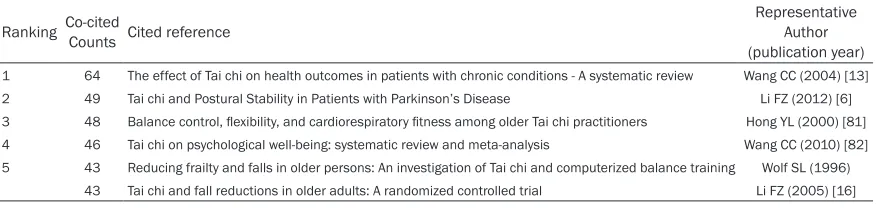
research field [5]. The top five co-cited refer -ences related to co-cited counts and centrality are listed in Tables 6 and 7, respectively. The most cited article was “The effect of Tai chi on health outcomes in patients with chronic conditions - a systematic review” in 2004, indi-cating that Tai chi appears to have
physiologi-cal and psychosocial benefits. It also appears
to be safe and effective in promoting balance
control, flexibility, and cardiovascular fitness in
older patients with chronic conditions. However, most indications in which Tai chi was applied lacked a theoretical foundation concerning the
mechanisms of benefit. More well-designed
studies are needed [13].
The cited article with the highest centrality was “Challenges inherent to Tai chi research: Part I - Tai chi as a complex multicomponent interven-tion”. The research team believed that Tai chi is a complex multicomponent intervention that integrates numerous physical, cognitive, and ritualistic components. They discussed addi-tional challenges inherent to the study of Tai chi, including Tai chi’s pluralism, the concept of Tai chi dosage, and long-term versus short-term
evaluations of Tai chi’s efficacy and safety. Furthermore, they outlined the benefits and
[image:7.612.89.511.72.317.2]limitations of commonly employed clinical re- search methods [14].
Table 5. Top 5 active authors in terms of co-citation counts and centrality
Ranking Co-citation counts Cited author Ranking Centrality Cited author
1 269 Wolf SL 1 0.56 Wolf SL
2 243 Lan C 2 0.49 Li FZ
3 242 Li FZ 3 0.22 Wang CC
4 205 Wang CC 4 0.19 Kutner NG
5 121 Taylor-Piliae RE 5 0.14 Wolfson L
[image:7.612.91.524.348.426.2]Note: The data has been taken from the publication year to retrieved date (September 14, 2018).
of Tai chi urgently needs intervention from new visual angles, new ideas, and new methods. Citations of periodical papers were relatively
[image:8.612.90.505.71.382.2]old, showing that research literature in the field
Table 6. Top five co-cited references related to Tai chi research
Ranking Co-cited Counts Cited reference Representative Author (publication year)
1 64 The effect of Tai chi on health outcomes in patients with chronic conditions - A systematic review Wang CC (2004) [13] 2 49 Tai chi and Postural Stability in Patients with Parkinson’s Disease Li FZ (2012) [6] 3 48 Balance control, flexibility, and cardiorespiratory fitness among older Tai chi practitioners Hong YL (2000) [81] 4 46 Tai chi on psychological well-being: systematic review and meta-analysis Wang CC (2010) [82] 5 43 Reducing frailty and falls in older persons: An investigation of Tai chi and computerized balance training Wolf SL (1996)
43 Tai chi and fall reductions in older adults: A randomized controlled trial Li FZ (2005) [16]
Note: The data has been taken from the publication year to retrieved date (September 14, 2018).
Table 7. Top five co-cited references in terms of centrality
Ranking Co-cited Counts Cited reference Representative Author (publication year)
1 64 The effect of Tai chi on health outcomes in patients with chronic conditions - A systematic review Wang CC (2004) [13] 2 49 Tai chi and Postural Stability in Patients with Parkinson’s Disease Li FZ (2012) [6] 3 48 Balance control, flexibility, and cardiorespiratory fitness among older Tai chi practitioners Hong YL (2000) [81] 4 46 Tai chi on psychological well-being: systematic review and meta-analysis Wang CC (2010) [82] 5 43 Reducing frailty and falls in older persons: An investigation of Tai chi and computerized balance training Wolf SL (1996) [83] 43 Tai chi and fall reductions in older adults: A randomized controlled trial Li FZ (2005) [16]
[image:8.612.89.529.416.520.2]Note: The data has been taken from the publication year to retrieved date (September 14, 2018). Figure 8. Map of cited
[image:8.612.89.533.564.668.2]Visualization analysis of Tai chi
For example, “Tai chi”, “Tai chi Chuan”, and “Tai chi exercise” were grouped together, as well as “older people” and “elders”.
The top 30 keywords from each year were selected, generating a keyword co-occurrence map. This resulted in 198 nodes and 793 links (Figure 9A). As shown in Table 8 and Figure 9A, randomized controlled trials were the main research method. Tai chi exercise research
Analysis of keyword co-occurrence and burst keywords
A knowledge map of keyword co-occurrence
[image:9.612.93.522.82.574.2]reflects hot topics, while burst keywords (key -words that are cited frequently over time) indi-cate frontier topics over time. Since the same keywords might have different meanings in dif-ferent studies, keywords of same or similar meaning were grouped together in CiteSpace. Figure 9. Map of keywords
(A) and keyword clusters
mainly focused on balance, quality of life, falls, and strength. Test subjects were mainly adults, older adults, and women.
Clustering analysis brings closely-related topics
together to display research fields. In this paper,
keywords cluster analysis was conducted using
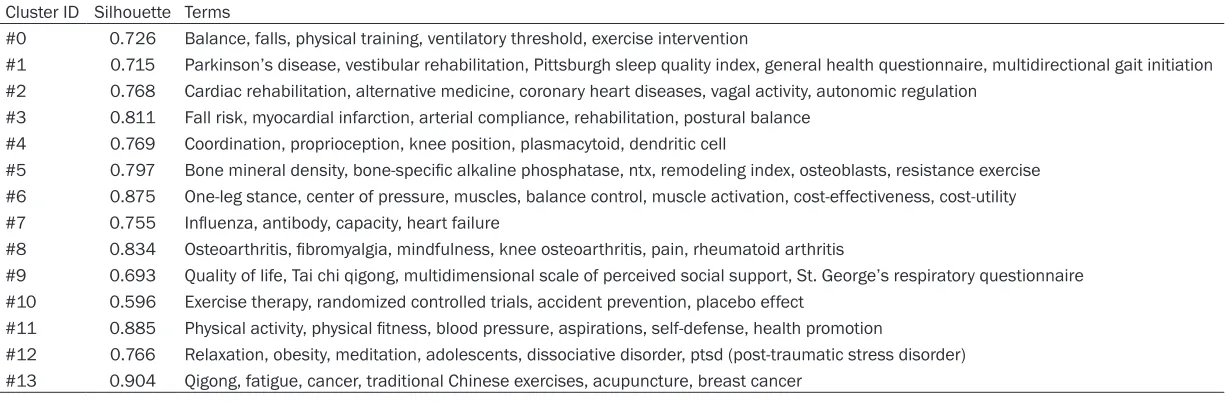
the pathfinder algorithm via CiteSpace (Table 9). From the clustering map (Figure 9B), 14 clusters were generated, forming 6 knowledge groups (hot topics).
Tai chi and balance (#0, #4, #6): “Balance” was
the keyword with the most centrality and high-est frequency (210). It was closely related to occurrence of falls. Of Americans aged 65 years and older, falls are the leading cause of injury death and disability. Finding effective methods to prevent older adults from falling has become a public health priority [15]. Tai chi is an effective intervention that can improve the balance of older people, decreasing the number of falls and risk of falling [16, 17]. Previous studies have found that Tai chi could improve balance through better proprioception [18], enhance postural control ability [19, 20], and coordination of gait [21]. In addition, it has
potential benefits and safety for balance in
people with cerebellar ataxia, peripheral
ves-tibular hypofunction patients, Parkinson’s dis-ease, and strokes [22-25].
Intervention of Tai chi on bones, muscles, and joints (#3, #5, #8): Tai chi intervention on the musculoskeletal system has been a hot topic in Tai chi research. In the past 20 years, Tai chi has been proven to be an effective intervention on bones, muscles, and joints. For example, it improves muscle strength [26, 27], relieves pain, improves the physical function of knee osteoarthritis (KOA) [28], exerts positive effects on bone loss [29], increases bone formation [30], and prevents osteoporosis and related fractures [31, 32].
[image:10.612.92.523.84.362.2]Tai chi promotes health and the quality of life in people with chronic diseases (#1, #2, #7, #9, #11, #13): In recent years, people with chronic diseases have been the key research target population. Tai chi was included in one of the clinical policy recommendations for non-phar-macological methods of chronic pain [33, 34]. More and more researchers have found Tai chi to be an effective complementary and alterna-tive intervention to many kinds of chronic dis-eases, involving Parkinson’s disease [35, 36], type 2 diabetes [37], COPD [38], chronic heart failure [39, 40], hypertension [41, 42], chronic Table 8. Top 20 keywords in terms of frequency and centrality
Ranking Frequency Keyword Ranking Centrality Keyword
1 446 Tai chi 1 0.43 Balance
2 303 Exercise 2 0.29 People
3 230 Older adult 3 0.25 Women
4 210 Balance 4 0.20 Physical activity
5 177 Randomized controlled trial 5 0.20 Intervention
6 127 Physical activity 6 0.20 Meta-analysis
7 124 Fall 7 0.19 Community
8 123 Quality of life 8 0.19 Aged
9 106 Health 9 0.17 Gait
10 91 People 10 0.17 Practitioner
11 89 Intervention 11 0.17 Qigong
12 81 Meta-analysis 12 0.13 Risk factor
13 78 Adult 13 0.13 Performance
14 74 Strength 14 0.12 Rehabilitation
15 71 Women 15 0.12 Aerobic exercise
16 55 Rehabilitation 16 0.12 Yoga
17 54 Clinical trial 17 0.12 Efficacy
18 48 Risk 18 0.12 Postural balance
19 48 Program 19 0.11 Aging
Visualization analysis of Tai chi
Table 9. Keywords clustering analysis of Tai chi Research
Cluster ID Silhouette Terms
#0 0.726 Balance, falls, physical training, ventilatory threshold, exercise intervention
#1 0.715 Parkinson’s disease, vestibular rehabilitation, Pittsburgh sleep quality index, general health questionnaire, multidirectional gait initiation #2 0.768 Cardiac rehabilitation, alternative medicine, coronary heart diseases, vagal activity, autonomic regulation
#3 0.811 Fall risk, myocardial infarction, arterial compliance, rehabilitation, postural balance #4 0.769 Coordination, proprioception, knee position, plasmacytoid, dendritic cell
#5 0.797 Bone mineral density, bone-specific alkaline phosphatase, ntx, remodeling index, osteoblasts, resistance exercise
#6 0.875 One-leg stance, center of pressure, muscles, balance control, muscle activation, cost-effectiveness, cost-utility #7 0.755 Influenza, antibody, capacity, heart failure
#8 0.834 Osteoarthritis, fibromyalgia, mindfulness, knee osteoarthritis, pain, rheumatoid arthritis
#9 0.693 Quality of life, Tai chi qigong, multidimensional scale of perceived social support, St. George’s respiratory questionnaire #10 0.596 Exercise therapy, randomized controlled trials, accident prevention, placebo effect
#11 0.885 Physical activity, physical fitness, blood pressure, aspirations, self-defense, health promotion
systems researchers, including path analyses,
structural equation modeling, and confirmatory
factor analysis [72].
Cost-effectiveness of Tai chi (#6): Cost-effec- tiveness analysis has become a well-accepted component of clinical trials, with the capture of health resource usage and health state utilities directly from study subjects [73]. Fall-related injuries among older adults, especially among older women, have been associated with sub-stantial economic costs [74]. Studies have sug-gested that Tai chi intervention could provide a more positive return on investment [75, 76]. A single intervention study indicated that, con-cerning the cost-utility of seven interventions reported as effective for preventing falls in older adults, Tai chi greatly reduced costs [77]. So-called “burst words” represent words that are cited frequently over a period of time. CiteSpace was used to detect burst keywords, considered to be indicators of research frontier topics over time. As shown in Figure 10, the strongest citation burst keywords appeared between 1999 to 2014. Analysis in terms of the strongest citation burst keywords and time-line view (Figure 11) of the 14 clusters revealed the hot topics and frontiers in different periods. In the past 20 years, Tai chi research could be divided into 3 periods: elementary period, rapid growth period, and stable development period.
Before 2000, the total number of publications
was relatively small. The strongest citation burst keyword was “balance”. Most studies were more about balance, rehabilitation, physi-cal activity, exercise, older adults, falls, health,
and strength. Balance was the research fron
-tier of the relationship between Tai chi and health promotion of the elderly during this peri-od. The musculoskeletal system was the most studied system.
There was rapid growth from 2000 to 2014, with a marked increase of articles published and a wide of diseases/conditions addressed in clinical studies. The strongest citation burst keywords were about rehabilitation, falls, car-diorespiratory function, postural stability, and
flexibility. Bursts showed that the musculoskel -etal system was still a hot topic in Tai chi research. At the same time, more keywords, like randomized control trail, quality of life, bo- ne mineral density, rheumatoid arthritis, de- lumbar muscle strain [43], rheumatic diseases
[44], osteopenia [45], strokes [46, 47], hyper-lipidemia [48], asthma [49], and end-stage renal disease (ESRD) [50]. In addition, Tai chi practice could improve immune function and
prevent influenza [51]. Recent studies have
found that Tai chi is more suitable for long-term exercise, indicating that its short-term effects are not obvious [52].
Cancer has been a hot topic of Tai chi research in recent years. Studies have suggested that
Tai chi offers an exercise capacity benefit in
several types of cancers [53]. It has positive effects on the quality of life in cancer survivors, involving decreasing side effects undergoing chemotherapy, as well as improved fatigue, immune function, and cortisol levels [54-57].
Tai chi and psychological well-being (#12): As a mind-body therapy, like qigong or yoga, Tai chi
shows psychological benefits [58], such as
improved emotion regulation and altered
self-awareness [59]. These benefits reduced the
severity of depression, anxiety, and stress in obese adults and university students [60, 61], improved mental states and sleep quality of elderly patients [62], and highlighted the posi-tive impact on the psychology of Parkinson’s disease (PD) patients [63], stroke survivors [64, 65], and individuals with posttraumatic stress disorder [66]. Many studies have shown that the psychological effects of Tai chi might be related to intervention on the structure and function of the brain [67-69].
Research methods of Tai chi (#10): “Randomized controlled clinical trials” was a high-frequency keyword. It was the most common and effec-tive research method of Tai chi research. However, almost all RCTs were single-blinded. It is not easy to enforce double blinding. There
were many deficiencies in studies concerning
whole-Visualization analysis of Tai chi
obtained more acceptance
all over the world. Based on
clinical research, mechani- sm studies gradually beca- me the breakthrough-point for further research. With the intervention of modern operational biomechanics, neurobiology, and other
sci-entific research
techniqu-es, research content of this stage was sublimated from the previous stage.
In the past 4 years, no burst keywords were generated in CiteSpace (Figure 10). The number of publications shows a decline (Figure 2), indicating that the 4 years had no obvious frontiers. The timeline view map (Fi- gure 11) suggests that Tai chi research involves more diseases and has been tr- ansformed from therapeu-tic effects to “how” and “why” it works. The bursts and timeline view revealed that Tai chi research is mo- re extensive and in-depth but still not enough. More research is necessary. As far as current research is concerned, research barri-mentia, depression, osteoarthritis, and chronic
heart failure, appeared. This indicates that the emphasis of the research had gradually ch- anged from health promotion to clinical re- search on the intervention of disease. As shown in Figure 11, most lines were found in this peri-od, indicating that this period was a hot period of Tai chi research.
After 2014, new high-frequency keywords, such as recommendations, guidelines, chronic pain, mindfulness, cancer, mood, and mechanisms, were representative of research hot topics. Tai chi intervention is currently included as a non-pharmacologic treatment recommendation in many guidelines of chronic disease, such as chronic lower back pain [78], knee osteoarthri-tis [79], and chronic pain [33]. Tai chi has
ers need to be overcome, conducting further study based on previous outcomes due to the limitations of Tai chi research. For example, reductions in falls following Tai chi training probably results from multiple mechanisms,
including increasing leg strength and flexibility,
[image:13.612.90.387.80.430.2]changing in neuromuscular patterning/control, reduced fear of falling, improved body aware-ness and concentration, and many cognitive strategies. These factors are likely to interact with one another, change in relative importance over time, and differ for different practitioners [80]. Studies attempting to understand the mechanisms of underlying therapeutic effects of Tai chi might need to draw on the tools used in disciplines, such as epidemiology, sociology, and ecology, which commonly deal with com-plex and multivariate phenomena [14].
Visualization analysis of Tai chi
Conclusion
All included studies demonstrated the
impor-tant health benefits of Tai chi in prevention,
treatment, or rehabilitation. Geriatric disease has always been a hot topic of Tai chi research.
China and the USA, with high publication rates
and centrality, were demonstrated to be the
main research powers in this field. The stron
-gest collaborations were identified between
many developed countries and famous
institu-tions. These were beneficial to the develop -ment of Tai chi research. Although the average IF of professional and core journals related to Tai chi was <3, there were some articles pub-lished in high-IF journals. Some articles rec- eived many citations. The average IF of high cited journals was >15, indicating that Tai chi
research had high influence and received in-ternational attention. It is valuable and signifi -cant. The exchange and cooperation among authors are not enough, however. It should be done to strengthen the cooperation and ex-
change among scientific research teams,
en-hance the depth and breadth of Tai chi research cooperation, improve the quality of research, and realize the sharing of resources. During the 20 years, the 6 hot topics of Tai chi concerned balance, musculoskeletal system, chronic dis-eases, psychological well-being, research me- thods, and cost-effectiveness. The bursts sh- owed no obvious frontiers in the past 4 years. However, from the timeline view, it could be speculated that mechanisms and chronic dis-eases are important points. Also, the elderly remained the main subjects of research. Re- searchers should pay close attention to rele-vant studies in the coming years.
In conclusion, this study provides insight into Tai chi research, providing valuable information for researchers in identifying new perspectives concerning potential collaborators and cooper-ative institutions, hot topics, and research fr- ontiers.
Acknowledgements
The authors would like to express their appre-ciation to professor CM Chen. He invented Ci- teSpace, which is free to use. Tingting Zhang
and Ying Ye are co-first authors. ZTT and YY col -lected the literature and wrote the article. PYZ, RRY, and YMN revised the article, while ZQ designed the study. All authors read and ap-
toward data analysis, drafting, and critically revising the paper and agree to be accountable for all aspects of the work. This work was sup-ported by a grant from National Natural Science Foundation of China (No 61801058).
Disclosure of conflict of interest
None.
Address correspondence to: Dr. Qi Zhang, Basic Medical School, Chengdu University of Traditional
Chinese Medicine, No. 37, Shi Er Qiao Road, Cheng- du 610075, China. Tel: +8602861800222; E-mail: [email protected]
References
[1] Apolloni RW. Supreme ridgepole: Sunlutang’s thoughts on Taijiquan (Tai-Chi-Chuan). Rever-Revista De Estudos Da Religiao 2018; 18: 209-236.
[2] Hochberg MC, Altman RD, April KT, Benkhalti
M, Guyatt G, McGowan J, Towheed T, Welch V, Wells G and Tugwell P. American college of rheumatology 2012 recommendations for the use of nonpharmacologic and pharmacologic therapies in osteoarthritis of the hand, hip, and knee. Arthrit Care Res 2012; 64: 465-474. [3] Zhou QJ. Conflict and harmony: on the interna -tional translation versions of Tai Ji Quan. J Sport Sci 2011; 31: 84-93.
[4] Xie P. Study of international anticancer re-search trends via word and document co-citation visualization analysis. Scientometrics 2015; 105: 611-622.
[5] Chen MC. CiteSpace II: detecting and visualiz-ing emergvisualiz-ing trends and transient patterns in
scientific literature. J Am Soc Inf Sci Tec 2006;
57: 359-377.
[6] Li FZ, Harmer P, Fitzgerald K, Eckstrom E,
Stock R, Galver J, Maddalozzo G and Batya SS.
Tai chi and postural stability in patients with Parkinson’s disease. New Engl J Med 2012; 366: 511-519.
[7] Wang CC, Schmid CH, Rones R, Kalish R, Yinh J, Goldenberg DL, Lee Y and McAlindon T. A
randomized trial of Tai chi for fibromyalgia.
New Engl J Med 2010; 363: 743-754.
[8] Irwin MR, Olmstead R, Carrillo C, Sadeghi N,
Nicassio P, Ganz PA and Bower JE. Tai chi chih
compared with cognitive behavioral therapy for the treatment of insomnia in survivors of breast cancer: a randomized, partially blinded, noninferiority trial. J Clin Oncol 2017; 35: 2656-2665.
self-older fallers from the emergency department-a randomized controlled trial. J Am Geriatr Soc 2016; 64: 518-525.
[10] Irwin MR, Olmstead R and Oxman MN. Aug- menting immune responses to varicella zoster virus in older adults: a randomized, controlled trial of Tai chi. J Am Geriatr Soc 2007; 55: 511-517.
[11] Sungkarat S, Boripuntakul S, Chattipakorn N,
Watcharasaksilp K and Lord SR. Effects of Tai chi on cognition and fall risk in older adults with mild cognitive impairment: a randomized controlled trial. J Am Geriatr Soc 2017; 65: 721-727.
[12] Logghe IH, Zeeuwe PE, Verhagen AP,
Wijnen-Sponselee RT, Willemsen SP,
Bierma-Zei-nstra SM, van Rossum E, Faber MJ and Koes
BW. Lack of effect of Tai chi Chuan in prevent -ing falls in elderly people liv-ing at home: a ran-domized clinical trial. J Am Geriatr Soc 2009; 57: 70-75.
[13] Wang CC, Collet JP and Lau J. The effect of Tai chi on health outcomes in patients with chron-ic conditions - a systematchron-ic review. Arch Intern Med 2004; 164: 493-501.
[14] Wayne PM and Kaptchuk TJ. Challenges inher-ent to t’ai chi research: part I - t’ai chi as a com-plex multicomponent intervention. J Altern Complem Med 2008; 14: 95-102.
[15] Stevens JA, Sleet DA and Rubenstein LZ. The
influence of older adults’ beliefs and attitudes
on adopting fall prevention behaviors. Am J Lifestyle Med 2018; 12: 324-330.
[16] Li FZ, Harmer P, Fisher KJ, McAuley E, Chau- meton N, Eckstrom E and Wilson NL. Tai chi and fall reductions in older adults: a
random-ized controlled trial. J Gerontol A Biol Sci Med
Sci 2005; 60: 187-194.
[17] Hain TC, Fuller L, Weil L and Kotsias K. Effects of T’ai Chi on balance. Arch Otolaryngol 1999; 125: 1191-1195.
[18] Guo LY, Yang CP, You YL, Chen SK, Yang CH,
Hou YY and Wu WL. Underlying mechanisms of
Tai-Chi-Chuan training for improving balance ability in the elders. Chin J Integr Med 2014; 20: 409-415.
[19] Sun W, Wang L, Zhang C, Song QP, Gu HX and Mao DW. Detraining effects of regular Tai chi exercise on postural control ability in older women: a randomized controlled trial. J Exerc Sci Fit 2018; 16: 55-61.
[20] Zhou JH, Chang SW, Cong Y, Qin MQ, Sun W, Lian JH, Yao J, Li WP and Hong YL. Effects of 24 weeks of Tai chi exercise on postural control among elderly women. Res Sports Med 2015; 23: 302-314.
[21] Hass CJ, Gregor RJ, Waddell DE, Oliver A, Smith
DW, Fleming RP and Wolf SL. The influence of
Tai chi training on the center of pressure
tra-jectory during gait initiation in older adults. Arch Phys Med Rehab 2004; 85: 1593-1598. [22] Winser SJ, Kannan P, Pang M, Smith C and
Tsang WW. Potential benefits and safety of T’ai
Chi for balance and functional independence in people with cerebellar ataxia. J Altern Co- mplem Med 2018; [Epub ahead of print]. [23] McGibbon CA, Krebs DE, Wolf SL, Wayne PM,
Scarborough DM and Parker SW. Tai chi and vestibular rehabilitation effects on gaze and whole-body stability. J Vestib Res 2004; 14: 467-478.
[24] Winser SJ, Tsang WN, Krishnamurthy K and Kannan P. Does Tai chi improve balance and reduce falls incidence in neurological disor-ders? A systematic review and meta-analysis. Clin Rehabil 2018; 32: 1157-1168.
[25] Au-Yeung SS, Hui-Chan CW, Tang JC. Short-form Tai chi improves standing balance of peo-ple with chronic stroke. Neurorehab Neural Re 2009; 23: 515-522.
[26] Lu X, Hui-Chan CW and Tsang WW. Effects of Tai chi training on arterial compliance and muscle strength in female seniors: a random-ized clinical trial. Eur J Prev Cardiol 2013; 20: 238-245.
[27] Lu X, Hui-Chan CW and Tsang WW. Tai chi, arte-rial compliance, and muscle strength in older adults. Eur J Prev Cardiol 2013; 20: 613-9. [28] Ye JJ, Cai SF, Zhong WH, Cai SH and Zheng QK.
Effects of Tai chi for patients with knee osteo-arthritis: a systematic review. J Phys Ther Sci 2014; 26: 1133-1137.
[29] Peppone LJ, Mustian KM, Janelsins MC, Palesh OG, Rosier RN, Piazza KM, Purnell JQ, Darling TV and Morrow GR. Effects of a structured weight-bearing exercise program on bone me-tabolism among breast cancer survivors: a
fea-sibility trial. Clin Breast Cancer 2010; 10:
224-229.
[30] Shen CL, Williams JS, Chyu MC, Paige RL,
Stephens AL, Chauncey KB, Prabhu FR, Ferris
LT and Yeh JK. Comparison of the effects of Tai chi and resistance training on bone metabo-lism in the elderly: a feasibility study. Am J Chin Med 2007; 35: 369-381.
[31] Lui PP, Qin L and Chan KM. Tai chi Chuan exer-cises in enhancing bone mineral density in ac-tive seniors. Clin Sport Med 2008; 27: 75-86. [32] Chan KM, Qin L, Lau MC, Woo J, Au S, Choy WY,
Lee KM and Lee SH. A randomized, prospec-tive study of the effects of Tai chi Chun exer-cise on bone mineral density in postmeno-pausal women. Arch Phys Med Rehab 2004; 85: 717-722.
[33] Kligler B, Bair MJ, Banerjea R, DeBar L,
Visualization analysis of Tai chi
non-pharmacological approaches to chronic musculoskeletal pain. J Gen Intern Med 2018; 33: S16-S23.
[34] Tick H, Nielsen A, Pelletier KR, Bonakdar R,
Simmons S, Glick R, Ratner E, Lemmon RL, Wayne P, Zador V; Pain Task Force of the Academic Consortium for Integrative Medicine and Health. Evidence-based nonpharmacolog-ic strategies for comprehensive pain care: the consortium pain task force white paper. Explore (NY) 2018; 14: 177-211.
[35] Li FZ, Harmer P, Fisher KJ, Xu JH, Fitzgerald K and Vongjaturapat N. Tai chi-based exercise for older adults with Parkinson’s disease: a pilot-program evaluation. J Aging Phys Act 2007; 15: 139-151.
[36] Gao Q, Leung A, Yang YH, Wei QC, Guan M, Jia CS and He CQ. Effects of Tai chi on balance and fall prevention in Parkinson’s disease: a randomized controlled trial. Clin Rehabil 2014; 28: 748-753.
[37] Shi KJ. A study of the influence of Tai chi Chuan
exercise on immune function of type 2 diabe-tes patients. Med Sport 2016; 69: 388-394. [38] Zhu SC, Shi K, Yan J, He ZP, Wang Y, Yi QF and
Huang H. A modified 6-form Tai chi for patients
with COPD. Complement Ther Med 2018; 39: 36-42.
[39] Gu Q, Wu SJ, Zheng Y, Zhang Y, Liu C, Hou JC, Zhang K and Fang XM. Tai chi exercise for pa-tients with chronic heart failure a meta-analy-sis of randomized controlled trials. Am J Phys Med Rehab 2017; 96: 706-716.
[40] Yeh GY, Wood MJ, Lorell BH, Stevenson LW,
Eisenberg DM, Wayne PM, Goldberger AL,
Davis RB and Phillips RS. Effects of Tai chi
mind-body movement therapy on functional status and exercise capacity in patients with chronic heart failure: a randomized controlled trial. Am J Med 2004; 117: 541-548.
[41] Lo HM, Yeh CY, Chang SC, Sung HC and Smith GD. A Tai chi exercise programme improved ex-ercise behaviour and reduced blood pressure in outpatients with hypertension. Int J Nurs Pract 2012; 18: 545-551.
[42] Sun J and Buys N. Community-based
mind-body meditative Tai chi program and its effects on improvement of blood pressure, weight, re-nal function, serum lipoprotein, and quality of life in Chinese adults with hypertension. Am J Cardiol 2015; 116: 1076-1081.
[43] Lu T, Song QY, Xu RM and Zhang LY. Effect of Tai chi exercise in combination with auricular plaster on patients with lumbar muscle strain. Int J Clin Exp Med 2015; 8: 2949-2953. [44] Michalsen A. Naturopathic and
complementa-ry medicine in the treatment of rheumatic dis-eases. Aktuelle Rheumatol 2015; 40: 454-460.
[45] Chyu MC, James CR, Sawyer SF, Brismee JM,
Xu KT, Poklikuha G, Dunn DM and Shen CL. Effects of Tai chi exercise on posturography, gait, physical function and quality of life in postmenopausal women with osteopaenia: a randomized clinical study. Clin Rehabil 2010; 24: 1080-1090.
[46] Zhang Y, Liu HW, Zhou L, Chen K, Jin H, Zou YH and Li ZH. Applying Tai chi as a rehabilitation program for stroke patients in the recovery phase: study protocol for a randomized con-trolled trial. Trials 2014; 15: 7.
[47] Kim H, Kim YL and Lee SM. Effects of thera-peutic Tai chi on balance, gait, and quality of life in chronic stroke patients. Int J Rehabil Res 2015; 38: 156-161.
[48] Ma M, Song QH, Xu RM, Zhang QH, Shen GQ, Guo YH and Wang Y. Treatment effect of the method of Tai chi exercise in combination with inhalation of air negative oxygen ions on hyper-lipidemia. Int J Clin Exp Med 2014; 7: 2309-2313.
[49] Lin HC, Lin HP, Yu HH, Wang LC, Lee JH, Lin YT,
Yang YH, Li PY, Sun WZ and Chiang BL.
Tai-Chi-Chuan exercise improves pulmonary function and decreases exhaled nitric oxide level in both asthmatic and nonasthmatic children and improves quality of life in children with
asthma. Evid Based Complement Alternat Med
2017; 2017: 13.
[50] Dziubek W, Bulinska K, Kusztal M, Kowalska J,
Rogowski A, Zembron-Lacny A, Golebiowski T,
Ochmann B, Pawlaczyk W, Klinger M and
Wo-zniewski M. Evaluation of exercise tolerance in dialysis patients performing Tai chi training:
preliminary study. Evid Based Complement
Alternat Med 2016; 2016: 5672580.
[51] Yang Y, Verkuilen J, Rosengren KS, Mariani RA, Reed M, Grubisich SA and Woods JA. Effects of a Taiji and qigong intervention on the antibody
response to influenza vaccine in older adults.
Am J Chin Med 2007; 35: 597-607.
[52] Song QH, Zhang QH, Xu RM, Ma M, Zhao XP, Shen GQ, Guo YH and Wang Y. Effect of Tai-chi exercise on lower limb muscle strength, bone mineral density and balance function of elderly women. Int J Clin Exp Med 2014; 7: 1569-1576.
[53] Pan H, Pei YX, Li BX, Wang Y, Liu J and Lin HS.
Tai chi Chuan in postsurgical non-small cell lung cancer patients: study protocol for a ran-domized controlled trial. Trials 2018; 19: 9. [54] Janelsins MC, Davis PG, Wideman L, Katula JA,
Sprod LK, Peppone LJ, Palesh OG, Heckler CE, Williams JP, Morrow GR and Mustian KM. Effects of Tai chi Chuan on insulin and cytokine levels in a randomized controlled pilot study on
breast cancer survivors. Clin Breast Cancer
[55] Zhang LL, Wang SZ, Chen HL and Yuan AZ. Tai chi eercise for cancer-related fatigue in pa-tients with lung cancer undergoing chemoth- erapy: a randomized controlled trial. J Pain Symptom Manage 2016; 51: 504-511.
[56] Mustian KM, Katula JA, Gill DL, Roscoe JA, Lang D and Murphy K. Tai chi Chuan, health-related quality of life and self-esteem: a ran-domized trial with breast cancer survivors. Support Care Cancer 2004; 12: 871-876. [57] Zeng YC, Luo TZ, Xie HA, Huang ML and Cheng
AS. Health benefits of qigong or Tai chi for can -cer patients: a systematic review and meta-analyses. Complement Ther Med 2014; 22: 173-186.
[58] Jimenez PJ, Melendez A and Albers U.
Psy-chological effects of Tai chi Chuan. Arch Ge- rontol Geriat 2012; 55: 460-467.
[59] Tang YY, Jiang CH and Tang RX. How mind-body practice works-integration or separation? Front Psychol 2017; 8: 3.
[60] Liu X, Vitetta L, Kostner K, Crompton D, Willi-
ams G, Brown WJ, Lopez A, Xue CC, Oei TP, Byrne G, Martin JH and Whiteford H. The ef -fects of Tai chi in centrally obese adults with
depression symptoms. Evid Based
Comple-ment Alternat Med 2015; 2015: 879712. [61] Gallegos J, Aguilar-Parra JM, Cangas AJ, Ro-
sado A and Langer AI. Effect of mind/body in-terventions on levels of anxiety, stress and de-pression among future primary school teacher: a controlled study. Rev Psicodidact 2016; 21: 87-101.
[62] Yue WY, Cao JM, Zhou HT and Xu RM. Tai chi in combination with acupoint massage can im-prove sleep quality of elderly patients with chronic insomnia. Int J Clin Exp Med 2016; 9: 4316-4323.
[63] Sumec R, Filip P, Sheardova K and Bares M. Psychological benefits of nonpharmacological
methods aimed for improving balance in
Parkinson’s disease: a systematic review.
Be-hav Neurol 2015; 2015: 620674.
[64] Chan WN and Tsang WW. Effect of Tai chi Training on dual-tasking performance that in-volves stepping down among stroke survivors:
a pilot study. Evid Based Complement Alternat
Med 2017; 2017: 9134173.
[65] Taylor-Piliae RE and Haskell WL. Tai chi exer-cise and stroke rehabilitation. Top Stroke Rehabil 2007; 14: 9-22.
[66] Tsai PF, Kitch S, Chang JY, James GA, Dubbert P, Roca JV and Powers CH. Tai chi for posttrau-matic stress disorder and chronic musculo-skeletal pain a pilot study. J Holist Nurs 2018; 36: 147-158.
[67] Wei GX, Xu T, Fan FM, Dong HM, Jiang LL, Li HJ, Yang Z, Luo J and Zuo XN. Can Taichi reshape the brain? A brain morphometry study. PLoS One 2013; 8: 9.
[68] Yin SF, Zhu XY, Li R, Niu YN, Wang BX, Zheng
ZW, Huang X, Huo LJ and Li J. Intervention-induced enhancement in intrinsic brain activity in healthy older adults. Sci Rep 2014; 4: 9. [69] Blake H and Batson M. Exercise intervention in
brain injury: a pilot randomized study of Tai chi qigong. Clin Rehabil 2009; 23: 589-598. [70] Ruddy KJ, Stan DL, Bhagra A, Jurisson M and
Cheville AL. Alternative exercise traditions in cancer rehabilitation. Phys Med Rehabil Clin N Am 2017; 28: 181-192.
[71] Wayne PM and Kaptchuk TJ. Challenges
inher-ent to t’ai chi research: part II-defining the in -tervention and optimal study design. J Altern Complem Med 2008; 14: 191-7.
[72] Bell IR, Caspi O, Schwartz GE, Grant KL,
Gaudet TW, Rychener D, Maizes V, Weil A. Integrative medicine and systemic outcomes research: issues in the emergence of a new model for primary health care. Arch Intern Med 2002; 162: 133-40.
[73] Ramsey S, Willke R, Briggs A, Brown R, Buxton M, Chawla A, Cook J, Glick H, Liljas B, Petitti D,
Reed S. Good research practices for cost-effec-tiveness analysis alongside clinical trials: the ISPOR RCT-CEA task force report. Value Health 2010; 8: 521-533.
[74] Stevens JA, Corso PS, Finkelstein EA and Miller TA. The costs of fatal and non-fatal falls among older adults. Injury Prev 2006; 12: 290-295. [75] Li FZ and Harmer P. Economic evaluation of a
Tai Ji Quan intervention to reduce falls in peo-ple with Parkinson disease, oregon, 2008-2011. Prev Chronic Dis 2015; 12: 9.
[76] Carande-Kulis V, Stevens JA, Florence CS, Be-attie BL and Arias I. A cost-benefit analysis of
three older adult fall prevention interventions. J Saf Res 2015; 52: 65-70.
[77] Frick KD, Kung JY, Parrish JM and Narrett MJ. Evaluating the cost-effectiveness of fall pre-vention programs that reduce fall-related hip fractures in older adults. J Am Geriatr Soc 2010; 58: 136-141.
[78] Qaseem A, Wilt TJ, McLean RM, Forciea MA; Clinical Guidelines Committee of the American College of Physicians. Noninvasive treatments for acute, subacute, and chronic low back pain: a clinical practice guideline from the American college of physicians. Ann Intern Med 2017; 166: 514-530.
[79] Brosseau L, Taki J, Desjardins B, Thevenot O,
Fransen M, Wells GA, Imoto AM, Toupin-April K, Westby M, Gallardo ICÁ, Gifford W, Laferri- ère L, Rahman P, Loew L, Angelis G, Cavallo S,
Shallwani SM, Aburub A, Bennell KL, Van der
Visualization analysis of Tai chi
[83] Wolf SL, Barnhart HX, Kutner NG, McNeely E,
Coogler C and Xu T. Reducing frailty and falls in older persons: an investigation of Tai chi and computerized balance training. Atlanta FICSIT group. Frailty and injuries: cooperative studies of intervention techniques. J Am Geriatr Soc 1996; 44: 489-97.
and mind-body exercise programs. Clin Rehabil 2017; 31: 582-595.
[80] Wayne PM, Krebs DE, Wolf SL, Gill-Body KM,
Scarborough DM, McGibbon CA, Kaptchuk TJ, Parker SW. Can Tai chi improve vestibulopathic postural control? Arch Phys Med Rehab 2004; 85: 142-152.
[81] Hong YL, Li JX and Robinson PD. Balance con
-trol, flexibility, and cardiorespiratory fitness among older Tai chi practitioners. Brit J Sport
Med 2000; 34: 29-34.
[82] Wang CC, Bannuru R, Ramel J, Kupelnick B,
Scott T and Schmid CH. Tai chi on psychologi-cal well-being: systematic review and
meta-analysis. BMC Complem Altern Med 2010; 10: