Humus Substances and Soil Aggregates
in the Soils with Different Texture
Erika TOBIAŠOVÁ
1*, Gabriela BARANČÍKOVÁ
2, Erika GÖMÖRYOVÁ
3,
Božena DĘBSKA
4and Magdalena BANACH-SZOTT
41Department of Soil Science, Slovak University of Agriculture in Nitra, Nitra, Slovakia; 2Soil Science and Conservation Research Institute – National Agriculture and Food Centre,
Lužianky, Slovakia; 3Faculty of Forestry, Technical University in Zvolen, Zvolen, Slovakia; 4University of Technology and Life Sciences, Bydgoszcz, Poland
*Corresponding author: [email protected]
Abstract
Tobiašová E., Barančíková G., Gömöryová E., Dębska B., Banach-Szott M. (2018): Humus substances and soil aggre-gates in the soils with different texture. Soil & Water Res., 13: 44−50.
Humus substances (HS) influence the incorporation of carbon into soil aggregates in many ways. In this study the influence of HS and their fractions in the soil on the proportions of carbon (total organic, labile, non-labile) in water-resistant macro-aggregates (WSA) and differences between the amount of carbon in WSA in coarse-grained (CGS) and fine-coarse-grained (FGS) soils with dependence on the proportions of HS in the soil were deter-mined. The experiment included three soils (Haplic Chernozem, Haplic Luvisol, Eutric Cambisol), each of them with two different soil textures (CGS, FGS) from four ecosystems (forest, meadow, urban, and agro-ecosystem). In CGS, higher proportions (52 and 50%) of smaller (< 1 mm) dry-sieved macro-aggregates (DSA) and also WSA were determined, while in FGS, higher proportions (51 and 53%) of larger DSA (> 7 mm) and WSA (> 2 mm) were detected. A negative correlation was recorded between the content of organic carbon in the fractions of WSA and the amount of extracted humic acids (HA) in CGS, and fulvic acids (FA) in FGS. In CGS, the correla-tion between the carbon content in WSA and HA bound with Ca2+ and Mg2+, which forms humates (HA2), was
negative. In FGS, a negative correlation was recorded between the carbon content in WSA and free aggressive FA (FA1a) and free FA and those, which are bound with monovalent cations and mobile R2O3 (FA1) in the soil. In the case of FA1a, a negative correlation was recorded in FGS and also in CGS, however this influence was more marked in CGS than in FGS (by about 21% higher correlation). In CGS, the influence of HA and FA in soil on the content of labile carbon in aggregates was stronger than in FGS. In CGS, a higher proportion of carbon in aggregates was detected in the case of lower stability of HS and HA and, on the contrary, in FGS, a higher content of carbon in aggregates was detected in the case of their higher stability.
Keywords: fulvic acids; humic acids; macro-aggregates; organic carbon; soil texture
The accumulation and decomposition of soil organic carbon are in a close relation with molecular char-acteristics of soil organic matter (SOM) (Spaccini
et al. 2002), which is important in the stabilization of macro-aggregates (Helfrich et al. 2008). Soil aggregation is closely linked to different fractions of SOM, mainly with polysaccharides, humic acids
frac-tions (clay, silt) are in a positive correlation with total organic carbon (TOC) and the coarse fractions (sand) in a negative (Burke et al. 1989; Bronson et al. 2004). A significant part of clay minerals is in the linkage with a large amount of organic substances (Jastrow 1996), which can be stabilized through the adsorption on the mineral surfaces (Baldock & Skjemstad 2000), bridges of polyvalent cations (Muneer & Oades 1989), binding into the interlayers of clay minerals (Kleber et al. 2007). The stabilization of SOM is mainly controlled by the organo-mineral association (Cai et al. 2016) and the iron-oxides and hydroxides. The content and quality of HS strongly influence the total and labile trace elements content in the soil (Karabcová et al. 2015) that can play the role of possible glue agents. HS are one of the most important fractions of SOM (Vergnoux et al. 2011), which may also through its functional groups enter into interactions with metal ions to form complexes. In terms of a long term stability of soil aggregates, their humified and hydrophobic components are mainly important (Sodhi et al.
2009). The objectives of this study were as follows: (i) to assess the influence of HS and their fractions in the soil on the proportions of carbon (TOC, la-bile, non-labile) in water-resistant macro-aggregates (WSA), (ii) to determine the differences between the amount of carbon in WSA in coarse-grained (CGS) and fine-grained (FGS) soils with dependence on the proportions of HS in the soil.
MATERIAL AND METHODS
Characteristics of the territory. The study areas are located in different parts of Slovakia. Haplic Chernozem comes from the localities Pata (48°16'N, 17°49'E) and Voderady (48°16'N, 17°34'E) and one of the Haplic Luvisols comes from the locality Veľké Zálužie (48°18'N, 17°57'E), which are situated on the northern border of the Danube Basin. Geologi-cal structure is characterized by Neogene strata, which are covered with younger Quaternary rocks. The other Haplic Luvisol comes from the locality
Včelince (48°23'N, 20°19'E) situated in the Southern Slovak Basin. Geological structure is characterized by Mesozoic gemerids. Eutric Cambisol comes from the locality Selce (48°46'N, 19°12'E), which is situated at the slopes of the Staré Hory Mountains. Geological structure is characterized by the core mountains of the Central Western Carpathians, which are covered with shales, sandstones, and dolomites. The other Eutric Cambisol comes from the locality Prietrž (48°40'N, 17°26'E), which is situated at the Myjava Hills. Geological structure is characterized by the Carpathian flysch.
Experimental details. The experiment included three soil types (Haplic Chernozem, Haplic Luvisol, Eutric Cambisol) (IUSS Working Group WRB 2006), each of them with two different soil textures (CGS, FGS) (Table 1), derived from four types of ecosystems (forest, meadow, urban, and agro-ecosystem). These are the soils of lowlands and uplands, which have the largest proportion in Slovakia and are intensively ag-riculturally used. The forest ecosystems were natural forests with human control, the meadow ecosystems were created by man 30 years ago, and the urban ecosystem soils were derived from urban landscape (grasses in a town influenced by human activities). The fields in the agro-ecosystems were managed by different farms under real production conditions.
[image:2.595.305.532.136.200.2]Soil samples and analytical methods used. The soil samples were collected in three replicates to a depth of 0.30 m, and dried at a constant room tem-perature of 25 ± 2°C. For determining the chemical
Table 1. Differences in the soil texture (%) in the coarse--grained (CGS) and finecoarse--grained soils (FGS) analyzed
Sand Silt Clay
CGS 48.50b 41.71a 9.79a
FGS 18.97a 53.69b 27.34b
[image:2.595.305.532.679.744.2]abstatistically significant differences (P < 0.05, Tukey’s test)
Table 2. Differences in the fractional composition of dry--sieved macro-aggregates (%) in the coarse-grained (CGS) and fine-grained soils (FGS) analyzed
> 7 5–7 3–5 1–3 0.5–1 0.25–0.5 (mm)
CGS 17.38a 14.02a 16.86a 18.80a 13.44b 7.64b
[image:2.595.63.290.695.744.2]FGS 35.27b 15.07a 17.29a 22.04a 7.59a 2.50a abstatistically significant differences (P < 0.05, Tukey’s test)
Table 3. Differences in the fractional composition of wa-ter-resistant macro-aggregates (%) in the coarse-grained (CGS) and fine-grained soils (FGS) analyzed
> 5 3–5 2–3 1–2 0.5–1 0.25–0.5 (mm)
CGS 6.00a 7.04a 10.46a 13.53a 20.84b 20.68b
properties, the samples were ground. To determine the fractions of soil aggregates (Tables 2 and 3), the soil samples were divided by the sieve (dry and wet sieve) to size fractions of the net aggregates (Sarkar & Haldar 2005). The particle size distribution was de-termined after dissolution of CaCO3 with 2 mol/dm3 HCl and oxidation of the organic matter with 30% H2O2. After repeated washing, the samples were dis-persed using Na(PO3)6. Silt, sand, and clay fractions were determined according to the pipette method (van Reeuwijk 2002). In the soil (Table 4) and soil aggregates (Tables 5 and 6), the TOC by wet combus-tion (Orlov & Grišina 1981) and labile carbon (CL) by KMnO4 oxidation (Loginov et al. 1987) were determined. The fractions of HS (Table 7) – free HA and HA bound with monovalent cations and mobile R2O3 (HA1), HA bound with Ca2+ and Mg2+ which forms humates (HA2), HA bound with mineral
components and stabile R2O3 (HA3), free aggressive FA (FA1a), free FA and FA bound with monovalent cations and mobile R2O3 (FA1), FA bound with Ca2+ and Mg2+ which forms fulvates (FA2), FA bound with mineral components and stabile R2O3 (FA3) were de-termined according to the method of Ponomareva and Plotnikova (1975).
The obtained data were analyzed using Statgraphic Plus statistical software (Ver. 4, 1994). A multifactor ANOVA model was used for individual treatment comparisons at P < 0.05, with separation of the means by Tukey’s multiple-range test. Correlation analy-sis (Pearson’s correlation coefficient) was used to determine the relationships between the HS in the soils and carbon in the soil aggregates. Significant correlation coefficients were tested at P < 0.05 and
P < 0.01.
RESULTS AND DISCUSSION
[image:3.595.64.292.139.187.2]The proportion of aggregate fractions and soil texture. In this experiment, the relation of stabile organic substances like HS in the soil and soil aggre-gates was influenced mainly by textural composition, soil genesis, and finally by ecosystem. The proportion of DSA and WSA fractions was different in CGS and FGS. Larger DSA (> 7 mm) and WSA (> 2 mm) had higher proportion in FGS and smaller DSA (< 1 mm)
Table 4. Differences in the contents of organic carbon (mg/kg) in the coarse-grained (CGS) and fine-grained soils (FGS) analyzed
TOC CL CNL
CGS 15 684a 2 215a 13 468a
FGS 19 047a 2 216a 16 831a
TOC – total organic carbon, CL – labile carbon, CNL – non-labile carbon; astatistically significant differences (P < 0.05,
Tukey’s test)
Table 5. Differences in the content of total organic carbon in fractions of dry-sieved macro-aggregates (mg/kg) in the coarse-grained (CGS) and fine-grained soils (FGS) analyzed
> 7 5–7 3–5 1–3 0.5–1 0.25–0.5 CGS 17 511a 17 763a 17 706a 18 558a 19 031a 16 578a
[image:3.595.64.291.540.588.2]FGS 17 899a 18 700a 19 155a 19 844a 20 882a 20 911a astatistically significant differences (P < 0.05, Tukey’s test)
Table 6. Differences in the content of total organic carbon in fractions of water-resistant macro-aggregates (mg/kg) in the coarse-grained (CGS) and fine-grained soils (FGS) analyzed
> 5 3–5 2–3 1–2 0.5–1 0.25–0.5 CGS 18 682a 18 303a 18 342a 18 919a 17 120a 15 501a
FGS 21 076a 20 313a 20 103a 20 244a 19 842a 18 820a astatistically significant differences (P < 0.05, Tukey’s test)
Table 7. Differences in the fractional composition of humus substances (%) in the coarse-grained (CGS) and fine-grained soils (FGS) analyzed
HA1 HA2 HA3 ΣHA FA1a FA1 FA2 FA3 ΣFA
CGS 8.30b 14.56b 11.87a 34.63a 6.97b 13.48b 8.62a 7.99a 37.06a
FGS 6.42a 10.78a 15.70b 32.90a 4.49a 4.88a 10.65a 10.08b 29.77b
HA1 – humic substances free and those bound with monovalent cations and mobile R2O3, HA2 – bound with Ca2+, HA3 –
bound with mineral components and stabile R2O3, ΣHA – sum of humic acids, FA1a − free aggressive fulvic acids, FA1 – bound
with monovalent cations and mobile R2O3, FA2 – bound with Ca2+, FA3 – bound with mineral components and stabile R 2O3,
[image:3.595.65.529.657.704.2]and WSA (< 1 mm) in CGS (Tables 2 and 3). In FGS, larger aggregates are formed more easily, because they have a higher content of clay, which has a large specific surface and a number of available binding positions that are important in the formation of organo-mineral components (Eustehues et al. 2003). In CGS, the content of organic substances playing a function of glue agent is lower, so that the aggregates are more susceptible to disruption, therefore there is a lower proportion of larger aggregates and a higher proportion of smaller aggregates. The proportions of DSA (1‒5 mm) and WSA (1‒2 mm) fractions with a more optimal size were relatively balanced in CGS and FGS (Tables 2 and 3).
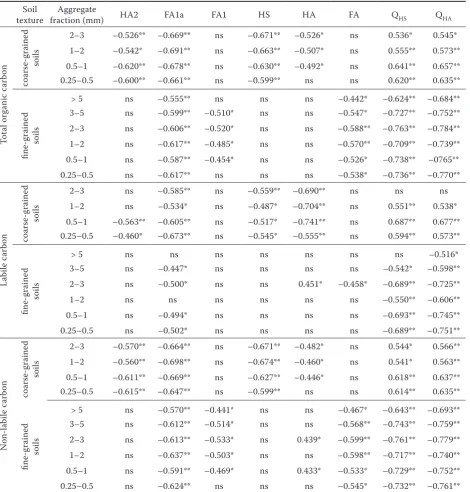
Quantity of humus substances in the soil and carbon content in the aggregates. HS not only par-ticipate on the formation of stabile macro-aggregates (Tisdall & Oades 1982), but significantly influence the contents of carbon in the aggregates fractions. A negative correlation was recorded between the content of organic carbon in the fractions of WSA and the amount of extracted HA in CGS and FA in FGS (Table 8). In CGS, the formation of aggregates is greatly limited due to a high content of sand frac-tion, which does not provide sufficient binding posi-tions for the formation of organo-mineral complexes (Creamer et al. 2013). There are mainly organic substances with dominant aliphatic components (Jindaluang et al. 2013) and organic substances that subject to more intensive oxidation, at which the pH decreases, which also results in the remov-ing of further potential glue agents, that are bi- and tri-valent cations. As FA are soluble under a whole range of pH, they migrate into the lower parts of the soil profile (Perminova et al. 2005), and so in CGS, in relation to the aggregates formation they play rather a role of an indirect factor (decreasing of pH) and their direct influence is not more markedly reflected. FA have also a higher acidity than HA, because in comparison to them FA contain more functional groups with the acidic reaction (-COOH, -C=O, -OH) (Stevenson 1994). FA are an important source of H+ and in FGS they act also destructively on the inorganic components, particularly on the clay minerals, thereby many bonds in aggregates are dis-rupted and the aggregates break down. Therefore, at a higher proportion of FA in the soil, a lower content of carbon (mainly non-labile (CNL)) in the aggregates, in which it was originally stabilized, was reflected (Table 8). On the contrary, the influence of HA was reflected in CGS. Due to the decrease of pH in the
process of the organic substances decomposition, with the present mobilization of bi- and tri-valent cations, causes the precipitation of HA, and the part of available binding positions is blocking (Brady 1990) that decrease their properties as glue agents. Thus it indirectly inhibits also the incorporation of labile components into soil aggregates that are not able to create stabile bonds with sand. Therefore in CGS, at a higher proportion of HA in the soil, a lower content of not only labile, but also stabile compo-nents in the soil aggregates was reflected (Table 8).
Quality of humus substances in the soil and carbon content in the aggregates. The previous is supported by different correlations between the content of carbon in the aggregates and stability of HS and HA. In the case of CGS, a positive correlation and in the case of FGS a negative correlation was detected between the contents of labile carbon (CL) and non-labile carbon (CNL) in the aggregates and coloured quotients of HS (QHS) and HA (QHA) (Table 8). In CGS, a higher car-bon content in the aggregates was at a lower stability of HS and HA. In CGS, fine roots and fungal hyphae significantly participate in the stabilization of macro-aggregates, therefore these aggregates are richer in CL and there is also a smaller amount of components in the environment that would contribute to stabiliza-tion of HS. Moreover, if HA are less stabilized and younger and also if there is a sufficient amount of easily available radicals in the environment, a more intensive recovery of their peripheral parts occurs. On the contrary, in FGS, at a higher stability of HA the carbon content in the aggregates is higher, too. Here the HS create bonds with clay minerals, they are not only adsorbed on their surfaces, but also can penetrate into clay interlayers (Kleber et al. 2007). In FGS, aromatic carbon components are dominant in organic structures (Jindaluang et al. 2013). HA themselves can also be a part of the aggregates, so at a higher stability of HA there is also a higher carbon content in the aggregates.
pronounced. FGS, with a higher content of clay min-erals, mainly smectites, are subjected also to higher volume changes (Dalal & Bridge 1996) and thus
[image:5.595.64.535.124.617.2]retain a higher amount of water. Water can serve also as a bridge between organic ligand and the clay micelle (Tan 2003).
Table 8. Correlation between carbon in fractions of water-resistant macro-aggregates and parameters of humus sub-stances in the soil
Soil
texture fraction (mm)Aggregate HA2 FA1a FA1 HS HA FA QHS QHA
Tot
al or
ganic c
arb
on
co
ars
e-g
raine
d
soil
s
2–3 –0.526** –0.669** ns –0.671** –0.526* ns 0.536* 0.545*
1–2 –0.542* –0.691** ns –0.663** –0.507* ns 0.555** 0.573**
0.5–1 –0.620** –0.678** ns –0.630** –0.492* ns 0.641** 0.657**
0.25–0.5 –0.600** –0.661** ns –0.599** ns ns 0.620** 0.635**
fine-g
raine
d
soil
s
> 5 ns –0.555** ns ns ns –0.442* –0.624** –0.684**
3–5 ns –0.599** –0.510* ns ns –0.547* –0.727** –0.752**
2–3 ns –0.606** –0.520* ns ns –0.588** –0.763** –0.784**
1–2 ns –0.617** –0.485* ns ns –0.570** –0.709** –0.739**
0.5–1 ns –0.587** –0.454* ns ns –0.526* –0.738** –0765**
0.25–0.5 ns –0.617** ns ns ns –0.538* –0.736** –0.770**
La
bile c
arb
on coars
e-g
raine
d
soil
s
2–3 ns –0.585** ns –0.559** –0.690** ns ns ns
1–2 ns –0.534* ns –0.487* –0.704** ns 0.551** 0.538*
0.5–1 –0.563** –0.605** ns –0.517* –0.741** ns 0.687** 0.677**
0.25–0.5 –0.460* –0.673** ns –0.545* –0.555** ns 0.594** 0.573**
fine-g
raine
d
soil
s
> 5 ns ns ns ns ns ns ns –0.516*
3–5 ns –0.447* ns ns ns ns –0.542* –0.598**
2–3 ns –0.500* ns ns 0.451* –0.458* –0.689** –0.725**
1–2 ns ns ns ns ns ns –0.550** –0.606**
0.5–1 ns –0.494* ns ns ns ns –0.693** –0.745**
0.25–0.5 ns –0.502* ns ns ns ns –0.689** –0.751**
Non-l
abile c
arb
on
co
ars
e-g
raine
d
soil
s
2–3 –0.570** –0.664** ns –0.671** –0.482* ns 0.544* 0.566**
1–2 –0.560** –0.698** ns –0.674** –0.460* ns 0.541* 0.563**
0.5–1 –0.611** –0.669** ns –0.627** –0.446* ns 0.618** 0.637**
0.25–0.5 –0.615** –0.647** ns –0.599** ns ns 0.614** 0.635**
fine-g
raine
d
soil
s
> 5 ns –0.570** –0.441* ns ns –0.467* –0.643** –0.693**
3–5 ns –0.612** –0.514* ns ns –0.568** –0.743** –0.759**
2–3 ns –0.613** –0.533* ns 0.439* –0.599** –0.761** –0.779**
1–2 ns –0.637** –0.503* ns ns –0.598** –0.717** –0.740**
0.5–1 ns –0.591** –0.469* ns 0.433* –0.533* –0.729** –0.752**
0.25–0.5 ns –0.624** ns ns ns –0.545* –0.732** –0.761**
HA2 – humic acids bound with Ca2+; FA1a – free aggressive fulvic acids; FA1 – fulvic acids free and bound with mobile R 2O3;
HS – humus substances; HA – humic acids; FA – fulvic acids; QHS – coloured quotient of humus substances; QHA – coloured
quotient of humic acids; **P < 0.01; *P < 0.05; ns ‒ not significant
On the other hand, in FGS, a negative correlation between the carbon content, mainly non-labile, in the aggregates and FA1a and FA1 in the soil was recorded. In the case of FA1a, a negative correlation was recorded in CGS, as well. FA are more acidic than HA, have substantially higher content of COOH groups and are an important source of H+, moreover FA1a are a fraction of free aggressive FA. At a lower pH, a higher amount of carbon is in a labile form (Tobiašová 2011), resulting in a decreasing of the aggregate stability and releasing of carbon from them. This process is more marked in CGS than in FGS. But the influence of FA1 was recorded only in FGS and only in relation to CNL. Both fractions, FA1a and FA1, are characterized by high acidity, but FA1 consists partly of free fulvic acids, although for the most part it consists of salts and complex com-pounds with mobile hydrated sesquioxides, mainly with aluminium (Kononova 1966). Monovalent cations, mainly Na+,are a highly dispersive agent that directly causes disruption of aggregates (Batra
et al. 1997). The result of this can be that at a higher proportion of FA1 in FGS the stability of carbon decreases through the disruption of aggregates, so that the CNL content in the aggregates decreases. Overall, in CGS, the influence of HA and also FA on the CL content in the aggregates was more marked than in FGS.
CONCLUSION
Humic acids were correlated mainly with the pro-portion of organic carbon, labile and non-labile, in the fractions of water-resistant macro-aggregates in the coarse-grained soils and the fulvic acids were cor-related with their amounts in the fine-grained soils. The influence of humic acids and fulvic acids in the soil more strongly affected the content of labile carbon in coarse-grained soils than in fine-grained soils. The higher was the stability of humus sub-stances, the higher was the content of carbon in the aggregates in fined-grained soils and the lower in coarse-grained soils.
Fractions of humic acids and fulvic acids influ-enced the carbon content in water-resistant macro-aggregates in different way depending on the soil texture.
Acknowledgements. This work was supported by the Slo-vak Research and Development Agency under the contract No. APVV-14-0087.
References
Baldock J.A., Skjemstad J.O. (2000): Role of the soil matrix and minerals in protecting natural organic materials against biological attack. Organic Geochemistry, 31: 697–710.
Bartlová J., Badalíková B., Pospíšilová L., Pokorný E., Šarapatka B. (2015): Water stability of soil aggregates in different systems of tillage. Soil and Water Research, 10: 147–154.
Batra L., Kumar A., Manna M.C., Chhabra R. (1997): Mi-crobiological and chemical amelioration of alkaline soil by growing Karnal grass and gypsum application. Experi-mental Agriculture, 33: 389–397.
Brady N.C. (1990): The Nature and Properties of Soils. New York, Macmillan Publishing Company.
Bronson K.F., Zobeck T.M., Chua T.T., Acosta-Martinez V., van Pelt S.R., Booker J.D. (2004): Carbon and nitrogen pools of southern high plains cropland and grassland soils. Soil Science Society of America Journal, 68: 1695–1704. Burke I.C., Yonker C.M., Parton W.J., Cole C.V., Flack K.,
Schimel D.S. (1989): Texture, climate, and cultivation effects on soil organic matter content in United States grassland soils. Soil Science Society of America Journal, 53: 800–805. Cai A., Feng W., Zhang W., Xu M. (2016): Climate, soil
texture, and soil types affect the contributions of fine-fraction-stabilized carbon to total soil organic carbon in different land uses across China. Journal of Environmen-tal Management, 172: 2–9.
Creamer C.A., Filley T.R., Boutton T.W. (2013): Long-term incubations of size and density separated soil fractions to inform soil organic carbon decay dynamics. Soil Biology and Biochemistry, 57: 496–503.
Dalal R.C., Bridge B.J. (1996): Aggregation and organic mat-ter storage in sub-humid and semi-arid soils. In: Carmat-ter M.R., Stewart B.A. (eds): Structure and Organic Matter Storage in Agricultural Soils, Advances in Soil Science. Boca Raton, CRC Lewis Publishers: 263–308.
Eustehues K., Rumpel C., Kleber M., Kögel-Knaber I. (2003): Stabilisation of soil organic matter by interactions with minerals revealed by mineral dissolution and oxidative degradation. Organic Geochemistry, 34: 1591–1600. Hayes M.H.B., Swift R.S. (1990): Genesis, isolation,
com-position and structures of soil humic substances. In: de Boodt M.F., Hayes M.H.B., Herbillon A. (eds): Soil Col-loids and their Associations in Aggregates. New York, London, Plenum Press: 245–305.
IUSS Working Group WRB (2006): World Reference Base for Soil Resources 2006. World Soil Resources Reports No. 103, Rome, FAO.
Jastrow J.D. (1996): Soil aggregate formation and the accrual of particulate and mineral associated organic matter. Soil Biology and Biochemistry, 28: 665–676.
Jindaluang W., Kheoruenromne I., Suddhiprakarn A., Singh B.P., Singh B. (2013): Influence of soil texture and mineral-ogy on organic matter content and composition in physi-cally separated fractions soils of Thailand. Geoderma, 195–196: 207–219.
Karabcová H., Pospíšilová L., Fiala K., Škarpa P., Bjelková M. (2015): Effect of organic fertilizers on soil organic carbon and risk trace elements content in soil under permanent grassland. Soil and Water Research, 10: 228–235. Kleber M., Sollins P., Sutton R. (2007): A conceptual model
of organo-mineral interactions in soils: self-assembly of organic molecular fragments into zonal structures on mineral surfaces. Biogeochemistry, 85: 9–24.
Kononova M.M. (1966): Soil Organic Matter. Its Nature, its Role in Soil Formation and in Soil Fertility. Oxford, Pergamon Press, Ltd.
Loginov W., Wisniewski W., Gonet S.S., Ciescinska B. (1987): Fractionation of organic carbon based on sus-ceptibility to oxidation. Polish Journal of Soil Science, 20: 47–52.
Muneer M., Oades J.M. (1989): The role of Ca-organic in-teractions in soil aggregate stability III. Mechanisms and models. Australian Journal of Soil Research, 27: 411–423. Orlov D.S., Grišina L.A. (1981): Practical Work in the
Chem-istry of Humus. Moskva, IMU. (in Russian)
Perminova I.V., Hatfield K., Hertkorn N. (2005): Use of humic substances to remediate polluted environments: From theory to practice. In: Perminova I.V., Hatfield K., Hertkorn N. (eds): Proc. NATO Advanced Research Workshop, Zvenigorod, Sept 23–29, 2002. NATO Science Series: IV. Earth and Environmental Sciences. Springer.
Ponomareva V.V., Plotnikova T.A. (1975): Determination of Group and Fraction Composition of Humus According to I.V. Tiurin, the Modification of V.V. Ponomareva and T.A. Plotnikova. Agrochemical Methods of Soil Study. Moskva, Nauka. (in Russian)
Sarkar D., Haldar A. (2005): Physical and Chemical Meth-ods in Soil Analysis. Delhi, New Age International, Ltd. Sodhi G.P.S., Beri V., Benbi D.K. (2009): Soil aggregation and
distribution of carbon and nitrogen in different fractions under long-term application of compost in rice-wheat system. Soil and Tillage Research, 103: 412–418. Spaccini R., Piccolo A., Conte P., Haberhauer G., Gerzabek
M.H. (2002): Increased soil organic carbon sequestration through hydrophobic protection by humic substances. Soil Biology and Biochemistry, 34: 1839–1851.
Stevenson F.J. (1994): Humus Chemistry: Genesis, Compo-sition, Reactions. Extraction, Fractionation, and General Chemical Composition. New York, John Wiley & Sons. Inc.
Tan K.H. (2003): Humic Matter in Soil and Environment. Principles and Controversies. New York, Basel, Marcel Dekker, Inc.
Tisdall J.M., Oades J.M. (1982): Organic matter and water stable aggregates in soils. Journal of Soil Science, 33: 141–163.
Tobiašová E. (2011): The effect of organic matter on the structure of soils of different land use. Soil and Tillage Research, 114: 183–192.
Van Reeuwijk L.P. (2002): Procedures for Soil Analysis. Wageningen, ISRIC.
Vergnoux A., Guiliano M., DiRocco R., Domeizel M., Thé-raulaz F., Doumenq P. (2011): Quantitative and mid-infrared changes of humic substances from burned soils. Environmental Research, 111: 205–214.