JOURNAL OF FOREST SCIENCE, "&, 2002 (1): 3848
Multiple-purpose forest management is an untenable theoretical concept, but it increases the risk of failure as anyone who must selectively harvest trees has just a few logging options to contemplate, each of them being a po-tential threat either for the future generation of trees or for the remaining trees. When harvesting old large-crowned trees the logger has to use heavy equipment and therefore, some hydromorphic degradation of the soil is inevitable (HERBAUTS et al. 1996; LACEY, RYAN 2000). This risk is not negligible in the European boreal forest, where winters are warmer and warmer and it is almost impossible to skid all logs onto frozen soil, as a common rule of thumb recommends. The destructive effect upon physical properties of forest soils has been presented in recent literature, and it is proved that the most important damage occurs during ground-based skidding, being as-sociated with the first trips (BALLARD 2000; GRIGAL 2000).
As the regeneration process is continuous on larger and larger areas, logging operations are performed now and then, according to prescribed managerial provisions, but more often than it is the case for an even-age stand where only a few commercial thinnings and final cutting are enough. The lower the intensity of extraction, the higher
the degree of damage to the residual stand. For example in Malaysia it was found that traditional logging opera-tions, without prior planning of felling direcopera-tions, brought about 60 damaged trees per hectare while the loss can be reduced to 40 trees per hectare if the whole process is carefully designed and supervised (MARN, JONKERS 1981).
The biodiversity should not be at stake when different logging technologies are used. Comparing the effect of ground skidding and helicopter logging upon biodiversi-ty indicators in floodplain forests, JONES et al. (2000) found no significant difference between the two logging technologies eight years after logging operations. Nev-ertheless, the richness in species does not necessarily mean good-quality timber at maturity age. Therefore some attempts are worth mentioning in this respect. In order to design a feasible and optimal set of economic incentives to improve the logging operation quality, BACH (1999) developed an optimal control model and simulated alternative outcomes. Two basic alternatives were considered: an area-dependent subsidy and a vol-ume-based subsidy. Appraising the present value of an average concession of 10,000 ha, it was found that with-out any subsidy for logging operations and a higher
ef-Tradable permits in logging operations
M. D
RAGOIUniversity Stefan cel Mare, Faculty of Forestry, Suceava, Romania
ABSTRACT: The paper presents a new system of tradable permits combined with ecological bonds that is able to promote environment-friendly logging technologies, supposed to be less harmful to the forest ecosystem. All loggers deposit in advance ecological bonds on to-be-harvested volume basis and a certain number of permits to damage is freely given per each cubic meter, by the public authority. After surveying the damage caused throughout all harvested tracts, the number of permits on the volume basis is recomputed for each logger according to the magnitude and importance of damage caused. The logging company that caused smallest damage and saved most permits is allowed to sell to another competitor the number of permits which makes the difference between the two companies. The main section of the paper presents five simulations based on reliable scenarios that have been developed on some effective data referring to two types of damage produced by seven Romanian logging companies in 1999, in Suceava state county forest. Firstly, the deterministic scenario shows that environment-friendly companies become more competitive due to the new system because they have an addi-tional income from sold permits. Conversely, companies unable to protect the environment are to pay more for being in business and thus their capacity to buy more timber is diminished. Assuming that companies able to get money due to this kind of trade are also able to improve their technology and can afford to buy more timber, it was demonstrated that the technological transfer is encouraged by the new system that might be combined with a regular compensation paid to the landowner as well. The greater the bond, the more advantageous the system for fewer and fewer companies. The lower the bond, the more companies can take advantage of the system but less money is collected from a given market.
fort to protect the remaining trees the total value decreases from $ 1.51 m to $ 0.81 m. An interesting outcome is the relationship between the relative price of additional ef-fort needed to protect residual stand and the relative price of timber. It was found that if the price of effort is set to one, prices for all four groups of the species considered should increase by 147% to persuade the concessionaires to reduce damage.
The paper is organized as follows. The second section, which is the largest one, presents a new system of tradable permits in five sub-sections focused on motives to adopt tradable permits, and the social optimum level of damage vs. the private optimum when the landowner behaves as a risk seeker. This section ends with designing the system that is further employed in a spreadsheet simulator used to demonstrate how the new system is supposed to work. The basic information gathered from real logging operations and the expected results of the new combination of eco-nomic instruments are presented in the third section. Con-clusions and comments end the paper.
TRADABLE PERMITS FOR LOGGING OPERATIONS
MOTIVES TO ADOPT TRADABLE PERMITS
It has been a long time since tradable (or marketable) permits have been used to phase out different types of pollution. Their theoretical framework can be found in DALES (1968), where they are regarded as economic in-struments able to encourage the industry to minimize costs over time, promoting so-called dynamic efficien-cy. Extensive reviews of tradable permits in a broader context of market-oriented instruments can be found in STAVINS (2000) and TIETENBERG (1999). Basically, dy-namic efficiency is achieved by encouraging firms to in-novate or to improve their technology in order to pay lower abatement costs (BURTRAW 2000). This
assump-tion has been taken for granted when designing the sim-ulator that is presented below.
As multiple-use forest management is focused on tim-ber production, which is a private good, and on services provided by forests (runoff and erosion control, biodi-versity preservation and so forth) that are public goods, there are two different optimal levels for damage to con-sider: a private optimum and a social optimum.
The first attempt to propose a tradable permit system targeting the social optimum level of extraction was de-signed by Dr. Ian Munn (MUNN 1997). The main idea is to grant a certain amount of permits within the market, assuming that the landowners who want to harvest more than the prescribed allowable cut should purchase extra permits from the landowners intending to harvest less or nothing. On the permit supply side the price of permits increases the managerial cost and thus less stumpage is marketed at a higher price. The above-mentioned paper just broached the new subject in forest economics and no technical details about effective implementation were provided along with the theoretical background.
SOCIAL OPTIMUM VS. PRIVATE OPTIMUM LEVEL OF DAMAGE
Now let us consider the loggers private cost to pre-vent damage, the landowners private cost of accepting damages1, and the social cost of damage (Fig. 1). As the
social cost refers to public goods, the social loss of each possible level of damage is higher because it is prices that are summed up for the same quantity of output, not quantities for the same price. Therefore, in spite of well-defined property rights to the land, the optimum level of environmental protection from the social point of view (Sp) is higher than the optimum level from a private point of view (Po) as it is shown in Fig. 1.
As stated above, the idea of transferable pollution rights is quite old but it has not penetrated in forest economics so far. One of the reasons of introducing tradable permits into environmental economics was the relatively low cost of transactions. STAVINS (1995) reviewed possible sourc-es of transaction costs as follows: 1. search of informa-tion, 2. bargaining and decision and 3. monitoring and enforcement. The first type of costs does not represent a real problem for logging operations because any kind of damage (further referred to as externalities) can be easily found in the forest, a long time after it was in-curred. The second source of expenses is the most prob-lematic because of the nature of negative externalities. They are not homogeneous at all and the associated abate-ment marginal costs vary on a large scale.
According to the typology of tradable permits revised by STAVINS (1995), the type of economic instruments that are being proposed falls within emission permits trading, with high transaction costs incurred by expensive monitoring. But
[image:2.595.58.284.55.216.2]1A cost needs being compensated by charges and penalties. Fig. 1. Social optimum vs. Private optimum of damages
Social optimum level of protection Private optimum level of protection
100% protection Social cost
Landowner’s private cost
in the case of logging operations this cost is paid anyway because it is associated with timber trade, not only with per-mits trade. After a logger has harvested a tract, both the log-ger and the forest owner survey the area in order to identify all damage the logger should be charged for.
PRIVATE OPTIMUM AND RISK BEHAVIOUR
According to Coases rule, negative externalities can be better diminished if property rights are clearly defined and transaction costs are negligible. If a person or a communi-ty affected by a certain negative externalicommuni-ty can bargain a compensation with the company that generates the ex-ternality, that company is interested in reducing the pollu-tion level in order to pay less. In the case of logging process this principle holds true too, and the woodland owner is supposed to ask for an appropriate compensation for log-ging damages, whenever and wherever they occur during the harvesting process. In such a case, the problem is how to assess the real value of the loss. One should take into account what type of risk behaviour characterizes the owner because the price asked for damage reflects the land-owners private disutility, which is influenced by the stumpage price. If the price is a good one, the landowner is supposed to behave like a risk seeker as the gain from sale is certain while the loss is uncertain and upcoming.
Consider that the total landowners income depends upon the price of stumpage along with the compensation for logging damage. Consider the most apparent and the most likely type of damage debarking of the remaining trees (hereinafter referred to as residual stand). Letting L be the present value of the loss, it holds that
p t t t p t t
t p e V p e
V
L= ⋅ ⋅ −⋅ − ⋅ ⋅ −'⋅
'
' (1)
the variables having the following meanings:
V(t) tree volume at normal maturity age; V(t) tree volume at
age t when it is harvested as salvage product; p(t) expected
price for average tree; t prescribed rotation; t age when the tree is harvested as salvage product due to logging damage;
p discount rate.
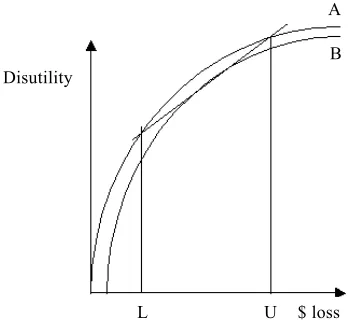
Both the volume and the price of damaged tree are af-fected by estimation errors that cannot be avoided as long as only statistical models can be used in such a matter. The interval of confidence of the present loss is bounded by a lower value (L) and an upper value (U) as Fig. 2 shows.
Consider the disutility function as concave in the eco-nomic loss (A), i.e. the second derivative is negative. If the loss is zero, then disutility is zero, too. As it is proved by WATZOLD (2000), the uncertainty of the loss means a downward shift of the disutility function2, from the
curve A to the curve B, as the decision maker landown-er in this case contemplates a linear combination be-tween disutility to be compensated and the real economic loss. That means the accepted private disutility is still zero although the future loss becomes positive.
Further, the greater the uncertainty, the greater the ac-cepted loss, and it is worth recalling that the volume esti-mation error is larger for uneven-aged structures and little known species that are disregarded in yield tables. Consistently with the same assumption of risk seeking when the price fetched by the timber is high, the accept-ed level of damage is higher for the lesser-known spe-cies, supposed to be rare species. Recalling the private optimum shown in Fig. 1 when timber is sold at a high price, the private optimum level is supposed to move to the left because the accepted level of damage, mentioned as a term of the harvesting contract, is higher.
PROPERTY RIGHTS AND TRADABLE PERMITS
Rewording the problem of logging injuries in terms of tradable permits principle, any logger has the right to damage, and that one who has damaged less has the right to sell her or his saved permits to damage to that log-ger who has already damaged more, and could damage more in the future. Having rendered the problem in these terms, the public authority can assign some rights to dam-age per each cubic meter of timber, and these rights are further regarded as permits.
Consider two loggers (Fig. 3), a single type of damage say, residual stand each logger having a different mar-ginal cost of preventing damage, ceteris paribus. The curve OA represents the first loggers marginal cost of prevention while the second loggers marginal cost is OB. Either of them has reached a private optimum level of damage, say, 70%, and 40% respectively. The area of tri-angle OAA stands for the total cost defrayed by the first logger to prevent damage while the area of triangle OBB stands for the total cost of preventive measures adopted by the second logger3.
According to the principle of equally distributed prop-erty rights to damage, the second logger would have the right to damage 70%, as the first logger did, not only 40%. The second logger has the right to sell the differ-ence of 30% of rights to damage while the first one should purchase this invented commodity, if and only if the social planner, hereinafter referred to as the principal, enforces such a market. If the second logger had protect-ed just 30% of residual stand, as the first one did, he or she would have paid just the area OCA, which is the difference between the area OBB and ACBB, which stands for the additional expenses. This outlay can be
2The quoted article deals with social disutility and a social planner decision maker, supposed to be risk adverse, but the problem is
the same.
3The two tracts are identical, so are harvested volumes. The cost of prevention measures, represented on the y-axis refers to the
compensated if the second logger sells the rights he has to damage that is permits at the price BD, which is based on the harvested volume. Doing so, the net cost of preventing damage defrayed by the second logger is the same as if he or she made the same bad job as the first logger, that is ensuring protection for 30% of the residu-al stand only. In turn, the first logger has to internresidu-alise the social cost of a worse protection, by paying the initial prevention cost (area OAA), plus the value of permits he or she had to purchase, considering the volume-based price DB for each cubic meter he has already harvested. Analytically, the fair price per cubic meter for permits to damage one percent more trees (P), sold to the worse logger, is
( )
' ' '
'
A B
dx x g P
B
A
−
=
∫
(2)where g(x) stands for the function that relates the marginal cost of adopting protection measures by the most environment-friendly logger.
So far, nothing has been mentioned about the transac-tion cost, which is not negligible in a real world. Consid-er the principals cost of monitoring the transaction, instead of, adding up this value to the cost per permit, it is obvious that only the loser will pay the transaction cost because this transaction cost is added to the price per per-mit. Therefore, a higher transaction cost will encourage rather the loser to improve the quality of logging opera-tions than the winner to maintain her or his comparative advantage over the competition.
DESIGNING THE SYSTEM
Unlike the previous approach (MUNN 1997), the sys-tem drawn in the following section is a mixture of re-volving (returnable) ecological bonds4 and tradable
permits, deemed both to minimize transaction costs and to allow for a fair allocation of revenues, supposed to encourage technological progress. All bonds are gath-ered in a single deposit subject at commercial interest rate. The logger who will be the most competitive from the ecological point of view will get this deposit, plus an additional revenue from all the other loggers, according to the price per permit and the difference between the up-dated number of permits he has achieved and the up-dat-ed number of permits each other logger has achievup-dat-ed.
The new combination of economic instruments does not substitute regular charges for damage produced to trees, soils and seedlings, supposed to be set up by the landowner, but it is deemed to reduce the negative im-pact of having imperfect information about the real cost (private and/or social) of this damage.
Although some economists are sceptical on the free dis-tribution of permits (see STAVINS 1995), the proposed model is actually a combination of grandfathering the number of permits per cubic meter is the same for all loggers combined with auction, as permits are assigned to each logger along with the purchased timber and only after the auction. Who gets stumpage by auction, receives permits. More stumpage, more permits.
Assume that for each cubic meter of wood, the princi-pal issues n tradable permits. At the end of the year each logger will have used up some of the permits he had, according to his technology, in different ways: by de-stroying more or fewer new seedlings (where shelter-wood systems are to be applied), debarking the remaining trees or scratching the fertile soil layer. All these nega-tive externalities5 are being taken into account at the end
of the year and the public authority is to assess how many tradable permits are left per cubic meter harvested from each tract, as follows:
1 ;
1 1 2 3 1+ 2+ 3=
+ + − ⋅ ⋅
= k k k
A L k A S k T D k V
N
i i
i i
i i i
[image:4.595.300.523.59.209.2]i η (3)
Fig. 2. The influence of uncertainty on the disutility of a risk seeker landowner
Fig. 3. Marginal costs of prevention and the fair price of per-mits sold out assuming that the “right to damage” (property right) is the same for the two companies
% protected trees C
0 30% 60%
A
B’ D B
A’ $/m3
4Romanian National Forest Administration currently uses such ecological bonds, as each logger should deposit 5% of the tract value
at the starting price.
L U $ loss Disutility
A
[image:4.595.71.246.60.220.2]Table 1. Values for the weights assigned to the three types of negative externalities likely to occur when an even aged stand is harvested6
Forest management main goal Type of yield Damaged trees Damaged seedlings Fertile soil layer destroyed
Environmental protection secondarymain 0.50.3 0.00.2 0.50.5
Timber production secondarymain 0.70.4 0.00.5 0.30.1
6These preliminary values are not based on relative costs of logging in different conditions and estimations of social disutility.
where variables referring to the tract i have the following mean-ings:
Ni number of permits left from the tract i, of volume Vi,
η initial number of permits grandfathered by the principal per each cubic meter,
Ti total number of harvested trees,
Di total number of the remaining trees that were damaged
during harvesting operations,
Ai total area of the tract,
Si total area of natural regeneration destroyed during
harvest-ing operations,
Li total area on which the fertile soil layer was removed,
k1,2,3 weights assigned to each type of negative externality.
The weights assigned to externalities are of crucial im-portance for compensating the relative advantage caused by different logging conditions. From the principals point of view these weights should also reflect either risk aversion or risk neutrality or, on the contrary, a risk seek-er behaviour (Table 1). These options depend on the type of yield, the type of damage and the main goal of forest management (timber production or environmental pro-tection).
The level of the ecological bond plays an important role as it depends on 1. the size of the market, expressed by the transaction volume (the larger the market, the low-er the bond because the winnlow-er collects bonds from a larger quantity of timber) and 2. the number of loggers operating on that market.
For each logger j, the number of permits per cubic meter (πj) left for a possible trade is calculated as fol-lows:
∑
∑
=
i ij i
ij
j
V N
π (4)
where Nijstands for the number of permits saved after logging
the tract i by the loggerj, and Vij is the volume of that
respec-tive tract.
Having this information, the best logger can be easily designated as having the highest number of saved per-mits per cubic meter, that means the highest value for π. Every other logger comes by a number of permits equal to the product between the volumes he has already
har-vested and the difference between the highest number of tradable permits left per cubic meter (max π) and her or his own value for π. Assume that logger X won the com-petition: initially he received five permits per cubic meter and he consumed just one permit. The logger Y used up 1.5 permits per cubic meter, and she or he harvested a total volume of 150,000 cubic meters. Y should buy from X 150,000 cubic meters times 0.5 permits per cubic meter, which is 75,000 permits.
All other loggers should purchase from the winner the rights to harvest in the forthcoming year, and the single role of the ecological bond deposited by each logger is to ensure this trade. If at the end of the year the logger Y has a bond say, $ 5,000 worth and he has to pay $ 7,000 to be allowed to harvest next year, he will pay just the differ-ence of $ 2,000, otherwise he will lose the right to har-vest in the forthcoming year, along with the $ 5,000 bonds.
An interesting problem worth discussing in this con-text is the relationship between the number of permits issued by the principal, his/her ability to learn from the trade and the behaviour of the companies who are trad-ing those permits, on a small market (ANDERSSON 1997). In our approach, although the process is completely trans-parent for the principal, simulations have proved the risk of issuing an insufficient number of permits. Therefore, it is recommended to issue more permits in the first year to be sure that only one company wins the game. The principal should also be aware that after a couple of years the number of loggers might be lower, and the risk of a slack market might occur again. To prevent this un-wanted phenomenon, more permits are required. Sensi-tivity tests are presented in the last section.
The most competitive logging company may set up the price of permits sold to other companies. If the price is very high, the burden for the company could be much higher than its ecological bond and the company will fall in the red. Such a company has two options: to pay the debt or to give up harvesting ahead, losing the bonds the company has purchased. The winning company is likely to target the highest possible income by selling permits, but the principal should expect the winning company to collude with another one or, on the contrary, to squeeze
5Some of them can be referred to as additional costs (damages produced to trees and seedlings), while penalties produced to the soil
the companies placed at the second and the third places in order to get rid of them as competitors on the same market.
A key problem worth discussing in the context of trad-able permits for loggers is the following: should the win-ner be allowed to ask any price? The answer is no because the tradable permit system should not be used as a shield for unfair competition on the timber market. A small log-ging company might purchase just a small tract by offer-ing a huge price for timber and a low ecological bond; afterwards it may harvest the timber without being pe-nalized and thus it might be designated as the best oper-ator on the market. Getting this position, the company could ask such a high price of permits as one or several larger companies cannot afford to pay. So, an additional rule is necessary: the winning company should not be allowed to ask from the next two companies prices high-er than the bonds phigh-er cubic methigh-er these companies have had. This is one of the reasons why the threshold bond per cubic meter is so important and needs careful ap-proach and successive adjustments. If it is too low, the market with tradable permits will be inefficient in the sense of promoting new technologies. If it is too high, the timber market might be distorted by an unfair com-petition on the other market where permits are sold.
Therefore, two threshold prices are worth considering: the highest price allowed to ask for permits sold to the next two companies and the lowest price allowed to ask for permits sold to all other companies. Consequently, the highest price (Pmax) is given by relation (5), which
results from equation (6) standing for the condition that the winning company may not receive from the next two companies more money than these companies have de-posited in bonds.
( ) 3 max max
N N
G P
− =
(5)
The variables have the following significations: G stands for the ecological bond per cubic meter, Nmax
the number of permits saved by the winning company, N3 the number of permits saved by the company ranked
on the third position that harvested the quantity V3.
Con-sidering the interest rate, relation (5) changes into (7)
3 3
max
3 (N N ) G V
V
P⋅ ⋅ − = ⋅ (6)
) (
) 1 (
3 max max
N N
p G P
− +
= (7)
The lowest price is G, i.e. the ecological bond per cu-bic meter that is paid in advance. It means that a compa-ny unable to be ranked on the third position at least will pay for the right to harvest ahead as much as the ecolog-ical bond at least.
NUMERICAL EXEMPLIFICATION
PRIMARY DATA
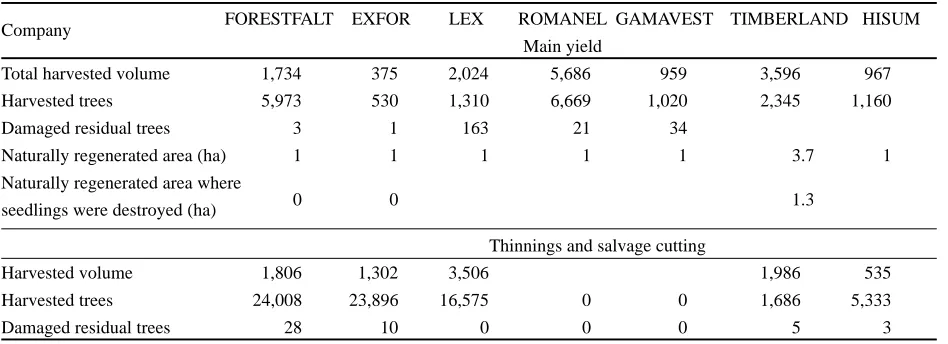
In order to demonstrate the efficiency of tradable per-mits, two examples were developed based on real data provided by Suceava Forest County, the largest subsid-iary of Romanian National Forest Administration. The input data (Table 2) show the ecological side-effects of seven logging companies that harvested in 1999. Due to the lack of data referring to damage caused to the soil layer, that kind of externality is neglected.
[image:6.595.56.530.550.722.2]It was considered that all companies managed to obey the silvicultural rules and none of them was penalized. Having stated this assumption, it is evident that tradable permits are more advantageous because of the dynamic reduction in any kind of harvesting damage beyond any threshold that may be set up by technical standards or
Table 2. Primary data concerning yields and associated damage caused by seven logging companies
Company FORESTFALT EXFOR LEX ROMANEL GAMAVEST TIMBERLAND HISUM
Main yield
Total harvested volume 1,734 375 2,024 5,686 959 3,596 967
Harvested trees 5,973 530 1,310 6,669 1,020 2,345 1,160
Damaged residual trees 3 1 163 21 34
Naturally regenerated area (ha) 1 1 1 1 1 3.7 1
Naturally regenerated area where
0 0 1.3
seedlings were destroyed (ha)
Thinnings and salvage cutting
Harvested volume 1,806 1,302 3,506 1,986 535
Harvested trees 24,008 23,896 16,575 0 0 1,686 5,333
Damaged residual trees 28 10 0 0 0 5 3
7The logger could be the buyer when stumpage is actually sold or could be just a contractor who is paid by the landowner for
protocols between landowners and loggers and irrespec-tive of the type of transaction7.
Thereafter two scenarios have been devised: a purely deterministic one to demonstrate how tradable permits enforce competitiveness, and a stochastic one to test whether the technological diffusion might occur. The fol-lowing assumptions have been adopted, some of them being considered for one scenario only.
1. Per each cubic meter of stumpage to harvest, the prin-cipal issues 500 permits8 per year.
2. The companys competitiveness depends on its capac-ity to make profit. Companies are expected to respond in two ways, according to their role on the market: every additional income means more timber to pur-chase the next year and every additional liability means less timber available for the forthcoming year, as the willingness to pay diminishes. The company that sold permits in the previous year can afford to pur-chase an extra quantity available on the market be-cause companies that purchased permits cannot afford to purchase that timber.
3. The company that has sold permits once is able to im-prove its harvesting technology and to decrease the
degree of damage to some extent for all years ahead (for the stochastic scenario only).
4. Harvesting conditions are the same during the simula-tion period (for the deterministic scenario only). 5. All logging companies are reluctant to use tradable
permits and they collude. Consequently, the winning company sells permits at the lowest possible prices to other companies.
The effects on the harvesting capacity brought about by additional costs of permits are summarized in Table 3. Data have been produced in a very simple manner con-sidering the average price of stumpage and a linear rela-tionship between the additional outlay paid to purchase permits and the willingness to pay: if the additional cost per cubic meter incurred by acquired permits equals the average price of stumpage there is no chance to buy any stumpage the subsequent year. That means a 100% rela-tive decrease in volume if the additional cost brought about by permits equals the average price of stumpage money goes to permits instead of stumpage. Conversely, if a company sold tradable permits, the income from this trade would increase both the affordable price for the next year and the affordable outlay for additional protective measures that can be regarded as a technological break-through. Say that a company gained $ P in 1999 from marketable permits while the supply for 2000 is Q. In this case, the company could be able to pay an extra price of $ P/2Q per each cubic meter along with an additional outlay of $P/2Q to improve operations quality. There-fore, the stumpage that cannot be purchased by the losers goes to the winner but all of them are encouraged to dam-age less and less, for different reasons: to pay less in the case of losers, to gain more in the case of the winner.
RESULTS
[image:7.595.71.548.73.214.2]The algorithm has been implemented in two electronic workbooks. Three different bonds have been considered (1,000 ROL/m3, 5,000 ROL/m3 and 10,000 ROL/m3),
Table 3. Relative decrease in the volume to harvest within the next year
Additional liability brought about by permits purchased Relative decrease in the volume to at the end of the year (ROL9/m3) harvest within the next year (%)
0 25,000 0
25,001 50,000 5
50,001 75,000 10
... ... ...
... ... ...
450,001 475,000 90
475,001 500,000 95
More than 500,001 100
9 Romanian currency
8The number of permits per cubic meter and the ecological bond should be set up in such a way that only one company should win
the right to sell permits. Otherwise the system is not efficient in terms of technological diffusion as more winners share the gain from selling permits.
Fig. 4. Assignment scheme for 1,000 ROL/m3 bond
Harvest
yield
(m
3)
[image:7.595.71.300.518.683.2]a single discount rate (6%) and 500 permits per cubic meter assumed to be grandfathered by the principal each year. The main purposes of the simulation are as follows: to evaluate the effect of the ecological bond on the com-petitiveness of logging companies and to illustrate how the technological transfer among logging companies might occur.
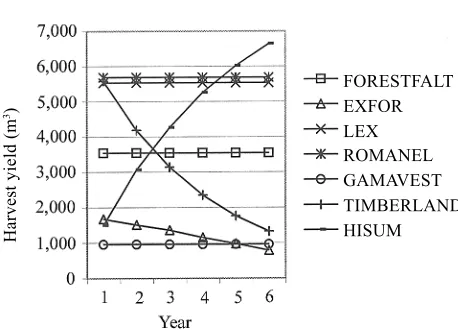
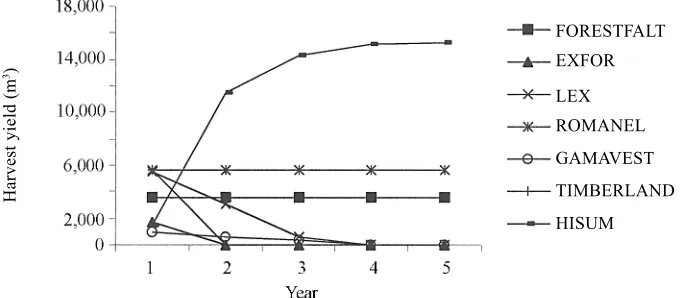
The first outcome consists of three assignment schemes (Figs. 4, 5 and 6) referring to the same volume of stump-age harvested by seven companies, under three bonds and deterministic assumptions already presented.
An insignificant bond of 1,000 ROL/m3 has a low
ef-fect on the competitiveness of companies. Fig. 4 shows that the most ecological company (HISUM) takes a little advantage of having the opportunity to sell permits. The volume assumed to be harvested by this firm ranges from about 1,500 cum in the first year to less than 7,000 cum in the sixth year of the simulation period at the expense of the worst companies, i.e. EXFOR and LEX.
Increasing the bond up to 5,000 ROL/m3 under the
same assumption of collusion between the companies the graph looks different (Fig. 5). The company that caused greatest damage and harvested the lowest volume from the very beginning (EXFOR) collapsed after the second year because of the burden of permits to buy. The second worse company, LEX, is supposed to give up harvesting in the sixth year only, and the total volume harvested by the green-hand company (HISUM) at the end of period is about ten times higher.
A bond of 10,000 ROL/m3 seems to be most efficient
in this context. As shown in Fig. 6, after the first four
years of using the combination of ecological bonds and tradable permits only three companies have been left on the market. Comparing this bond with the average win-ning price reported in the last row of Table 3 there is no doubt that the ecological bond could not reduce very much the auctioneers willingness to pay for wood, which is the physical commodity.
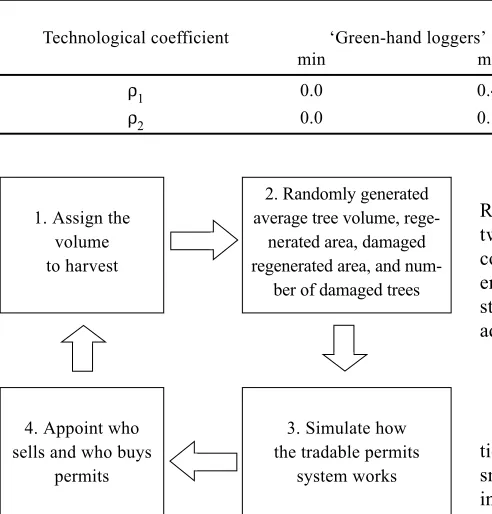
For the latter scenario, some input data have been ran-domly generated within specific ranges. The whole sim-ulation is depicted in Fig. 7. The main characteristic that makes the difference from the technological point of view is how the ranges of the externalities have been random-ly generated (box 2 in Fig. 7). A company that has al-ready sold permits is able to damage less due to the better technology the company affords to employ. Such a com-pany is hereinafter referred to as a green logger.
The first input data refers to the harvested volume, all other data being randomly generated on this basis. The num-ber of harvested trees is the harvested volume divided by the average tree volume. Further, all damage has been ran-domly generated within different ranges, depending on the type of damage and on the status of being green logger. More precisely, damage has been generated as follows:
1
ρ
⋅
=
n
t
;r
=
s
ρ
2,where t stands for the number of damaged remaining trees,
[image:8.595.63.375.67.198.2]n for the number of harvested trees, r for the area of destroyed regeneration, s for the regenerated area (randomly produced, too) while ρ1 and ρ2, hereinafter referred to as technological coefficients have been randomly generated in different rang-es, as it is shown in Table 4.
Fig. 5. Assignment scheme for 5,000 ROL/m3 bond
FORESTFALT EXFOR LEX ROMANEL GAMAVEST TIMBERLAND HISUM
Fig. 6. Assignment scheme for 10,000 ROL/m3 bond
Harvest
yield
(m
3)
[image:8.595.57.403.606.755.2]46 J. FOR. SCI., 48, 2002 (1): 38–48 Fig. 8. Assignment scheme and winning companies for 1,000 ROL/m3 bond –
sto-chastic simulation Table 4. Ranges of technological coefficients have been randomly generated
Coefficient boundaries
Technological coefficient Green-hand loggers Other loggers
min max min max
ρ1 0.0 0.40 0.1 0.50
ρ2 0.0 0.18 0.0 0.33
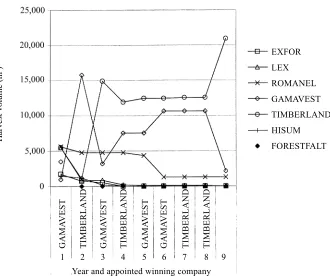
The simulation loop described in Fig. 7 has run nine times, that means a nine-year simulation period. The same assumption of collusion between loggers has been con-sidered and thus the principal has had to intervene on the market by means of the ecological bond only. Two levels for the ecological bond have been considered: 1,000 ROL/m3
and 5,000 ROL/m3.
Fig. 8 shows the result of using 1,000 ROL/m3
ecolog-ical bonds. Because such a low bond means a sluggish competition, all the seven companies remain on the mar-ket after nine years but it is to note four of them became green-hand loggers during this period of time, presum-ably due to better technologies they afforded to get.
Fig. 9 shows the outcome of using a bond of 5,000 ROL/m3. A stiffer competition is evident because only
two companies (GAMAVEST and TIMBERLAND) could afford to improve logging technologies, all the oth-er companies having harvested too small quantities of stumpage and thus having less and less chances to take advantage of sold permits.
DISCUSSIONS AND CONCLUSIONS
Nevertheless, the results provided both by determinis-tic and stochasdeterminis-tic simulations are questionable since only small amounts of effective data have been processed. For instance, serious damage like removal of the fertile soil layer has been completely neglected, simply because of the lack of records.
In the real life, the outcome of the new system may be different due to new companies that enter the market. A comparative advantage once gained low harvesting damage and the right to sell permits might be lost in the future. However, in spite of its limitations, the model gives a clue on how the system of tradable permits can be employed to improve logging operations. It also outlines the relationship between the value of the ecological bond, the size of the market (in terms of the quantity of stump-age sold) and the competitiveness of companies, which finally depends on the value of the ecological bond.
Presumably, logging companies will collude more or less on such a market but definitely all of them will de-posit the lowest acceptable bond per cubic meter. There-fore, every now and then the principal should re-consider Fig. 7. Flowchart of stochastic simulation
1. Assign the volume to harvest
2. Randomly generated average tree volume,
rege-nerated area, damaged regenerated area, and
num-ber of damaged trees
4. Appoint who sells and who buys
permits
3. Simulate how the tradable permits
system works
1 2 3 4 5 6 7 8 9
EXFOR LEX ROMANEL GAMAVEST TIMBERLAND HISUM FORESTFALT
EXFOR EXFOR EXFOR LEX LEX LEX
FORESTF
A
LT
ROMANEL ROMANEL
Year and appointed winning company
Harvest volume (m
[image:9.595.78.418.575.733.2]the three important parameters bond value, number of permits issued per cubic meter and relative weights of damage in order to pursue the final goal: less and less damage caused by logging operations. For instance, if the rate of specific damage goes up, the associated weight must be higher and higher. Definitely, no spectacular re-sults will come up in the first year, but it was demonstrat-ed that a dynamic fedemonstrat-edback eventually occurs, and it depends on the bond value.
For the principal, an important clue on the appropriate value of the bond is the market price of more environ-ment-friendly driving equipment, such as light tractors, skylines or horses. It is not compulsory to buy a new equipment in order to improve the quality of logging ope-rations: money can go to skilled labour instead of so-phisticated equipment. This issue could be an important matter in the context of sustainable rural development because there is no ecological threat in making timber harvesting a sort of cottage industry, even at the cost of lower productivity. The social responsibility of local loggers for maintaining their own environment is thus encouraged by the new system which works on the pure-ly commercial basis and effectivepure-ly rewards green-hand loggers.
It is obvious that on a small market and under a low-priced ecological bond the gain from permits is low and, most probably, less effective. The only advantage of working on a small market is a low monitoring cost. On a larger market, under a low bond, the technological progress is more likely to occur and diffuse among log-gers as the simulations have demonstrated. If the princi-pal is interested in keeping in business only a few competitive companies, then a higher bond is to be adopt-ed, regardless of the size of the market.
A c k n o w l e d g e m e n t s
The study was developed during a Fulbright scholar-ship focussed on market-oriented instruments for sustain-able forest management, hosted by North Carolina State University. I am grateful to Dr. JOE ROISE and Dr. ELIN SILLS for helpful discussions on the first draft of the pa-per. I also particularly wish to thank professor JOSEPH BUONGIORNO for giving me the opportunity to present the model in a seminar hosted by Wisconsin College of Forest Ecology and Management.
R e f e re n c e s
ANDERSSON F., 1997. Small pollution markets: tradable per-mits versus revelation mechanisms. J. Envir. Econ. Mgmt,
32:3850.
BACH C.F., 1999. Economic incentives for sustainable man-agement: a small optimal control model for tropical forestry. Ecol. Econ., 30: 251265.
BALLARD T.M., 2000. Impacts of forest management on northern forest soils. Forest Ecol. Mgmt, 133: 3742. BURTRAW D., 2000. Innovation Under the Tradable Sulfur
Dioxide Emission Permits Program in the U.S. Electricity Sec-tor. Resources for the Future, Discussion Paper 0038: 26. DALES J.H., 1968. Pollution, Property, and Prices. Toronto,
University of Toronto Press: 111.
GRIGAL D.F., 2000. Effects of extensive forest management on soil productivity. Forest Ecol. Mgmt, 138: 167185. HERBAUTS J., EL BAYAD J., GRUBER W., 1996. Influence
[image:10.595.62.392.54.331.2]of logging traffic on the hydromorphic degradation of acid forest soils development on loessic loam in the middle-Bel-gium. Forest Ecol. Mgmt, 87: 193207.
Fig. 9. Assignment scheme and winning companies for 5,000 ROL/m3 – stochastic
simulation
EXFOR LEX ROMANEL GAMAVEST TIMBERLAND HISUM FORESTFALT
GAMA
VEST
TIMBERLAND GAMA
VEST
GAMA
VEST
GAMA
VEST
TIMBERLAND TIMBERLAND TIMBERLAND
1 2 3 4 5 6 7 8 9 Year and appointed winning company
Harvest volume (m
Obchodovatelná povolení k tìbì døeva
M. DRAGOI
Univerzita v Suceavì, Lesnická fakulta, Rumunsko
ABSTRAKT: Pøíspìvek prezentuje nový systém obchodovatelných povolení k tìbì døeva, kombinovaný s ekologickou zárukou. Systém je schopen podporovat tìební technologie a firmy, které jsou etrné k ivotnímu prostøedí, tj. ménì poko-zují lesní ekosystémy. Vechny tìební spoleènosti musí pøed tìbou sloit tzv. ekologickou záruku (bond) na základì pøedpokládaného objemu tìby. Tento vklad je vytvoøen za úèelem zajitìní efektivní transakce s tìebními povoleními na konci roku. Souèasnì pro kadou jednotku (m3) døeva, které má být vytìeno, obdrí tìaøské spoleènosti urèité mnoství
povolení k obchodování na konci roku, a to podle úrovnì, ve které dokáou ochránit zbylý stojící porost, nárost a pùdu. V dané fázi po zjitìní kody vzniklé na vech tìebních plochách je znovu vypoèítáno mnoství povolení pro základ objemu pro kadou tìební spoleènost podle velikosti a závanosti vzniklých kod. Té tìaøské spoleènosti, která zpùsobila nejmení kodu a uetøila (tj. má navíc) nejvíce tìebních povolení, je dovoleno prodat kadému dalímu tìebnímu subjek-tu takové mnoství povolení k tìbì, které tvoøí rozdíl mezi tìmito dvìma spoleènostmi. Pøísluný odpovìdný orgán na tyto transakce dohlíí tak, e stanoví prahové (limitní) ceny pro tìební povolení prodané druhé a tøetí spoleènosti, pøièem nejlepí spoleènost si nemùe urèit více, ne èiní existující ekologický vklad (bond). Hlavní èást pøíspìvku sestává z pìti modelových simulací zaloených na pravdìpodobných scénáøích, které byly vytvoøeny na základì reálných údajù o tìbách zahrnujících dva typy kod, zpùsobených sedmi rumunskými tìaøskými spoleènostmi v roce 1999 v Krajských státních lesích Suceava. Za pøedpokladu, e nejlepí spoleènost zkvalitní v dùsledku pøíjmu z prodeje povolení k tìbì své technolo-gie, pøispívá uvedený systém k vyí konkurenèní výhodì proti ostatním. V pøíspìvku je ukázáno, e technologické inovace jsou daným postupem podnìcovány. Systém mùe být také kombinován s pravidelnou kompenzací, placenou majitelùm pùdy.
Klíèová slova: obchodovatelná povolení; tìební èinnost; revolvingové vklady
Corresponding author:
Dr. MARIAN DRAGOI, University Stefan cel Mare din Suceava, Faculty of Forestry, Universitatii 1, Suceava 5800, Romania tel.: + 403 021 61 47 ext. 130, home + 401 688 13 72, fax: + 403 052 00 80, e-mail: [email protected], [email protected] JONES R.H., STOKES S.L., LOCKABY B.G., STANTURF
J.A., 2000. Vegetation responses to helicopter and ground based logging in blackwater floodplain forests. Forest Ecol. Mgmt, 139: 215225.
LACEY S.T., RYAN P.J., 2000. Cumulative management im-pacts on soil physical properties and early growth of Pinus radiata. Forest Ecol. Mgmt, 138: 321333.
MARN H.M., JONKERS W., 1981. Logging Damage in Trop-ical High Forests. Working paper No. 5, The Government of Malaysia/FAO, Kuching.
MUNN I.A., 1997. Marketable Harvesting Permits. Proc. of the 26th Annual Southern Forest Economics Workshop.
Gatlinburg, TN: 133134.
STAVINS R.N., 1995. Transaction costs and tradeable permits. J. Envir. Econ. Mgmt, 29: 133148.
STAVINS R.N., 2000. Experience with Market-Based Envi-ronmental Policy Instruments. Resource for the Future, Dis-cussion Paper 00-09: 67.
TIETENBERG T., 1999. Tradable Permit Approaches to Pol-lution Control: Faustian Bargain or Paradise Regained? In: KAPLOWITZ M.D. (ed.), Property Rights, Economics, and the Environment. Stamford: 329.
WATZOLD F., 2000. Efficiency and applicability of economic concepts dealing with environmental risk and ignorance. Ecol. Econ., 33: 299311.