On a Fuzzy
c
-means Algorithm
for Mixed Incomplete Data
Using Partial Distance and Imputation
Takashi Furukawa, Shin-ichi Ohnishi, and Takahiro Yamanoi
Abstract—The focus of fuzzy c-means clustering method is normally used on numerical data. However, most data existing in databases are both categorical and numerical. To date, clustering methods have been developed to analyze only complete data. Although we sometimes encounter data sets that contain one or more missing feature values (incomplete data), traditional clustering methods cannot be used for such data. Thus, we study this theme and discuss clustering methods that can handle mixed numerical and categorical incomplete data. In this paper, we propose an algorithm that uses the missing categorical data imputation method and distances between numerical data that contain missing values. Finally, we show through numerical experiments that our proposed method is applicable to real data.
Index Terms—Clustering, Fuzzy c-means, incomplete data, mixed data, Partial distance.
I. INTRODUCTION
C
LUSTERING is the most popular method for dis-covering group and data structures in datasets. It is used for example in data and web mining. Fuzzy clustering allows each datum to belong to some clusters. Thus data are classified into an optimal cluster accurately[1]. The k -means algorithm is the most popular algorithm used in scientific and industrial applications because of its simplicity and efficiency. Whereas k-means gives satisfactory results for numeric attributes, it is not appropriate for data sets containing categorical attributes because it is not possible to find a mean of categorical value. Although, traditional clustering methods handle only numerical data, real world data sets contain mixed (numerical and categorical) data. Therefore, traditional clustering methods cannot be applied to mixed data sets. Recently, clustering methods that deal with mixed data sets have been developed[4][5].Moreover, when we analyze real world data sets, we encounter incomplete data. Incomplete data are found for example through data input errors, inaccurate measures, and noise. Traditional clustering methods cannot be directly applied to data sets that contain incomplete data, so we need to treat such data. A common approach to analyzing data with missing values is to remove attributes and/or instances with large fractions of missing values. However, this ap-proach excludes partial data from analytical consideration and hence compromises the reliability of results. Therefore, we need analytical tools that handle incomplete categorical data, a process that is called imputation. To date, many
T.Furukawa is with the Graduate school of Engineering Hokkai-Gakuen University, Sapporo, Japan e-mail: [email protected]
Shin-ichi Ohnishi and Takahiro Yamanoi are with Faculty of Engineering Hokkai-Gakuen University, Sapporo, Japan email: [email protected]
imputation methods have been proposed, but most apply only to numerical variables. Thus, when analyzing categorical data or mixed data containing missing values, one has to eliminate from consideration data with missing values. Moreover, an imputation method applicable to fuzzy clustering is rare.
Fuzzy c-means(FCM) clustering is a very popular fuzzy extension of k-means. However, FCM for mixed data cannot be applied to data that contains missing data. Therefore, we use the imputation method for missing categorical data, and then we apply FCM clustering for mixed data. If we en-counter missing numerical data, we use the PDS distance[7] instead of the Euclidean distance.
In this paper, we describe the development of a fuzzy clustering algorithm for mixed data with missing numerical and categorical data. The next section introduces the FCM algorithm. Section III presents the clustering algorithm for mixed data. Sections IV and V introduce the missing categor-ical imputation method, and the notion of distance between data that contain missing values. Section VI proposes a fuzzy clustering algorithm that can treat mixed incomplete data.
A. Fuzzyc-means clustering
The FCM algorithm proposed by Dunn[1] and extended by Bezdek[2] is one of the most well-known algorithms in fuzzy clustering analysis. This algorithm uses the squared-norm to measure similarities between cluster centers and data points. It can only be effective in clustering spherical clusters. To cluster more general datasets, a number of algorithms have been proposed by replacing the squared-norm with other similarity measures[3]. The notation that we use throughout is as follows. Let xi = (xij), i = 1, . . . , n, j = 1, . . . mis
a feature value of the ith data vector, c is the number of
clusters. bc = (bc1, . . . , bcm)T is the cluster center of the
cth cluster,u
ci is the degree to whichxi belongs to thecth
cluster. Then,uci satisfies the following constraint
C ∑
c=1
uci= 1, i= 1, . . . , n (1)
The FCM algorithm for solving equation (2) alternates the optimizations ofLf cm over the variables uandb
Lf cm= C ∑
c=1
n ∑
i=1 uθci
∑m
j=1
(xij−bcj)2
(2)
1) Fuzzy c-means clustering for mixed databases: The
FCM algorithm has been widely used and adapted. However, only numerical data can be treated; categorical data cannot. When we analyze categorical data, we have to implement a quantification of such data. For example, suppose we ob-tainednsample data that havemcategorical data consisting of Kj categories.
Then, thejth item data can be expressed as an (n×K j)
dummy variable matrix Gj = {gijk}, i = 1, . . . , n, k =
1, . . . , Kj
gijk= {
1, data icontains categoryk
0, otherwise (3)
Honda et al. proposed a method that combined the quan-tification of categorical data and the fuzzy clustering of numerical data[5]. The variables up to(m−q)are numerical; the rest is categorical. Calculating
L=
C ∑
c=1
n ∑
i=1 uθci
m∑−q
j=1
(xij−bcj)2+ m ∑
j=m−q+1
(gTijqj−bcj)2
(4) whereqj is a categorical score, which can be computed as
follows
qj = (
GTj (∑C
c=1 Ucθ
)
Gj
)−1( C
∑
c=1
bcjGTjU θ c1n
)
(5)
To obtain a unique solution, we impose the following con-straint.
1TnGjqj= 0 (6)
qTjGTjGjqj=n (7)
Algorithm: Fuzzyc-means algorithm for mixed databases
1. Initialize membership uci, c = 1, . . . , C, i = 1, . . . , n
and cluster center bcj, c = 1, . . . , C, then normalize
uci satisfying (1).
2. Update category scoreqj, j=m−q+ 1, . . . , m, using equation (5) according to constraint conditions (6) and (7). We then interpretgT
ijqj as thejthnumerical score
xij.
3. Update cluster center bcj using
bcj= ∑n
i=1u
θ cixij ∑n
i=1uθci
(8)
4. Update membership uciusing
uci= ( C
∑
l=1
(
Dci
Dli ) 1
θ−1)− 1
(9)
where
Dci=∥xi−bc∥2 (10)
Ifxi=bc,uci= 1/Ci
5. Letϵjudgment value for convergence. CompareuNEWci touOLDci using
max
c,i ∥u
NEW
ci −u
OLD
ci ∥< ϵ (11)
If true then stop, otherwise return to Step2.
II. MISSING CATEGORICAL DATA IMPUTATION METHOD
Recently, missing data imputation has been recognized and developed as an important task. However, we are not accustomed to combining the clustering algorithm and the imputation method. Most missing data imputations are re-stricted to only numerical data. There are a few methods that permit missing categorical data or mixed data impu-tation[8][9]. If attributes and/or instances are missing, we do not apply the clustering algorithm. Instead, we apply the imputation method to fill the missing values, and then we can apply the clustering algorithm. In this paper, we use the missing categorical data imputation method, a“novel rough set model based on similarity”, as proposed by Sen et al[7]. DEFINITION1. (Missing Attribute Set) An incomplete in-formation system is denoted S =< U, A, V, f >; with attribute set A={ak|k= 1,2, . . . , m};V is the domain of
the attribute.V =Vk, Vk is the domain of the attributeak,
which is the category value.ak(xi)is the value of attribute
ak of object xi, and ”∗” means missing value. The missing
attribute set (MAS) of objectxi is defined as follows:
M ASi={k|ak(xi) =∗, k= 1,2, . . . , m}
DEFINITION2. (Similarity between objects) For two ob-jects xi ∈ U and xj ∈ U, their similarity Pk(xi, xj) of
attributeak is defined as
Pk(xi, xj) = {
1, ak(xi) =ak(xj)∧ak(xi)̸=∗ ∧ak(xj)̸=∗
0, ak(xi)̸=ak(xj)∨ak(xi) =∗ ∨ak(xj) =∗
(12) Then the similarity of the two objects of all attributes is defined as:
P(xi, xj) =
0,∃ak∈A(ak(xi)̸=ak(xj)∧ak(xi)̸=∗ ∧ak(xj)̸=∗
∑m
k=1Pk(xi, xj), others
(13) The similarity matrix isM(i, j) =P(xi, xj).
DEFINITION3. (Nearest undifferentiated set (NS) of an object) The NS of objectxi∈U is defined as a setN Si of
objects that have a maximum similarity:
N Si={j | (M(i, j) = max
xk∧k̸=i(M(i, k)))∧M(i, j)>0}
Algorithm: Missing Categorical Data Imputation 1. Set parameter num = 0 to record the quantity of
imputation data in the current iteration; for all the xi∈U, ifxihas missing attribute, compute its missing
attribute set M ASi and nearest undifferentiated set
N Si;
2. For all the objects xi that have missing attributes,
which means M ASi ̸= ϕ, do the perform loop for
all the k∈M ASi in order:
2.1 if|N Si|= 0,
break(to deal with the next missing attribute object); 2.2 if|N Si|= 1, assumej∈N Si andak(xj)̸=∗, then:
ak(xi) =ak(xj);
num+ +; 2.3 if|N Si| ≥2,
2.3.1 If there existsm, n∈N Si satisfied
set:
ak(xi) =∗;
2.3.2 Otherwise, if there existsj0∈N andak(xj0) : num+ +;
3. if num >0, return to Step1, otherwise, go to step4; 4. End. Other methods can be used.
III. DISTANCES BETWEEN DATA THAT CONTAIN MISSING VALUES
In some situations, the feature vectors in X =
{x1, . . . ,xn} can have missing feature values. Any data
with some missing feature values are called incomplete data. The original FCM algorithm and the FCM algorithm for mixed databases is a useful tool, but it is not directly ap-plicable to data that contain missing values. Hathaway et al. proposed four approaches to incomplete data[6]: the whole data strategy(WDS), the partial distance strategy(PDS), the optimal completion strategy(OCS), and the nearest prototype strategy(NPS). In WDS, if the proportion of incomplete data is small, then it may be useful to simply delete all incomplete data and apply FCM to the remaining complete data. WDS should be used only if npn
x ≤ 0.75, where np =|XP| and
ns = |X| ·m. The cases when missing values ∥XM∥ are
sufficiently large that the use of the WDS cannot be justified entails calculating partial (squared Euclidean) distances using all available (non-missing) feature values, and then scaling this quantity by the reciprocal of the proportion of compo-nents used. For this study, we used the PDS approach for mixed databases containing incomplete data.
In the PDS approach, the general formula for the partial distance calculation of Dci is
Dci=
m Ii
m ∑
j=1
(xij−bcj)2Iij (14)
where
Iij = {
0 (xij ∈XM)
1 (xij ∈XP)
for 1≤i≤n,1≤j≤m (15)
Ii= m ∑
j=1
Iij (16)
XP ={xij| the value forxij is present inX}
XM ={xij| the value forxij is missing from X}
For example, let m = 3 and n = 4. Denoting missing values by *,
X =
1
∗ ∗
4
∗
Then, XP ={x1= 1, x4= 4},XM ={x2, x3, x5}, and
Dci=∥xi−bc∥22
=∥(1 ∗ ∗ 4 ∗)T−(5 6 7 8 9)T∥22
= 5
(5−3)((1−5) 2
+ (4−8)2)
(17)
The PDS version of the FCM algorithm, is obtained by making two modifications of the FCM algorithm. First, we calculate Dci in (10) for incomplete data according to (14)
– (16). Second, we replace the calculation ofbin (8) with
bcj = ∑n
i=1u
θ ciIijxcj ∑n
i=1uθciIij
(18)
IV. FCMFOR MIXED DATABASES WITH INCOMPLETE DATA
For clustering analysis, treating missing data becomes especially important when the fraction of missing values is large and the data are of mixed type. We combine the FCM algorithm for mixed databases with the imputation method and the PDS approach to construct a FCM algorithm for mixed databases containing missing values. Here, we assume incomplete mixed data xij,i= 1, . . . , n,j = 1, . . . , m, the
values up tom−qcorrespond to numerical data and the rest is categorical. The dummy valuable matrix Gj = {gijk},
k = 1, . . . , Kj, is described in equation (3). Applying the
FCM algorithm to mixed databases that contain incomplete data is considered as follows:
Algorithm: FCM for mixed databases containing incom-plete data
1. If there are missing categorical data, use the imputation algorithm described in Section IV, and separate the complete categorical data xij(i = 1, . . . , n, j =m−
q+ 1, . . . , m)
2. Initialize membership uci and cluster center bcj, then
normalizeucisatisfying ∑n
i=1uci= 1,i= 1, . . . , n.
3. Update the category score
qj = (
GTj
(∑C
c=1 Ucθ
)
Gj
)−1( C
∑
c=1
bcjGTjU θ c1n
)
(19) according to the following constraint conditions:
1TnGjqj = 0 (20)
qTjGTjGjqj=n. (21)
We interpret gT
ijqj to be the jthnumerical scorexij.
4. Update cluster centerbcj using
bcj = ∑n
i=1u
θ ciIijxcj ∑n
i=1uθciIij
(22)
5. Update membership uci using
uci= ( C
∑
l=1
(
Dci
Dli ) 1
θ−1)−1
(23)
whereDci is calculated form
Dci=
m Ii
m ∑
j=1
(xij−bcj)2Iij (24)
6. Let ϵ be a set value to judge convergence. Then compare uNEWci touOLDci using
max
c,i ∥u
NEW
ci −u
OLD
ci ∥< ϵ (25)
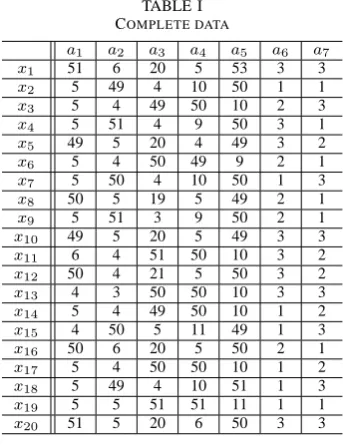
TABLE I COMPLETE DATA
a1 a2 a3 a4 a5 a6 a7
x1 51 6 20 5 53 3 3
x2 5 49 4 10 50 1 1
x3 5 4 49 50 10 2 3
x4 5 51 4 9 50 3 1
x5 49 5 20 4 49 3 2
x6 5 4 50 49 9 2 1
x7 5 50 4 10 50 1 3
x8 50 5 19 5 49 2 1
x9 5 51 3 9 50 2 1
x10 49 5 20 5 49 3 3
x11 6 4 51 50 10 3 2
x12 50 4 21 5 50 3 2
x13 4 3 50 50 10 3 3
x14 5 4 49 50 10 1 2
x15 4 50 5 11 49 1 3
x16 50 6 20 5 50 2 1
x17 5 4 50 50 10 1 2
x18 5 49 4 10 51 1 3
x19 5 5 51 51 11 1 1
x20 51 5 20 6 50 3 3
TABLE II
FUZZYCLUSTERINGRESULTI complete data x1 0.153 0.405 0.442
x2 0.566 0.157 0.277
x3 0.292 0.500 0.208
x4 0.299 0.495 0.207
x5 0.298 0.498 0.204
x6 0.152 0.405 0.443
x7 0.156 0.404 0.440
x8 0.562 0.159 0.279
x9 0.562 0.158 0.281
x10 0.295 0.497 0.208
x11 0.302 0.494 0.205
x12 0.156 0.400 0.445
x13 0.565 0.157 0.278
x14 0.154 0.404 0.442
x15 0.566 0.156 0.278
x16 0.156 0.404 0.440
x17 0.285 0.502 0.213
x18 0.295 0.498 0.207
x19 0.565 0.159 0.276
x20 0.566 0.156 0.278
V. EXPERIMENTALRESULTS
In this section, we show the performance of our algorithm for mixed incomplete data.
A. Artificial data example
We use 20 artificial samples that have seven attributes(a1 toa5 are numerical; the rest is categorical) shown in Table 1. Each categorical item has 3 categories (denoted 1, 2 or 3). As incomplete data sets, we employ data sets in which 25% of the samples have missing attributes.
Table 2 and 3 lists the clustering results to compare complete and incomplete data. Values in bold font correspond to clusters to which the sample most belongs. This result shows that the clustering algorithm is sufficiently useful for incomplete data.
B. Real data example
We use credit approval datasets from UCI Machine Learn-ing Repository which have 683 samples, 15 attributes(6 is numerical and the rest categorical), and 53 missing values.
TABLE III
FUZZYCLUSTERINGRESULTII incomplete data x1 0.309 0.309 0.383
x2 0.600 0.220 0.180
x3 0.085 0.496 0.418
x4 0.090 0.495 0.415
x5 0.086 0.497 0.417
x6 0.287 0.323 0.390
x7 0.308 0.309 0.382
x8 0.598 0.220 0.182
x9 0.604 0.212 0.184
x10 0.088 0.495 0.417
x11 0.095 0.489 0.416
x12 0.317 0.303 0.380
x13 0.600 0.220 0.180
x14 0.310 0.308 0.382
x15 0.603 0.218 0.178
x16 0.308 0.309 0.382
x17 0.086 0.494 0.420
x18 0.086 0.496 0.417
x19 0.565 0.238 0.197
x20 0.603 0.218 0.178
TABLE IV
ATTRIBUTES AND MISSING VALUES
Attribute type Category Missing
A1 C 2 12
A2 N - 12
A3 N - 0
A4 C 4 4
A5 C 3 4
A6 C 14 4
A7 C 9 4
A8 N - 0
A9 C 2 0
A10 C 2 0
A11 N - 0
A12 C 2 0
A13 C 3 0
A14 N - 13
[image:4.595.83.254.59.502.2]A15 N - 0
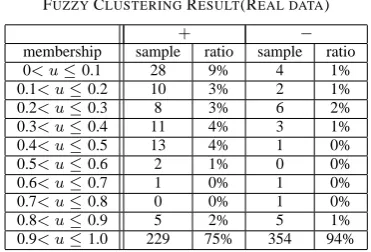
Table 4 lists the type of attribute(”N” is numerical and ”C” is categorical) and the number of missing values. This database has its own real classification result, i.e., each sample has been classified into 2 groups ”+” or ”−”. the fuzzification parameter θ is 1.2. Table 5 presents the result for this incomplete mixed data using the proposed fuzzy clustering method. The two pairs of column under headings ”+” and ”−” present the group´ s value to respective cluster1 and cluster2. The number and percentage of samples with membership value over 10 intervals between 0 and 1 are found in both parts. Figure 1 also describes the results of the clustering result; 77% of the ”+” group samples have high membership in cluster1 and almost all of ”−” group samples are strongly classified in cluster 2. The result shows that our proposed method is applicable for these real data.
VI. CONCLUSION
Fig. 1. Fuzzy Clustering Result(Real data)
TABLE V
FUZZYCLUSTERINGRESULT(REAL DATA)
+ −
membership sample ratio sample ratio
0< u≤0.1 28 9% 4 1%
0.1< u≤0.2 10 3% 2 1%
0.2< u≤0.3 8 3% 6 2%
0.3< u≤0.4 11 4% 3 1% 0.4< u≤0.5 13 4% 1 0%
0.5< u≤0.6 2 1% 0 0%
0.6< u≤0.7 1 0% 1 0%
0.7< u≤0.8 0 0% 1 0%
0.8< u≤0.9 5 2% 5 1%
0.9< u≤1.0 229 75% 354 94%
mixed data containing missing values, we plan to study other imputation methods for categorical incomplete data and other distance measures, for instance, WDS, OCS, and NPS, for missing numerical values. Furthermore, we will investigate the influence of the missing portion of data.
REFERENCES
[1] J. C. Dunn: A Fuzzy Relative of the ISODATA Process and Its Use in Detecting Compact Well-Separated Clusters, Journal of Cybernetics 3: 32-57, 1973.
[2] J. C. Bezdek: Pattern Recognition with Fuzzy Objective Function Algorithms, Plenum Press, 1981
[3] Sen Wu, Xiaodong Feng, Yushan Han, Qiang Wang: Missing Categori-cal Data Imputation Approach Based on Similarity, IEEE International conference on Systems, Man, and Cybernetics, 2012.
[4] Yosr Naija, Kaouther Blibech, Salem Chakhar, Riadh Robbana: Exten-sion of Partitional Clustering Methods for Handling Mixed Data, IEEE International Conference on Data Mining Workshop, 2008.
[5] Wu, K. L. and Yang, M. S.: Alternative c-means clustering algorithms, Pattern Recognition vol. 35, pp. 2267-2278, 2002.
[6] Honda.K, Ichihashi.H: Fuzzy c-means clustering of mixed databases including numerical and nominal variables, Cybernetics and Intelligent Systems, 2004 IEEE Conference on ,Vol.1,2004
[7] R. J. Hathaway, J. C. Bezdek: Fuzzy c-means Clustering of Incomplete Data, IEEE Transactions on Systems, Man and Cybernetics, Part B, Vol.31, No. 5, pp.735-744, 2001