Priority Based Voice Calls Simulation on Global
System for Mobile Communications Network
Kuboye B. Moses, Alese B. Kayode and Oyeyiola Oyedoyin
Abstract— Network congestion in voice communication and signal quality degradation are the major problems of the Global System for Mobile Communication (GSM) most especially as customers’ increases. These are issues that constantly and continuously demand further researches to improve network performance. This work focuses on how the voice calls can be managed on the network in order to minimized congestion experienced on the network. It classifies calls into different classes according to the type and nature of
services offered and they are: special voice (Sv), handoff voice
(Hv), retrial voice (Rv) and new voice (Nv). This model is to
manage the different calls based on their priority in order to reduce congestion on the GSM network. The implementation of the proposed model was done using C# programming language and the snapshots of the interfaces of the system implementation were analyzed.
Index Terms— Priority, GSM, Simulation, Voice, calls.
I. INTRODUCTION
rom time immemorial, information and communication have formed the basis of human existence. People want to reach others and to be reached. This desire has been a driving force, motivating men to continuously seek for a new and effective means of disseminating information to one another on real time basis irrespective of distance. This explosion in technology ushered in this desire with advent of first generation cellular telephone systems that enable people to communicate with one another irrespective of time and place. This first generation cellular telephone system, which was analog system, was launched in 1960s before digital communication became prevalent [1].
Global system for mobile communication (GSM) is a globally accepted standard for digital cellular communication. GSM is the name of a standardization group established in 1982 to create a common European mobile telephone standard that formulated specifications for a pan-European mobile cellular radio system operating at 900 MHz [2]. The evolution of Global System for Mobile communication (GSM) has brought about significant change in our social life for voice and data communication.
Manuscript received December 7, 2015 and accepted January 6, 2016 B. M Kuboye is with the Federal University of Technology, Akure, Ondo State, Nigeria. Phone: 234-08033865251; [email protected]; [email protected]
B. K. Alese is with the Federal University of Technology, Akure, Ondo State, Nigeria e-mail: [email protected].
O. O. Oyeyiola graduated from the department of Computer Science at the the Federal University of Technology, Akure, Ondo State, Nigeria.
Cellular communication is one of the fastest growing and most demanding telecommunications applications today. It represent
s a continuously increasing percentage of all new telephone subscriptions around the world.
Several studies have been carried out on voice communication which encompasses GSM, GSM network, handover/handoff services and GSM congestion. One important area of application of the GSM is the support of voice and data multimedia services [3]. Setting up and maintain a call involves a number of tasks: identifying the called person, determining the location, routing the call, and ensuring that the connection is sustained as long as the conversation lasts. After the transaction, the connection is terminated and the calling user is charged for the service he has used. Due to the rapid growth in mobile users and the limited scarce radio resources, efficient management of radio resources becomes a key factor in enhancing the network performance.
Several resources allocation schemes have been proposed to improve system performance in integrated voice wireless networks. Tang et al [4] proposed a scheme which combined the queuing strategy and priority control to improve the performance of class calls in multi-service personal communications multi-services. The continuation of an active call is one of the most important quality measurements in cellular systems. The reason why handoffs are critical in cellular communication systems is that neighboring cells are always using a disjoint subset of frequency bands, so negotiations must take place between the mobile station (MS), the current serving base station (BS), and the next potential BS [5]. Handoff process enables a cellular system to provide such a facility by transferring an active call from one cell to another.
Different approaches are proposed and applied in order to achieve better handoff service. In cellular technologies, a simple scheme is employed in allocating channels for new and handoff calls without preference, that is, new calls and handoff calls have the same priority and are treated the same way. It shows that the probabilities of new call blocking and handover failure are the same and calls arriving at idle channel are assigned on the first-come first-serve basis regardless of whether the call is new or handoff. This scheme is known as the non-prioritized scheme (NPS). However, Cellular users prefers blocking of new calls than dropping of ongoing calls thus the need for the prioritization of handoff calls [6]. Therefore, it becomes necessary to introduce methods for decreasing the probability of handover failure as well as new call blocking. Handoff prioritization schemes provide improved performance at the expense of a reduction in the total admitted traffic and an
increase in the blocking probability of new calls; however, the improvement in performance is related with the way each scheme gives priorities to handoff calls [7]. Prioritization schemes assign more channels to the handoff calls than new calls thereby giving handoff calls higher priority over the new users.
Network congestion is the unavailability of network to the subscriber at the time of making a call. It is the situation when the blocking occurs and no free path can be provided for an offered call. That is, when a subscriber cannot obtain a connection to the wanted subscriber immediately [8]. Network congestion and signal quality degradation are the major problems of the Global System for Mobile communication most especially as the number of customers increases. The problem of network congestion affects the quality of service (QoS) rendered by a network, therefore congestion control is of utmost importance for the sustainability of the system. Network congestion demands constant and continuous researches to improve network performance. Several attempts had been made to manage the congestion in mobile networks which includes channel borrowing, cell-splitting, cell sectoring, development of micro-cells, dynamic channel allocation and deployment of soft handover schemes. The various attempts in managing congestion fall in either the congestion avoidance category or congestion management category. Congestion avoidance has however been adjudged the best scheme for controlling network congestion [9].
II. BRIEF DESCRIPTION OF CALL TYPES
The classes of calls are of two types, the voice and data. In this work, the voice call is subclassified into four types. They are special, handoff, retrial and new calls. These characteristics of each call types are hereby described
A. Special voice (Sv) calls
These are calls that have the highest priority access to the network. Anytime these set of subscribers try to get access to the network they are given the highest preference, thereby, getting easily connected. These subscribers include fire fighters, police on emergencies, and doctors on emergencies.
B. Handoff voice (Hv) calls
They have the second priority level. The continuation of an active call is one of the most important quality measurements in cellular systems [10]. Handoff/handover process enables a cellular system to provide such a facility by transferring an active call from one cell to another. This usually happen when a subscriber who has been connected to a cell wanted to connect to a new cell as result of movement of the subscriber to the new cell, so there will be a need for the subscriber to continue the call with a free channel in the new cell. In the process of this transfer, if there is no free channel, it call preempt a lower priority already engaging the channel in the new cell.
C. Retrial Calls (Rv)
They have priority next to handoff. In GSM, those calls that face blocking may automatically retry, this traffic is called retrial traffic or call. Here, the retrial traffic is given a higher priority over the new call for a period of time after which the priority ceases, this is done in other not to allow
subscriber new call to be blocked indefinitely and also, not to give unnecessary priority to a subscriber who has gone for a long period of time to come back to have priority over a new call. The assumption here is that if the call is important, the subscriber will call back within some few seconds.
D. New calls (Nv)
These are the calls just trying to have access to the network for the first time and thereby have the lowest priority.
III. MODEL DESCRIPTION
A cellular network model of one cell only is considered in this work. It is assumed that we are treating homogenous cells, that is, cells that are identical and have the same traffic parameters, so it is enough to investigate one cell, and the handoff effect from the adjacent cells to this cell and from this cell to adjacent cells is described by handoff processes [6]. The total C channels in the cell are dynamically
assigned to three pools using Partial Partitioning schemes as shown diagrammatically in Fig. 1.
Fig. 1. Complete sharing schemes
Pool 1 has q1channels for voice traffic exclusively, Pool 2 has q2channels shared for special voice class, handoff voice and handoff data, Pool 3 has q3 channels for data traffic exclusively,
Thus
C = q1 + q2+ q3 ………1.0
Note that q1, q2 and q3 are not specific channels but just a label for the pools of channels. The reason for this model is to guarantee a level of quality of service (QoS) for voice and data traffic since the practice is that voice calls always have priority over data users; therefore a specific sum of channels should be exclusively reserved for data users. Furthermore, each of the pools will be shared by different classes of services using a complete sharing, that is, each pool will be allowed to be accessed by different classes of call available in the pool.
IV. PROPOSED SYSTEM FLOWCHART
In this work, the calls are separated into classes according to their type. The probability of congestion of each of this call type as it will behave on the network is simulated in this work. The special voice call has the highest priority, which means, it can only be blocked when the channels are filled with other special voice calls because it cannot preempt itself. The handoff voice calls will be blocked when the channel is filled with special voice call
Retry
Lost call N Voice calls
Call Blocked Y
Y
Rv? Y
Y N N Drop LPC Call Accepted Y Occupied Channels < q1‐
(Hv + Sv)
Any LPC?
Call Blocked
Occupied Channels < q1‐
(Hv + Sv+Rv)
Y
N N N
Y Sv?
Hv?
N N
Nv
N
Occuppied Channels < q1+q2
Call Accepted
Occuppied Channels < q1+q2‐Sv
Y Y N Any LPC ?
Drop LPC
Any LPC?
Call Dropped Y
Y
[image:3.595.60.310.39.766.2]N
Fig. 2. Flowchart of the proposed system
and other handoff calls. Even if there is no special voice but the channels in q1 and q2 are filled with handoff calls and any other handoff calls tries to make a call, it will be blocked. Retrial voice call will be blocked if the channel of q1 is filled with special, handoff and retrial calls. The retrial call can only preempt new calls. Meanwhile, for the retrial and new calls to have access to the channel, the handoff and special will need to access q2 before q1, they will only access q1 if only there is no free channel in q2. In this work, a retrial call is defined as any call that call back within the 30s from its previous attempt when it was blocked. We are trying to prevent a situation where a call trying to access a channel will be blocked for a longtime. Also, we are preventing a situation where a caller that has gone to sleep for more than 30s will suddenly call back to get access thereby preventing a new call that might be urgent. It is of the believed in this work that if a call is important, you will call back within some seconds. A new call will be blocked in q1 channel if there is no free channel. As soon as the call is blocked, its number will be registered in the cache in the network, then, if the call is repeated within 30s it will assume a new status of retrial call. All these assumptions and processes have been incoporated in the flowchart shown in Fig. 2.
V. ALGORITHM FOR VOICE COMMUNICATION The algorithms for the proposed model used for voice communication on the GSM network are presented here. The algorithms are in two fold. The first one has no threshold for the handoff call while the second has threshold to restrict handoff call from occupying the channels unnecessarily.
1. START
2. SET CODES
3. WHILE SERVICE = TRUE
4. GET CALL
5. IF CHANNEL q1 or q2 = FREE THEN
6. LOAD CALL TO FREE CHANNEL
7. GO TO 2
8. ELSE
9. IF CALL = sv AND AT LEAST EITHER
hv or hd CALL is ON CHANNEL q2 or AT LEAST rv or nv IS ON CHANNEL q1 THEN 10. DROP CALL WITH LEAST PRIORITY 11. LOAD sv CALL TO TIMESLOT (TK) 12. WHILE SERVICE =TRUE
13. CONTINUE THE CALL
14. WEND
15. ELSE
16. IF CALL = hv AND AT LEAST EITHER
hd CALL is ON CHANNEL q2 OR AT LEAST rv or nv IS ON CHANNEL q1 THEN
17. DROP CALL WITH LEAST PRIORITY 18. LOAD hv CALL TO TIMESLOT (TK) 19. WHILE CALL = TRUE AND NO
HIGH PRORITY WAITING 20. CONTINUE THE CALL 21. WEND
22. ELSE
CACHE) AND AT LEAST nv IS ON CHANNEL q1 THEN
24. DROP CALL WITH LEAST PRIORITY
25. LOAD rv CALL TO TIMESLOT (TK)
26. WHILE CALL = TRUE AND NO HIGH PRORITY WAITING
27. CONTINUE THE CALL 28. WEND
29. ELSE
30. IF CALL = nv AND CALL ON CHANNEL q1 IS nv CALL THEN 31. DROP CALL
32. END IF 33. END IF 34. END IF 35. END IF
36. DROP THE CALL 37. GOTO 3
VI. NETWORK SIMULATION
[image:4.595.44.279.49.280.2]The main application window of the network simulator comes up after the start button has been clicked as shown in Fig. 3. This window consists of the call centre where the users need to enter call number. When a number is entered, the “Start” button is pressed and the call will start by allocating a free channel if available to the number. If all channels are occupied and the incoming call is a handoff call, the call with the lowest priority will be preempted and the number stored in a temporary register. A handoff call cannot preempt another handoff call because they have the same priority. The call number in the temporary store will be there for a period of 30 seconds which is the time frame given for the number redialed. If the preempted call dialed again before the expiration of this 30s and there is a free channel or there is new call on the channel to preempt, then, it will be connected to the channel.
Fig. 3.: Channel Window
The “Register” column is a temporary storage which registers the number of callers that had been blocked as a result of lack of free channel for communication. If any call in this register reappears before the expiration of the 30s, they will be regarded as a retrial call else they are classified as new call. For that conversation to continue, the old channel must hand the call over to a new channel in a new
cell. During the process of handoff, if there is a free channel then, there will be seamless handoff; The handover call is a call that has been connected to the network using a channel for communication but while the conversation is still on, the caller moves to another cell expecting to use a new channel in otherwise, the call will have to preempt a call with lower priority if there is any, in order to forestall the situation of call dropping, thereby discontinue the conversation.
[image:4.595.316.554.202.415.2]A scenario where a call is successfully allocated free channel irrespective of call type is shown in Fig. 4. Any call type will connect to the network at this point since there is at least a free channel.
Fig. 4. Calls successfully allocated tofree channel
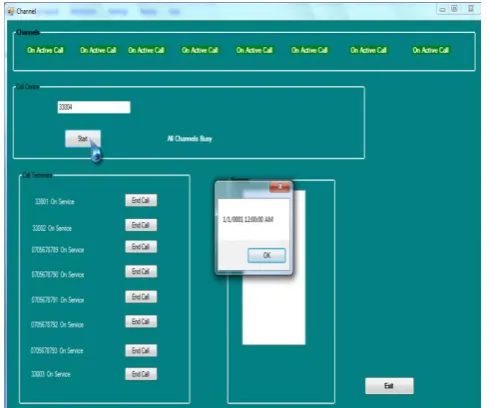
However, a situation where all channels are busy and any call entering at this point will have to follow the rules is shown in Fig. 5. That is, a call of equal priority to the call on the channel will be blocked; otherwise, it has to preempt a lower call for it to start conversation on the network.
[image:4.595.47.288.499.668.2] [image:4.595.313.557.532.736.2]A situation where a handoff call is blocked due to unavailability of free channel on the target cell while moving away from the old cell to the new cell is shown in Fig. 6. The target cell is filled with call type that is either of the same group type or higher priority call type since it call preempt a lower priority call type. The only call that was successfull in this situation is special call that has the highest priority.
[image:5.595.47.279.167.353.2]Fig. 6. Call successful for special subscriber but blocke dfor Handover A window where a call was preempted into the temporary register by the special call is shown Fig. 7. A preempted call is given a retrial priority, that means that if the conversation needs to continue, the subscriber will call back within the 30s range of time given to retrial call, otherwise it is lost completely.
Fig. 7. Call preempted into the temporary register.
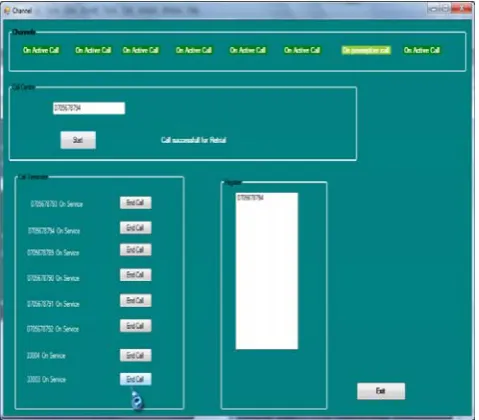
A retrial call successfully given a chance on the network by preempting a lower priority call on the network is shown in Fig. 8.
Fig. 8. A retrial call was successfully given a chance on the network.
VII. CONCLUSION
This work focuses on how the congestion experienced on the GSM network can be minimized. It classifies subscribers into different classes according to the type and nature of services offered. Thereafter, a level of priority was set among the classes so that the most urgent and important service will have access to the channel on the network by preempting the lower priority when there is congestion and there is no free channel to communicate. Also, the voice communication and data communication over the GSM network using the different classes of subscribers were analyzed. The effects of each class on the network and its impact on another class are shown. Based on the benefits expected to be derived from the developed system, it is strongly recommended that multi-level priority be implemented in voice communication of GSM Network.
REFERENCES
[1] Goldsmith A. (2005). “Wireless Communications”, Cambridge University Press.
[2] www.iec.org/online/tutorials/gsm
[3] Wei-Yeh Chen, Jean-lien C. Wu (2005) “Proceedings of 19th International Conference on Advanced Information Networking and Applications (AINA’05).
[4] Tang L., Shensheng T. and Wei L. (2004). “A Channel Allocation Model With Preemptive Priority for Integrated Voice/Data Mobile Networks”, Proceedings of the First International Conference onQuality of Service in Heterogeneous Wired/Wireless Networks (Qshine’04) 0-7695-2233-5/04 IEEE
[5] Zeng A. and Agrawal, D.P., (2002). “Modeling and Efficient Handling of Handoffs in Integrated Wireless Mobile Networks,” IEEE Transanction Vehicular Technology, Vol. 51, No. 6.
[6] Roszik J., Sztrik J. and Che-Soong K. (2003). “Retrial Queues in The PerformanceModeling of Cellular Mobile Networks Using Mosel”, International Journal of Simulation Vol. 6 No. 1-2
[7] Sgora and Vergados, (2009). “Handoff Prioritization and Decision Schemes in Wireless Cellular Networks: A Survey” IEEE Communications Surveys & Tutorials, Vol. 11, No. 4, Fourth Quarter 2009
[image:5.595.52.286.481.664.2][9] Alarape M.A, Akinwale A.T & Folorunso O. (2011) “A combined scheme for controlling GSM Network calls congestion” volume 14(3).