Abstract—It is important to make the most efficient business decisions while solving a problem to meet the requirements and to reduce losses. These solutions must be robust, keeping in mind the changes in the requirements and external environment. A robust multi criteria decision making method is proposed. An example of a satellite orbit and launch vehicle selection problem are used as a case study and evaluation of the proposed method is demonstrated.
Keywords—Entropy weights, robust multi criteria decision making, selection problem, VIKOR.
I. INTRODUCTION
HEREhas been an increase in demand of products and services, recently. This has led to an increase in monopoly, thereby an increase in competition and the need for industries to be efficient while making business decisions. Therefore, multi criteria decision making (MCDM) is required for trade off analysis in an uncertain environment with multi-objectives. The solutions found must be robust, keeping in mind the changes in the requirements and external environment. In this paper, a robust multi criteria decision making method is proposed. This method builds on the existing method of solving using Analytical Hierarchy Process (AHP) weights in the Technique for Order Preference by Similarity to Ideal Solution (TOPSIS) technique for ranking. The drawbacks of both methods are overcome by using weights from Entropy and also using the VIseKriterijumska Optimizacija I Kompromisno Resenje (VIKOR) technique for ranking, respectively. The configuration of this paper includes definition and formulation of a Robust Multi Attribute Decision Making (RMCDM) problem (Chap. II), survey of related conventional works (Chap. III). Proposed novel RMCDM method (Chap. IV), and demonstration of the merit of the proposed method using a case study of a satellite orbit and launch vehicle selection problem (Chap. V).
Manuscript received December 08, 2016; revised January 10, 2017. Heena Shah is a second year masters student of the Graduate School of Information, Production and Systems, Waseda University, Kitakyushu 808 0135 Japan (phone:080 4278 74242; mail: [email protected]).
Tomohiro Murata is a professor at the Graduate school of Information, Productions and Sytems, Waseda University, Kitakyushu, 808 0135 Japan. (mail: [email protected]).
Evgeny Malamura is a doctor student at the Graduate school of Information,.Productions and Sytems, Waseda University, Kitakyushu, 808 0135 Japan.(mail: [email protected])
II. PROBLEM DESCRIPTION
MCDM is also known as Multi Attribute Decision Making (MADM). MCDM methods are mathematical models used to solve complicated problems including various criteria for each aspect and choose the best aspect. In all methodologies, it is revealed that the relative importance or priority weights assigned to the considered evaluation criteria have an immense role in obtaining the accurate rankings of the alternatives. [2] Some examples of the method include AHP, TOPSIS, VIKOR,
Fuzzy Set Theory, WSM (Weighted Sum Model) and WPM (Weighted Sum Model). However, conventional MCDM methods have the following drawbacks.
1) Objective weights of the criteria do not consider the DM’s opinion and therefore, should not be used alone.
2) Often both subjective and objective weights of the criteria are not considered at the same time.
[image:1.595.307.545.467.592.2]3) Two objectives of risk and gain are not considered and compromised together at the same time to get robust solutions.
Fig. 1 RMCDM problem
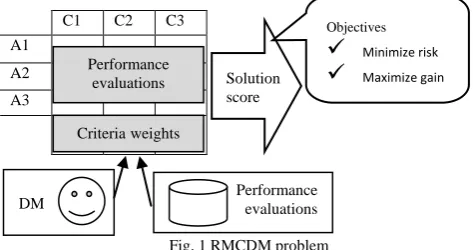
A few of the alternatives of the same type but different characteristics are available as in Fig. 1. Subjective weights of the criteria are assigned by the DM. Objective of minimizing risk and maximizing gain need to be compromised as per the requirement of the DM and accordingly, a distinct robust solution needs to be suggested to the DM. Therefore, a robust optimization method is proposed and formulated as below.
Objective function:
Total score for ranking 𝑉𝑇𝑘 = 𝑛Ck++ 1 − 𝑛 𝑄𝑘
Components:
Score for objective of risk Ck+= 𝑟𝑙=1𝑏𝑙[ 𝑤𝑙𝑐𝑙 −
𝑛𝑖𝑠]
Score for objective of gain 𝑄𝑘= 1 − 𝑟𝑙=1𝑤𝑙 𝑝𝑖𝑠 −
Study on Robust Multi Criteria Decision
Making for a Selection Problem
Heena Shah, Tomohiro Murataand Evgeny Malamura
T
C1 C2 C3
A1
A2
A3
Performance evaluations
Criteriaweights
DM Performance evaluations Solution score
𝑐𝑙 for 𝑏𝑙 = 1
Total weight of criteria 𝑤𝑙 = 𝑚𝑤𝑜𝑙+ (1 − 𝑚)𝑤𝑠𝑙
Objective weight of criteria 𝑤𝑜𝑙 = 1−𝐻𝑙
𝑟− 𝑟𝑙=1𝐻𝑙
Subjective weight of criteria 𝑤𝑠𝑙 =1
𝑟 𝑎𝑗𝑙 𝑟 𝑙=1
Subject to
𝑉𝑇 ∈ [0, … ,1] total score for ranking
Ak kth alternative
xkl > 0 Performance of the Ak with respect to Cl
wl∈ [0, … ,1] total weight of the Cl 𝑏𝑙 = 1 𝑖𝑓 benefit criterion
𝑏𝑙 = −1 𝑖𝑓 cost criterion
III. RELATED WORKS A. AHP
It is a well-known MCDM method of scientific analysis and decision-making by calibration of hierarchies whose elements are goals, criteria, sub-criteria and alternatives. [5] Its weighting method is subjective because it allows the DM to clearly assign weights through pairwise comparison and ensure consistency. However, the weights are therefore not completely reliable. Because, if higher weights are assigned to criteria that have similar values and vice versa, the final scores are similar and thus, the solution suggested to the DM is not distinct. The final score calculation is a mere weighted sum and doesn’t have a specified objective.
B. Entropy weighting method
Shannon introduced the information entropy theory, which is based on the thermodynamic principle where entropy is the degree of disorder of the molecules in a substance for the first time. It has been applied as a measure of disorder, unevenness of distribution, the degree of dependency or complexity of a system. [7]
Entropy weighting is a method which is made up of the monitoring values of evaluation index in objective conditions, can determine the target and the degree of order and effectiveness by referring to evaluation of information entropy. Weights being from Entropy weighting method make the rank lists more objective. [12] It avoids the subjectivity of the weights of various criteria, and therefore the results of evaluation can be better able to reflect the actual situation. [6] However, it fails to accommodate the DM’s requirements.
C. TOPSIS
TOPSIS is a widely accepted in the context of MCDM. It is usually used to prioritize alternatives through comparing them to the best and the worst solutions. [8] The aim of this method is to minimize risk. Thus, the best solution is farthest from the worst solution but there is no guarantee that it is the closest to the positive ideal solution.
Possibility of incorporating qualitative and quantitative factors is one of the benefits of this technique. Another benefit of this method is the ability of separating indicators into cost or profit categories. [8] However, it uses the simple weighting technique, which may make it difficult for the DM to assign the weights correctly and check for consistency. It doesn’t consider the objective of gain, which is equally important.
D. VIKOR
VIKOR means multi-criteria optimization and compromise solution [9]. VIKOR method is mainly based on the particular measure of closeness to the ideal solution and it focuses on selecting the best choice from a set of feasible alternatives in presence of mutually conflicting criteria by determining a compromise solution. VIKOR method integrates maximum group utility and minimal individual regret simultaneously [10]. It aims to maximize gain but doesn’t consider the objective of risk. It also uses the simple waiting technique like TOPSIS and has the same drawbacks.
IV. PROPOSED METHODOLOGY
A. Goals of the proposed method are;
1) To accommodate the DM’s preferences, reduce the subjectivity and ensure distinct solutions. Since the entropy and AHP weights don’t have any units, the total weight can be calculated through weighted sum.
2) To meet the objectives of both minimizing risk and maximizing gain. Since TOPSIS and VIKOR scores also don’t have any units, the total score can be calculated through weighted sum.
[image:2.595.312.523.392.690.2]B. Procedure of Proposed method
Fig. 2 Proposed method
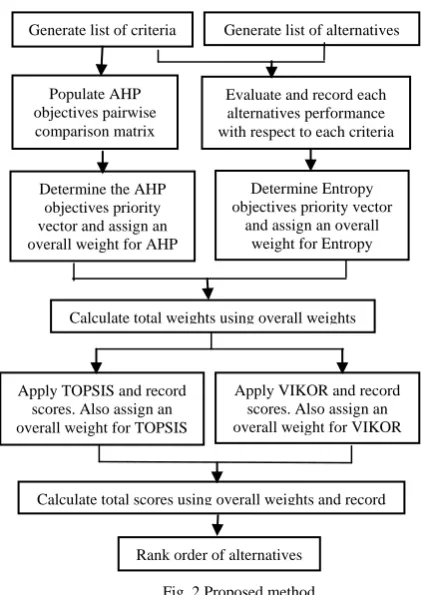
The proposed methodology illustrated in Fig. 2 is as follows:
Step 1: The list of the criteria related to the problem is generated through brain storming activities and experiences. They must be quantifiable or converted into that type.
Step 2: The list of alternatives is then generated from Generate list of criteria Generate list of alternatives
Evaluate and record each alternatives performance with respect to each criteria
Determine Entropy objectives priority vector
and assign an overall weight for Entropy Determine the AHP
objectives priority vector and assign an overall weight for AHP
Calculate total weights using overall weights
Apply TOPSIS and record scores. Also assign an overall weight for TOPSIS
Calculate total scores using overall weights and record Apply VIKOR and record
scores. Also assign an overall weight for VIKOR
Rank order of alternatives Populate AHP
which the best one will be picked and suggested to the DM later.
Step 3: The performance of each alternative is evaluated and recorded with respect to each criterion. These performances may be direct facts or have to be calculated from the design variables. If limits have been set for performance evaluations under each criterion, alternatives whose performance evaluations cross that limit are omitted.
Step 4: Entropy weights are calculated from the performance evaluations. This helps the DM understand which criterion gives more information. Further, an overall weight is set for entropy weighting method. This indicates the objectivity of the results.
Step 5: The AHP objectives pairwise comparison matrix is populated with the preferences from the DM using the Saaty scale.
Step 6: The AHP objectives priority vector is determined from the objectives pairwise comparison matrix using AHP. Further, an overall weight is set for AHP weighting method. This indicates the subjectivity of the results.
Step 7: The total weights are calculated using the Entropy and AHP weights along with the overall weights.
Step 8: These weights along with the performance evaluations matrix are then used for applying TOPSIS and the TOPSIS scores are recorded. Further, an overall weight is assigned to the TOPSIS method. This indicates the importance of the objective of minimizing risk.
Step 9: Total weights and performance evaluations are also used for applying VIKOR. The VIKOR scores are recorded. Further, an overall weight is assigned to the VIKOR method. This indicates the importance of the objective of maximizing gain.
Step 10: Using TOPSIS and VIKOR scores along with their overall weights, total scores are calculated.
Step 11: A ranking is then established and the best solution is recommended to the DM.
V. CASE STUDY AND EVALUATIONS A. Satellite orbit and launch vehicle selection problem
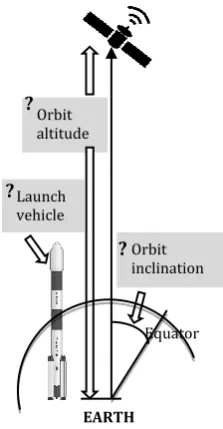
The case study and data are used from [1]. Integrated throughout this paper is an example application of this method to the scenario of choosing a launch vehicle and circular orbit for a small, responsive military reconnaissance satellite. In this scenario, a 400 kg satellite is to be launched to monitor activity at an unfriendly missile launch site at 40.85°N latitude, and the decision-maker must choose the orbit in which to place the satellite as well as what launch vehicle to use. The on-board targeted sensor is assumed to have a total field of view angle of 1° and a nadir ground sample distance of 1.0 m at a reference altitude of 400 km. The satellite’s ballistic coefficient is assumed to be 110 kg/m², a representative average for satellites [3, 4], and minimal propellant is available for orbit maintenance. [1]
The various possibilities for design variables, orbit altitude, orbit inclination and launch vehicle are listed in the table I. The DM chooses these and a total of 840 design alternatives were listed. After step 3, these were reduced to 59.
The table II shows the list of criteria and their characteristics. The hierarchy for AHP is given in the fig. 4.
It also shows the relation between design definitions and criteria.
[image:3.595.372.484.134.349.2]These 59 alternatives, their performance evaluations, criteria along with AHP prioritization matrix given in the table III and IV were directly used in the experiments of this paper from the reference paper.
Fig. 3 Problem from case study
TABLE I
DESIGN DEFINITIONS FOR SATELLITE EXAMPLE [1] Orbit altitude Orbit inclination Launch vehicle
200 0 Falcon 1
300 10 Falcon 1e
400 20 Pegasus XL
600 30 Pegasus XL with HAPS
1000 40 Taurus 2110
1500 50 Taurus 2210
2000 60 Taurus 3110
70 Taurus 3210
80 Minotaur I
90 Minotaur IV
Athena I Athena II
TABLE II
CRITERIA WITH UNITS AND TYPE FOR SATELLITE EXAMPLE [1] C1 Launch margin (percent) Benefit
C2 Launch cost ($FY09M) Cost
C3 Launch reliability (percent) Benefit C4 Image FOV area (𝑘𝑚2) Benefit
C5 Image nadir GSD (m) Cost
[image:3.595.303.546.522.782.2]C6 Mean worst-case daily data latency (hrs.) Cost C7 Mean Daily coverage time (hrs.) Benefit C8 Orbit lifetime (yrs.) Benefit
Fig. 4 Schematic depiction of AHP hierarchy
Equator Orbit inclination Orbit
altitude
Launch vehicle
EARTH
? ?
TABLE III
PERFORMANCE EVALUATIONS OF DESIGN ALTERNATIVES FOR SATELLITE EXAMPLE [1]
[image:4.595.303.549.617.776.2]R C1 C2 C3 C4 C5 C6 C7 C8 1 0.1 22.4 93.6 38.3 1 14.8 0.62 0.5 2 31.9 22.4 97.9 38.3 1 14.8 0.62 0.5 3 86.4 42.4 95.2 38.3 1 14.8 0.62 0.5 4 27.4 22.4 97.9 38.3 1 14.1 1 0.5 5 76.9 42.4 95.2 38.3 1 14.1 1 0.5 6 22.8 22.4 97.9 38.3 1 12.8 1 0.5 7 67.1 42.4 95.2 38.3 1 12.8 1.18 0.5 8 18 22.4 97.9 38.3 1 11.7 1.1 0.5 9 56.9 42.4 95.2 38.3 1 11.7 1.1 0.5 10 91.5 10.2 93.1 38.3 1 6.3 0.8 0.5 11 13.1 22.4 97.9 38.3 1 6.3 0.8 0.5 12 46.4 42.4 95.2 38.3 1 6.3 0.8 0.5 13 80.9 10.2 93.1 38.3 1 4.7 0.72 0.5 14 8 22.4 97.9 38.3 1 4.7 0.72 0.5 15 35.5 42.4 95.2 38.3 1 4.7 0.72 0.5 16 69.4 10.2 93.1 38.3 1 3.7 0.72 0.5 17 88.8 28.6 97.6 38.3 1 3.7 0.72 0.5 18 2.8 22.4 97.9 38.3 1 3.7 0.72 0.5 19 24.3 42.4 95.2 38.3 1 3.7 0.72 0.5 20 18.6 22.4 97.9 86.1 1.5 14.8 0.94 20.4 21 70 42.4 95.2 86.1 1.5 14.8 0.94 20.4 22 14.4 22.4 97.9 86.1 1.5 13.2 1.31 20.4 23 61.1 42.4 95.2 86.1 1.5 13.2 1.31 20.4 24 96.3 10.2 93.1 86.1 1.5 11 1.51 20.4 25 10 22.4 97.9 86.1 1.5 11.9 1.51 20.4 26 51.8 42.4 95.2 86.1 1.5 11.9 1.51 20.4 27 87.8 10.2 93.1 86.1 1.5 11 1.52 20.4 28 5.5 22.4 97.9 86.1 1.5 11 1.52 20.4 29 42.2 42.4 95.2 86.1 1.5 11 1.52 20.4 30 78.4 10.2 93.1 86.1 1.5 6.5 1.16 20.4 31 95.4 28.6 97.6 86.1 1.5 6.5 1.16 20.4 32 0.9 22.4 97.9 86.1 1.5 6.5 1.16 20.4 33 32.2 42.4 95.2 86.1 1.5 6.5 1.16 20.4 34 68.2 10.2 93.1 86.1 1.5 4.8 1.04 20.4 35 84.3 28.6 97.6 86.1 1.5 4.8 1.04 20.4 36 21.9 42.4 95.2 86.1 1.5 4.8 1.04 20.4 37 57 10.2 93.1 86.1 1.5 3.9 1 20.4 38 72.5 28.6 97.6 86.1 1.5 3.9 1 20.4 39 11.3 42.4 95.2 86.1 1.5 3.9 1 20.4 40 98.8 28.6 97.6 239.3 2.5 14.7 0.94 2050.1 41 92.7 28.6 97.6 239.3 2.5 12.7 1.48 2050.1 42 39.8 42.4 95.2 239.3 2.5 12.7 1.48 2050.1 43 85.8 28.6 97.6 239.3 2.5 11.8 1.84 2050.1 44 32 42.4 95.2 239.3 2.5 11.8 1.84 2050.1 45 78.2 28.6 97.6 239.3 2.5 10.6 2.07 2050.1 46 23.9 42.4 95.2 239.3 2.5 10.6 2.07 2050.1 47 69.9 28.6 97.6 239.3 2.5 9.7 2.14 2050.1 48 15.5 42.4 95.2 239.3 2.5 9.7 2.14 2050.1 49 99.5 28.6 97.6 239.3 2.5 8.9 2 2050.1 50 60.7 28.6 97.6 239.3 2.5 8.9 2 2050.1 51 6.7 42.4 95.2 239.3 2.5 8.9 2 2050.1 52 89 28.6 97.6 239.3 2.5 5 1.64 2050.1 53 50.8 28.6 97.6 239.3 2.5 5 1.64 2050.1 54 88.4 31.6 97.6 239.3 2.5 5 1.64 2050.1 55 77.6 28.6 97.6 239.3 2.5 4 1.58 2050.1 56 40.2 28.6 97.6 239.3 2.5 4 1.58 2050.1 57 75.6 31.6 97.6 239.3 2.5 4 1.58 2050.1 58 7.2 42.4 95.2 538.3 3.8 11.2 2.08 28984.7 59 0.9 42.4 95.2 538.3 3.8 10.3 2.40 28984.7
TABLE IV
AHP PRIORITIZATION MATRIX FOR SATELLITE EXAMPLE [1] Criteria C1 C2 C3 C4 C5 C6 C7 C8 C1 1 1/3 3 5 1/6 1/3 1/2 3 C2 3 1 5 7 1/4 1/3 1/2 5 C3 1/3 1/5 1 3 1/8 1/5 1/4 1/5 C4 1/5 1/7 1/3 1 1/9 1/8 1/7 1/7
C5 6 4 8 9 1 4 5 7
C6 3 3 5 8 1/4 1 2 5
C7 2 2 4 7 1/5 1/2 1 3
C8 1/3 1/5 5 7 1/7 1/5 1/3 1
In this demonstration, the overall weights for AHP, Entropy, TOPSIS and VIKOR were assumed to be 0.5 as well as the weights within VIKOR for objectives of
maximizing group utility and minimizing individual regret were assumed to be 0.5. However, the DM as per his requirement can give these.
B. Experiment
The following methods were applied on the same data set to realize the effect of the changes made in each, weighting and ranking method.
Method 1 is the original method from the reference paper, which included AHP and TOPSIS without overall weights. This was carried out to confirm the method and results from the paper.
Method 2 included steps from method 1 and Entropy along with overall weights for AHP and Entropy. This is was carried out to realize the effect of Entropy on the results.
Method 3 included steps from method 1 and VIKOR along with overall weights for TOPSIS and VIKOR. This was done to realize the effect of VIKOR.
Method 4 is the proposed method.
C. Results
TABLE V
OBJECTIVE, SUBJECTIVE AND TOTAL WEIGHTS FOR THE SATELLITE EXAMPLE
wo ws w
C1 0.0904 0.0743 0.0824
C2 0.0279 0.1259 0.0769
C3 0.0001 0.0318 0.0159
C4 0.1131 0.0183 0.0657
C5 0.0303 0.3797 0.2050
C6 0.0370 0.1833 0.1101
C7 0.0243 0.1220 0.0732
C8 0.6770 0.0646 0.3708
The entropy weights (wo) were found to be directly proportional to the variation of the performance evaluations for the respective criteria. The AHP weights (ws) differ largely from entropy weights. This indicates that the result found only using AHP are not distinct. The total weights (w) are an average of both in this case. This balances the subjectivity as well as objectivity and its use is therefore, recommended.
Fig. 5 Final scores for the Satellite example application
0 0.2 0.4 0.6 0.8 1
1 5 9 13 17 21 25 29 33 37 41 45 49 53 57
Final
sc
ore
Design alternatives Final scores
Method 1 Method 2
Method 3 Method 4
Method 1 Method 3
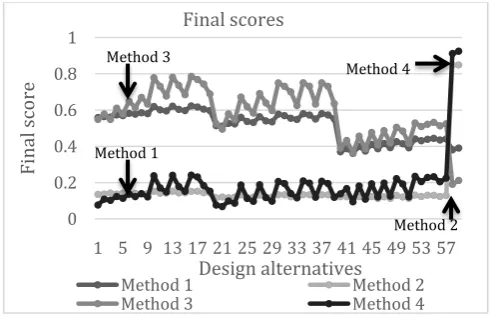
The presence of Entropy brings out the best solutions discretely. This is noticed in method 2 and 4 of fig. 5. The scores are not very high in method 1 and 2 of fig. 5 when TOPSIS is used alone. When AHP is used alone in method 1 of fig. 5, the solutions are not very discrete. The scores are on the higher side in method 3 of fig. 5 when VIKOR is used along with TOPSIS. Since method 4 includes weighted sum of VIKOR and TOPSIS score, VIKOR scores are higher than that of TOPSIS. The solutions in VIKOR are closer to the positive ideal solution than in TOPSIS.
TABLE VI
TOP 5 RANKS FOR 4 METHODS APPLIED ON THE SATELLITE EXAMPLE Method Rank 1 Rank 2 Rank 3 Rank 4 Rank 5
1 16 13 10 17 18
2 58 59 17 13 10
3 16 13 10 17 34
4 59 58 16 13 10
In the results of method 1, the top 5 designs lie between 10 and 18. This result is the same as in the original reference paper in spite of the author also accommodating uncertainty. In the results of method 2, the scores of the designs are between 0.11 and 0.85 but most are low and 2 are high. The scores are extreme as the solutions found using entropy weights are discrete. The top 5 designs are 58 and 59 as well as lie between 10 and 17. Design 58 and 59 possess very similar performance evaluations. They are top 2 designs because of the entropy weights of benefit criteria 4 and 8 being high along with the performance evaluations of those designs under those criteria whereas the entropy weight of the cost criterion 2 is low along with the low value of the designs under that criterion. Both designs have very similar characteristics.
In the results of method 3, the scores of the designs vary between 0.19 and 0.79. The top 5 designs lie between 10 and 17 along with 34 and have high scores because they meet the objectives of minimizing risk and maximizing gain the most.
In the results of method 4, the scores of the designs vary from 0.92 to 0.068.The top five designs are 59, 58 and the rest lie in between 10 and 16. The results possess combined characteristics of the above 3 methods.
Finally, results from the original paper (method 1) and proposed method (method 4) are compared in detail.
Design 16 and 13 are a group of best solutions by the original method. Design 16 and 13 have a launch margin of 69.4% and 80.9% and mean worst case data latency of 3.70hrs and 4.70hrs respectively. They both have a launch cost of 10.2$FY09M, launch reliability of 93.10 %, image FOV area of 38.30𝑘𝑚2, image nadir GSD of 1m, mean
daily coverage of 0.72hrs and orbit lifetime of 0.50 years. Except for launch margin they have very similar or same performance evaluations over all criteria. For both design alternatives, the launch margin is slightly higher, the launch cost is the lowest, the launch reliability is lowest, the image FOV Area is the lowest, image nadir GSD is the lowest, the mean worst case daily data latency is the lowest, the mean daily coverage time is low and the orbit lifetime is the lowest compared to values under the respective criteria.
Designs 16 and 13, which were suggested as the family of
best solution in the original paper, have an orbit altitude of 400km, use the Falcon 1e launch vehicle and have an orbit inclination of 90deg and 80deg, respectively.
Design 59 and 58 are a group of best solutions by the proposed method. Design 59 and 58 have a launch margin of 0.9% and 7.2%, mean worst case data latency of 10.3hrs and 11.2hrs and mean daily coverage of 2.40hrs and 2.08hrs respectively. They both have a launch cost of 42.4$FY09M, launch reliability of 95.2 %, image FOV area of 538.3𝑘𝑚2,
image nadir GSD of 3.8m and orbit lifetime of 28984.7 years. Except for launch margin they have very similar or same performance evaluations over all criteria. For both design alternatives, the launch margin is low, the launch cost is the highest, the launch reliability is average, the image FOV Area is the highest, image nadir GSD is the highest, the mean worst case daily data latency is high, the mean daily coverage time is high and the orbit lifetime is the highest compared to the values under the respective criteria.
Design 59 and 58, both have an orbit altitude of 1500km, use Athena I as the launch vehicle but the orbit inclinations are 40deg and 30deg, respectively.
The original paper prioritized criteria, which had more similar values than the ones with different performance evaluations. However, if there are any changes in the priority weights, the solutions would change quickly as they are highly sensitive. Since the proposed method makes use of the weights from the original paper as well as objective weights which give high priority to criteria with more different performance evaluations and vice versa, if there are changes in the priority weights, the solutions would not change soon since they are not as sensitive.
TABLE VII
COMPARISON OF PERFORMANCE EVALUATIONS OF THE BEST SOLUTIONS Type Gain Risk Gain Gain Risk Risk Gain Gain R C1 C2 C3 C4 C5 C6 C7 C8 R13 high
er
lowe st
lowe st
lowe st
lowe st
lowe st
low lowe st R16
R58 low
high est
aver age
high est
high est
high high est
high est R59
The solutions from the original method have a higher value under a benefit criterion but all the values under the cost criterion are the lowest. Therefore, these results are minimizing risk. The solutions from the proposed method are low and average under two benefit criteria, respectively. They are also high under one cost criterion and highest under the two others. Therefore, these results are striking a balance between minimizing risk and maximizing gain. The proposed method allows the DM to prioritize his goals of maximizing gain and minimizing loss as well as use them together.
Thus, the best solutions suggested using the proposed method are very different from that of the original paper. However, the changes made for the proposed method ensure robustness. This is because the ranking was done keeping in mind the objectives of minimizing risk and maximizing gain as well as the goal of achieving discrete solutions unlike the original method.
VI. CONCLUSION
A robust MCDM method was introduced in this paper. This included achieving the goals of minimizing risk and maximizing gain along with discrete solutions. VIKOR and Entropy were added to the original method from the reference paper to overcome the drawbacks. VIKOR proved to maximize gain, TOPSIS minimized risk, Entropy ensured discrete solutions and AHP accommodated the DM’s preferences. Overall weights were introduced to balance between AHP and Entropy weights as well as TOPSIS and VIKOR scores according to the DM. Design 59 was recommended to the DM. This proposed method may be applied in various fields like sports, manufacturing, and service and so on. The novelty lies in using all of those methods together. Future work includes applying this method in uncertain conditions as well as sensitivity analysis of the overall weights. This uncertainty may be in the characteristics of the alternatives or in the subjective weights of decision maker.
REFERENCES
[1] Jarret M. Lefleur, “Probabilistic AHP and TOPSIS for Multi-Attribute Decision Making under Uncertainty,” IEEAC paper #1135, Version 2.
[2] Xie Chuansheng, Dong Dapeng, Hua Shengping, Xu Xin and Chen Yingjie, “Safety Evaluation of Smart Grid based on AHP-Entropy Method,” The 2nd International Conference on Complexity Science & Information Engineering, Systems Engineering Procedia 4 (2012) 203 – 209
[3] Kroese D. P., Brereton T. Taimre and T. Botev Z. I, "Why the Monte Carlo method is so important today," WIREs Compute Stat 6: 386– 392. doi:10.1002/wics.1314.
[4] Lyon, A. (2014). “Why are Normal Distributions Normal?,” The British Journal for the Philosophy of Science.
[5] A. Altuzarra, J.M. Moreno-Jimenez and M. Salvador, "A Bayesian prioritization procedure for AHP-group decision making," European Journal of Operational Research, Vol. 182 No.1, pp. 367-382, 2007. [6] Bing He and Denghao Gao, “Variable Weight Recognition Model Of
Atmospheric Quality Comprehensive Assessment And Its Application[J],” Environmental Engineering, 2001;(6):57-58 [7] Zhaohong Wanga and Wei Zhan, “Dynamic Engineering
Multi-criteria Decision Making Model Optimized by Entropy Weight for Evaluating Bid,” International Symposium on Engineering Emergency Management 2011, Systems Engineering Procedia 5 ( 2012) 49 – 54
[8] Shakeri* A., Shafia M.A. and Seyedhosseini S.M., “Utilizing TOPSIS intensified with adjustment similarity factor to determine price of technology,” Management Science Letters 2 (2012) 1385–1396. [9] Ebrahimnejada S., Mousavib S.M., Tavakkoli-Moghaddamc R. and
Heydard M., "Evaluating high risks in large-scale projects using an extended VIKOR method under a fuzzy environment," International Journal of Industrial Engineering Computations 3 (2012) 463–476 [10] Chakrabortya* S. and Chatterjeeb P., "Selection of materials using
multi-criteria decisionmaking methods with minimum data," Decision Science Letters 2 (2013) 135–148
[11] http://images.clipartpanda.com/satellite-clipart-satellite-clipart-1.jpg . This site is for basic cliparts.
[12] Jelena Jovanovic, Heena Shah, Aleksandar Vujovic and Zdravko Krivokapic, “Application of MCDM methods in Evaluation of Environmental Impacts,” International Journal of Quality Research