Abstract— This paper is devoted to the research analysis of stress-strain state of anisotropic massif containing the deep located diagonal mines of arbitrary profile under the propagation of elastic longitudinal and shift waves. The special case of generalized plane deformation is considered at this paper to demonstrate possible results of the solutions for different located mines (drifts, crosscuts and diagonal mines). The cases of two fundamental problems are considered as boundary conditions in the given paper. Based on solutions for generalized plane deformation we demonstrate different diagrams and graphs for the concentration of stresses and displacements in dependency of various physical and mechanical properties of anisotropic rock massif, incident waves and ways of mines location.
Index Terms—anisotropic (transtropic) massif, generalized plane deformation, deep founded mines, drifts, crosscuts, diagonal mines, diffraction, PP-wave, SV-wave, SH-wave.
I. INTRODUCTION
According to the solutions that were got in the publications [1-5] we can consider the methods of generalized plane deformation for anisotropic rock massif containing the mines with arbitrary profile and location related to the inclined layers of the massif under the propagation of elastic longitudinal and shift waves. The nature of the most underground structures, their arbitrary location related to the massif stratification allow us to simulate the state of such structures as being related to the case of generalized deformation.
Anisotropic (or simplified transversal-isotropic) model of the folded-layered massif with tilted plane-parallel layers near the underground structures allows us to consider the horizontal mines, depending on the spatial orientation, namely , the rock drifts (are developed across the line of spread), crosscuts and so-called diagonal mines, which
The 2013 International Conference of Applied and Engineering Mathematics
Lyazzat B. Atymtayeva with the Kazakh-British Technical University, Almaty, Republic of Kazakhstan (phone: 8-727-272-15-02; fax: 8-727- 250- 46-51, e-mail: [email protected], [email protected] )
Zhailau K. Masanov with the Research Institute of Mechanical Engineering and Machine named after U. A. Zholdasbekov, Almaty, Republic of Kazakhstan (phone: 8-727-272-34-26; fax: 8-727-291-50-60)
Bagdat E. Yagaliyeva with the Research Institute of Mechanical Engineering and Machine named after U. A. Zholdasbekov, Almaty, Republic of Kazakhstan (phone: 8-727-272-34-26; fax: 8-727-291-50-60, e-mail: [email protected] ).
occupy an intermediate position between the drifts and crosscuts. [1,6]
By using the methods of generalized plane deformation, as well as rigorous theory of cylindrical functions we can build the solution for the main fundamental problems of elasticity theory to define the stress-strain state of the diagonal deep located mines (in common case) with arbitrary profile under the diffraction of elastic longitudinal and shift waves [ 1,6,7-11].
After the transforming the complex potentials in Hankel and Bessel cylindrical functions [7-8] at the boundary conditions in the case of consideration of the first and second fundamental problems we can get the infinite system of linear algebraic equations that may be solved by reduction method. By the reason of complicated rigorous justification approaches of the given systems we show the convergence of the solution numerically.
II. ANALYSIS OF STRESS-STRAIN STATE OF THE ROCK MASSIF WITH SINGLE DIAGONAL MINE IN CASE OF SOLVING THE FIRST
FUNDAMENTAL PROBLEM
Let's hold the dynamical analysis of stress-strain state of different diagonal mines with various kinds of profile (from circular to non-circular) deep located in transversal-isotropic rock massif with different physical and mechanical properties such as siltstone and sandstone (see table 1 for different values of elastic constants) . The rock massif contains inclined folded layers under the angle , the falling longitudinal and shift waves spread under the angle with the value from 0 to 180 degree and range of frequencies from 0 to 100 Hertz. This is a range of the frequencies that are the most appearing in the real measuring.
According to the theoretical rigorous solution for qualitative and quantitative analysis of the stress-strain state of the single and pair mutual diagonal mines (by analogy with [2-4]) we develop the algorithm and software package in the MatLab 7.0 environment.
The results of getting the contour normal and tangential stresses (nn)Г , (n)Г , (3)Г and displacements are
based on the solutions of the infinite systems of algebraic linear equations by reduction method. The system contains no more than 20 equations. It allows us to meet the boundary conditions with error less than 0.1% for the ratio of the amplitude values of the stresses in falling and reflective waves at the case of first fundamental problem solving and for the ratio of displacements in falling and reflective waves at the case of the second fundamental problem consideration.
Analysis of Stress-strain State of Diagonal
Mines in Multilinked Anisotropic Massif under
the Actions of Elastic Waves
Table 1 – Elastic constants of some rocks samples [1] Rock Elastic constants of rocks samples
Е1*10-5
кг/см2 Е1*10 -5
кг/см2 G-52*10 кг/см 2
1
2siltstone 6,210 5,680 2,290 0,215 0,260 siltstone 1,074 0,523 0,120 0,413 0,198 sandstone 2,987 3,411 0,215 0,134 0,150 sandstone 1,520 0,960 0,490 0,210 0,280
a)
b)
c)
d)
Figure 1 - Dependency of stresses and displacements of diagonal circular mine from the ways of its location in the
massif at the different types of waves: a)-b) propagation of PP-waves; c)-d) propagation of
SV-waves
Pruning the series is occurred by the process of the satisfaction of boundary conditions and analyzing of the unknown coefficients in the system equations.
The testing of results we hold on famous solutions for drift mines [12-33].
On the figure 1 we can show the dependency of stress-strain characteristics of the free lining circular diagonal mine from the angle of its location in rock massif for the case of propagation of longitudinal (PP-) and shift (SV-) waves. The rock massif has the vertical layering (here,
=90, =0, =15 Hz).
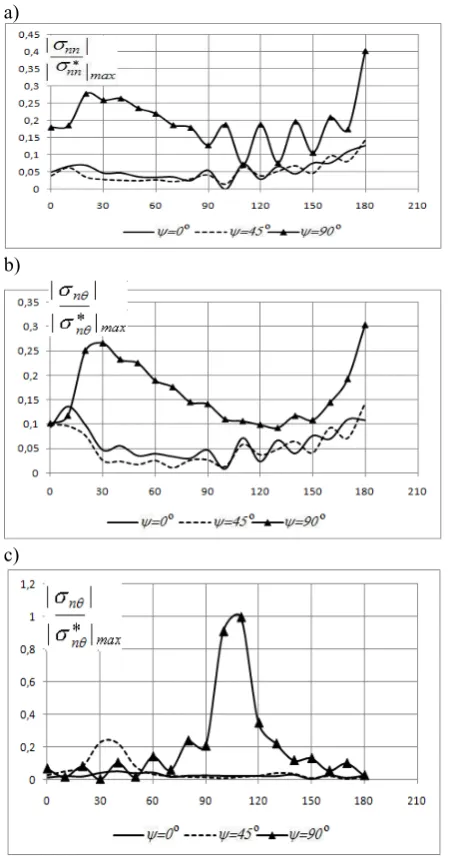
As can be seen from the figures, there is a tendency to increase the distribution of displacement and stresses with the increasing of angle deviation of the axis of the diagonal mine in relation to plane of isotropy. Nature of the changes in stresses and displacements has identical wave effects. It should also be noted that the unloaded diagonal mine has the geometrical symmetry and symmetry of elastic properties of the massif related to vertical and horizontal axes of its cross-sector plane. At the same time the symmetries of the stresses and strains are not observed in the common case. It takes place only under the influence of PP-wave propagation. By analysis the dependency of stress-strain state of diagonal mines in anisotropic rock massif from the angle of deviation of mine’s axis from plane of isotropy we can conclude that the stress concentration are increasing with the growing of the angle deviation especially at the case of PP-wave propagation. The most critical value is observed for crosscuts ( =90). Moreover the strong increase of stresses can be noted during the increasing of the angle of falling waves.
At the case of SV-waves propagation we can discover abrupt decreasing of distribution of stresses during the increasing the angle of falling waves and growing deviation angles of the mine’s axis from plane of isotropy. The critical values are noted for the crosscuts as in case of PP-waves diffraction.
At the case of displacements analysis we can remark the opposite picture. During the increasing of deviation angle of the mine’s axis from the plane of isotropy and with the growing of falling PP-waves angle values we can notice the fall of values in displacements distribution. The maximum values of displacements are observed at the case of drifts. For the propagation of SV-waves we distinguish the splash of displacement values when the angle of falling waves =
45 . For = 90 we discover the symmetry of displacements distribution in respect to vertical axis.
maximal values of stresses are observed at frequency in 15 Hz
a)
b)
c)
Figure 2 - Dependencies of contour stresses for circular diagonal mine with rigid lining from the values of mine’s axis
[image:3.595.55.285.74.505.2]deviation angle
in respect to plane of isotropy and different kinds of wavesFigure 3 – Diagrams of distribution of normal stresses on the contour of drift diagonal mine in depend on frequencies
of falling PP-waves
III. ANALYSIS OF STRESS-STRAIN STATE OF THE ROCK MASSIF WITH TWO DIAGONAL MINES
We can also demonstrate the dependences of displacements and stresses on the location of mines relative to the plane of isotropy. Thus, for the deep-located mines we can observe certain symmetry of values when the angle of the plane of isotropy coincides with the angle of wave incidence, and the mines’ location is co-directed with the front of the incident waves. This fact allows us to conclude that the concentration of shear stresses and longitudinal displacements is independent of the location of mines and the certain physical and mechanical medium parameters and the characteristics of incident waves, which is typical for deep founded mines, when the free massif surface has no effect on the stress-strain state of the underground structures.
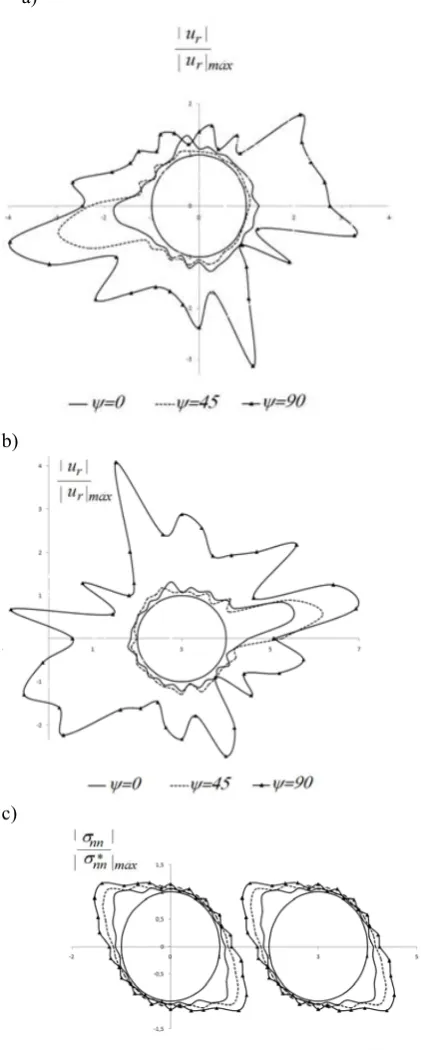
On the Figures 4 and 5 we show graphs and diagrams of the distribution of displacements and stresses on the free contours of mutual influenced diagonal mines in transtropic massif with vertical stratification, depending on the mine’s axis deviation angle from the plane of isotropy under the falling longitudinal waves (angle of incidence = 0), value of distance between the mines is 4R (R is a mine’s radius).
а)
b)
Figure 4 – Influence of mine’s axis deviation angle from the plane of isotropy to the distribution of contour displacements
of two circular mines
[image:3.595.312.537.338.661.2]distribution of contour stresses and displacements of the same mines under the angle of incident waves =45.
We can mention not only the influence of ways of mines location in the massif but their significant mutual influence to each other. For instance, the increase of mine’s axis deviation angle leads to growing concentration of contour displacements and stresses. Moreover, in the zone of falling waves and on the bridge between the mines we can observe the significant splashes of the displacement values.
a)
b)
[image:4.595.46.257.167.693.2]c)
Figure 5 – The mutual influence of two circular diagonal mines in the case of the changing of angle ). The angle of
incident waves =45; the massif stratification is vertical: a), b) – displacements on the left and right mine’s contours,
relatively, c) the stresses on both mine’s contours
IV. CONCLUSION
Mathematical foundations of the anisotropic model are particularly complicated in comparison with isotropic one, but this complexity is offset by the advantages of anisotropic model that makes it possible to consider new research issues of anisotropic mediums in the generalized cases of different problems.
Different effects provided by anisotropic medium in conjunction with the properties of the incident waves and the ways of mines location show a significant influence of these factors on the stress-strain state of the rock massif. They serve as evidence that the given problems require further study of the dynamic stability of underground structures, relying on mathematical models of anisotropic media.
Therefore, the problems of wave propagation in rock mass, weakened by mines and other underground facilities have many prospects for research.
During the last decades the projects related with topics above are carried out by the Kazakh-British Technical University and the Institute of Mechanics and Engineering Science named after U. A. Zholdasbekov, Republic of Kazakhstan.
REFERENCES
[1] Zh.S.Erzhanov, Sh.M.Aitaliyev, Zh.K.Masanov, “Seismically stressed state of underground constructions in anisotropic layered massif”, Alma-Ata, Publishing House “Nauka”, 1980, Russian
[2] L. Atymtayeva “Research of dynamics of anisotropic multiply massif under the impact of stationary diffraction of elastic waves at the case of solving the first fundamental problem” //Reports of Kazakhstan Republic National Academy of Science, No2, 2010. - pp.105-113, Russian
[3] L. Atymtayeva, Zh. Masanov, B. Yagaliyeva, G. Myrzakhmetova “Dynamics of transtropic elastic continuums with non-homogeneities” //Proceedings of World Congress on Engineering 2010, the 2010 International Conference of Mechanical Engineering, London, UK, 30 June-2 July, 2010. - P. 1024-1027.
[4] L. Atymtayeva, Zh. Masanov, B. Yagaliyeva, G. Myrzakhmetova “Stationary diffraction of elastic waves on the mine tunnels in the anisotropic layered massif” // Proceedings of the International conference “Modern problems of applied mathematics and mechanics: theory, experiment and practice”, Novosibirsk, Russia, May 30 – June 4 , 2011, http://conf.nsc.ru/niknik-90/reportview/36661
[5] L. B. Atymtayeva , Zh. K. Masanov, and .B. E. Yagaliyeva “Diffraction of Elastic PP-, SV-and SH-Waves on the Arbitrary Deep-founded
Cavities in the Anisotropic Rock Massif” //Proceedings of the World
Congress on Engineering 2012, Vol III , WCE 2012, July 4 - 6, 2012, London, U.K., pp.1907-1912
[6] S.G. Lechnitsky “Theory of elasticity for the anisotropic media”. Moscow, 1951 (in Russian)
[7] A.N.Guz, V.D.Kubenko, M.A.Cherevko, “Diffraction of elastic waves”, Kiev, Publishing House “Naukova dumka”, 1978, Russian G.I.
[8] A.S.Kosmodamianski, V.I.Storozhev, “Dynamical tasks of elasticity theory for anisotropic environments”, Kiev, Publishing House Naukova dumka”, 1985, Russian
[9] N.I. Muskhelishvili, “Some basic problems of the mathematical theory of elasticity”, Moscow, 1977, Russian
[10] Petrashen “Propagation of waves in anisotropic elastic mediums”, Leningrad, Nauka, 1980. - 280 p., Russian
[11] E. Delesan, D. Ruaie “Elastic waves in solids”, Moscow, Nauka, 1982. – 424 p., Russian
[12] Y.-H. Pao “Dynamical concentration of stresses in elastic plane, Applied mechanics” (Proceedings of American Society of Civil Engineers (ASCE)): collection of translations, 1962, No2, pp. 147-154, Russian.
[14] C.C. Chao “Diffraction of flexural wave by a cavity in a elastic plate“ AIAA, Journal , 1964, v. 2, p, 145-152.
[15] A.N.Guz, V.T.Golovchan, “Diffraction of elastic waves in multicoherent bodies”, Kiev, Publishing House “Naukova dumka”, 1972, Russian
[16] N.A.Shulga, V.I. Colodii. “Diffraction of SH-waves on noncircular cylindrical cavity”, Applied mechanics, 1984, Vol.17, No3, Russian [17] A.S.Kosmodamianski, V.I.Storozhev, “Dynamical tasks of elasticity
theory for anisotropic environments”, Kiev, Publishing House Naukova dumka”, 1985, Russian
[18] A.S.Kosmodamianski, L.B.Obodovski,V.I.Storozhev “Diffraction of elastic waves on anisotropic cylindrical inclusion inside the multicoherent areas”, Proceedings of Science Academy of USSR, Vol. A, 1980, No10, pp.38-41,Russian House “Gosstroiizdat”, 1959, Russian.
[19] Zh.S.Erzhanov, Sh.M.Aitaliyev, L.A.Alekseeva, “Dynamic of tunnels and underground pipelines”. – Alma-Ata, Publishing House “Nauka”, 1989, Russian
[20] Banaf, Goldsmith “Diffraction of stationary elastic waves on the obstacles of arbitrary forms” // Applied mechanics (Proceedings of American Society of Civil Engineers (ASCE)): collection of translations,. 1963. V.30. - No4. - PP.126-134, Russian
[21] Sh.G. Napetvaridze “Seismic stability of hydraulic facilities in seismic
conditions” ,Moscow,Gosstroiizdat, 1959, Russian
[22] N.N Fotiyeva “Calculation of the linings of underground structures in seismically active areas”, Moscow, 1980. – 222 p., Russian
[23] Xu Y., Han F. “Scattering of SH-waves by multiple semi-cylindrical canyons”. //Dizhen gongcheng yu gongcheng zhendong – 1992. – Vol.12. - №2, p.12-18.
[24] Lui D., Han F. “Application of the method of complex function to scattering of SH-wave in anisotropic media” //18-th International Congress Theoretical and Applied Mechanics, Haifa, Aug.22-28, 1992. – Haifa, 1992. – P.95.
[25] Guoqing Wang, Dianku Liu. “Scattering of SH-wave by multiple circular cavities in half space”. // Journal “Earthquake Engineering and Engineering Vibration”, Vol.1 No.1, June 2002, Article ID: 1671-3664(2002)01-0036-09, P. 36-44.
[26] Jianwen Liang, Hao Zhang and Vincent W Lee. “A series solution for surface motion amplification due to underground twin tunnels: incident SV waves” // Journal “Earthquake Engineering and Engineering Vibration”, Vol. 2, Nо 2, December 2003, DOI: 10.1007/s11803-003-0012-x. - Р.289-298.
[27] Jianwen Liang, Hao Zhang and Vincent W Lee. “A series solution for surface motion amplification due to underground group cavities: Incident P waves”. // Acta Seismologica Sinica, Vol. 17, Nо 3, DOI: 10.1007/s11589-004-0052-y. – Р.296-307.
[28] Gai Bing-zheng. “On the diffraction of elastic wave and dynamic stress concentration”. //CNKI:SUN:LXJZ.0.1987-04-001
[29] Liu Diankui Liu Hongwei. Scattering and dynamic stress concentration of SH-wave by interface circular hole // CNKI:ISSN:0459-1879.0.1998-05-009
[30] Xu Ping ,Xia Tang-dai , Han Tong-chun. Scattering of elastic wave by a cylindrical shell deeply embedded in saturated soils // Acta Seismologica Sinica. - Mar., 2006 Article ID: 1000-9116(2006)02-0191-08, Vol.19 No.2.- P.191-198
[31] D. S. Kim, and K. Konagai. Seismic isolation effect of a tunnel covered with coating material. //Aseismic design. Available online 11 April 2001.
[32] V. W. Lee, M. E. Manoogian and S. Chen. Antiplane SH-deformations near a surface rigid foundation above a subsurface rigid circular tunnel. // Earthquake Engineering and Engineering Vibration, Vol.1, No 1, P.27-35, DOI: 10.1007/s11803-002-0004-2.
![Table 1 – Elastic constants of some rocks samples [1]](https://thumb-us.123doks.com/thumbv2/123dok_us/473596.545611/2.595.57.276.192.724/table-elastic-constants-rocks-samples.webp)