Original Article
Impact of NFKB1 and NFKBIA gene polymorphism and
additional gene-gene interaction on liver
cancer risk in Chinese population
Xiaobin Wang1*, Xinjie Hao1*, He Wang1, Mingmin Wang1, Fengbo Sun2, Xiaoping Fan1, Tianli Fan1
1Department of Liver Diseases, Qingdao Sixth People’s Hospital, Qingdao, Shandong Province, China;
2Department of General Surgery, Qingdao Hiser Hospital, Qingdao, Shandong Province, China. *Co-first authors.
Received July 31, 2016; Accepted September 24, 2016; Epub December 1, 2016; Published December 15, 2016
Abstract: Aims: To investigate the role of genetic polymorphisms of NFKB1 and NFKBIA genes and additional gene-gene interactions on susceptibility of liver cancer. Methods: Logistic regression was performed to investigate asso-ciation between SNPs in NFKB1 and NFKBIA genes and liver cancer risk and generalized multifactor dimensionality
reduction (GMDR) was used to analyze the gene-gene interaction. Results: Liver cancer risk was significantly higher
in carriers of T allele in NFKBIA-rs696 than those with CC genotype (CT+TT versus CC), adjusted OR (95% CI)=1.49 (1.15-1.87), and was higher in carriers of del allele in NFKB1-rs28362491 than those with ins/ins genotype (del/ ins+del/del versus ins/ins), adjusted OR (95% CI)=1.62 (1.26-2.03), and higher in carriers of G allele in rs230496-NFKB1 than those with AA genotype (AG+GG versus AA), adjusted OR (95% CI)=1.61 (1.31-2.02). Liver cancer risks were the highest in participants with rs696-CT or TT and rs28362491-ins/del or del/del genotype, compared to subjects with rs696-CC of and rs28362491-ins/ins genotype, OR (95% CI)=4.62 (2.94-6.58). Haplotype containing the rs696-T and rs3138053-A alleles was associated with increased liver cancer risk, OR (95% CI)=1.56 (1.19-2.08), P=0.0015, and haplotype containing the rs28362491-del and rs230496-G alleles was also associated with increased liver cancer risk, OR (95% CI)=2.36 (1.65-3.85), P<0.001. Conclusions: rs696 and rs28362491 polymor-phism and their additional interaction were associated with increased liver cancer risk. Haplotype containing the rs696-T and rs3138053-A alleles, rs28362491-del and rs230496-G alleles were associated with increased liver cancer risk.
Keywords: NFKBIA, NFKB1, liver cancer, interaction, haplotype
Introduction
Liver cancer is the fifth most common cancer
and the third most common cause of cancer-related death worldwide. It threatens the health and safety of worldwide populations [1]. Acco- rding to World Health Organization report in 2012, annually more than 700000 patients died from liver cancer, and this number is rising year by year [2]. Incidences of liver cancer were different in different countries or populations, and the incidences of liver cancer were the
highest in circum-Pacific of Asia and South of
Sahara [3]. Several risk factors for liver cancer have been reported previously, including chron-ic infections of hepatitis B virus (HBV) and hep-atitis C virus (HCV), which were the most impor-tant risk factors for liver cancer [4, 5]. Although
the liver cancer is a rapidly fatal disease, early diagnosis is important for better prognosis, treatment and recovery [6].
Chronic inflammation, which plays an important
role in hepato-carcinogenesis, has been wildly accepted as a main risk factor. However, the molecular and cellular mechanisms linking
inflammation and liver cancer remain unclear.
Recent studies have suggested that nuclear
factor-κB (NF-κB) may play an important role in
bridging the actions of growth factors and
chronic inflammation to liver cancer [7, 8]. One
of these susceptibility loci [9, 10] is found on chromosome 4q24 and harbors, and was a
chain gene [11] specific to B cells [12]. NFKB1
is a major transcription regulator for the immune system, including differentiation, cell adhesion, proliferation and apoptosis [13], and
binds to REL, RELA or RELB to form the NF-κB complex. This complex could be inhibited by IκB
proteins (e.g. NFKBIA), which located on
chro-mosome 14q13, and could inactivate NF-κB by
cytoplasmic trapping. Previously, some genetic
variations of NF-κB have been reported to be
associated with several types of cancer risk, such as breast, prostate, stomach, mouth and so on. However, little is known about the asso-ciation between genetic polymorphisms of
NF-κB genes and susceptibility of liver cancer.
To our knowledge, till now, only one study focused on impact of NFKB1 and NFKBIA gene polymorphism on liver cancer in Chinese popu-lation was conducted previously. In addition, no study focused on the impact of interaction among several single nucleotide polymor-phisms (SNPs) of NFKB1 and NFKBIA gene on susceptibility of liver cancer were conducted. So the aim of this study was to investigate the role of genetic polymorphisms of NFKB1 and NFKBIA gene and additional gene-gene interac-tions on susceptibility of liver cancer based on Chinese Han population.
Materials and methods
Subjects
This was a case-control study. Participants were consecutively recruited between January 2011 and September 2014 from Qingdao No. 6 People’s Hospital. A total of 826 subjects (356 males, 470 females), including 286 liver cancer patients and 540 control subjects were select-ed, the mean age for all participants was 70.6±15.4 years. Liver cancer cases were diag-nosed by combination of pathological examina-tion, ultrasound and clinical manifestations.
Identification of the stage of tumor is based on International Classification of Disease, Ninth
Revision (ICD-9), codes of 155.0 (primary mali- gnant neoplasms), 155.1 (malignant neopla- sms of the intrahepatic bile ducts) or 155.2
(unspecified malignant neoplasms of the liver).
Controls were matched by sex, age and ethnic background. Normal controls with family histo-ry of liver cancer were excluded. All controls were free of any cancer at the time of cancer diagnosis for the corresponding case. Informed consent was obtained from all participants.
Body measurements
Data on demographic information, lifestyle risk factors and family history of all kinds of cancer for all participants were obtained using a stan-dard questionnaire administered by trained staffs. Cigarette smokers were those who self-reported smoking cigarettes at least once a day for 1 year or more. Alcohol consumption was expressed as the sum of milliliters of alcohol per week from wine, beer, and spirits. Body weight, height and waist circumference (WC) were measured. BMI (body mass index) was calculated as weight in kilograms divided by the square of the height in meters. WC was mea-sured two times at 1 cm above the umbilicus at minimal respiration by trained observers; the mean of the two WC measurements was uti-lized in the analysis. Blood samples were col-lected in the morning after at least 8 hours of fasting. All plasma and serum samples were frozen at -80°C until laboratory testing. All anal-ysis was performed by the same lab.
Genomic DNA extraction and genotyping
We selected SNPs according to the following criterions: 1) within the NFKBIA and NFKB1 gene, which have been reported previously; 2) and minor allele frequency (MAF) greater than 2%. Three SNPs of NFKBIA gene and three SNPs of NFKB1 gene were selected for geno-typing in the study: rs696, rs3138053, rs227- 3650, rs28362491, rs230530 and rs230496. ABI Prism7000 software and allelic discrimina-tion procedure was used for genotyping of fore-mentioned six SNPs. Genomic DNA from par-ticipants was extracted from EDTA-treated whole blood, using the DNA Blood Mini Kit (Qiagen, Hilden, Germany) according to the
manufacturer’s instructions. A 25 μl reaction
mixture including 1.25 ul SNP Genotyping
Assays (20×), 12.5 μl Genotyping Master Mix
(2×), 20 ng DNA, and the conditions were as fol-lows: initial denaturation for 10 min and 95°C, denaturation for 15 s and 92°C, annealing and extension for 90 s and 60°C, 50 cycles. All
SNPs were detected by Taqman fluorescence
probe. Probe sequences of all SNPs were shown in Table 1.
Quality control
the assays of genomic DNA extracting and genotyping (SNPs), including: 1) questionnaire investigation were administered by staffs, who were trained for more than 6 times; 2) before the formal investigation, we conducted a pre-survey for 100 participants; 3) data input was administered by person and double-equipment, to decrease mistake by
consisten-cy check; 4) when we finished genotyping for all
SNP and participants, we extracted about 1/10 of the subjects for consistency check, and the consistency rate was 100%.
Statistical analysis
The mean and standard deviation (SD) were calculated for normally distributed continuous variables, and percentages were calculated for categorical variables. The categorical data
were compared using χ2 test. Further,
continu-ous variables were compared using Student’s t test. Hardy-Weinberg equilibrium (HWE) and
Results
A total of 826 subjects (356 males, 470 fe- males), including 286 liver cancer patients and 540 normal subjects were selected. The mean age of all participants was 70.6±15.4 years.
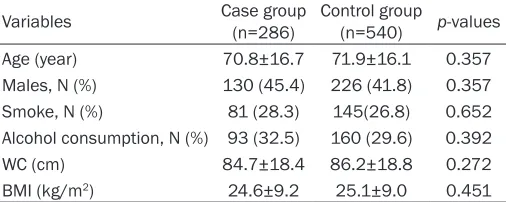
Participants characteristics stratified by cases
and controls are shown in Table 2. The distribu-tions of gender, smoking and drinking were not
significantly different between cases and con -trols. The means of age, WC and BMI were also
not significantly different between cases and
controls.
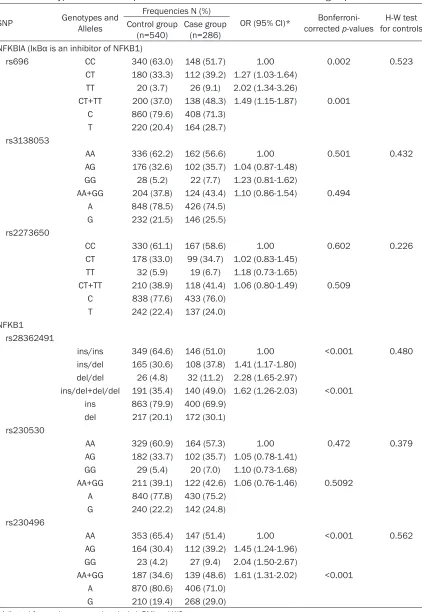
All genotypes were distributed according to Hardy-Weinberg equilibrium in controls (all p values were more than 0.05). The frequency of
rs696-T allele in NFKBIA gene was significantly
higher in liver cancer cases than that in con-trols (28.7% vs 20.4%), and the frequencies of rs28362491-del allele and rs230496-G allele
[image:3.612.91.525.84.270.2]of NFKB1 gene were also significantly higher in
Table 1. Description and Probe sequence for 6 SNPs used for Taqman fluorescence probe analysis
SNP ID Chromosome Functional Consequence substitution Probe sequenceNucleotide
NFKBIA (IκBα is an inhibitor of NFKB1)
rs696 2758 G.>A 14:35401887 Utr variant 3 prime C>T 5’-CCTACCACAATAAGACGTTTTGGGC [C/T] AGGCAGTGTGCAGTGTGGATATAAG-3’ rs3138053 14:35405648 Upstream variant 2 KB A>G 5’-ACGATCCTTTTTCTGCGGGAGCACA [A/G]
TGTAGGTCAGATAGCATAAACGAAT-3’ rs2273650 14:35401592 Utr variant 3 prime C>T 5’-AACAATACATTATGTACACCATTTA [C/T]
AGGAGGGTAACACAAACCTTGACAG-3’ NFKB1
rs28362491 294 ins/del 4:102500998 Intron variant, upstream variant 2 KB - 5’-CTCCGTGCTGCCTGCGTTCCCCGACC [-/ATTG] ATTGGGCCCGGCAGGCGCTTCCTGG-3’ rs230530 4:102532823 Intron variant A>G 5’-TTTTTAGCACCAAACATCTTAATTT [A/G]
CATTCAAATAAATGAGAACCACCAT-3’ rs230496 4:102567334 Intron variant A>G 5’-TGTCTGGATTTGCTTGAGACAGCCC [A/G]
GTTTGCCCCTGACCTAATTGTTTAT-3’
Table 2. General characteristics of 826 study participants in case and control group
Variables Case group (n=286) Control group (n=540) p-values Age (year) 70.8±16.7 71.9±16.1 0.357 Males, N (%) 130 (45.4) 226 (41.8) 0.357 Smoke, N (%) 81 (28.3) 145(26.8) 0.652 Alcohol consumption, N (%) 93 (32.5) 160 (29.6) 0.392 WC (cm) 84.7±18.4 86.2±18.8 0.272 BMI (kg/m2) 24.6±9.2 25.1±9.0 0.451
Note: Means ± standard deviation for age; WC, waist circumference; BMI, body mass index.
[image:3.612.92.345.317.418.2]Table 3. Genotype and allele frequencies of 6 SNPs between case and control group
SNP Genotypes and Alleles
Frequencies N (%)
OR (95% CI)* corrected Bonferroni- p-values for controlsH-W test Control group
(n=540) Case group (n=286)
NFKBIA (IκBα is an inhibitor of NFKB1)
rs696 CC 340 (63.0) 148 (51.7) 1.00 0.002 0.523 CT 180 (33.3) 112 (39.2) 1.27 (1.03-1.64)
TT 20 (3.7) 26 (9.1) 2.02 (1.34-3.26)
CT+TT 200 (37.0) 138 (48.3) 1.49 (1.15-1.87) 0.001 C 860 (79.6) 408 (71.3)
T 220 (20.4) 164 (28.7) rs3138053
AA 336 (62.2) 162 (56.6) 1.00 0.501 0.432 AG 176 (32.6) 102 (35.7) 1.04 (0.87-1.48)
GG 28 (5.2) 22 (7.7) 1.23 (0.81-1.62)
AA+GG 204 (37.8) 124 (43.4) 1.10 (0.86-1.54) 0.494 A 848 (78.5) 426 (74.5)
G 232 (21.5) 146 (25.5) rs2273650
CC 330 (61.1) 167 (58.6) 1.00 0.602 0.226 CT 178 (33.0) 99 (34.7) 1.02 (0.83-1.45)
TT 32 (5.9) 19 (6.7) 1.18 (0.73-1.65)
CT+TT 210 (38.9) 118 (41.4) 1.06 (0.80-1.49) 0.509 C 838 (77.6) 433 (76.0)
T 242 (22.4) 137 (24.0) NFKB1
rs28362491
ins/ins 349 (64.6) 146 (51.0) 1.00 <0.001 0.480 ins/del 165 (30.6) 108 (37.8) 1.41 (1.17-1.80)
del/del 26 (4.8) 32 (11.2) 2.28 (1.65-2.97)
ins/del+del/del 191 (35.4) 140 (49.0) 1.62 (1.26-2.03) <0.001 ins 863 (79.9) 400 (69.9)
del 217 (20.1) 172 (30.1) rs230530
AA 329 (60.9) 164 (57.3) 1.00 0.472 0.379 AG 182 (33.7) 102 (35.7) 1.05 (0.78-1.41)
GG 29 (5.4) 20 (7.0) 1.10 (0.73-1.68)
AA+GG 211 (39.1) 122 (42.6) 1.06 (0.76-1.46) 0.5092 A 840 (77.8) 430 (75.2)
G 240 (22.2) 142 (24.8) rs230496
AA 353 (65.4) 147 (51.4) 1.00 <0.001 0.562 AG 164 (30.4) 112 (39.2) 1.45 (1.24-1.96)
GG 23 (4.2) 27 (9.4) 2.04 (1.50-2.67)
AA+GG 187 (34.6) 139 (48.6) 1.61 (1.31-2.02) <0.001 A 870 (80.6) 406 (71.0)
G 210 (19.4) 268 (29.0)
liver cancer cases than that in controls (30.1% vs 20.1%, 29.0% vs 19.4%). Logistic regression analysis showed that liver cancer risk was
significantly higher in carriers of T allele of
NFKBIA-rs696 than those with CC genotype (CT+TT versus CC), adjusted OR (95% CI)=1.49 (1.15-1.87), Bonferroni-corrected p-value was 0.001. In addition, we also found liver cancer
risk was also significantly higher in carriers of
del allele of rs28362491-NFKB1 than those with ins/ins genotype (del/ins+del/del versus ins/ins), adjusted OR (95% CI)=1.62 (1.26-2.03) (Bonferroni-corrected p-value less than 0.001), was also higher in carriers of G allele of the rs230496-NFKB1 than those with AA genotype (GA+GG versus AA), adjusted OR (95% CI)=1.61 (1.31-2.02), Bonferroni-corre- cted p-value less than 0.001. However, we did
not find any significant association between the
others SNP and liver cancer after covariates adjustment (Table 3).
We employed the GMDR model to investigate the impact of the interaction among 6 SNPs on liver cancer risk after adjustment for covari-ates. Table 4 summarizes the results obtained from GMDR analysis for gene-gene interaction,
we found that there was a significant two-locus
model (P=0.0100) involving rs696 and rs283- 62491, indicating a potential gene-gene inter-action between rs696 and rs28362491. Over- all, the two-locus models had a cross-validation consistency of 10 of 10, and had the testing
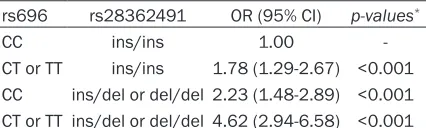
accuracy of 62.17%. Table 5 summarizes the results obtained from interaction analysis between two SNP by using logistic regression. We found that subjects with CT or TT of rs696 and ins/del or del/del of rs28362491 genotype have the highest liver cancer risk, compared to subjects with CC of rs696 and ins/ins of rs28362491 genotype, OR (95% CI)=4.62 (2.94-6.58), after covariates adjustment. Pairwise LD analysis between SNPs was mea-sured, and D’ value between rs696 and rs31- 38053 was 0.514, D’ value between rs283- 62491 and rs230496 was 0.626. The most common haplotype in NFKBIA was rs696-C and rs3138053-A haplotype, the haplotype fre-quencies were 0.5696 and 0.4502 in case group and control group, and the most common haplotype in NFKB1 was rs28362491-ins and rs230496-A haplotype, the haplotype frequen-cies were 0.5105 and 0.4428 in case group and control group. Haplotype containing the rs696-T and rs3138053-A alleles was associ-ated with increased liver cancer risk, OR (95% CI)=1.56 (1.19-2.08), P=0.0015, and haplo-type containing the rs28362491-del and rs230496-G alleles was also associated with increased liver cancer risk, OR (95% CI)=2.36 (1.65-3.85), P<0.001, after adjustment for gender, age, smoke, alcohol, BMI and WC (Tables 6 and 7).
Discussion
In the current study, we investigated the impact of NFKBIA and NFKB1 gene polymorphism on liver cancer risk. We found that NFKBIA and NFKB1 gene polymorphisms were associated with increased liver risk. Liver cancer risks were
significantly higher in carriers of T allele of
NFKBIA-rs696 than those with CC genotype,
and also significantly higher in carriers of del
[image:5.612.92.526.85.173.2]allele of the rs28362491-NFKB1 than those
Table 4. Best gene-gene interaction models, as identified by GMDR Locus
no. Best combination Cross-validation consistency accuracyTesting p-values*
2 rs696, rs28362491 10/10 0.6217 0.0100
3 rs696, rs28362491, rs230496 9/10 0.5399 0.0547
4 rs696, rs28362491, rs230496, rs230530 8/10 0.5399 0.1719 5 rs696, rs28362491, rs230496, rs230530, rs3138053 9/10 0.5590 0.0547 6 rs696, rs28362491, rs230496, rs230530, rs3138053, rs2273650 8/10 0.4958 0.3770
*Adjusted for gender, age, smoke, alcohol, BMI and WC.
Table 5. Interaction analysis for rs696 and rs28362491 by using logistic regression
rs696 rs28362491 OR (95% CI) p-values*
CC ins/ins 1.00 -CT or TT ins/ins 1.78 (1.29-2.67) <0.001 CC ins/del or del/del 2.23 (1.48-2.89) <0.001 CT or TT ins/del or del/del 4.62 (2.94-6.58) <0.001
[image:5.612.91.304.228.292.2]with ins/ins genotype and higher in carriers of G allele of the rs230496-NFKB1 than those
with AA genotype. However, we did not find any significant association between the others SNP
and liver risk before and after covariates adj- ustment. NFKB1 gene, which located at chro-mosome 4q23-q24 and composed of 24 exons [14], is a non-DNA binding protein. Several genetic polymorphisms in NFKB1 have been reported, and in these polymorphisms, rs283- 62491 was the mostly studied SNP, several associations were reported between rs2836- 2491 and many types of cancer, including breast, prostate, stomach, mouth and so on [15-17]. But little is known about the relation-ship between NFKB1 and NFKBIA gene and liver cancer. To our knowledge, the current study was the second study focused on the association between NFKB1, NFKBIA gene and liver cancer risk in Chinese population. Previously, just one study conducted by Gao et al [18] involved in this association, they indi-cated that rs28362491 del and rs230496-G were associated with higher risk of liver cancer, liver cancer risk was higher in carriers of the NFKB1 GA and AA (rs230525-rs230530) hap-lotypes, but they did not found any association between NFKBIA variants and risk of live can-cer. Cheng et al [19] indicated that the NFKB1
tive regulation of NF-κB expression. In a study
on HBV-induced hepatocarcinogenesis, the prevalence of NFKB1-rs28362491 polymor-phism was higher in HCC patients than that in healthy controls [22]. The results of the current study was consistent with the results of the study by Gao et al [18], which was also conduct-ed in Chinese Han population, however, they
did not find any SNP of NFKBIA gene associated
with liver cancer. In the current study, we found that NFKBIA gene polymorphism was
associat-ed with increasassociat-ed liver risk, which was signifi -cantly higher in carriers of T allele of NFKBIA-rs696 than those with CC genotype.
Liver cancer was influenced by many genetic
factors and both NFKBIA and NFKB1 genes were associated with increased liver cancer risk, so it was necessary to investigate the impact of gene-gene interaction among several SNPs of NFKBIA and NFKB1 gene on liver can-cer risk. We employed the GMDR analysis to investigate the impact of the interaction among 6 SNPs on liver cancer risk, and we found that
there was a significant gene-gene interaction
[image:6.612.90.399.96.189.2]between rs696 and rs28362491, subjects with CT or TT of rs696 and ins/del or del/del of rs28362491 genotype have the highest liver cancer risk, compared to subjects with CC of
Table 6. Haplotype analysis on association between NFKBIA and liver cancer
Haplotypes rs696 rs3138053
Frequencies
OR (95% CI) p-values*
Control group group Case
H1 C A 0.5696 0.4502 1.00 --H2 T A 0.2219 0.3017 1.56 (1.19-2.08) 0.0015 H3 C G 0.1782 0.1913 1.32 (0.95-1.78) 0.080 H4 T G 0.0303 0.0567 1.49 (0.93-1.42) 0.105
*Adjusted for gender, age, smoke, alcohol, BMI and WC.
Table 7. Haplotype analysis on association between NFKB1 and liver cancer
Haplotypes rs28362491 rs230496
Frequencies
OR (95% CI) values*p- Control
group group Case
H1 ins A 0.5105 0.4428 1.00 --H2 del A 0.2688 0.2809 1.28 (0.95-1.77) 0.286 H3 ins G 0.1858 0.2095 1.39 (0.79-1.86) 0.528 H4 del G 0.0349 0.0669 2.36 (1.65-3.85) <0.001
*Adjusted for gender, age, smoke, alcohol, BMI and WC.
rs28362491 polymorp- hism was associated with increased hepato-cellular carcinoma (HCC) risk. Marcos et al [20] suggested that the de- letion allele of the rs28- 362491 polymorphism was associated with higher risk of developing alcoholic liver cirrhosis (ALC) through an incre-
ase in inflammation.
[image:6.612.91.400.247.337.2]posi-rs696 and ins/ins of rs28362491 genotype. To
our knowledge, this is the first study on the
impact of gene-gene interaction between NFKBIA and NFKB1 gene on liver cancer sus-ceptibility. Loci that are located nearby on the same chromosome may be in linkage disequi-librium (LD). This means that alleles at these loci are not inherited in an independent manner but certain allele combinations occur more often than expected by random segregation. The implication of LD in association studies is that knowledge of variation at a certain posi-tion also gives knowledge of variaposi-tion at linked loci. The haplotype analysis represents a much more powerful approach than analysis for SNP and provides important information on recom-bination (physical exchange of DNA during mei-osis), vital for locating disease-causing muta-tions by linkage. Because the single SNP regression demonstrated that NFKBIA and
NFKB1 gene significantly affect the develop -ment of liver cancer risk, haplotypes were inferred to capture possible allelic associa-tions. In current study, we found that the most common haplotype in NFKBIA was rs696-C and rs3138053-A haplotype, and the most com-mon haplotype in NFKB1 was rs28362491-ins and rs230496-A haplotype, haplotype contain-ing the rs696-T and rs3138053-A alleles, and haplotype containing the rs28362491-del and rs230496-G alleles were statistically
associat-ed with increasassociat-ed liver cancer risk. IκBα was
the inhibitor of NFKB1, and could be encoded by NFKBIA gene [23]. The dysfunction or down
regulation of IκBα will lead to over activation of NF-κB. Till now, epidemiological studies on
NFKBIA were relatively rare. A 2758G/A poly-morphism (rs696) in 30-untranslated region
might regulate the expression of IκBα and thus affect the activation of NF-κB. Sun and col -leagues [24] suggested that higher frequency of AG genotype was associated with colorectal cancer in Chinese old patients.
Several limitations of this study should be con-sidered. Firstly, limited number of SNP in NFKBIA and NFKB1 gene was chosen in this study. More SNPs should be included in the fur-ther studies. Secondly, environmental factors should be included in the gene-environment analysis, including lifestyle, diet and activity factors. Thirdly, the etiology of liver cancer might be different for men and women, so the gender difference on the association of genetic
polymorphisms with liver cancer should be investigated in the future studies.
In conclusion, the results of current study indi-cated that rs696 in NFKBIA and rs28362491 and rs230496 in NFKB1 gene polymorphism were associated with increased liver risk. There
was a significant gene-gene interaction
bet-ween rs696 and rs28362491, subjects with CT or TT of rs696 and ins/del or del/del of rs28362491 genotype have the highest liver cancer risk, compared to subjects with CC of rs696 and ins/ins of rs28362491 genotype. Haplotype containing the rs696-T and rs313- 8053-A alleles, and haplotype containing the rs28362491-del and rs230496-G alleles were associated with increased liver cancer risk.
Acknowledgements
The writing of this paper was supported by Qingdao No. 6 People’s Hospital. We thank all the partners and staffs who help us in the pro-cess of this study.
Disclosure of conflict of interest
None.
Address correspondence to: Xiaoping Fan and Tianli Fan, Department of Liver Diseases, Qingdao Sixth People’s Hospital, 9 Fushun Road, Shibei Dis-trict, Qingdao 266033, Shandong Province, China. Tel: +86-532-85623921; E-mail: fanxpxp123@163. com (XPF); [email protected] (TLF)
References
[1] Schutte K, Bornschein J, Malfertheiner P. Hepatocellular carcinoma-epidemiological tr- ends and risk factors. Dig Dis 2009; 27: 80-92.
[2] Ferlay J, Soerjomataram I, Dikshit R, Eser S, Mathers C, Rebelo M, Parkin DM, Forman D, Bray F. Cancer incidence and mortality world-wide: sources, methods and major patterns in GLOBOCAN 2012. Int J Cancer 2015; 136: E359-86.
[3] Feo F, Frau M, Tomasi ML, Brozzetti S, Pascale RM. Genetic and epigenetic control of molecu-lar alterations in hepatocellumolecu-lar carcinoma. Exp Biol Med (Maywood) 2009; 234: 726-36. [4] Gao J, Xie L, Yang WS, Zhang W, Gao S, Wang
[5] Boyle P, Levin B. World cancer report 2008. Lyon: International Agency for Research on Cancer; 2008.
[6] Yuen MF, Hou JL, Chutaputti A. On behalf of the
Asia Pacific Working Party on Prevention
of Hepatocellular Carcinoma. Hepatocellular
carcinoma in the Asia pacific region. J
Gastroenterol Hepatol 2009; 24: 346-353. [7] He G, Karin M. NF-kappaB and STAT3-key
players in liver inflammation and cancer. Cell
Res 2011; 21: 159-68.
[8] Berasain C, Castillo J, Perugorria MJ, Latasa
MU, Prieto J, Avila MA. Inflammation and liver
cancer: new molecular links. Ann N Y Acad Sci 2009; 1155: 206-21.
[9] Hampe J, Schreiber S, Shaw SH, Lau KF, Bridger S, Macpherson AJ, Cardon LR, Sakul H, Harris TJ, Buckler A, Hall J, Stokkers P, van Deventer SJ, Nürnberg P, Mirza MM, Lee JC, Lennard-Jones JE, Mathew CG, Curran ME. A genomewide analysis provides evidence for
novel linkages in inflammatory bowel disease
in a large European cohort. Am J Hum Genet 1999; 64: 808-816.
[10] Vermeire S, Rutgeerts P, Van Steen K, Joossens S, Claessens G, Pierik M, Peeters M, Vlietinck
R. Genome wide scan in a Flemish inflamma -tory bowel disease population: support for the IBD4 locus, population heterogeneity, and epistasis. Gut 2004; 53: 980-986.
[11] Sen R, Baltimore D. Multiple nuclear factors interact with the immunoglobulin enhancer se-quences. Cell 1986; 46: 705-16.
[12] Barnes PJ, Karin M. Nuclear factor-kappaB: a
pivotal transcription factor in chronic inflam -matory diseases. N Engl J Med 1997; 336: 1066-71.
[13] Baldwin AJ. Series introduction: the transcrip-tion factor NF-kappaB and human disease. J Clin Invest 2001; 107: 3-6.
[14] Mathew S, Murty VV, Dalla-Favera R, Chaganti RS. Chromosomal localization of genes encod-ing the transcription factors, c-rel, NF-kappaB
p50, NF-kappaB p65, and lyt-10 by fluores -cence in situ hybridization. Oncogene 1993; 8: 191-3.
[15] Curran JE, Weinstein SR, Griffiths LR.
Poly-morphic variants of NFKB1 and its inhibitory protein NFKBIA, and their involvement in spo-radic breast cancer. Cancer Lett 2002; 188: 103-7.
[16] Yu Y, Liu H, Jin M, Zhang M, Pan Y, Zhang S, Li Q, Chen K. The joint association of REST and NFKB1 polymorphisms on the risk of colorec-tal cancer. Ann Hum Genet 2012; 76: 269-76.
[17] Lin CW, Hsieh YS, Hsin CH, Su CW, Lin CH, Wei LH, Yang SF, Chien MH. Effects of NFKB1 and NFKBIA Gene Polymorphisms on Sus- ceptibility to Environmental Factors and the Clinicopathologic Development of Oral Cancer. PLoS One 2012; 7: e35078.
[18] Gao J, Xu HL, Gao S, Zhang W, Tan YT, Rothman N, Purdue M, Gao YT, Zheng W, Shu XO, Xiang YB. Genetic polymorphism of NFKB1 and NFKBIA genes and liver cancer risk: a nested case-control study in Shanghai, China. BMJ Open 2014; 4: e004427.
[19] Cheng CW, Su JL, Lin CW, Su CW, Shih CH, Yang SF, Chien MH. Effects of NFKB1 and NFKBIA Gene Polymorphisms on Hepatoce- llular Carcinoma Susceptibility and Clinic opathological Features. PLoS One 2013; 8: e56130.
[20] Marcos M, Pastor I, González-Sarmiento R, Laso FJ. A Functional Polymorphism of the NFKB1 Gene Increases the Risk for Alcoholic Liver Cirrhosis in Patients With Alcohol Dependence. Alcohol Clin Exp Res 2009; 33: 1857-62.
[21] Zou YF, Yuan FL, Feng XL, Tao JH, Ding N, Pan FM, Wang F. Association between NFKB1-94ins/delATTG promoter polymorphism and cancer risk: a meta-analysis. Cancer Invest 2011; 29: 78-85.
[22] He Y, Zhang H, Yin J, Xie J, Tan X, Liu S, Zhang Q, Li C, Zhao J, Wang H, Cao G. IkappaBalpha gene promoter polymorphisms are associa- ted with hepatocarcinogenesis in patients in-fected with hepatitis B virus genotype C. Carcinogenesis 2009; 30: 1916-1922.
[23] Le Beau MM, Ito C, Cogswell P, Espinosa R 3rd, Fernald AA, Baldwin AS Jr. Chromosomal local-ization of the genes encoding the p50/p105 subunits of NF-kappaB (NFKB2) and the I kap-pa B/MAD-3 (NFKBI) inhibitor of NF-kapkap-paB to 4q24 and 14q13, respectively. Genomics 1992; 14: 529-31.