A Framework for the Evaluation of Adaptive IR
Systems through Implicit Recommendation
Catherine Mulwa1, Seamus Lawless1, M. Rami Ghorab1, Eileen O’Donnell1, Mary Sharp1 and Vincent Wade1
1Knowledge and Data Engineering Research Group, School of Statistics and Computer Science,
Trinity College Dublin,
{mulwac, ghorabm, odonnee, seamus.lawless, mary.sharp, vincent.wade}@scss.tcd.ie
Abstract. Personalised Information Retrieval (PIR) has gained considerable attention
in recent literature. In PIR different stages of the retrieval process are adapted to the user, such as adapting the user’s query or the results. Personalised recommender frameworks are endowed with intelligent mechanisms to search for products, goods and services that users are interested in. The objective of such tools is to evaluate and filter the huge amount of information available within a specific scope to assist users in their information access processes. This paper presents a web-based adaptive framework for evaluating personalised information retrieval systems. The framework uses implicit recommendation to guide users in deciding which evaluation techniques, metrics and criteria to use. A task-based experiment was conducted to test the functionality and performance of the framework. A Review of evaluation techniques for personalised IR systems was conducted and the results of the analysed survey are presented.
Keywords: Personalisation, Personalised Information Retrieval Systems, Implicit Recommendations, User-based Evaluation, Task-based Evaluation
1 Introduction
personalisation in IR is aimed at improving the user’s experience by incorporating user subjectivity in the retrieval process.
The rest of this paper is structured as follows: Section 2 presents a summary of a comparison of personalisation approaches and evaluation techniques in PIR systems. Section 3 introduces the proposed framework to evaluate AIRS systems. Also the methodology, architecture design, functionality and evaluation of the framework are also introduced. Finally section 4 concludes the paper and proposes future work.
2. A Review of Personalisation Approaches and Evaluation
Techniques for AIRS
Personalised Information Retrieval (PIR) is a research area which has gained attention in recent literature and is motivated by the success of both areas, IR and AH (Gauch et al., 2007, Micarelli et al., 2007). IR systems have the advantage of scalability when dealing with large document collections and performing a vast amount of information processing. AH systems have the advantage of including the user in the process and thus the ability to satisfy individual user needs by modeling different aspects of the user. In PIR, different stages of the retrieval process are adapted to the user such as adapting the user’s query and/or the results. This review focuses on personalisation approaches and existing evaluation techniques for PIR systems.
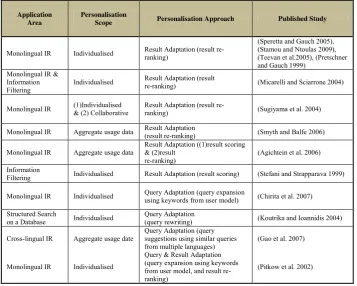
2.1 Overview of Personalisation Approaches
Table 1: Comparison of Personalisation Approaches
Application Area
Personalisation
Scope Personalisation Approach Published Study
Monolingual IR Individualised Result Adaptation (result re-ranking)
(Speretta and Gauch 2005), (Stamou and Ntoulas 2009), (Teevan et al.2005), (Pretschner and Gauch 1999)
Monolingual IR & Information
Filtering Individualised
Result Adaptation (result
re-ranking) (Micarelli and Sciarrone 2004)
Monolingual IR (1)Individualised& (2) Collaborative Result Adaptation (result re-ranking) (Sugiyama et al. 2004)
Monolingual IR Aggregate usage data Result Adaptation (result re-ranking) (Smyth and Balfe 2006)
Monolingual IR Aggregate usage data Result Adaptation ((1)result scoring & (2)result
re-ranking) (Agichtein et al. 2006)
Information
Filtering Individualised Result Adaptation (result scoring) (Stefani and Strapparava 1999)
Monolingual IR Individualised Query Adaptation (query expansion using keywords from user model) (Chirita et al. 2007)
Structured Search
on a Database Individualised Query Adaptation (query rewriting) (Koutrika and Ioannidis 2004)
Cross-lingual IR Aggregate usage date Query Adaptation (query suggestions using similar queries
from multiple languages) (Gao et al. 2007)
Monolingual IR Individualised
Query & Result Adaptation (query expansion using keywords from user model, and result re-ranking)
(Pitkow et al. 2002)
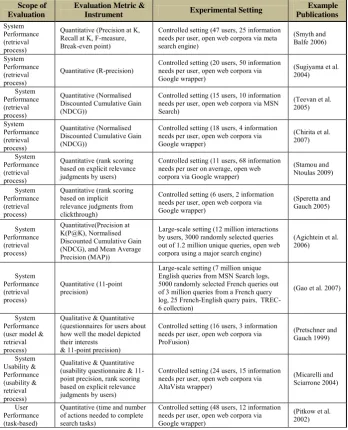
2.2 Evaluation Approaches for PIR Systems
Table 1: Comparison of Evaluation Techniques
Scope of Evaluation
Evaluation Metric &
Instrument Experimental Setting
Example Publications System Performance (retrieval process)
Quantitative (Precision at K, Recall at K, F-measure, Break-even point)
Controlled setting (47 users, 25 information needs per user, open web corpora via meta search engine) (Smyth and Balfe 2006) System Performance (retrieval process)
Quantitative (R-precision) Controlled setting (20 users, 50 information needs per user, open web corpora via Google wrapper)
(Sugiyama et al. 2004) System Performance (retrieval process) Quantitative (Normalised Discounted Cumulative Gain (NDCG))
Controlled setting (15 users, 10 information needs per user, open web corpora via MSN Search)
(Teevan et al. 2005) System Performance (retrieval process) Quantitative (Normalised Discounted Cumulative Gain (NDCG))
Controlled setting (18 users, 4 information needs per user, open web corpora via Google wrapper)
(Chirita et al. 2007)
System Performance (retrieval process)
Quantitative (rank scoring based on explicit relevance judgments by users)
Controlled setting (11 users, 68 information needs per user on average, open web corpora via Google wrapper)
(Stamou and Ntoulas 2009) System Performance (retrieval process)
Quantitative (rank scoring based on implicit relevance judgments from clickthrough)
Controlled setting (6 users, 2 information needs per user, open web corpora via Google wrapper) (Speretta and Gauch 2005) System Performance (retrieval process) Quantitative(Precision at K(P@K), Normalised Discounted Cumulative Gain (NDCG), and Mean Average Precision (MAP))
Large-scale setting (12 million interactions by users, 3000 randomly selected queries out of 1.2 million unique queries, open web corpora using a major search engine)
(Agichtein et al. 2006) System Performance (retrieval process) Quantitative (11-point precision)
Large-scale setting (7 million unique English queries from MSN Search logs, 5000 randomly selected French queries out of 3 million queries from a French query log, 25 French-English query pairs, TREC-6 collection)
(Gao et al. 2007)
System Performance (user model & retrieval process)
Qualitative & Quantitative (questionnaires for users about how well the model depicted their interests
& 11-point precision)
Controlled setting (16 users, 3 information needs per user, open web corpora via ProFusion) (Pretschner and Gauch 1999) System Usability & Performance (usability & retrieval process)
Qualitative & Quantitative (usability questionnaire & 11-point precision, rank scoring based on explicit relevance judgments by users)
Controlled setting (24 users, 15 information needs per user, open web corpora via AltaVista wrapper) (Micarelli and Sciarrone 2004) User Performance (task-based)
Quantitative (time and number of actions needed to complete search tasks)
Controlled setting (48 users, 12 information needs per user, open web corpora via Google wrapper)
(Pitkow et al. 2002)
3 The Proposed Personalised Framework
3.1 Methodology and Architectural Approach
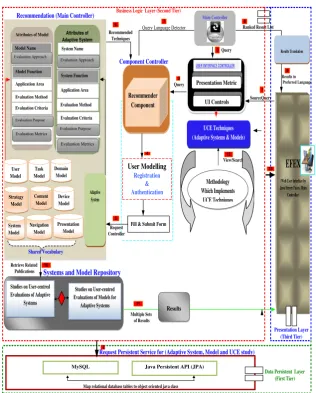
significant with respect to: i) conducting iterative development, ii) requirements management, iii) designing a component-based architecture iv) visual modeling of the system, v) quality management and vi) change control management. The user-centred evaluation approach is used in order to verify the quality of an AIRS, detecting problems in the system functionality or interface, and supporting adaptivity decisions. The framework is designed as a web-based 3-tier architecture, as can be seen in Figure 1, which consists of: i) the presentation layer, ii) The business logic layer
which is pulled out from the presentation tier, it controls the frameworks functionality by performing detailed processing and iii) the data persistence layer which keeps data neutral and independent from application servers or business logic. The framework is divided into 4 major sections (i.e. the recommender, repository for current studies and search interface, and a user-centred evaluation methodology).
USER INTERFACE
UI Controls Presentation Metric User Modelling Registration & Authentication Presentation Layer (Third Tier)
MySQL Java Persistent API (JPA)
Data Persistent Layer (First Tier)
Map relational database tables to object oriented java class
Request Persistent Service for (Adaptive System, Model and UCE study)
Query Language Detector
Business Logic Layer (Second Tier)
Results Translation
Adaptive System
Shared Vocabulary
Systems and Model Repository
Fill & Submit Form
Studies on User-centred Evaluations of Adaptive
Systems
Studies on User-centred Evaluations of Models for
Adaptive Systems
Component Controller
EFEX
(Web User Interface by Java Server Faces, Main Controller) Recommendation (Main Controller)
User Model Task Model Domain Model Content Model Strategy Model Navigation Model Presentation Model System Model Device Model Results SourceQuery Ranked Result List Recommended Techniques 1 3 4 5 7 Multiple Sets of Results Results in Preferred Language Query 3 6 8 9 Request Controller Retrieve Related Publications 2 10 12 View/Search 13 11 Attributes of Adaptive System System Purpose System Function Application Area Evaluation Method Evaluation Criteria
Data Type Analysis Context & where used
System Name Attributes of Model
Model Purpose Model Function Application Area Evaluation Method Evaluation Criteria Data-Type Analysis
Context & where used Model Name
Recommender Component
Query
USER INTERFACE CONTROLLER
Main Controller
Methodology Which Implements
UCE Techniques
[image:5.595.139.456.287.681.2]UCE Techniques (Adaptive Systems & Models) Evaluation Approach Evaluation Approach Evaluation Purpose Evaluation Purpose Evaluation Metrics Evaluation Metrics
3.2 Implementation and Technologies Used
A combination of several technologies was used to implement the framework:
NetBeans 6.9 - platform, Apache Lucene - Search engine, Apache OpenJPA - To
store and Retrieve data from the database, Apache Tomcat - server, Myfaces-core - Java Server Faces (JSF) used to display data on the Web, MySql-win32 - MySql database server, MySql-connector-java - Connector for java to communicate to mySql, Google Translate– to translate the presented information into users choice of language, Json - To parse translations.
3.3 Proposed Implicit Recommendation Algorithm
The algorithm implemented in this framework applies implicit recommendation techniques to personalise and recommend evaluation methods, metrics and criteria. Suppose two types of users want to use the framework: i) User A wants to get recommendations on how to evaluate an AIRS system. The user does not know which methods, criteria or metrics to use; ii) User B wants to get recommendations on how to evaluate an AIR system he/she has developed. The user knows which methods, criteria or metrics to use, but is not sure whether they are the most appropriate ones. He/she wants recommendations on how to evaluate his system. Using the algorithm provided in Figure 2, the framework provides implicit recommendations to the users.
Figure 2: Functionality of the Recommender Algorithm
Start:
Step1: The user selects the system categories and approach in the initial steps. Step 2. Using the categories selected the recommender does the following
a. Select all the systems belonging to these categories
b. Select all the evaluations that have been carried out on these systems
c. Using the approach of these evaluations all the methods, metrics and criteria are retrieved from database together with their evaluation results.
d. All the evaluation results for each method, metric and criteria are stored in a list. e. Each result has a success score and a flag as to whether this evaluation was carried
out specifically for this system or not. If it was it is given extra weight in the scoring process.
f. When all the results for each method, metric and criteria are collated they are added up and the list is sorted by score.
g. The results are presented as a percentage of the highest score in the list which will always have 100%
h. If the methods, metrics and criteria in the list match the methods, metrics and criteria being used in the current evaluation then they may be highlighted in the list.
End
3.4 Benefits and Functions of the Framework
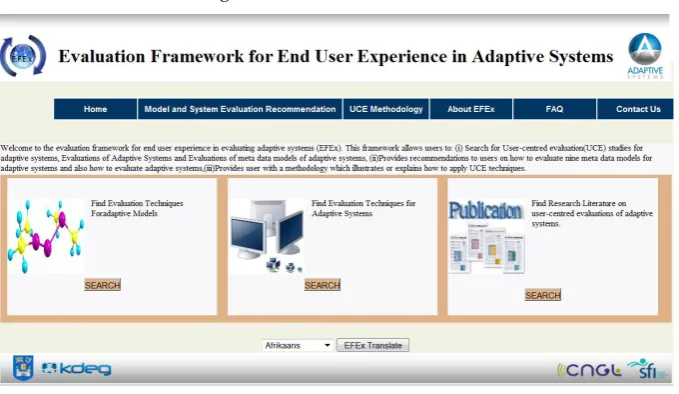
in order to provide personalised services. Figure 3 presents the index page of the framework. Users are able to:
Search for literature published from 2000 to date, such as user-centred evaluation (UCE) studies or evaluations of adaptive systems (i.e. adaptive hypermedia, adaptive educational hypermedia, adaptive e-learning, adaptive recommender, PIR and AIRS systems). The query results presented to the user are based on the following characteristics of the evaluated system: system name, developer, evaluation approach, evaluation purpose, system description, application area, evaluation methods, evaluation criteria, evaluation metrics, year of evaluation and finally what was improved by the adaptation.
Get implicit recommendations on how to combine different evaluation methods,
metrics and measurement criteria in order to evaluate a specific system.
[image:7.595.128.468.320.517.2] Translate the user interface into 49 different languages to suit the user.
Figure 3: A Web-based User Interface
3.4 Task-based Experiments and User Evaluations
maintain a specified level of performance; iii) usability, assessing how understandable and usable the framework is; iv) efficiency, evaluating the capability of the framework to exhibit the required performance with regards to the amount of resources needed; and v) maintainability, concerned with the framework’s capability to be modified and finally portability, which will involve measuring the frameworks capability to be used in a distributed environment.
The results from the requirements specification and preliminary evaluation phase were used to improve the functionality of the developed framework. A major evaluation will be conducted for the final phase. This will involve a large number of users performing several tasks.
4 Conclusion and Future Work
This paper described a review and classification of personalised IR approaches and evaluation techniques for PIR systems in the literature. Future personalised IR systems could build on harnessing the benefits of both implicit and explicit approaches to gathering user information and feedback about the user’s searches. There are currently no standard evaluation frameworks for AIRS systems. The framework presented in this paper will be a significant contribution to both the AH and IR scientific communities. Evaluators of AIRS systems should ensure that the correct evaluation methods, metrics and criteria are used while evaluating these systems. Two major evaluations of the framework will be conducted in future to test the: i) usability and performance of the overall framework and ii) end-user experience of using the framework.
Acknowledgements
This research is based upon works supported by Science Foundation Ireland (Grant Number: 07/CE/I1142) as part of the Centre for Next Generation Localization (www.cngl.ie). The authors are grateful for the suggestions of the reviewers for this paper.
References
AGICHTEIN, E., BRILL, E. & DUMAIS, S. 2006. Improving Web Search Ranking by Incorporating User
Behavior Information. 29th Annual International ACM SIGIR Conference on Research and
Development in Information Retrieval (SIGIR 2006). Seattle, Washington, USA: ACM.
BARRY, C. L. & SCHAMBER, L. 1998. Users' criteria for relevance evaluation: a cross-situational
comparison. Information processing & management, 34, 219-236.
CHIRITA, P.-A., FIRAN, C., S. & NEJDL, W. 2007. Personalised Query Expansion for the Web. 30th
Annual International ACM SIGIR Conference on Research and Development in Information Retrieval
(SIGIR 2007). Amsterdam, The Netherlands: ACM.
Cleverdon, C. W., Mills, J., and Keen, E. M. (1966) An inquiry in testing of information retrieval systems
(2 vols.) (Cranfield, UK: Aslib Cranfield Research Project, College of Aeronautics).
GAO, W., NIU, C., NIE, J.-Y., ZHOU, D., HU, J., WONG, K.-F. & HON, H.-W. 2007. Cross-Lingual
Query Suggestion Using Query Logs of Different Languages. 30th Annual International ACM SIGIR
Conference on Research and Development in Information Retrieval (SIGIR 2007). Amsterdam, The
Netherlands: ACM.
LAWLESS, S., MULWA, C. & O'CONNOR, A. Year. A Proposal for the Evaluation of Adaptive
Personalised Information Retrieval. In: Proceedings of the 2nd International Workshop on Contextual
KOUTRIKA, G. & IOANNIDIS, Y. 2004. Rule-based Query Personalised in Digital Libraries.
International Journal on Digital Libraries, 4, 60-63.
MICARELLI, A. & SCIARRONE, F. 2004. Anatomy and Empirical Evaluation of an Adaptive Web-Based
Information Filtering System. User Modeling and User-Adapted Interaction, 14, 159-200.
PRETSCHNER, A. & GAUCH, S. 1999. Ontology Based Personalised Search. 11th IEEE International
Conference on Tools with Artificial Intelligence (ICTAI 1999). Chicago, Illinois, USA: IEEE.
PITKOW, J., SCHUTZE, H., CASS, T., COOLEY, R., TURNBULL, D., EDMONDS, A., ADAR, E. &
BREUEL, T. 2002. Personalised Search. Communications of the ACM, 45, 50-55.
SMYTH, B. & BALFE, E. 2006. Anonymous Personalised in Collaborative Web Search. Information
Retrieval, 9, 165-190.
SPERETTA, M. & GAUCH, S. 2005a. misearch. IEEE/WIC/ACM International Conference on Web
Intelligence (WI 2005). Compiegne University of Technology, France: IEEE Computer Society.
STAMOU, S. & NTOULAS, A. 2009. Search Personalised Through Query and Page Topical Analysis.
User Modeling and User-Adapted Interaction, 19, 5-33.
STEFANI, A. & STRAPPARAVA, C. 1999. Exploiting NLP Techniques to Build User Model for Web
Sites: the Use of WordNet in SiteIF Project. 2nd Workshop on Adaptive Systems and User Modeling on
the World Wide Web. Toronto, Canada
SUGIYAMA, K., HATANO, K. & YOSHIKAWA, M. 2004. Adaptive Web Search Based on User Profile
Constructed without Any Effort from Users. 13th International Conference on World Wide Web
(WWW 2004). New York, USA: ACM.
TEEVAN, J., DUMAIS, S. T. & HORVITZ, E. 2005. Personalizing Search via Automated Analysis of
Interests and Activities. 28th Annual International ACM SIGIR Conference on Research and
Development in Information Retrieval (SIGIR 2005). Salvador, Brazil: ACM.
TOBAR, C. M. 2003. Yet another evaluation framework. Second Workshop on Empirical Evaluation of