Dynamic Contextual Usage Metadata for Learning Resource Reuse in Adaptive
Environments
Eddie Walsh, Rachael Rafter, Owen Conlan and Vincent Wade
Knowledge and Data Engineering Group
School of Computer Science and Statistics,
Trinity College Dublin, Ireland.
{walshe8,rachael.rafter,owen.conlan,vincent.wade}@scss.tcd.ie
Abstract
Drawing on the experiences and context of others who have already used a particular resource can greatly facili-tate that resource’s reuse. Such reuse is essential when the resources in question are digital learning assets, services and models which are expensive both in terms of time and monetary expenditure to develop and use. When these re-sources are deployed in personalised settings, where each user may be delivered a tailored sequence of resources that uniquely suits their particular needs, gathering and feder-ating a rich view of how these resources are being used be-comes important. In this article we describe an approach to facilitating the federating of contextual usage data, which is compiled over the lifecycle of a resource. Given that this data is likely to come from a range of different sources, our approach will need to be able to cope with the high level of heterogeneity expected in terms of its structure, syntax and semantics. We describe how such data may be used to sup-port users in assessing the value of learning resources and facilitating their appropriate reuse.
Keywords: Learning Resources, Adaptivity, Usage
Meta-data, Reuse, Integration
1. Introduction
Deciding when and where to appropriately reuse learn-ing resources is far from trivial. Factors such as the do-main knowledge, pedagogical soundness and the individ-uality of users are well documented important considera-tions for course design [4]. To date, most learning resource metadata has remained rather static, typically summarising the characteristics of the learning resource and the original author’s vision of its usage. Dynamic contextual informa-tion about how, why and by whom the resource is used is typically not considered. It is this information that is
cru-cial for the reuse of learning resources; it informs us about the suitability of the resource for a particular context, and chronicles how the resource is used in practice, which does not necessarily coincide with the original author’s expecta-tion of its usage. In short, this data gives course authors access to a rich body of experience that scaffolds their de-sign choices and encourages them to reuse existing learning resources whose appropriateness has been validated via his-torical evidence.
In this paper we argue that, what we term contextual
usage metadata, should supplement the standard metadata associated with learning resources, and importantly, detail when and where the deployment of a resource has been par-ticularly successful. Drawing on the experiences and con-text of others who have already used a particular resource can greatly facilitate that resource’s reuse. Such reuse is es-sential when the resources in question are digital learning objects, services and models that are costly in terms of time and monetary expenditure to develop and deploy.
To provide reuse of learning resources in these envi-ronments requires dynamic federation of contextual usage metadata. Various implicit and explicit usage data is gen-erated by multiple, often interchangeable, services and as a result can vary in structural, syntactic and semantic hetero-geneity. To achieve federation requires methods to mediate the heterogeneity inherent in various learning environments and their resulting metadata models.
Our contributions in this paper are two-fold. We begin by discussing the federation of contextual usage metadata from multiple heterogeneous sources, and borrow from our previ-ous work on federating user information [15]. Specifically we describe a new approach based on FUMES; an interop-erability system for the automatic, on-demand, exchange of user information between multiple heterogeneous sources. Then we move on to describe how federated contextual us-age metadata may be used to better facilitate the reuse of learning resources.
In Section 2 we review related work. Section 3 describes our proposed approach for the federation of contextual us-age metadata from different heterogenous sources, and Sec-tion 4 discusses how such metadata may be exploited to sup-port the reuse of learning resources.
2. Related Work
2.1
Contextual Usage Metadata
To date in personalised e-learning systems, the meta-data used to describe learning resources has remained rather static, and the pool of content and services, as well as the context in which the personalisation is carried out, is very
limited [2, 5, 3]. However we are beginning to see an
emerging shift towards more openly described resources. For example, services are playing an increasingly pivotal role in modern e-learning systems, facilitating interactions between learner and system. Services by their very nature are typically designed to be open and reusable. Further-more, e-learning resources are being deployed in more di-verse scenarios, that cater not only for the standard class-room style of course, but for independent or collaborating learners as well.
There have however been a few attempts to move
to-wards more dynamic and contextual usage metadata.
Con-textualised attention metadata[10, 11, 16] is one example that uses the AttentionXML standard developed in 2004. The attention that a user gives to different resources (such as feeds, blogs, wikis) and any associated interactions are tracked and analysed with respect to the context in which they are carried out. The contextualised attention metadata schema not only records an action that a user took, but also registers when the action took place, through which tool the action took place, what other things the user was doing at
the time, the community to which the user belongs, and the user’s profile [11]. This can be used to update a user model and provide information about a user’s current interests; to provide empirical analysis of the actual use of learning ob-jects to administrators of learning management systems; or finally as input to a recommender system tasked with sug-gesting new objects to learners, [10].
With similar motivations McCalla describes the
eco-logical approachto designing e-learning environments, in which information about how learning objects are used in practice is accumulated [8, 1]. The learner model is split into two, where one half represents the long-term character-isticsof the learner, and the other representsepisodic short-term information about the learner’s experiences with the current learning object. The former might contain informa-tion like the preferred learning style, past knowledge and learning goal for example, while the latter would provide traces of the learner’s interaction with the learning object, how he evaluated it, and any of his test results relating to the learning object’s content.
When the learner consumes a learning object, the cur-rent state of his profile (containing both parts) is attached to the learning object. Over time the learning object col-lects many learner model snapshots which can be mined for usage patterns. The patterns might then be used to inform a recommender system, to determine the strength or weak-ness of a learning object for a particular pedagogical goal (either for an individual or type of user) or to identify learn-ers who would benefit from working together for example, (the interested reader should refer to [1] for a complete list of intended purposes).
Lehmann et al. [7] refer to usage information about
learning resources as lifecycle information. The lifecycle
of a learning resource is comprised of a number of phases: authoring (the learning resource is created), provision (it is provided to educators or learners), learning (the resource is used) and re-authoring (the resource is adapted for a new context). In particular when a resource is re-authored, it may be unitised, adapted, updated or re-aggregated as parts are added, adapted, removed, or combined with parts of other learning resources. Like contextualised attention metadata and the data captured by the ecological approach, contextual information is captured about the usage of
learn-ing resources. However additionally, so-called relation
it has gathered to date.
Finally, the iLog system [13, 9] tags learning objects
with what it termsempirical usage metadata. The
meta-data is generated from observations about students’ inter-actions with learning objects, for example how long they spend on a page or exercise, which is mined from session log files. Feature selection and data mining techniques are employed to isolate salient characteristics associated with particular learning outcomes, then, an association rule min-ing algorithm generates the resultmin-ing prediction rules. For example a rule might dictate that if a student has not yet taken a calculus course, and the student found the learn-ing object confuslearn-ing, then their likelihood of failure is 27%. The empirical usage metadata is finally generated based on the salient characteristics and the extracted rules.
2.2
Contextual Usage Metadata Federation
As e-learning environments become more service-oriented and incorporate multiple learning resource providers, the exchange of contextual usage metadata will become increasingly important. Sharing the metadata al-lows a more informed view of user interactions with each learning resource and provides benefits for both course au-thors and learners such as improved reuse and personalisa-tion of learning resources.
Many of the previously mentioned approaches that fa-cilitate usage metadata also incorporate methods to recon-cile the usage metadata from various sources. In the work of Najjar et al., [10] the attention metadata approach uses the common open standard, AttentionXML, to track usage metadata across multiple systems. Usage metadata from log files is converted into the AttentionXML format using man-ually constructed transforms and the resulting data streams are merged.
In McCalla’s work on the ecological approach to e-learning environments [8], usage metadata is essentially de-rived from attaching user models to individual learning ob-jects. To reuse the learning objects requires a means to pro-vide interoperability of user models or, as suggested by Mc-Calla, a standardised user model. He also suggests related work examining agent-based learning objects as a means to mediate interoperability of usage metadata.
The iLog approach presented by Riley et al. [13] uses learning object wrappers to transfer usage metadata to a server where it is processed and attached to a standard-based metadata model for that learning object.
The LIS.KOM framework proposed by Lehmann et al. [7] also uses a centralised server to process the usage metadata. Here, the usage metadata is provided by local clients that collect data from custom add-ins in systems such as learning management systems and repositories.
These are all interesting and varied approaches to usage
metadata federation that provide different levels of integra-tion. However, due to the lack of standards in this area many of these approaches rely on the use of commonly adopted, custom metadata formats and methods to obtain, represent and transfer usage metadata between different locations. To integrate new systems in these approaches, the same for-mats and techniques will need to be fully adopted and this will likely require significant integration effort and exper-tise.
Looking beyond the area of usage metadata, there are other interesting approaches to federation in related areas. In more general metadata exchange, Haslhofer [6] describes mapping approaches to share digital resource metadata. As new mappings can be constructed for any new type of meta-data the mapping approach allows significant flexibility and extensibility. The mapping approach is common in many fields such as database, ontology and user model integra-tion. It is the approach adopted in FUMES [15] to provide user model interoperability and, as described in the follow-ing section, is extended in FUMES2 to support learnfollow-ing re-source usage metadata.
3
Dynamic Federation of Contextual Usage
Metadata
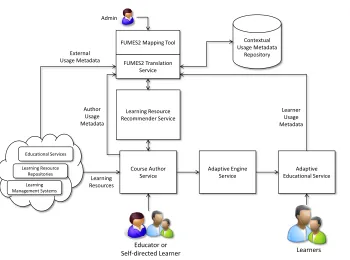
In this section we propose an approach, shown in Fig-ure 1, to provide dynamic contextual usage metadata from multiple sources for the reuse of learning resources in an adaptive educational environment. In particular, this section will focus on the metadata federation component FUMES2. The Federated Usage Metadata Exchange Service (FUMES2) allows the dynamic capture, exchange and up-date of usage metadata between multiple heterogeneous sources. FUMES2 is an advancement of previous research into learner model exchange called the Federated User Model Exchange Service (FUMES) [15].
FUMES2 provides dynamic usage metadata exchange between multiple service components. For example, Fig-ure 1 shows FUMES2 gathering and integrating explicit and implicit usage metadata from a course author in the course author service and the learners in the adaptive education service. This usage metadata can be used to support sub-sequent course authors in selecting and reusing learning re-sources.
Similarly, FUMES2 can be used to retrieve usage meta-data from multiple external sources like learning manage-ment systems, learning repositories and various educational services. In this case, valuable usage metadata can be re-trieved to enhance the selection of learning resources and to overcome “cold-start” problems in adaptive course design.
Course Author Service FUMES2 Mapping Tool
Learning Resource Recommender Service External
Usage Metadata
Adaptive Engine Service
Adaptive Educational Service
Educator or
Self-directed Learner Learners
Learning Resources
Learner Usage Metadata Admin
Educational Services Learning Resource
Repositories Learning Management Systems
Contextual Usage Metadata
Repository FUMES2 Translation
Service
[image:4.612.127.477.76.336.2]Author Usage Metadata
Figure 1. Learning Resource Reuse Approach
standardisation requires techniques to mediate this hetero-geneity and in FUMES2 a mapping approach is adopted.
For sources that do not explicitly collect usage data for exchange purposes, a lightweight plug-in is used to filter and extract resource usage metadata from internal compo-nents such as log files. For example, in a learning man-agement system detailed logs of user interactions with re-sources are usually recorded. These logs can be mined to provide detailed contextual resource usage metadata for many learners.
One of the major benefits of the FUMES2 mapping ap-proach over the related work described in Section 2 is that the usage metadata does not have to conform to any particu-lar standard or custom format and can be represented using the system’s own structure and syntax. The mapping ap-proach taken by FUMES2 allows greater flexibility in how the metadata in the various components is represented and reused. The usage metadata can be manipulated using vari-ous predefined mapping types available within FUMES2.
The FUMES2 mapping tool can be used to create map-pings from the usage metadata of the various sources to a canonical usage metadata model. This canonical model encapsulates core types of usage metadata and is extensi-ble to support varied types. The FUMES2 mapping tool is a web-based application that allows an administrator to rapidly create graphical mappings between equivalent us-age metadata without the need to learn underlying
transla-tion technologies.
Once the mappings have been created, they can be ex-ecuted automatically and on-demand using the FUMES2 translation service. The translation service is a web ser-vice component that dynamically exchanges usage meta-data between the various integrated services. When a ser-vice makes a request for updated usage metadata the transla-tion service retrieves usage metadata from the other sources and executes the mappings previously created in the map-ping tool. This performs a translation of the heterogeneous usage metadata into the common canonical model represen-tation. Following this, a second set of mappings are exe-cuted to translate the canonical model into the target sys-tem’s usage metadata representation.
Implicit and explicit usage metadata from the course au-thor service and adaptive educational service is fed back through FUMES2 to the contextual usage metadata repos-itory thereby allowing a consistent feedback cycle for the update of resource usage metadata. This allows for more dynamic, up-to-date contextual usage metadata in this ap-proach and ultimately allows more targeted personalisation for each individual learner.
4
Contextual Usage Metadata for Reuse
We have now an approach to federating contextual usage metadata from multiple heterogenous sources. We argue that such federation is necessary for compiling a collection of metadata large enough in order for meaningful patterns to be exposed. Certainly, gathering data from multiple sources alleviates somewhat the cold start situation where there is not contextual information about a particular learning re-source yet in an individual system.
Clearly contextualised usage data is becoming a worth-while consideration in e-learning systems. Related research has begun to explore how this information may be used to monitor not only when and how content is used, but also when and how (certain) services are used (contextualised attention metadata) and how learning resources are adapted (lifecycle information). Usage data supports both learner and educator in capitalising on the advantages of an online education environment.
However to date, learning resources have been seen as rather independent entities, where knowledge prerequisites are the only glue between different resources. In particular, thenarrativesof the courses, where the learning resources have been deployed has not yet been fully explored. We ar-gue that such information is especially useful for scaffold-ing educators in designscaffold-ing quality e-learnscaffold-ing courses.
Learning resources are not independent resources, and typically have many inherent links between them that go be-yond the basic prerequisite knowledge. In fact learning re-sources are not always presented in sequence to the learner to begin with; this is especially true when the e-learning course contains both content and services. For example in a peer review exercise, the student might be presented with the content of the article under review, in parallel to services which allow him to rate and provide feedback on it.
Therefore, we believe that the contextual usage data that describes a resource should include details about the nar-rative of any course in which it has been used, i.e., the conceptual flow (which may be adaptive) which details the other learning resources contained in the course and the un-derlying structure between them. Of course, information describing the learners who have consumed the resources, how those resources were adapted or personalised, and any indications about the success of the resources deployment
are still recorded.
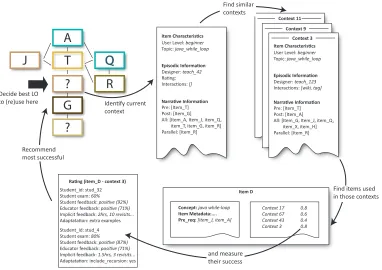
The combination of this information can then be used to scaffold course authors. For example in Figure 2 the course author has some resources he wants to use in his course (A, T, J, Q, R and G) and is looking to add some more. The system can now recommend learning resources to the au-thor that not only fulfil a particular pedagogic requirement, but that have been used in a similar context before. The author can examine whether that resource was successful, for which students or kinds of students it was particularly successful, and how it was adapted for those students.
5
Summary
Analysing how learning resources are used by others can greatly facilitate their reuse. In adaptive learning en-vironments in particular, rich usage information can sup-port course authors in the selection and reuse of appropriate learning resources. However, learning resources can be dis-tributed in many heterogeneous locations making the gath-ering and exchanging of up-to-date usage data a difficult challenge. In this paper, we have discussed some related work in the area of usage metadata and its federation. Sub-sequently, we presented a new approach to facilitate the dy-namic federation of usage metadata from multiple sources. This approach uses mapping techniques to provide a flexi-ble and extensiflexi-ble method to overcome structural, syntactic and semantic heterogeneity in usage metadata. Following this, an approach is described that shows how federated us-age metadata can be used to better facilitate the selection and reuse of learning resources.
Acknowledgement
This work was funded by Science Foundation Ireland via grant 08/IN.1/I2103: Adaptive and adaptable media and services for dynamic personalisation and contextualisation (AMAS).
References
[1] C. Brooks and G. McCalla. Towards flexible learning object metadata.Engineering Education, 16(1 - 2):50–63, 2006. [2] P. Brusilovsky. Methods and techniques of adaptive
hyper-media. User Modeling and User-Adapted Interaction, 6(2-3):87–129, July 1996.
[3] O. Conlan and V. Wade. Evaluation of APeLS - An Adaptive eLearning Service Based on the Multi-Model, Metadata-Driven Approach. In P. De Bra and W. Nejdl, editors,
J
A
T
Q
R
G
?
?
Item Characteristics
Episodic Information
Narrative Information
User Level: beginner Topic: java_while_loop
Designer: teach_42 Rating: Interactions: []
Pre: [Item_T] Post: [Item_G] All: [Item_A, Item_J, item_Q, item_T, item_G, item_R] Parallel: [Item_R]
Context 11 Context 9
Item Characteristics
Episodic Information
Narrative Information
User Level: beginner Topic: java_while_loop
Designer: teach_123 Interactions: [wiki, tag]
Pre: [Item_T] Post: [Item_A] All: [Item_G, Item_J, item_Q, item_X, item_H] Parallel: [Item_R]
Context 3
Item D
Concept: java while-loop Item Metadata:.... Pre_req: [item_J, item_A]
Context 17 Context 67 Context 43 Context 3
0.8 0.6 0.4 0.8 Rating (item_D - context 3)
Student_id: stud_32 Student exam: 60% Student feedback:positive (92%)
Educator feedback:positive (71%)
Implicit feedback:2hrs, 10 revisits...
Adaptatation: extra examples
Decide best LO
to (re)use here Identify current context
Find similar contexts
Find items used in those contexts
and measure their success Recommend
most successful
Student_id: stud_4 Student exam: 80% Student feedback:positive (87%)
Educator feedback:positive (71%)
Implicit feedback:1.5hrs, 3 revisits...
[image:6.612.105.487.72.342.2]Adaptatation: include_recursion: yes
Figure 2. Strategy for Identifying Suitable LOs for (Re)Use
[4] D. Dagger, O. Conlan, and V. Wade. Personalisation for All: Making Adaptive Course Composition Easy. Special issue of the IEEE Journal of Educational Technology and Society, 8(3):9–25, July 2005.
[5] P. de Bra, D. Smits, and N. Stash. The Design of AHA! InProceedings of the 17th ACM Conference on Hypertext and Hypermedia, pages 133 – 134, Odense, Denmark, Aug. 2006.
[6] B. Haslhofer and W. Klas. A survey of techniques for achieving metadata interoperability. ACM Computing Sur-veys, 42(2):1–37, 2010.
[7] L. Lehmann, T. Hildebrandt, C. Rensing, and R. Steinmetz. Capture, Management, and Utilization of Lifecycle Informa-tion for Learning Resources. IEEE Transactions on Learn-ing Technologies, 1(1):75–87, Jan. 2008.
[8] G. McCalla. The Ecological Approach to the Design of E-Learning Environments: Purpose-based Capture and Use of Information about Learners.Journal of Interactive Media in Education - Special Issue on the Educational Semantic Web, 7, 2004.
[9] L. D. Miller, L.-K. Soh, B. Neilsen, K. Kupzyk, A. Samal, E. Lam, and G. Nugent. Revising computer science learning objects from learner interaction data. InProceedings of the 42nd ACM technical symposium on Computer science edu-cation - SIGCSE ’11, pages 45 – 50, Dallas, Texas, USA, Mar. 2011. ACM Press.
[10] J. Najjar, E. Duval, and M. Wolpers. Attention Metadata: Collection and Management. InIn Proceedings of the work-shop on logging traces of web activity: the mechanics of data collection, at the 15th International World Wide Web
Conference (WWW 06), pages 1 – 4, Edinburgh, Scotland, May 2006.
[11] X. Ochoa and E. Duval. Use of contextualized attention metadata for ranking and recommending learning objects. InProceedings of the 1st international workshop on Con-textualized attention metadata: collecting, managing and exploiting of rich usage information (CAMA 06), pages 9 – 16, Arlington, VA, USA, Nov. 2006.
[12] I. O’Keeffe and V. Wade. Personalised Web Experiences: Seamless Adaptivity across Web Service Composition and Web Content. InUser Modeling, Adaptation and Personal-ization, pages 480–485. Springer Berlin / Heidelberg, 2009. [13] S. Riley, L. Miller, L.-K. Soh, A. Samal, and G. Nugent. In-telligent Learning Object Guide (iLOG): A Framework for Automatic Empirically-Based Metadata Generation. In Pro-ceeding of the 2009 conference on Artificial Intelligence in Education, pages 515–522, Brighton, UK, July 2009. [14] V. P. Wade and H. Ashman. Guest Editors’ Introduction:
Evolving the Infrastructure for Technology-Enhanced Dis-tance Learning. IEEE Internet Computing, 11(3):16–18, May 2007.
[15] E. Walsh, A. O’Connor, and V. Wade. Supporting Learner Model Exchange in Educational Web Systems. In7th Inter-national Conference on Web Information Systems and Tech-nologies, Noordwijkerhout, The Netherlands, May 2011. [16] M. Wolpers, J. Najjar, K. Verbert, and E. Duval. Tracking