MCWP 4-1
Logistics Operations
U.S. Marine Corps
Unless otherwise stated, whenever the masculine or feminine gender is used, both men and women are included.
Changes: Readers of this publication are encouraged to submit suggestions and changes that will improve it. Recommendations may be sent directly to Commanding General, Marine Corps Combat Development Command, Doctrine Division (C 42), 3300 Russell Road, Suite 318A, Quantico, VA 22134-5021 or by fax to 703-784-2917 (DSN 278-2917) or by E-mail to smb@doctrine div@mccdc. Recommendations should include the following information:
• Location of change
Publication number and title Current page number
Paragraph number (if applicable) Line number
Figure or table number (if applicable) • Nature of change
Add, delete
Proposed new text, preferably double-spaced and typewritten • Justification and/or source of change
Washington, D.C. 20380-1775
15 April 1999
FOREWORD
1. PURPOSE
Marine Corps Warfighting Publication (MCWP) 4-1, Logistics Operations, expands on the themes developed in Marine Corps Doctrinal Publication (MCDP) 4, Logistics, and provides essential information needed to under-stand the conduct of logistics planning and operations in a joint environ-ment. Logistics Operations provides commanders and logisticians with a broad perspective on the Marine Corps’ logistics missions and objectives. It addresses the Marine Corps’ core logistics capabilities at the strategic, operational, and tactical levels of war. This publication describes how ac-tivities at each level of war interact with and support acac-tivities at other lev-els of war, ensuring that effective logistics support exists down to the tactical commander.
2. SCOPE
MCWP 4-1 introduces the Marine Corps logistics organization and support structure, depicts an overview of the processes used to plan and execute lo-gistics support, and discusses how emerging operational concepts impact logistics. MCWP 4-1 builds on the foundation established in MCDP 4, and it should be read by all Marine officers.
MCWP 4-1 provides an overview of Marine Corps logistics at all levels of war. Detailed information on the conduct of logistics at each level of war will be found in follow-on, logistics warfighting publications: MCWP 4-11, Tactical Logistics (and subordinate functional publications in the 4-11 series); MCWP 4-12, Operational Logistics; and MCWP 4-13, Stra-tegic Logistics. These publications in conjunction with MCDP 4, Logis-tics; Joint Publication 4-0, Doctrine for Logistic Support of Joint Operations; and Naval Doctrine Publication 4, Naval Logistics, provide the information and background necessary to effectively plan and execute logistics operations at all echelons.
3. SUPERSESSION
Reviewed and approved this date.
BY DIRECTION OF THE COMMANDANT OF THE MARINE CORPS
J.E. RHODES
Lieutenant General, U.S. Marine Corps Commanding General
Marine Corps Combat Development Command
Table of Contents
Page
Chapter 1. Overview of Marine Corps Logistics
1001 Service Responsibility 1-1
1002 Marine Corps Logistics Mission 1-1
1003 Logistics Core Capabilities 1-2
1004 The Levels of Logistics and the Logistics Pipeline 1-3
1005 Principles of Logistics Support 1-5
1006 Functional Areas of Marine Corps Logistics 1-6
Chapter 2. Marine Corps Logistics Responsibilities and Organization
2001 Logistics Responsibilities 2-1
2002 Command Relationships and Other Authorities 2-3
2003 Headquarters, Marine Corps 2-6
2004 Staff Cognizance and Logistics Support 2-8
2005 Operating Forces 2-10
2006 Marine Corps Reserve 2-16
2007 Supporting Establishment 2-16
2008 War Materiel Support 2-18
Chapter 3. Command and Control of Logistics
3001 Command and Control Organization and Architecture 3-1
3002 Command and Control Organizations and the Levels of War 3-2
3003 Command and Control Information Systems 3-5
3004 Information Management and Technology Improvements 3-8 3005 Considerations for Joint or Multinational Command and Control of Logistics 3-12
Chapter 4. Logistics Planning
4001 Planning at the Levels of War 4-1
4002 Administrative and Operational Planning 4-2
4003 Planning for Resources 4-2
4004 Principles and Considerations 4-2
4005 Mission and Task Analysis 4-5
4006 Factors Affecting Logistics Planning 4-6
4007 Coordination in Planning 4-7
4008 Planning Systems 4-7
Chapter 5. Logistics Execution
5001 Expeditionary Operations 5-1
5002 Predeployment Actions 5-2
5003 Deployment 5-4
5004 Entry 5-8
5005 Enabling and Decisive Actions 5-14
5006 Power Projection From the Sea and Amphibious Operations 5-15
5007 Redeployment 5-16
5008 Joint or Multinational Operations 5-17
Appendices
A Emerging Concepts A-1
B Acronyms B-1
Overview of Marine Corps Logistics
As defined in Joint Publication (Joint Pub) 1-02,
Department of Defense Dictionary of Military and Associated Terms, logistics is “the science of planning and carrying out the movement and maintenance of forces.” In its most comprehen-sive sense, logistics provides materiel support, health service support, facilities support, and ser-vice support. Materiel support is the design devel-o p m e n t , a c q u i s i t i devel-o n , s t devel-o r a g e , m devel-o v e m e n t , distribution, maintenance, evacuation, and dispo-sition of materiel. Health service support is the movement, evacuation, and hospitalization of per-sonnel. Facilities support is the acquisition or con-struction, maintenance, operation, and disposition of facilities. Service support is the acquisition or furnishing of services. Specific logistics needs are tailored to meet the conditions and the level of war under which a military force operates.
1001. Service Responsibility
United States Code, Title 10, assigns each Service responsibility for organizing, training, and equip-ping forces for employment in the national inter-est. Joint Pub 4-0, Doctrine for Logistic Support of Joint Operations, states that each Service is re-sponsible for the logistics support of its own forc-es. Joint Pub 4-0 further clarifies logistics support responsibilities for forces assigned to combatant commanders. The combatant commander may then delegate the responsibility for providing or coordinating support for all Service components in the theater or designated area to the Service component that is the dominant user. However, each Service retains its basic logistics responsibil-ities except when logistics support agreements or arrangements are established with national agen-cies, allies, joint forces, or other Services.
1002. Marine Corps Logistics
Mission
On the basis of United States Code, Title 10, and joint doctrine, the Marine Corps, in coordination and cooperation with the Navy, has made logisti-cal self-sufficiency an essential element of Marine air-ground task force (MAGTF) expeditionary warfighting capabilities. This means that the Marine Corps’ logistics mission, at all command and support levels, is to generate MAGTFs that are rapidly deployable, self-reliant, self-sustain-ing, and flexible and that can rapidly reconstitute. This goal leads to further corollaries:
l Rapid deployment demands that MAGTF
organizations, equipment, and supplies be readily transportable by land, in aircraft, and on ships.
l A self-reliant MAGTF is task-organized to
support itself logistically with accompany-ing supplies for specific timeframes without undue concern for resupply or developed in-frastructure ashore.
l A MAGTF’s logistics capabilities and
ac-companying supplies enable it, depending on size, to self-sustain its operations for up to 60 days while external resupply channels are organized and established.
l Marine Corps maneuver warfare philosophy
l A MAGTF’s inherent self-sustainment and
rapid deployability capabilities allow it to reconstitute itself rapidly and permit rapid withdrawal from a completed operation and immediate re-embarkation for follow-on missions.
1003. Logistics Core Capabilities
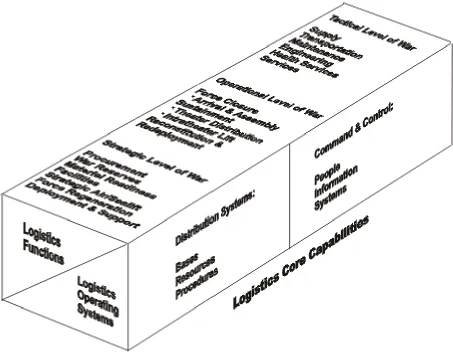
At all levels of war, logistics core capabilities pro-vide the commander with the ability to accom-plish the defined functions of logistics. The Marine Corps’ core capabilities are the individual, functional logistics operating systems that exist at each level of war and are tied together by com-mand and control. Marine Corps logistics core ca-pabilities are essential to the expeditionary
character that distinguishes MAGTFs from other military organizations. See figure 1-1.
a. Logistics Operating Systems
Marine Corps doctrinal publication (MCDP) 4,
[image:8.612.75.528.337.693.2]Logistics, indicates that fundamental to all logis-tics operating systems are distribution systems that consist of functional resources and proce-dures. Functional resources consist of bases, orga-n i z a t i o orga-n s , p e o p l e , a s s e t s , e q u i p m e orga-n t , a orga-n d facilities. Procedures include functional processes that not only distribute resources where they are needed but also apply those resources to generate logistic capability. Logistic operating systems joined with command and control address all lo-gistics functions (both functional resources and processes) at every level of war.
b. Command and Control of Logistics
MCDP 4 states that command and control of lo-gistics enables the commander to recognize re-quirements and provide the required resources. Command and control must provide visibility of both capabilities and requirements. This visibility allows the commander to make decisions regard-ing the effective allocation of scarce, high-de-mand resources. Additionally, comhigh-de-mand and control facilitates the integration of logistics oper-ations with other warfighting functions so that the commander’s time for planning, decision, execu-tion, and assessment is optimized. Only when command and control effectively supports the lo-gistics effort can lolo-gistics effectively and effi-ciently support the mission, manage distribution of capabilities, provide a shared real-time picture of the battlespace, anticipate requirements, allo-cate resources, and effect the timely distribution of resources. See chapter 3 for more information on command and control.
1004. The Levels of Logistics
and the Logistics Pipeline
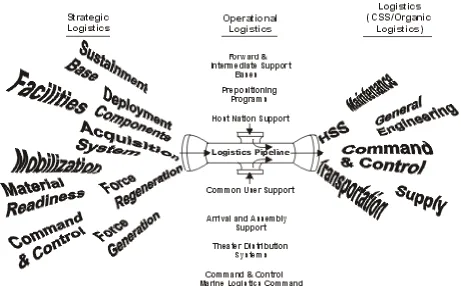
The strategic, operational, and tactical levels of logistics function as a coordinated whole, rather than as separate entities. Although the Marine Corps generally focuses on the tactical level of lo-gistics, it is imperative that all Marines under-stand the interaction of all three logistics levels. These levels interconnect like sections of a pipe-line, tying together logistics support at the strate-gic, operational, and tactical levels. See figure 1-2 (on page 1-4).
The joint staff, individual Services, and associat-ed national agencies (Defense Logistics Agency and Office of the Secretary of Defense) address strategic logistics issues. The Services coordinate their required strategic and operational logistics interfaces. Combatant commanders and their lo-gistics staffs—supporting and supported—man-age both strategic and operational logistics issues that affect their assigned missions. Service com-ponents and the subordinate commander, their lo-gistics staffs, and logisticians down to the
individual, small-unit level deal with operational and tactical logistics responsibilities.
a. Strategic Logistics
Strategic logistics supports organizing, training, and equipping the forces that are needed to further the national interest. It links the national econom-ic base (people, resources, and industry) to mili-tary operations. The combination of strategic resources (the national sustainment base) and dis-tribution processes (our military deployment components) represents our total national capabil-ities. These capabilities include the Department of Defense (DOD), the Military Services, other Gov-ernment agencies as necessary or appropriate, and the support of the private sector. Strategic logis-tics capabilities are generated based on guidance from the National Command Authorities and lo-gistics requirements identified by the operating forces. Lead times to coordinate and plan strategic logistics vary, ranging from up to a decade or more for equipment development and fielding, to 2 years for fiscal and routine operational contin-gency planning, to mere days for positioning forc-es around the globe in crisis rforc-esponse.
The combatant commander and his staff (princi-pally the J-4, Logistics Directorate) plan and oversee logistics from a theater strategic perspec-tive. They assign execution responsibilities to Service components unless a joint or multination-al functionmultination-al command is formed to perform the-ater strategic logistics functions. The joint staff and combatant commanders generate and move forces and materiel into theater and areas of oper-ations where operational logistics concepts are employed.
At the strategic level, the Marine Corps—
l Procures weapons and equipment (except
aircraft and class V[A]).
l Recruits, trains, and assembles forces. l Establishes facilities, bases, and stations to
house and maintain forces and stockpile re-sources.
l Mobilizes forces.
l Oversees and coordinates employment of
strategic-level transportation assets.
l Regenerates forces.
l Provides command and control to manage
the flow of resources from the strategic to the tactical level.
b. Operational Logistics
Operational logistics links tactical requirements to strategic capabilities in order to accomplish op-erational goals and objectives. It includes the
sup-port required to sustain campaigns and major operations. Operational logistics supports con-ducting campaigns and providing theater-wide lo-gistics support, generally over periods of weeks or months. Operational logisticians assist in resolv-ing tactical requirements and coordinate the allo-cation, apportionment, and distribution of resources within theater. They interface closely with operators at the tactical level in order to identify theater shortfalls and communicate these shortfalls back to the strategic source. At the operational level, the concerns of the logistician and the operator are intricately interrelated.
[image:10.612.72.533.89.375.2]The Marine Corps’ operating forces, assisted by Headquarters, Marine Corps and the supporting establishment, are responsible for operational lo-gistics. Commander, Marine Corps Forces, or the senior MAGTF command element in the absence of an in-theater Marine component commander performs operational logistics support functions. Commander, Marine Corps Forces, may establish
a theater Marine Logistics Command for the pur-pose of performing operational logistics functions to support tactical logistics requirements in the ar-ea of operations.
The focus of operational logistics is to balance the MAGTF deployment, employment, and support requirements to maximize the overall effective-ness of the force. Marine Corps operational logis-tics orients on force closure, sustainment, reconstitution, and redeployment of Marine forces in theater, which includes—
l Providing operational-level command and
control for effective planning and manage-ment of operational logistics efforts.
l Establishing intermediate and forward
sup-port bases.
l Supporting employment of
geopreposi-tioned and maritime preposigeopreposi-tioned assets.
l Supporting arrival and assembly of forces in
theater, and their reception, staging, onward movement, and integration.
l Coordinating logistics support with joint,
other-Service, and host nation agencies.
l Reconstituting and redeploying MAGTFs
and maritime prepositioning forces (MPFs) for follow-on missions.
c. Tactical Logistics
Tactical logistics includes organic unit capabili-ties and the combat service support (CSS) activi-ties necessary to support military operations. Its focus is to support the commander’s intent and concept of operations while maximizing the com-mander’s flexibility and freedom of action.
Tactical logistics involves the coordination of functions required to sustain and move units, per-sonnel, equipment, and supplies. These functions must deliver flexible and responsive combat ser-vice support to meet the needs of the forces en-gaged in operations. Therefore, the response time of tactical logistics is necessarily rapid and re-quires anticipatory planning to provide responsive support. Supply and maintenance activities
gener-ate mgener-ateriel readiness; transportation resources move personnel, equipment, and supplies within the tactical area of operations; and general engi-neering support, health service support, and gen-eral services support contribute to mission accomplishment.
The MAGTF is specifically designed to possess the organic CSS organizations that it needs to ac-complish assigned missions. Although no single element of the MAGTF has all of the operational and logistics capabilities needed to operate inde-pendently, each element has the capability for at least some basic self-support tasks. The combat service support element (CSSE) provides general ground logistics support to the command element (CE), ground combat element (GCE), and avia-tion combat element (ACE). The ACE possesses unique aviation logistics support capabilities es-sential for aircraft operations. Typically, the MAGTF deploys with accompanying supplies that enable it to conduct operations that range from 15 to 60 days (the period when resupply channels are being established and flow of sup-plies initiated).
1005. Principles of Logistics
Support
a. Responsiveness
Responsiveness is the right support in the right place at the right time. Among the logistics princi-ples, responsiveness is the keystone. All other principles become irrelevant if logistics support does not support the commander’s concept of op-erations.
b. Simplicity
Simplicity fosters efficiency in both the planning and execution of logistics operations. Mission-type orders and standardized procedures contrib-ute to simplicity. Establishment of priorities and preallocation of supplies and services by the sup-ported unit can simplify logistics support opera-tions.
c. Flexibility
Flexibility is the ability to adapt logistics structure and procedures to changing situations, missions, and concepts of operation. Logistics plans and op-erations must be flexible to achieve both respon-siveness and economy. A commander must retain command and control over subordinate organiza-tions to maintain flexibility. The principle of flex-ibility also includes the concepts of alternative planning, anticipation, reserve assets, redundancy, forward support of phased logistics, and central-ized control with decentralcentral-ized operations.
d. Economy
Economy is providing sufficient support at the least cost without impairing mission accomplish-ment or jeopardizing lives. At some level and to some degree, resources are always limited. When prioritizing limited resources and allocating them sufficiently to achieve success without imbalance or inordinate excess, the commander is, in effect, applying economy.
e. Attainability
Attainability (or adequacy) is the ability to pro-vide the minimum, essential supplies and services required to begin combat operations. The com-mander’s logistics staff develops the concept of logistics support; completes the logistics estimate; and initiates resource identification on the basis of
the supported commander’s requirements, priori-ties, and apportionment. An operation should not begin until minimum essential levels of support are on hand.
f. Sustainability
Sustainability is the ability to maintain logistics support to all users throughout the area of opera-tions for the duration of the operation. Sustain-ability focuses the commander’s attention on long-term objectives and capabilities of the force. Long-term support is the greatest challenge for the logistician, who must not only attain the mini-mum, essential materiel levels to initiate combat operations (readiness), but also must maintain those levels for the duration to sustain operations.
g. Survivability
Survivability is the capacity of the organization to protect its forces and resources. Logistics units and installations are high-value targets that must be guarded to avoid presenting the enemy with a critical vulnerability. Since the physical environ-ment typically degrades logistics capabilities rath-er than destroys them, it must be considrath-ered when planning. Survivability may dictate dispersion and decentralization at the expense of economy. The allocation of reserves, development of alter-native sources, and phasing of logistics support contribute to survivability.
1006. Functional Areas of
Marine Corps Logistics
a. Supply
The six functions of supply are—
l Requirements determination: routine,
pre-planned, or long-range.
l Procurement. l Distribution. l Disposal. l Storage. l Salvage.
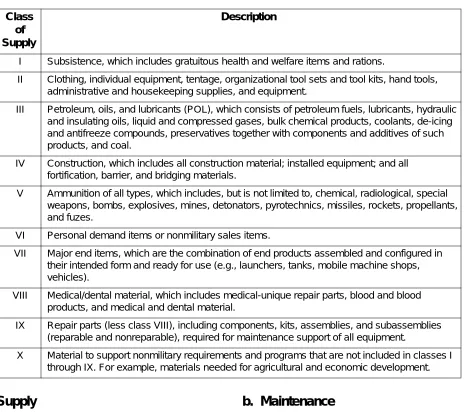
Supply is separated into general categories, or classes, based on a physical characteristic or pur-pose. Table 1-1 identifies the classes of supply.
b. Maintenance
Maintenance involves those actions taken to re-tain or restore materiel to serviceable condition. The purpose and function of equipment mainte-nance are universally applicable, but the Marine Corps has developed distinct applications for the support of ground-common and aviation-unique equipment. Maintenance includes eight functions:
l Inspection and classification.
l Servicing, adjusting, and tuning.
l Testing and calibration.
l Repair.
[image:13.612.82.551.99.511.2]l Modification.
Table 1-1. Classes of Supply.
Class of Supply
Description
I Subsistence, which includes gratuitous health and welfare items and rations.
II Clothing, individual equipment, tentage, organizational tool sets and tool kits, hand tools, administrative and housekeeping supplies, and equipment.
III Petroleum, oils, and lubricants (POL), which consists of petroleum fuels, lubricants, hydraulic and insulating oils, liquid and compressed gases, bulk chemical products, coolants, de-icing and antifreeze compounds, preservatives together with components and additives of such products, and coal.
IV Construction, which includes all construction material; installed equipment; and all fortification, barrier, and bridging materials.
V Ammunition of all types, which includes, but is not limited to, chemical, radiological, special weapons, bombs, explosives, mines, detonators, pyrotechnics, missiles, rockets, propellants, and fuzes.
VI Personal demand items or nonmilitary sales items.
VII Major end items, which are the combination of end products assembled and configured in their intended form and ready for use (e.g., launchers, tanks, mobile machine shops, vehicles).
VIII Medical/dental material, which includes medical-unique repair parts, blood and blood products, and medical and dental material.
IX Repair parts (less class VIII), including components, kits, assemblies, and subassemblies (reparable and nonreparable), required for maintenance support of all equipment.
l Rebuilding and overhaul. l Reclamation.
l Recovery and evacuation.
Joint Pub 1-02 identifies three levels of mainte-nance: depot, intermediate, and organizational. These levels are applicable to both ground and
[image:14.612.57.543.211.449.2]aviation maintenance. All maintenance activity is contained within these three levels. However, there is a difference between ground and aviation maintenance and the activities performed in each echelon of maintenance. Tables 1-2 and 1-3 reflect ground and aviation activities at each level. .
Table 1-2. Levels and Echelons of Ground Equipment Maintenance.
Levels of Maintenance Echelons of Maintenance1
Organizational—Authorized at, performed by,
and the responsibility of the using unit. Consists of cleaning, servicing, inspecting, lubricating, adjusting, and minor repair.
First—Limited action performed by crew or operator as
prescribed by applicable manuals.
Second—Limited action above the operator level
per-formed by specialist personnel in the using unit.
Intermediate—Performed by designated
agencies in support of the using unit or, for certain items of equipment, by specially authorized using units. Includes repair of subassemblies, assemblies, and major end items for return to lower echelons or to supply channels.
Third—Component replacement usually performed by
specially-trained personnel in owning or CSS units.
Fourth—Component and end item overhaul and rebuilding
performed by CSS units at semipermanent or fixed sites.
Depot—Major overhaul and complete
rebuilding of parts, subassemblies, assemblies, and end items.
Fifth—End item overhaul and rebuilding performed by
industrial-type activities using production line techniques, programs, and schedules.
[image:14.612.56.541.510.719.2]1Equipment technical manuals and stock lists specify echelon of repair for each item.
Table 1-3. Levels of Aviation Equipment Maintenance Activities.
Levels of Maintenance Maintenance Activities
Organizational Tactical and training squadrons and Marine Corps air stations with aircraft assigned.
Intermediate MALS in the following locations: 1st MAW
2d MAW
3d MAW
Okinawa, JA Iwakuni, JA
Element in Kaneohe Bay, HI
Cherry Point, NC New River, NC (2) Beaufort, SC
Miramar, CA (2) Camp Pendelton, CA Yuma, AZ
Table 1-2 shows the levels of ground maintenance subdivided by echelon. Organizational-level maintenance (1st and 2d echelons) is performed by the using unit on its organic equipment in both ground and aviation units. Intermediate-level maintenance (3rd and 4th echelons) is conducted by the MAGTF CSS units (and non-CSS organi-zations that may possess intermediate-level maintenance capabilities) for ground equipment and by a Marine aviation logistics squadron (MALS) for aviation equipment. Depot-level maintenance for ground equipment, particularly Marine Corps-specific items, is performed at Marine Corps multi-commodity maintenance cen-ters at Albany, Georgia, and Barstow, California.
The Commander, Naval Air Systems Command, coordinates aviation, depot-level maintenance needs. Aviation maintenance support for a Marine expeditionary force (Forward) (MEF [Fwd]) may come from an intermediate maintenance activity or may be provided through a combination of maritime prepositioning ships (MPS) assets, fly-in support packages, and/or off-the-shelf spares or organic repair support from an aviation logistics support ship. While a MAGTF is aboard amphibi-ous shipping, its aircraft maintenance support is provided by the ship’s aircraft maintenance department, augmented by personnel from one or more of the MALS. Smaller MAGTFs draw sup-port from MALS allowance lists (aviation consol-idated allowance lists, consolconsol-idated allowance lists), fly-in support packages, and/or contingency support packages in a variety of combinations.
c. Transportation
Transportation is moving from one location to an-other using highways, railroads, waterways, pipe-lines, oceans, or air. For a MAGTF, transportation is defined as that support needed to put sustain-ability assets (personnel and materiel) in the cor-rect location at the proper time in order to start and maintain operations. A major disruption of transportation support can adversely affect a MAGTF’s capability to support and execute the attributes of maneuver, flexibility, boldness, and sustainability—key elements to battlefield suc-cess. The transportation system that supports an
expeditionary MAGTF not only includes the means of transportation but also the methods to control and manage those transportation means. The functions of transportation include—
l Embarkation.
l Landing support.
l Motor transport.
l Port and terminal operations.
l Air delivery.
l Material handling equipment.
l Freight or passenger transportation.
d. General Engineering
General engineering supports the entire MAGTF. It involves a wide range of tasks performed in the rear area that serve to sustain forward combat op-erations (e.g., vertical or horizontal construction, facilities maintenance).
The functions of general engineering include—
l Engineer reconnaissance.
l Horizontal and vertical construction.
l Facilities maintenance.
l Demolition and obstacle removal.
l Explosive ordnance disposal.
e. Health Services
The objective of health services is to minimize the effects of wounds, injuries, and disease on unit effectiveness, readiness, and morale. This objec-tive is accomplished by a proacobjec-tive, prevenobjec-tive medicine program and a phased health care system (levels of care) that extends from actions taken at the point of wounding, injury, or illness to evacua-tion to a medical treatment facility that provides more definitive treatment. Health service support deploys smaller, mobile, and capable elements to provide essential care in the theater. Health ser-vice support resources are flexible and adaptable and can be tailored to missions ranging from major theater wars to military operations other than war. The major components of casualty care and man-agement are first response, prehospitalization treatment, forward resuscitative surgery, tailor-able hospital care, and en route care. The functions of health services are—
l Health maintenance: routine sick call,
phys-ical examination, preventive medicine, den-tal maintenance, record maintenance, and reports submission.
l Casualty collection: selection of and
man-ning of locations where casualties are as-sembled, triaged, treated, protected from further injury, and evacuated.
l Casualty treatment: triage and treatment
(self-aid, buddy aid, and initial resuscitative care).
l Temporary casualty holding: facilities and
services to hold sick, wounded, and injured personnel for a limited time (usually not to exceed 72 hours). The medical battalion, FSSG, is the only health service support unit staffed and equipped to provide temporary casualty holding.
l Casualty evacuation: movement and
ongo-ing treatment of the sick, wounded, or in-jured while in transit to medical treatment facilities. All Marine units have an evacua-tion capability by ground, air, or sea.
f. Services
Joint Pub 4-0, Naval doctrine publication (NDP) 4, Naval Logistics, and MCDP 4 discuss a variety
of nonmateriel and support activities that are identified as services. These services are executed in varying degrees by each of the military Services, the Marine Corps supporting establish-ment, and the MAGTF. An understanding of the division of labor and interrelationship of the re-sponsibilities and staff cognizance for specific services is essential to accomplish services as a function.
Typically, within the Marine expeditionary force (MEF), the FSSG provides the following services:
l Disbursing. l Postal. l Legal.
l Security support. l Exchange. l Civil affairs.
l Graves registration.
Marine Corps Logistics Responsibilities
and Organization
Successful deployment, sustainment, employ-ment, and redeployment of a MAGTF are the re-sult of well-coordinated logistics support activities conducted at the strategic, operational, and tactical levels. This chapter describes the lo-gistics responsibilities, organization of forces, and materiel support responsibilities that are the foun-dation of effective Marine Corps logistics. The or-ganization of forces, materiel support, and assigned logistics responsibilities are structured with one goal—to logistically support MAGTF operations. They provide logisticians with the ca-pability to respond quickly to changing support requirements. Initially, logistics support is drawn from internal Marine Corps/Navy resources locat-ed within the operating forces, the Marine Corps Reserve, and the supporting establishment. Spe-cific operational requirements dictate the extent to which additional logistics support is drawn from other Services, non-DOD resources, and multina-tional resources.
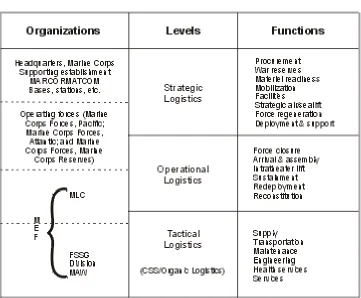
The structural organization of the Marine Corps consists of Headquarters, Marine Corps; operat-ing forces; the Marine Corps Reserve; and the supporting establishment. Each category has in-herent logistics capabilities and specific logistics responsibilities at the strategic, operational, and tactical levels of war. The primary mission of Headquarters, Marine Corps and the supporting establishment is to provide manpower and logis-tics support to the operating forces. Table 2-1 (on page 2-2) shows how each major organization functions at each level of war to provide a contin-uum of logistics support. Responsibilities and ca-pabilities overlap because no organization or level of support can function effectively without exten-sive, continuous coordination between supported and supporting organizations.
2001. Logistics Responsibilities
United States Code, Title 10, specifies logistics responsibilities within DOD. Within the Depart-ment of the Navy, the Commandant of the Marine Corps is responsible for Marine Corps logistics. The Commandant ensures that Marine Corps forces under the command of a combatant com-mander or Marine Corps forces under the opera-tional control of a unified, subunified, or joint t a s k f o r c e ( J T F ) c o m m a n d e r a r e t r a i n e d , equipped, and prepared logistically to undertake assigned missions.
a. Marine Corps Service Responsibilities
Marine Corps service responsibilities generally are exercised through administrative control chan-nels. The Marine Corps’ logistics responsibilities include—
l Preparing forces and establishing reserves
of equipment and supplies for the effective prosecution of war.
l Planning for the expansion of peacetime
components to meet the needs of war.
l Preparing budgets for submission through
the Department of the Navy based on input from Marine forces and Fleet Marine Force commanders assigned to unified commands (input must be in agreement with the plans and programs of the respective unified com-manders).
l Conducting research and development and
l Developing, garrisoning, supplying,
equip-ping, and maintaining bases and other in-stallations.
l Providing administrative and logistics
sup-port for all Marine Corps forces and bases.
l Ensuring that supported unified
command-ers are advised of significant changes in Marine Corps logistics support, including base adjustments, that would impact plans and programs.
b. Joint Responsibilities
The Commandant, as a member of the Joint Chiefs of Staff, ensures that the Marine Corps—
l Prepares integrated logistics plans, which
in-clude assignment of logistics responsibili-ties.
l Prepares integrated plans for military
mobi-lization.
l Reviews major personnel, materiel, and
lo-gistics requirements in relation to strategic and logistics plans.
l Reviews the plans and programs of
com-manders of unified and specified commands to determine their adequacy, feasibility, and suitability for the performance of assigned missions.
c. Subordinate Commander’s Responsibilities
[image:18.612.127.488.88.386.2]The Commandant vests in Marine Corps com-manders, at all levels of command, the responsi-bility and authority to ensure that their commands are logistically ready for employment and that lo-gistics support operations are efficient and effec-tive. This responsibility and authority is exercised through administrative command channels for routine matters of logistics readiness and service planning. Designated commanders (usually at the Marine Corps forces component and/or MAGTF level) are also under the operational command of unified, subunified, and/or JTF commanders for planning and conducting specified operations. Marine Corps forces, MAGTF commanders, and their subordinate commanders exercise the
appropriate logistics responsibilities and authority derived from the joint force commander of a spec-ified operation. Operational assignments do not preclude Service administrative command respon-sibilities and obligations. Commanders in the op-erating forces, supporting establishment, and the Marine Corps Reserve delegate authority for lo-gistics matters to designated subordinates.
2002. Command Relationships
and Other Authorities
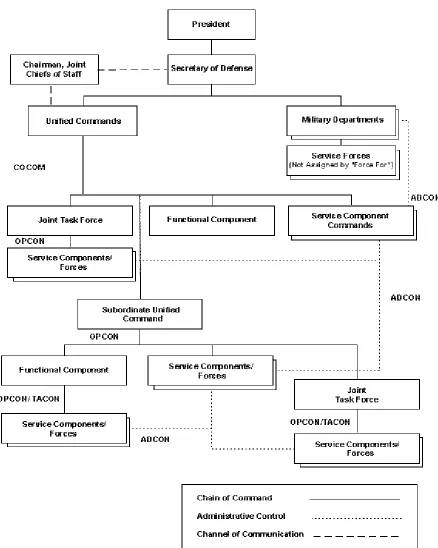
A commander must understand the distinction be-tween command relationships and other authori-ties, particularly in the area of logistics support. Command relationships consist of combatant command, operational control, tactical control, and support. Other authorities consist of adminis-trative control, coordinating authority, and direct liaison authority. See Joint Pub 0-2, Unified Ac-tion Armed Forces(UNAAF), for detailed infor-mation. See figure 2-1 (on page 2-4).
a. Combatant Command
Combatant command (COCOM) is nontransfera-ble command authority established by United States Code, Title 10, Section 164. It is exercised only by commanders of unified or specified com-batant commands unless otherwise directed by the National Command Authorities. COCOM is the authority of a combatant commander to perform, over an assigned force, those functions of com-mand necessary to accomplish the missions as-signed to the command. These functions include organizing and employing commands and forces, assigning tasks, designating objectives, and giv-ing authoritative direction over all aspects of mili-tary operations, joint training, and logistics.
COCOM cannot be delegated. It should be exer-cised through the commanders of subordinate or-ganizations. Normally, this authority is exercised through subordinate joint force commanders, Ser-vice commanders, or functional component com-manders. COCOM provides full authority to organize and employ commands and forces as the
combatant commander considers necessary to ac-complish the assigned mission. Operational con-trol is inherent in COCOM. COCOM includes the authority to exercise directive authority for logis-tics matters (or delegate directive authority for a common support capability). A combatant com-mander’s directive authority for logistics includes the authority to issue directives, including peace-time measures, to subordinate commanders when authority is necessary to ensure the following:
l Effective execution of approved operation
plans.
l Effectiveness and economy of operation.
l Prevention or elimination of unnecessary
duplication of facilities and overlapping of functions among Service component com-mands.
The exercise of directive authority for logistics by a combatant commander is designed to enhance wartime effectiveness. It does not discontinue Service responsibility for logistics support or override peacetime limitations imposed by legis-lation, DOD policy or regulations, budgetary con-siderations, local conditions, and other specific conditions prescribed by the Secretary of Defense or the Chairman, Joint Chiefs of Staff.
b. Operational Control
Operational control (OPCON) is transferable command authority that may be exercised by commanders at any echelon at or below the level of combatant command (command authority). It includes authoritative direction over all aspects of military operations and the joint training neces-sary to accomplish the assigned mission. OPCON normally provides full authority to organize com-mands and forces and to employ those forces as the commander deems necessary. OPCON, in and of itself, does not include directive authority for logistics or matters of administration, discipline, internal organization, or unit training. These are elements of COCOM, and they must be specifi-cally delegated by the combatant commander.
subordinate joint force commanders, Service commanders, or functional component command-ers. Normally, the operational control channel
[image:20.612.78.516.79.627.2]di-rects operational employment of assigned forces, including the conduct of logistics support opera-tions at the operational and tactical levels of war.
Commanders in the operating forces and the Marine Corps Reserve normally exercise OPCON over subordinate organizations through estab-lished chains of command. Specified Marine forc-es and/or MAGTF commanders are assigned to designated joint force commanders for tactical employment.
c. Tactical Control
Tactical control (TACON) is the command au-thority over assigned or attached forces or com-mands or a military capability made available for tasking that is limited to the detailed and usually local direction and control of movements or ma-neuvers necessary to accomplish assigned mis-sions or tasks. TACON may be delegated to and exercised by commanders at any echelon at or be-low the level of combatant command. It is inher-ent in OPCON.
d. Support
Support is a command authority. A support rela-tionship is established by a superior commander between subordinate commands when one organi-zation should aid, protect, complement, or sustain another organization. Support relationships can be further categorized in terms of general support, mutual support, direct support, and close support.
Support may be exercised by commanders at any echelon at or below the level of combatant com-mand. The establishing authority is responsible for ensuring that both the supported and support-ing commanders understand the degree of author-ity the supported commander is granted. The National Command Authorities have the authority to designate a support relationship between two combatant commanders. The designation of a supporting relationship is important because it conveys priorities to commanders and staffs who are planning or executing joint operations.
e. Administrative Control
Administrative control (ADCON) is used for rou-tine, noncombat administration matters. It is the authority through which the Commandant exer-cises Title 10 responsibilities to prepare Marine
organizations for possible operational employ-ment under a unified, subunified, or JTF com-mander. The Marine Corps’ administrative control channel flows from the Commandant to all subordinate commanders in the operating forc-es, the Marine Corps Reserve, and the supporting establishment. The Commandant also directs the operations of the supporting establishment.
The administrative control channel generates and maintains operational capability through the func-tions of organizing, training, equipping, and sus-taining operational forces. ADCON includes direction or exercise of authority over subordinate or other organizations with respect to administra-tion and support. This includes organizaadministra-tion of Service forces, control of resources and equip-ment, personnel manageequip-ment, unit logistics, indi-vidual and unit training, readiness, mobilization, demobilization, discipline, and other matters not included in the operational missions of subordi-nate or other organizations.
f. Coordinating Authority
Coordinating authority is a consultative relation-ship, not an authority. It is more applicable to planning than to operations. Coordinating authori-ty may be exercised by commanders or individu-als at any echelon at or below the level of combatant command. Coordinating authority is delegated to a commander or individual for coor-dinating specific functions and activities involv-ing forces of two or more military departments or forces of the same Service. Commanders have the authority to require consultation between parties, but not to compel agreement.
g. Direct Liaison Authorized
2003. Headquarters, Marine
Corps
Headquarters, Marine Corps staffs, departments, and divisions discussed in the following subpara-graphs are responsible to the Commandant for ad-ministrative management, policy generation, and provision of operational guidance for the operat-ing forces, the Marine Corps Reserve, and the supporting establishment.
a. Installation and Logistics Department
The Commandant delegates authority for desig-nated matters of Marine Corps logistics policy and management to the Deputy Chief of Staff, In-stallations and Logistics (I&L) Department. This authority includes liaison and coordination for lo-gistics action with Headquarters, Marine Corps staff principals, Marine Corps commanders, sis-ter-Services, the Joint staff, and DOD agencies. Within the I&L Department, there are functional divisions responsible for plans, policies, and stra-tegic mobility (Code LP); facilities and services (Code LF); and contracting (Code LB).
Note: At the time of publication, responsibility for Marine Corps life cycle management was in tran-sition from Headquarters, Marine Corps cogni-zance to the recently created Marine Corps Material Command (MARCORMATCOM) (see par. 2007b). Logistics issues pertaining to the in-frastructure management process and articula-tion of Service logistics policy will be retained by Headquarters, Marine Corps I&L Department. As specific responsibilities are realigned between Deputy Chief of Staff, I&L Department, and Com-mander, MARCORMATCOM, they will be incor-porated as a change to this publication.
The following functions are executed by the divi-sion indicated in parentheses:
l Formulating Marine Corps strategic
mobili-ty policy and programs (Code LP).
l Coordinating Marine Corps sustainability
policy and programs (Code LP).
l Coordinating Marine Corps logistics
infor-mation systems issues with Marine Corps users, the Office of the Secretary of De-fense, and the joint community (Code LP).
l Coordinating with other Services/agencies
on inter-Service logistics matters that affect the Marine Corps (Code LP).
l Developing logistics ground equipment
re-source reporting, policy, and criteria (Code LP).
l Providing policy guidance and technical
di-rection in the management of Marine Corps supply and maintenance systems (Code LP).
l Sponsoring structure for the MAGTF CSSE
(Code LP).
l Sponsoring, formulating, justifying,
manag-ing, and executing the Operation & Mainte-nance, Marine Corps Division of the Navy Working Capital Fund, Marine Corps Indus-trial Fund, and the Marine Corps portion of Family Housing Navy and Military Con-struction Navy appropriations (Codes LP and LF).
l Developing and managing facilities policy,
acquisition, construction, leasing, encroach-ment protection, technical inspections, and real property maintenance (Code LF).
l Providing oversight of Marine Corps
instal-lation programs worldwide (Code LF).
l Disposing of facilities and real property
(Code LF).
l Providing oversight of the food service,
laundry, and dry cleaning plants (Code LF).
l Providing oversight of transportation and
traffic management (Code LF).
l Managing garrison mobile equipment and
property programs (Code LF).
l Providing contingency, crisis support
trans-portation management office, and subsis-tence support for deploying forces (Code LF).
l Providing support and oversight of the
con-tracting function Marine Corps-wide (Code LB).
l Procuring supplies, equipment, and services
systems/equipment for operating forces) (Code LB).
l Establishing contractual liaison with
organi-zational elements of the Marine Corps, De-partment of the Navy, DOD, and other Government agencies, as necessary (Code LB).
b. Aviation Department
The Aviation Department is responsible for desig-nated matters of logistics policy and management. It coordinates logistics action with other agencies as part of its responsibility for Marine Corps avia-tion.
Specific functions within the purview of the Avia-tion Logistics Support Branch, AviaAvia-tion Depart-ment, include—
l Coordinating the aviation logistics and
avia-tion ground support requirements relative to maritime and/or land prepositioning.
l Assisting the Chief of Naval Operations and
other support agencies in the distribution of aeronautical and related material to ensure adequate outfitting of Marine Corps aviation units.
l Developing logistics plans and programs for
aviation units and representing Marine Corps aviation in the development of naval aviation maintenance and supply policies and procedures.
l Representing Marine Corps aviation in the
development and execution of maintenance plans, test equipment master plans, and inte-grated logistics support plans for aeronauti-cal weapons systems and related equipment subsystems and ordnance.
l Representing the Marine Corps in
develop-ing naval aviation maintenance and aviation supply policies and procedures.
l Providing comments, directions, and
recom-mendations on logistics support for aviation weapons systems and associated equipment that are under development or in procure-ment.
l Coordinating the aviation logistics and
avia-tion ground support requirements relative to deployment and employment and maritime and/or land prepositioning.
l Developing plans and programs and
imple-menting, in conjunction with cognizant commands and offices, Marine Corps avia-tion needs for expediavia-tionary airfield equip-ment and operations including, but not limited to, arresting gear, lighting systems, mobile facilities, weather services, cold weather equipment, shelters, work spaces, clothing, aircraft fire and rescue, and avia-tion ground support.
l Determining priority of aviation ground
support equipment during PPBS (Planning, Programming, and Budgeting System) pro-cesses.
l Sponsoring aviation-peculiar Marine
Corps-funded ground support equipment procure-ment.
l Developing and monitoring plans and
pro-grams on aviation ordnance.
l Coordinating logistics support needs for
air-borne armament and armament-handling equipment.
l Supervising and monitoring the Aviation
Explosive Safety Program and conventional ammunition.
l Supervising and monitoring the Marine
Corps portion of the Navy Targets and Range Program and its associated instru-mentation.
l Functioning as the occupational field
spe-cialists in aviation maintenance, avionics, ordnance, supply, airfield services, and weather services military occupational spe-cialties (MOSs).
l Monitoring and analyzing aircraft readiness
data and making recommendations on ap-propriate actions.
l Assisting in planning, developing, and
l Identifying, monitoring, and resolving
avia-tion installaavia-tion, encroachment, air installa-tion compatible use zone, and airfield and facility criteria issues and problems.
l Reviewing activity master plans, site
evalu-ation reports, advance base functional com-ponents, aviation war reserve materiel (WRM) plans, and range and target air space management requirements.
l Assisting Chief of Naval Operations and
other support agencies in the planning, pro-gramming, development, and fielding of au-tomated data processing equipment and software to support Marine aviation logis-tics.
l Providing program direction for the Marine
aviation logistics support program (MAL-SP) within approved aviation plan require-ments.
l Coordinating with Chief of Naval
Opera-tions, Naval Air Systems Command and subordinate Department of the Navy activi-ties in matters pertaining to MALSP policy and requirements
c. Programs and Resources Department
The Programs and Resources Department has var-ious responsibilities for developing Marine Corps warfighting capabilities. It coordinates the devel-opment and documentation of Marine Corps pro-grams. It is responsible for generating the Marine Corps portion of the biennial Department of the Navy Program Objective Memorandum (POM) in the PPBS. The Planning, Programming, and Bud-geting System controls both Marine Corps logis-tics support requirements (based on the funded levels of forces and equipment) and logistics ca-pabilities (based on authorized operations and maintenance funding levels, fielded forces, and equipment being supported). Tasks performed by the Programs and Resources Department include, but are not limited to, the following:
l Serving as the Headquarters, Marine Corps
principal point of contact for all program planning aspects of the DOD Planning,
Pro-gramming, and Budgeting System within military department channels.
l Monitoring and reviewing the execution of
Marine Corps programs and assessing the attainment of objectives as reflected in the Department of the Navy POM and the DOD future years defense program.
l Coordinating and publishing such guidance
as is required for development of the Marine Corps POM and portions of the Department of the Navy POM.
l Providing principal Headquarters, Marine
Corps staff representation to Navy program-ming forums.
l Coordinating staff action in developing data
for inclusion in the POM and submitting the approved data to the Department of the Navy.
l Providing a capability for analyzing existing
and proposed Marine Corps policies and programs to identify potential effects on fis-cal, manpower, and materiel resources.
l Providing interface with external program
analysis efforts of concern to the Marine Corps.
2004. Staff Cognizance and
Logistics Support
Commanders normally delegate authority for lo-gistics matters to members of their staffs and sub-o r d i n a t e c sub-o m m a n d e r s a s d i s c u s s e d i n t h e following subparagraphs.
a. G-4/S-4 (Logistics Officer)
within a command and between supported and supporting commands.
Specific responsibilities include—
l Advising the commander and the G-3/S-3
on the readiness status of major equipment and weapons systems.
l Developing policies and identifying
require-ments, priorities, and allocations for logis-tics support.
l Integrating organic logistics operations with
logistics support from external commands or agencies.
l Coordinating and preparing the
nonaviation-peculiar logistics and CSS portions of plans and orders.
l Supervising the execution of the
command-er’s orders regarding logistics and combat service support.
l Ensuring that the concept of logistics
sup-port clearly articulates the commander’s vi-sion of logistics and CSS operations.
l Ensuring that the concept of logistics
sup-ports the tactical concept of operations and the scheme of maneuver.
l Identifying and resolving support
deficien-cies.
l Collating the support requirements of
subor-dinate organizations.
l Identifying the support requirements that
can be satisfied with organic resources and passing nonsupportable requirements to the appropriate higher/external command.
l Supervising command support functions
tra-ditionally associated with garrison logistics support, food services, maintenance man-agement, ordnance, ammunition, and real property management.
l Coordinating with the amphibious task force
(ATF) N-4 and the MAGTF G-4/S-4 for the aviation-specific support provided under ACE G-4/S-4 cognizance.
b. G-3/S-3 (Operations Officer) of Logistics Organizations
The G-3/S-3 of organizations provide ground-common or aviation-peculiar logistics support to other organizations plans and supervise logistics support operations. Specific functions of the G-3/ S-3 include—
l Coordinating with the G-3/S-3 of supported
organizations during the development of their concepts of operation and schemes of maneuver to ensure that they are support-able.
l Coordinating with both the G-3/S-3 and
G-4/S-4 of supported organizations to iden-tify logistics support requirements and de-velop estimates of supportability for their concepts of operation.
l Recommending the composition and
organi-zation of supporting organiorgani-zations based on guidance from higher headquarters and the concepts of operation and schemes of ma-neuver of supported organizations.
l Coordinating and supervising execution of
the command’s logistics support operations and providing liaisons elements to the sup-ported commands. (The CSSE is the prima-ry agency for ground-common logistics support operations in the MAGTF. The ACE is responsible for aviation-specific support.)
c. Assistant Chief of Staff, Aviation Logistics Department Officer, and Commanding Officer, Marine Aviation Logistics Squadron
The aviation logistics department officer and the Marine logistics squadron commanding officer—
l Determine the ACE’s aviation-specific
lo-gistics support requirements, assign priori-ties, and allocate logistics resources for the ACE and those areas under their cogni-zance.
l Coordinate with the appropriate Navy
activ-ities/agencies when the resources to support an ACE (in those areas under their cogni-zance) are to be provided in whole or in part by Navy units/agencies.
l Coordinate with the MAGTF G-4/S-4, the
CSSE G-3/S-3, and the ACE G-4/S-4 on in-tegration of organic capabilities of ACE lo-gistics support organizations under their cognizance.
l Coordinate with the ATF N-4 and the
MAGTF G-4/S-4 for aviation-peculiar sup-port under their cognizance.
l Prepare and supervise applicable portions of
the ACE operation order and operation plan relating to logistics functions under their cognizance.
d. Comptroller
The comptroller is responsible for matters per-taining to financial management. The comptroller has cognizance over budgeting, accounting, dis-bursing, and internal review. In organizations not authorized a comptroller, fiscal matters may be assigned to one or more staff sections. Normally, comptroller responsibilities are assigned to the G-4/S-4, and disbursing responsibilities are as-signed to the G-1/S-1 (personnel officer). Func-tions performed by the comptroller include, but are not limited to, the following:
l Budgeting, which includes—
n Preparing guidance, instructions, and
di-rectives for budget matters.
n Reviewing resource requirements and
jus-tifications for command financial pro-grams.
n Compiling annual, exercise, and
opera-tion budgets.
l Accounting, which includes—
n Maintaining records, including records of
obligations and expenditures against al-lotments and project orders.
n Preparing financial accounting reports. n Supervising cost accounting functions.
l Disbursing, which includes—
n Managing payrolls, travel and per diem
allowances, and public vouchers.
n Preparing disbursing reports and returns.
l Internal review, which includes—
n Designing new and improving existing
audit policies, programs, methods, and procedures.
n Testing the reliability and usefulness of
accounting and financial data.
n Examining the effectiveness of control
provided over command assets and mak-ing appropriate recommendations.
2005. Operating Forces
The operating forces constitute the forward pres-ence, crisis response, and fighting power avail-able to joint force commanders. Marine Corps operating forces are primarily composed of Marine Corps Forces Atlantic (II MEF) under the Commander, Marine Corps Forces, Atlantic, and Marine Corps Forces, Pacific (I and III MEF) un-der the Commanun-der, Marine Corps Forces, Pacif-ic. Each commander of Marine Corps forces is assigned or designated as the Marine Corps com-ponent to the unified command to which his forc-es are assigned. The commander of Marine Corps forces is responsible for the coordination and management of strategic and operational support issues.
a. Marine Corps Forces Component
commands (e.g., U.S. Forces Korea and U.S. Forces Japan). Regardless of the command level, the Marine Corps component commander deals directly with the joint force commander in matters that affect assigned Marine Corps forces. The Marine Corps component commander is responsi-ble for training, equipping, and sustaining Marine Corps forces assigned to the joint force. The Marine Corps component commander retains and exercises control of Marine Corps logistics sup-port, except for Service support agreements, or as directed by the joint force commander. Regard-less of how the joint force commander conducts operations, the Marine Corps component com-mander provides administrative and logistics sup-port for the MAGTFs.
b. Marine Logistics Command
The commander of Marine Corps forces may es-tablish a Marine logistics command to support the functions of force closure, sustainment, and reconstitution/redeployment. The Marine logis-tics command establishes the Marine Corps the-ater support structure to facilitate reception (arrival/assembly), staging, onward movement, and integration operations. On order, the Marine Corps logistics command provides operational lo-gistics support to Marine forces as the Marine component operational-level logistics agency in theater. It is a task organization option, not a per-manent organization. The commander of Marine Corps forces may choose to assign a specific FSSG responsibility for Marine logistics com-mand functions. The comcom-mander of Marine Corps forces assigns Marine component resourc-es to an FSSG for detailed task organization and conduct of Marine logistics command support op-erations in theater based on the operational situa-tion, theater geography, C2 (for both tactical operations and logistics), and infrastructure re-quirements.
c. Navy and Marine Corps Type Commanders
Naval operating forces are assigned to type com-manders for the purposes of training, employ-ment, and logistics support. The duties of this assignment complement, rather than conflict with, concurrent duties as a component commander.
Commanding General, Fleet Marine Force, Pacif-ic, and Commanding General, Fleet Marine Force, Atlantic, have type commander status for the Marine Corps to include class V(A) materiel, except for Marine Corps aviation. The Command-er, Naval Air Force, Atlantic; the CommandCommand-er, Naval Air Force, Pacific; and the Commander, Naval Air Force, Marine Corps Reserve, are the type commanders for Marine Corps aircraft and aviation support, except for aviation ammunition. Aviation ammunition support resides with Com-manding General, Fleet Marine Forces, Atlantic, and Commanding General, Fleet Marine Forces, Pacific. Commanding General, Fleet Marine Forces, Pacific, and Commanding General, Fleet Marine Forces, Atlantic, also exercise administra-tive control in assignment, employment, and lo-gistics support of aircraft and engines as specified by the Chief of Naval Operations.
d. Marine Air-Ground Task Force
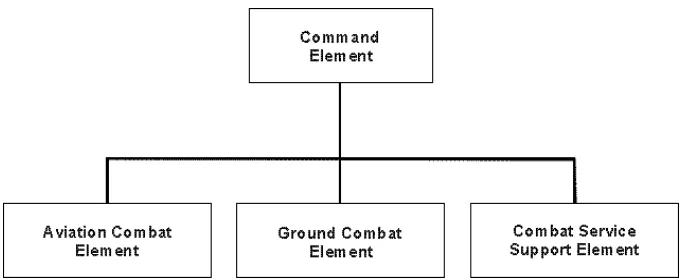
The MAGTF is specifically designed to meet mis-sion-oriented requirements of amphibious warfare and expeditionary operations. It addresses the needs for interoperability and mutual support with other elements of the fleet as well as with joint/ multinational forces. The MAGTF is formed fol-lowing a building block concept (the joint force/ fleet commander’s operational requirement or mission is analyzed and type units are drawn from a Marine division, aircraft wing, and FSSG). It is placed under the command of one commander to form an air-ground team that will accomplish the mission.
days of expeditionary operations independent of resupply.
(1) Marine Expeditionary Force. The MEF provides its own headquarters element (normally supported by at least one FSSG as the CSSE), at least one division as the ground combat element, and a Marine aircraft wing as the ACE. In addi-tion to the logistics support capabilities that each MEF possesses, the MEF is designed to deploy with accompanying supplies to support its initial operations for 60 days.
The MEF command element provides the com-mand and control necessary for the effective plan-ning and execution of all MAGTF operations. Its headquarters has some limited self-support. It is not logistically self-sufficient and is supported by the FSSG.
The CSSE is task-organized to provide a full range of support functions from sea bases aboard naval shipping or from expeditionary bases ashore. The CSSE provides sustainment for the MAGTF. The FSSG is the MEF’s CSSE. It is a
[image:28.612.118.460.74.214.2]grouping of functional battalions that provides tactical-level ground CSS support to all elements of the MEF. The FSSG can also provide theater-level operational logistics support to the Marine component of a joint command, when designated the Marine logistics command. FSSG organiza-tions are structured to provide task-organized groups to support independently deployed battal-ions, regiments, and MAGTFs or geographically separated units in garrison. The FSSG is the em-bodiment of a fundamental principle—economy of operations through centralization of logistics resources and decentralization in executing sup-port operations. The FSSG was designed in a con-scious effort to attain efficient use of scarce logistics resources (personnel, supplies, and equipment) and to effect a rational, aggressive as-signment of work priorities. On the basis of METT-T, the FSSG task-organizes the appropri-ate capability into smaller combat service support groups/detachments in direct support of specific task-organized units of the MEF for temporary operations or for more prolonged garrison support in isolated locations. It also sources MEU service support groups, the CSSE of a MEU, from its or-ganic CSS capability (see fig. 2-3).
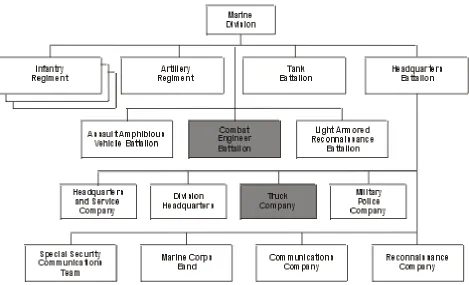
[image:28.612.76.528.605.708.2]The MEF GCE is task-organized to conduct ground operations in support of the MAGTF mis-sion. The Marine division is the MEF GCE. It de-pends on the FSSG as its primary source of logistics support. However, the division has or-ganic combat engineer capability that it can em-ploy in general and direct support of division organizations before requesting additional support from the engineer assets of the FSSG. The divi-sion also possesses a limited general and direct support motor transport capability, which is nor-mally employed in support of the division head-quarters. See figure 2-4.
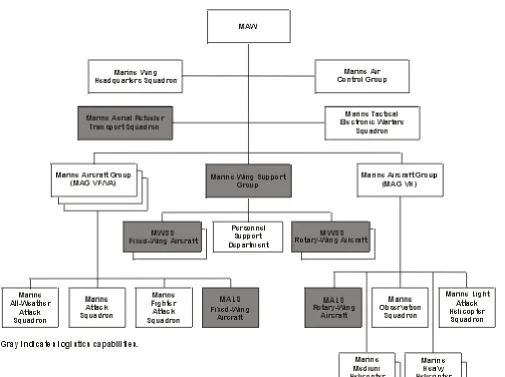
The ACE is task-organized to support the MAGTF mission by performing some or all of the six functions of Marine aviation: antiair warfare, assault support, offensive air support, air recon-naissance, electronic warfare, and control of aircraft and missiles. The Marine aircraft wing (MAW) is the MEF’s ACE. The MAW possesses limited CSS capabilities in the MWSG that provides aviation-oriented ground logistics
support. These capabilities include engineer, transportation, and services capabilities for gener-al and direct support of wing organizations both in garrison and while deployed. The Marine Aviation Logistics Squadron provides intermedi-ate-level, aircraft-specific aviation supply, maintenance, avionics, and ordnance capabilities in direct support of aircraft squadrons and groups. The MAW depends on the FSSG as its primary external source of ground logistics support and for delivery of aviation bulk commodities. See figure 2-5 (on page 14).
[image:29.612.77.546.72.357.2](2) Marine Expeditionary Unit (Special Operations Capable). The Marine expedition-ary unit (special operations capable) (MEU [SOC]) is the standard forward-deployed Marine expeditionary organization. It continually forward deploys for quick response to potential or devel-oping contingencies. It has a command element, a reinforced battalion, a composite squadron, and a MEU service support group. The standard accom-panying sustainment for a MEU is 15 days of
supplies, except for aviation. Aviation support aboard ships is designated for 90 days of combat flying hours, except for class V(A), which is constrained to 15 days of ammunition due to limits of amphibious explosive storage.
(3) Special Purpose MAGTF. A special pur-pose MAGTF is organized to accomplish a spe-cific mission, operation, or exercise. As such it can be organized, trained, and equipped to con-duct a wide variety of expeditionary operations. The size and capabilities of its elements will vary with the mission. Normally, a combat service sup-port detachment (CSSD) is task-organized to be the CSSE. The assigned mission will reflect the
logistics functional capabilities and the level of organic sustainment assigned.
(4) Air Contingency MAGTF. An air contin-gency MAGTF (ACM) consists of air-deployable forces that are maintained in both Marine Forces, Pacific, and Marine Forces, Atlantic. Lead ele-ments are always ready to deploy on short notice. ACMs are task-organized based on mission, threat, and airlift availability.
[image:30.612.50.555.88.465.2]The size of the force can range from a reinforced rifle company to a regimental-sized force with an appropriately sized CSSE. The CSSE is organized
to support the ACM in accomplishing the follow-ing missions:
l Stability operations (presence,
humanitari-an assisthumanitari-ance, security, peacekeeping, humanitari-and counterinsurgency operations).
l Limited-objective operations
(noncomba-tant evacuation, amphibious raid, airfield seizure, and counterterrorism operations).
l Conventional combat operations
(amphibi-ous operations, operations ashore, and rein-forcement).
e. Other Logistics Support Programs
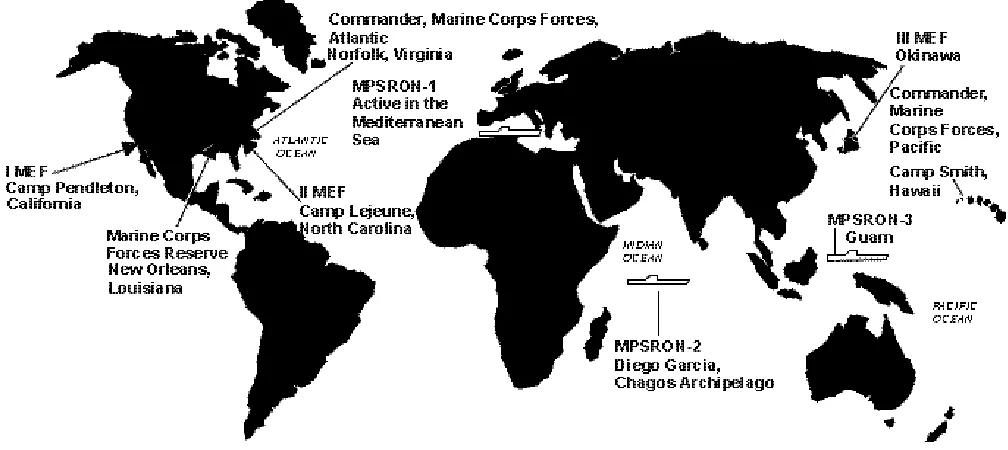
(1) Maritime Prepositioning Forces. MPFs provide an added dimension to strategic mobility, readiness, and global responsiveness. The MPF program involves 13 ships (three new ships are planned by fiscal year 2000) and includes three m a r i t i m e p r e p o s i t i o n i n g s h i p s s q u a d r o n s (MPSRONs). These squadrons are strategically positioned around the world (see fig. 2-6). By prepositioning the bulk of equipment and 30 days of supplies for a notional 17,600-man force aboard specially designed ships, the MPF pro-gram reduces MAGTF response time from weeks to days. Included in each MPSRON is organiza-tional-level, common aviation support equipment
and limited, intermediate-level support equip-ment.
Personnel and selected equipment designated to marry up with MPF supplies and equipment make up what is termed the fly-in echelon. The fly-in echelon can be airlifted quickly to an objective ar-ea to join with required equipment at a secure site. As part of this fly-in echelon, the MAGTF ACE deploys with a fly-in support package that, when combined with prepositioned assets on the MPSRON, provides critical aviation support for 30 days of combat flying. Equipment and sup-plies, to a limited extent, can be offloaded selec-tively to support smaller MAGTFs.
[image:31.612.57.561.78.303.2](2) Aviation Logistics Support Ship. The aviation logistics support ship (TAVB) is a program developed to transport critical, tailored, intermediate-level maintenance and supply support to a forward operating area in support of deployed aircraft. There are two TAVBs (one located on the west coast and one on the east coast). They are under the administrative control of the Military Sealift Command in Ready Reserve Force-5. They provide a dedicated sealift for movement of the Marine aviation logistics squadron supplies and equipment and an afloat intermediate maintenance activity capability. This
immediate maintenance activity is task-organized to repair aircraft parts and equipment of the aircraft platforms within the MAGTF.
(3) Norway Geoprepositioning Program. The Norway Geoprepositioning Program is a ca-pability similar in scope to that of an MPS squad-r o n . T h e p squad-r o g squad-r a m , e s t a b l i s h e d w i t h t h e Government of Norway, permits the preposition-ing and maintenance of a brigade’s worth of equipment in underground storage facilities in Norway.
2006. Marine Corps Reserve
The Marine Corps Reserve is organized under the Commander, Marine Corps Forces Reserve. The mission of the Marine Corps Reserve is to provide trained units and qualified individuals to be available for active duty in time of war or national emergency and at such other times as the national security may require. The structure of the Marine Corps Reserve predominantly reflects the active operating forces. The Marin