HEADQUARTERS DEPARTMENT OF THE ARMY
United States Army Training and Doctrine Command Fort Monroe, Virginia 23651-5000
TRADOC Pamphlet 600-4 1 October 2003
IET
FOREWORD
This handbook is a handy pocket reference for subjects in which you must maintain proficiency. It condenses information from field manuals, training circulars, Army regulations, and other sources.
You will need this handbook in initial-entry training (IET). Carry it with you at all times. Use it to review the training you will receive and to prepare for proficiency testing. It will also be useful throughout your military career.
This handbook addresses both general subjects and selected combat tasks. It includes evaluation guides to test your knowledge. You must know this information in order to be an effective soldier. The information on selected combat tasks is important, regardless of your grade or military occupational specialty (MOS).
i DEPARTMENT OF THE ARMY
HEADQUARTERS
UNITED STATES ARMY TRAINING AND DOCTRINE COMMAND
Fort Monroe, Virginia 23651-5000
PERSONNEL—GENERAL
IET SOLDIER'S HANDBOOK
(2 October 2003)
Chapter 1. General Subjects ... 1-1 Army History ... 1-1 Heritage and Traditions ... 1-3 Army Organization... 1-5 Chain of Command ... 1-7 Rank Insignia ... 1-8 Officer ... 1-8 Warrant Officer ... 1-10 Enlisted ... 1-11 Rank Abbreviations ... 1-12 Military Time ... 1-12 Customs and Courtesies ... 1-14 Saluting ... 1-14 Rendering Honor to the Flag ... 1-16 Courtesies ... 1-18 Role of the Chaplain ... 1-19
Personal Courage ... 2-22
Chapter 3. Standards of Conduct...3-1 Uniform Code of Military Justice ... 3-1 Punitive articles ... 3-4 Forms of Punishment ... 3-9 Courts-Martial ... 3-12 Nonjudicial Punishment ... 3-14 Equal Opportunity Policy ...3-15 Complaint Process ... 3-16 Whistleblower Protection Act ... 3-18 Fraternization ... 3-20 Improper Associations ... 3-21 Sexual Harassment Policy ...3-23 Appropriate Behavior ... 3-27 Alcohol and Drug Abuse ... 3-27 Consideration of Others ... 3-28 Homosexual Conduct Policy ... 3-28 Dignity and Respect ... 3-32 Rape Prevention ... 3-32 Suicide Prevention ... 3-34 Ethical Decision Making ... 3-38 Awards and decorations ... 3-38 Terrorism ... 3-43
iii Body Piercing and Tattoos ... 4-38 Uniform Wear and Maintenance ... 4-38 Boots ... 4-39 Insignia Placement ... 4-39 Individual Equipment ... 4-45 Bivouac Equipment ... 4-48 Physical Readiness Training (PRT) ... 4-52 Phases of PRT ... 4-53 Components of PRT ... 4-55 Principles of PRT ... 4-56 Training Injuries ... 4-56 Selecting Proper Running Footwear ... 4-58 Sports Bra Selection ... 4-60 Nutrition ... 4-60 Safety ... 4-63 Prevention of Cold Weather Injuries ... 4-63 Prevention of Hot Weather Injuries ... 4-67 Prevention of Hyponatremia ... 4-70 Field and Personal Hygiene ... 4-71 Disease Prevention ... 4-71 Guard Duty ... 4-74 Interior Guard ... 4-74 Exterior Guard ... 4-77
CHAPTER 5. Selected Common Tasks ... 5-1
Section I. COMMUNICATIONS ... 5-1 113-571-1022 Perform Voice Communications ... 5-1
Section II. NAVIGATION ... 5-9 071-329-1001 Identify Terrain Features on a Map ... 5-9 071-329-1002 Determine the Grid Coordinates
of a Point on a Military Map ... 5-17 071-329-1003 Determine a Magnetic
Section III. WEAPONS ...5-35 M16A2 Rifle ... 5-35 071-311-2025 Maintain an M16A2 Rifle ...5-35 071-311-2026 Perform a Function Check
on an M16A2 Rifle ... 5-51 071-311-2027 Load an M16A2 Rifle ... 5-54 071-311-2028 Unload an M16A2 Rifle ...5-59 071-311-2029 Correct Malfunctions of an M16A2 Rifle ... 5-60 NTN Routine Preventive Maintenance Checks and
Services of the M16A2 Rifle ...5-62 NTN Marksmanship Fundamentals ...5-65 NTN Firing Positions ...5-75 NTN Position of the Coach ...5-78 NTN Checklist for the Coach ...5-79 071-311-2030 Zero an M16A2 Rifle ...5-80 M249 Squad Automatic Weapon ...5-88 Clearing Procedures ...5-89 Load an M249 SAW ...5-90 Unload an M249 SAW ...5-92 Correct Malfunctions of an M249 SAW ...5-93 Hand Grenades ...5-95 071-325-4401 Perform Safety Checks on Hand Grenades ...5-95 071-325-4407 Employ Hand Grenades ...5-99 M18A1 Claymore Mine ...5-101 071-325-4425 Employ an M18A1 Claymore Mine ...5-101 071-325-4426 Recover an M18A1 Claymore Mine ...5-113 M203 Grenade Launcher ...5-115 071-311-2127 Load an M203 Grenade Launcher ...5-116 017-311-2128 Unload an M203 Grenade Launcher ...5-118 M136 AT4 Light Antiarmor Weapon ...5-119 071-054-0001 Prepare an M136 Launcher for Firing ...5-121 071-054-0003 Perform Misfire Procedures on
an M136 Launcher ...5-128 071-054-0002 Restore an M136 Launcher to
v Section IV. INDIVIDUAL SKILLS ... 5-131 NTN Cover, Concealment and Camouflage, ... 5-131 NTN Operate as a Member of a Squad ... 5-142 NTN Foot Marches ... 5-152 NTN Fighting Positions ... 5-164 NTN Bayonet/Combatives Fighting ... 5-172 NTN Rifle with Fixed Bayonet ... 5-187
Section V. TACTICAL SKILLS ... 5-194 301-348-1050 Report Information of Potential
Intelligence Value (SALUTE Report) ... 5-194 071-326-0502 Move Under Direct Fire ... 5-198 071-326-0511 React to Flares ... 5-207 071-331-0801 Challenge Persons Entering Your Area ... 5-208
Section VI. NUCLEAR, BIOLOGICAL, CHEMICAL 5-210 NTN Standardized MOPP Levels ... 5-211 031-503-1014 Detect Chemical Agents
Using M8 or M9 Detector Paper ... 5-213 031-503-1018 React to a Nuclear Hazard ... 5-217 031-503-1019 React to Chemical or
Biological Hazard or Attack ... 5-223 031-503-1024 Replace Canister on Your
M40-Series Protective Mask ... 5-227 031-503-1025 Protect Yourself from Chemical and
Biological Injury or Contamination Using Your
M40-Series Protective Mask with Hood ... 5-229 031-503-1026 Maintain Your M40-Series
Protective Mask with Hood ... 5-240 031-503-1033 Decontaminate Your Skin
Using the M291 Skin Decontaminating Kit (SDK) ... 5-250 031-503-1034 Decontaminate Your Individual
Equipment Using the M295 Individual Equipment
Decontamination Kit (IEDK) ... 5-256
NTN Perform First Aid to Restore Breathing ...5-269 NTN Perform First Aid to Control Bleeding ...5-281 081-831-1007 Perform First Aid for
Treatment of Burns ...5-299 081-831-1034 Perform First Aid
for Splinting a Fracture ...5-303 081-831-1053 Perform First Aid
and Practice Individual Preventive Medicine
Countermeasures ...5-311 081-831-1044 Perform First Aid
for Nerve Agent Injury ...5-341 081-831-1046 Perform First Aid
and Transporting Casualties ...5-352
Appendix
1-1 CHAPTER 1
GENERAL SUBJECTS
ARMY HISTORY
“Resolved, That a General be appointed to command all the continental forces, raised, or to be raised, for the defence of American liberty.” The above resolution of the Second Continental Congress on 14 June 1775 established the beginnings of the United States Army as we know it today. The very next resolution unanimously selected George Washington as commanding general of the first Continental Army.
From Lexington to Trenton to Valley Forge, the
Continental Army proved the critical force in fighting and winning the war for American Independence (See Appendix B – Declaration of Independence). The Army has been the keeper of American freedom ever since.
From the outset, civilian control of the military was a governing principle of the American system. In 1787, the Constitution placed the military under the control of the President. His role as commander-in-chief requires every soldier to follow and obey his orders (See Appendix F – Soldier Responsibilities).
intended that the Regular Army serve only as a supplement to local militias, the “regulars” ultimately played the crucial role in both the War of 1812 and the Mexican War (1846-48).
In December of 1860, the Army consisted of merely 16,000 officers and enlisted men. By 1865, Civil War expansion had increased that number to an astounding 1,000,000. Victory for the Union in the Civil War returned the Army to a strength of only 25,000 troops.
An analysis of the Army’s role in the Spanish-American War (1898) revealed deficiencies in the War Department. After becoming Secretary of War in 1899, Elihu Root reorganzied and revitalized the department. By the time the Army entered World War I in 1917, it was at its peak in terms of training and professionalism. Over 2,000,000 men followed General John J. Pershing to France as part of the American Expeditionary Force.
Following victory in the “War to End All Wars,” the Army remained at a strength of approximately 125,000 from 1919 to 1939. However, when Nazi Germany invaded France in 1940, the U.S. Government re-instituted conscription (the draft) and forces ballooned to 1,640,000.
1-3 1944, American forces fought with courage to preserve freedom for the world.
Following the fall of the Nazis and the surrender of the Japanese in August 1945, the Army again contracted – this time to a strength of approximately 500,000.
Expansions followed during America’s participation in the Korean and Vietnam Wars. And though it reduced in size during the interim periods of peace, the Army still remained relatively large due to the looming presence of the Cold War.
When the forces of Communism fell in the late 1980s, civilian leaders began to re-evaluate the Army’s role and it again went through a dramatic reduction in size. Recently, the Army claimed a major victory in Desert Storm, defeating the 4th-largest enemy in the world in 100 hours. The Army has also had a crucial role in bringing peace to several areas of conflict as well as continuing to protect and advance American interests. No matter how the Army changes, or what the specific mission may be, the soldier’s role never changes: to support and defend the Constitution of the United States against all enemies, foreign and domestic.
HERITAGE AND TRADITIONS
The Army Song
"The Army Goes Rolling Along" is the official Army song (See Appendix D). It is proper to stand at attention when it is played. Known originally as the “Caisson Song”, the music was composed in 1908 by Lieutenant
brigadier general). The Army dedicated it as the official Army Song on 11 November 1956 – Veteran’s Day.
Uniforms
Historically, military uniforms have made it easier to identify units. Until the nineteenth century, different military organizations used brightly-colored clothing to distinguish themselves on the battlefield. This made it easier for a commander to control his forces. As weapons have become more lethal, survivability has become more crucial. Today, American military uniforms emphasize protective coloration. However, the Army has maintained the heritage of historical uniforms through more formal attire such as Dress Blues.
Formations
Organizational Flags and Guidons
Every military unit has its own colors. Colors represent the heart of a unit and are always located with the commander. Units receive streamers for their
achievements that are then attached to their guidon above the colors. Capturing a unit’s colors represents defeating that unit; in recent history a unit would fight to the death to protect its colors. The image of the American Flag accompanying General George Washington as he crosses the Delaware River signifies the importance of colors on the battlefield – from the nation’s symbol down to the company guidon.
ARMY ORGANIZATION
The United States Army is made up of two parts: the active and reserve components. The Active Component consists of soldiers who are on full-time active duty. The Reserve Component consists of the Army National Guard and the Army Reserve. The Reserve Component receives
military training and is ready to be called to active duty if necessary. Army units can be organized several ways, but the following example is fairly typical:
• The squad is the smallest unit, consisting of eight to ten soldiers. The squad leader is a Noncommissioned Officer (NCO).
• The platoon includes the platoon leader (2LT/1LT), platoon sergeant (SFC) and two or more squads.
• The company includes the company commander (CPT), first sergeant (1SG) a headquarters, and two or more platoons.
• The battalion includes the battalion commander (LTC), his staff and headquarters, the command sergeant major (CSM) and approximately 3-5 companies.
• The brigade includes the brigade commander (COL), command sergeant major, a headquarters, and
approximately 3-6 battalions.
1-7 1st Infantry Division – Germany (HQ)
2nd Infantry Division – Korea
3rd Infantry Division – Ft. Stewart, GA (HQ) 4th Infantry Division – Ft. Hood, Texas (HQ) 10th Mountain Division – Ft. Drum, New York 25th Infantry Division – Hawaii
82nd Airborne Division – Ft. Bragg, N. Carolina 101st Airborne Division – Ft. Campbell, KY 1st Armored Division – Germany (HQ) 1st Cavalry Division, Ft. Hood, Texas
• Organizations higher than the division include the Corps, Army, Major Command (MACOM), and in times of war, the Theater.
Chain of Command and NCO Support Channel
Your chain of command has legal responsibility for your training, discipline, and overall welfare. It includes the noncommissioned officer directly over you (your first-line supervisor), as well as officers and civilians from your company commander to the President of the United States. The NCO support channel, while not directly a part of your chain of command, is often just as important, and includes the noncommissioned officers (PSG, 1SG, CSM) who play a vital role in whatever unit you are a part of.
My Chain of Command
Battalion Commander ____________________________ Brigade Commander______________________________ Division/Post Commander _________________________ TRADOC Commander____________________________ Chief of Staff of the Army _________________________ Secretary of the Army_____________________________ Secretary of Defense______________________________ President of the United States_______________________
My NCO Support Channel
Platoon Sergeant_________________________________ First Sergeant ___________________________________ Battalion CSM __________________________________ Brigade CSM ___________________________________ Division/Post CSM ______________________________ TRADOC CSM _________________________________ Sergeant Major of the Army _______________________
RANK INSIGNIA
You must be able to recognize the ranks of Army personnel immediately.
Officer
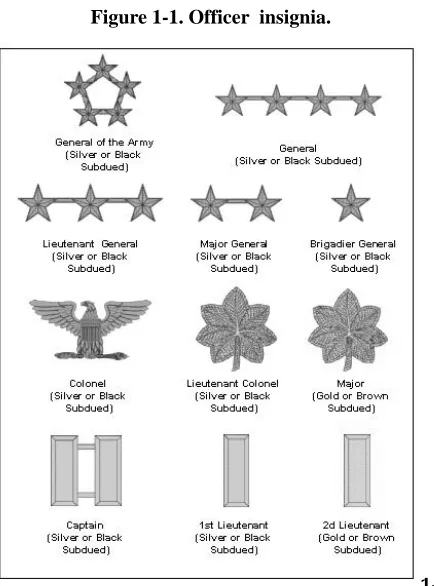
The highest officer rank is the five-star general (General of the Army) and the lowest is the second lieutenant. Figure 1-1 shows the ranks with their insignia.
Likewise, address both colonels and lieutenant colonels as "Colonel (last name)" and first and second lieutenants as "Lieutenant (last name)."
Address warrant officers as "Mr. (last name)" or "Ms. (last name)." Figure 1-2 shows the five warrant officer ranks.
[image:17.315.62.279.107.400.2]Figure 1-2. Warrant officer insignia.
Enlisted
Enlisted ranks range from private to sergeant major (grades E1 to E9) of the Army. Figure 1-3, shows the enlisted ranks with their insignia.
Figure 1-3. Enlisted insignia.
Rank Abbreviations 2LT – Second Lieutenant
1LT – First Lieutenant CPT – Captain
MAJ – Major
LTC – Lieutenant Colonel COL – Colonel
BG – Brigadier General MG – Major General LTG – Lieutenant General GEN – General
PVT – Private
PV2 – Private Second Class PFC – Private First Class SPC – Specialist
CPL – Corporal SGT – Sergeant SSG – Staff Sergeant SFC – Sergeant First Class MSG – Master Sergeant 1SG – First Sergeant SGM – Sergeant Major
CSM – Command Sergeant Major
MILITARY TIME
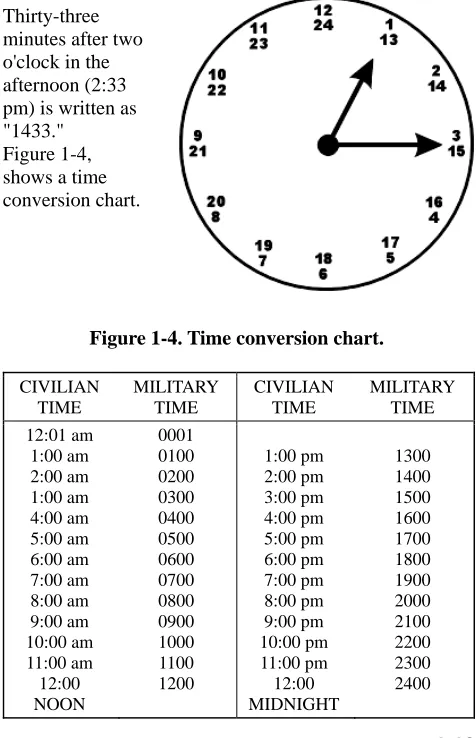
All US military services tell time by using the numbers "1" to "24" for the 24 hours in a day. A day begins at one minute after midnight and ends at midnight the same day. For example, eight minutes after midnight
Thirty-three minutes after two o'clock in the afternoon (2:33 pm) is written as "1433."
[image:21.315.49.287.27.396.2]Figure 1-4, shows a time conversion chart.
Figure 1-4. Time conversion chart.
CUSTOMS AND COURTESIES
Saluting
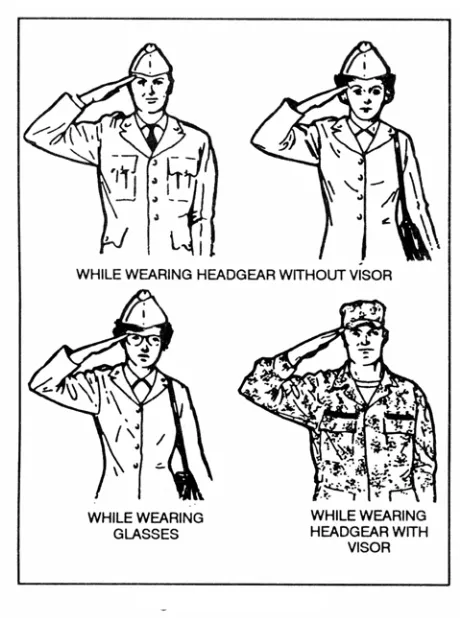
The origin of the hand salute is uncertain. Some historians believe it began in late Roman times when assassinations were common. A citizen who wanted to see a public official had to approach with his right hand raised to show that he did not hold a weapon. Knights in armor raised visors with the right hand when meeting a comrade. This practice gradually became a way of showing respect and, in early American history, sometimes involved removing the hat. By 1820, the motion was modified to touching the hat, and since then it has become the hand salute used today.
During your time in the Army, you salute to show respect toward an officer, flag, or our country. The proper way to salute with or without a weapon is described in FM 22-5. The rules of saluting are as follows:
• When you meet someone outside, salute as soon as you recognize that he or she is an officer (or, if you are walking toward the officer, wait until you are about six steps away).
• Salute all officers (recognized by rank) in official vehicles identified by special plates or flags.
1-15 • If in a group, and an officer approaches, the first soldier to recognize the officer calls the group to attention and all personnel salute.
• If you approach an officer while you are double-timing alone, assume quick time march and render the hand salute. When the salute is returned, execute order arms and resume double-timing.
• The salute is always initiated by the subordinate and is terminated only after acknowledgment by the individual being saluted.
• Accompany the salute with an appropriate greeting, such as, "Good morning/afternoon, sir/ma'am."
• Salutes are not required to be rendered by or to personnel who are driving or riding in privately owned vehicles.
• It is not customary for enlisted personnel to exchange salutes, except in some ceremonial situations.
• Never render a salute with a noticeable object in your mouth or right hand.
Rendering Honor to the Flag
The flag of the United States is the symbol of our nation. The union, white stars on a field of blue, is the honor point of the flag. The union of the flag and the flag itself, when in company with other flags, are always given the honor position, which is on the right. Rules for displaying the flag follows:
• The flag of the United States will be displayed outdoors at all Army installations.
• Only one flag of the United States will be flown at one time at any continental United States (CONUS) Army installation except as authorized by the commanding generals of major Army commands.
• The flag will be displayed daily from reveille to retreat. If illuminated, it may be displayed at night during special events or on special occasions deemed appropriate by the commander.
• The flag of the United States is the only flag that may be flown from a flagpole over an Army installation. An exception is the Minuteman flag that, if awarded, may be flown beneath the flag of the United States.
1-17 When the flag is being raised in the morning or lowered in the evening, you should stand at attention on the first note of Reveille or "To the Colors." ("Colors" refer to the flag of the United States and can also include the unit flag.) Give the required salute. If you are involved in some duty that would be hampered by saluting, you do not need to salute. You normally face the flag when saluting, unless duty requires you to face in some other direction. At the conclusion of the ceremony, resume your regular duties.
Whenever Reveille is played, and you are not in formation and not in a vehicle, come to attention at the first note, face the flag, and give the required salute. If no flag is near, face the music and salute. If you are in formation, salute only on the order "Present arms." If you are in civilian clothing, stand at attention and place your right hand over your heart. These honors also apply to the national anthems of foreign countries during ceremonies or parades. The words to the National Anthem are shown in Appendix C.
Vehicles in motion should stop. If you are in a car or on a motorcycle, dismount and salute. If you are with a group in a military vehicle or bus, remain in the vehicle. The individual in charge will dismount and salute.
Courtesies
The following rules will help you conduct yourself appropriately in the presence of officers and anyone senior to you in rank:
• When talking to an officer, stand at attention unless given the order "At ease." When you are dismissed, or when the officer departs, come to attention and salute.
• When an officer enters a room, the first soldier to recognize the officer calls personnel in the room to attention but does not salute. A salute indoors is rendered only when one is reporting.
• When accompanying a senior, walk on his left.
• When entering or exiting a vehicle, the junior ranking person is the first to enter, and the senior in rank is the first to exit.
1-19 Note: The officer or NCO may give the directive "Carry on." This means the soldier or soldiers should continue with whatever they were doing previously.
This same directive may be used in many other situations outside of formation, such as in the barracks and break areas.
• When outdoors and approached by an NCO, you should stand (if seated) and greet the NCO by saying, "Good morning, sergeant," "Good afternoon, sergeant," or "Good evening, sergeant (last name, if known)."
• When you report to an officer for any reason, it is important to make a good first impression. If you are outdoors, approach the officer to whom you are reporting and stop about two steps from him, assuming the position of attention. Give the proper salute and say, for example, "Sir/Ma'am, Private Smith reports." If you are indoors, use the same procedures as above, except remove your headgear before reporting. If you are armed, however, do not remove your headgear.
Role of the Chaplain
every soldier’s spiritual needs are met.
Chaplains hold weekly services (both in garrison and in the field), are available for individual counseling, and are one of two members of the military who retain the privilege of confidentiality (the other being Army lawyers). The chaplain also plays a key role in helping promote programs such as suicide prevention.
In the IET environment, chaplains are of particular value in helping soldiers succeed under difficult and stressful conditions. They assist the commander in teaching, displaying, and instilling the Army Values and in maintaining high morale within the unit.
CHAPTER 2 ARMY VALUES
“Everywhere you look on the fields of athletic competition, in combat training, operations, and in civilian communities soldiers are doing what is right.”
Former Sergeant Major of the Army Julius W. Gates
LOYALTY. Bear true faith and allegiance to the U.S. Constitution, the Army, your unit, and other soldiers.
“Loyalty is the big thing, the greatest battle asset of all. But no man ever wins the loyalty of troops by preaching loyalty. It is given to him as he proves his possession of the other virtues.”
Brigadier General Samuel L.A. Marshall Men Against Fire (1947)
Bearing true faith and allegiance is a matter of believing in, and devoting yourself to something or someone. A loyal soldier is one who supports the leadership and stands up for fellow soldiers. Wearing the uniform of the United States Army is a highly visible means of expressing your loyalty. You show your loyalty to your unit by doing you share. Any time you choose one individual's actions—right or wrong—over the safety and welfare of the rest of the unit, or over your own interest and commitment, you are eroding the value of loyalty.
2-3 A loyal individual does the following:
• Respects the Constitution and laws
• Puts obligations in correct order: the
Constitution, the Army, the unit, and finally, self
• Observes higher Headquarters priorities
• Works within the system without manipulating it for personal advantage
• Shows faithfulness to unit and comrades
• Carries out tough orders without expressing personal criticism
• Defends soldiers against unfair treatment from outside or above
Since before the founding of the republic, America’s Army has respected its subordination to its civilian political leaders. This subordination is fundamental to preserving the liberty of all Americans. You began your Army career by swearing allegiance to the Constitution which designates the president as commander in chief.
GEN George Washington at Newburgh, New York (The Newburgh Conspiracy)
Following its victory at Yorktown in 1781, the Continental Army set up camp at Newburgh, New York, to wait for peace with Great Britain. The central government formed under the Articles of
Confederation proved weak and unwilling to supply the Army properly or even
pay the soldiers who had won the war for independence. After months of waiting, many officers, angry and impatient, suggested that the Army march on the seat of government in Philadelphia,
Pennsylvania, and force Congress to meet the Army’s demands. One colonel even suggested
that General Washington become King George I.
Army must maintain in order to protect the freedom enjoyed by all Americans.
DUTY. Fulfill your obligations.
“The essence of duty is acting in the absence of orders or direction from others, based on an inner sense of what is morally and
professionally right.”
General John A. Wickham Former Army Chief of Staff
Duty delineates the sum total of all laws, rules, etc., that make up our organizational, civic, and moral obligations. Our values originate with duty because, at a minimum, we expect all members of the Army to fulfill their obligations. We often expect individuals to exceed their duty,
especially in ethical matters. The nation's highest award, the Medal of Honor, imparts the notion of an individual acting "above and beyond the call of duty." Doing your duty means more than carrying out your assigned tasks. The work of the United States Army is a complex
combination of missions, tasks, and responsibilities—all in constant motion. And the work, inevitably, is a matter of building one assignment or task on work that has been done previously. Doing your duty is a very important responsibility.
Duty also means being able to accomplish tasks as part of a team. You must fulfill your obligations as a part of your unit. Examples include: voluntarily assuming your share of the work load, willingly serve as a member of a team, or assuming a leadership role when appropriate.
You demonstrate the value of duty when you complete a task even when no one is looking, or when you resist the temptation to take "shortcuts" that might undermine the integrity of the final product. You do your duty as a soldier every time you do something that needs to be done — without being told.
An individual who expresses the value of duty will, at a minimum, do the following:
• Carry out requirements of job/office
• Fulfill legal, civic, and moral obligations
• Sacrifice personal time in pursuit of excellence
Duty in Korea
CPT Viola B. McConnell was the only Army nurse on duty in Korea in July of 1950. When hostilities broke out, she escorted nearly 700 American evacuees from Seoul to Japan aboard a freighter designed to accommodate only 12 passengers. CPT McConnell assessed priorities for care of the evacuees and worked exhaustively with a medical team to care for them. Once in Japan, she requested reassignment back to Korea. After all she had already done, CPT McConnell returned to Taejon to care for and evacuate wounded soldiers of the 24th Infantry Division.
CPT McConnell understood and fulfilled her duty to the Army and to the soldiers she supported in ways that went beyond her medical training. Duty
isn’t reserved for special occasions. When a platoon sergeant tells a squad leader to inspect weapons, the squad leader has fulfilled his minimum obligation when he has checked the weapons. He’s done what he was told to do. But if the squad leader finds weapons that are not clean or serviced, his sense of duty tells him to go beyond the platoon sergeant’s instructions. The squad leader does his duty when he corrects the problem and ensures the weapons are up to standard.
RESPECT. Treat people as they should be treated.
In the Soldier's Code, we pledge to "treat others with dignity and respect and expect others to do the same." Respect to a soldier simply means treating people as they should be treated. It means giving others the same consideration we would like or expect to be given.
“The discipline which makes the soldiers of a free country reliable in battle is not to be gained by harsh or tyrannical treatment. On the contrary, such treatment is far more likely to destroy than to make an army. It is possible to impart instruction and to give commands in such manner and such a tone of voice to inspire in the soldier no feeling; but an intense desire to obey, while the opposite manner and tone of voice cannot fail to excite strong resentment and a desire to disobey. The one mode or the other of dealing with
subordinates springs from a corresponding spirit in the breast of the commander. He who feels the respect which is due to others cannot fail to inspire in them regard for himself, while he who feels, and hence manifests, disrespect toward others, especially his inferiors, cannot fail to inspire hatred against himself.”
Major General John M. Schofield
2-9 The Army is one huge team, made up of hundreds of component parts. There must be connections — ground rules — so that when one soldier approaches, works with, or talks to another, it is with immediate and unquestioned cooperation and respect. The Army mirrors our country's diversity. Each of us has something to contribute. Respect is what allows us to appreciate the best in other people. Respect is trusting that all people have done their jobs— fulfilled their duty. Self-respect is a vital ingredient within the Army value of respect that results from knowing you have dug down deep to put forth your best effort.
Taking care of yourself physically shows your self-respect, keeping fit, not using drugs or tobacco products (smoking, chewing, and so forth). Finally, respect for other people includes not using profanity and obscene gestures. You are now in the military. What might have been acceptable in your civilian life may not be acceptable in the Army.
Respect is also an essential component for the
development of disciplined, cohesive, and effective war fighting teams. In the deadly confusion of combat, soldiers often overcome incredible odds to accomplish the mission and protect the lives of their comrades. This spirit of selfless service and duty is built on a soldier’s personal trust and regard for fellow soldiers.
harassment; it includes the broader issue of civility, the way people treat each other and those they come in contact with. It involves being sensitive to diversity and one’s own behaviors that others may find insensitive, offensive, or abusive. Soldiers and DA civilians, like their leaders, treat everyone with dignity and respect.
An individual who consistently expresses respect does the following:
• Recognizes dignity of all
• Demonstrates consideration for others; is discreet and tactful when correcting or questioning others
• Is courteous and polite
• Demonstrates concern for safety and well-being of others
• Creates a climate of fairness
• Values diversity and is sensitive to diversity issues.
Colonel Robert Gould Shaw and the 54th Massachusetts Infantry Regiment
(Civil War – 1863)
Robert Shaw was serving as a captain in the 2nd Massachusetts when Massachusetts Governor John Andrew selected him for a special assignment. Shaw was to muster and command the first regiment of African-American troops organized in a Northern state. On 18 Jul 1863, the regiment won undying glory by leading the bloody assault on Fort Wagner, South Carolina. In the attack, nearly half the regiment was killed, wounded, or captured. Colonel Shaw was among those who died. For his bravery in battle, Sergeant William H. Carney became the first African-American to earn the Medal of Honor.
The example of steadfast courage and heroism set by the 54th Massachusetts paved
the way for the enlistment of over 200,000 African-Americans in the Union Army and Navy.
2-11 Colonel Shaw and the
soldiers of the 54th Massachusetts believed
SELFLESS SERVICE. Put the welfare of the Nation, the Army, and your subordinates before your own.
In serving your country, you are doing your duty loyally, without thought of recognition or gain. The reward of selfless service is the satisfaction of a job well done—a successful accomplishment that reflects on the soldier and his or her unit. The greatest means of accomplishing selfless service is to dedicate yourself to the teamwork which is the
underlying strength of the Army. It is when thousands of soldiers work together as a team that spectacular results arise.
“The nation today needs men who think in terms of service to their country and not in terms of their country’s debt to them.”
General Omar N. Bradley Former General of the Army
The basic building block of selfless service is the commitment of each team member to go a little further, endure a little longer, and look a little closer to see how he or she can add to the effort of the unit, platoon, or
company. Selfless service is larger than just one person. With dedication to the value of selfless service, each and every soldier can rightfully look back and say, "I am proud to have served my country as a soldier."
service to the nation, the value also requires that the service member properly take care of family and self.
An individual who properly demonstrates the value of
selfless service does the following:
• Focuses priorities on service to the Nation
• Places needs of the Army above personal gain
• Ensures that soldiers’ needs are met before attending to personal needs
• Balances mission, family, and personal needs
• Gives credit due others and accepts blame for the team
CPL HIROSHI H. MIYAMURA Medal of Honor, 1951
2-13 Corporal, U.S. Army, Company H, 7th Infantry Regiment, 3rd Infantry Division. Awarded the Medal of Honor for his actions near Taejon-ni, Korea, 24 and 25 April 1951.
jumped from his shelter wielding his bayonet in close hand-to-hand combat killing approximately 10 of the enemy. Returning to his position, he administered first aid to the wounded and directed their evacuation. As another savage assault hit the line, he manned his machinegun and delivered withering fire until his ammunition was expended. He ordered the squad to withdraw while he stayed behind to render the gun inoperative. He then bayoneted his way through infiltrated enemy soldiers to a second gun emplacement and assisted in its operation.
When the intensity of the attack necessitated the withdrawal of the company, Cpl. Miyamura ordered his men to fall back while he remained to cover their movement. He killed more than 50 of the enemy before his ammunition was depleted and he was severely wounded. He maintained his magnificent stand despite his painful wounds, continuing to repel the attack until his position was overrun. When last seen he was fighting ferociously against an overwhelming number of enemy soldiers. Cpl. Miyamura's indomitable heroism and consummate devotion to duty reflect the utmost glory on himself and uphold the illustrious traditions on the military service.
HONOR. Live up to all the Army values.
“What is life without honor? Degradation is worse than death.”
Lieutenant General
2-15 When we talk about "living up to" something, we mean being worthy of it. We must make choices, decisions, and actions based on the Army core values. Nowhere in our values training does it become more important to emphasize the difference between "knowing" the values and "living" them than when we discuss the value of honor. Honor is a matter of carrying out, acting, and living the values of respect, duty, loyalty, selfless service, integrity, and personal courage in everything you do.
Noticing a situation and deciding to take action to assist another involves respect, duty, and honor. It was a matter of honor that soldiers, at great risk to themselves, distributed food in Somalia and kept the peace in Bosnia, while managing to protect the communities. There are hundreds of examples of soldiers who have distinguished themselves with honorable actions and lives. The Nation's highest military award is named "The Medal of Honor." This award goes to soldiers who make honor a matter of daily living—soldiers who develop a habit of being honorable, and solidify that habit with every value choice they make.
An individual with honor does the following:
• Adheres to a public code of professional Army values
MSG Gary Gordon and SFC Randall Shughart (Mogadishu, Somalia)
During a raid in Mogadishu in October 1993, MSG Gary Gordon and SFC Randall Shughart, leader and member
of a sniper team with Task Force Ranger in Somalia, were providing precision and suppressive fires from helicopters above two helicopter crash sites. Learning that no ground forces were available to rescue one of the downed aircrews and aware that a growing number of enemy were closing in on the site, MSG Gordon and SFC Shughart volunteered to be inserted to protect their critically wounded comrades. Their initial request was turned down because of the danger of the situation. They asked a second time; permission was denied. Only after their third request were they inserted.
they had depleted their ammunition and were fatally wounded. Their actions saved the life of an Army pilot.
No one will ever know what was running through the minds of MSG Gordon and SFC Shughart as they left the comparative safety of their helicopter to go to the aid of the downed aircrew. The two NCOs knew there was no ground rescue force available, and
They certainly knew there was no going back to their helicopter. They may have suspected that things would turn out as they did; nonetheless, they did what they believed to be the right thing.
They acted based on Army values, which they had clearly made their own: loyalty to their fellow soldiers; the duty to stand by them, regardless of the circumstances; the personal courage to act, even in the face of great danger; selfless service, the willingness to give their all. MSG Gary I. Gordon and SFC Randall D. Shughart lived Army values to the end; they were posthumously awarded Medals of Honor.
INTEGRITY. Do what’s right, legally and morally.
“The American people rightly look to their military leaders not only to be skilled in the
technical aspects of the profession of arms, but also to be men of integrity.”
General J. Lawton Collins Former Army Chief of Staff
When we say that someone has integrity, we mean that person respects the rules of an organization, the country, and life. Such persons can be counted on to do the right thing, live honestly, and relate to others without playing games or having false agendas. Integrity is a quality you develop by adhering to moral principles. It requires that we do and say nothing that deceives others. As your integrity grows, so does the trust others place in you. It's integrity that requires us to pay our debts on time, turn in items that someone else has lost, and follow rules as laid out in the law or in the code of human ethics and morality. The Soldier's Code says, "No mater what situation I am in, I will never do anything for pleasure, profit, or personal safety that will disgrace my uniform, my unit, or my country." The more choices you make based on integrity, the more this highly prized value will affect your relationships with family and friends, and, finally, your fundamental acceptance of yourself.
A soldier displays integrity when he or she:
• Always acts according to what he or she knows to be right, even at personal cost.
• Possesses a high standard of moral values and principles
• Shows good moral judgment and
demonstrates consistent moral behavior
2-19 • Shows candor and fairness in evaluating
subordinates’ work
• Shows consistency between words and deeds
• Uses the authority and power that comes with rank to work for mission
accomplishment or for soldiers instead of for personal or private gain
• Puts being right ahead of being popular or easy
• Abides by principles
SSG ROY P. BENAVIDEZ
Detachment B-56, 5th Special Forces Group, Republic of Vietnam
West of Loc Ninh on 2 May 1968
helicopters attempted extraction, but were unable to land due to intense enemy small arms and anti-aircraft fire.
Sergeant Benavidez was at the Forward Operating Base in Loc Ninh monitoring the operation by radio when these helicopters returned to off-load wounded crewmembers and to assess aircraft damage. Sergeant Benavidez voluntarily boarded a returning aircraft to assist in another extraction attempt. Realizing that all the team members were either dead or wounded and unable to move to the pickup zone, he directed the aircraft to a nearby clearing where he jumped from the hovering helicopter, and ran approximately 75 meters under withering small arms fire to the crippled team.
Prior to reaching the team's position he was wounded in his right leg, face, and head. Despite these painful injuries, he took charge, repositioning the team members and directing their fire to facilitate the landing of an extraction aircraft, and the loading of wounded and dead team members. He then threw smoke canisters to direct the aircraft to the team's position. Despite his severe wounds and under intense
enemy fire, he carried and dragged half of the wounded team members to the awaiting aircraft. He then provided protective fire by running alongside the aircraft as it moved to pick up the remaining team members.
2-21 the dead team leader. When he reached the leader's body, Sergeant Benavidez was severely wounded by small arms fire in the abdomen and grenade fragments in his back. At nearly the same moment, the aircraft pilot was mortally wounded, and his helicopter crashed. Although in extremely critical condition due to his multiple wounds, Sergeant Benavidez secured the classified documents and made his way back to the wreckage, where he aided the wounded out of the overturned aircraft, and gathered the stunned survivors into a defensive perimeter. Under increasing enemy automatic weapons and grenade fire, he moved around the perimeter distributing water and ammunition to his weary men, reinstilling in them a will to live and fight.
wounded. Only then, in extremely serious condition from numerous wounds and loss of blood, did he allow himself to be pulled into the extraction aircraft. Sergeant Benavidez' gallant choice to join voluntarily his comrades who were in critical straits, to expose himself constantly to withering enemy fire, and his refusal to be stopped despite numerous severe wounds, saved the lives of at least eight men. His fearless personal leadership, tenacious devotion to duty, and extremely valorous actions in the face of overwhelming odds were in keeping with the highest traditions of the military service, and reflect the utmost credit on him and the United States Army.
PERSONAL COURAGE.
Face fear, danger,
or adversity (physical or moral)
“The concept of professional courage does not always mean being tough as nails either. It also suggests a willingness to listen to the soldier’s problems, to go to bat for them in a tough situation, and it means knowing just how far they can go. It also means being willing to tell the boss when he’s wrong.”
CSM William Connelly
Former Sergeant Major of the Army
Personal Courage includes the notion of taking
responsibility for decisions and actions.
2-23
perform critical self-assessment, to confront new
ideas, and to change. Leaders must make
decisions that involve risk and often must take a
stand in the face of ambiguity or adversity.
Taking risks pertains to the battlefield in war,
but more frequently occurs with your boss in
peace.
A courageous soldier does the following:
• Controls fear in physical and moral contexts
• Takes responsibility for decisions and actions
• Accepts responsibility for his own mistakes and shortcomings
• Confronts problems directly and takes action based on what he believes is right, regardless of what others may think
• Speaks up for what he believes is important and then is gracious whether his ideas are accepted or rejected
• Reports on successes and failures with equal candor
• Puts them self on the line to deal with important problems
• Always shares mistakes if it will help the team improve
Personal courage has long been associated with our Army. Accounts of the dangers and hardships that soldiers face are legendary. Personal courage is not the absence of fear; rather, it is taking positive action in spite of the fear. It takes two forms: physical and moral.
Physical courage means overcoming fears of bodily harm and doing your duty. It’s the bravery that allows a soldier to take risks in combat in spite of the fear of wounds or death. Physical courage is what gets the soldier at Airborne School out the aircraft door. It’s what allows an infantryman to assault a bunker to save his buddies. With physical courage, it is a matter of enduring physical duress and, at times, risking personal safety.
In contrast, moral courage is the willingness to stand firm on your values, principles, and convictions, even when threatened. Moral courage is sometimes overlooked, both in discussions of personal courage and in routine, daily activities. Moral courage often expresses itself as candor. Candor means being frank, honest, and sincere with others while keeping your words free from bias, prejudice, or malice.
out by the soldiers who have never seen a battlefield. You can build up your personal courage by daily standing up for and acting upon the things that you know are right.
SSG CLIFFORD C. SIMS
Company D, 2d Battalion (Airborne), 501st Infantry, 101st Airborne Division
Near Hue, Republic of Vietnam, 21 February 1968
Company D was assaulting a heavily fortified enemy position concealed within a dense wooded area when it encountered strong enemy defensive fire. Once within the woodline, SSgt. Sims led his squad in a furious attack against an enemy force, which had pinned down the 1st Platoon and threatened to overrun it. His skillful leadership provided the platoon with freedom of movement and enabled it to regain the initiative.
SSgt Sims was then ordered to move his squad to a position where he could provide covering fire for the company command group and to link up with the 3d Platoon, which was under heavy enemy pressure. After moving no more than 30 meters SSgt Sims noticed that a brick structure in which ammunition was stocked was on fire. Realizing the
danger, SSgt Sims took immediate action to move his squad from this position. Though in the process of leaving the area 2 members of his squad were injured by
the subsequent explosion of the ammunition, SSgt Sims' prompt actions undoubtedly prevented more serious casualties from occurring.
3-1 CHAPTER 3
STANDARDS OF CONDUCT
The Uniform Code of Military Justice (UCMJ)
Military discipline is founded upon self-discipline, respect for authority, and the embracing of the professional Army ethic with its supporting individual values. Military discipline is developed through individual and group training to create a mental attitude that will result in proper conduct and prompt obedience to lawful military
authority. There are 3 basic rules:
• Don’t break the rules (What are the rules? Example - UCMJ, regulations)
• Take responsibility for your actions
• Keep your hands to yourself
While military discipline is the result of effective training, it affects every aspect of military life. It is a trait found in individuals and units that is manifested by
• Unit cohesion, bonding, and a spirit of teamwork;
• Smartness of appearance and action;
• Cleanliness and maintenance of dress, equipment, and quarters;
• Respect to seniors and mutual respect between senior and subordinate personnel;
• Fairness, justice, and equity for all soldiers, regardless of race, religion, color, gender, or national origin.
The UCMJ applies to active duty service members:
• 24 hours a day/7 days a week
• Anywhere you are in the world
• After discharge, if discharge was obtained fraudulently
• After active duty status is terminated (for Reserve and National Guard soldiers)
In other words, it is your duty to abide by the laws and regulations governed by the UCMJ, 24 hours a day, 7 days a week, for as long as you are in the Army. All persons in the military service are required to strictly obey and promptly execute the legal orders of their lawful seniors. Laws and regulations are part of everyday life. The UCMJ gives us judicial authority, which is essential to the Army's ability in accomplishing its military mission. The UCMJ is the statute that prescribes criminal law for soldiers.
3-3 The principle that an accused is innocent until proven guilty applies to both nonjudicial punishment and courts-martial. You have the right to be informed of any charges against you, as well as the names of accusers and known witnesses. You also have -
The right to remain silent. You do not have to say anything that could be used to convict you. Anything you say can be used as evidence against you.
The right to a military lawyer, unless you wish to hire a civilian lawyer at your own expense.
Protection against double jeopardy. If found innocent by court-martial, you cannot be tried again by a court-martial for the same crime.
The right to sentence review. Higher authority automatically reviews a conviction received in the military. The sentence cannot be increased but may be left as it is or decreased.
The right to a speedy public trial.
The right to call witnesses favorable to you.
The right to an interpreter if you do not fully understand the English language.
The right to be tried by a military judge alone rather than by a court-martial panel, unless the case is tried as a capital offense. If the soldier does not elect trial by military judge, a trial with members will automatically be afforded the soldier.
The right to trial by court-martial. You may refuse Article 15 punishment and demand trial by court-martial.
PUNITIVE ARTICLES
The following list contains the descriptive title and general provisions of selected punitive articles of the UCMJ that commonly occur in the training environment:
1. ARTICLE 83 - Fraudulent Enlistment, Appointment, or Separation. Any soldier who -
a. Procures his own enlistment or appointment in the armed forces by knowingly false representation or deliberate concealment as to his qualifications for that enlistment or appointment and receives pay and allowances there under, or
b. Procures his own separation from the armed forces by knowingly false representation or deliberate concealment as to his eligibility for that separation; shall be punished as a court-martial may direct.
3-5 a. Fails to go to his appointed place of duty at the time prescribed;
b. Goes from that place; or
c. Absents himself or remains absent from his unit, organization, or place of duty at which he is required to be at the time prescribed; shall be punished as a court-martial may direct.
3. ARTICLE 89 - Disrespect Toward A Superior Commissioned Officer. Any soldier who behaves with disrespect toward his superior commissioned officer shall be punished as a court-martial may direct. Disrespectful behavior is that which detracts from the respect due the authority of a superior commissioned officer or noncommissioned officer. It may consist of :
a. Acts or language;
b. Abusive epithets or other contemptuous or denunciatory language;
c. Neglecting the customary salute; or
d. Showing marked disdain, indifference, insolence, impertinence, undue familiarity, or other rudeness in the presence of the superior.
a. Strikes his superior commissioned officer or draws or lifts up any weapon or offers any violence against him while he is in the execution of his office; or
b. Willfully disobeys a lawful command of his superior commissioned officer shall be punished, if the offense is committed in time of war, by death or such other punishment as a court-martial may direct, and if the offense is committed at any other time, by such punishment, other than death.
5. ARTICLE 91 – Insubordinate Conduct Toward Warrant Officer, Noncommissioned Officer, or Petty Officer. Any soldier who -
a. Strikes or assaults a warrant officer,
noncommissioned officer, or petty officer, while that officer is in the execution of his office;
b. Willfully disobeys the lawful order of a warrant officer, noncommissioned officer, or petty officer; or
c. Treats with contempt or is disrespectful in language or deportment toward a warrant officer, noncommissioned officer, or petty officer while that officer is in the
execution of his office; shall be punished as a court-martial may direct.
3-7 a. Violates or fails to obey any lawful general order or regulation;
b. Having knowledge or any other lawful order issued by a member of the armed forces, which it is your duty to obey, fails to obey the order; or
c. Is derelict in the performance of his duties; shall be punished as a court-martial may direct.
7. ARTICLE 115 – Malingering. Any soldier who for the purpose of avoiding work, duty, or service -
a. Feigns illness, physical disablement, mental lapse or detriment; or
b. Intentionally inflicts self-injury; shall be punished as a court-martial may direct.
8. ARTICLE 121 – Larceny and Wrongful Appropriation. Any soldier who wrongfully takes, obtains, or withholds, by any means, from the possession of the owner or of any other person any money, personal property, or article of value of any kind
b. With intent temporarily to deprive or defraud another person of the use and benefit of property or to appropriate it to his own use or the use of any person other than the owner, is guilty of wrongful appropriation; shall be punished as a court-martial may direct.
9. ARTICLE 128 – Assault. Any soldier who -
a. Attempts or offers with unlawful force or violence to do bodily harm to another person, whether or not the attempt or offer is consummated, is guilty of assault and shall be punished as a court-martial may direct.
b. Commits an assault with a dangerous weapon or other means or force likely to produce death or grievous bodily harm; or
c. Commits an assault and intentionally inflicts grievous bodily harm with or without a weapon; is guilty of aggravated assault and shall be punished as a court-martial may direct.
10. ARTICLE 134 – General Article.
a. All disorders and neglects to the prejudice of good order and discipline in the armed forces;
b. All conduct of a nature to bring discredit upon the armed forces; and
3-9 cognizance of by a general, special, or summarized court-martial according to the nature and degree of the offense, and shall be punished at the discretion of that court.
FORMS OF PUNISHMENT
The following are forms of punishment that may be imposed for violations of the UCMJ. All forms of punishment are subject to restrictions specified in the UCMJ. The UCMJ provides limitations of sentences based on the nature of the crime; the form of adjudication (nonjudicial punishment or court-martial); and the position/rank of the individual assigning the punishment or the type of court-martial that convicted the soldier.
1. Reprimand. The convening authority of a court-martial or commanding officer may punish a soldier by censure, or condemn as wrong. A reprimand is a severe form of censure that adversely reflects upon the conduct of the person addressed. A court-martial shall not specify the terms or wording of a reprimand. A reprimand, if
approved, shall be issued, in writing, by the convening authority. A reprimand adjudged by a court-martial is a punitive censure.
be forfeited each month and the number of months the forfeitures will last.
3. Fine. A fine makes the accused immediately liable to the United States for the entire amount of money specified in the sentence. A fine may only be adjudged by a court-martial, and it may be adjudged instead of or in addition to forfeiture. However, a fine is normally used only as a sentence in cases where the accused was unjustly enriched as a result of the offense of which convicted.
4. Reductioninpaygrade. Except as provided in R.C.M. 1301(d), a court-martial may sentence an enlisted member to be reduced to the lowest or any intermediate pay grade.
5. Restrictiontospecifiedlimits. Restriction deprives the accused of normal liberty privileges. The sentence will specify the physical and geographic locations in which the individual is allowed, how long the restriction shall last, and when that individual must be present at specific locations.
6. Hardlaborwithoutconfinement. Hard labor without confinement is performed in addition to other regular duties and does not excuse or relieve a person from performing regular duties. Ordinarily, the immediate commander of the accused will designate the amount and character of the labor to be performed.
3-11 adjudge a sentence to solitary confinement or to
confinement without hard labor. The authority executing a sentence to confinement may require hard labor whether or not the words "at hard labor" are included in the sentence.
8. Punitiveseparation. A court-martial may not adjudge an administrative separation from the service. There are three types of punitive separation.
a. Dismissal. Dismissal applies only to commissioned officers, commissioned warrant officers, cadets, and midshipmen and may be adjudged only by a general court-martial. Regardless of the maximum punishment specified for an offense in Part IV of this Manual; a dismissal may be adjudged for any offense of which a commissioned officer, commissioned warrant officer, cadet, or midshipman has been found guilty;
dishonor, after having been convicted of offenses usually recognized in civilian jurisdictions as felonies, or of offenses of a military nature requiring severe punishment; and
c. Badconductdischarge. A bad-conduct discharge applies only to enlisted persons and may be
adjudged by a general court-martial and by a special court-martial that has met the requirements of R.C.M. 201(F)(2)(B). A bad-conduct discharge is less severe than a dishonorable discharge and is designed as a punishment for bad-conduct rather than as a punishment for serious offenses of either a civilian or military nature. It is also appropriate for an accused who has been convicted repeatedly of minor offenses and whose punitive separation appears to be necessary.
9. Death.
COURTS-MARTIAL
There are three types of courts-martial: summary, special, and general. Trials by courts-martial are the military equivalents of trials by judges and juries. The differences among the three are based on their composition, level of authority, and severity of punishments authorized.
3-13 minor offenses and to make sure that justice is done, with the interests of both the government and the accused being safeguarded. Only enlisted personnel may be tried by summary martial. Anyone subject to summary court-martial may refuse to be tried by summary court-court-martial. Whether an offense is minor depends on several factors, including the nature and circumstances of the offense. Also considered is the age, rank, duty assignment, record, and experience of the accused. The maximum punishment that can be given by a summary court-martial to a soldier pay grade E4 or below is -
• Confinement at hard labor for one month.
• Forfeiture of two-thirds of a month's pay for one month.
• Reduction to the lowest enlisted grade.
Special Court-Martial. This court consists of a military judge and not less than three panel members when required. It is held for relatively serious offenses. The maximum punishment that can be given by a special court-martial is -
• Confinement at hard labor for six months.
• Forfeiture of two-thirds of a month's pay for six months.
• Reduction to the lowest enlisted grade.
General Court-Martial. This court consists of a military judge and not less than five panel members when required. It is held for serious offenses. A general court-martial may impose any authorized punishment including the death penalty in certain cases.
NONJUDICIAL PUNISHMENT
Under the provisions of the UCMJ, Article 15, commanding officers may impose nonjudicial punishment upon soldiers who commit minor offenses within their units. The purpose of nonjudicial punishment is to train, correct, and reform. It also promotes positive behavior changes in soldiers without the stigma of a court-martial conviction.
If you are the accused soldier, you have the option of either demanding trial by court-martial or accepting nonjudicial punishment.
Once your commanding officer has passed judgment and sentenced you, if you feel that the punishment awarded to you is unjust or disproportionate to the offense, you may appeal all or part of your sentence to the next higher authority. The appeal authority may set aside, decrease, suspend, or let stand any portion or the entire original sentence. However, he cannot in any way increase the original sentence.
court-3-15 martial. There are two types of Article 15 proceedings: summarized and formal.
• Summarized proceedings may be used for very minor misconduct. The punishment should not exceed an oral reprimand, extra duty, restriction for 14 days, or any combination of these punishments.
• Formal proceedings begin with the initial notification and end with the appeals process. The maximum punishments for a soldier grade E4 and below by a field grade commander include a reprimand, extra duty for 45 days, restriction for 60 days, correctional custody for 30 days, loss of ½ pay per month for 2 months, rank reduction to one or more lower grades, or a combination of any of these punishments.
The Army’s Equal Opportunity (EO) Program and Policy
The EO program ensures an Army-wide, concentrated effort to maximize human potential and to ensure fair treatment for all persons based solely on merit, fitness, and capability in support of readiness. The EO philosophy is based on fairness, justice, and equity.
• On and off post
• Extends to soldiers, civilian employees, and family members
• Includes working, living, and recreational environments
The EO complaints processing system addresses grievances that allege unlawful discrimination or unfair treatment on the basis of race, national origin, color, gender, and/or religious affiliation, or sexual harassment. Attempts should always be made to solve the problem at the lowest possible level within an organization.
If a complaint is submitted, it will be investigated. Those personnel found to be in violation of the EO Policy are subject to the punishment under the UCMJ.
EO Complaint Process
Individuals are encouraged to attempt to resolve their complaints by confronting the alleged offender or by informing other appropriate officials about the offensive behavior or other allegations of unequal or unfair treatment.