VMIVME-5576
REFLECTIVE MEMORY BOARD
INSTRUCTION MANUAL
DOCUMENT NO. 500-005576-000 F
Revised August 4, 1998
VMIC
12090 SOUTH MEMORIAL PARKWAY HUNTSVILLE, ALABAMA 35803-3308
© Copyright September 1991. The information in this document has been carefully checked and is believed to be entirely reliable. While all reasonable efforts to ensure accuracy have been taken in the preparation of this manual, VMIC assumes no responsibility resulting from omissions or errors in this manual, or from the use of information contained herein.
VMIC reserves the right to make any changes, without notice, to this or any of VMIC’s products to improve reliability, performance, function, or design.
VMIC does not assume any liability arising out of the application or use of any product or circuit described herein; nor does VMIC convey any license under its patent rights or the rights of others.
For warranty and repair policies, refer to VMIC’s Standard Conditions of Sale.
AMXbus, BITMODULE, COSMODULE, DMAbus, Instant OPC wizard logo, IOWorks Access, IOWorks Foundation, IOWorks man figure, IOWorks Manager, IOWorks Server, MAGICWARE, MEGAMODULE, PLC ACCELERATOR (ACCELERATION), Quick Link, RTnet, Soft Logic Link, SRTbus, TESTCAL, “The Next Generation PLC”, The PLC Connection, TURBOMODULE, UCLIO, UIOD, UPLC, Visual Soft Logic Control(ler), VMEaccess, VMEmanager, VMEmonitor, VMEnet, VMEnet II, and VMEprobe are trademarks and The I/O Experts, The I/O Systems Experts, The Soft Logic Experts, and The Total Solutions Provider are service marks of VMIC.
VMIC
All Rights Reserved
This document shall not be duplicated, nor its contents used for any
The I/O man figure, IOWorks, UIOC, Visual IOWorks, and WinUIOC are registered trademarks of VMIC. ActiveX is a trademark and Microsoft, Microsoft Access, MS-DOS, Visual Basic, Visual C++, Win32, Windows, Windows NT, and XENIX are registered trademarks of Microsoft Corporation.
MMX is a trademark and Pentium is a registered trademark of Intel Corporation.
PICMG and CompactPCI are registered trademarks of PCI Industrial Computer Manufacturers’ Group. Other registered trademarks are the property of their respective owners.
A
B
C
D
E
F
04/09/92
06/29/92
11/16/92
01/16/93
11/04/93
08/04/98
Release Per ECO
Cover, Pages ii, v,vi, Section 2, Section 6, and Appendix A
Cover, Pages ii, vi, and Section 5
Add Appendix B
Add Appendix C
Cover, Pages ii, 3-1, 5-12, Notice Page, and Table of Contents
92-0085
92-0163
92-0250
92-0535
93-0839
98-0498
RECORD OF REVISIONS
REVISION
THE FOLLOWING GENERAL SAFETY PRECAUTIONS MUST BE OBSERVED DURING ALL PHASES OF THIS OPERATION, SERVICE, AND REPAIR OF THIS PRODUCT. FAILURE TO COMPLY WITH THESE PRECAUTIONS OR WITH SPECIFIC WARNINGS ELSEWHERE IN THIS MANUAL VIOLATES SAFETY STANDARDS OF DESIGN, MANUFACTURE, AND INTENDED USE OF THE PRODUCT. VME MICROSYSTEMS INTERNATIONAL CORPORATION ASSUMES NO LIABILITY FOR THE CUSTOMER’S FAILURE TO COMPLY WITH THESE REQUIREMENTS.
GROUND THE SYSTEM
To minimize shock hazard, the chassis and system cabinet must be connected to an electrical ground. A three-conductor AC power cable should be used. The power cable must either be plugged into an approved three-contact electrical outlet or used with a three-contact to two-contact adapter with the grounding wire (green) firmly connected to an electrical ground (safety ground) at the power outlet.
DO NOT OPERATE IN AN EXPLOSIVE ATMOSPHERE
Do not operate the system in the presence of flammable gases or fumes. Operation of any electrical system in such an environment constitutes a definite safety hazard.
KEEP AWAY FROM LIVE CIRCUITS
Operating personnel must not remove product covers. Component replacement and internal adjustments must be made by qualified maintenance personnel. Do not replace components with power cable connected. Under certain conditions, dangerous voltages may exist even with the power cable removed. To avoid injuries, always disconnect power and discharge circuits before touching them.
DO NOT SERVICE OR ADJUST ALONE
Do not attempt internal service or adjustment unless another person, capable of rendering first aid and resuscitation, is present.
DO NOT SUBSTITUTE PARTS OR MODIFY SYSTEM
Because of the danger of introducing additional hazards, do not install substitute parts or perform any unauthorized modification to the product. Return the product to VME Microsystems International Corporation for service and repair to ensure that safety features are maintained.
DANGEROUS PROCEDURE WARNINGS
Warnings, such as the example below, precede only potentially dangerous procedures throughout this manual. Instructions contained in the warnings must be followed.
!
OR
OR
WARNING
* * * * * * * * * * * * * * *
* * * * * * * * * * * * * * * *
* *
* * * CAUTION
SAFETY SYMBOLS
GENERAL DEFINITIONS OF SAFETY SYMBOLS USED IN THIS MANUAL
Instruction manual symbol: the product is marked with this symbol when it is necessary for the user to refer to the instruction manual in order to protect against damage to the system.
Indicates dangerous voltage (terminals fed from the interior by voltage exceeding 1000 volts are so marked).
Protective conductor terminal. For protection against electrical shock in case of a fault. Used with field wiring terminals to indicate the terminal which must be connected to ground before operating equipment.
Low-noise or noiseless, clean ground (earth) terminal. Used for a signal common, as well as providing protection against electrical shock in case of a fault. Before operating the equipment, terminal marked with this symbol must be connected to ground in the manner described in the installation (operation) manual.
Frame or chassis terminal. A connection to the frame (chassis) of the equipment which normally includes all exposed metal structures.
Alternating current (power line).
Direct current (power line).
Alternating or direct current (power line).
The WARNING sign denotes a hazard. It calls attention to a procedure, a practice, a condition, or the like, which, if not correctly performed or adhered to, could result in injury or death to personnel.
VMIVME-5576
REFLECTIVE MEMORY BOARD
TABLE OF CONTENTS
Page
SECTION 1. INTRODUCTION
1.1 FEATURES ... 1-1 1.2 FUNCTIONAL DESCRIPTION ... 1-2 1.2.1 Software Requirements to Use Reflective Memory Board... 1-2 1.2.2 Hardware Requirements to Use Reflective Memory Board ... 1-2
SECTION 2. PHYSICAL DESCRIPTION AND SPECIFICATIONS SECTION 3. THEORY OF OPERATION
3.1 OPERATIONAL OVERVIEW... 3-1 3.2 BASE ADDRESS SELECTION ... 3-1 3.3 FIBER-OPTIC LINK SPEED SELECTION ... 3-1 3.4 BUS INTERRUPTER MODULE (BIM)... 3-2 3.5 ADDRESSING FEATURES... 3-2 3.6 NODE LATENCY... 3-2
SECTION 4. PROGRAMMING
500-005576-000
TABLE OF CONTENTS (Continued)
Page
SECTION 5. CONFIGURATION AND INSTALLATION
5.1 UNPACKING PROCEDURES ... 5-1 5.2 PHYSICAL INSTALLATION ... 5-1 5.3 JUMPER INSTALLATIONS ... 5-1 5.3.1 Extended Address Field (J4) ... 5-3 5.3.2 Address Pass Through Field (J7) ... 5-3 5.3.3 Standard Address Match Field (J7) ... 5-3 5.3.4 Board Node ID Field (J9) ... 5-9 5.3.5 Address Modifier Select (J8)... 5-9 5.3.6 Fast Field (J5)... 5-9 5.3.7 Mask Field (J3) ... 5-9 5.3.8 Spare Field (J6) ... 5-9 5.4 FIBER-OPTIC LINK CONFIGURATION ... 5-12 5.5 IACK DAISY CHAIN ... 5-12
SECTION 6. MAINTENANCE
6.1 MAINTENANCE... 6-1 6.2 MAINTENANCE PRINTS ... 6-1
LIST OF FIGURES
Figure Page
TABLE OF CONTENTS (Concluded)
LIST OF FIGURES (Concluded)
Figure Page
5.3.2-2 VMIVME-5576 Extended Address with 1/2 Mbyte Option Example .... 5-7 5.3.2-3 VMIVME-5576 Extended Address with 1/4 Mbyte Option Example .... 5-8 5.3.4-1 VMIVME-5576 Board Node ID Jumper Field ... 5-10 5.3.5-1 Address Modifier Jumper Options ... 5-9 5.3.5-2 VMIVME-5576 Address Modifier Jumper Field... 5-11
LIST OF TABLES
Table Page
4.1-1 VMIVME-5576 Memory Map ... 4-2 4.6-1 VMIVME-5576 Interrupt Codes... 4-5 4.7-1 VMIVME-5576 Node IDs ... 4-6 4.9-1 BIM Register Mapping for Interrupts, 0 to 3... 4-7 4.9-2 BIM Vector Register Mapping... 4-8
APPENDIX
A Assembly Drawing, Parts List, and Schematic
B Example Code
500-005576-000
SECTION 1
INTRODUCTION
1.1 FEATURES
The VMIVME-5576 is a high performance, yet easy-to-use, method of linking from two to 256 VMEbus systems together by the use of global memory. Any data word written to a specific location in memory will show up in the same location in each of the other 255 nodes with no programming or other intervention required by the user.
The Reflective Memory Board has several unique features:
a. No software necessary to establish communications
b. On-board interrupt generation ability. Any node may generate interrupts on any or all other nodes on the system.
c. Facilitates communications over very long link lengths, i.e., up to 2,000 meters
d. Can be selected to operate in privileged or nonprivileged modes or in both modes at once
e. Memory can be configured to run in either A24 or A32 addressing schemes
f. Supports 8-, 16-, 24-, 32-bit transfers (bi-directional)
g. Attention interrupts are channeled to one of seven programmable interrupt levels
h. Double Eurocard form factor
i. Any board may be jumpered to be any Node
j. Selectable 256 K, 512 K, or 1 Mbyte of SRAM on-board
1.2 FUNCTIONAL DESCRIPTION
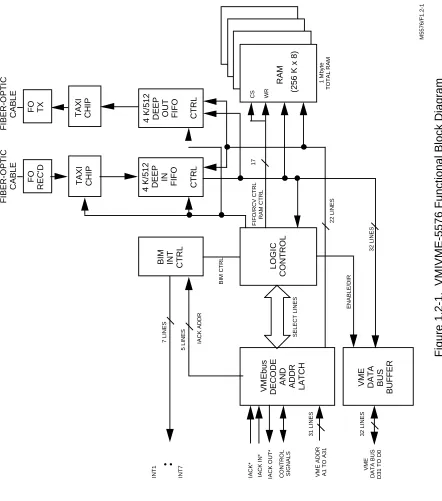
The link between two nodes is established through the use of FIFO memory which is routed through fiber-optic drivers/receivers. Figure 1.2-1 shows the block diagram of the Reflective Memory Board. Note that the FIFO memory is on the same bus as the SRAM memory. The user only sees the SRAM memory and is not aware of the FIFO memory which does the actual bus transfer to the other boards. The Reflective Memory Board appears to the user as standard SRAM memory and can be used as such. The only effect noticeable to the user due to the presence of the communications bus is that SRAM will take slightly longer to DTACK when the FIFO is writing to RAM.
1.2.1 Software Requirements to Use Reflective Memory Board
The Reflective Memory Board upon power-up is able to establish the board-to-board link without any program setup. The Bus Interrupter Module (BIM) which controls the interrupt generation on the Reflective Memory Board is initialized to mask all interrupts upon power-up.
If interrupts are desired, the appropriate registers in the BIM chip must be initialized through software control. A CSR is also present on the board which controls the Fail LED on the Reflective Memory Board. The user must Write to the CSR after any test software is run successfully on the board in order to turn OFF the Fail LED. There is no automatic diagnostic software on the board to perform self-test function so the LED being ON does not indicate a failure on-board unless the VME chassis software control actually has turned it ON. LED ON is a standard power-up mode for the Fail LED. If the output FIFO becomes over half full, the Reflective Memory Board will issue an interrupt if the BIM has been programmed and enabled. The user software may choose to ignore this warning. If the output FIFO becomes completely full, a Bus Error (BERR) will be issued to the user once an attempt is made to Write to a Reflective Memory Board that has a full output FIFO.
1.2.2 Hardware Requirements to Use Reflective Memory Board
500-005576-000 4 K/ 512 DE EP IN FI FO 4 K /512 DE EP OU T FI F O CT RL CT R L IN T 1 IN T 7 • • BI M
INT CTR
L LO GI C CONT ROL VM Eb u s DE CO DE AN D ADD R LATC H VME DAT A BUS BUF F ER VME D A T A BU S 1 T O D 0 VM E AD D R A1 T O A 3 1 IA C K * IA C K IN * C K OU T * CO NT RO L SI G N A L S IA CK A DDR B IM CT RL S E LE CT LI NE S E N A B L E /D IR 1 M b yt e TOTA L R A M RA M
CS WR (256 K x 8
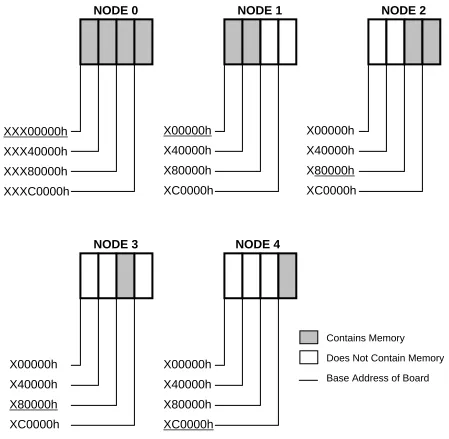
[image:11.612.84.526.188.689.2]There is a restriction on address configuration relating to each 1 Mbyte boundary for the 512 K and 256 K option Reflective Memory Boards. Even though the 512 K option may be mapped on any 512 K boundary, relative to the 1 Mbyte boundaries, there is an upper and a lower position (see Figure 3.5-1). All boards must be mapped to the same position relative to 1 Mbyte boundaries.
500-005576-000
SECTION 2
PHYSICAL DESCRIPTION AND SPECIFICATIONS
SECTION 3
THEORY OF OPERATION
3.1 OPERATIONAL OVERVIEW
The VMIVME-5576 allows up to 256 VMEbus chassis to be linked together in a sequential fashion. Data written to any node appears in all other nodes some period of time later. The link between the nodes is two fiber-optic cables which pass address, data, and interrupt information between adjacent boards on the link.
The VMIVME-5576 allows a user to Read or Write the RAM address space at will. All memory Writes are stored in SRAM on the board and also put in a FIFO to be broadcast to all other nodes. An interrupt command may also be written to any or all chassis by writing a data word into a specific location in RAM. The data value written dictates which node(s) will receive the interrupt. The interrupt is sent out in the order the data was received from the VMEbus, so if a block of data was written to the board before the interrupt command is sent, then the data will be broadcast to all boards before the interrupt command is broadcast.
NOTE:
IF THERE ARE EMPTY SLOTS TO THE LEFT OF THE VMIVME-5576, THEN IACK JUMPERS MUST BE INSTALLED FOR THE EMPTY SLOTS. OTHERWISE, THE VMIVME-5576 WILL INTERMITTENTLY FAIL TO RESPOND TO VMEbus READS AND WRITES.
3.2 BASE ADDRESS SELECTION
The base address of the VMIVME-5576 is jumper-selectable. Once the base address is established, all other writes to the VMIVME-5576 will be relative to the base address. Each node on the link may have a different base address. Only the relative offset to the base address is passed across the link. Thus, each board on the link may have a different VMEbus address and addressing mode.
3.3 FIBER-OPTIC LINK SPEED SELECTION
500-005576-000
results from sending each data twice. The redundant transmissions statistically lowers the probability of data corruption. The probability of data transmission failure of both transmissions is once every three thousand years. Redundant transmissions guarantee that all data will arrive across the link correctly. A fiber-optic transfer error is a rare event and the board which has the receive error has the capability to notify the local VME chassis that it has occurred. In most systems it should be preferable to operate in single transmission mode to maintain high data throughput. In the case a retransmission request is too slow, the double transmission mode is available.
3.4 BUS INTERRUPTER MODULE (BIM)
To facilitate handling of interrupts, an MC68153 is used on the board. The attention interrupts (INT1, INT2, and INT3) are used to signal an interrupt from a remote chassis. An interrupt (INT0) may be generated when the transmit FIFO on the node being written to by the VMEbus becomes over half full. The transmit FIFO over half full condition occurs when the local node has received data from the local VME chassis but has not been granted permission to transmit its data on the link. All interrupts are masked off at power-up and become enabled under program control.
3.5 ADDRESSING FEATURES
Not all nodes have to be configured with the same memory size. Nodes may be configured to make optimum use of memory. An example is shown in Figure 3.5-1.
3.6 NODE LATENCY
XXX00000h XXX40000h XXX80000h XXXC0000h
NODE 0
X00000h X40000h X80000h XC0000h
NODE 1
X00000h X40000h X80000h XC0000h
NODE 2
X00000h X40000h X80000h XC0000h
NODE 3
X00000h X40000h X80000h XC0000h
NODE 4
Contains Memory
Does Not Contain Memory Base Address of Board
[image:16.612.80.529.78.517.2]M5576/F3.5-1 Figure 3.5-1. Example Memory Configurations
500-005576-000
SECTION 4
PROGRAMMING
4.1 PROGRAMMING
Although the VMIVME-5576 VMEbus Reflective Memory Board is software transparent on power-up, some registers are present to facilitate user information and interrupt generation. Table 4.1-1 shows the memory mapped registers used by the VMIVME-5576.
4.2 BOARD IDENTIFICATION (ID) REGISTER
The Board ID Register allows the user to verify the presence of the Reflective Memory Board at the correct address. The VMIVME-5576 Board ID number is $18 HEX.
4.3 NODE ID REGISTER
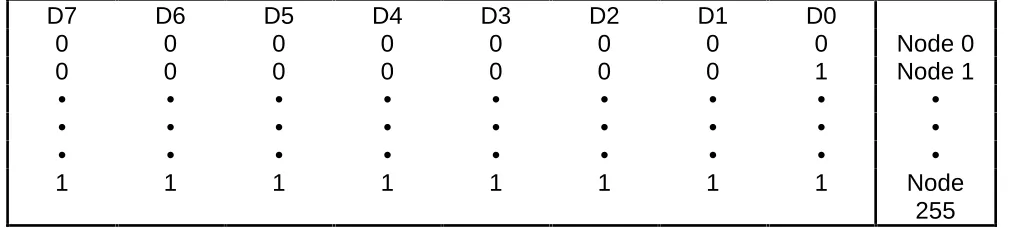
A value from 0 to 255 can be read from this byte. The value read corresponds to the node ID jumper selected for the board.
4.4 BOARD CONTROL AND STATUS REGISTER (CSR)
The CSR contains local node state information. The CSR is mapped as follows:
BIT 7 BIT 6 BIT 5 BIT 4 BIT 3 BIT 2 BIT 1 BIT 0
LED FAST
RCV HALF-
FULL
TX HALF-
FULL
BAD DATA
OWN
DATA MASK TX
EMPTY
BIT 0 - Fast mode (6.2 Mbytes/sec) if high (Read Only)
Fast mode transmits each data transfer once on the fiber-optic link. If the jumper J5 is installed, each transfer is sent twice on the fiber-optic link (3.2 Mbytes/sec).
BIT 1 - Mask Transfer Error Interrupt Masks on high (Read Only)
Table 4.1-1. VMIVME-5576 Memory Map 01 04 05 06 07 23 26 27 2A 2B 2E 2F 33 37 3B 3F 40 Board ID Node ID CSR CMD Register CMD Node INT0 Mode Control
INT1 Sender ID INT1 Mode Control
INT2 Sender ID INT2 Mode Control
INT3 Sender ID INT3 Mode Control
INT0 Vector INT1 Vector INT2 Vector INT3 Vector RAM RELATIVE ADDRESS
(HEX) DESCRIPTION CONTENTS
ID (18 H) Node No. Status Flags Interrupt Address Node to get Interrupt
(MC68153 BIM) Node ID of INT1 Sender
(MC68153 BIM) Node ID of INT2 Sender
(MC68153 BIM) Node ID of INT3 Sender
500-005576-000
BIT 2 - Own-data (high if link intact) (Read/Write)
This bit indicates that the local node has received data back that had originated on the local node. It may be reset by writing this bit to a logic "zero". Once set by receiving its own node ID from the fiber-optic receiver, the bit remains set until cleared by the local VME side.
BIT 3 - Bad-data (high if error occurred) (Read/Write)
This bit indicates that a single transfer error has occurred. It does not depend on the mask jumper to be removed. In redundant transmission mode (3.2 Mbyts/sec), it indicates only that a transfer error occurred on one of the two transfers.
BIT 4 - Transmit FIFO empty - empty when low (Read Only)
BIT 5 - Transmit FIFO half-full - over half-full when low (Read Only)
These two bits display status on the transmit FIFO on the local node. The current status of the transmit status is displayed.
BIT 6 - Receive FIFO half-full at least half-full when low (Read Only)
This bit displays current status of the receive FIFO. This bit should never be low. If this bit goes low, local VME access should be suspended or at least curtailed for a period of time or data loss could occur. This bit going low would be an indication of a local VME problem, i.e., extremely slow release of data strobes after DTACK. In a proper functioning VME system, this should never occur.
BIT 7 - Fail LED Status (Read/Write) logic 1 = LED ON, logic 0 = LED OFF
4.5 PROGRAMMING THE MC68153 BIM
The MC68153 contains one Interrupt Control Register (ICR) and one Interrupt Vector Register (IVR) for each of the four interrupt sources. All four Control Registers are identical. All four Vector Registers are also identical.
4.5.1 Register Description
4.5.2 Control Registers (23H, 27H, 2BH, 2FH)
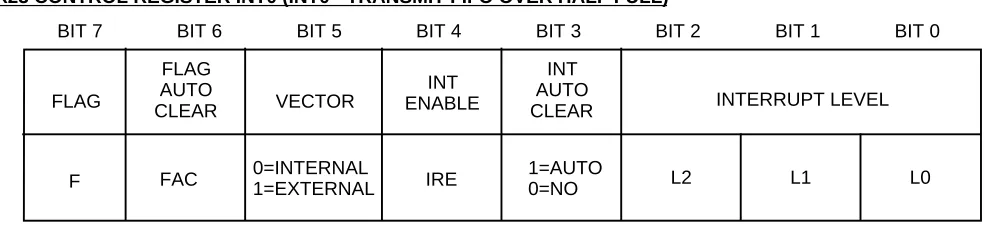
There is a Control Register for each interrupt source, see Table 4.9-1, i.e., CR0 controls INT0, CR1 controls INT1, etc. Each Control Register is divided into several fields:
a. Interrupt level (L2, L1, L0) - The least significant 3-bit field of the register determines the level at which an interrupt will be generated:
L2 L1 L0 IRQ LEVEL
0 0 0 DISABLED
0 0 1 IRQ1
0 1 0 IRQ2
0 1 1 IRQ3
1 0 0 IRQ4
1 0 1 IRQ5
1 1 0 IRQ6
1 1 1 IRQ7
A value of "zero" in the field disables the interrupt.
b. Interrupt Enable (IRE) - This field (Bit 4) must be set (high level) to enable the bus interrupt request associated with the Control Register. Thus, if the INTX line is asserted and IRE is cleared, no interrupt request (IRQX) will be asserted.
c. Interrupt Auto-Clear (IRAC) - If IRAC (Bit 3) is set , IRE (Bit 4) is cleared during an interrupt acknowledge cycle responding to this request. This action of clearing IRE disables the interrupt request. To re-enable the interrupt associated with this register, IRE must be set again by writing to the Control Register.
d. External/Internal (X/IN) - Bit 5 of the Control Register determines the response of the MC68153 during an interrupt acknowledge cycle. If the X/IN bit is clear (low level) the BIM will respond with vector data and a DTACK signal, i.e., an internal response, If X/IN is set, the vector is not supplied and no DTACK is given by the BIM, i.e., an external device should respond. Always set to "zero" for the VMIVME-5576.
e. Flag (F) - Bit 7 is a flag that can be changed without affecting chip operation.
f. Flag Auto-Clear (FAC) - If FAC (Bit 6) is set, the Flag bit is automatically cleared during an interrupt acknowledge cycle.
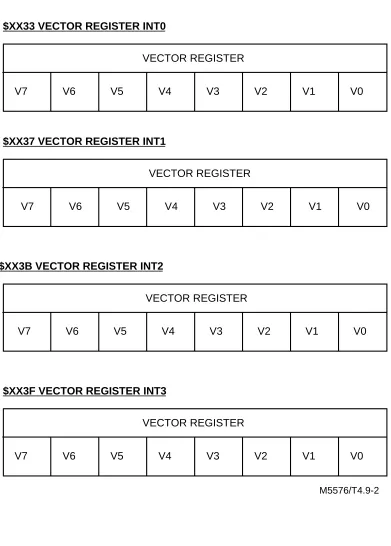
4.5.3 Vector Registers (33H, 37H, 3BH, 3FH)
500-005576-000
4.5.4 Device Reset
When the MC68153 is reset, the registers are set to a known condition. The Control Registers are set to all "zeros" (low). The Vector Registers are set to $0F. This value is the MC68000 vector for an uninitialized interrupt vector.
4.6 THE COMMAND REGISTER DEFINITION (06H)
The VMIVME-5576 may generate an interrupt in any or all other chassis through the use of the Command Register. Valid choices for interrupts are: 1,2,3. Table 4.6-1 shows all combinations possible. The interrupts are processed just like data so all words sent previous to the interrupt command will be present on receiving board’s memory before the interrupt will be issued to the receiving board. The Command Register is Write only.
Table 4.6-1. VMIVME-5576 Interrupt Codes
FUNCTION
D7 D6 D5 D4 D3 D2 D1 D0 0 0 0 1
X 1 X X X X X X interrupt is generated in all chassis 1 0
1 1
interrupt 2 is generated
not valid, no interrupt is generated interrupt 1 is generated
interrupt 3 is generated (INT level set by CRINT3) (INT level set by CRINT2) (INT level set by CRINT1)
X 0 X X X X X X interrupt is generated in chassis ID which was written previously at relative address 07H. A word or Lword Write can specify both interrupt type and receiving Node ID in one transfer.
M5576/T4.6-1
In the event of an external interrupt (i.e., int1, int2, int3), the VMIVME-5576 will prevent the loss of any subsequent interrupt of the same type through the use of a dedicated FIFO for each interrupt type. The interrupt handler must execute a Read of the sender ID Register in order to allow the next interrupt of the same type to be sent to the BIM. An example is that an interrupt int1 has been sent across the link immediately followed by a second int1. The receiving node must determine that the VMIVME-5576 has issued a int1 through the use of the resulting VME int level (0 through 7) and its vector. The second interrupt will remain in the int1 FIFO until the receiving node executes a Read of location 26 HEX which will allow the second interrupt int1 to be issued to the BIM. This method guarantees that all interrupts sent on the link will be serviced and the receiver knows the ID of the node which sent the interrupt it is currently servicing. Only one Read per interrupt is allowed, otherwise loss of subsequent interrupts may occur.
4.7 COMMAND NODE (07H)
[image:22.612.50.558.196.310.2]This register contains the node ID of the node to receive the interrupt sent by writing the command register. This register must be set at the same time by using a 16-bit word write to both command register and command node or prior to writing the command register. Table 4.7-1 shows node ID patterns.
Table 4.7-1. VMIVME-5576 Node IDs
D7 D6 D5 D4 D3 D2 D1 D0
0 0 0 0 0 0 0 0 Node 0
0 0 0 0 0 0 0 1 Node 1
• • • • • • • • • • • • • • • • • • • • • • • • • • •
1 1 1 1 1 1 1 1 Node
255
M5576/T4.7-1
4.8 INTERRUPT SENDER ID REGISTERS (26H, 2AH, 2EH)
The three interrupt sender ID registers contain the ID of the node which originated the interrupt currently being serviced. All data sent across the fiber-optic link is tagged with the ID of the originating node so it may be removed from the link once it has been passed around the link one time. The ID is stored in the appropriate register if the data word received is an interrupt. As part of the interrupt handler software, the user must read the appropriate ID register in order to re-arm the currently used interrupt. This process insures that all interrupts sent to the node will be processed. The user may or may not use the ID but it must be read as part of the interrupt handler process.
In the event that a certain interrupt has been masked off at the BIM, the FIFO for that interrupt may be cleared by writing to the ID register for the specific interrupt level before the BIM is armed. The ID write process is to be done in addition to the BIM arming process. In the interrupt handling sequence, the user should do only one read per interrupt cycle. Erroneous results will be caused by multiple reads.
4.9 LOCAL STATUS INTERRUPT
500-005576-000
Table 4.9-1. BIM Register Mapping for Interrupts, 0 to 3
$XX23 CONTROL REGISTER INT0 (INT0 - TRANSMIT FIFO OVER HALF FULL)
BIT 7
FLAG
F
BIT 6 BIT 5 BIT 4 BIT 3 BIT 2 BIT 1 BIT 0 FLAG
AUTO CLEAR
FAC 0=INTERNAL 1=EXTERNAL VECTOR INT ENABLE INT AUTO CLEAR L2 L1 1=AUTO 0=NO L0 INTERRUPT LEVEL
$XX27 CONTROL REGISTER INT1 (INT 1 - RECEIVED INTERRUPT FROM OTHER NODES)
BIT 7
FLAG
F
BIT 6 BIT 5 BIT 4 BIT 3 BIT 2 BIT 1 BIT 0 FLAG
AUTO CLEAR
FAC 0=INTERNAL 1=EXTERNAL VECTOR INT ENABLE INT AUTO CLEAR L2 L1 1=AUTO 0=NO L0 INTERRUPT LEVEL
$XX2B CONTROL REGISTER INT2 (INT2 - RECEIVED INTERRUPT FROM OTHER NODES)
BIT 7
FLAG
F
BIT 6 BIT 5 BIT 4 BIT 3 BIT 2 BIT 1 BIT 0 FLAG
AUTO CLEAR
FAC 0=INTERNAL 1=EXTERNAL VECTOR INT ENABLE INT AUTO CLEAR L2 L1 1=AUTO 0=NO L0 INTERRUPT LEVEL
$XX2F CONTROL REGISTER INT3 (INT3 - RECEIVED INTERRUPT FROM OTHER NODES)
BIT 7
FLAG
F
BIT 6 BIT 5 BIT 4 BIT 3 BIT 2 BIT 1 BIT 0 FLAG
AUTO CLEAR
V7 V6 V5 V4 V3 V2 V1 V0 VECTOR REGISTER
[image:24.612.113.504.105.651.2]$XX33 VECTOR REGISTER INT0
Table 4.9-2. BIM Vector Register Mapping
V7 V6 V5 V4 V3 V2 V1 V0
VECTOR REGISTER $XX37 VECTOR REGISTER INT1
V7 V6 V5 V4 V3 V2 V1 V0
VECTOR REGISTER $XX3B VECTOR REGISTER INT2
V7 V6 V5 V4 V3 V2 V1 V0
VECTOR REGISTER $XX3F VECTOR REGISTER INT3
500-005576-000
SECTION 5
CONFIGURATION AND INSTALLATION
5.1 UNPACKING PROCEDURES
* * * * * * * * * * * * * * *
* * * * * * * * * * * * * * * *
* *
* * * CAUTION
SOME OF THE COMPONENTS ASSEMBLED ON VMIC’s PRODUCTS MAY BE SENSITIVE TO ELECTROSTATIC DISCHARGE AND DAMAGE MAY OCCUR ON BOARDS THAT ARE SUBJECTED TO A HIGH ENERGY ELECTROSTATIC FIELD. WHEN THE BOARD IS TO BE LAID ON A BENCH FOR CONFIGURING, ETC., IT IS SUGGESTED THAT CONDUCTIVE MATERIAL BE INSERTED UNDER THE BOARD TO PROVIDE A CONDUCTIVE SHUNT. UNUSED BOARDS SHOULD BE STORED IN THE SAME PROTECTIVE BOXES IN WHICH THEY WERE SHIPPED.
Upon receipt, any precautions found in the shipping container should be observed. All items should be carefully unpacked and thoroughly inspected for damage that might have occurred during shipment. The board(s) should be checked for broken components, damaged printed circuit board(s), heat damage, and other visible contamination. All claims arising from shipping damage should be filed with the carrier and a complete report sent to VMIC together with a request for advice concerning the disposition of the damaged item(s).
5.2 PHYSICAL INSTALLATION
* * * * * * * * * * * * * * *
* * * * * * * * * * * * * * * *
* *
* * * CAUTION
DO NOT INSTALL OR REMOVE BOARD WHILE POWER IS APPLIED.
De-energize the equipment and insert the board into an appropriate slot of the chassis. While ensuring that the board is properly aligned and oriented in the supporting card guides, slide the board smoothly forward against the mating connector until firmly seated.
5.3 JUMPER INSTALLATIONS
Figures 5.3-1 shows the layout of jumpers on the Reflective Memory board.
P2 P1
J4
J10
J7 J9
MEM DEPTH 1 MEM DEPTH 2
J1 J2 A4 A3 A2 A1 J3 J5 J6 Extended Address Field Standard Address Field Board ID Nodes M A S K F A S T S P A R E J8 2 1 3 Address Mode Select. STD/EXTD ADDRESS SEL A2 8 M S B L S B XMIT RCV * * * *
Must be left open (1 Meg RAM opt) Must be left open (1/2 Meg RAM opt)
A3 1 A3 0 A2 7 A2 9 A2 6 A2 2 AP1 9 AP1 8 A2 1 A2 3 A2 0 A2 5 A2 4 A1 9 A1 8
ID7 ID6 ID5 ID4 ID3 ID2 ID1 ID0
* * ** * * * ** M5576/F5.3-1
500-005576-000
5.3.1 Extended Address Field (J4)
If the extended address jumper, J10, is installed, the extended address match field becomes active. The extended address field selects A31 through A24. An installed jumper is a logic low and no jumper is a logic "one". Refer to Figures 5.3.1-1 and 5.3.1-2.
5.3.2 Address Pass Through Field (J7)
J1 and J2 are configured at the factory and should not need configuration by the user. The information in the rest of this paragraph is for reference only. Refer to Figure 5.3.2-1.
Since the Reflective Memory Board may operate at several different SRAM sizes, the Address field must be able to accommodate the different memory sizes. The Address Pass Through Field performs this function.
If the 1 Meg SRAM option is used, the address field A23 through A20 are valid options for standard address jumper selections. The 512 K SRAM option is the same as the 1 Meg option with the addition of the AP19 pass through jumper. The A19 standard address field jumper may also be used with this option. Refer to Figures 5.3.2-2 and 5.3.2-3.
Since the address pass through jumper pattern is fixed by board memory depth, the field is hard-wired at the factory for the optional memory depth used on the board.
5.3.3 Standard Address Match Field (J7)
The standard address match field is always active. An installed jumper indicates a logic "zero" address. Some jumpers must be left open (no jumper) depending on the board memory options. The Active fields are as follows:
*1 Meg: (A23 through A20) A19 and A18 must be left open (Both Pass Through and Address Field)
512 K: (A23 through A19) A18 must be left open (Both Pass Through and Address Field)
256 K: (A23 through A18)
P2 P1
J7 J9
MEM DEPTH 1 MEM DEPTH 2
J1 J2 A4 A3 A2 A1 J3 J5 J6 Standard Address Field Board ID Nodes M A S K F A S T S P A R E J8 2 1 3 Address Mode Select. M S B L S B XMIT RCV * * * *
Must be left open (1 Meg RAM opt) Must be left open (1/2 Meg RAM opt)
A2 2 AP1 9 AP1 8 A2 1 A2 3 A2 0 A1 9 A1 8 ID 7 ID 6 ID 5 ID 4 ID 3 ID 2 ID 1 ID 0 * * ** * * * ** J10 STD/EXTD ADDRESS SEL JUMPER ARRANGEMENT TO CONFIGURE EXTENDED ADDRESS $5AXXXXXX HEX J4 Extended Address Field A2 8 A3 1 A3 0 A2 7 A2 9 A2 6 A2 5 A2 4 M5576/F5.3.1-1
500-005576-000 P2 P1 J4 J10 J7 J9
MEM DEPTH 1 MEM DEPTH 2
J1 J2 A4 A3 A2 A1 J3 J5 J6 Extended Address Field Board ID Nodes M A S K F A S T S P A R E J8 2 1 3 Address Mode Select. STD/EXTD ADDRESS SEL A2 8 M S B L S B XMIT RCV * * * *
Must be left open (1 Meg RAM opt) Must be left open (1/2 Meg RAM opt)
A3 1 A3 0 A2 7 A2 9 A2 6 A2 2 AP1 9 AP1 8 A2 1 A2 3 A2 0 A2 5 A2 4 A1 9 A1 8 ID 7 ID 6 ID 5 ID 4 ID 3 ID 2 ID 1 ID 0 * * ** * * * ** JUMPER ARRANGEMENT TO CONFIGURE EXTENDED ADDRESS $XX9XXXXX HEX
NOTE THAT FOR STANDARD ADDRESSES THIS JUMPER FIELD IS A
DON’T CARE!
Standard Address
Field
M5576/F5.3.1-2
P2 P1
J4
J10
J7 J9
MEM DEPTH 1 MEM DEPTH 2
J1 J2 A4 A3 A2 A1 J3 J5 J6 Extended Address Field Board ID Nodes M A S K F A S T S P A R E J8 2 1 3 Address Mode Select. STD/EXTD ADDRESS SEL A2 8 M S B L S B XMIT RCV * * *
Must be left open (1 Meg RAM opt) Must be left open (1/2 Meg RAM opt)
A3 1 A3 0 A2 7 A2 9 A2 6 A2 5 A2 4 ID 7 ID 6 ID 5 ID 4 ID 3 ID 2 ID 1 ID 0 JUMPER ARRANGEMENT TO CONFIGURE 1 MEGABYTE RAM
OPTION 1/4 M b yte 1/2 M b yte 1 M b yte Standard Address Field A2 2 AP1 9 AP1 8 A2 1 A2 3 A2 0 A1 9 A1 8 * * * ** * * * ** FACTORY CONFIGURED DO NOT ALTER! M5576/F5.3.2-1
500-005576-000 P2 P1 J4 J10 J7 J9
MEM DEPTH 1 MEM DEPTH 2
J1 J2 A4 A3 A2 A1 J5 J6 Extended Address Field Standard Address Field Board ID Nodes M A S K F A S T S P A R E J8 2 1 3 Address Mode Select. STD/EXTD ADDRESS SEL A2 8 M S B L S B XMIT RCV * * * *
Must be left open (1 Meg RAM opt) Must be left open (1/2 Meg RAM opt)
A3 1 A3 0 A2 7 A2 9 A2 6 A2 2 AP1 9 AP1 8 A2 1 A2 3 A2 0 A2 5 A2 4 A1 9 A1 8 ID 7 ID 6 ID 5 ID 4 ID 3 ID 2 ID 1 ID 0 * * ** * * * ** J3 JUMPER ARRANGEMENT TO CONFIGURE EXTENDED ADDRESS $5A90XXXX HEX WITH 1/2 MEGABYTE RAM
OPTION
M5576/F5.3.2-2
P2 P1
J4
J10
J7 J9
MEM DEPTH 1 MEM DEPTH 2
J1 J2 A4 A3 A2 A1 J5 J6 Extended Address Field Standard Address Field Board ID Nodes M A S K F A S T S P A R E J8 2 1 3 Address Mode Select. STD/EXTD ADDRESS SEL A2 8 M S B L S B XMIT RCV * * * *
Must be left open (1 Meg RAM opt) Must be left open (1/2 Meg RAM opt)
A3 1 A3 0 A2 7 A2 9 A2 6 A2 2 AP1 9 AP1 8 A2 1 A2 3 A2 0 A2 5 A2 4 A1 9 A1 8 ID 7 ID 6 ID 5 ID 4 ID 3 ID 2 ID 1 ID 0 * * ** * * * ** J3 JUMPER ARRANGEMENT TO CONFIGURE EXTENDED ADDRESS $5A94XXXX HEX WITH 1/4 MEGABYTE RAM
OPTION
M5576/F5.3.2-3
500-005576-000
5.3.4 Board Node ID Field (J9)
The Board Node ID field identifies each board on the Memory link. No ID may be used more than once on the link. All nodes on the link should be sequentially numbered starting with 0. Jumper field J9, provides a double hexidecimal digit defining the board node ID. An installed jumper sets the corresponding bit to 0. There is no relation between node number and physical position on the link. Nodes may be physically located in any order. Refer to Figure 5.3.4-1.
5.3.5 Address Modifier Select (J8)
The Reflective Memory Board may operate in one of three modes, supervisory data access, nonprivileged data access, or both. The different options are shown in Figures 5.3.5-1 and 5.3.5-2.
3
1 1 3
3 1
J8 J8 J8
M5576/F5.3.5-1
NONPRIVILEGED
BOTH SUPERVISORY
Figure 5.3.5-1. Address Modifier Jumper Options
5.3.6 Fast Field (J5)
If the J5 jumper is left off the fiber-optic link rate is 6.2 Mbytes. If the jumper is present, the link rate is 3.2 Mbytes. The 3.2 Mbytes rate results from transmitting every data word twice. If an error is detected in the first transmission, it is thrown away and the second transmission of data is used. If the first transmission is okay, the second is ignored.
5.3.7 Mask Field (J3)
If the mask jumper is present, the INT0 on the MC68153 interrupt IC is set when a data error is detected. The CSR can be read to determine if the INT0 was set by the transmitter becoming half-full or by a transfer error. If the mask jumper is removed then no interrupt is generated. In redundant transfer mode, the user does not care if a transfer error occurs on a single transfer since the second transfer statistically is certain to be received correctly. The CSR bit 3 is always set if a single transfer error is detected regardless of the state of the mask jumper.
P2 P1
J4
J10
J7 J9
MEM DEPTH 1 MEM DEPTH 2
J1 J2 A4 A3 A2 A1 J3 J5 J6 Extended Address Field Standard Address Field Board ID Nodes M A S K F A S T S P A R E J8 2 1 3 Address Mode Select. STD/EXTD ADDRESS SEL A2 8 M S B L S B XMIT RCV * * * *
Must be left open (1 Meg RAM opt) Must be left open (1/2 Meg RAM opt)
A3 1 A3 0 A2 7 A2 9 A2 6 A2 2 AP1 9 AP1 8 A2 1 A2 3 A2 0 A2 5 A2 4 A1 9 A1 8 ID 7 ID 6 ID 5 ID 4 ID 3 ID 2 ID 1 ID 0 * * ** * * * ** JUMPER ARRANGEMENT TO CONFIGURE A BOARD NODE ID OF
$07 HEX
M5576/F5.3.4-1
500-005576-000 P2 P1 J4 J10 J7 J9
MEM DEPTH 1 MEM DEPTH 2
J1 J2 A4 A3 A2 A1 J3 J5 J6 Extended Address Field Standard Address Field Board ID Nodes M A S K F A S T S P A R E J8 2 1 3 Address Mode Select. STD/EXTD ADDRESS SEL A2 8 M S B L S B XMIT RCV * * * *
Must be left open (1 Meg RAM opt) Must be left open (1/2 Meg RAM opt)
A3 1 A3 0 A2 7 A2 9 A2 6 A2 2 AP1 9 AP1 8 A2 1 A2 3 A2 0 A2 5 A2 4 A1 9 A1 8 ID 7 ID 6 ID 5 ID 4 ID 3 ID 2 ID 1 ID 0 * * ** * * * ** JUMPER ARRANGEMENT TO CONFIGURE BOTH SUPERVISORY AND NONPRIVILEGED DATA ACCESS M5576/F5.3.5-2
5.4 FIBER-OPTIC LINK CONFIGURATION
A link of VMIVME-5576 is formed by connecting the transmit of Card A into the receiver of Card B. Card B’s transmitter is then connected to the receiver of Card C and so on. The last card in the link has its transmit connected back to Card A receiver to close the link.
When data has been sent around the link and returns to the originating node, two things happen. One, the data is removed from the link. This is done by comparing an ID tag sent with data to the local node ID. If a match is determined, the data is removed. The second event which occurs is that the OWN-ID bit is set in the CSR. Loop data latency can be measured by writing a "zero" to the OWN-ID bit in the CSR and polling until it returns to a "one" state. This test assumes there is no other data originated by the local node on the link before the latency test is initiated. The data write to the CSR is passed around the link as regular traffic but will not affect the status of any other nodes CSR. The CSR data write provides a means to measure latency without giving up any memory which may be in use in order to measure data transfer latency.
If data was not generated by the local node, it is placed in the receive FIFO. The receive FIFO then places data in RAM and into the transmit FIFO to be sent to the next node on the link. Data can be mixed from the local VME and the link based on which arrives at what time. Just because two data transfers arrive in one node back-to-back does not guarantee a transfer cannot be inserted between them by the local VME card.
Priority is given to the local VME card in case of a simultaneous access to the RAM and the transmit FIFO by the local VME and the receive FIFO. In any other case, the other must wait for the current cycle to finish to gain access to the RAM.
5.5 IACK DAISY CHAIN
If there are empty slots to the left of the VMIVME-5576, then IACK Jumpers must be installed for the empty slots. Otherwise, the VMIVME-5576 will intermittently fail to respond to VMEbus reads and writes.
500-005576-000
SECTION 6
MAINTENANCE
6.1 MAINTENANCE
This section of the technical manual provides information relative to the care and maintenance of VMIC’s products. Should the products malfunction, the user should verify the following:
a. Software
b. System configuration
c. Electrical connections
d. Jumper or configuration options
e. Boards fully inserted into their proper connector location f. Connector pins are clean and free from contamination
g. No components of adjacent boards are disturbed when inserting or removing the board from the VMEbus card cage
h. Quality of cables and I/O connections
User level repairs are not recommended. Contact VMIC for a Return Material Authorization (RMA) Number. This RMA Number must be obtained prior to any return.
6.2 MAINTENANCE PRINTS
APPENDIX A
APPENDIX B
Compiled using Cross code C compiler, using the VMIC test code library. This file should be loaded into the 1st VME chassis CPU, setup as node 0. This routine will setup and process interrupts then report those interrupts received. The second thing this software will do is to attempt to fill the output fifo over half full and then process and report that interrupt 0 occurred.
*/
#include <stdio.h> #include <test.h> #include "5576int.h"
/*
Declare a global pointer to the 5576 board. */
Vmic5576 * uut = (( Vmic5576 *)( VME_STANDARD )); /* "VME_STANDARD" defined in
VMIC Library */ /*
Declare external functions */
void isr_int0( void ); void isr_int1( void ); void isr_int2( void ); void isr_int3( void );
/*
global variables for the interrupt routines */
int int0status,int1status,int2status,int3status;
main() {
int aa;
int0status = 0xff; int1status = 0; int2status = 0; int3status = 0;
printf("\r\n\n Receive Interrupts from remote VME chassis test");
/*
** initialize intr vector table to point to timer ISR **
** System dependent initialization where our system ** is a Force CPU-33 Single Board Computer.
**
** USER_VECTOR() is a macro in our test library that ** adds a passed value to the first available
** user vector for the Force CPU-33 interrupt table. */
setvect( USER_VECTOR( 0 ), &isr_int0 ); setvect( USER_VECTOR( 1 ), &isr_int1 ); setvect( USER_VECTOR( 2 ), &isr_int2 ); setvect( USER_VECTOR( 3 ), &isr_int3 );
/*
** initialize intr vector register to installed ISR */
uut->int0vr = USER_VECTOR( 0 ); uut->int1vr = USER_VECTOR( 1 ); uut->int2vr = USER_VECTOR( 2 ); uut->int3vr = USER_VECTOR( 3 );
/*
Clear interrupt registers of all previous interrupts */
uut->int1sid = 0; /* data doesn’t matter */ uut->int2sid = 0;
uut->int3sid = 0;
/*
Setup interrupt mode control registers */
uut->int0mc = IRQ_LEVEL_7 : INT_ENABLE; /* interrupt 0 enabled at level 7
Auto clear bit 3 low - off, X/IN bit 5 low - internal */
uut->int1mc = IRQ_LEVEL_5 : INT_ENABLE; /* interrupt 1 enabled at level 5
Auto clear bit 3 low - off, X/IN bit 5 low - internal */
uut->int2mc = IRQ_LEVEL_3 : INT_ENABLE; /* interrupt 2 enabled at level 3
Auto clear bit 3 low - off, X/IN bit 5 low - internal */
uut->int3mc = IRQ_LEVEL_1 : INT_ENABLE; /* interrupt 3 enabled at level 1
Auto clear bit 3 low - off, X/IN bit 5 low - internal */
printf("\r\n**** Setup waiting on interrupts from node 1."
"\r\nHit any key to continue after sending interrupts\r\n");
getc();
printf("int0 status = %x, int1 = %x, int2 = %x,"
"int3 = %x",int0status,int1status,int2status,int3status);
uut->mem5576 = 0xaa;
}
printf("\r\nint0 status = %x, int1 = %x, int2 = %x,"
"int3 = %x",int0status,int1status,int2status,int3status);
printf("\r\nint0 should be f4 hex, Hit any key to continue"); getc();
printf("\r\n\n ***** sending interrupts 1,2,3 to node 1."); for (aa = 1;aa < 4;aa += 1)
{
uut->cmdnd = 0x01; /* node one into register 0x07 */
uut->cmdreg = aa; /* Send interrupts 1,2,3 to node in reg. 0x07 */
}
printf("\r\n\nProgram complete");
}
#pragma interrupt() void isr_int0( void ) {
int0status = uut->csr;
/* wait for transmit fifo to clear. */ do{
}while( ( uut->csr & TXFIFO_UHF) == 0 );
}
#pragma interrupt() void isr_int1( void ) {
int1status = uut->int1sid; /* read id reg. to clear the interrupt. */ }
#pragma interrupt() void isr_int2( void ) {
int2status = uut->int2sid; /* read id register to clear the interrupt. */
}
#pragma interrupt() void isr_int3( void ) {
int3status = uut->int3sid; /* read id register to clear the interrupt. */
/*
This is the header file for the VMIVME-5576 Reflective Memory Board Interrupt test. This file assumes the 2 boards are -200 option.
Both VMIVME-5576 boards are jumpered for Standard Either Mode access. */
struct vmivme_5576 { union reg_5576 {
unsigned char reg_5576_b[64]; /* register space */ unsigned short reg_5576_w[32];
unsigned int reg_5576_l[16];
} r5576u;
unsigned char vmivme_5576_mem[1048512]; };
typedef struct vmivme_5576 Vmic5576; /* 5576 type define */
/* register definitions */
#define bid r5576u.reg_5576_b[0x01] /* Board ID */
#define nid r5576u.reg_5576_b[0x04] /* Node ID */
#define csr r5576u.reg_5576_b[0x05] /* Control & Status Register */
#define cmdreg r5576u.reg_5576_b[0x06] /* Command register */
#define cmdnd r5576u.reg_5576_b[0x07] /* Command node */
#define int0mc r5576u.reg_5576_b[0x23] /* interrupt 0 mode
control register */
#define int0vr r5576u.reg_5576_b[0x33] /* interrupt 0
vector register */
#define int1sid r5576u.reg_5576_b[0x26] /* interrupt 1 sender
ID register */
#define int1mc r5576u.reg_5576_b[0x27] /* interrupt 1 mode
control register */
#define int1vr r5576u.reg_5576_b[0x37] /* interrupt 1
vector register */
#define int2sid r5576u.reg_5576_b[0x2a] /* interrupt 2 sender
ID register */
#define int2mc r5576u.reg_5576_b[0x2b] /* interrupt 2 mode
control register */
#define int2vr r5576u.reg_5576_b[0x3b] /* interrupt 2
vector register */
#define int3sid r5576u.reg_5576_b[0x2e] /* interrupt 3 sender
ID register */
#define int3mc r5576u.reg_5576_b[0x2f] /* interrupt 3 mode
control register */
#define int3vr r5576u.reg_5576_b[0x3f] /* interrupt 3
vector register */
#define mem5576 vmivme_5576_mem[0x0] /* memory */
/* Control Status Register bit define’s */
/* command register bit def’s */
#define GLOBAL_INT 0x40
#define INT_1 0x01
#define INT_2 0x02
#define INT_3 0x03
/* bim control bits (for regs. int0mc-int3mc) */
#define FLAG_BIT 0x80
#define FLAG_AUTO_CLR 0x40
#define EXT_VECTOR 0x20 /* set to 0 for internal operation */
#define INT_ENABLE 0x10
#define INT_AUTO_CLR 0x08
#define IRQ_LEVEL_7 0x07
#define IRQ_LEVEL_6 0x06
#define IRQ_LEVEL_5 0x05
#define IRQ_LEVEL_4 0x04
#define IRQ_LEVEL_3 0x03
#define IRQ_LEVEL_2 0x02
#define IRQ_LEVEL_1 0x01
#define INT_DISABLE 0x00
#define MEM_OFF 0x40
/* Board ID register value */
#define ID_5576 0x18
/* Interrupt FIFO depth in bytes */
#define INT_FIFO_DEPTH 512
/* Base address pointers */ /*
Reg5578 * regbase_5578 = ((Reg5578*)(VME_STANDARD + reg_off));*/ /* registers *
/
/*
Memory * membase_5578 = ((Memory *)(VME_STANDARD + mem_off));*/ /* memory *
APPENDIX C
accessed from VMEbus after or more nodes on 5550 network. (Iackin must multiple writes. be in place on the backplane even if interrupts
are not used on the node)
2) The local node ID is higher than the maximum node ID strapped on Node 0.
3) System throughput has reached maximum and FIFO’s have filled up with data to be sent and the transmit FIFO half-full signal has been ignored.
4) P3/P4 cable swapped or lines are open between cable and local node.
5) No Node 0 present to pass token.
Communications lost after 1) Receive FIFO’s on one or more nodes have power down and up of one been ’glitched’ by an out of spec txclk on link. or more Nodes on link Reset all nodes or issue link reset to nodes
strapped to listen to the link reset signal.
Erratic communications on 1) Link rate too high for cable length
data link i.e., RATE MAX LENGTH
_______________________________
1 (20 MBYTE/SEC) 50’
2 (10 MBYTE/SEC) 100’
3 (5 MBYTE/SEC) 250’
4 (2.5 MBYTE/SEC) 1000’
2) Open cable at one or more pins on link.
3) Terminator resistors not installed on end nodes of link or extra terminators have been left on center nodes.
4) P3/P4 pins pushed back on Node connector. Inspect pins for damage.
Node does not answer at 1) Address pass through for specific memory expected Address size not strapped correctly. (See
Configuration section of manual.)
2) Address modifier Incorrectly strapped on card
3) Address strapped wrong (Certain LSB
address jumpers must be left off because of memory size options).
Data written to one node 1) For nodes of memory size 1 MBYTE or does not appear in other smaller, a 1 MBYTE relative address is
nodes passed. If two 0.25 MBYTE cards are not
mapped in the same relative address in relation to the 1 MBYTE boundary then they will not communicate appear to communicate since they contain no common space in RAM. The 2 and 4 MBYTE cards pass a 4 MBYTE relative address and thus must be mapped in the same address relative to 4 MBYTE
boundaries. (Note 4 and 2 MBYTE nodes may not be used on the same link as 1 MBYTE or smaller nodes due to the fact that they look at different relative address sizes)
2) The sending node ID is higher than the maximum node ID strapped on Node 0.
3) Open or defective connection to cable P3 or P4
4) Defective FIFO module on either receiving node or transmitting node. (The bad card may be found by checking memory on other nodes to see if they received data correctly.)
Receive FIFO fills up and 1) Iackin has not been connected to the interrupt never empties out even after Arbiter card. (VME Slot 0 card.)
link traffic stops.
Data Bits dropped or data 1) Damaged or defective FIFO on node appears in wrong address
in memory. 2) Link rate set too high for cable length
3) Link rate set too high for cable length
4) Damaged cable or connection on node with data error.
When interrupts are being used 1) Iack-in is not daisy chained from the CPU to a spurious interrupt is issued the reflective memory card on the backplane.
from the CPU VME spec requires all empty VME slots to
have Iack-in jumpered to Iack-out. Reflective memory cards expect Iack-in to be driven even if interrupts are not being used.
2) The Iack-in/Iack-out jumper has been placed on backplane for the slot the reflective