Abstract— The main trends of the development of the cyber-physical structure presented in Gartner's Hype Cycle 2017 are described to apply them in science, education, transport, industry and state structures. Prospective directions of the market-feasible technologies, related to green cyber-social monitoring and management of society, are proposed. An expanded description of technologies focused on the creation of the smart digital world, green cities and 5G telecommunications is performed. Recommendations are given for using the top 10 technologies of 2017 in business, scientific and educational processes of higher education.
Index Terms— cloud-driven computing, cyber-physical computing, digital world, hype cycle emerging technologies, quantum memory-driven computing.
I. INTRODUCTION
The key to the future of humanity on a green planet contains five components: 1) The digital world. 2) New materials. 3) Genetic engineering. 4) Mutation of living. 5) Sun-energy.
The digital world is based on precise digital identification of all cyber-physical, cyber-social processes and phenomena in time and space. The goal of creating a digital world is intelligent cyber-physical and social computing for exhaustive digital monitoring and metric intellectual management of all processes and phenomena to improve people's quality of life and preserve the planet's ecology. The existing computing power of the entire planet is not enough for solving the mentioned problem due to the low productivity of global computing and the high energy consumption of existing classical and quantum computers. This gives grounds to search alternative technologies for implementing computer-based innovative architectures. Quantum memory-driven and logic-free computing, which excludes costly, energy-consuming and logic-like (or, not) operations of superposition and entanglement, may be a possible solution of the problem. The mutual relations between quantum and classical computing are based on the following axioms, which have to be taken into account
Vladimir Hahanov is with the Kharkov National University of Radioelectronics, Kharkov, 61166, Ukraine (phone: 380577021326; fax: 380577021326; e-mail: [email protected]).
Ka Lok Man is with the Xi’an Jiaotong-Liverpool University, China. (e-mail: [email protected]).
Wajeb Gharibi is with the Jazan University, Jazan, KSA. (e-mail:
Anastasia Hahanova is with the Kharkov National University of Radioelectronics, Kharkov, 61166, Ukraine (phone: 380577021326; fax: 380577021326; e-mail: [email protected]).
Eugenia Litvinova is with the Kharkov National University of Radioelectronics, Kharkov, 61166, Ukraine (phone: 380577021326; fax: 380577021326; e-mail: [email protected]).
when creating innovative computing: 1) Quantum computing is isomorphic to the classical one: data structures and operations (qubit, superposition, entanglement) of quantum computing have a one-to-one correspondence with analogous components of the classical computing (bits, or, not). 2) Quantum uncertainty in computing has a strict determinism, excluding "probability, like a fig leaf on the bare body of our ignorance". Albert Einstein. 3) Any processes and phenomena of quantum computing can be realized (simulated) on the classical ones. 4) Any processes and phenomena of classical computing can be realized (simulated) on a quantum one. 5) Statement. Memory-driven and logic-free computing architecture is more technological and less energy consuming in the classical and quantum formats of implementation.
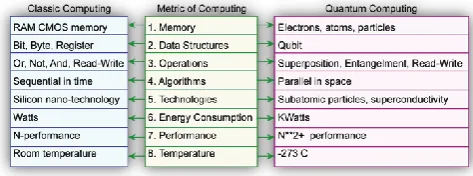
[image:1.595.309.546.418.506.2]A one-to-one correspondence between quantum and classical computing is shown in Fig. 1. Here we consider all the metric components necessary for the realization of computing: 1) memory, 2) addressable data structures, 3) operations, 4) algorithms, 5) technologies, 6) energy consumption, 7) performance, 8) temperature conditions.
Fig. 1. Metric comparison of classical and quantum computing
Integrally, quantum computing differs from the classical one by a parallel solution of combinatorial problems, which ensures high performance, due to the concurrent representation a finite set of discrete states in the quantum point of a subatomic scale. A classic computer leverages nanotechnology dimensions of the register memory in the silicon crystal, which is by several orders greater than the subatomic particles. However, low temperature superconductivity (-270 degrees Celsius) is required for photon control of subatomic particles, which are provided by the amount of energy that is in several orders higher than the energy consumption of a classical computer. Naturally, all the tasks of parallel quantum computing can be performed on a classical computer due to the unitary state coding, which requires an exponential increase in the memory costs of the data storage. The development paths of classical and quantum computing cross at the point of additive synthesis or the growth of subatomic logic-free memory structures controlled by photons that will have a
Cyber-Physical Emerging Computing
daily cycle solar energy dependence similar to the plant organisms.
The goal of the research is to create architecture and methods of quantum computing for parallel minimization of Boolean functions and hardware solving the coverage problem.
The objectives are: 1) Analysis of the Top technologies of cyber-physical computing for solving real-world problems. 2) Creation of memory-driven architecture of quantum computing for parallel solving the problems of synthesis and analysis. 3) Development of a quantum method for parallel minimization of Boolean functions and solving the coverage problem.
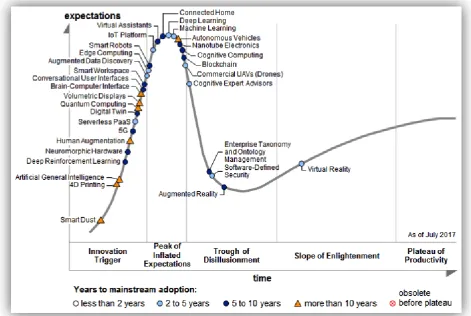
There are certain trends in the green world, which provide the technological basis for creating cyber-social computing, as a part of cyber-physical computing, within Internet of Things. Gartner Inc., which is creating a global technology, cyber-fashion, added eight new trends to its Hype Emerging Technologies Cycle brand in 2017 (Fig. 2): 5G, Artificial General Intelligence, Deep Learning, Deep Reinforcement Learning, Digital Twin, Edge Computing, Server-less PaaS, and Cognitive Computing [1,2].
Edge computing is a technology aimed to improve the performance of cloud services by leveraging special intelligent computational procedures at the location of the mobile user or embedded microsystem. Digital Twin creates cyber images of physical processes and phenomena. As in
the mirror, if there is no reflection of a digitized company, (university) in the cyberspace, then it is not in the physical space. Serverless PaaS is hardware-free architecture for organizing cloud-computing processes based on a platform as a service (Platform as a Service). The economy of the cloud platform is clearly advantageous in comparison with server support of the activities of the companies. Therefore, all small and medium businesses within two years will move to cloud infrastructure and services.
[image:2.595.61.533.418.734.2]How to understand the phases of the Gartner cycle? 1) Innovation trigger means the launch of innovation, where potential breakthrough technologies that are interesting for the market, with unproven commercial consistency, are replacing existing cyber-physical structures. 2) The peak of inflated expectations is the high level of bloated market expectations, where timely advertising creates successful precedents for implementing innovative technologies on the failure field. 3) A trough of disillusionment means the arrival of disappointment, when interest in technology goes down, experiments do not confirm the expected market attractiveness, individual developers improve their products and learn about investments. 4) Slope of Enlightenment means a slope of insight, when there are examples of technologies that benefit the enterprise; there are finances for pilot projects. 5) Plateau of Productivity means an area of sustainable productivity enhancement, when the technologies, products and services that are created find their consumers on the market.
II.THE THREE MAIN AREAS OF THE CYBER CULTURE
Cyber culture is the development level of social and technological moral relations between society, physical green world and cyberspace, determined by the implementation of Internet services for precise digital monitoring and reliable metric management in all processes and areas of human activity, including education, science, life, production and transport, in order to improve people life quality and preserve the planet's ecosystems. Short definition: Cyber culture is a moral metric of computing excellence to achieve the social significance and recognition.
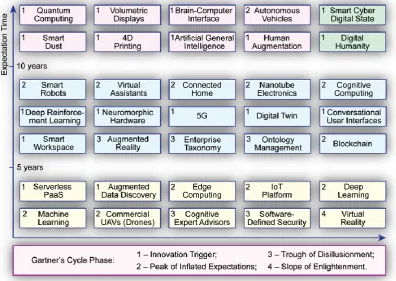
Hype-cycle 2017 forms the planet’s cyber culture for the next 5-10+ years by expert analysis of more than 1800 possible technologies performed by leading research and consulting companies. A list of 33 + 2 top Gartner-table technologies creates a cyber culture, shown in Fig. 3, and also competitive advantages for subjects of the market in the fields of science, education, industry and transport.
The first three places in the Gartner-top-cycle are assigned to the following strategic directions: Artificial Intelligence Everywhere, Transparently Immersive Experiences and Digital Platforms.
Artificial intelligence everywhere becomes the most disruptive technology in the next 10 years due to the availability of computing power, infinite volumes of big data and achievements in the implementation of neural networks to adapt to the new situations that no one has ever encountered before. Enterprises, which are interested in leveraging artificial intelligence, consider the following
technologies to be useful for themselves: Deep Learning, Deep Reinforcement Learning, Artificial General Intelligence, Autonomous Vehicles, Cognitive Computing, Commercial UAVs (Drones), Conversational User Interfaces, Enterprise Taxonomy and Ontology Management, Machine Learning, Smart Dust, Smart Robots and Smart Workspace. Thus, Artificial General Intelligence in the next 10 years will penetrate into all fields of human activity, as a technological service immersed in the cyber space, including 30 percent of high-tech and transport companies.
Smart workspace means to be connected to the infrastructure of solving production problems in space and time in the format of 24/7. At the same time, virtual private networks are used, the metric for measuring the potential and performance results, the presence of a certain cyber culture and the choice of the most convenient places for doing business. High self-motivation for the successful and efficient performance of the task stipulates the leverage of dynamically changing cyber-physical workspace for creativity, which is invariant to the office, home, transport, places of rest and sports.
[image:3.595.102.499.451.732.2]2) Transparently immersive experiences are becoming more human oriented and provide the following: transparency of relations between people, business and things; the flexibility and adaptability of the links between the workplace, home, enterprise and other people. Gartner-Inc. also predicts the introduction into practice of the following expecting critical technologies: Autonomous
Vehicles, Brain-Computer Interfaces, Smart Dust, 4D Printing, Augmented Reality (AR), Connected Home, Human Augmentation, Nanotube Electronics, Virtual Reality (VR), and Volumetric Displays. Integration of cyber technologies is aimed at ensuring the quality of human life by creating: smart workspace, connected home, augmented reality, virtual reality and the growing brain-computer interface. For example, Human Augmentation technology aims to expand or supplement human capabilities to improve the health and quality of life through the harmonious use of cognitive and biotechnical improvements, as parts of the human body. Volumetric Displays visualize objects using 3D active voxels in three dimensions with a 360-degree spherical viewing angle, where the image of the phenomenon changes as the viewer moves. 4D Printing technology is an innovation of 3D printing, where structural materials can be transformed after manufacturing the product in order to adapt it to human needs and the environment.
3) Digital Platforms of technological culture are formed by components: 5G, Digital Twin, Edge Computing, Blockchain, IoT, Neuromorphic Hardware, Quantum Computing, Serverless PaaS and Software-Defined Security. Technologies such as Quantum Computing and Blockchain will create the most unpredictable and disruptive breakthroughs for humans in the next 5-10 years. Neuromorphic Hardware is considered as the future of artificial intelligence, which is aimed at creating a neuromorphic-computing chip that can replace the cloud computing power of the Apple Siri Data Center in solving complex machine learning problems (Chris Eliasmith, a theoretical neuroscientist and co-CEO of the Canadian AI startup Applied Brain Research) [3]. Otherwise, inside the iPhone will be a digital brain in the form of a neuromorphic IP-core, which solves all the tasks of interaction of a gadget with the outside world in real time. IBM's neuromorphic universal chip, due to spike asynchronism, consumes three orders of magnitude less energy with a fivefold increase in the number of transistors that exceed Intel's existing hardware solutions. For programming hardware-oriented algorithms, compilers are used: Nengo, Python. At present, the following chips are already implemented using the Nengo compiler: vision systems, speech systems, motion control, adaptive robotic controllers, and also Spaun-chip for offline interactive communication between the computer and the environment. Software-Defined Security (SDS) or Catbird is designed to protect system objects or logical structures in virtual space. This is due to the fact that network security no longer has physical boundaries within the framework of the logical architecture existence of the cloud service. Therefore, an accurate and flexible SDS is created as a complement to infrastructures and data centers without the presence of special security devices. Scaling SDS makes it possible to create or acquire the minimum necessary security conditions in a certain place and time, which significantly reduces the material costs of forming a quality SDS service.
III. EXAMPLES OF LEVERAGING TOP TECHNOLOGIES
High level costs for research and development from Amazon, Apple, Baidu, Google, IBM, Microsoft and Facebook stimulate the creation of original, patentable solutions in the field of Deep Learning and Machine Learning, among which are: Amazon Alexa, Apple Siri, Google Now, Microsoft Cortana. Gartner Inc. is sure that the tools for in-depth training will account for 80% of the standard funds for scientists by 2018. Today, on the websites of companies, technologies and data on scientific research are becoming available: Amazon Machine Learning, Apple Machine Learning Journal, Baidu Research, Google Research, IBM AI and Cognitive Computing, Facebook Research.
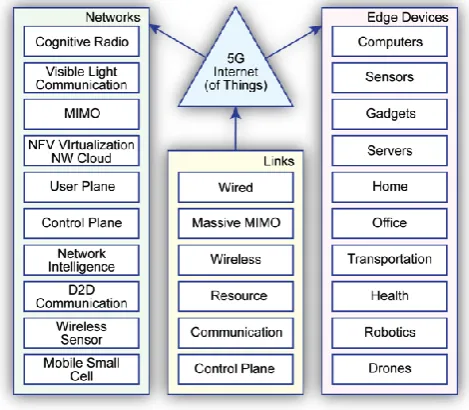
The introduction of telecommunication 5G-technology (Figure 4) in the coming decade will provide the market with expected innovative solutions for the security, scalability and performance of global green networks and connections in transport, IoT, industry, healthcare.
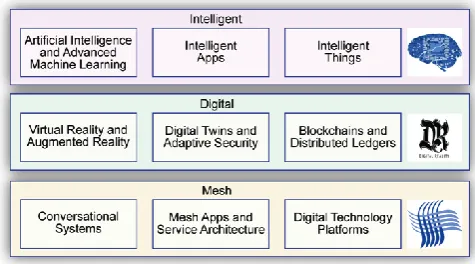
[image:4.595.309.544.555.760.2]The world is becoming more and more green, intelligent, digitized and strongly connected (networked) to the people, things and services [5-9]. Fig. 5 presents a picture consisting of top-ten strategic green trends in the IT industry in 2017 [2, 10-12], which should be adopted by all companies and universities wishing to form new business projects on the NASDAQ market of goods and services.
Practically today, a new, more sophisticated smart digital intelligent cyber-physical world is created to share a harmonious existence of people in an environment of people-friendly goods and services. Thus, the general picture of the desired world consists in the desire: 1) to digitize all objects and processes on the planet (spatial, biological, technical, social, virtual); 2) to implement scalable artificial intelligence into all digitized cyber-physical processes and phenomena; 3) to connect all intelligent objects and processes into smart, scalable network within the framework of a digitized common cyberspace. The purpose of creating a digital intelligent smart cyber-physical world is the quality of life of a moral person, the elimination of social defects and the green ecology of the planet.
[image:5.595.309.547.55.187.2]To create successful businesses and new educational courses, Gartner Inc. recommends to take into account assumptions about strategic planning, which include 10 points: 1) By 2020, 100 million consumers will buy into the expanded reality, including using Head-Mounted Displays (HMDs). 2) By 2020, 30% of web browsing sessions will be performed without using a screen. More than 5 of the 550 million Apple iPhone owners will use AirPods to exchange voice messages. Five percent of consumer-oriented websites will be equipped with audio interfaces (including voice chats with voice support). 3) By 2019, 20% of brands will abandon their mobile applications (in favor of the MASA – Mesh App and Service Architecture). 4) By 2020 smart algorithms will positively affect the behavior of more than 1 billion global workers. 5) By 2022, a business based on the leverage of detachments will cost 10 billion dollars. 6) By 2021, 20% of all human activities will be included, at least, in the services of one of the seven leading global companies (Google, Apple, Facebook, Amazon, Baidu, Alibaba and Tencent) 7) Until 2019, every dollar invested in innovation, will require an additional 7 dollars for the basic execution of the project. 8) During the course of 2020, Internet of Things (IoT) will increase the demand for data centers by 3%. Indoor display devices, such as Amazon Echo and Google Home, will be located in more than 10 million homes. 9) By 2022, IoT will save consumers and businesses $ 1 trillion a year, targeting services and supplies. By 2020, Android Auto will use about 40 million cars, and 37 million vehicles will leverage CarPlay. 10) By 2020, 40% of employees will be able to cut their spending on health using a fitness tracker.
Fig. 5. Top-9 disruptive areas in the computing industry
IV. CONCLUSION
1. Cyber trends from Gartner Inc. give the opportunity of corporate architecture and university leaders to keep up with digital business processes in science, education and industry, timely respond to cyber threats, utilize business innovation and determine an effective digital business strategy for sustainable development of states. In fact, Hype-cycle is a deep spatio-temporal 4D-analytics of the modern market state related to sustainable cyber-physical development of the smart technologies for the next 10-15 years.
2. For the university, the Hype-cycle determines the vital need to invest the innovative technologies in the students' knowledge, in order to obtain in 5-10 years the army of creative experts capable of raising the state from the ruins of modern cyber ignorance. Otherwise, the Gartner cycle to the university is a strategy of its cyber-physical sustainable development in time and space. Any strategy developed without knowledge of the pace and direction of technological change will suffer from incorrect planning of actions, the destruction of business, science and education. For instance, it should be borne in mind that in 2018 robobosses will accurately monitor and remotely manage 3 million workers in the world with the goal of: metrically assessing the potential of employees, distributing tasks, logically routing their implementation, invariant to positioning the workplace, assessing quality and productivity.
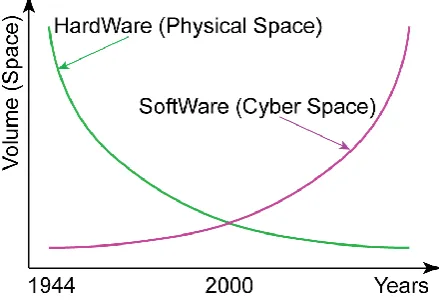
Fig. 6. Interaction of volumes of cyber-physical components
4. Nevertheless, hardware and software technologies are represented in the Hype-cycle (on the market) practically at the same proportions (50:50): 1) Hardware-driven technologies are: 4D Printing, Volumetric Displays, Nanotube Electronics, Brain-Computer Interface, Human Augmentation, Autonomous Vehicles, Cognitive Computing, Commercial UAVs (Drones), Smart Dust, Smart Robots, Smart Workspace, Connected Home, 5G, IoT Platform, Edge Computing, Neuromorphic Hardware, Quantum Computing; 2) Software-driven technologies are: Deep Learning, Deep Reinforcement Learning, Artificial General Intelligence, Enterprise Taxonomy, Ontology Management, Machine Learning, Virtual Assistants, Cognitive Expert Advisors, Digital Twin, Blockchain, Serverless PaaS, Software-Defined Security, Virtual Reality, Augmented Reality, Augmented Data Discovery, Conversational User Interfaces, Digital Humanity, Smart Cyber Digital State.
5. The same ratio of hardware and software technologies is shown in the Gartner-forecast, which means that the levels of their capitalization on the NASDAQ market tend to parity. A good example of parity is Apple ($ 800 billion - NASDAQ 2017) and Google ($ 570 billion). These manufacturers are significantly different in that they rely on the wisdom of their teams (experts) armed with the doctrine: "consumers can not predict their own needs" [11]. The alternative is the policy of Microsoft (503 billion), which conducts extensive research before launching the product, for example, such as Windows Phone. According to Gartner, Apple's share in the global mobile phone market is 14.2% compared to 3.3% for Microsoft. Who do I trust, experts or consumers? The answer is unambiguous – to the experts, in 4D format (always, everywhere and on all issues).
REFERENCES
[1] L. Columbus. “Gartner's Hype Cycle for Emerging Technologies, 2017 Adds 5G And Deep Learning For First Time”. [Online]. Available:
https://www.forbes.com/sites/louiscolumbus/2017/08/15/gartners- hype-cycle-for-emerging-technologies-2017-adds-5g-and-deep-learning-for-first-time/#646a4cf34be2
[2] “Gartner Identifies Three Megatrends That Will Drive Digital Business Into The Next Decade“. STAMFORD, Conn., Aug. 15, 2017. [Online]. Available: http://www.gartner.com/newsroom/id/3784363
[3] A. Frank. “The future of AI is neuromorphic. Meet the scientists building digital 'brains' for your phone”. 2017. [Online]. Available: http://www.wired.co.uk/article/ai-neuromorphic-chips-brains [4] A. Gupta and R. K. Jha, "A Survey of 5G Network: Architecture and
Emerging Technologies," IEEE Access, vol. 3, pp. 1206-1232, 2015. [5] C. Zhu, V. C. M. Leung, L. Shu and E. C. H. Ngai, "Green Internet of
Things for Smart World," IEEE Access, vol. 3, pp. 2151-2162, 2015. [6] V. Kharchenko, Y. Kondratenko, J. Kacprzyk (Eds.), “Green IT
Engineering: Concepts, Models, Complex Systems Architectures”, In the book series "Studies in Systems, Decision and Control" (SSDC), vol. 1, Berlin, Heidelberg: Springer International Publishing, 2017. [7] V. Kharchenko, Y. Kondratenko, J. Kacprzyk (Eds.), “Green IT
Engineering: Components, Networks and Systems Implementation”.
In the book series "Studies in Systems, Decision and Control" (SSDC), vol. 2, Berlin, Heidelberg: Springer International Publishing, 2017.
[8] K. Christidis and M. Devetsikiotis, "Blockchains and Smart Contracts for the Internet of Things," IEEE Access, vol. 4, pp. 2292-2303, 2016. [9] “Blockchains: How They Work and Why They’ll Change the World”.
IEEE Spectrum. October 2017. [Online]. Available: https://spectrum.ieee.org/computing/networks/blockchains-how-they-work-and-why-theyll-change-the-world
[10] A. Zanella, N. Bui, A. Castellani, L. Vangelista and M. Zorzi, "Internet of Things for Smart Cities," IEEE IoT Journal, vol. 1, no. 1, pp. 22-32, Feb. 2014.
[11] D.W. Cearley, M.J. Walker, B. Burke.“Top 10 Strategic Technology Trends for 2017”. 14 October, 2016. [Online]. Available:
https://www.gartner.com/doc/3471559?srcId=1-7578984202&utm_campaign=RM_GB_
2017_TRENDS_QC_E2_What&utm_medium=email&utm_source=E
loqua&cm_mmc=Eloqua-_-Email-_-LM_RM_GB_2017_TRENDS_QC_E2_What-_-0000