1
Abstract—Building design phase is the backbone of a construction project. Design phases should be accompanied by third parties who are involved in achieving a high-quality building. Expectations of different stakeholders can be better reflected in the design by considering varioust aspects and treating the design as a multi-criteria decision-making process (MCDM). This study primarily focuses on integrating stakeholders’ will into the design with an MCDM tool called as Quality Function Deployment (QFD). To deal with uncertain qualitative and non-homogeneous data, QFD is applied with the 2-Tuple extensions. The proposed 2-Tuple integrated QFD model is implemented to a sustainable hospital building design to illustrate its strength and applicability.
Index Terms—2-Tuple linguistic representation, building design, quality function deployment, sustainable hospital design
I. INTRODUCTION
UILDING design is a process where a set of criteria and objective are needed to be evaluated. A range of data shall be taken into consideration during building design, complicating the design phase. A systematic concept, based on multi-criteria decision-making (MCDM) approach, can facilitate such decision problems. MCDM processes can produce a suitable decision-making environment where experienced decision makers (DMs) knowledgeable about the subject are involved in reaching the goals.
In a case where more than one DM is involved, the input data for the process can be provided in different forms such as numerical, interval-valued or qualitative assessment [1]. Consequently, aggregation of differently formed data becomes a critical stage of the decision-making. Unifying various formed data under one form is the primary step to obtain meaningful aggregated assessments from DMs. For this type of occasions, Herrera and Martinez introduced the 2-Tuple linguistic approach in 2000 [2]. 2-Tuple linguistic representation model provides a flexible environment where data gathered in different forms can be unified under a common form without loss of information. It also gives a chance to compute with unified data [3].
1This work is financially supported by Galatasaray University Research Fund (Project No:18.102.001).
Deniz Uztürk is with Department of Business Administration, Galatasaray University34349 İstanbul, Turkey([email protected])
Gülçin Büyüközkan is with the Department of Industrial Engineering, Galatasaray University, 34349 İstanbul, Turkey Tel: +902122274480, Fax: +902122595557 ([email protected])
This study focuses on a decision-making process with the eventual goal of designing a building. In this process, the primary aim is to reflect stakeholders’ opinions in the design phase. To achieve this objective, Quality Function Deployment (QFD), a technique to reflect customer need into production or design phase in manufacturing or a service sector [4], is deployed. Building design processes are similar to manufacturing or service processes where customers’ will be transferred to the service or production. Due to this similarity, QFD has been chosen for this building design problem. Moreover, to strengthen its ability to deal with qualitative and non-homogeneous data derived from multiple DMs, QFD is integrated with 2-Tuple. This integration provides some benefits, such as creating a flexible environment to DMs for expressing their judgments in their preferred form and computing different varied data under one common form to achieve meaningful assessments for a building design according to the will of stakeholders. To test the plausibility of the proposed method, the 2-Tuple integrated-QFD approach is applied to a sustainable hospital design case.
Hospital design is chosen as an application area due to its considerable number of stakeholders. Also, pleasing stakeholder is a significant strategic advantage for a hospital in the healthcare sector.
For this application; first, a list of sustainable hospital building requirements is identified, as a customer need (CNs) in QFD, based on an extensive literature research. Later, the detected sustainable building requirements are given to a group of people from the Galatasaray University for their evaluation as potential hospital stakeholders. Their evaluation established the importance to be transformed into design requirements for a sustainable hospital building. Later, with the help of experts and a detailed literature review, the design requirements (DRs) to achieve sustainability are identified. Different DMs evaluated CN-DR pairings in their own linguistic scales according to their experience about the subject. As a result, a ranking of the DRs is obtained after applying 2-Tuple-integrated QFD. Detailed steps of the proposed methodology for the hospital building design is presented in Fig. 1.
The rest of the paper is formed as follows: Next section gives a literature review about 2-Tuple MCDM applications and sustainable building design. Then, the details of the application of the proposed 2-Tuple integrated methodology is presented. After the case study, results and discussions are provided. As the last part the conclusions are given.
Stakeholder Preference Based 2-Tuple
Integrated Method for Sustainable Hospital
Design
Deniz Uztürk, Gülçin Büyüközkan
Fig. 1. Detailed methodology for the proposed 2-Tuple integrated House of Quality matrix of QFD for sustainable hospital design
II. LITERATURE REVIEW
First,an in-depth literature review is carried out to evaluate and identify different MCDM techniques used with 2-Tuple extensions in the literature. Then, an elaborated literature review is done to obtain sustainable hospital requirements as CNs in QFD. Later, with the help of experts and literature research suitable DRs are identified as engineering requirements, which can realize CNs.
A) 2-Tuple Linguistic Model and MCDM
2-Tuple and its extensions have been applied to a wide variety of subjects and MCDM methodologies. VIKOR technique is the most selected method employed with 2-Tuple; it is used for material selection problems [5], waste management subject [6] and human resource evaluations [7]. Another highly used 2-Tuple integrated technique is TOPSIS, such as in robot evaluations and selection [8] and personnel selection areas [9].
Other methods such as DEMATEL [10], Delphi and MULTIMOORA [11], [12]are also combined with the 2-Tuple. These applications are selection problems; however, in design and evaluation cases QFD method is more common. QFD is studied with 2-Tuple in supplier evaluation [12], warehouse design [13]; product design [14], [15]; market segment selection [16]; and sustainable buildings [17].
In this paper, the QFD method is chosen thanks to its comfortable and robust computational steps, which can efficiently reflect customer needs into engineering requirements. Also, as apparent from the 2-Tuple QFD integrated studies; this technique is suitable for design problems. Also, by combining QFD with 2-Tuple, this study provides a flexible decision-making environment to DMs about their preferred forms of judgments.
B) Sustainable Hospital Building
Hospital building design is a very crucial component of hospital construction. The design of the building should be low-cost, user-friendly, innovative and attractive at the same time. Achieving these goals transforms this process into an MCDM practice. Today, sustainable buildings are critical due to significant effects of buildings to their environments.
Climate change effects push us to build more sustainable buildings. Moreover, sustainability and environmental consciousness have become a substantial competitive advantage in every sector. As a result, even in the healthcare sector sustainable buildings have become a priority.
1) Sustainable Hospital Building Requirements as CNs in QFD
A broad literature review is done to identify sustainable hospital requirements, as presented in Table I.
TABLEI
CNS FOR SUSTAINABLE HOSPITAL BUILDING Sustainability Requirements CN1 Less resource use
CN2 Natural lighting CN3 Natural ventilation CN4 Renewable energy CN5 Strategic landscaping CN6 Healing environment CN7 Material selection CN8 Safety
CN9 Unique and sustainable design CN10 Low cost
CN11 Business continuity CN12 Equal opportunity
2) Design Requirements (DRs) for a Sustainable Hospital Building
DRs are generated according to CNs. Experts opinions and a broad literature search are performed to identify DRs, as presented in Table II.
CN-DR relation is essential; DRs should be related to at least one CN to evaluate a relation matrix with CN-DR pairs in QFD.
[image:2.595.359.497.422.599.2]χ:F(sT)→ST
χ(F(sT))=Δ j=0j.γj
g
∑
γj
j=0 g
∑
⎛⎝ ⎜ ⎜
⎞
⎠ ⎟
⎟=Δ(β)=(s,α) the design stage. The necessary steps (Fig. 1) of the
framework are as follows: TABLEII
DRS FOR SUSTAINABLE HOSPITAL BUILDING Design Requirements
DR1 Sensors
DR2 Light Control Systems DR3 Building Orientation
DR4 Types, sizes, and shapes of openings DR5 Fixed light windows for skylights DR6 Blocking noise
DR7 LED lightings DR8 Low-flow plumbing DR9 Non-toxic material use
DR10 Solar panels for building covering DR11 Building forms and dimensions DR12 Rainwater management DR13 Emergency escape systems DR14 Continuous maintenance
DR15 Sustainable and innovative architecture DR16 Equal employment opportunity DR17 Equal accessibility
1. Detecting sustainable hospital building requirements as CNs in QFD framework.
2. Assigning weights of CNs according to stakeholder preferences.
3. Detecting design requirements to accomplish CNs as DRs in QFD framework.
4. Applying 2-Tuple integrated QFD framework to obtain the priorities for sustainable hospital building design.
A) Detecting sustainable hospital building requirements
As mentioned in the previous section (Table I); CNs are identified with extensive literature research about sustainable buildings and sustainable hospitals. Twelve different CN are identified and are given to a group of people to evaluate their weights.
B) Assigning weights of CNs according to stakeholders preferences
A group of volunteers of 20 people is gathered from the Galatasaray University to evaluate CNs to weight them for the proposed QFD framework.
A 1-3-9 scale of evaluation is provided to the group to take their assessments about the requirements. This 1-3-9 scale is chosen because it is the fundamental evaluation scale for QFD. It also provides an essential focus on the most important criteria than the 1-2-3 scale [18].
Each member of the group evaluated each CN, and as a result, their average score is assigned as a CN weight after being normalized.
C) Detecting DRs according to the CNs in the QFD framework
As mentioned in Table II, the DRs are identified concerning CNs and expert opinion for the problem. The next step is the assessment of the CN-DR pair relations to apply the QFD framework.
D) Application of the 2-Tuple Integrated QFD framework
The essential aim of applying 2-Tuple-integrated QFD is to obtain DR priorities for sustainable hospital building design that fits well with stakeholders’ expectations.
For this case, two experts are chosen to evaluate the relations between each CN and DR. Different linguistic scales are assigned to these experts due to the difference of their experience about the sustainable building concept. These linguistic scales are presented in Table III. Their aggregation is done with the 2-Tuple methodology. Five-scaled linguistic variables are assigned to the first expert, considering that she is a junior expert on the subject. Nine-scaled linguistic variables are assigned to the second expert, considering her long experience in sustainable buildings.
TABLEIII
LINGUISTIC SCALES FOR EXPERTS 1st Expert 𝑺
𝒊
𝟓 2ndExpert 𝑺
𝒊 𝟗
None (N) 𝑺𝟎𝟓 None (N) 𝑺𝟎𝟗
Low(L) 𝑺𝟏𝟓 Very Low (VL) 𝑺𝟏𝟗
Medium(M) 𝑺𝟐𝟓 Low (L)
High(H) 𝑺𝟑𝟓 Almost Medium (AM) 𝑺𝟐𝟗
Very High(VH) 𝑺𝟒𝟓 Medium (M) 𝑺𝟑𝟗
Almost High (AH) 𝑺𝟒𝟗
High (H) 𝑺𝟓𝟗
Very High (VH) 𝑺𝟕𝟗
Perfect (P) 𝑺𝟖𝟗
The critical conflict in this QFD application is that input data are gathered in varied forms. For example, CN importance data are numerical form between [0,1], while expert judgments are collected in linguistic form with different granularity. For such a setting, the 2-Tuple linguistic method is the best solution.
First, different granulated linguistic variables are normalized at the same granularity. Since the nine-scaled linguistic variables have the highest granularity, they are normalized under it [15]. Steps of the normalization process are as follows:
As a beginning, the intersection of fuzzy membership functions of the two scales is needed, as in Fig.2.
Fig. 2.The intersection of membership functions of nine and five scaled linguistic variables
Later, by applying (1), S5can be represented as S9 [2].
(1)
[image:3.595.84.251.88.331.2] [image:3.595.326.533.534.642.2](BLTS), cis a function that transforms such a fuzzy set into a 2-tuple linguistic value. gi is the membership function of the fuzzy sets related to the linguistic terms ST, and g is the granularity of the linguistic term set F(ST).
As the second stage, a similar implementation is applied for numerical values between [0,1]. The function tNST transforms numerical values into the fuzzy set in ST.
t,-.: [0,1] → 𝐹(𝑆.)
t,-.(𝜗) = = 𝑠?A𝛾? B
?CD
𝛾?= 𝜇F?(𝜗) =
⎩ ⎪ ⎨ ⎪
⎧0, 𝑖𝑓 𝜗 ∉ 𝑠𝑢𝑝𝑝𝑜𝑟𝑡(𝜇F?(𝑥) TUVW
XWUVW, 𝑖𝑓 𝑎?≤ 𝜗 ≤ 𝑏?
1, 𝑖𝑓 𝑏?≤ 𝜗 ≤ 𝑑? ]WUT
]WU^W, 𝑖𝑓 𝑑?≤ 𝜗 ≤ 𝑐?
(2)
where 𝜇F?(. )is the membership function of linguistic labels
which is an element of ST. The membership function is represented with (𝑎?, 𝑏?, 𝑐?, 𝑑?) parameters in (2) but when
the fuzzy membership function is triangular 𝑏?= 𝑑?.
(2) provides us with a fuzzy set of the numerical function. Then, by applying, (1) the fuzzy set can be transformed into the 2-Tuple form.
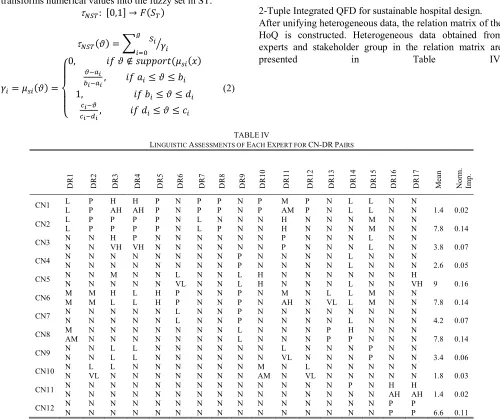
2-Tuple Integrated QFD for sustainable hospital design. After unifying heterogeneous data, the relation matrix of the HoQ is constructed. Heterogeneous data obtained from experts and stakeholder group in the relation matrix are
presented in Table IV.
TABLEIV
LINGUISTIC ASSESSMENTS OF EACH EXPERT FOR CN-DRPAIRS
DR
1
DR
2
DR
3
DR
4
DR
5
DR
6
DR
7
DR
8
DR
9
DR
10
DR
11
DR
12
DR
13
DR
14
DR
15
DR
16
DR
17
Me
an
No
rm
.
Im
p.
CN1 L L
P P
H AH
H AH
P P
N N
P P
P P
N N
P P
M AM
P P
N N
L L
L L
N N
N
N 1.4 0.02 CN2 L L P P P P P P P P N N L L N P N N N N H H N N N N N N M M N N N N 7.8 0.14
CN3 N N N N H VH VH P N N N N N N N N N N N N P P N N N N N N L L N N N N 3.8 0.07 CN4 N N N N N N N N N N N N N N N N P P N N N N N N N N L L N N N N N N 2.6 0.05
CN5 N N N N M N N N N N L VL N N N N L L H H N N N N N N N L N N N N H VH 9 0.16 CN6 M M M M H L L L H H P P N N N N P P N N M AH N N L VL L L M M N N N N 7.8 0.14
CN7 N N N N N N N N N N L L N N N N P P N N N N N N N N N L N N N N N N 4.2 0.07 CN8 M AM N N N N N N N N N N N N N N L L N N N N N N P P H P N N N N N N 7.8 0.14
CN9 N N N N L L L L N N N N N N N N N N N N L VL N N N N N N P P N N N N 3.4 0.06 CN10 N N L VL L N N N N N N N N N N N N N M AM N N L VL N N N N N N N N N N 1.8 0.03
CN11 N N N N N N N N N N N N N N N N N N N N N N N N N N P N N N H AH H AH 1.4 0.02
CN12 N N N N N N N N N N N N N N N N N N N N N N N N N N N N N N P P P P 6.6 0.11
In the relation matrix of Table IV, the first letter represents the first expert’s evaluation, and latter represents the second expert’s evaluation. Unification of these differently-granulated evaluations are done with (1), and later they are aggregated with the Weighted Aggregation Operator
(WAO) with (3): 𝑥⃑ = b∑ ∆
Ue(𝑟
?f, 𝛼?f) × ∆Ue(𝑤?, 𝛼?) j
?Ce
∑ ∆Ue(𝑤 ?, 𝛼?) j
?Ce
k
= ∆ b∑ 𝛽?f× 𝑤?
j ?Ce
∑j?CD𝑤?
k
(3)
where (𝑟?f, 𝛼?f) is the evaluation of each expert for the𝑖𝑡ℎ
CR and 𝑗𝑡ℎ DR;(𝑤?, 𝛼?) stands for the weights of experts
and 𝑛 represents the number of experts and 𝛽? is the 𝛽
values for 𝑖𝑡ℎCN and 𝑗𝑡ℎ DR. The aggregated matrix is given in Table V.
After obtaining the aggregated decision matrix, in the final step, the priorities of DRs are calculated with (4).
p𝑣f, 𝛼fr = 1/𝑚 = ∆Ue u
?Ce
p𝑟?f, 𝛼?fr × ∆Ue(𝑐?, 𝛼?) (4)
where 𝑚 stands for the number of CNs, p𝑣f, 𝛼fr is the
importance of DRs as a result, p𝑟?f, 𝛼?fr represents the
values in the relationship matrix for 𝑖𝑡ℎ CN and 𝑗𝑡ℎ DR and
(𝑐?, 𝛼?) is the weight of each CN assigned by the stakeholder
group in the 2-Tuple form.
[image:4.595.46.546.143.563.2]TABLEV
AGGREGATED RELATION MATRIX WITH 2-TUPLE FORMED CN IMPORTANCE
IV. RESULTS AND DISCUSSIONS
In this paper, a 2-Tuple-integrated QFD framework is presented for sustainable hospital building designs. The ranking of DRs is obtained by applying (4) to the aggregated relation matrix. The aggregated 2-Tuple formed the final relation matrix, and the ranking of the DRs is presented in Table V. The most critical three design requirements that need to be considered in the first place are found as:
1. Building orientation 2. Non-toxic material use
3. Fixed light windows for skylight
The importance obtained from the stakeholder group shows that natural light, safety, and healing environment are the most crucial stakeholder expectations from the design. Accordingly, in priorities of QFD, DRs that are highly scored by experts about these three sustainability requirements are identified to be the essential DRs for prioritizing during the design phase.
The 2-Tuple-integrated QFD framework can successfully reflect stakeholders’ idea to the building design case. This can lead the competent planning of buildings to address stakeholder needs and to gain a strategic edge as a charming hospital in the healthcare sector.
V. CONCLUSION
This study focused on the sustainable hospital building design problem in the existence of non-homogeneous and multi-granular data.
The concept of sustainability has become essential in virtually every sector nowadays. These developments also affect buildings, emphasizing the importance given to sustainable buildings. Even in the healthcare sector, sustainable buildings are sought due to customer satisfaction and reduction of impact on the environment. In this study, a sustainable hospital building design was discussed and treated as an MCDM process.
This MCDM method provides an easy decision-making environment, as it can quickly gather experts’ qualitative evaluations. Numerical evaluations are preferred in stakeholder group evaluations. The reason for this preference was to get a quicker return from the stakeholder group.
These preferences have created a nonhomogeneous environment for the decision-making. To overcome this complexity, the 2-Tuple method is utilized.
A robust and simple tool of design, QFD, is used with the 2-Tuple extensions. As a result, sustainable hospital building priorities are obtained according to stakeholder preferences. In this study, a small group of potential stakeholders is chosen for time limitations. For further studies, the CN importance can be investigated more closely for more reliable and robust rankings. In addition, other 2-Tuple-based MCDM methods can be explored for their effectiveness, compared to the proposed methodology. This method can also be implemented in a selection problem, where different hospitals are assessed according to these DRs obtained from this application.
This 2-Tuple-integrated QFD framework can also be
Im p . (N ,0 .1 7) (L, 0. 23 ) (L ,-0. 42) (L ,0 .3 1) (L ,0 .1 5) (L ,-0. 42) (L ,0 .2 3) (N ,0 .5 ) (L ,0 .2 5) (N ,0 .2 5) (N ,0 .1 7) (L ,-0. 08) DR1 7 (V L ,-0. 12) (V L ,-0. 12) (V L ,-0. 12) (V L ,-0. 12) (V H ,-0. 46) (V L ,-0. 12) (V L ,-0. 12) (V L ,-0. 12) (V L ,-0. 12) (V L ,-0. 12) (H ,-0. 46) (P ,-0. 33) 5 DR1 6 (V L ,-0. 12) -(V L ,-0. 12) (V L ,-0. 12) (V L ,-0. 12) (V L ,-0. 12) (V L ,-0. 12) (V L ,-0. 12) (V L ,-0. 12) (V L ,-0. 12) (V L ,-0. 12) (H ,-0. 46) (P ,-0. 33) 14 DR1 5 (L ,-0. 28) (M ,0 .0 2) (L ,-0. 28) (V L ,-0. 12) (V L ,-0. 12) (M ,0 .0 2) (V L ,-0. 12) (V L ,-0. 12) (P ,-0. 33) (V L ,-0. 12) (V L ,-0. 12) (V L ,-0. 12) 8 DR1 4 (L ,-0. 28) (V L ,-0. 12) (V L ,-0. 12) (L ,-0. 28) (V L ,-0. 12) (L ,-0. 28) (V L ,-0. 12) (V H ,-0. 46) (V L ,-0. 12) (V L ,-0. 12) (P ,-0. 33) (V L ,-0. 12) 9 DR1 3 (V L ,-0. 12) (V L ,-0. 12) (V L ,-0. 12) (V L ,-0. 12) (V L ,-0. 12) (V L ,0 .2 2) (V L ,-0. 12) (P ,-0. 33) (V L ,-0. 12) (V L ,-0. 12) (V L ,-0. 12) (V L ,-0. 12) 10 DR1 2 (P ,-0. 33) (V L ,-0. 12) (V L ,-0. 12) (V L ,-0. 12) (V L ,-0. 12) (V L ,-0. 12) (V L ,-0. 12) (V L ,-0. 12) (V L ,-0. 12) (V L ,0 .2 2) (V L ,-0. 12) (V L ,-0. 12) 16 DR1 1 (M ,-0. 48) (H ,0 .0 4) (P ,-0. 33) (V L ,-0. 12) (V L ,-0. 12) (A H ,-0. 48) (V L ,-0. 12) (V L ,-0. 12) (V L ,0 .2 2) (V L ,-0. 12) (V L ,-0. 12) (V L ,-0. 12) 4 DR1 0 (P ,-0. 33) (V L ,-0. 12) (V L ,-0. 12) (V L ,-0. 12) (H ,0 .0 4) (V L ,-0. 12) (V L ,-0. 12) (V L ,-0. 12) (V L ,-0. 12) (M ,-0. 48) (V L ,-0. 12) (V L ,-0. 12) 12
DR9 (VL
,-0. 12) (V L ,-0. 12) (V L ,-0. 12) (P ,-0. 33) (L ,-0. 28) (P ,-0. 33) (P ,-0. 33) (L ,-0. 28) (V L ,-0. 12) (V L ,-0. 12) (V L ,-0. 12) (V L ,-0. 12) 2
DR8 (P
,-0. 33) (V L ,-0. 12) (V L ,-0. 12) (V L ,-0. 12) (V L ,-0. 12) (V L ,-0. 12) (V L ,-0. 12) (V L ,-0. 12) (V L ,-0. 12) (V L ,-0. 12) (V L ,-0. 12) (V L ,-0. 12) 17
DR7 (P
,-0. 33) L, -0. 28) (V L ,-0. 12) (V L ,-0. 12) (V L ,-0. 12) (V L ,-0. 12) (V L ,-0. 12) (V L ,-0. 12) (V L ,-0. 12) (V L ,-0. 12) (V L ,-0. 12) (V L ,-0. 12) 15
DR6 (VL
,-0. 12) (V L ,-0. 12) (V L ,-0. 12) (V L ,-0. 12) (V L ,0 .2 2) (P ,-0. 33) (L ,-0. 28) (V L ,-0. 12) (V L ,-0. 12) (V L ,-0. 12) (V L ,-0. 12) (V L ,-0. 12) 11
DR5 (P
,-0. 33) (P ,-0. 33) (V L ,-0. 12) (V L ,-0. 12) (V L ,-0. 12) (H ,0 .0 4) (V L ,-0. 12) (V L ,-0. 12) (V L ,-0. 12) (V L ,-0. 12) (V L ,-0. 12) (V L ,-0. 12) 3
DR4 (H
,-0. 46) (P ,-0. 33) (V H ,0 .1 7) (V L ,-0. 12) (V L ,-0. 12) (L ,-0. 28) (V L ,-0. 12) (V L ,-0. 12) (L ,-0. 28) (V L ,-0. 12) (V L ,-0. 12) (V L ,-0. 12) 6
DR3 (H,0
.0 4) (P ,-0. 33) (H ,-0. 46) (V L ,-0. 12) (M ,0 .0 2) (V H ,-0. 46) (V L ,-0. 12) (V L ,-0. 12) (L ,-0. 28) (V L ,0 .2 2) (V L ,-0. 12) (V L ,-0. 12) 1
DR2 (P
,-0. 33) (P ,-0. 33) (V L ,-0. 12) (V L ,-0. 12) (V L ,-0. 12) (M ,0 .0 2) (V L ,-0. 12) (V L ,-0. 12) (V L ,-0. 12) (V L ,0 .2 2) (V L ,-0. 12) (V L ,-0. 12) 7
DR1 (L
,-0. 28) (L ,-0. 28) (V L ,-0. 12) (V L ,-0. 12) (V L ,-0. 12) (M ,0 .0 2) (V L ,-0. 12) (M ,-0. 48) (V L ,-0. 12) (V L ,-0. 12) (V L ,-0. 12) (V L ,-0. 12) 13
CN1 CN2 CN3 CN4 CN5 CN6 CN7 CN8 CN9 CN1
applied to those design problems that face with difficulties due to multigranular and nonhomogeneous data.
REFERENCES
[1] D. Elloumi and S. Dhouib, "New multi-criteria approach dealing with dependent and heterogeneous criteria for end-of-life product strategy,"
Applied Mathematics and Computation, vol. 2018, no. 5, p. 1668–
1681, 2011.
[2] F. Herrera and L. Martinez, "A 2-tuple fuzzy linguistic representation model for computing with words," IEEE Transactions on Fuzzy Systems, vol. 8, no. 6, p. 746–752, 2000.
[3] F. Herrera, L. Martinez and P. Sanchez, "Managing non-homogeneous information in group decision making," European Journal of
Operational Research, vol. 166, pp. 115-132, 2005.
[4] Y. Akao, "QFD: Quality Function Deployment – Integrating Customer Requirements into Product Design," Productivity Press, 2004. [5] H.-C. Liu, L. Liu and J. Wu, "Material Selection using an Interval
2-Tuple Linguistic VIKOR Method Considering Subjective and Objective Weights," Materials and Design, no. 52, pp. 158-167, May 2013.
[6] H.-C. Liu, J.-X. You, X.-J. Fan and Y.-Z. Chen, "Site selection in waste management by the VIKOR method using linguistic assessment," Applied Soft Computing, no. 21, pp. 453-461, April 2014. [7] P. Liu and X. Wu, "A competency evaluation method of human
resources managers based on multi-granularity linguistic variables and VIKOR method," Technological and Economic Development of
Economy, vol. 18, no. 4, pp. 696-710, 2012.
[8] H.-C. Liu, M.-L. Ren, J. Wu and Q.-L. Lin, "An interval 2-tuple linguistic MCDM method for robot evaluation and selection," International Journal of Production Research, vol. 52, no. 10, pp. 2867-2880, 2014.
[9] M. Dursun and E. E. Karsak, "A fuzzy MCDM approach for personnel selection," Expert Systems with Applications, vol. 37, pp. 4324-4330, 2010.
[10] M. A. Quader, S. Ahmed, R. A. R. Ghazilla and M. D. Shameem Ahmed, "Evaluation of Criteria for CO2 Capture and Storage in the Iron and Steel Industry Using the 2-tuple DEMATEL Technique,"
Journal of Cleaner Production, no. 120, pp. 207-220, 2016.
[11] H.-C. Liu, Jian-XinYou, ChaoLu and Yi-ZengChen, "Evaluating health-care waste treatment technologies using a hybrid multi-criteria decision making model," Renewable and Sustainable Energy Reviews, vol. 41, pp. 932-942, 2015.
[12] A. Cid-López, M. J. Hornos, R. n. A. Carrasco and E. Herrera-Viedma, "SICTQUAL: A fuzzy linguistic multi-criteria model to assess the quality of service in the ICT sector from the user perspective," Applied Soft COmputing, no. 37, pp. 807-910, September 2015.
[13] G. Büyüközkan and D. Uztürk, "Combined QFD TOPSIS Approach with 2-Tuple Linguistic Information for Warehouse Selection," in
International Conference on Fuzzy Systems (FUZZ-IEEE), Naples,
2017.
[14] L. He, X. Ming, M. Li, M. Zheng and Z. Xu, "Understanding customer requirements through quantitative analysis of an improved fuzzy Kano's model," in Proceedings Of The Institution Of Mechanical
Engineers Part B-Journal Of Engineering Manufacture, 2017.
[15] M. Li, "The Extension of Quality Function Deployment Based on 2-Tuple Linguistic Representation Model for Product Design under Multigranularity Linguistic Environment," Mathematical Problems in Engineering, vol. 2012, 2012.
[16] Z.-L. Wang, J.-X. You and H.-C. Liu, "Uncertain Quality Function Deployment Using a Hybrid Group Decision Making Model," Symmetry, vol. 8, no. 11, p. 119, 2016.
[17] L. C. Wood, C. Wang, H. Abdul-Rahman and N. S. J. Abdul-Nasir, "Green hospital design: integrating quality function deployment and end-user demands," Journal of Cleaner Production, vol. 112, pp. 903-913, 2014.
[18] P. David O. Hunt, "Popping a Project: Using a 1-3-9 Ranking System in Selecting a Project," 2017. [Online]. Available: https://davidhuntpe.files.wordpress.com/2015/10/use-of-a-1-3-9-scoring-system-for-evaluating-project-alternatives.pdf.
[19] M. Li, "The Extension of Quality Function Deployment Based on