Digging For Worms, Fishing For Answers
The CERIAS Intrusion Detection Research Group
Center for Education and Research in Information Assurance and Security
Purdue University
West Lafayette, IN
Abstract
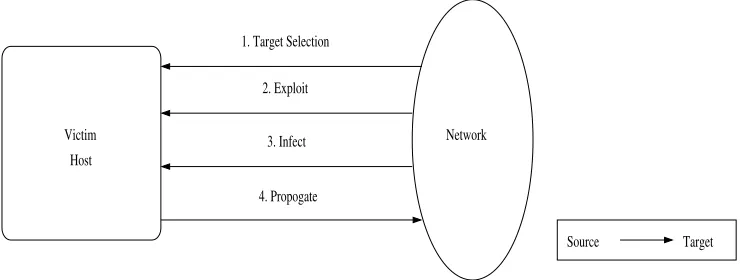
Worms continue to be a leading security threat on the In-ternet. This paper analyzes several of the more widespread worms and develops a general cycle for them. The life-cycle, from the point of view of the victim host, consists of four stages: target selection, exploitation, infection, and propagation. While not all worms fall into this framework perfectly, by understanding them in this way, it becomes ap-parent that the majority of detection techniques used today focus on the first three stages. This paper presents a tech-nique that is used in the fourth stage to detect the class of worms that use a horizontal scan to propagate. An argu-ment is also made that detection in the fourth stage is a viable, but under-used technique.
1. Introduction
Worms continue to be a serious threat to the Internet as a whole. A worm is an “Independent program that replicates from machine to machine across network connections often clogging networks and information systems as it spreads” [19]. To date, the worms that have become widespread have been relatively benign. However, as worm writers become more sophisticated, the potential damage caused by worms becomes incalculable. Warhol and Flash worms [18] illus-trate ways in which worms can become more sophisticated and rapidly spread. In fact, more recent worms such as Slap-per [4] have set up Distributed Denial of Service (DDoS) networks as they spread.
To model how worms behave and propagate, a four stage life-cycle was developed. Our life-cycle is constructed from the point of view of an uninfected host. First, the host is selected as a target by the worm from a remote machine. The host is then compromised through some sort of exploit.
Florian Buchholz, Thomas E. Daniels, James P. Early, Rajeev Gopalakrishna, R. Patrick Gorman, Bejamin A. Kuperman, Sofie Nystrom, Addam Schroll, and Andrew Smith. This paper was partially funded by the sponsors of CERIAS
After being compromised, the worm then infects the host. Finally, the worm propagates by choosing other targets to infect. Not all worms fit perfectly within this framework; however, from a conceptual standpoint, the actions in each stage are present in a worm’s behavior and can be success-fully applied to most of the worms in the past few years.
As worms have been identified as a significant security threat, a number of techniques have been developed to de-fend against them. However, the majority of the focus has been on the first three stages of a worm’s life-cycle. For ex-ample, signature based network intrusion detection systems are used to detect exploits and host based intrusion detection systems are used to detect infections based upon modified, deleted, or added files.
This paper focuses on techniques that can be used to de-tect and contain worms in the fourth stage, propagation. A class of worms that behave similarly in the fourth stage is also identified. By watching outbound network traffic from an infected host, it is possible to detect these worms as they attempt to propagate. There are a number of advantages in this form of detection, including being notified of an in-fected host and containing any further infection on the local network or in other domains (potentially protecting one’s reputation). Furthermore, even if a worm is not detected when it enters the network, it may be possible to detect it on its way out.
The next section describes the four stage life-cycle of a worm in greater detail. Section 3 discusses the techniques currently being used to detect worms in the context of the four stage life-cycle. Section 4 looks at the different tech-niques that can be used to detect a worm in the fourth stage. Finally, a preliminary implementation, future work and con-clusions are presented.
2
The Four Stage Life-cycle
Host Victim
Source Target Network
1. Target Selection
2. Exploit
3. Infect
[image:2.612.113.483.73.213.2]4. Propogate
Figure 1. The Four Stage Life-cycle of a Worm
The four stage life-cycle, as shown in Figure 1, is from the point of view of a host that is about to become infected. The arrows represent the source of each stage, but are not necessarily indicative of separate network traffic or connec-tions.
The four stages in the life-cycle are:
1. Target selection
2. Exploitation
3. Infection
4. Propagation
In practice, the actions in the first and fourth stages are the same. However, from the point of view of the attacked host, they appear differently. This will become clear as each of these stages is described in more detail. The Lion worm, described in both [2] and [5], will be used as an example to illustrate the actual actions of a worm in each stage.
2.1
Target Selection
The target selection stage is the phase when an unin-fected host is chosen to be attacked. This is where the worm performs reconnaissance to determine other potential vic-tims.
From the point of view of the host that is about to be in-fected, this may be as simple as a single network probe. For example, the Lion worm simply probes a potential victim to see if it is running a service on port 53. If there is indeed a service running, then the worm moves into the second stage to attempt to exploit the victim.
2.2
Exploitation
The exploitation phase is when the worm compromises the target by exploiting a particular vulnerability. Often-times, worms use well known vulnerabilities and published exploits to compromise their target.
In the Lion example, a BIND exploit [1] is used to com-promise the host and obtain root privileges. If the victim is successfully compromised, then the worm moves into the third stage, infection.
2.3
Infection
The infection stage is the most broad in the life-cycle, as the worm copies itself on to the victim machine and then performs any number of different actions. The line between the infection and exploitation stage is sometimes blurred. For example, the Code Red worm [3] actually loads itself into the victim’s memory as part of the exploit used to com-promise the victim. The infection stage is understood to be the time when the worm “sets up shop” on the newly infected machine. For example, the worm can open back-doors, change system files, or attempt to hide its presence by replacing system utilities with trojan horses.
The Lion worm connects to a predetermined website to download itself to the newly infected host, mails several system files (including/etc/shadow) to a predetermined email address, and adds an entry to/etc/inetd.conf
to allow attackers to connect to port 10008 with root access. After the worm has set itself up on the newly infected host, it then moves into the fourth stage of the life-cycle, propagation.
2.4
Propagation
network traffic. This is an important distinction and allows new techniques to be used in worm detection.
The Lion worm begins its propagation by randomly choosing an IP address as a base. Then, starting with this base address, it uses aTCP SYNscan to probe on port 53. It repeatedly increments the address by one to get the next target it will probe. It scans well over a hundred hosts per second.
2.5
Four Stage Life-cycle Summary
Looking at the entire life-cycle for the Lion worm, a vic-tim host would see:
Stage One - A connection attempt on port 53
Stage Two - A BIND exploit on port 53
Stage Three - An outbound connection to a website to download the worm, filesystem changes to open a backdoor, and outbound email transferring sensitive system files
Stage Four - A series of rapid outbound scans probing port 53 on randomly selected hosts
In Table 1, included at the end of the paper, several of the more prolific worms are broken into the described four stage life-cycle. Every worm in the table scans to find po-tential victims. TheNetwork Probecategory illustrates this, and lists the port numbers of any scanned ports. In addition, some worms use email in order to spread themselves. This category was included for completeness, but is not other-wise addressed. TheExploitcategory gives the targeted ser-vice and the CERT Advisory that describes the vulnerabil-ity. TheInfectioncategory includes columns for filesystem modifications, backdoors, and other activity. A filesystem modification includes everything from a copy of the worm being placed on the system to changing system files. A backdoor includes techniques such as adding new users to the system and opening a root shell server (in which case the port is listed). TheOthercolumn contains activities that do not fall into the first two, such as emailing out system files, connecting to a server to download the worm, or setting up a DDoS client. ThePropagationcategory includes anOther column, which accounts for different spreading techniques such as a web server infecting a client.
This table gives the intuition behind how each worm can be detected or prevented in its different stages.
3
Detection Techniques in the First Three
Stages
Having described the four stage life-cycle of a worm, it becomes apparent that the majority of tools used to combat
worms focus on the first three stages. This section will look at the different techniques being used today in each stage, as well as the limitations that these tools face.
3.1
Detecting Target Selection
As discussed, from the point of view of the victim host, the target selection phase typically involves an inbound net-work probe on a particular port. Firewalls are designed to block this type of probe. If a remote machine is attempting to access a service it does not have permission to access, the firewall can block it. However, worms often target services that are available to the public, such as a web server. In this case, detection in this phase can be reduced to the detection of an inbound portscan.
The standard technique used to detect a port scan is “test-ing for X events of interest across a Y-sized time window [11].” For example, one can test for the same source ad-dress accessing 10 different ports on the same destination machine within a two second interval. This claim is sup-ported by a survey of a number of different network intru-sion detection systems that use slight variations of the afore-mentioned technique to detect portscans [17].
This technique is viable if the scanning host actually trig-gers X events; however, as noted earlier, the scanning host may only send one probe into a network. It does not need to scan multiple ports, or multiple hosts.
In the case where a target can be selected with one probe, such as a connection to a web server on port 80, very little can be done to detect the worm at this stage in the life-cycle.
3.2
Detecting Exploits
Because of the difficulty of detecting the scans described in the prior stage, much of the work that has been done to detect and prevent worms falls into detecting attempts to exploit vulnerabilities.
The first, and most effective line of defense against worms and any other network attack is to keep servers up-to-date with the latest patches. Many of the worms in circu-lation today exploit well known vulnerabilities for which patches exist (and existed even before the worms began spreading). Furthermore, many worms simply copy their predecessors and exploit the same vulnerabilities. Using Ta-ble 1, it can be seen that Code Red v1 and Code Red II both exploit the same vulnerability. Similarly, Adore exploits the same vulnerabilities that Lion and Ramen exploit.
generate an alert when a worm attempts to attack a host on the network.
The limitations of network intrusion detection systems and patches are well known. If a new vulnerability is at-tacked, and the exploit has never been seen in the wild, patches will probably not have been released and signatures will not have been written to detect it. Consequently, a host will be vulnerable, and a signature based NIDS will miss the exploit. Furthermore, there are several techniques that can be used to avoid detection by a NIDS, with varying de-grees of success depending upon the actual NIDS that is deployed. These include techniques such as slightly vary-ing the signature of the worm, overlappvary-ing fragmentation attacks, and others [14].
3.3
Detecting Infection
Due to the number of different actions a worm can take in this stage, there are many different techniques that may be used to detect infection. A few of them will be discussed here.
Oftentimes, once a worm has been captured on the In-ternet, antivirus products are quickly updated to detect it. Thus, if a particular file is suspected of being a worm, an up-to-date antivirus product may be able to detect it.
If a worm modifies important system files, such as re-placing utilities with trojan horses or adding services in
/etc/inetd.conf, a file integrity program such as Tripwire [9] can be used to detect these changes. Every worm in Table 1 makes a filesystem change of some kind. If monitored system files are changed, a tool like Tripwire can easily detect it.
If a worm starts a server on particular port, perhaps to open a backdoor into the system, combining the use of a network scanner [7] and system utilities such asnetstat
can detect it. For example, these tools could detect the root-shell servers set up by both the Sadmind and Lion worms.
Because of the number of different actions a worm can take, there is no single answer to detection in this stage. Instead, a number of different techniques may be of use that depend upon the particular worm. At the same time, it is easy to envision a worm with little noticeable footprint on the host system. For example, the worm could load itself into memory, and then remove any trace of its presence on the filesystem. In this case, detection in this stage becomes difficult.
Using the detection techniques from the first three stages of the life-cycle, administrators have a variety of tools that can protect their networks. However, if a worm were re-leased that carefully targeted its victims, exploited a new vulnerability, and left a small footprint on the system, more would need to be done to detect its presence. That detection can take place in the fourth stage of the life-cycle.
4
Detecting Propagation
As described, a new, properly designed worm may evade detection in the first three stages. However, it can still be possible to detect its presence when it attempts to propa-gate. As much of the focus in the security community is in protecting the network from attack, a motivation for the im-portance of tools that can be used after a successful attack will also be discussed.
All the worms analyzed in this paper have one charac-teristic in common: they rapidly scan randomly selected IP addresses to find new victims. Thus, with this type of worm, detection reduces to a type of outbound scan detection.
4.1
Prior Work In Detecting Scans
GrIDS [16] is an intrusion detection system designed to detect large scale attacks on a network. It does so by build-ing activity graphs of network traffic and analyzbuild-ing them in relation to graphs that model different attacks. GrIDS has been used to detect the spread of a worm by looking for a tree-like connection graph resulting from the worm as it branches out to newly infected hosts. It can also detect sweeps, which occur when a host connects to many other hosts in succession.
Other intrusion detection systems can have outbound scan detection built in by using modules or the rule descrip-tion language. The Bro IDS’s policy scripting language can be used to detect scans. Essentially, it can be told to watch for the number of connections to cross a particular threshold [12], where a connection consists of a single source address and either a destination address or port. No timing mecha-nism is used.
A Snort Portscan preprocessor1 [15] has also been de-veloped. The preprocessor allows the specification of the network to monitor for portscans, the threshold number of ports that are accessed, the period of time the threshold must be exceeded in, and a log file for the results. A limitation of this preprocessor is that only the scan’s destination net-work can be specified, thus it cannot be configured toonly watch outbound scans. That is, one cannot specify a range of addresses to watch for originating scans.
While the tools and techniques exist to detect scan activ-ity, the main focus has been on detecting inbound scans. At the same time, the goal has been to detect general port scan activity, as opposed to focusing solely on the more special-ized type of scanning used by worms. While existing IDSs allow outbound scan detection to be built in, the prevalence of worms in the past few years suggests that this is not be-ing done. Thus, the next section will narrow the classic X events in Y period of time technique to detect the outbound scans that are frequently used by worms.
4.2
Revisiting the X Events in Y Period of Time
Technique
Outbound scan detection has advantages over its coun-terpart – inbound scan detection. One such advantage is the ability to see all of the scans leaving the scanning host. As discussed in Section 3.1, the most widely used technique to detect a scan is to look for a certain number of events that occur within a set period of time. This technique is limited when watching inbound traffic, as a scan may only probe one host on any given network, and thus consist of only one event. However, watching outbound traffic may trigger enough events to detect the worm, even if it probes several different networks.
Many types of scans exist [6], and any detection mech-anism would have to take this into account. Instead of fo-cusing on particular scan types, the TCP SYN scan with a horizontal scan footprint[17] will be examined.
A horizontal scan occurs when a worm is only probing a particular port on a set of different hosts. The Lion worm uses a horizontal scan to probe port 53 on randomly selected IP addresses. In this case, the source IP address (src ip) and the destination port (dst prt) are the same across ev-ery probe, while the destination IP address (dst ip) and the (src prt) will change.
The worms in Table 1 represent a class of worms that use a horizontal scan to find potential victims. Thus, a technique that can detect a horizontal scan would also detect all of the worms in this table.
It will be assumed that detection is not performed on the infected host, but rather at a network sensor that can see all of the traffic generated by the infected host. At the same time, it should be noted that where a sensor should be placed on the network has been widely debated in the security com-munity and is not always as straight-forward as it might first appear.
To detect this type of scan, the following C-like pseu-docode can be used:
typedef (src_ip, dst_prt) conn;
/* Called for every outbound packet */ process_conn(conn) {
if( conn.exists ) { /* We have seen */ conn.counter++;
if( conn.counter > THRESHOLD) { generate_alert();
} }
else if(src_ip in specified range) {
/* Create a new pair */ add(conn);
conn.counter = 1;
/* Period of time to count events */ conn.timer = QUANTUM;
} }
/* Called every second */ timer() {
foreach( conn ) { conn.timer--;
if( conn.timer == 0 ) remove(conn);
} }
A key to this approach is determining the appropri-ate QUANTUM and THRESHOLD values. Or, deter-mining what window should be used such that if we ob-serve THRESHOLD repeated (src ip, dst prt) pairs, an alert is generated. These numbers will vary based on the characteristics of a particular network’s traffic, and will need to be experimented with to find effective values.
While this technique is similar to what has been used in the past, the fundamental difference is that it is designed to watchoutboundtraffic for horizontal scans. It does this by making sure the source IP address originates from within the local network (the specified range). This technique is a viable one for worms that are designed to spread rapidly, such as the worms in Table 1 and Warhol worms [18].
This type of monitoring – watching outbound traffic to detect a worm after it has already infected the network – has additional advantages over standard inbound traffic moni-toring, several of which are enumerated in [8]. A few of these advantages will be discussed next.
4.3
Increased Confidence in Alerts
Portscans in general are highly prevalent on the Inter-net, and though often used as a first step in an attack, by themselves they pose little threat. They are so common that administrators often do not have time to follow up on them, and thus consider them part of the background noise of the Internet.
While detection of an inbound portscan may be accept-able, a local host scanning out to the Internet is likely to violate a network’s usage policy. In addition, detected out-bound portscans should be much less frequent.
4.4
Containing the Damage
A potentially devastating characteristic of a worm is its ability to spread quickly across the Internet. Once a worm has been designed to automatically compromise a machine and then spread, authors can incorporate any other behavior they desire. Thus, the ability to contain a worm is important. One tool that has been written to slow down worms and portscans isLaBrea[10]. Essentially, LaBrea allows a TCP connection to be opened to a nonexistent host, and then sim-ply sits on the connection. Thus, when a worm attempts to connect to nonexistent IP addresses on one’s network, it is tricked into believing that a machine is indeed there.
By watching outbound traffic, an administrator should be alerted when it appears that a worm is attempting to propa-gate from an infected local host. This gives an administrator the opportunity to go to the host, investigate, and take cor-rective action. Furthermore, as many worms target the local network in addition to remote machines, by detecting the worm’s presence, the machines on the local network may be protected.
By containing the damage a worm does, and limiting its ability to spread, there is also the benefit of protecting one’s public relations.
4.5
Public Relations
The widespread discovery that one has been infected with a worm can be a public relations nightmare. The reluc-tance to admit to suffering a security breach is well known. A recent study in [13] shows that in 2001, only 36% of those who were seriously attacked reported it to law enforcement. This number is actually up from a low of 17% in 1998. While there are a number of reasons for this low number, one reason is the potential damage to one’s reputation. This is supported by the web pages that were set up listing net-works that were infected during the height of the Code Red worm’s spread. A number of these networks pulled them-selves off-line to contain the worm and protect their image. Once a worm’s scanning behavior or exploit signature has been determined, administrators can easily tell when their network is being scanned by a worm and where the worm is coming from. Furthermore, once the scanning host is identified, it is easy to determine the entity (company, University, etc.) that is infected by a particular worm.
If the public finds out that an Internet security company, financial institution, or retail company has been infected by a worm, public confidence may be shaken. It can lead to questions such as: “If this security company cannot defend itself against a worm, how can it defend me?” or “If this bank has been infected by a worm, are my personal files and accounts safe?” Thus, it makes sense to do everything possible to contain a worm once it has infected the network.
5
Limitations
The technique described in this paper is a step in the right direction, but it does have limitations.
Just as one can envision a worm that evades detection in the first three stages, it is easy to envision one that evades detection in the fourth stage as well. For example, if the worm is content to spread slowly, an outbound scan will not be detected. Despite this, attempted detection in this stage succeeds in raising the bar in some way. Furthermore, a slow moving worm may work against its ultimate goals, as administrators will have more time to detect and remove it while notifying the general public. To date, the worms discovered in the wild have attempted to spread as quickly as possible, but there is no guarantee that future evolutions will do the same.
While the described technique attempts to detect out-bound scans, worms may evolve to employ other techniques to spread in the future. Such examples may include em-bedding themselves into standard client/serverHTTPtraffic or taking advantage of the prevalentpeer-to-peernetworks [18].
6
Current Implementation and Future Work
Thus far, experimentation is still in the early stages. A prototype is in the development stage as a Snort preproces-sor [15], based on the pseudo code in Section 4.2. Develop-ing it as a preprocessor allows it run anywhere that Snort can run. It is currently designed to watch for TCP SYN scans, but will be augmented to handle other scans as described in [6].
While preliminary tests on an isolated network can de-tect rapid horizontal scans, the next step is to deploy it on a production network. This will allow it to be fine-tuned to determine if THRESHOLD and QUANTUM values can be found that are capable of detecting the propagation stage of a worm, while not generating excessive false positives.
Techniques to detect other types of outbound scans are also going to be investigated. One such scan is the verti-cal scan. This occurs when a scanning host probes several ports on the same target. For example, the default setting in Nmap can be used to determine the services a host is run-ning between ports 1 and 1024.
7
Conclusions
The majority of the effort being put into stopping worms today focuses on the first three stages of their life-cycle: target selection, exploitation, andinfection. Firewalls can block network probes, network intrusion detection systems can detect attempts to exploit vulnerabilities, and host based intrusion detection systems can detect modified, added, and removed files. Despite these efforts, worms can still be de-signed to avoid detection by these different tools.
Little has been done to detect worms in the fourth stage of their life-cycle,propagation. This paper discusses using the standard paradigm of watching for a particular number of events to occur in a given period of time. However, in-stead of applying this technique to inbound traffic, it is ap-plied to horizontal scans in outbound traffic. This has the distinct advantage of being able to see all the network traf-fic associated with a particular host. Consequently, worms that were not detected in the first three stages can potentially be detected here.
As the fourth stage occurs after infection, techniques in this area do not explicitly protect the network. Thus, moti-vations for the use of tools that work in this stage are dis-cussed. These motivations include containing the worm, in-creased confidence in alerts, and protecting public relations. More attention should be paid to this phase of the worm’s life-cycle, and this paper takes steps in this direction.
References
[1] CERT. Advisory CA-2001-02, Multiple Vulnerabilities in BIND. http://www.cert.org/advisories/ CA-2001-02.html, January 2001.
[2] CERT. Incident Note IN-2001-03, Exploitation of BIND Vulnerabilities. http://www.cert.org/incident_ notes/IN-2001-03.html, March 2001.
[3] CERT. Incident Note IN-2001-08, Code Red Worm Exploiting Buffer Overflow in IIS Indexing Service DLL. http://www.cert.org/incident_notes/ IN-2001-08.html, July 2001.
[4] CERT. Advisory CA-2002-27, Apache/mod ssl Worm. http://www.cert.org/advisories/ CA-2002-27.html, September 2002.
[5] M. Fearnow and W. Stearns. SANS Global Incident Anal-ysis Center - Lion Worm Version 0.12. http://www. sans.org/y2k/lion.htm, April 2001.
[6] Fyodor. The Art of Port Scanning. http://www. insecure.org/nmap/nmap_doc.html, September 1997.
[7] Fyodor. Nmap. http://www.insecure.org/nmap, 2001.
[8] R. P. Gorman and E. H. Spafford. Reversing the Network Intrusion Detection Paradigm: The Advantages of Outbound Misuse Detection.CERIAS Technical Report, March 2002.
[9] G. H. Kim and E. H. Spafford. The design and imple-mentation of tripwire: A file system integrity checker. In ACM Conference on Computer and Communications Secu-rity, pages 18–29, 1994.
[10] T. Liston. LaBrea: The Tarpit. http://www. hackbusters.net/LaBrea/, 2002.
[11] S. Northcutt, D. McLachlan, and J. Novak. Network Intru-sion Detection: An Analyst’s Handbook. New Riders Pub-lishing, second edition, September 2000.
[12] V. Paxson. Bro: A system for detecting network intruders in real-time. Computer Networks, 31(23-24), pages 2435– 2463, December 1999.
[13] R. Power. Computer Security Issues & Trends. Computer Security Institute, Spring 2001.
[14] T. H. Ptacek and T. N. Newsham. Insertion, Evasion, and Denial of Service: Eluding Network Intrusion Detection. Se-cure Networks, Inc., January 1998.
[15] M. Roesch. Snort: The Open Source Network Intrusion De-tection System. http://snort.sourcefire.com/, 2002.
[16] S. Staniford-Chen, S. Cheung, R. Crawford, M. Dilger, J. Frank, J. Hoagland, K. Levitt, C. Wee, R. Yip, D. Zerkle. Grids–a graph based intrusion detection system for large networks. The 19th National Information Systems Security Conference, 1996.
[17] S. Staniford, J. A. Hoagland, and J. M. McAlerney. Prac-tical Automated Detection of Stealthy Portscans. To appear in the Journal of Computer Security, 2002. Available at http://www.silicondefense.com/ research/pubs.htm.
[18] S. Staniford, V. Paxson, and N. Weaver. How to Own the Internet in Your Spare Time. To Appear in the Proceedings of the 11th USENIX Security Symposium, August 2002. [19] G. Stocksdale. NSA Glossary of Terms Used in
Table 1. Worms’ Behavior in the Four Stage Life-Cycle
Target Selection (inbound) Exploitation Infection Propagation (outbound)
Worm Email Network
Probe (port #)
Targeted Service
Vulner.
Ex-ploited
File-system Mod.
Backdoor Other Email Network
Probe Other
Nimda Yes Yes (80,600)
IIS, Code
Red II and
Sadmind Backdoors
CA-2001-06 Yes No Yes Yes Yes (80,600)
Yes (open net-work shares, embedded javascript)
Code Red
v1 No Yes (80)
IIS 4.0/5.0, Cisco Series
600 DSL
routers
CA-2001-13 Yes No No No Yes (80) No
Code Red
II No Yes (80)
IIS 4.0/5.0, Cisco Series
600 DSL
routers
CA-2001-13,
IN-2001-09 Yes Yes No No Yes (80) No
Adore No Yes
(21,53,111,515)
BIND, LPRng, rpc.statd, wu-ftpd
CA-2001-02,
IN-2001-01 Yes Yes Yes No
Yes (21,53,
111,515) No
Sadmind No Yes (80,111) IIS, Solstice
Sadmind
CA-2001-11,
MS00-078 Yes
Yes (port
600) No No Yes (80,111) No
Lion No Yes (53) BIND CA-2001-02 Yes Yes (port
10008) Yes No Yes (53) No
Ramen No Yes
(21,111,515)
wu-ftp, rpc.statd, LPRng
IN-2001-01 Yes Yes Yes No Yes
(21,111,515) No
Cheese No Yes (10008) Lion
Back-door IN-2001-05 Yes No No No Yes (10008) No
Digispid.B No Yes (1433) Microsoft
SQL Server IN-2002-04 Yes Yes Yes No Yes (1433) No
Slapper No Yes (80,443)
OpenSSL (with Apache running)
CA-2002-27 Yes Yes (port