Reld-portable GC-MS instrumentation currently in use by the OPCW inspectorate. Use of GC with one or more spectrometric technique such as mass spec-trometry is required to conRrm the presence of chem-ical warfare agents. For this reason many analyses are carried out by GC-MS under electron impact or chemical ionization conditions. For analyses involv-ing low levels of chemical warfare agents in the pres-ence of high levels of interfering chemical back-ground, GC-MS-MS is receiving increased attention. Atmospheric pressure ionization (e.g. electrospray (ESI), ionspray and atmospheric pressure CI) tech-niques may be used for the direct mass spectrometric analysis of the hydrolysis products of chemical war-fare agents in aqueous samples. Examples of LC-ESI-MS methods for these analyses are relatively few, and only recently has this technique been demonstrated for the analysis of the nerve agents as well. These new LC-ESI-MS methods complement existing GC-MS methods for the analysis of chemical warfare agents and their hydrolysis products and will likely replace some GC-MS methods currently in use for the analy-sis of contaminated aqueous samples.
See also: II/Chromatography: Gas: Column Techno-logy; Detectors: Mass Spectrometry; Detectors: Selective. Chromatography: Liquid: Detectors: Mass Spectro-metry.
Further Reading
Bonierbale E, Debordes L and Coppet L (1997) Application of capillary column gas chromatography to the study of
hydrolysis of the nerve agent VX in rat plasma.Journal of Chromatography B688: 255d264.
Compton JAF (1988) Military Chemical and Biological Agents. Caldwell, NJ: The Telford Press.
D’Agostino PA (1995) Chemical warfare agentsdanalysis and characterization. In: Townshend A and Worsfold PJ (eds.),Encyclopedia of Analytical Science, pp. 599d608. London: Academic Press.
D’Agostino PA, Hancock JR and Provost LR (1999) Packed capillary liquid chromatography-electrospray-mass spectrometry analysis of organophosphorus chemical warfare agents. Journal of Chromatography A 840: 289d294.
Gander TJ (1996)Jane’s NBC Protective Equipment. Lon-don: Butler and Tanner Inc.
Ivarsson U, Nilsson H and Santesson J (1992)A BrieTng Book on Chemical Weapons. Ljungforeytagen Oregro. Kaipainen A, Kostiainen O and Riekkola M-L (1992) Iden-tiRcation of chemical warfare agents in air samples using capillary column gas chromatography with three simul-taneous detectors.Journal of Microcolumn Separations
4: 245d251.
Kientz ChE (1998) Review: Chromatography and mass spectrometry of chemical warfare agents, toxins and related compounds: state of the art and future prospects.
Journal of Chromatography814: 1d23.
Methodology and Instrumentation for Sampling and Anal-ysis in the VeriRcation of Chemical Disarmament (1977d1994) Helsinki: The Ministry of Foreign Affairs of Finland.
Somani SM (1992)Chemical Warfare Agents. New York: Academic Press.
Witkiewicz Z, Mazurek M and Szulc J (1990) Review: Chromatographic analysis of chemical warfare agents.
Journal of Chromatography503: 293d357.
CHIRAL SEPARATIONS
Amino Acids and Derivatives
See III / AMINO ACIDS AND DERIVATIVES: CHIRAL SEPARATIONS
Capillary Electrophoresis
B. J. Clark, University of Bradford,Bradford,UK
Copyright^ 2000 Academic Press
Background
Since its commercial inception in 1988 capillary elec-trophoresis (CE) has increasingly offered the
applicationRelds, the separation of compounds with one or more chiral centres has been particularly suc-cessful. Analytical chiral separations increased in im-portance throughout the 1980s: considerable interest was generated in the resolution of stereoisomers of food additives, agrochemicals, petrochemicals and pharmaceuticals. During this time the analyst was presented with numerous procedures to examine chiral compounds. Chromatography and, parti-cularly, high performance liquid chromatography (HPLC) with immobilized chiral stationary phases used as column packings was the most successful for separation of enantiomeric mixtures, albeit at con-siderable cost.
However, chiral separations by chromatography do not give a unique solution to all difRculties relating to the resolution of chiral compounds. Thus, with CE analysts have another tool at their disposal, with all the beneRts of the technique to be exploited. Two major processes of separation are undertaken in en-antiomeric separations. The commonest procedure is where the enantiomers are resolved directly as diastereoisomers in the conditions of a chiral environ-ment present in the capillary. The transient dia-stereoisomers are formedin situand resolved on the basis of their different physicochemical properties. Alternatively, conventional CE separations follow after off-line diastereomeric derivatives are produced through reaction of the analyte with optically active reagents, in a procedure which is commonly referred to as an indirect method. An example is the resolution of the diastereomeric pairs of D, L-tryptophan with (#)-diacetyl-L-tartaric anhydride which are resolved on a polyacrylamide-coated, conventional silica cap-illary. Certain precautions are necessary within this procedure; primarily, a reagent of very high optical purity (100%) is required for speciRc reaction with the individual enantiomers. Variability in purity of a reagent sample would result in diastereomeric inter-ference and errors in the determination of the analytes. Incomplete reaction and differences in the speed of reaction are also problems which must be addressed when carrying out the derivatization.
Over the last 10 years, a number of CE modes have been examined for separation of stereoisomers. Of these, capillary zone electrophoresis (CZE) in con-junction with chiral additives in the buffer phase is the most frequently used for charged chiral com-pounds. For neutral chiral analytes (and charged compounds), micellar electrokinetic chromatography (MEKC) has been applied through a chiral surfactant or a chiral additive and achiral surfactant, as addi-tives to the buffer in a conventional silica capillary, when operated at the critical micelle concentration. In contrast to these applications where the selector
acts in free solution, some success with constraining the chiral selector within the capillary has been achieved. Two approaches have been considered}
at-taching the selector to the capillary wall or trapping it within a gel (in capillary gel electrophoresis), al-though in practice, limited applications have been reported so far. The most recent proposal for optical separations is through electrochromatography, where a chiral stationary phase is packed into the silica capillary and the mobile phase moves under elec-troosmoticSow (EOF).
Chiral Selector in the Buffer Phase
Ligand Exchange
CE enantiomeric resolution was Rrst established, through a procedure named ligand exchange. This is based on metal chelate complexation with copper or zinc at the centre of the complex. It was directed towards amino acids, which as dansyl-labelled deriv-atives were resolved through initially interacting cop-per (Cu(II)) andL-histidine in the run buffer and then forming a ternary metal complex with an enantiomer of a chiral amino acid. In an enantiomeric mixture the metal complexes can have differential stability, and therefore mobility differences between the enantio-mers result. In the case above, a neutral pH buffer was used, which gives a positively charged metal}
histidine interaction and the enantiomer forming the higher stability complex migrates faster. One draw-back of this procedure is the requirement that the amino acid in the metal}amino acid interaction has to
be of very high purity to stop enantiomeric impurities being introduced into the assay. Following the initial research, the same group impressively resolved 14 racemic amino acids by this procedure where the complex was Cu(II)}aspartame. At present the
pro-cedure is limited to amino acids, with some extension to peptides and additional separations, and most ap-plications appeared in the early years of CE.
Cyclodextrins
Figure 1 Capillary-zone electrophoresis resolution with -cyc-lodextrin (-CD) of the drug nomifensine maleate (65 mg L\1)
which has the hydrophobic group close to the chiral centre. The buffer was 20 mmol L\1sodium tetraborate (pH 12.5) containing
20 mmol L\1 -CD. The capillary was 37 cm (30 cm to
de-tector);50m i.d. The applied voltage was 20 kV, detection wavelength 284 nm and temperature 303C.
comprised of 6}8D-(#)-glycopyranose units as-,
-and -CD. The molecules are shaped as truncated cones, with relatively hydrophilic exteriors, due to secondary C2 and C3 hydroxy groups at the top and primary C6 hydroxy groups at the bottom of the cone. The rigid structure presents an internal hydro-phobic cavity, which will accommodate ring-struc-tured enantiomers. Therefore, for chiral recognition of enantiomers, the most favourable chemical struc-ture is where the hydrophobic centre, such as a cyc-loalkane or aromatic group (which generally interacts most closely with-CD), gives a close cavityRt. But one of the enantiomers gives a poorer stericRt, which results in differential binding constants between the enantiomers. Typically, a small molecule with a single aromatic ring will include with a tightRt into the -CD cavity. Additionally, hydrogen-bonding sites are required for interaction with the secondary hydroxyls on the rim of the cavity and at least one repulsive interaction with the CD. Generally, for in-teraction with the CDs the chiral molecule’s hydro-phobic centre should be close to the chiral centre (Figure 1).
CDs are generally reasonably straightforward to work with in CE. They are commercially available, ultraviolet transparent and, during method develop-ment, the concentration and the buffer conditions, such as pH, can easily be changed, without the need for long equilibration times. One area of slight difR -culty is solubility which, although adequate in water or organic solvent for and (14.5 and 23.2 g per 100 mL in water), is only 1.85 g per 100 mL with the commonly used -CD. Other general properties are
that CDs are neutral molecules and that the difference in electrophoretic mobility in mixtures has to occur from the charge on the chiral analytes. In method development it is important to optimize the enan-tiomeric separation, and there are three main areas of interest, two of which revolve around solvation ef-fects, inSuenced through varying the pH and the organic additive concentrations. The CD concentra-tion is also important: a theoretical model, has been described which indicates a maximum concentration for enantiomeric resolution. Other researchers have conRrmed this and extended discussions to chiral separation models which include the function of pH and organic additives in the buffer. Other parameters shown to have an inSuence on resolution include buffer concentration and internal diameter of the capillary.
It was clear, however, in method development and in stereoselective HPLC assays with chiral additives that the solubility of the native CDs was a limiting factor, particularly with -CD. As a result a large number of CD derivatives have been synthesized and tested and are now commercially available for use in CE. These range from the electrophoretically neutral methylated -CD and hydroxypropyl -CD to charged species, such as methylamino-CD and sul-fobutylated -CD. In the former case solubility is improved manifold and, in the latter case, in addition to improved solubility the charge on the CD gives electrophoretic mobility to uncharged and neutral chiral compounds. Apart from these advantages the derivatized CDs often have different enantioselectivi-ties over the native CDs (Figure 2). The Rrst enan-tioseparations with CDs were carried out in 1985 as an extension to isotachophoresis, where the CD was added to the leading buffer. However Fanali is credi-ted with one of theRrst uses of-CD for the resolu-tion of ephedrine alkaloids by CZE.
Figure 2 The resolution of oxamniquine by capillary-zone elec-trophoresis with neutral cyclodextrins. Resolution was at pH 2.25 with hydroxypropyl-CD, but there was no resolution with-CD at this pH. The-CD gives resolution at pH 12, but with reversed migration order. (A) 50 mmol L\1disodium hydrogen phosphate
(pH 12) with 25 mmol L\1 -CD; applied voltage 15 kV; (B)
50 mmol L\1sodium dihydrogen phosphate (pH 2.25) containing
40 mmol L\1 hydroxypropyl -CD; applied voltage 20 kV. The
temperature was 303C and detection wavelength 246 nm.
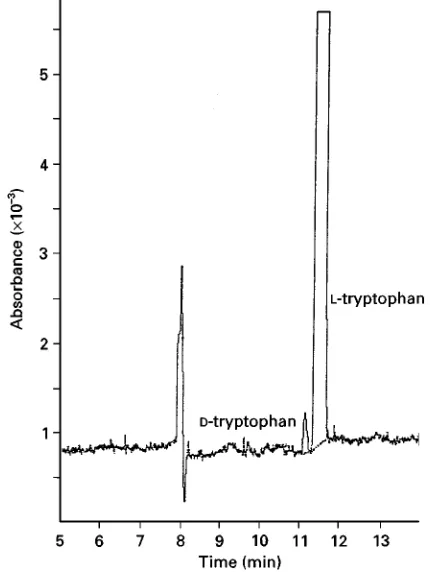
Figure 3 Detection of D-tryptophan at 0.05%m/m in L -tryp-tophan (LOD (3;s/n) 0.01% m/m) with a polyamine coated capillary (eCAPTMwith polyamine regeneration solution) to give
a positive charge on the capillary. Capillary was 37 cm (30 cm to detector);50m fused silica and buffer 40 mmol L\1
tris-phos-phoric acid containing 75 mmol L\1 -CD. The applied voltage
was!10 kV, detection wavelength 241 nm, injection time 2 s and operating temperature 303C.
the presence of the L-enantiomer. During these runs the polarity is reversed over the conventional direc-tion of operadirec-tion. The coated capillaries mendirec-tioned above are commercially available and have been shown to be stable if used within the suggested limits. The anionic (sulfonic acid) coated capillaries are of particular interest in chiral and conventional separ-ations as they give a consistent EOF over the range pH 3}9 and therefore are more controlled in
opera-tion.
Crown Ethers
[image:4.568.296.511.342.628.2]Figure 4 The resolution of oxamniquine by capillary-zone elec-trophoresis with heparin in the electrolyte solution. The electrolyte was 50 mmol L\1sodium dihydrogen phosphate (pH 3.0)
contain-ing 2% m/v heparin. The capillary was 71 cm (50 cm to de-tector);50m i.d., the applied voltage 20 kV, temperature 303C and the detection wavelength 246 nm.
Table 1 The critical micelle concentrations of chiral surfactants and achiral surfactants
Surfactant Critical micelle
concentration (mmol L\1)
Chiral
Sodium cholate 14
Sodium taurocholate 13
Sodium deoxycholate 5
Sodium taurodeoxycholate 4
SodiumN-dodecanoyl-L-valinate 6 (403C)
Achiral
Sodium dodecyl sulfate (SDS) 8
Sodium decane sulfate 40
Tetradecyltrimethylammonium bromide
(TTAB) 4
Cetyltrimethylammonium bromide
(CTAB) 1
extensively used because they need to be applied under controlled conditions as they are highly toxic and they are limited to amines and alkylamines. However, in the applications reported they give high-ly efRcient resolutions of certain chiral compounds. Other Chiral Additives
Apart from the CDs, linear oligosaccharides are po-tential chiral discriminators in CE, and maltodextrin mixtures, corn syrups and pure malto-oligosacchar-ides have all been used to resolve non-steroidal anti-inSammatory drugs (NSAIDs). Polysaccharides have also been discussed in these reports, with applications of heparin, a naturally occurring mammalian mu-copolysaccharide (anticoagulant), in the resolution of chiral drugs. The molecule is chiral, highly anionic and helical and has been used in the chiral discrimina-tion of antimalarials and antihistaminics. InFigure 4, oxamniquine is resolved with a large resolution factor with 2%w/v heparin. Thus heparin and some of the other polysaccharides with their high separation
ef-Rciencies appeared to be good alternatives to CDs. There is one drawback: because of their hetero-geneous character, batch-to-batch and different source material can result in changes in the resolution and therefore method robustness would be question-able for regular assay for industry.
Proteins provide another alternative based on suc-cesses in HPLC and particularly separations with 1-acid glycoprotein (AGP) and bovine serum al-bumin (BSA) for chiral drug separations. BSA has
been cross-linked with glutaraldehyde to form a poly-mer matrix. However, BSA has a high ultraviolet background and as such needs to be used in indirect detection mode or where the gel is only partially loaded on to the capillary and stops just before the detection window. AGP, ovosomucoid (egg white) and fungal cellulose have all been used, with some success. The major problem with the fungal cellulose is absorption on to the capillary wall if used with uncoated capillaries, although adding materials such as polyethylene glycol or methyl cellulose into the electrolyte does alleviate wall interaction.
Micellar Electrokinetic Capillary
Chromatography
[image:5.568.290.517.525.712.2]Figure 5 The use of bile salts to resolve the enantiomers of diltiazem and related substances by chiral micellar electrokinetic chromatography (MEKC). The electrolyte was 20 mmol L\1
dis-odium hydrogen phosphate}sodium tetraborate (pH 7.0) contain-ing 50 mmol L\1 sodium taurodeoxycholate. The capillary was
65 cm (50 cm to detector);50m i.d. Applied voltage was 20 kV, detection wavelength was 210 nm and temperature was 253C. cationic, zwitterionic and nonionic }which can be
both synthetic and naturally occurring. The synthetic group includes the anionic sodium dodecyl sulfate (SDS) and cationic cetyltrimethylammonium bromide (CTAB).
A slightly different process, microemulsion elec-trokinetic chromatography, has recently been de-veloped. In this process a combination of oil}
water}surfactant and co-surfactant such as an alkyl
chain alcohol is used as a pseudo-stationary phase.
Chiral Surfactants
These can be synthetic optically active amino acid derivatives and natural surfactants, such as glycyrrhic acid, -escin, bile salts and digitonin. Digitonin is nonionic, but has been used as a mixed micelle with SDS to give the electrophoretic mobility, to resolve chiral amino acids. These materials are generally water-soluble and can be added easily at micelle con-centrations to the electrolytes in MEKC, although viscosity increases should be noted. Initially enan-tiomeric separations were directed towards neutral chiral compounds such as benzoin, and warfarin, a heart drug, which were selectively resolved with materials such as sodium N-dodecanoyl-L-valinate (SDVal) andN-dodecanoyl-L-glutamate (SDGlu). But it was soon realized that charged chiral compounds could also be resolved. Sodium taurocholate (STC) or the taurodeoxycholate (STDC) has been used under acidic conditions for the resolution of dansylated-DL-amino acids and for carboline derivatives and 2,2 -dihydroxy-1,1-dinaphthyl used under neutral condi-tions for the drug diltiazem (Figure 5).
Chiral Selector with an Achiral Surfactant
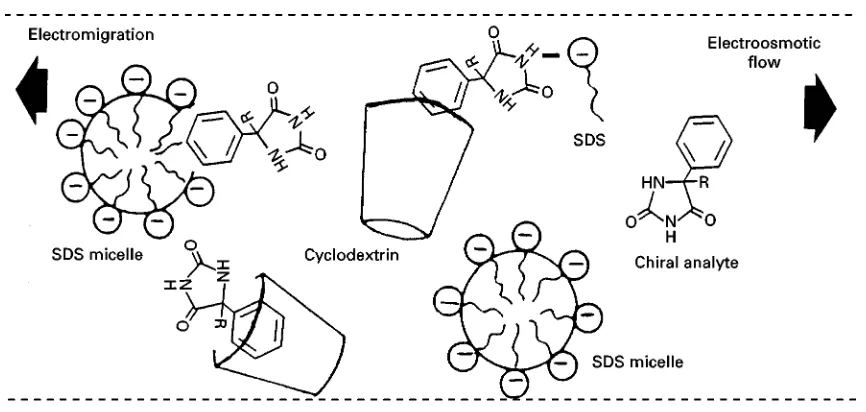
This mode can give added selectivity to resolution of both neutral and charged chiral molecules, as the solutes are distributed between chiral selector such as a CD, the aqueous phase and the micelle (Figure 6). As a result, the chiral analytes will move in and out of the micelle/CD, with the CD moving with the EOF and the micelle (depending on polarity) moving ac-cording to charge. Racemic amino acids, -blocker drugs, Trogers base and the drug terbutaline have all been resolved with this procedure. In the case of terbutaline either 5 mmol L\1 di-O-methyl- -cyclodextrin or 15 mmol L\1 -cyclodextrin was successfully used with 15 mmol L\1SDS. Other ap-proaches have been to carry out competetive separ-ations with CD-MEKC, where an additive, such as D-camphor-10-sulfonate, is introduced into the buffer and competes for inclusion with the chiral analytes. With this procedure an improved resolution of Trogers base was obtained. Overall, this form of
separation of chiral analytes has become quite popu-lar, particularly as there are many derivatized CDs to choose from, and many examples have been pub-lished. Of the native CDs, -CD has shown the greatest success, which is the opposite of the case with the conventional addition of CDs to the buffer phase. In this case the larger inner diameter of the cavity of the-CD allows not only the chiral molecules to be included but also the surfactant.
Capillary Electrochromatography
(
CEC
)
Figure 6 Schematic of the chiral analyte 5-alkyl-5-phenyl hydantoin distributed between the cyclodextrin, the aqueous phase and the micelle. SDS, Sodium dodecyl sulfate.
on the surface of the particles in contact with the mobile phase and produces apotential. The poten-tial of CEC wasRrst demonstrated in 1987, showing the presence of the partitioning effects and, for charged analytes, the continued effect of electromig-ration. In terms of the separation conditions in CEC and HPLC, the stationary and mobile phases are very similar, but the separation efRciency can be much improved. Many applications of electrochromatogra-phy are currently being studied and the range of capillary packing materials continues to expand.
Chiral stationary phases are being examined by a number of researchers. In one of theRrst reports of chiral separations by CEC 5m AGP, immobilized on to silica, was packed into a 50m internal dia-meter capillary. Cationic and neutral enantiomers were resolved by this method, which included ben-zoin and the drugs cyclophosphamide and hexobar-bital. This early work did not illustrate large improve-ments in peak efRciency over other procedures as the capillary packing methods required improvement, but it did illustrate the potential.
CDs have also been used as immobilized silica-based materials and the neutral CD hydroxypropyl- -CD silica was used in resolution of the basic drug mianserin. In method design with the CDs, the choice of the background electrolyte has played an impor-tant part and pH, organic modiRer and differences in
Reld strength have all been considered. The direction ofSow past the detector was shown to be dependent on the background electrolyte used. For -cyclodex-trin and a phosphate buffer the direction of Sow is
towards the cathode, but with triethylammonium acetate theSow is reversed. This can be beneRcial in controlling the order of retention in CEC. The pH change in the electroosmotic mobility can be used to obtain a suitable overall retention time. Organic modiRers such as methanol and acetonitrile in the electrolyte have an effect on both the retention and enantioselectivity. The results from studies with CD-bonded silica phases indicate that a range of para-meters and additives can affect the retention and enantioresolution in CEC, as they do with chiral stationary phases in HPLC.
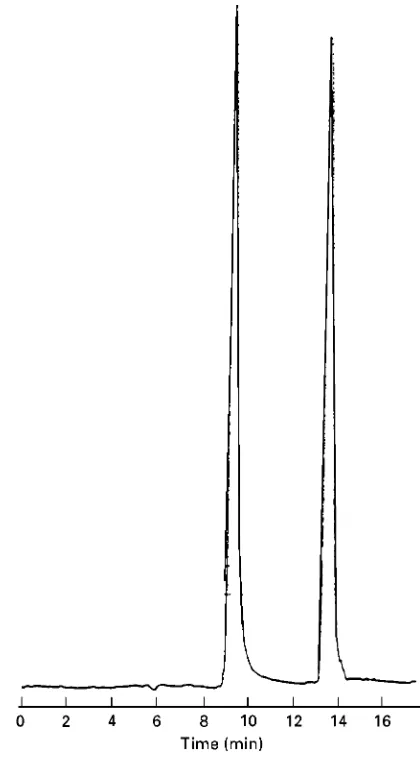
Other stationary phases which have been shown to give enantioseparations are the cellulose and amylose derivatives which have been coated on to silica. These stationary phases are known as Chiralcel and Chiral-pak phases (Daicel, Japan), respectively. These mater-ials have been successful in HPLC for enantioselectiv-ity with a wide range of chiral compounds and have recently been utilized as packing materials for CEC (Figure 7). Generally in CEC good resolution has been achieved for a number of chiral compounds resolved by HPLC, with improvements in separation efRciencies in many cases.
Future Developments
Figure 7 Electrochromatographic resolution of methylphenyl barbitone by a Chiralcel OJ (Daicel, Japan) chiral stationary phase. The cellulose ester derivative commercially coated on to silica was packed into a 30 cm (21 cm packed and 22 cm to detection window);75m i.d. fused silica capillary. The mobile phase was acetonitrile}water (70 : 30 v/v), applied voltage 15 kV and temperature 253C.
shorter overall migration times. Many different areas are showing considerable research interest, such as electrochromatography, where in the future com-mercially available columns may prevail over in house methods of packing capillaries with chiral sta-tionary phases. Generally, commercial interest in the area of capillary packings is likely to increase as more ‘tailor-made’ phases are introduced.
Further Reading
Chankvetadze B, Endresz G and Blaschke B (1996) Charged cyclodextrin derivatives as chiral selectors in capillary electrophoresis. Chemical Society Reviews
141}153.
Clark BJ (1994) Separations of enantiomeric compounds by chiral selectors in the mobile or solvent phase. In: Subramaninan G (ed) A Practical Approach to Chiral Separations, p. 311. Weinheim, Germany: VCH. Kuhn R and Hoffstetter-Khun S (1993) Capillary
Elec-trophoresis: Principles and Practice. Berlin: Springer-Verlag.
Lelievre F, Yan C and Zare RN (1996) Capillary electroch-romatography: operating characteristics and enan-tiomeric separations. Journal of Chromatography A723: 145}156.
Nishi H and Terabe S (1995) Optical resolution of drugs by capillary electrophoretic techniques.Journal of Chro-matography A694: 245}276.
Rabel SR and Stobaugh JF (1993) Applications of capillary electrophoresis in pharmaceutical analysis. Pharmaceut-ical Research10: 171}175.
Schmitt T and Engelhardt H (1995) Optimisation of enan-tiomeric separations in capillary electrophoresis by re-versal of the migration order and using different de-rivatized cyclodextrins. Journal of Chromatography A697: 561}570.
Wren SAC (1993) Theoretical aspects of chiral separation in capillary electrophoresis.Journal of Chromatography A603: 235}241; 609: 363}367; 636: 57}62.
Cellulose and Cellulose Derived Phases
J. Dingenen, Janssen Research Foundation, Belgium
Copyright^ 2000 Academic Press
Introduction
The properties of cellulose derivatives for the separ-ation of enantiomers were recognized in 1966 by LuKtringhaus and Peters. The full potential of micro-crystalline cellulose triacetate (CTA) was deRnitely established by Hesse and Hagel in 1973. Meanwhile,