
COMBAT SYSTEMS
Volume 1. Sensor Elements
VOLUME 1. SENSOR ELEMENTS.
PART I. SENSOR FUNCTIONAL CHARACTERISTICS
Note: Boldface entries on the following pages are not yet completed.
TABLE OF CONTENTS iii
Volume I Sensor Elements. Part I. Sensor Functional Characteristics iii Volume II Sensor Elements. Part II. Sensor Technologies vii Volume III Engagement Elements. Parts I & II. Conventional Weapons xii Volume IV Engagement Elements. Part III. Unconventional Weapons xvi Volume V Control Elements and Platform Integration xix
FOREWORD. INTRODUCTION TO COMBAT SYSTEMS xxv
PREFACE. SENSOR FUNCTIONAL CHARACTERISTICS 1
CHAPTER 1. SIGNATURES, OBSERVABLES, & PROPAGATORS 3
Sensors, Transducers, and Detectors 3
Observables 4
Signatures and Propagators 5
References 11
Problems 12
CHAPTER 2. PROPAGATION OF ELECTROMAGNETIC RADIATION. I.
– FUNDAMENTAL EFFECTS 13
What is Electromagnetic Radiation 13
Attenuation of Electromagnetic Radiation in Bulk Materials 20
Reflection and Refraction 23
Interference 28
Huygens’ Principle and Diffraction 30
Mie Scattering 35
References 37
Problems 38
CHAPTER 3. PROPAGATION OF ELECTROMAGNETIC RADIATION. II.
– WEATHER EFFECTS 39
Introduction 39
Structure of the Atmosphere 45
Molecular Absorption 56
Aerosol Scattering 67
Hydrometeors – Fogs and Clouds 71
CHAPTER 4. PROPAGATION OF ELECTROMAGNETIC RADIATION. III.
– REFRACTIVE EFFECTS 107
Horizon Extension 107
Ducting and Mirages 114
Atmospheric Turbulence 128
Ionospheric Effects 148
References 154
Problems 156
CHAPTER 5. PROPAGATION OF ELECTROMAGNETIC RADIATION IV.
– OTHER ATMOSPHERIC AND UNDERWATER EFFECTS 159
Contrast Transmission 159
Smoke, Dust, and Battlefield Obscurants 162
Pasquill Stability and Atmospheric Diffusion 168
Transmission Through Stratified Media 176
Multipath 179
Terrain Masking 183
Underwater Propagation 187
References 190
Problems 192
CHAPTER 6. PROPAGATION OF ACOUSTIC RADIATION 195
What is Acoustic Radiation? 195
The Speed of Sound 199
Attenuation of Acoustic Radiation 204
Reflection and Refraction of Acoustic Radiation 215
Seismic Waves 228
References 234
Problems 236
CHAPTER 7. NUCLEAR RADIATION: ITS ORIGIN AND PROPAGATION 239
The Nuclear Radiation Particle “Zoo” 239
Nuclear Particle Reactions 247
Nuclear Particle Reaction Rates 255
Attenuation of Nuclear Radiation 257
Radiation Exposure and Dose 266
Radioactive Decay 268
References 277
Problems 279
CHAPTER 8. RADIOMETRY, PHOTOMETRY, & RADIOMETRIC ANALYSIS 281
Radiometry 281
Photometry 287
Radiometric Analysis – Range Equations 290
Blackbody Radiation 293
Reflectance 296
References 302
CHAPTER 9. SENSOR FUNCTIONS 305
Uses of Sensor Systems 305
Six Primary Sensor Functions 307
Incidental Sensor Functions 309
Problems 310
CHAPTER 10. SEARCH 311
Introduction to Search 311
Circle Packing 313
Area Search 319
Volume Search 327
Incorporating Effects of Non-Unity Detection Probability into Search 330
References 332
Problems 333
CHAPTER 11. DETECTION 335
What is Detection? 335
Basics of Detection Theory 336
Impact of Signal Fluctuations on Detection 345
Impact of Pulse Integration on Detection 350
Example: Turbulence Effects on Laser Radar Detection 354
System Level Concerns Involving Detection 360
Clutter and Clutter Rejection 362
References 363
Problems 364
CHAPTER 12. ESTIMATION 367
Characteristics of Measurements 367
Sensor Resolution 369
Parameter Estimation 376
Discrimination 379
Pattern Recognition 383
References 386
Problems 387
CHAPTER 13. MODULATION AND DEMODULATION 389
Modulation and Demodulation 389
Amplitude Modulation 394
Frequency Modulation 398
Phase Modulation 402
Pulse Modulation 404
Pulse Code Modulation 406
References 413
Problems 414
CHAPTER 14. IMAGING AND IMAGE-BASED PERCEPTION 415
Applications of Johnson’s Criteria 429 Information-Based Johnson’s Criteria 435 Example: Atmospheric Turbulence Effects on Laser Radar Images 440
References 446
Problems 448
CHAPTER 15. TRACKING 451
Tracking Systems 451
Tracking Filters 457
Fixed-Coefficient Filters 463
Kalman Filters 471
Comparison of Fixed-Coefficient and Kalman Filters 474
Multisensor, Multiplatform Tracking 475
Target Motion Analysis 479
References 493
Problems 494
APPENDIX A. UNITS, PHYSICAL CONSTANTS, AND USEFUL
CONVERSION FACTORS 497
Units 497
Non-SI Systems of Units 500
Natural Units 505
Decibels and Logarithmic Units 506
Units of Attenuation 510
Dimensional Analysis 512
Useful Physical Constants 515
Selected Conversion Factors 518
Useful Mathematical Relations 521
References 533
APPENDIX B. FINITE DIFFERENCE AND FINITE ELEMENT TECHNIQUES 535 Finite Difference Approximation of Derivatives 535 Finite Difference Solution of Differential Equations 537 Finite Element Computation of Definite Integrals 539
References 540
APPENDIX C. PROBABILITY AND STATISTICS 541
Combinatorial Analysis 541
Probability 543
Random Variables and Functions of Random Variables 546 Statistics 554 Variance and Covariance of Vector Random Functions 557
References 559
VOLUME 2. SENSOR ELEMENTS.
PART II. SENSOR TECHNOLOGIES
TABLE OF CONTENTS iii
Volume I Sensor Elements. Part I. Sensor Functional Characteristics iii Volume II Sensor Elements. Part II. Sensor Technologies vii Volume III Engagement Elements. Parts I & II. Conventional Weapons xii Volume IV Engagement Elements. Part III. Unconventional Weapons xvi Volume V Control Elements and Platform Integration xix
FOREWORD. INTRODUCTION TO COMBAT SYSTEMS xxv
PART II. SENSOR TECHNOLOGIES
1PREFACE 1
CHAPTER 1. CONVENTIONAL RADARS. I. IMPLEMENTATION 5
Microwave Radar 5
Microwave Radiation Sources 14
Transmission Lines and Waveguides 29
Antennas 49
Mixers and Intermodulation 60
Processing Elements 68
Radar Displays 81
Millimeter-Wave Radar 85
References 89
Problems 91
CHAPTER 2. CONVENTIONAL RADARS. II. PERFORMANCE 93
The Radar Equation(s) 93
Radar Cross Section 99
Surface Clutter 113
Waveforms and Ambiguity 119
Performance Estimation Examples 133
References 140
Problems 141
CHAPTER 3. COHERENT LASER RADARS 143
Taxonomy of Laser Radars 143
Introduction to Coherent Laser Radars 146
Two- and Three-Dimensional Imaging 170
Moving Target Detection 176
Laser Anemometry and Wind Sensing 181
Differential Absorption and Remote Chemical Analysis 195
Laser Vibratometry and Target Identification 204
References 213
Problems 215
CHAPTER 4. NONCOHERENT LASER RADARS 217
Introduction 217
Laser Rangefinders and Designators 219
Laser Rangefinder Performance Analysis 224
The LANTIRN Laser Transmitter-Receiver (LTR) 233
Lidar Systems 237
Noncoherent DIAL Systems 240
Elastic Lidar 247
Fluorescence Lidar 250
Raman Lidar 254
Bathymetric Lidar 258
Active Imaging Systems 259
References 267
Problems 269
CHAPTER 5. SYNTHETIC APERTURE RADARS 273
Introduction 273
Doppler Beam Sharpening 274
Range-Doppler Imaging 277
Aperture Synthesis 281
Synthetic Aperture Radar (SAR) 288
Spotlight SAR 297
Inverse Synthetic Aperture Radar (ISAR) 298
References 300
Problems 301
CHAPTER 6. OTHER RADAR TECHNOLOGIES 303
Bistatic Radar 303
Passive Coherent Location (PCL) 326
Bistatic SAR 331
Over-The-Horizon Radar 334
Ultrawideband and Impulse Radars 348
Low Probability of Intercept (LPI) Radars 352
References 355
Problems 357
CHAPTER 7. THERMAL IMAGERS 359
Introduction 359
Infrared Radiation Detectors 364
Imaging Performance 391
Line Scan Sensors and Radiometric Imagers 403
Multispectral and Hyperspectral Imagers 404
References 417
Problems 420
CHAPTER 8. INFRARED SEARCH & TRACK SYSTEMS 423
Infrared Search & Track System 423
Air Target Infrared Signatures 431
Target Discrimination in IRST Systems 435
Reticle-Based Trackers and Seekers 442
Other Infrared Tracking Sensors 449
References 452
Problems 453
CHAPTER 9. ELECTRO-OPTICAL SENSORS 455
Direct View Optics and Human Vision 455
Photomultiplier Tubes and Avalanche Photodiodes 468
Image-Intensified Optics 479
Electro-Optical Streaking Cameras and Framing Cameras 491
Night Vision Goggles 495
Image Intensifier Performance Model 500
Ultraviolet Sensors 507
Television Sensors 514
References 542
Problems 545
CHAPTER 10. PASSIVE RF SENSORS 547
Radar Warning Receivers 547
Radio Frequency Interferometers 554
Microwave and Millimeter-Wave Radiometers 561
References 565
Problems 566
CHAPTER 11. ACOUSTIC SENSORS 567
Atmospheric Acoustic Sensors 567
Passive Sonar 581
Sonar Transducers 607
Active Sonar 615
Acoustic Daylight 633
Seismic Sensors 637
References 656
Problems 658
CHAPTER 12. FIELD SENSORS 661
Magnetometers 661
Gravitational Field Detector 708
References 724
Problems 726
CHAPTER 13. NUCLEAR, BIOLOGICAL, AND CHEMICAL (NBC) SENSORS 727
Introduction 727
Nuclear Radiation Sensors (Radiacs) 732
Biological Agent Sensors 757
Chemical Agent Sensors 784
References 818
Problems 822
CHAPTER 14. METEOROLOGICAL AND OCEANOGRAPHIC SENSORS 823
Introduction 823
Temperature 825
Pressure 835
Wind Speed and Direction 842
Humidity 854
Precipitation Rate and Total Precipitation 857
Visibility and Turbidity 860
Cloud Height and Cloud Coverage 863
Stevenson Screen 865
Salinity 866
Bathythermographs 874
References 878
Problems 881
CHAPTER 15. MISCELLANEOUS SENSORS AND TRANSDUCERS 883
Identification Friend-or-Foe (IFF) 883
Star Tracker 892
Inertial Sensors – Gyros and Accelerometers 897
Netted Sensor Systems 914
References 931
Problems 934
APPENDIX D. FOURIER TRANSFORMS 935
APPENDIX E. LAPLACE TRANSFORMS 945
APPENDIX F. BESSEL FUNCTIONS 951
APPENDIX G. LASERS 955
Energy Levels 955
Emission and Absorption 958
Population Inversions and Pumping 963
Threshold for Laser Oscillation 968
Laser Pumping Mechanisms 970
Laser Resonators and Modes 979
Some Commonly-Used Lasers 987
APPENDIX H. OPTICS AND OPTICAL SYSTEMS 997
Geometric Optics 997
Lenses and Mirrors 1000
Image Formation 1007
Compound Lenses 1012
Prisms 1018
Aberrations 1027
Chromatic Aberration 1034
References 1039
APPENDIX I. SEMICONDUCTORS AND DETECTION 1041
Electron Energy States in Solids 1041
Semiconductor Device Fabrication 1048
Semiconductor Electronic Devices 1061
Integrated Circuits 1070
Semiconductor Detector Structures 1073
References 1077
VOLUME 3. ENGAGEMENT ELEMENTS.
PARTS I & II. CONVENTIONAL WEAPONS
TABLE OF CONTENTS iii
Volume I Sensor Elements. Part I. Sensor Functional Characteristics iii Volume II Sensor Elements. Part II. Sensor Technologies vii Volume III Engagement Elements. Parts I & II. Conventional Weapons xii Volume IV Engagement Elements. Part III. Unconventional Weapons xvi Volume V Control Elements and Platform Integration xix
FOREWORD. INTRODUCTION TO COMBAT SYSTEMS xxv
PART I. ELECTROMAGNETIC WEAPONS
1PREFACE 1
CHAPTER 1. INFORMATION WARFARE 3
The Scope of Information Warfare 3
Information Operations 17
Information Weapons 26
References 43
Problems 47
CHAPTER 2. ELECTRONIC WARFARE 49
The Electromagnetic Environment and Electronic Warfare 49
Denial Jamming 61
Deception Jamming 67
Decoys 84
Mine Countermeasures 100
Defense Suppression and Disruption 122
Signature Alteration and Target Screening 124
Electronic Protection (Electronic Counter-Countermeasures) 134
Hard Kill-Soft Kill Interactions 138
Integrated Electronic Warfare Systems 143
References 145
Problems 149
CHAPTER 3. LASER-BASED OPTICAL & INFRARED COUNTERMEASURES 151
Retroreflection in Optical Systems 151
Laser Radiation Effects on the Human Visual System 160
Damage in Optical Systems 174
Electro-Optical Countermeasures 181
The Conventional Weapons Convention 186
Infrared Laser Countermeasures 196
References 232
CHAPTER 4. DIRECTED ENERGY WEAPONS 237
Generic Directed Energy Weapons 237
Effects of Directed Energy Weapons 246
High Power Microwave Weapons 252
High Energy Lasers 260
Adaptive Optics 278
Particle Beam Weapons 291
References 304
Problems 308
PART II. PROJECTILE WEAPONS
309PREFACE 309
CHAPTER 5. OVERVIEW OF PROJECTILE WEAPONS 311
Introduction 311
Self-Propelled Projectiles (Rockets, Missiles, and Torpedoes) 314 Externally-Propelled Projectiles (Guns, Artillery, Bullets, and Shells) 324 Thrown, Dropped, or Emplaced Projectiles (Bombs, Grenades, and Mines) 344
References 364
Problems 367
CHAPTER 6. EXPLOSIVES 369
Introduction 369
Hydrodynamics of Ideal Gases 371
Explosions and Shock Waves 381
Elements of Explosive Trains 390
Characteristics of Explosives 394
Explosive Formulations 403
Fuel-Air Explosives, Dispersed Explosives, and Thermobaric Weapons 416
Incendiary Formulations 422
Future Developments in Explosives 427
References 431
Problems 434
CHAPTER 7. ARMOR 435
Introduction 435
High Velocity Impact 437
Armor Penetration 445
Principles of Armor Protection 452
References 459
Problems 461
Fragmentation Warheads 479
Kinetic Energy Armor-Piercing Warheads 489
Shaped Charge Warheads 493
Fuel-Air Explosive Warheads 502
Reactive Warheads 503
Non-nuclear EMP Warheads 508
References 511
Problems 512
CHAPTER 9. FUZES 515
Types of Fuzes 515
Impact Fuzes 516
Influence Fuzes 518
Proximity Fuzes 522
Miscellaneous Other Fuzes 528
Coordination of Fuzing and Warhead Detonation 533
References 537
Problems 538
CHAPTER 10. AERODYNAMICS AND BALLISTICS 539
Basic Aerodynamics 539
Weight and Buoyancy 546
Lift and Drag 550
Hydrodynamic Resistance 570
Aerodynamic Stability – Good and Bad? 578
Powered Flight and Aircraft Maneuvering 583
Rocket Motion 604
Interior and Intermediate Ballistics 611
Projectile Motion (External Ballistics) 617
Orbital Motion 629
References 638
Problems 639
CHAPTER 11. PROPULSION 641
Rocket Engine Nozzle Theory 641
Rocket Propulsion 655
Rocket Propellants 671
Air-Breathing Propulsion Systems – Internal Combustion Engines 682 Air-Breathing Propulsion Systems – Jet Engines 695
Ship, Submarine, and Torpedo Propulsion 701
Batteries, Fuel Cells, and Radioisotope Thermal Generators 712
Propellers 734
Gun Propellants 741
Electromagnetic Propulsion 761
References 774
Problems 778
CHAPTER 12. LAUNCHING SYSTEMS 779
Rocket and Missile Launchers 797
Bombs 817
Submunition Dispensers 826
Underwater Launching Techniques 831
References 835
Problems 837
CHAPTER 13. GUIDANCE 839
Guidance Techniques 839
Navigational Guidance 844
Radar Guidance 849
Infrared Guidance 861
Acoustic Guidance 879
References 885
Problems 887
CHAPTER 14. CONTROL AND ACTUATION SYSTEMS 889
Automatic Control Systems 889
Control System Performance 894
Missile Control Techniques 919
Actuators 932
References 941
Problems 942
VOLUME 4. ENGAGEMENT ELEMENTS.
PART III. UNCONVENTIONAL WEAPONS
TABLE OF CONTENTS iii
Volume I Sensor Elements. Part I. Sensor Functional Characteristics iii Volume II Sensor Elements. Part II. Sensor Technologies vii Volume III Engagement Elements. Parts I & II. Conventional Weapons xii Volume IV Engagement Elements. Part III. Unconventional Weapons xvi Volume V Control Elements and Platform Integration xix
FOREWORD. INTRODUCTION TO COMBAT SYSTEMS xxv
PART III. UNCONVENTIONAL WEAPONS
1
PREFACE 1
CHAPTER 1. PROLIFERATION OF WEAPONS OF MASS DESTRUCTION (WMD) 7 Weapons of Mass Destruction - A Working Definition 7
Types of WMD 9
WMD Arms Control Treaties, Conventions, Protocols, and Other Agreements 14 Reasons for Proliferation or Non-Proliferation 76
Requirements for Proliferation 86
Probable and Potential Proliferators 92
References 95
Problems 102
CHAPTER 2. NUCLEAR EXPLOSIVES 103
Types of Nuclear Explosives 103
Fission Reactions in Nuclear Explosives 110
Fusion Reactions in Nuclear Explosives 128
Criticality and Critical Mass 134
Assembly of the Critical Mass 145
The Early Nuclear Weapon Designs 151
References 162
Problems 164
CHAPTER 3. NUCLEAR MATERIALS 167
Production of Nuclear Explosives 167
Types of Nuclear Materials 169
Nuclear Fuel Cycles 171
Uranium Ores 173
Uranium Mining and Milling 181
Conversion of Uranium 185
Enrichment of Uranium 189
Production of Plutonium, Uranium-233, and Transuranic Isotopes 241
Reprocessing of Nuclear Fuels 247
Preparation of Other Nuclear Weapon Materials 255
References 257
Problems 261
CHAPTER 4. NUCLEAR EXPLOSION EFFECTS 263
Introduction 263
Blast Effects 268
Ground Motion Effects and Cratering 294
Underwater Shock Effects 312
Generation of Water Waves 316
Thermal Radiation Effects 322
Initial Nuclear Radiation 337
Fallout 352
Electromagnetic Pulse Effects 363
Integrated Effects Analysis 372
Employment of Nuclear Weapons 384
References 387
Problems 390
CHAPTER 5. RADIOLOGICAL WEAPONS AND EFFECTS 391
Historical Aspects of Radiological Weapons 391
What Makes a Good Radiological Weapon? 395
Production of Radionuclides 405
Health Effects and Employment of Radiological Weapons 421
Exposure and Dose Estimation 434
Important Potential Radiological Warfare Agents 446
Radiological Weapon Defense 464
References Problems
CHAPTER 6. CHEMICAL WEAPONS AND EFFECTS Historical Uses of Chemical Weapons
Classes of Chemical Weapons and Their Effects What Makes a Good Chemical Weapon
Persistence of Chemical Agents
Essential Concepts of Military Toxicology Mechanisms of Chemical Agent Toxicity Production of Chemical Agents
Employment of Chemical Warfare Agents
Important Chemical Warfare Agents and their Characteristics Chemical Weapon Defense
What Makes a Good Biological Weapon Production of Biological Agents
Employment of Biological Warfare Agents
Important Biological Warfare Agents and their Effects Biological Weapon Defense
References Problems
CHAPTER 8. WMD DELIVERY SYSTEMS Overview
Ballistic Missiles
Air-delivered WMD Systems Artillery-delivered WMD
Other Military WMD Delivery Systems Covert WMD Delivery Systems
References Problems
CHAPTER 9. NONLETHAL WEAPONS Types of Nonlethal Weapons
Nonlethal Weapon Technologies
Friendly and Hostile Employment of Nonlethal Weapons Limitations of Nonlethal Weapons
References Problems
CHAPTER 10. POSSIBLE WEAPONS OF THE FUTURE Introduction
Environmental Modification Tectonic Weapons
Gravitic Weapons
Advanced Nuclear Weapons Nanobots
Ethnic Weapons Psy Weapons
Enhanced Warfighters References
Problems
APPENDIX J. SELECTED REVIEW OF CHEMISTRY
APPENDIX K. SELECTED REVIEW OF ANATOMY, PHYSIOLOGY, & BIOCHEMISTRY
VOLUME 5. CONTROL ELEMENTS & PLATFORM
INTEGRATION
TABLE OF CONTENTS iii
Volume I Sensor Elements. Part I. Sensor Functional Characteristics iii Volume II Sensor Elements. Part II. Sensor Technologies vii Volume III Engagement Elements. Parts I & II. Conventional Weapons xii Volume IV Engagement Elements. Part III. Unconventional Weapons xvi Volume V Control Elements and Platform Integration xix
FOREWORD. INTRODUCTION TO COMBAT SYSTEMS xxv
PART I. COMMAND, CONTROL, COMPUTERS,
1COMMUNICATIONS, & INTELLIGENCE (C
4I) SYSTEMS
PREFACE 1
CHAPTER 1. COMMAND & CONTROL Command and Control Architecture Command and Control Elements Internal Communications
References Problems
CHAPTER 2. RADIO COMMUNICATIONS Long-range Communications
Line-of-Sight Communications Satellite Communications References
Problems
CHAPTER 3. DATA COMMUNICATION LINKS Data Communications
Communications Architectures Expandible Data Networks
Fibers versus Wires versus Transmission Lines Redundancy
References Problems
CHAPTER 4. COMPUTER ELEMENTS “Computer” Architecture
TEMPEST References Problems
CHAPTER 5. NAVIGATION SYSTEMS Introduction
Celestial Navigation Inertial Navigation Doppler Navigation Correlation Navigation
Hyperbolic Radionavigation – LORAN Range-Based Radionavigation – GPS Map Systems
Terrain Following, Terrain Avoidance, and Obstacle Avoidance Systems References
Problems
CHAPTER 6. INTELLIGENCE SYSTEMS Direction-Finding Systems
Electronic Support Measures Systems
Image Processing and Interpretation Equipment System Security Engineering
Basic Security Considerations Targeting
References Problems
PART II. SURVIVABILITY
PREFACE
CHAPTER 7. OBSERVABLES REDUCTION
Major Observables Useful for Detection and Recognition Philosophy of Observables Reduction
Radar Signature Reduction Infrared Signature Reduction Visual Signature Reduction Acoustic Signature Reduction
Electromagnetic Emission Reduction Low Probability of Intercept Transceivers Magnetic Signature Reduction
CHAPTER 8. ENGAGEMENT ANALYSIS Essentials of Engagement Analysis Simple Engagements
Layered Defense
Probability of Raid Annihilation Attrition
Lanchester Equations Salvo Equations References Problems
CHAPTER 9. NBC CONTAMINATION SURVIVABILITY Contamination Detection
Countermeasures Washdown System Collective Protection
Design Practices for NBC Environments Agent Resistant Coatings
Decontamination Systems References
Problems
CHAPTER 10. BALANCING STEALTH, HARDNESS, AND ACTIVE DEFENSE Warships Will Suffer Hits
Limits of Stealth
Limits of Defensive Weapons (Active Defense) Limits of Hardness (Armor and Structural Design) Limits of NBC Defenses
Achieving Balance References
Problems
CHAPTER 11. THE SYSTEM ENVIRONMENT Defining the System Environment
Environmental Variations over the System Life Cycle Environmental Specifications
Special Environments References
Problems
PART III. TOPSIDE DESIGN
PREFACE
Required Operational Capabilities (ROCs) Projected Operating Environments (POEs) Mission Element Selection
Self-Defense Element Selection Communication Element Selection Navigation Element Selection Ancillary Element Selection References
Problems
CHAPTER 14. ELEMENT LOCATION CONSIDERATIONS General Location Considerations
Sensor Fields of Regard Weapon Arcs of Fire Stacks and Intakes
Access to Decks and Interior Spaces Boats, Davits, Cranes, Kingposts, Etc. Aviation Operations
Towed Systems References Problems
CHAPTER 15. ELECTROMAGNETIC INTERFERENCE (EMI) Basics of Electromagnetic Interference
Self-Jamming
Intermodulation Noise Broadband Noise
Antenna Pattern Modification Antenna Separation Requirements References
Problems
CHAPTER 16. MULTISENSOR INTEGRATION CONCERNS Levels of Integration
Boresight Alignment Aperture Sharing
Line of Sight Stabilization
Handover From One Sensor to Another Sensor Fusion
References Problems
CHAPTER 17. SAFETY CONSIDERATIONS System Safety Engineering
Weapon Firing Safety
Explosives Safety (Magazines and Ordnance Handling) Electromagnetic Radiation Safety
Problems
APPENDIX L. SUMMARY OF SYSTEMS ENGINEERING Introduction
The Systems Engineering Process Systems Engineering Analyses Concept Synthesis
Specialty Discipline Integration Systems Engineering Management
APPENDIX M. SEMICONDUCTOR LOGIC AND MICROPROCESSORS Boolean Logic
Logic Circuit Families CMOS Logic Elements Processing Elements
FOREWORD
INTRODUCTION TO “COMBAT SYSTEMS”
Combat systems are the integrated systems that give modern military units their enormous warfighting (and peacekeeping) potential. In the current context, combat systems include almost everything on board modern platforms (ships, submarines, ground vehicles, aircraft, or spacecraft are platforms) except those related to structure, mobility, and habitability (if the platform is manned). The elements that make up modern combat systems include the sensor systems that detect and track the targets, the weapons that engage the targets, the command & control systems that authorize or assist the engagement of the targets, and anything else needed to integrate the elements into a platform and permit the operator to use and control them.
This set of books evolved from notes used in two one-quarter courses to teach the elements of combat systems and systems integration to military officers in the Total Ship Systems Engineer-ing (TSSE) program at the Naval Postgraduate School (NPS) in Monterey, California. Students in this multidisciplinary program are drawn from three curricula at NPS: Naval & Mechanical Engineering, Electrical Engineering, and Combat Systems Science & Technology. The students take six elective courses (1 on systems engineering, 1 on shipboard power systems, 1 on naval architecture, 1 on hull, mechanical, & electrical integration, and 2 on combat systems elements and integration) and perform a six-month capstone ship design project in addition to fulfilling all requirement for M. S. degrees in Mechanical Engineering, Electrical Engineering, or Applied Physics, respectively. The students are typically junior naval officers (mostly O-3 – Lieutenants) who have served at least two tours aboard ship and have been given the opportunity to obtain graduate technical educations prior to their next promotions. The majority of these are Engineering Duty Officers, although a number have been Unrestricted Line Officers. However, the classes have also had a number of Coast Guard officers, and even a few Marine Corps and Army officers and Department of Defense civilians. Although most of the students were interested in Naval surface ships and came from the Surface Warfare community, a number were aviators, submariners, space systems operators, and even armor officers. This fact coupled with the author’s belief in the necessity of joint warfare led him to tailor the course to avoid restriction of the discussions to “Surface Navy only” systems. A Systems Engineering and Analysis (SEA) program was developed a few years ago to teach technology to future requirements setters in the Unrestricted Line Community. The two TSSE courses on combat systems were expanded to four courses in the SEA curriculum, necessitating the incorporation of more material into the texts.
Another consideration in the design of the courses was the diversity of the students. Because the students come from vastly different undergraduate backgrounds, the only commonality that could be assumed was the curriculum requirements of having taken one-year of calculus and one-year of calculus-based physics at the undergraduate level. However, these courses have typically been taken by the students at least five to eight years prior to their beginning the TSSE program and the skills taught in those classes have seldom been required to perform their interven-ing military jobs. This meant that all necessary technical background had to be contained within the courses themselves. Another consideration was the fact that the courses were intended to educate systems engineers in sufficient detail to be able to interact with element designers, not to educate element designers in the intricacies of their craft. However, based on the author’s fifteen years as an element designer followed by fifteen more years as a systems engineer (element integrator), it was decided that excess design-level information was preferable to insufficient design-level information. Shortcomings in the author’s own breadth of knowledge will guarantee less than complete detail in more a than a few of the topics to be covered. Nevertheless, even experienced element designers may find organizing principles and a philosophical framework connecting their specialty to other fields in ways that they may not have consciously recognized from their own experience.
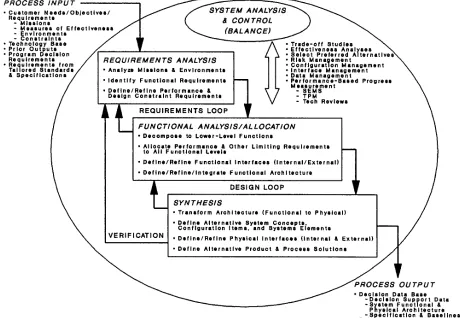
This material is taught as part of a broader systems engineering-oriented curriculum. Although this is not a firm requirement – the material contained in these volumes is relatively self-contained – the author feels that a systems engineering approach to the subject of combat systems is essential for successful utilization of the principles presented here. In both of the curricula currently using this material, the students take at least one course in systems engineering principles and processes. This course may be taken prior to or concurrent with the course that covers the material in the first two volumes of this text. The systems engineering process that is taught is captured in Figure F-1. To facilitate internalization of this overall process, the combat systems courses attempt to emphasize those aspects that might impact requirements, functional capabilities, concept synthesis, and performance analysis.
The TSSE program was established because the Navy realized that combat systems and ship hull, mechanical, and electrical (HM&E) design had become stovepiped with combat systems and HM&E engineering being in separate stovepipes. Requirements entered the bottom of the stovepipes and systems came out the top. However, there was no interconnections along the length of the stovepipes. The top was the first time that combat systems interacted with HM&E. As a result, there were interface problems and inefficiencies. TSSE was intended to provide cross channels between the stovepipes to prevent the standard problems that arose. TSSE appears to have been very successful in doing this.
Figure F-1. The systems engineering process.
especially at the systems engineering level. Combat systems should not be taught or practiced as a set of stovepipes, but as an integrated discipline. The key is in recognizing the many common aspects of these systems elements and teaching them once, and then pointing out the individual areas where these common elements may be applied, and providing the necessary language to describe and use these common elements in the same fashion as taught individually by the stovepiped disciplines. This will be illustrated further as we proceed through the foreward.
product improvement strategies, manpower planning, establishment of embedded training requirements, and conceptual designs of weapon components outside his area of expertise. The author’s original specialty was lasers and their applications – yet he became involved in designing fuzes, propulsion schemes, signal processing techniques, seekers, warheads, launchers, and power supplies, among others, in addition to all of the normal activities of systems engineering. The requirement of breadth and depth is further supported both by the need of systems engineers to know the value and potential contributions of every specialty discipline involved in complex design tasks (to insure that they are considered equally in the overall design) as well as the need to know enough of the jargons of those specialty disciplines to be able to communicate as near peers with the specialty experts. The system engineer is the final technical arbiter of disputes between specialty disciplines. Specialty engineers are much more likely to accept such arbitration if they feel the arbiter understands their point of view and their problems and is therefore capable of making enlightened technical decisions. It is the author’s belief that one cannot be a systems engineer without broad and deep knowledge of the domain in which that systems engineering is being carried out.
Performing trade studies of widely differing technical solutions and synthesizing truly innovative concepts requires the systems engineer to collect and evaluate data from highly diverse sources. It is quite common for the multiple authors of that data to have used widely differing terminology to describe basically the same thing. For example, in the collection of microwave attenuation data one group may quote their results in terms of loss tangents, another in terms of complex refractive indices, and a third in terms of extinction coefficients. A “Rosetta Stone” is needed to help translation of the different terminology into a common language. Good systems engineers have created, inherited, or otherwise acquired a number of such Rosetta Stones during their career. In the present text, the author makes every attempt to present the important Rosetta stones that he has acquired or developed.
At points in the presentation the author makes strong points concerning problems that system procurers often encounter. A certain amount of cynicism may be detected here. The author has been given too many reasons not to be slightly cynical. He seen (and even worse, experienced) the cancellation of too many programs prior to their completion. In some instances, the cancella-tions came about because of inadequacy of the technology; in others, due to inadequacy of the program management. In still others, there were attempts to go against political expediency. The systems engineer on a program is seldom the highest authority on that program and cannot control or even influence all of these factors. However, he can help guarantee that cancellation is not due to engineering incompetence. Where there are lessons to be learned from past mistakes (and since the author considers himself to be an expert – experts are defined as those who have already made every mistake that novices are likely to make – he has made many himself) those lessons should be shared. In studying “lessons learned”, a little cynicism is often justified.
Another aspect of philosophical outlook that shows up in this book stems from the author’s intermittent involvement with the “electronic warfare” community. He has been consistently impressed by the ingenuity with which countermeasures experts can find ways to negate the performance of “flawlessly designed” military systems. This is not universally true of systems designers. Many are blissfully unaware of the existence of a countermeasures community. There is also a strong tendency for design engineers to be enamored of the technologies with which they work. This leads to an unwillingness to closely examine the shortcomings of those technologies. To prevent certain disaster, the systems engineer must not also share this trait. At the same time as he is providing counsel and guidance to making a system work, the system engineer should also be thinking “How can I break it?”. Someone working for our adversaries is certainly asking that same question. Countermeasures, vulnerability, and survivability find frequent and serious discussion throughout these volumes.
Lastly, this is not merely a textbook that condenses a well-established body of knowledge. Nor is it a handbook that collects the varied works and thoughts of others. Although it is a textbook that presents a condensed body of knowledge and it was designed to provide much of the utility of a handbook, it also contains considerable original material that the author has not found the time or place to publish before. Many derivations are the author’s (references to the original source are given when the author is merely following a standard derivation) as are many of the tables and figures presented. Finally, the author has made an attempt to present a coherent philosophy and comprehensive presentation of combat systems. Some of the original material stems from this effort. He hopes the following pages reflect at least partial success in that attempt.
In summary, this work attempts to present a coherent approach to combat systems by making maximum use of “universal” tools and techniques. These include Rosetta stones, analogies, common formalisms, lessons learned, and “How can I break it?”, combined with considerable original material to unify prior work into a comprehensive presentation of the subject.
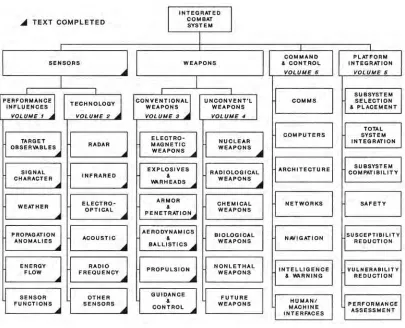
Figure F-2. Integrated combat systems – the “Big Picture”.
such a way as to optimize the performance of the whole. The term sensors covers a wide variety of devices ranging from the simple and minute (such as a simple telescope) to the enormous and complex (such as a phased array microwave radar). The systems engineer needs to be able to select from this variety, compare the performance of diverse sensors on a logical and quantifiable basis, and combine the outputs from multiple sensors to perform complex warfighting functions. Experience has taught that performing this task requires two kinds of knowledge: the factors that influence sensor performance and the technologies relevant to specific sensor systems.
influences is essential to effective design and use of sensor systems. It is helpful to have this understanding before studying the sensors themselves.
Nevertheless, of equal importance are the technologies that are used to implement the sensor systems. One cannot make decisions about the utility or lack of utility of a radar if one doesn’t know what a radar is. In military applications we must be concerned about sensors ranging from radars (microwave radars, laser radars, synthetic aperture radars, bistatic radars, over-the-horizon radars, etc.) to infrared sensors (thermal imagers, infrared search and track, reticle seekers) to electro-optical sensors (television, image intensifiers, direct vision) to acoustic sensors to radio frequency intelligence sensors to other diverse kinds of sensors (radiation monitors, star trackers, magnetic anomaly detectors, etc.). Many of the concepts used in one kind of sensor find analogs in other kinds of sensor. For example, there is no fundamental difference between phased array antennas in radar systems and phased array transducers in sonar systems. It is surprising how many instances of similar analogies can be identified.
Sensors are an essential part of a total combat system. It is difficult to employ weapons if the targets cannot be located. On the other hand, without weapons, located targets cannot be attacked. Sensors not only locate targets, they are integral to the performance of the weapons themselves. Without seekers or fuzes or navigation systems, most weapons would not be effective. This is why sensors are emphasized first. However, the systems engineer must understand all aspects of the problem. Understanding of weapons also requires two kinds of knowledge: the means by which weapons accomplish their function (effectors) and the means by which the effectors are delivered to the targets (delivery systems). Effectors include directed energy and the means to produce and direct it, explosives and their use in warheads, kinetic energy weapons, weapons of mass destruction (WMD – nuclear, chemical, and biological weapons), and even nonlethal weapons. Delivery systems include guns, bombs, and missiles. Delivery systems of all kinds can be understood by understanding a few basic elements. These elements include basic aerodynamics (the forces that act on bodies in motion), control systems (the way in which feedback systems respond to commands and external disturbances), guidance (determination of desired motional characteristics), actuation (transformation of desired motion into actual motional characteristics), propulsion (the means of acceleration objects to high speeds and/or maintaining those speeds), and ballistics (the motions of projectiles). Special characteristics of WMD delivery systems also need discussion.
organized as well as the way in which complete weapons systems are organized and interconnected. It is a critical topic to be assimilated and internalized. Complete weapons systems must also accommodate the specialized systems used for navigation and for intelligence gathering, dissemination, and analysis. Since all systems still require human beings to perform critical decision functions, it is important to understand aspects of human/machine interfaces. This field addresses subjects such as displays, symbology, input/output devices, and controls (switches, knobs, etc.) and how to design such interfaces to maximize information transfer and minimize operator error.
Sensors, weapons, and control elements do not of themselves constitute complete and effective combat systems. A combination of a thermal imager, a laser-designated missile, and a radio command guidance link can perform all of the functions desired of a weapon system, except that it won’t work. The pieces cannot properly interact with each other. Integration is the key to functioning systems. Key to this task is the rational selection of subsystems and the intelligent placement of these subsystems on the platform destined to carry them. Integration is a task that must be iterative. The initial selection and placement will invariably create integration problems that must be addressed. For example, it may be necessary to physically align the reference axis of a thermal imager with that of a laser designator. Initial placement of the thermal imager high on a mast and the laser designator with the missile launcher on a deck poses alignment problems. The mast is a flexible structure that can move relative to the deck, the relative motion makes alignment a difficult if not insurmountable problem. It would be better to co-locate the imager and the designator. Selected systems may have electromagnetic compatibility problems. It is common for radars to set off electronic warfare systems and for those electronic warfare systems to attempt to jam the radars. Virtually any sensor or weapon element may cause compatibility problems or be susceptible to compatibility problems with other elements. Safety issues are rampant with sensors, weapons, and communications systems. Radar emissions can kill and lasers can blind; heat and blast from rocket motors are clear hazards; even communications antennas carry voltages that can shock individuals who may contact them. The survivability of the platform is one of the primary concerns of the combat systems engineer. Survivability is usually considered to be the sum of two parts: susceptibility (the ability of threat weapons to be delivered against the platform) and vulnerability (the ability of threat weapons to damage or destroy the platform once those weapons are delivered). Both selection and placement of combat systems elements can affect susceptibility and vulnerability. In addition, specific platform design functions that relate to survivability are usually delegated to combat systems. For example, stealth (low observables) and armor are the province of the combat systems engineer not the naval architect (ship designer). Lastly, it is essential that the entire system be capable of being evaluated before being sent into combat. Performance assessment is used to evaluate all of the integration decisions made by the combat systems engineer. Any decision found wanting needs to be revisited (necessitating the iterative character of integration). Development of effective integrated combat systems requires consider-ation of all of the elements of this “Big Picture”.
different courses at NPS (the two TSSE courses and six other sensors and weapons courses in other curricula). A single volume would have been too massive (over 2000 pages) and would have delayed availability of all of the included information for several years. The five volumes:
* Sensor Functional Characteristics * Sensor Technologies
* Conventional Weapons * Unconventional Weapons
* Control Elements and Platform Integration
are intended to be used in sequence, but have been made as self-contained as possible.
For example, Volume 1 discusses the nature of sensor observables, the effects of propaga-tion through the environment, the funcpropaga-tions that sensors perform, and the ways in which the performance of those functions are analyzed. Volume 1 presents a minimal set of tools needed to perform analyses and a theoretical framework within which any and every kind of sensor can be analyzed in a fashion that permits direct comparisons and understanding through analogies. Appendices augment the material and reduce the necessity for reference to other works in order to solve realistic problems. A student who thoroughly understood the material in Volume 1 would know almost everything needed to be able to understand a totally new and generic sensor system. However, he would know very little about any specific sensor technology, such as radar or sonar. Volume 2 discusses specific sensor technologies applicable to military systems. It treats every major kind of radar, infrared, electro-optical, acoustic, nuclear sensor system, as well as a few others. Each sensor is discussed in terms of sensor architecture, critical components and their function, key mission uses, and useful design relations. Analogy is used extensively. Once a technology or phenomenon has been discussed with respect to one sensor type, discussions of the same technology or phenomenon in other sensor types is done by analogy. The author has attempted to discuss every major sensor class in Volume 2. Both realized and potential future performance are evaluated. Sensor designers with a good grasp of one sensor type will often find that study of Volume 2 alone is enough to gain a good understanding of other sensor types. Novices will need to study Volume 1 first.
Volume 3 discusses conventional weapons and weapons systems. It breaks the discussion into two major divisions of weapons: electromagnetic weapons (information warfare, directed energy weapons, and electronic warfare) and projectile weapons (guns, missiles, bombs, torpedoes, etc.). Common aspects of each weapon type are pointed out as are differential aspects of individual weapons. Aspects of key components such as warheads, guidance, and propulsion are discussed in separate chapters. Volume 3 covers the gamut of conventional weapons useful for military purposes.
Volume 5 discusses control elements (communications and processing systems) and the overall integration of sensors, weapons, and control elements with the platforms to achieve usable and complete combat systems. Elements of survivability, observables reduction, structural hardening, operations analysis, electromagnetic compatibility, and system safety are necessarily covered here. Volume 5 is a candidate for possible division into two separate volumes in the future, but given the limited time available to cover these last topics in the courses for which the books are being developed, this is not likely to occur before a second or later edition.
For the most part, Volumes 3 and 4 can be used and studied independent of Volumes 1 and 2. However, as sensors play a role in many practical weapons systems, prior study of Volumes 1 and 2 will proved beneficial in appreciating Volumes 3 and 4. Volume 5 can be studied without prior study of Volumes 1-4. The principles are understandable and applicable in their own right. However, the presentation of these principles is geared to match the information and presentation in the earlier volumes
Each chapter of each volume is augmented by references to sources of specific results being quoted or of further information on key topics. A limited set of problems is also presented. These may be used for homework. However, their primary use is to indicate the kinds of problems that a combat systems engineer may encounter and to provide a rationale for the topics being covered. The author welcomes comments, corrections, suggested improvements, interesting problems, anecdotes, examples of the application of various principles, sample data from real sensor systems (if publishable), and additional topics for inclusion. This work has been evolving for nearly a decade. It should continue to evolve in the future. The author can be contacted via regular mail at:
Robert C. Harney, Ph.D.
Department of Systems Engineering Naval Postgraduate School
Monterey California, 93943 or via electronic mail at:
[email protected]. Robert C. Harney
PART I
SENSOR FUNCTIONAL CHARACTERISTICS
PREFACE
This section addresses those attributes which are common to broad classes of
sensor system. For example, the external environment dramatically affects the
performance of all sensor systems. Similarly, the ability to perform critical functions
such as detection or tracking, can be related to certain universal sensor characteristics
in an unambiguous fashion. Among these common attributes are the characteristics
of observable signals, the effects of propagation through the environment, and the
functions desired to be performed. Other than their use as examples, specific sensor
technologies are not discussed until Part II.
Specifically, this section describes a set of tools that can be used by the analyst
to predict and compare the performance of any kinds of sensor systems. Use of these
tools permits “apples to apples” trade studies to be made between sensors with little
or no physical similarity.
In addition, it will become apparent that even after a detailed discussion of radar
or sonar components, integration, and operation, the student will be unable to predict
the performance of any radar or sonar until after he has learned how to obtain and
incorporate the results of detection theory, estimation theory, and propagation theory,
among others.
CHAPTER 1
SIGNATURES, OBSERVABLES, & PROPAGATORS
Sensors, Transducers, and Detectors
This volume deals with sensors and their performance. According to the dictionary, a sensor is:
“a device that responds to a physical stimulus (as heat, light, sound, pressure, magnetism, or a particular motion) and transmits a resulting impulse (as for measurement or operating a control).” [1]
For purposes of this text, the author prefers his own slightly more pragmatic definition. A sensor is:
“a device that measures, observes, detects, or otherwise characterizes one or more attributes of an object, a collection of objects, or the external environment.”
In order to perform these tasks, a sensor must take information about the target that is expressed in one form (emitted or scattered waves, fields, or particles) and convert them into another form (currents in a wire or nerve impulses transmitted to our brains). The dictionary defines a transducer as:
“a device that is actuated by power from one system and supplies power usually in another form to a second system (as a telephone receiver is activated by electric power and supplies acoustic power to the surrounding air.” [1]
The author’s broader definition is:
“a device which converts information-carrying signals from one physical form into another physical form.”
Observables
Physical objects possess a myriad of properties: mass, volume, shape, motion, composition, ability to emit radiation, ability to absorb or reflect radiation, etc. Most of these properties can be detected and measured with appropriate sensors. Any property of an object that is measured or otherwise observed is called an observable of that object. For example, mass can be measured (in principle) by a scale. Mass is a potential observable of the object. Mass also creates a gravitational field, and the resulting field can be measured (in principle) by a gravitometer. Thus the gravitational field of an object is a potential observable. If an observer actually possesses and uses a sensor capable of measuring a potential observable, it becomes a real observable. Any object possesses hundreds of potential observables (too many to attempt to list), however, any practical sensor system or suite of sensors will only exploit a few real observables.
If there is a direct physical relationship between two observables, then measurement of one can be used to infer the value of the other. The relationship between mass and gravitational field strength is well established, so measurement of one allows us to unequivocally predict the value of the other. If this is true, then we assume that both quantities are observables of the system.
Signatures and Propagators
The measured value of any observable is called a signature of the object. The dictionary [2] defines a signature as a noun:
“a characteristic trace or sign that indicates the presence of a substance or the occurrence of a physical event.”
and as an adjective:
“serving to identify or distinguish a person or group.”
As in the earlier section, we shall broaden the definition of the noun to:
“a characteristic value of an observable that identifies the presence of an object, the occurrence of an event, and/or aids in identifying or distinguishing an object from other objects.”
Although the dictionary definitions imply uniqueness to signatures, just as one’s signature is supposed to identify you sufficiently uniquely that when it is placed on a check, your bank will give your money to someone else. However, the mark “X” is still used as a valid signature for illiterate persons. Clearly, X does not convey much uniqueness. Although the author believes that the term signature should be used for the measured value(s) of an observable or observables, especially those which discriminate the object from other objects, the terms observable and signature are often used interchangeably with little resulting confusion.
As we shall see later in this volume, all information is useful. However, some information may not seem so at first glance. If all we can do is measure mass, and we measure a mass of 1000 kg, this does not tell us whether it is a small car or a large bomb. However, it can tell us that the object is not a man and it is not an armored vehicle. This may or may not seem to be immediately useful. However, consider execution of a search of a classification tree (this topic will be discussed in more detail in Chapter 12). Basically, a classification tree is a diagram that breaks objects into finer and finer classes giving progressively more information about the object. A simple classifica-tion tree is illustrated in Figure 1-1. Any informaclassifica-tion that either directs a search onto a particular branch of the tree or discourages search of any branch or branches is useful information.
People who work with or design sensors are familiar with a limited number of observables. However, as we discussed in the previous section, there is an enormous variety of observables and a correspondingly large variety of sensors. To gain a better appreciation of this variety we have attempted to classify all known observables in several different ways. Such classifications serve not only to provide a semblance of order to a chaotic situation, but also sets the stage for possible future identification of novel (at least to most people) observables.
One distinct mode of classification is by the propagator of the observable information. A propagator is the physical entity that carries the observable information. If the observable is the radar cross section of a target, the propagator is electromagnetic radiation. If the observable is the sounds emitted by a target, the propagator is acoustic radiation. Based on his analysis and observations, the author has identified six distinctly different classes of propagator. These are listed along with examples of observables associated with each class of propagator and significant subclasses of propagator in Table 1-1.
We have already identified electromagnetic radiation as a major propagator of observable information. As we shall see in the next chapter there are several major and numerous minor subdivisions of the electromagnetic spectrum (for example, radio frequency, microwave, millimeter-wave, infrared, visible, and ultraviolet). Individual sensors seldom work over more than one of these subdivisions. Acoustic radiation is another major propagator. Sound waves carry information through the air and through water. Seismic waves carry acoustic information through the ground. Acoustic and electromagnetic radiation are the propagators associated with most of the sensors with which military personnel are familiar. Radars, sonars, thermal imagers, television imagers, image intensifiers, laser rangefinders, etc., all use either acoustic or electromagnetic radiation. Nuclear radiation is another significant propagator of information. The author has included x-rays and gamma rays in the class of nuclear radiation propagators, even though they are forms of electromag-netic radiation. The rationale for this involves the observation that x-rays and gamma rays tend to be associated with the same kinds of physical processes with which neutrons or alpha particles are associated. Furthermore, x-ray and gamma ray detectors tend to have different designs than electromagnetic detectors operating at lower energies such as the ultraviolet. In this case, the author decided that practical aspects outweighed theoretical ones.
Table 1-1. Classification schemes of observables.
BY PROPAGATOR RELATED OBSERVABLES
ELECTROMAGNETIC * ULTRAVIOLET, VISIBLE, INFRARED, MILLIMETER-WAVE, RADIATION MICROMILLIMETER-WAVE, OR RADIO FREQUENCY RADIATION
ACOUSTIC RADIATION * SOUND WAVES, SEISMIC WAVES
NUCLEAR RADIATION * X-RAYS, GAMMA RAYS, NEUTRONS, ALPHA PARTICLES, BETA PARTICLES
ATOMS & MOLECULES * ENGINE EXHAUSTS, PERSONNEL ODORS, CHEMICAL AGENTS, CONTRAILS
ENERGY & MOMENTUM * WAKE TURBULENCE, SHOCK WAVES, ENVIRONMENTAL HEATING, TURF/FOLIAGE DAMAGE
FIELDS * MAGNETIC FIELDS, ELECTRIC FIELDS,
GRAVITY, ELECTRIC CONDUCTIVITY, MAGNETIC PERMEABILITY
BY SOURCE RELATED OBSERVABLES
EMISSION * INTENTIONAL (ON-BOARD RADAR, SONAR,
RADIO, OR LASER RANGER)
* INADVERTENT (EMI, ACOUSTIC NOISE, THERMAL RADIATION, RADIOACTIVE DECAY)
REFLECTION/SCATTERING/ * NATURAL ILLUMINATION (VISION, TELEVISION)
ABSORPTION * ACTIVE ILLUMINATION (RADAR, SONAR, LASER)
OCCULTATION * SHADOWS, HOLES IN BACKGROUND NOISE
INELASTIC SCATTERING * FREQUENCY-SHIFTED RADIATION * INDUCED EMISSIONS
* KINEMATIC PERTURBATIONS
RESIDUE * MOLECULAR (EXHAUST, CONTRAIL, ODORS)
observable signatures in the form of their vapors. The atoms or molecules may be detected directly (e.g., with a mass spectrometer or a wet chemical sensor) or they may be detected indirectly by using electromagnetic radiation or some other propagator. Such hybrids involving more than one propagator often even more possibilities for sensor design.
Energy and momentum can act as propagators. Many people have felt the shock wave produced by a supersonic aircraft. This is an example of an energy/momentum propagator. Hearing the sonic boom is a hybrid propagator as it involves acoustic waves as well. Swimmers have felt the turbulence in the wake of a passing speedboat. Those who see the wake experience another hybrid propagator. Environmental heating produced by the presence of a warm object is another energy propagator example. Lastly, the expenditure of energy and momentum in a location can cause physical alteration of structures in that environment. Simple examples, like the foliage damage or turf displacement that is produced when an animal moves through the brush have been exploited by hunters and trackers for millennia. Finally, fields can be propagators. Many objects generate electric fields, magnetic fields, or gravitational fields. A magnetohydrodynamic propulsion unit may create a magnetic field that is measurable at considerable distances. Other objects may modify the characteristics of external fields. Different objects or conditions can alter the interactions characteristics of fields. Magnetic permeability, or electric conductivity are examples of interaction strengths that can carry information. For example, the conductivity of soil is a function of its moisture content and density. Both moisture content and density are different in an area of disturbed soil (such as that produced by digging a hole to bury a landmine) compared to undisturbed soil. Sensor technologies exist that are capable of measuring fields and interaction strengths of all kinds. Observables can also be categorized by their observable source. Figure 1-1 also illustrates this second categorization. Emission is a prominent source of information. Emission may be intentional such as that produced by sensors (radar, sonar, laser ranger, radios, etc.) on board the platform or it may be inadvertent, produced by natural processes (thermal emission or radioactive decay) or by artificial processes (such as electromagnetic interference or acoustic noise). Reflection, scattering, and/or absorption of radiation is another prominent source of observable characteristics. The source of the radiation may be natural illumination such as sunlight or earthshine (thermal emission from the surroundings) or it may be produced by active illumination by sensors such as radars, sonars, or laser sensors. Television systems and image intensifier systems may used either natural or active illumination. Related to absorption but qualitatively different is occultation, the loss of a background signal due to blockage of that signal by nearby objects. A shadow is a form of occultation. So is the loss of background acoustic noise when it is blocked by a submarine coated with acoustic coatings or the loss of blue sky (or night sky) background when an air target passes through the sensor line of sight. Lack of signal is a useful form of signal in its own right.
frequency scatters from molecules and emerges with different frequencies which have been shifted by the vibrational and/or rotational frequencies of the molecule. Induced emissions are different form of inelastic scattering. Nuclear particles incident on certain materials can be absorbed with the resultant emission of different particles. Neutrons incident on fissionable materials will react producing very distinctive emissions that can identify the material as being fissionable. Kinematic perturbations can be a source of observable characteristics. Every hunter or infantryman is familiar with the change in motion of a target when it is hit by a rifle bullet. In a more bizarre application, there have been serious proposals to discriminate reentry vehicles from decoys by bombarding them with sand (or possibly particle beams). Reentry vehicles are heavy and will not have their velocity changed significantly by a small change in momentum. Light decoys such as balloons will slow down considerably when they are hit with a small amount of high-velocity sand.
Residues are another source of observables. Molecular residues are vapors and odors produced by equipment or personnel. They also include fuel leakage, oil slicks, contrails, smoke from engine exhausts or cooking fires, etc. Energy residues include environmental damage, environmental heating, wakes, shock waves, turbulence, etc. Residues may yield the knowledge that certain kinds of system are (or were) present in the vicinity, without requiring direct observation of those systems. The last major source of observables is anomalies. An anomaly is an abnormal condition observed in a typically static quantity. Anomalies may exist in field strength, field direction, or interaction strength. For example, an iron object will modify the earth’s magnetic field in a characteristic fashion. At large distances, the change in the Earth’s field (the magnetic anomaly) will have a characteristic dipole shape.
A final way of categorizing observables is on the basis of their relative strength. Signal-dominant observables are characterized by a well-defined signal corrupted by a small amount of noise usually produced in the sensor itself. Radars and infrared sensors looking at sky backgrounds are examples in which the signal dominates. Clutter-dominant observables are characterized by signals that do not differ very much in strength from the background. The signal must be extracted based on small contrasts against the background. Variations in the background (clutter) may exceed the contrast of the target against the background. Imaging sensors, sonars, and radars looking at terrestrial backgrounds are often dominated by clutter. Typically, different kinds of signal processing must be employed when dealing with signal-dominant observables than when dealing with clutter-dominant observables. These distinctions will be addressed further when we discuss sensor functions and sensor implementations.
References
[1] Mish, Frederick C. (Editor in Chief), Merriam Webster’s Collegiate Dictionary 10th Ed. (Merriam-Webster, Springfield MA, 1993).
[2] Anonymous, Webster’s New Universal Unabridged Dictionary (Barnes & Noble Books, New York NY, 1996).
Problems
1-1. For each “propagator” of observables in Table 1-1 give at least one concrete example of a sensor using that observable. List as many examples as you can, but avoid duplication of basic principles.
1-2. For each “source” of observables in Table 1-1 give at least one concrete example of a sensor using that source. List as many examples as you can, but avoid duplication of basic principles. Every example listed in Problem 1-1 should be categorized in Problem 1-2. 1-3. For some military mission with which you are familiar, hypothesize a sensor to perform key
CHAPTER 2
PROPAGATION OF ELECTROMAGNETIC RADIATION. I.
FUNDAMENTAL EFFECTS
What is Electromagnetic Radiation?
Electromagnetic radiation consists of simultaneously oscillating electric and magnetic fields that can move from one point in space to another preserving certain fundamental characteristics of the oscillations. Of primary interest is the fact that these oscillating fields can transport energy from one point in space to another. No physical medium is required.
An old joke among physicists is based on Genesis 1:1 through 1:3 of the Bible [1]. In the language of the “King James version” it goes:
“In the beginning, God created the heaven and the earth. And the earth was without form, and void; and darkness was upon the face of the deep. And the Spirit of God moved upon the face of the waters.
And God said:
, (2.1)
∇ ⋅
D
r
=
4
πρ
, (2.2)
∇ ⋅ =
B
r
0
, (2.3)
∇ ×
+
∂
∂
=
r
r
E
c
B
t
1
0
: (2.4)
∇ ×
−
∂
∂
=
r
r
r
H
c
D
t
J
c
1
4
π
And there was light!
and
(2.6)
r
r
r
r
r
r
r
B
=
H
+
4
π
M
=
H
+
4
π χ
mH
=
(
1 4
+
π χ
m)
H
=
µ
H
can together be easily solved to yield wave equations.
Before performing this mathematical piece de resistance the multiplicity of terms used above needs to be defined. Specifically:
r r r r r r r E D P B H M c J e m = = = = = = = = = = = = = Electric Field Electric Displacement Electric Polarization Electric Susceptibility Dielectric Constant Magnetic Induction Magnetic Field Magnetization Magnetic Susceptibility Magnetic Permeability Speed of Light in Vacuum
Charge Density Current Density
χ
ε
χ
µ
ρ
The underlined quantities are complex constants. Now assume that the region of space of interest is empty (i.e., charge density and current density are zero). In empty space, Maxwell’s equations may be written as
∇ ⋅
E
r
=
0
, (2.1a), (2.2a)
∇ ⋅ =Br 0
![Figure 3-13. Absolute humidity of saturated air as a function of temperature.[16]](https://thumb-us.123doks.com/thumbv2/123dok_us/923734.605131/96.612.97.512.108.373/figure-absolute-humidity-saturated-air-function-temperature.webp)
![Figure 3-14. LOWTRAN7 calculation of the transmittance of the atmosphere in the infrared.The calculation assumes the mid-latitude winter climate model, with a rural aerosol model with 23 km visibility, and a 1 km horizontal path at sea level.[11]](https://thumb-us.123doks.com/thumbv2/123dok_us/923734.605131/97.612.77.535.417.709/calculation-transmittance-atmosphere-infrared-calculation-latitude-visibility-horizontal.webp)
![Figure 3-15. Contributors to atmospheric extinction in the visible and near infrared.[11]](https://thumb-us.123doks.com/thumbv2/123dok_us/923734.605131/99.612.99.506.124.686/figure-contributors-atmospheric-extinction-visible-near-infrared.webp)
![Figure 3-16. Contributors to atmospheric extinction in the mid infrared.[11]](https://thumb-us.123doks.com/thumbv2/123dok_us/923734.605131/100.612.102.500.113.668/figure-contributors-atmospheric-extinction-mid-infrared.webp)
![Figure 3-17. Relative extinction coefficient of tropospheric aerosols.[11]](https://thumb-us.123doks.com/thumbv2/123dok_us/923734.605131/101.612.115.503.419.683/figure-relative-extinction-coefficient-of-tropospheric-aerosols.webp)
![Figure 3-18. Correlation of visibility and atmospheric extinction at 10.6 µm.[24]](https://thumb-us.123doks.com/thumbv2/123dok_us/923734.605131/102.612.107.500.105.414/figure-correlation-visibility-atmospheric-extinction-um.webp)