Proceedings of the SIGDial 2019 Conference, pages 122–132 122
DEEPCOPY: Grounded Response Generation with
Hierarchical Pointer Networks
Semih Yavuz∗
University of California, Santa Barbara
Abhinav Rastogi Google AI
Guan-Lin Chao Carnegie Mellon University
Dilek Hakkani-Tür Amazon Alexa AI
Abstract
Recent advances in neural sequence-to-sequence models have led to promising results for several language generation-based tasks, including dialogue response generation, summarization, and machine translation. However, these models are known to have several problems, especially in the context of chit-chat based dialogue systems: they tend to generate short and dull responses that are often too generic. Furthermore, these models do not ground conversational responses on knowledge and facts, resulting in turns that are not accurate, informative and engaging for the users. In this paper, we propose and experiment with a series of response generation models that aim to serve in the general scenario where in addition to the dia-logue context, relevant unstructured external knowledge in the form of text is also assumed to be available for models to harness. Our proposed approach extends pointer-generator networks (See et al., 2017) by allowing the decoder to hierarchically attend and copy from external knowledge in addition to the dialogue context. We empirically show the effectiveness of the proposed model compared to several baselines including (Ghazvininejad et al., 2018; Zhang et al., 2018) through both automatic evaluation metrics and human evaluation on CONVAI2 dataset.
1 Introduction
Recently, deep neural networks have achieved state-of-the-art results in various tasks including com-puter vision, natural language and speech process-ing. Specifically, neural sequence-to-sequence models (Sutskever et al., 2014; Bahdanau et al.,
2015) have led to great progress in important down-stream NLP tasks like text summarization (Rush et al.,2015;Nallapati et al.,2016;See et al.,2017;
∗
Work done while interning at Google AI.
Tan et al.,2017;Yavuz et al.,2018), machine trans-lation (Cho et al., 2014; Sutskever et al., 2014;
Luong et al., 2015;Bahdanau et al., 2015), and reading comprehension (Xiong et al.,2017). How-ever, achieving satisfactory performance on dia-logue still remains an open problem. This is be-cause dialogues can have multiple valid responses with varying semantic content. This is vastly dif-ferent from the aforementioned tasks, where the generation is more conveniently and uniquely con-strained by the input source.
Although neural models appear to generate meaningful responses when trained with suffi-ciently large datasets in the chit-chat setting, such generic chit-chat models reveal several weaknesses that were reported by previous research (Serban et al., 2016; Vinyals and Le, 2015). Most com-mon problems include inconsistency in personality, dull and generic responses, and unawareness of long-term dialogue context. To alleviate these lim-itations, we turn our focus on a different problem setting for dialogue response generation where the model is provided a set of relevant textual facts (speaker persona descriptions) and is allowed to harness this knowledge when generating responses in a multi-turn dialogue. To handle the personality inconsistency issue, we ground our dialogue gen-eration model on external knowledge facts which are a list of persona descriptions in our applica-tion (Li et al., 2016a; Zhang et al., 2018). We explicitly use the dialogue history as memory for the model to condition on which potentially en-courages a more natural conversation flow. To-wards encouraging generation of more specific and appropriate responses while avoiding generic and dull ones, we use a hierarchical pointer network in our model such that it can copy content from two sources: current dialogue history and persona descriptions.
ar-chitecture DEEPCOPYthat extends the attentional sequence-to-sequence model with a hierarchical pointer network that enables the decoder to jointly attend and copy tokens from any of the facts avail-able as external knowledge in addition to the di-alogue context (encoder input). This is achieved entirely in an end-to-end fashion through factoring the whole copy mechanism into following three hierarchies/components: (i) a token-level atten-tion mechanism over the dialogue context to de-termine the probability of copying a token from the dialogue context, (ii) A hierarchical pointer network to determine the probability of copying a token from each fact, and (iii) An inter-source meta attention over the input sourcesdialogue context
andexternal knowledge, which combines the two copying probabilities. Using these components, a single copying probability distribution over the unique tokens appearing in the model input is com-puted exploiting the well-defined hierarchy among them. In addition, the model is equipped with a soft switch mechanism betweencopyingand gen-erationmodes similar to (See et al.,2017), which allows us to softly combine thecopying probabil-ities with the decoder’sgeneration probabilities
over a fixed vocabulary into a final output probabil-ity distribution over an extended vocabulary. We empirically show the effectiveness of the proposed DEEPCOPYmodel compared to several baselines including (Ghazvininejad et al.,2018;Zhang et al.,
2018) on CONVAI2 challenge.
2 Related Work
Earlier work on data-driven, end-to-end approaches to conversational response generation treated the task as statistical machine translation, where the goal is to generate a response given the previous dialogue turn (Ritter et al.,2011;Vinyals and Le,
2015). While these studies resulted in a paradigm change compared to earlier work, they do not in-clude mechanisms to represent conversation con-text. To tackle this problem and have a better rep-resentation of conversation context as input to gen-eration, (Serban et al.,2016) proposed hierarchi-cal recurrent encoder-decoder (HRED) networks. HRED combines two RNNs, one at the token level, modeling individual turns, and one at the dialogue level, inputting turn representations from the token-level RNNs. However, utterances generated by such neural response generation systems are often generic and contentless (Vinyals and Le,2015). To improve the diversity and content of generated
re-sponses, HRED was later extended with a latent variable that aims to model the higher level aspects (such as topic) of the generated responses, resulting in the VHRED approach (Serban et al.,2017).
Another challenge for dialogue response gen-eration is the integration of knowledge into the generated responses. (Liu et al.,2018) extracted facts relevant to a dialogue from knowledge using string matching, named entity recognition and link-ing, found additional entities from knowledge that are most relevant to the facts by a neural similar-ity scorer, and used these as input context features for the dialogue generation RNN. (Ghazvininejad et al.,2018) used end-to-end memory networks to base the generated responses on knowledge, where an attention over the knowledge relevant to the con-versation context is estimated, and multiple knowl-edge representations are included as input during the decoding of responses. In this work, we use end-to-end memory networks as a baseline.
Although much research has focused on re-sponse generation in a chit-chat setting, models trained on large datasets of human-human interac-tions of diverse speaker characteristics often tend to generate responses which are too vague and generic (common for most speakers) or inconsistent in personality (switching between different speakers’ characteristics). Recently, (Zhang et al.,2018) pre-sented the CONVAI2 challenge containing persona descriptions and over 10K real human chit-chats where speakers were required to converse based on their assigned persona. (Li et al.,2016a) learned speaker persona embeddings from a single-speaker setting (e.g. Twitter posts) or a speaker-address style (human-human conversations) to generate per-sonalized responses given a single utterance input. Another related work (Raghu et al.,2018) applies hierarchical memory network for task oriented dia-log problem. In this work, we compare our model with (Zhang et al.,2018) which uses a memory-augmented sequence-to-sequence response genera-tor grounded on the dialogue hisgenera-tory and persona.
3 Model
3.1 Problem Setup
Letx= (x1, x2, . . . , xn)denote the tokens in the
dialogue history. The dialogue is accompanied by a set of K relevant supporting facts, where
f(i) = (f1(i), f2(i), . . . , fni(i))is the list of tokens in
thei-th fact. Our goal is to generate the response as a sequence of tokensy = (y1, y2, . . . , ym)using
the dialogue history and supporting facts. Note here that we are not interested in retrieval/ranking based models (Weston et al.,2018) which rely on a set of candidate responses. Generative models are essential for this problem because we want to incorporate content from new facts during infer-ence which may not be present in the training set. Hence, using a predefined set of candidates may not ensure high coverage.
3.2 Baseline Models
In this section, we describe several baseline re-sponse generation models including the ones from existing work (Ghazvininejad et al.,2018;Zhang et al.,2018) and the in-house ones we propose as additional baselines.
3.2.1 Seq2Seq
In a sequence-to-sequence model with attention (Bahdanau et al.,2015), a sequence of input tokens is encoded using an LSTM encoder. At decoder stept, the decoder stateht, a context vectorctand
the previous decoder outputyt−1are used together to output a distribution over a fixed vocabulary of tokens obtained from the training set using a non-linear function. The context vector ct is an
attention-weighted combination of the encoder out-puts. In the following baseline models, we use different features as inputs to the encoder. The underlying model remains the same.
SEQ2SEQ+ NOFACT.Only the dialogue context tokensxare used as input to the encoder.
SEQ2SEQ + BESTFACTCONTEXT. We select the factf(c) whose tokens have highest unigram
tf-idf similarity to the dialogue context tokens.
[x||f(c)]is then used as input to the encoder, where ||denotes concatenation.
SEQ2SEQ + BESTFACTRESPONSE. We select the factf(r)whose tokens have highest unigram tf-idf similarity to the ground truth response.[x||f(r)]
is used as input to the encoder. The aim of this ex-periment is to have a better understanding of the ef-fect of fact selection on response generation, since using the ground truth for fact selection is not fair.
3.2.2 Memory Network
Our variations of Seq2Seq models described in Section3.2.1 incorporate facts by concatenating them to the dialogue context. Memory networks (Ghazvininejad et al., 2018; Zhang et al., 2018) are a more principled approach to incorporating external facts. Similar to (Ghazvininejad et al.,
2018), we use a context encoder to embed the con-text tokensxand obtain a list of outputs and final hidden stateu ∈Rd. As outlined in ( Ghazvinine-jad et al.,2018), a factf(i)is embedded into key and value vectorskiandmi, respectively. A
sum-maryo∈Rdof facts is then computed as an atten-tion weighted combinaatten-tion of(m1, m2, . . . , mK)
by conditioning on u and (k1, k2, . . . , kK). We
then combine the two summaries intouˆ=u+o, and use it to initialize the decoder state. We report results on the following variants:
MEMNET.This is equivalent to the model used in (Ghazvininejad et al.,2018), described above. This is essentially a sequence to sequence model with-out attention at every decoder step, except using the combined summaryuˆto initialize the decoder.
MEMNET+CONTEXTATTENTION. At each de-coder step, the dede-coder state attends over the en-coder outputs and obtains a context vector c(tc). This is equivalent to SEQ2SEQ+ NOFACTmodel from Section3.2.1, except using the fact summary
ˆ
uto initialize the decoder state.
MEMNET+FACTATTENTION. At each decoder step, we use the decoder state to attend over the value embeddings(m1, m2, . . . , mK)
correspond-ing to facts, and obtain a context vectorc(tf). This model is similar to thegenerative profile memory network(Zhang et al.,2018), where we apply atten-tion only on facts, and we set the decoder’s initial state to the combined summaryuˆ.
MEMNET+FULLATTENTION. This model em-ploys attention over both facts and dialogue context at each decoder step. The two attention modules are combined by concatenatingc(tc)andc(tf)(Zoph and Knight,2016).
3.2.3 Seq2Seq with Copy Mechanism
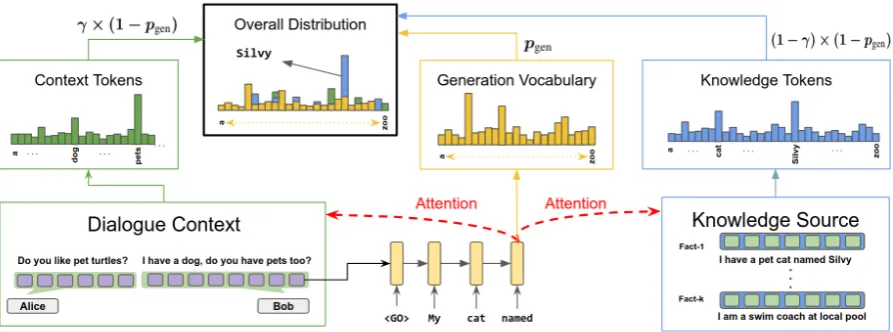
com-Figure 1: Overview of our proposed approach as described in Section3.3. The decoder statedtis used to attend over dialogue context and knowledge source to generate distributions for copying tokens from these sources. The decoder outputs a distribution over a fixed vocabulary. The three distributions are combined to yield the final distribution over tokens at each stept.
bined via a soft switch mechanism, allowing it to copy tokens from source in addition to generating from vocabulary. We report the results for the fol-lowing additional baselines obtained by equipping the corresponding Seq2Seq model in Section3.2.1
with copy mechanism: SEQ2SEQ + NOFACT + COPY, SEQ2SEQ+ BESTFACTCONTEXT+ COPY, SEQ2SEQ+ BESTFACTRESPONSE+ COPY.
3.3 DeepCopy with Hierarchical Pointer Networks
Pointer-generator network (See et al., 2017) can only copy tokens from the encoder input. In this section, we present our proposed DEEPCOPY model that extends pointer-generator network (See et al.,2017) using a novel hierarchical pointer net-work. Our model allows copying tokens from mul-tiple input sources (factsf(i),1≤i≤K), besides the encoder input (dialogue contextx).
A high-level overview of the proposed approach is illustrated in Figure1. At decoder stept, the decoder statehtis used to attend over the dialogue
context tokens and fact tokens to give a distribution over the tokens present in context and facts respec-tively. These distributions are then combined with the distribution output by the decoder over the fixed vocabulary to obtain the overall distribution.
Encoding a sequence. Letw= (w1, w2, . . . wn)
be a sequence of tokens. We first obtain a train-able embedded representation of each token in the sequence and then use a LSTM cell to encode the sequence of embedding vectors. We define
e,s=Encode(w), whereedenotes the final state of the LSTM ands = (s1, s2, . . . sn)denotes the
outputs of the LSTM cell at all steps.
Attention. Let u = (u1, u2, . . . un) be a
se-quence of vectors where ui ∈ Rp,1 ≤ i ≤ n and v ∈ Rq be a conditioning vector. The
at-tention module generates a linear combination
c of elements in u by conditioning them on v
as defined by the equations below. We define
α, c=Attention(u, v), whereαi ∈ Rnis the weight assigned toui, andc∈Rpis a vector rep-resentation of the sequenceuconditioned onv. In the equations below, w1 and W2 are parameters of appropriate dimension. In our setup, we use
p=q, w1∈Rp, andW2 ∈Rp×2p.
ei =wT1 tanh(W2[ui;v]) (1)
αi =
exp(ei)
Pn
j=1exp(ej)
(2)
c=
n
X
i=1
αiui (3)
Copying from Dialogue Context. Similar to our baseline models, we encode the dialogue context tokensx(Equation4) and apply attention to the en-coder outputs at a deen-coder stept(Equation5). This outputs attention weightsα(tx)and a representation of the entire contextc(tx). The attention weights are aggregated to obtain the distribution over context tokensp(tx)(w)(Equation6),
e(x),s(x)=Encode(x) (4)
α(tx), c(tx)=Attention(s(x), ht) (5)
p(tx)(w) = X
{i:xi=w}
α(t,ix) (6)
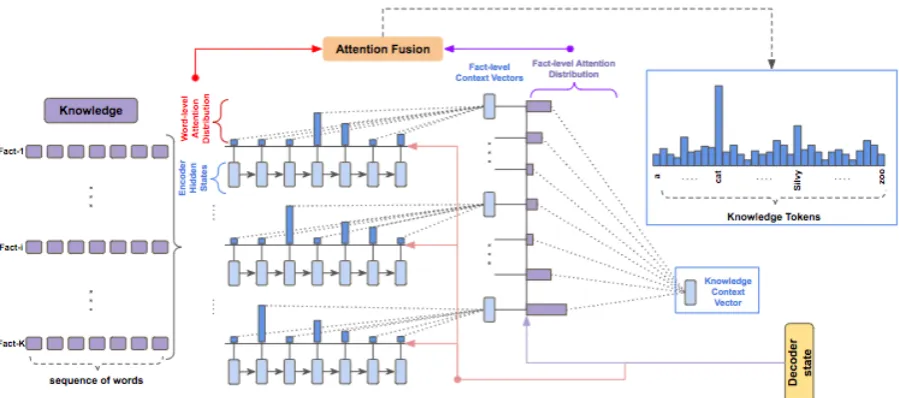
[image:4.595.78.525.66.232.2]net-Figure 2: Illustration of hierarchical pointer network. The decoder statedtis used to attend over tokens for each fact and also over the fact-level context vectors obtained by weighted average of token-level representations (w.r.t token-level attention weights) for each fact. The token-level attention weights are then combined with the attention distribution over facts (Equation
11) to generate the probability of copying each token in all the facts.
work (Figure2) as a general methodology for en-abling token-level copy mechanism from multiple input sequences or facts. Each factf(i)is encoded (Equation7) to obtain token level representations
s(f)(i) and overall representatione(f)(i). The de-coder state ht is used to attend over token level
representations (Equation8) and the overall fact-level representations of each fact (Equation9) by
e(f)(i),s(f)(i)=Encode(f(i)) (7)
α(tf)(i), ct(f)(i)=Attention(s(f)(i), ht) (8)
βt, c(tf)=Attention({c
(f)(i)
t }Ki=1, ht)
(9)
to compute the probability of copying a wordw
from facts as
p(tf)(w) =
K
X
j=1
p(tf)(f(j))·p(tf)(w|f(j))
=
K
X
j=1 βt,j
X
{l:fl(j)=w}
α(t,lf)(j) (10)
Inter-Source Attention Fusion We now present the mechanism to fuse the two distributionsp(tx)(w)
andp(tf)(w)representing the probabilities of copy-ing tokens from dialogue context and facts respec-tively. We use the decoder statehtto attend over
dialogue context representation c(tx) and overall fact representationc(tf)(Equation11). The result-ing attention weight γt0 = [γt,1−γt]is used to
combine the two copying distributions as shown in
Equation12.
γt, ct=Attention([c(tx), c
(f)
t ], ht) (11) pcopyt (w) =γtp(tx)(w) + (1−γt)p(tf)(w) (12)
Similar to Seq2Seq models, the decoder also out-puts a distribution pvocabt over the fixed training vocabulary at each decoder step using the overall context vectorctand decoder stateht. Having
de-fined the copy probabilitiespcopyt for tokens that appear in the model input, either the dialogue con-text or the facts in external knowledge source, we combinepvocabt andpcopyt using the mechanism out-lined in (See et al.,2017), except we usectdefined
in Equation11as the context vector instead.
To better isolate the effect of copying, a key com-ponent of the proposed DEEPCOPYmodel, we also conduct experiments with MULTISEQ2SEQmodel that incorporates the knowledge facts in the same way (by encoding each fact separately with LSTM, and attending on each by the decoder as in (Zoph and Knight,2016)), but relies completely on gener-ation probabilitieswithout a copy mechanism.
3.4 Training
We train all the models described in this section using the same loss function optimization. More precisely, given a modelM that produces a proba-bilitypt(w|y<t)of generating tokenwat decoding
[image:5.595.75.525.61.260.2]the negative log-likelihood loss function of
Jloss(Θ) =−
1
|y|
|y|
X
t=1
log(pt(yt|y<t,x,{f(i)}Ki=1))
for a training sample (x,y,{f(i)}K
i=1) where Θ denotes all the learnable model parameters.
4 Experiments
In this section, we describe the details of dataset, training process, evaluation metrics, and the perfor-mance results of DEEPCOPYmodel in comparison to proposed and existing baselines.
4.1 Dataset
We perform experiments for our problem setup on the recently released CONVAI2conversational AI
challengedataset, which is an extended version of PERSONACHAT(Zhang et al.,2018). The conver-sations in CONVAI2 are obtained by asking a pair of crowdworkers to chat with each other naturally based on their randomly assigned personas (from a set of 1155 personas) towards getting to know each other. Personas are created by a different set of crowdworkers, and they consist of ~5 natural language sentences, each describing an aspect of a person that can range from common hobbies like"I like to play basketball"to very specific facts like"I have a pet parrot named Tasha", reflecting a wide range of different personalities. The dataset con-tains ~11000 dialogues with ~160000 utterances, and 2000 dialogues with non-overlapping personas are used for validation and test. For our setting, we use personas as external knowledge sources that models can ground on while generating responses.
4.2 Training and Implementation Details
In all the models explored in this paper, we set the dialogue context to concatenation of the last two di-alogue turns separated by a specialCONCATtoken. The models are supplied with the persona facts of the side generating the response at the current turn, while the persona of the other side is concealed. We use a vocabulary of 18650 most frequent to-kens and all the remaining toto-kens are replaced with a specialUNKtoken. Embeddings of size 100 are randomly initialized and updated during training. We set the size of LSTM hidden layer to 100 for both encoder and decoder. The encoder and de-coder vocabularies and embeddings are shared. A shared LSTM encoder is used for encoding both dialogue context and facts of external knowledge source. The model parameters are optimized using
Adam (Kingma and Ba,2015) with a batch size of 32, a fixed learning rate of 0.001. We apply gradi-ent clipping to 5 when its norm exceeds this value. During inference, we generate responses by em-ploying a beam search of width 4. Our models are implemented inTensorFlow(Abadi et al.,2016).
4.3 Main Results
In this section, we present the experimental results in terms of both automatic measures and human evaluation.
4.3.1 Automatic Evaluation
In Table1, we present our results in comparison with the existing and proposed baseline models. We report the performance of each model across several metrics commonly used for evaluation of text generation models including perplexity, corpus BLEU (Papineni et al.,2002), ROUGE-L (Lin and Och,2004), CIDEr (Vedantam et al.,2014).
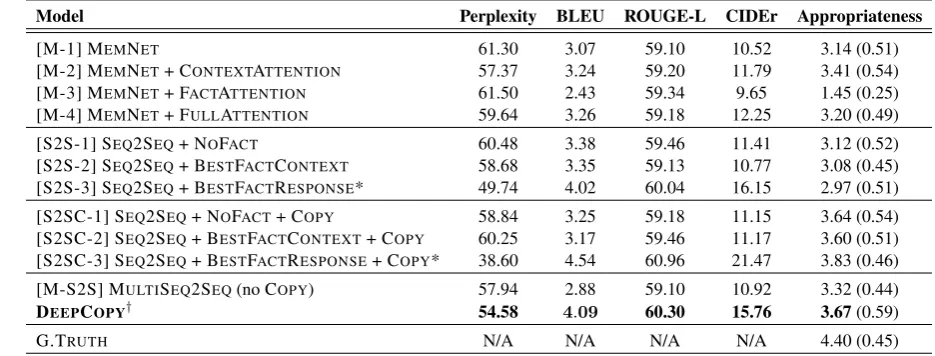
As expected, SEQ2SEQ + BESTFACTRE -SPONSEmodel and its +COPY version outperform all the other models across all the evaluation met-rics. This model pinpoints the importance of se-lecting the most suitable fact in the persona for the response to be generated at each turn, justifying our underlying motivation for conducting this experi-ment as highlighted in Section3.2.1. However, the most suitable fact for the response is not available in the real application scenario, where the models are responsible for picking the useful pieces of in-formation pertaining to the current dialogue turn to generate meaningful responses. Our proposed SEQ2SEQ+ BESTFACTCONTEXTmodel and its +COPY version, on the other hand, are valid
base-lines for this scenario where the best fact is selected completely based on the dialogue context without relying on the ground-truth response. This model outperforms the previously proposed memory net-work based model MEMNET(Ghazvininejad et al.,
Model Perplexity BLEU ROUGE-L CIDEr Appropriateness
[M-1] MEMNET 61.30 3.07 59.10 10.52 3.14 (0.51)
[M-2] MEMNET+ CONTEXTATTENTION 57.37 3.24 59.20 11.79 3.41 (0.54)
[M-3] MEMNET+ FACTATTENTION 61.50 2.43 59.34 9.65 1.45 (0.25)
[M-4] MEMNET+ FULLATTENTION 59.64 3.26 59.18 12.25 3.20 (0.49)
[S2S-1] SEQ2SEQ+ NOFACT 60.48 3.38 59.46 11.41 3.12 (0.52)
[S2S-2] SEQ2SEQ+ BESTFACTCONTEXT 58.68 3.35 59.13 10.77 3.08 (0.45) [S2S-3] SEQ2SEQ+ BESTFACTRESPONSE* 49.74 4.02 60.04 16.15 2.97 (0.51)
[S2SC-1] SEQ2SEQ+ NOFACT+ COPY 58.84 3.25 59.18 11.15 3.64 (0.54) [S2SC-2] SEQ2SEQ+ BESTFACTCONTEXT+ COPY 60.25 3.17 59.46 11.17 3.60 (0.51) [S2SC-3] SEQ2SEQ+ BESTFACTRESPONSE+ COPY* 38.60 4.54 60.96 21.47 3.83 (0.46)
[M-S2S] MULTISEQ2SEQ(no COPY) 57.94 2.88 59.10 10.92 3.32 (0.44)
DEEPCOPY† 54.58 4.09 60.30 15.76 3.67(0.59)
[image:7.595.59.527.63.241.2]G.TRUTH N/A N/A N/A N/A 4.40 (0.45)
Table 1: Main results on CONVAI2 dataset. Evaluation metrics on last three columns are better the higher. Perplexity is lower the better. The results of the proposed approach are presented in bold. * indicates that the corresponding model should be considered as a kind ofORACLEbecause it has access to the fact that is most relevant to the ground-truth response during the inference/test time as defined in Section3.2.1.†indicates that the improvement of DEEPCOPYin automatic evaluation metrics over each of the other models (except S2SC-3) is statistically significant with p-value of less than 0.001 on the paired t-test.
ontf-idf similarity may result in poor fact selec-tion when the lexical overlap between context and response is small which might be a common case especially for the CONVAI2 dataset as the focus of conversation may often change swiftly across the dialogue turns. The latter might be the reason why copying does not help much for this model since it might end up copying irrelevant tokens in the scenario mentioned above.
Our proposed DEEPCOPY model is designed to effectively address the aforementioned issues, where it has access to the entire set of persona facts per dialogue from which it is expected to include the useful pieces of information in the response. DEEPCOPYmodel outperforms all the models re-ported in Table1 except for SEQ2SEQ + BEST -CONTEXTRESPONSEmodels, which we already deem as kind of an upper bound because it has ac-cess to the most relevant fact to the response. This justifies the effectiveness of DEEPCOPY model compared to the existing works (Ghazvininejad et al., 2018; Zhang et al., 2018) and the addi-tional baselines we explored in this work. On the other hand, MULTISEQ2SEQperforms consider-ably worse than the DEEPCOPYmodel despite the fact they both have access to the entire set of facts and employ the same encoder-decoder architecture except for the copy mechanism. This further justi-fies the effectiveness of incorporating the proposed hierarchical pointer networks in DEEPCOPY be-cause integrating the external knowledge simply by employing multi-source attention as in (Zoph and Knight,2016) does not yield to a good solution
with competitive results, performing even worse than SEQ2SEQ + NOFACT on 3 of the metrics.
4.3.2 Human Evaluation
Although automatic metrics provide tangible in-formation regarding the performance of the mod-els, we augment them with human evaluations for a more comprehensive analysis of the resulting model generated responses. Towards this end, we randomly sample 100 examples from test data and ask human raters to evaluate the candidate model generated responses in terms of appropriateness. Each example is rated by 3 raters, who are shown a dialog history along with a set of persona facts (of the person in turn), and asked to rate each re-sponse based on itsappropriatenessin the dialogue context with a score from 1 (worst) to 5 (best).
Diversity Fact-Inclusion Agreement Model Distinct-2 / 3 / 4 F.Inc F.Per F.Hal F.Inc/F.Per
M-1 .004 / .006 / .010 0.41 0.01 0.40 0.99 / 0.99
M-2 .010 / .019 / .031 0.43 0.01 0.42 0.97 / 0.99
M-3 .001 / .001 / .002 0.06 0.04 0.02 0.99 / 0.99
M-4 .054 / .010 / .156 0.51 0.09 0.42 0.98 / 0.98
S2S-1 .012 / .022 / .036 N/A N/A N/A N/A / N/A
S2S-2 .012 / .022 / .035 0.54 0.04 0.50 0.97 / 0.99
S2S-3 .026 / .043 / .061 0.79 0.16 0.63 0.97 / 0.97
S2SC-1 .039 / .069 / .104 N/A N/A N/A N/A / N/A
S2SC-2 .035 / .067 / .109 0.73 0.36 0.37 0.99 / 0.99
S2SC-3* .058 / .111 / .178 0.73 0.55 0.18 0.98 / 0.96
M-S2S .035 / .065 / .104 0.47 0.05 0.42 0.96 / 0.98
DEEPCOPY .059 / .121 / .201 0.62 0.23 0.39 0.95 / 0.97
[image:8.595.100.499.63.297.2]G.TRUTH 0.35 / 0.66 / 0.84 0.76 0.49 0.27 0.93 / 0.96
Table 2: Lexical diversity and fact inclusion analysis results. Model names are abbreviated according to Table1.F.Incdenotes the ratio of responses that include factual information.F.PerandF.Haldenote the ratio of responses where the included fact is consistent with the persona or a hallucinated one, respectively.Agreementcolumn corresponds to Cohen’sκstatistic measuring inter-rater agreement on binary factual evaluation metrics forF.IncandF.Per. * indicates theORACLEmodel.
Appropriateness scores also demonstrate the ad-vantage of incorporating the soft copy mechanism. Comparing S2S (and M-S2S) models to their copy-equipped counterparts (S2SC) (and DEEPCOPY) in Table1immediately reveals a significant gain in appropriateness score. Another significant obser-vation to note here is that ground-truth responses obtain an average appropriateness score of4.4/5, which reflects both the noise in CONVAI2 dataset and the difficulty of generating the perfect response even for humans.
4.4 Further Analysis and Discussion
Lexical Diversity Analysis. In Table 2, we re-port the lexical diversity results using the distinct-ness metric introduced in (Li et al.,2016b). dis-tinct-nscore corresponds to the number of distinct
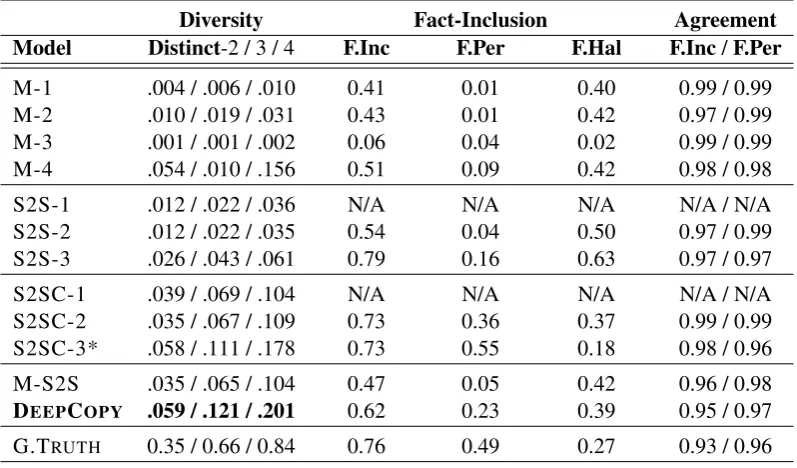
n-grams divided by total number of generatedn -grams. We can clearly observe that DEEPCOPY generates the most diverse responses among all the models including the copy-augmented oracle model (S2SC-3). Hence, diversity results further show that our proposed model is promising in ad-dressing the most commonly observedgeneric re-sponse problemmore effectively than existing mod-els by generating more diverse responses.
Fact Inclusion Analysis. We also conduct an anal-ysis on the kinds of factual information included in the model-generated responses. More precisely, our goal is to understand how often the generated
response includes a factual information (F.Inc), and whether this information is consistent with the per-sona facts (F.Per) or a hallucinated one (F.Hal). A good model can naturally include available facts from the persona and hallucinate others when the conversation context requires them. Towards this end, we ask3human raters to label responses with 1 (or 0) based on whether a fact is included, and if so, whether this fact is a persona-fact or not.
In Table2, we present an analysis for the kinds of factual information included in model generated responses. As can be seen from this analysis, mod-els that have a copy mechanism include more facts from the persona than the ones that do not. Another important observation is that the ground-truth re-sponses include facts from persona only in 49% of the times, which indicates that the provided persona facts remain insufficient to cover the complexity of the high entropy open-ended person-to-person conversations.
for hallucinated facts (F.Hal). Hence, there is noκ
statistic forF.Halin Table2.
Error Analysis. A deeper analysis of the examples where DEEPCOPY is assigned a worse appropri-ateness score than the best performing memory-network based baselines (M-2 and M-4) reveals the following further insights: (i) Some of these examples are corresponding to the cases where a generic response (e.g., "I’ve a dog named radar", one of the frequent generic responses, completely independent of persona facts) is rated much higher (5 to 1) than factual but slightly off (by a single word in this example) responses (e.g., "I have a dog for a living." coming from the persona fact "I walk dogs for a living."), (ii) In another sub-set of the analyzed examples, DEEPCOPYmodel generates a response (e.g., "yes, but I want to be-come a lawyer.") by incorporating a fact that has already been used in the previous turn of the di-alog whereas M-2 produces a generic response (e.g., "that’s great. do you have any hobbies?", again irrelevant to facts) which is rated higher. (iii) And most of the remaining cases fall into the class of examples where incorporating knowledge facts breaks the conversation flow, which is a crucial observation specific to this dataset that can also be supported by the low persona-fact inclusion ratio (49%) of ground-truth responses.
4.5 Qualitative Observations
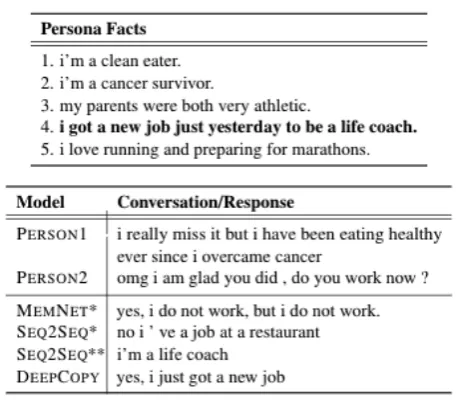
[image:9.595.306.537.62.264.2]In Figure3, we present an example dialogue where DEEPCOPYmodel generates a meaningful and flu-ent response by effectively mixingcopyand gen-erate modes. We can observe that it is able to attend on the right persona fact by taking the dia-logue context (especially the question at the end of PERSON2’s turn) into consideration. Furthermore, attending to the tokens of this fact, it produces a fluent and valid answer to yes/no question by gen-erating "yes" and copying the rest (and most) of the tokens from the fact. Although it copies most of the tokens from the fact, it is good to observe that it copies exactly the relevant pieces instead of just copying the entire fact. SEQ2SEQ+ BESTFACTRE -SPONSE+ COPYmodel’s response is also meaning-ful and fluent although it may not be as engaging for the continuation of dialog. However, the qual-ity of the response by SEQ2SEQ+ BESTFACTRE -SPONSEquickly degrades compared to its +COPY version. Although the response is still fluent and relevant to the dialogue context, it becomes rather irrelevant to the persona as the model seems to have
Figure 3: Example dialogue where the previous two turns from PERSON1 and PERSON2 along with the responses gen-erated by the models acting as PERSON1 are shown on the right. Persona facts for PERSON1 are provided on the left, among which the one in bold is the best fact w.r.t response. MEMNET*, SEQ2SEQ*, SEQ2SEQ** are abbreviations for MEMNET+ FULLATTENTION, SEQ2SEQ+ BESTFACTRE
-SPONSE, SEQ2SEQ+ BESTFACTRESPONSE+COPY models, respectively.
difficulty of picking the useful information from even the best persona fact it is provided with when the copy mechanism is disabled. Lastly, the re-sponse generated by MEMNET+FULLATTENTION model seems to still suffer from repetition, seman-tic consistency, and relevancy problems that were observed and reported by previous work.
5 Conclusion and Future Work
References
Martín Abadi, Paul Barham, Jianmin Chen, Zhifeng Chen, Andy Davis, Jeffrey Dean, Matthieu Devin, Sanjay Ghemawat, Geoffrey Irving, Michael Isard, Manjunath Kudlur, Josh Levenberg, Rajat Monga, Sherry Moore, Derek G. Murray, Benoit Steiner, Paul Tucker, Vijay Vasudevan, Pete Warden, Martin Wicke, Yuan Yu, and Xiaoqiang Zheng. 2016. Ten-sorflow: A system for large-scale machine learning. In 12th USENIX Symposium on Operating Systems Design and Implementation (OSDI 16).
Dzmitry Bahdanau, Kyunghyun Cho, and Yoshua Ben-gio. 2015. Neural machine translation by jointly learning to align and translate. InInternational Con-ference on Learning Representations (ICLR).
Kyunghyun Cho, Bart Van Merriënboer, Caglar Gul-cehre, Dzmitry Bahdanau, Fethi Bougares, Holger Schwenk, and Yoshua Bengio. 2014. Learning phrase representations using rnn encoder-decoder for statistical machine translation. arXiv preprint arXiv:1406.1078.
Michel Galley, Chris Brockett, Xiang Gao, Bill Dolan, and Jianfeng Gao. 2018. End-to-end conversation modeling: Moving beyond chitchat. http://workshop.colips.org/dstc7/ proposals/DSTC7-MSR_end2end.pdf. Online; accessed 23 October 2018.
Marjan Ghazvininejad, Chris Brockett, Ming-Wei Chang, Bill Dolan, Jianfeng Gao, Wen-tau Yih, and Michel Galley. 2018. A knowledge-grounded neural conversation model. InAAAI Conference on Artifi-cial Intelligence (AAAI).
Diederik P. Kingma and Jimmy Ba. 2015. Adam: A method for stochastic optimization. InInternational Conference on Learning Representations (ICLR).
Jiwei Li, Michel Galley, Chris Brockett, Georgios Sp-ithourakis, Jianfeng Gao, and Bill Dolan. 2016a. A persona-based neural conversation model. In Pro-ceedings of the 54th Annual Meeting of the Associa-tion for ComputaAssocia-tional Linguistics (Volume 1: Long Papers), pages 994–1003. Association for Computa-tional Linguistics.
Jiwei Li, Michel Galley, Jianfeng Brockett, Chris ad Gao, and Bill Dolan. 2016b. A diversity-promoting objective function for neural conversation models. InThe North American Chapter of the As-sociation for Computational Linguistics (NAACL).
C.Y. Lin and Franz Josef Och. 2004. Automatic eval-uation of machine translation quality using longest common subsequence and skip-bigram statistics. In Annual Meeting of the Association for Computa-tional Linguistics (ACL).
Shuman Liu, Hongshen Chen, Zhaochun Ren, Yang Feng, Qun Liu, and Dawei Yin. 2018. Knowledge diffusion for neural dialogue generation. In Proceed-ings of the 56th Annual Meeting of the Association
for Computational Linguistics (Volume 1: Long Pa-pers), pages 1489–1498. Association for Computa-tional Linguistics.
Minh-Thang Luong, Hieu Pham, and Christopher D. Manning. 2015. Effective approaches to attention-based neural machine translation. In Empir-ical Methods on Natural Language Processing (EMNLP).
Ramesh Nallapati, Bowen Zhou, Cicero dos Santos, Caglar Gulcehre, and Bing Xiang. 2016. Abstrac-tive text summarization using sequence-to-sequence rnns and beyond. In Computational Natural Lan-guage Learning (CoNLL).
Kishore Papineni, Salim Roukos, Todd Ward, and Wei-Jing Zhu. 2002. Bleu: A method for automatic evaluation of machine translation. InAnnual Meet-ing of the Association for Computational LMeet-inguistics (ACL).
Dinesh Raghu, Nikhil Gupta, and Mausam. 2018. Hier-archical pointer-generator network for task oriented dialog. arXiv preprint arXiv:1805.01216.
Alan Ritter, Colin Cherry, and William B Dolan. 2011. Data-driven response generation in social media. In Proceedings of the conference on empirical methods in natural language processing, pages 583–593. As-sociation for Computational Linguistics.
M. Alexander Rush, Sumit Chopra, and Jason Weston. 2015. A neural attention model for abstractive sen-tence summarization. InEmpirical Methods on Nat-ural Language Processing (EMNLP).
Abigail See, Peter J. Liu, and Christopher D. Manning. 2017. Get to the point: Summarization with pointer-generator networks. InAnnual Meeting of the Asso-ciation for Computational Linguistics (ACL).
Iulian Vlad Serban, Alessandro Sordoni, Yoshua Ben-gio, Aaron C Courville, and Joelle Pineau. 2016. Building end-to-end dialogue systems using gener-ative hierarchical neural network models. InAAAI Conference on Artificial Intelligence (AAAI).
Iulian Vlad Serban, Alessandro Sordoni, Ryan Lowe, Laurent Charlin, Joelle Pineau, Aaron C Courville, and Yoshua Bengio. 2017. A hierarchical latent variable encoder-decoder model for generating di-alogues. In AAAI Conference on Artificial Intelli-gence (AAAI).
Sainbayar Sukhbaatar, Arthur Szlam, Jason Weston, and Fergus Rob. 2014. End-to-end memory net-works. InAdvances in Neural Information Process-ing Systems (NIPS).
Jiwei Tan, Xiaojun Wan, and Jianguo Xiao. 2017. Abstractive document summarization with a graph-based attentional neural model. In Annual Meet-ing of the Association for Computational LMeet-inguistics (ACL).
Ramakrishna Vedantam, C. Lawrence Zitnick, and Devi Parikh. 2014. Cider: Consensus-based image description evaluation. arXiv preprint arXiv:1411.5726.
Oriol Vinyals, Meire Fortunato, and Navdeep Jaitly. 2015. Pointer networks. InAdvances in Neural In-formation Processing Systems (NIPS).
Oriol Vinyals and Quoc Le. 2015. A neural conversa-tional model. arXiv preprint arXiv:1506.05869.
Jason Weston, Emily Dinan, and Alexander H. Miller. 2018. Retrieve and refine: Improved sequence generation models for dialogue. arXiv preprint arXiv:1808.04776v2.
Caiming Xiong, Victor Zhong, and Richard Socher. 2017. Dynamic coattention networks for question answering. In International Conference on Learn-ing Representations (ICLR).
Semih Yavuz, Chung-Cheng Chiu, Patrick Nguyen, and Yonghui Wu. 2018. CaLcs: Continuously ap-proximating longest common subsequence for se-quence level optimization. InEmpirical Methods on Natural Language Processing (EMNLP).
Saizheng Zhang, Emily Dinan, Jack Urbanek, Arthur Szlam, Douwe Kiela, and Jason Weston. 2018. Per-sonalizing dialogue agents: I have a dog, do you have pets too? In Annual Meeting of the Associa-tion for ComputaAssocia-tional Linguistics (ACL).