Evaluation of language identification methods using 285 languages
Tommi Jauhiainen
University of Helsinki
@helsinki.fi
Krister Lind´en
University of Helsinki
@helsinki.fi
Heidi Jauhiainen
University of Helsinki
@helsinki.fi
Abstract
Language identification is the task of giv-ing a language label to a text. It is an im-portant preprocessing step in many auto-matic systems operating with written text. In this paper, we present the evaluation of seven language identification methods that was done in tests between 285 languages with an out-of-domain test set. The evalu-ated methods are, furthermore, described using unified notation. We show that a method performing well with a small num-ber of languages does not necessarily scale to a large number of languages. The HeLI method performs best on test lengths of over 25 characters, obtaining anF1-score of 99.5 already at 60 characters.
1 Introduction
Automatic language identification of text has been researched since the 1960s. Language identifica-tion is an important preprocessing step in many au-tomatic systems operating with written text. State of the art language identifiers obtain high rates in both recall and precision. However, even the best language identifiers do not give perfect results when dealing with a large number of languages, out-of-domain texts, or short texts. In this paper seven language identification methods are evalu-ated in tests incorporating all three of these hard contexts. The evaluations were done as part of the Finno-Ugric Languages and The Internet project (Jauhiainen et al., 2015) funded by the Kone Foun-dation Language Programme (Kone FounFoun-dation, 2012). One of the major goals of the project is creating text corpora for the minority languages within the Uralic group.
In Section 2, we describe the methods chosen for this evaluation. In Section 3, we present the corpora used for training and testing the methods
and in Section 4 we discuss and present the results of the evaluations of the methods using these cor-pora.
2 Previous work
There are not many previously published arti-cles which provide language identification results for more than 100 languages. Results for such evaluations were provided by King and Dehdari (2008), Jauhiainen (2010), Vatanen et al. (2010), Rodrigues (2012), and Brown (2012). King and Dehdari (2008) achieved 99% accuracy with 500 bytes of input for over 300 languages. Vatanen et al. (2010) created a language identifier which in-cluded 281 languages and obtained an in-domain identification accuracy of 62.8% for extremely short samples (5-9 characters). Rodrigues (2012) presents a boosting method using the method of Vatanen et al. (2010) for language identification. His method could possibly also be used with other language identification methods and we leave the evaluation of the boosting method to future work. The language identifier created by Brown (2012), ”whatlang”, obtains 99.2% classification accuracy with smoothing for 65 character test strings when distinguishing between 1,100 languages (Brown, 2013; Brown, 2014).
The HeLI method described in Jauhiainen et al. (2016) was used successfully with 103 lan-guages by Jauhiainen (2010). Some of the more detailed results concerning the Uralic languages for the evaluations presented in this paper were previously published by Jauhiainen et al. (2015).
In this section, we also include the original method of Cavnar and Trenkle (1994), as it is the most frequently used baseline in the language identification literature. As baselines, we have also included the methods presented by Tromp and Pechenizkiy (2011) and Vogel and Tresner-Kirsch (2012), which provided promising results when used with 6 languages.
2.1 On notation (Jauhiainen et al., 2016)
A corpusC consists of individual tokensuwhich may be words or characters. A corpusCis a finite sequence of individual tokens,u1, ...,ul. The total count of all individual tokensuin the corpusCis denoted bylC. A set of unique tokens in a corpus
Cis denoted byU(C). The number of unique
to-kens is referred to as|U(C)|. A feature f is some countable characteristic of the corpusC. When re-ferring to all featuresF in a corpusC, we useCF and the count of all features is denoted bylCF. The
count of a featuref in the corpusCis referred to as
c(C,f). Ann-gram is a feature which consists of a
sequence ofnindividual tokens. Ann-gram start-ing at positioniin a corpus is denotedui,...,i−1+n.
Ifn=1,uis an individual token. When referring
to alln-grams of length n in a corpusC, we use
Cn and the count of all such n-grams is denoted bylCn. The count of an n-gramuin a corpusCis
referred to asc(C,u)and is defined by Equation 1.
c(C,u) =
lC+1−n
∑
i=1
1 , ifu=ui,...,i−1+n
0 , otherwise (1)
The set of languages is G, and lG denotes the number of languages. A corpusC in language g
is denoted byCg. A language modelO based on
Cgis denoted byO(Cg). The features given values by the modelO(Cg) are the domaindom(O(Cg)) of the model. In a language model, a valuevfor the feature f is denoted byvCg(f). A corpus in an
unknown language is referred to as a mystery text
M. For each potential languagegof a corpusM, a resulting scoreR(g,M)is calculated.
2.2 N-Gram-Based Text Categorization
The method of Cavnar and Trenkle (1994) uses overlapping charactern-grams of varying size cal-culated from words. The language models are cre-ated by tokenizing the training texts for each lan-guage g into words and then padding each word with spaces, one before and four after. Each padded word is then divided into overlapping char-actern-grams of sizes from 1 to 5 and the counts of every uniquen-gram are calculated over the whole corpus. Then-grams are ordered by frequency and
kof the most frequentn-grams,u1, ...,uk, are used as the domain of the language model O(Cg) for the languageg. The rank of ann-gram u in lan-guagegis determined by then-gram frequency in the training corpusCgand denotedrankCg(u).
During language identification, the mystery text is treated in a similar way and a corresponding model O(M) of the k most frequent n-grams is
created. Then a distance score is calculated be-tween the model of the mystery text and each of the language models. The value vCg(u) is
calcu-lated as the difference in ranks betweenrankM(u) and rankCg(u) of the n-gram u in the domain
dom(O(M))of the model of the mystery text. If an
n-gram is not found in a language model, a special penalty value p is added to the total score of the language for each missing n-gram. The penalty value should be higher than the maximum possi-ble distance between ranks. We usep=k+1, as
the penalty value.
vCg(u) =
|rankM(u)−rankCg(u)|, ifu∈dom(O(Cg))
p, ifu∈/dom(O(Cg))
(2) The scoreRsum(g,M)for each languagegis the sum of values as in Equation 3.
Rsum(g,M) =
lMF
∑
i=1vCg
(fi) (3)
The language having the lowest score
Rsum(g,M) is selected as the identified lan-guage.
2.3 LIGA-algorithm
The graph-based n-gram approach called LIGA was first described in (Tromp, 2011). The method is here reproduced as explained in (Vogel and Tresner-Kirsch, 2012). The language models con-sist of relative frequencies of character trigrams and the relative frequencies of two consecutive overlapping trigrams. The frequency of two con-secutive overlapping trigrams is exactly the same as the 4-gram starting from the beginning of the first trigram. So the language models consist of the relative frequenciesvCg(u) of 3- and 4-grams
as in Equation 4.
vCg(u) =
c(Cg,u)
lCgn (4)
wherec(Cg,u), is the number of 3- or 4-gramsu andlCn
g, is the total number of 3- and 4-grams in
the training corpus.
highest score as opposed to the lowest score with the previous method.
In the logLIGA variation of the method, intro-duced by Vogel and Tresner-Kirsch (2012), the natural logarithm of the frequencies is used when calculating the relative frequencies, as in Equa-tion 5.
vCg(u) =
ln(c(Cg,u))
ln(lCn g)
(5)
Otherwise the method is identical to the original LIGA algorithm.
2.4 The method of King and Dehdari (2008)
King and Dehdari (2008) tested the use of the rela-tive frequencies of byten-grams with Laplace and Lidstone smoothings in distinguishing between 312 languages. They separately tested overlap-ping 2-, 3-, and 4-grams with both smoothing tech-niques. They used the Universal Declaration of Human Rights corpus, which is accessible using NLTK (Bird, 2006), separating the testing mate-rial before training. The values for each n-gram are calculated as in Equation 6,
vCg(u) =
c(Cg,u) +λ
lCgn+|U(Cgn)|λ (6)
wherevCg(u)is the probability estimate ofn-gram
u in the model and c(Cg,u) its frequency in the training corpus. lCgn is the total number of n
-grams of lengthnand|U(Cn
g)|the number of dis-tinctn-grams in the training corpus. λ is the Lid-stone smoothing parameter. When using Laplace smoothing, theλ is equal to 1 and with Lidstone smoothing, the λ is usually set between 0 and 1. King and Dehdari (2008) found that Laplace smoothing with the bigram model turned out to be the most accurate on two of their longer test sets and that Lidstone smoothing (with λ set to 0.5) was better with the shortest test set. King and Dehdari (2008) used theentropy(model, text)
function of NLTK, which evaluates the entropy be-tweentextandmodelby summing up the log prob-abilities of words found in the text.1
2.5 ”Whatlang” program (Brown, 2013)
The ”Whatlang” program uses variable length byte
n-grams from 3 to 12 bytes as its language model.
Kof the most frequentn-grams are extracted from
1Jon Dehdari recently uploaded the
instruc-tions to: https://github.com/jonsafari/ witch-language
training corpora for each language and their rel-ative frequencies are calculated. In the tests re-ported in (Brown, 2013), K varied from 200 to 3,500n-grams. After the initial models are gen-erated,n-grams, which are substrings of longern -grams in the same model, are filtered out, if the frequency of the longern-gram is at least 62% of the shorter n-grams frequency. The value vCg(u)
of an n-gram u in the model of the corpusCg is calculated as in Equation 7
vCg(u) =
c(Cg,u)
lCn g
0.27
n0.09 (7)
where c(Cg,u) is the frequency of the n-gram u andlCng is the number of alln-grams of the length
n in the training corpus Cg. The weights in the model are calculated so that the longer n-grams have greater weights than short ones with the same relative frequency. Baseline language mod-elsObase(Cg)are formed for each languagegusing the valuesvCg(u).
For each language modelObase(Cg), the cosine similarity between it and every other language model is calculated. A union ofn-grams is formed by taking all of the models for which the sim-ilarity is higher than an empirically determined threshold. The corpusCg is scanned for occur-rences of the n-grams in the union. If some of the n-grams are not found at all, these n-grams are then appended with negative weights to the base model. The negative weight used for an n -gramu in the model O(Cg) is the maximum co-sine similarity betweenObase(Cg) and the models containing ann-gramutimes the maximumvC(u) within those models. These negative weightedn -grams are called stop--grams. If the size of the training corpus for a certain model is less than 2 million bytes, the weights of the stop-grams are discounted as a function of the corpus size.
The score Rwhatlang(g,M) for the languagegis calculated as in Equation 8
Rwhatlang(g,M) =∑ivCg(ui)
lM1 (8)
whereuiare then-grams found in the mystery text
M. The score is also normalized by dividing it with the length (in characters) of the mystery text
lM1. The language with the highest score is identi-fied as the language of the mystery text.
ac-curacy with 1,100 languages for lines up to 65 characters is 98.68%, which is extremely good.
2.6 VariKN toolkit (Vatanen et al., 2010)
The problem with short text samples was consid-ered by Vatanen et al. (2010). Several smooth-ing techniques with a naive Bayes classifier were compared in tests of 281 languages. Absolute dis-counting (Ney et al., 1994) smoothing with a max-imumn-gram length of 5 turned out to be their best method. When calculating the Markovian prob-abilities in absolute discounting, a constant Dis subtracted from the countsc(C,uni−n+1)of all
ob-servedn-gramsun
i−n+1and the left-out probability mass is distributed between the unseenn-grams in relation to the probabilities of lower ordern-grams
Pg(ui|uin−−n1+2), as in Equation 9.
Pg(ui|uni−−1n+1) =
c(C,un
i−n+1)−D
c(C,uni−−1n+1) +λuni−−1n+1Pg(ui|u
n−1
i−n+2)
(9) The language identification is performed us-ing the ”perplexity” program provided with the toolkit.2 Perplexity is calculated from the Marko-vian probability P(M|Cg) =∏iPg(ui|uni−−n1+1) for the mystery textM given the training data Cg as in Equations 10 and 11.
Hg(M) =− 1
c(M,u)
∏
i log2Pg(ui|un−1
i−n+1) (10)
Rperplexity(g,M) =2Hg(M) (11)
2.7 The HeLI method
The HeLI3method (Jauhiainen, 2010) is described in Jauhiainen et al. (2016) using the same notation as in this article. In the method, each language is represented by several different language models only one of which is used for every word found in the mystery text. The language models for each language are: a model based on words and one or more models based on charactern-grams from one tonmax. When a word not included in the model based on words is encountered in the mystery text
M, the method backs off to using the n-grams of the sizenmax. If it is not possible to apply then -grams of the size nmax, the method backs off to lower ordern-grams and continues backing off un-til character unigrams, if needed. A development
2https://github.com/vsiivola/variKN
3https://github.com/tosaja/HeLI
set is used for finding the best values for the pa-rameters of the method. The three papa-rameters are the maximum length of the used charactern-grams (nmax), the maximum number of features to be in-cluded in the language models (cut-offc), and the penalty value for those languages where the fea-tures being used are absent (penaltyp). Because of the large differences between the sizes of the train-ing corpora, we used a slightly modified imple-mentation of the method, where we used relative frequencies as cut-offsc. The values in the mod-els are 10-based logarithms of the relative frequen-cies of the featuresu, calculated using only the fre-quencies of the retained features, as in Equation 12
vCg(u) = (
−log10c(Cg,u)
lCg
, ifc(Cg,u)>0 p , ifc(Cg,u) =0 (12) wherec(Cg,u)is the number of featuresuandlCg
is the total number of all features in languageg. If
c(Cg,u)is zero, thenvCg(u)gets the penalty value
p.
A score vg(t) is calculated for each word t in the mystery text for each languageg, as shown in Equation 13.
vg(t) =
v
Cg(t) , ift∈dom(O(Cg))
vg(t,min(nmax,lt+2)) , ift∈/dom(O(Cg))
(13) The whole mystery text M gets the score
RHeLI(g,M)equal to the average of the scores of the words vg(t) for each language g, as in Equa-tion 14
RHeLI(g,M) =∑ lT(M)
i=1 vg(ti)
lT(M)
(14) whereT(M)is the sequence of words andlT(M)is
the number of words in the mystery textM. The language having the lowest score is assigned to the mystery text.
3 Test setting
In addition to the Uralic languages relevant to the project (Jauhiainen et al., 2015), the languages for the evaluation of the language identification meth-ods were chosen so that we were able to train and test with texts from different sources, preferably also from different domains. We were able to gather suitable corpora for a set of 285 languages.4
4The list of all the languages and most of the sources
can be found athttp://suki.ling.helsinki.fi/
In our project we are interested in gathering as much of the very rare Uralic texts as possible, so we need a high recall. On the other hand, if our precision is bad, we end up with a high percent-age of incorrect langupercent-age labels for the rare lan-guages. For these reasons we use the F1-score as the main performance measure when evalu-ating the language identifiers. We calculate the language-level averages of recall, precision and theF1-score. Language-level averages are referred to as macro-averages by Lui et al. (Lui et al., 2014). As the number of mystery texts for each language were identical, the macro-averaged re-call equals the commonly used classification accu-racy5. TheF
β-score is based on the effectiveness
measure introduced by van Rijsbergen (1979) and is calculated from the precision pand recallr, as in Equation 15
Fβ= (1+β2)
pr
(β2p) +r
(15)
whereβ =1 gives equal weight to precision and
recall.
3.1 Training Corpora
The biggest bulk of the training corpora is formed from various Wikipedias.6 The collection sizes range from a few articles for the very small lan-guages to over a million articles in the English, German, French, Dutch and Italian collections. The sheer amount of linguistic material contained in the article collections makes using them as text corpora an appealing thought. The article collections had to be cleaned as they contained lots of non-lingual metadata and links as well as text in non-native languages. In addition to the text from Wikipedia, there is material from bible translations7, other religious texts8, the Leipzig Corpora Collection (Quasthoff et al., 2006), the AKU project9, S´ami giellatekno10, and generic web pages. Even with these additions, the amount
5The evaluation results for all the languages and
identi-fiers can be found athttp://suki.ling.helsinki.
fi/NodaEvalResults.xlsx.
6http://www.wikipedia.org
7http://gospelgo.com/biblespage.html,
http://worldbibles.org, http://ibt.org.ru,
http://gochristianhelps.com
8http://www.christusrex.org, https:
//www.lds.org
9http://www.ling.helsinki.fi/˜rueter/
aku-index.shtml
10http://giellatekno.uit.no
of training material differs greatly between lan-guages.
Each language has one file including all the training texts for that language. Some of the texts are copyrighted, so they cannot be published as such. The amount of training material differs dras-tically between languages: they span from 2,710 words of Tahitian to 29 million words of En-glish. Some of the corpora were manually exam-ined to remove text obviously written in foreign languages. Even after all the cleaning, the training corpora must be considered rather unclean.
3.2 Testing Corpora
The test corpora are mostly derived from the translations of the universal declaration of human rights.11 However, the test set includes languages for which no translation of the declaration is avail-able and for these languages texts were collected from some of the same sources as for the training corpora, but also from Tatoeba.12 Most of the test texts have been examined manually for purity, so that obvious inclusions of foreign languages were removed.
The aim was to have the mystery texts from dif-ferent domains than the training texts. Wikipedia refers to the declaration of human rights in several languages and in many places. In order to deal with possible inclusion of test material in train-ing corpora, every test corpus was divided into 30 character chunks and any lines including these chunks in the corresponding training corpus were removed. Also, if long sequences of numbers were noticed, they were removed from both corpora. There are still numbers in the test set and for ex-ample some of the 5 character or even 10 character sequences in the test set consist only or mostly of numbers.
The test set has been randomly generated from the test corpora. A test sample always begins at the beginning of a word, but it might end anywhere, including in the middle of a word. An extra blank was inserted in the beginning of each line when testing those language identifiers, which did not automatically expect the text to begin with a word. The test samples are of 19 different sizes ranging from 5 to 150 characters. Each language and size pair has 1,000 random (some can be identical) test samples. The full test set comprises of around 5.4
11http://www.unicode.org/udhr/
30 40 50 60 70 80 90 100
5 10 15 20 25 30 35 40 45 50 55 60 65 70
F-scor
e
Test length in characters
[image:6.595.308.520.59.268.2]LIGA LogLIGA Cavnar & Trenkle
Figure 1: Comparison between the F1-scores of the method of Cavnar and Trenkle (1994), LIGA, and logLIGA.
million samples to be identified.
4 The results and discussion
After training the aforementioned language identi-fiers with our own training corpora, we tested them against all the languages in our test suite.
4.1 The baselines
Cavnar and Trenkle (1994) included the 300 most frequentn-grams in the language models. In our tests the best results were attained using 20,000
n-grams with their method. From the LIGA vari-ations introduced by Vogel and Tresner-Kirsch (2012), we chose to test the logLIGA as it per-formed the best in their evaluations in addition to the original LIGA algorithm. For these three methods, the averaged results of the evaluations for 285 languages can be seen in Figure 1.
The results of both the LIGA and logLIGA al-gorithms are clearly outperformed by the method of Cavnar and Trenkle (1994). Especially the poor results of logLIGA were surprising, as it was clearly better than the original LIGA algo-rithm in the tests presented by Vogel and Tresner-Kirsch (2012). To verify the performance of our implementations, we tested them with the same set of languages which were tested in (Vogel and Tresner-Kirsch, 2012), where the baseline LIGA had an average recall of 97.9% and logLIGA 99.8% over 6 languages. The tweets in their dataset average around 80 characters. The results
55 60 65 70 75 80 85 90 95 100
5 10 15 20 25 30 35 40 45 50 55 60 65 70
Recall
[image:6.595.73.284.59.265.2]Test length in characters LIGA LogLIGA
Figure 2: The recall of LIGA and logLIGA algo-rithms with 6 languages.
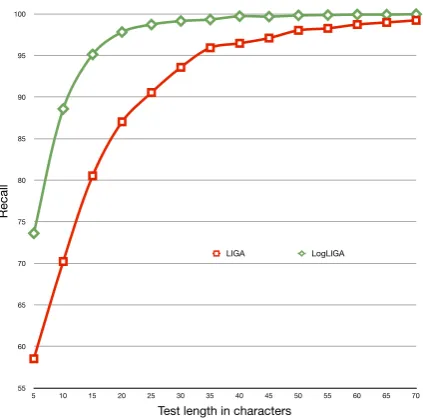
of our tests can be seen in Figure 2. The logLIGA clearly outperforms the LIGA algorithm and ob-tains 99.8% recall already at 50 characters even for our cross-domain test set. From these results we believe that especially the logLIGA algorithm does not scale to a situation with a large number of languages.
4.2 The evaluations
For the evaluation of the method of King and Dehdari (2008) we created Laplace and Lidstone smoothed language models from our training cor-pora and programmed a language identifier, which used the sum of log probabilities (we did not use NLTK) to measure the distance between the mod-els and the mystery text. We testedn-grams from 1 to 6 with several different values ofλ. King and Dehdari (2008) used byten-grams, but as our cor-pus is completely UTF-8 encoded, we usen-grams of characters instead.
Figure 3: TheF1-scores of the six best evaluated methods.
longest test sequences used in this article. We be-lieve that these two dissimilarities in test setting could be the reason for the differing results, but we decided that investigating this further was not within the scope of this article.
In the evaluation of the method of Brown (2013), we used the ”mklangid” program provided with the Brown’s package13 to create new lan-guage models for the 285 lanlan-guages of our test suite. The best results with the ”whatlang” were obtained using up to 10-byten-grams, 40,000 n -grams in the models, and 160 million bytes of training data as well as stop-grams. Stop-grams were calculated for languages with a similarity score of 0.4 or higher. The average recall obtained for 65 character samples was 98.9% with an F1 -score of 99.0%. Brown’s method clearly outper-forms the results of the algorithm of Cavnar and Trenkle (1994), as can be seen in Figure 3. One thing to note is also the running time. Running the tests using the algorithm of Cavnar and Trenkle (1994) with 20,000 n-grams took over two days, as opposed to the less than an hour with Brown’s ”Whatlang” program.
In order to evaluate the method used by Vatanen et al. (2010), we utilized the VariKN toolkit (Si-ivola et al., 2007) to create language models from our training data with the same settings: absolute discounting smoothing with a character n-gram length of 5. When compared with the Browns
13https://sourceforge.net/projects/
la-strings/
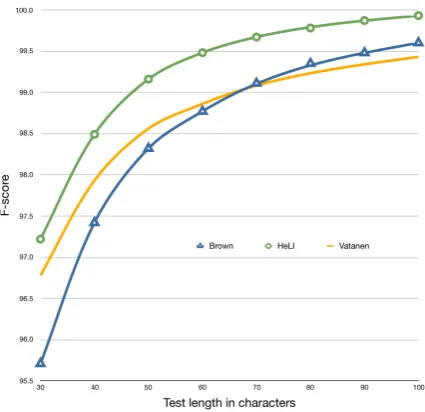
Figure 4: TheF1-scores of the HeLI method com-pared with the methods of Brown (2012) and Vata-nen et al. (2010).
identifier the results are clearly in favor of the VariKN toolkit for short test lengths and almost equal at test lengths of 70 characters, after which Brown’s language identifier performs better.
For the evaluation of the HeLI method we used a slightly modified Python based implementation of the method. In our implementation, we used relative frequencies as cut-offs c instead of just the frequencies. In order to find the best possi-ble parameters using the training corpora, we ap-plied a simple form of the greedy algorithm us-ing the last 10% of the trainus-ing corpus for each language as a development set. We started with the samen-gram lengthnmaxand the penalty value
p, which were found to provide the best results in (Jauhiainen, 2010). Then we proceeded using the greedy algorithm and found at least a local op-timum with the values nmax=6, c=0.0000005, and p=7. The HeLI method obtains high recall
and precision clearly sooner than the methods of Brown (2013) or Vatanen et al. (2010). The F1 -score of 99.5 is achieved at 60 characters, while Brown’s method achieved it at 90 characters and the method of Vatanen et al. (2010) at more than 100 characters, which can be seen in Figure 4. The method of Vatanen et al. (2010) performs better than the HeLI method when the length of the mys-tery text is 20 characters or less.
[image:7.595.74.283.59.266.2]Lang. ISO HL LG LL VK WL CT KG
N.-Aram. aii 5 5 5 5 5 10 80
Amharic amh 5 5 20 5 10 5
-Tibetan bod 5 10 10 5 5 25 20
Cherokee chr 5 10 15 5 5 20
-Greek ell 5 5 5 5 5 10 40
Gujarati guj 5 5 5 5 5 10 15
Armenian hye 5 5 5 5 5 10 65
Inuktitut iku 5 10 15 5 5 10
-Kannada kan 5 5 5 10 5 10 30
Korean kor 5 5 5 5 5 15 70
Malayal. mal 5 5 5 5 5 15 15
[image:8.595.74.286.63.165.2]Thai tha 5 5 5 20 5 15 25
Table 1: Some of the easiest languages to iden-tify showing how many characters were needed for 100.0% recall by each method.
Lang. ISO HL LG LL VK WL CT KG
Achinese ace 120 - - -
-Bislama bis 100 - - -
-Chayah. cbt - 70 - - 80 90 90
Danish dan 150 - - - - 100
-T. Enets enh 150 80 - 70 - - 45
Evenki evn 150 - - - 150
Erzya myv - - -
-Newari new - - - 90 - -
-Tumbuka tum - - - 90 150 150
-Votic vot - - - 150 - 100
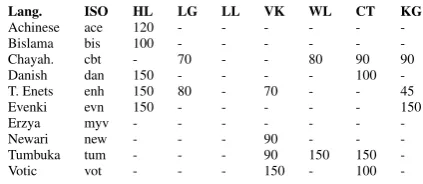
-Table 2: Some of the most difficult languages to identify showing how many characters were needed for 100.0% recall by each method.
lower F1-scores, the language identifier was also much slower when the words were not used. We also tested using Lidstone smoothing instead of the penalty values. The best results were acquired with the Lidstone value of 0.0001, almost reach-ing the same F1-scores as the language identifier with the penalty value p of 7. The largest differ-ences inF1-scores were at the lower mid-range of test lengths, being 0.5 with 25-character samples from the development set.
Some of the languages in the test set had such unique writing systems that their average recall was 100% already at 5 characters by many of the methods as can be seen in Table 1. Some of the most difficult languages can be seen in Table 2. In both of the Tables HL stands for HeLI, LG for LIGA, LL for LogLIGA, VK for VariKN, WL for Whatlang, CT for Cavnar and Trenkle, and KG for King and Dehdari.
5 Conclusions and Future Work
The purpose of the research was to test methods capable of producing good identification results in a general domain with a large number of lan-guages. The methods of Vatanen et al. (2010) and Brown (2012) outperformed the other meth-ods, even though the original method of Cavnar and Trenkle (1994) also obtained very good
re-sults. The recently published HeLI method outper-forms previous methods and considerably reduces the identification error rate for texts over 60 char-acters in length.
There still exists several interesting language identification methods and implementations that we have not evaluated using the test setting de-scribed in this article. These methods and imple-mentations include, for example, those of Lui and Baldwin (2012), Majli[Pleaseinsertintopreamble] (2012), and Zampieri and Gebre (2014).
Acknowledgments
We would like to thank Kimmo Koskenniemi for many valuable discussions and comments. This research was made possible by funding from the Kone Foundation Language Programme.
References
Steven Bird. 2006. Nltk: the natural language toolkit. In COLING-ACL ’06 Proceedings of the COLING/ACL on Interactive presentation sessions, pages 69–72, Sydney.
Ralf D. Brown. 2012. Finding and identifying text in 900+ languages. Digital Investigation, 9:S34–S43. Ralf D. Brown. 2013. Selecting and weighting
n-grams to identify 1100 languages. InText, Speech, and Dialogue 16th International Conference, TSD 2013 Pilsen, Czech Republic, September 2013 Pro-ceedings, pages 475–483, Pilsen.
Ralf D. Brown. 2014. Non-linear mapping for improved identification of 1300+ languages. In
Proceedings of the 2014 Conference on Empirical Methods in Natural Language Processing (EMNLP 2014), pages 627–632, Doha, Qatar.
William B. Cavnar and John M. Trenkle. 1994. N-gram-based text categorization. In Proceedings of SDAIR-94, 3rd Annual Symposium on Document Analysis and Information Retrieval, pages 161–175, Las Vegas.
Heidi Jauhiainen, Tommi Jauhiainen, and Krister Lind´en. 2015. The finno-ugric languages and the internet project. Septentrio Conference Series, 0(2):87–98.
Tommi Jauhiainen, Krister Lind´en, and Heidi Jauhi-ainen. 2016. Heli, a word-based backoff method for language identification. In Proceedings of the 3rd Workshop on Language Technology for Closely Re-lated Languages, Varieties and Dialects (VarDial), pages 153–162, Osaka, Japan.
[image:8.595.74.286.224.316.2]Josh King and Jon Dehdari. 2008. An n-gram based language identification system. The Ohio State Uni-versity.
Kone Foundation. 2012. The language programme 2012-2016. http://www.koneensaatio.fi/en.
Marco Lui and Timothy Baldwin. 2012. langid.py: an off-the-shelf language identification tool. In Pro-ceedings of the 50th Annual Meeting of the Associ-ation for ComputAssoci-ational Linguistics, pages 25–30, Jeju.
Marco Lui, Jey Han Lau, and Timothy Baldwin. 2014. Automatic detection and language identification of multilingual documents. Transactions of the Asso-ciation for Computational Linguistics, 2:27–40.
Martin Majliˇs. 2012. Yet another language identi-fier. InProceedings of the Student Research Work-shop at the 13th Conference of the European Chap-ter of the Association for Computational Linguistics, pages 46–54, Avignon.
Hermann Ney, Ute Essen, and Reinhard Kneser. 1994. On structuring probabilistic dependences in stochas-tic language modelling. Computer Speech and Lan-guage, 8(1):1–38.
Uwe Quasthoff, Matthias Richter, and Christian Bie-mann. 2006. Corpus portal for search in monolin-gual corpora. In Proceedings of the fifth interna-tional conference on Language Resources and Eval-uation, LREC 2006, pages 1799–1802, Genoa.
Paul Rodrigues. 2012.Processing Highly Variant Lan-guage Using Incremental Model Selection. Ph.D. thesis, Indiana University.
Vesa Siivola, Teemu Hirsim¨aki, and Sami Virpi-oja. 2007. On growing and pruning kneser-ney smoothed n-gram models. IEEE Transac-tions on Audio, Speech and Language Processing, 15(5):1617–1624.
Erik Tromp and Mykola Pechenizkiy. 2011. Graph-based n-gram language identification on short texts. In Benelearn 2011 - Proceedings of the Twentieth Belgian Dutch Conference on Machine Learning, pages 27–34, The Hague.
Erik Tromp. 2011. Multilingual sentiment analysis on social media. Master’s thesis, Eindhoven University of Technology, Eindhoven.
C. J. van Rijsbergen. 1979. Information Retrieval. Butterworths.
Tommi Vatanen, Jaakko J. V¨ayrynen, and Sami Virpi-oja. 2010. Language identification of short text seg-ments with n-gram models. InLREC 2010, Seventh International Conference on Language Resources and Evaluation, pages 3423–3430, Malta.
John Vogel and David Tresner-Kirsch. 2012. Ro-bust language identification in short, noisy texts: Improvements to liga. In The Third International Workshop on Mining Ubiquitous and Social Envi-ronments, pages 43–50, Bristol.