Introduction
11 In its recent submission to the Higher Education Strategy Group, the HEA described flexibility of
provision as “a key indicator of the responsiveness of Irish higher education to Irish society”.2 The
aim of this paper is to offer an elaboration of the HEA’s views on how the flexible learning agenda in Irish higher education might be advanced.
2 Ireland has an impressive track record in the expansion of higher learning opportunities and a comprehensive architecture for learning in place through the National Framework of Qualifications (NFQ). The implementation of modularisation and the adoption of the European Credit Transfer System (ECTS) in all publicly-funded and many privately-funded higher education courses is well advanced. Ireland’s lead over other countries in terms of these ‘Bologna reforms’ and the English-language basis of the majority of our higher education programmes means that Ireland is well placed to secure competitive advantage in terms of the delivery of quality higher learning to a global audience.
3 Technology is impacting significantly on higher education. The concepts of flexible learning and of open and distance learning (ODL) are technology-neutral in a theoretical sense but, in reality, they have been transformed by the advent of ‘Web 2.0’ technologies. ‘Web 2.0’ is not a single invention, but rather is situated within a group of new technologies that have dramatically eased
communications for non-technical people.3
4 There is a world-wide trend away from restricted access to knowledge towards open access, open source software and open publication. The widespread availability of communications technology threatens to undermine the elevated status historically enjoyed by higher education institutions in their role as the ultimate sources of knowledge, truth and discovery. Over the next five years university rankings are likely to become more sophisticated and to include web-based assessments of the scale and quality of the ‘intellectual footprint’ of individual institutions and systems.
5 Ireland is currently undergoing review and change of its higher education system. It is therefore timely to reconsider where Ireland’s higher education system is positioned on the global stage, recognising that higher education systems which are most successful in the future will be those characterised by innovation in teaching and research and by responsiveness to the needs of learners.
Our commitment to students and to the highest standards of quality can only be progressed through a renewed emphasis on quality and innovation in teaching and learning. This will require a more concerted emphasis on the initial and continuing training of academic staff, greater investment in learning resources and the adoption of institution-wide and system-wide supports for lecturers in learning technologies and innovative pedagogical approaches for learner engagement.4
6 This paper draws on and builds upon the report New Directions for Open and Distance Learning
in Ireland by an advisory group chaired by Professor Malcolm Skilbeck, submitted to the HEA in January 2009. The paper has a system-wide focus and includes proposals on how the HEA’s funding allocation mechanisms could be developed to support open and flexible learning in Irish higher education. The paper concludes by offering some reflections on a number of issues that require attention and action in order to maximise the flexibility and quality of Irish higher education.
1 The HEA wish to acknowledge the work of Áine Hyland and Muiris O’Connor in the preparation of this position paper. 2 HEA submission to the Higher Education Strategy Group, July 2009.
Definition of Open and Flexible Learning:
7 There is a plethora of designations applied to learning, some of which overlap or are effectively synonymous with flexible learning. These include blended learning, e-learning, open and distance
learning, personalised learning and web-based learning5. The UNESCO definition of Open and
Distance Learning (ODL) is insightful in that it reflects “the fact that all or most of the teaching is
conducted by someone removed in space and time from the learner, and that the mission aims to include greater dimensions of openness and flexibility, whether in terms of access, curriculum or other elements of structure”.6 Open and distance learning has played a major role in extending
educational opportunities in many parts of the world. It can directly improve the accessibility of higher education by facilitating work-based and community-based learning. It has potential to transform the internationalisation of Irish higher education and is being increasingly used as a very effective development aid strategy.
Flexible Provision of Higher Education
8 In recent decades open and flexible higher education internationally has developed along two parallel tracks. On the one hand, a number of single mode “open” universities/HEIs have emerged to absorb large numbers of new learners, while, on the other hand, increasing numbers of traditional universities have begun to offer their programmes through distance education as well as through conventional on-campus face-to-face delivery. The development of broadband and the internet enables courses to be delivered in ways never before possible and students can access an enormous range of resources, free from limitations of time and space. From a learner’s perspective, access to
higher education is no longer an “either/or” issue entailing access via ODL or campus based learning.
In the past three to five years in particular, since the introduction of Web 2.0 technologies, access to learning has become hugely flexible and learners can chose from a blend of different approaches. The current trend in education and training identifies methods and tools for delivering just-in-time, on-demand learning opportunities tailored to individual learners, taking into consideration their differences in skills level, perspectives, culture and other educational contexts.
9 The implications of new web technologies for the future of higher education are currently under active consideration in other higher education systems. Appendix 1 provides a brief review of some recent policy documents and developments in other English-speaking countries. A submission by Seamus Fox and Eamon Costello of Oscail to the HEA in May 2009 (reproduced on the HEA website), summarises the implications of online technologies for higher education as follows:
n Innovations in content development technologies will reduce the time and cost of development
of e-learning materials.
n Developments such as screen-casting software and ‘grassroots’ video will mean that it is easier
for the individual academic to create e-learning materials. Significantly the form of teaching facilitated by these technologies is relatively close to the current practice of most academics.
n The availability of an ever-increasing number of learning resources via open-access learning
resource repositories, online journal databases etc. will make it much easier for the individual academic to develop high quality e-learning materials.
n Online support for all students will incorporate a range of Web 2.0 technologies
n The key development in the provision of online support to students will be deepening use of
(often quite simple) online technologies in educationally innovative and creative ways with the aim of engendering a high quality learning experience.
10 A major and significant development in recent years, facilitating easy access to a wide range of learning materials, has been the availability of open educational resources (OER). These are defined as “teaching, learning, and research resources that reside in the public domain or have been released under an intellectual property license that permits their free use or repurposing by others”.7 They are
usually made available under what are known as ‘Creative Commons’ licences, which means they are available for reference and educational use at no cost to the user. The emerging so-called “open education movement” in higher education is transforming the educational landscape. By making educational assets free, open and accessible, the ecology and economics of education are being radically transformed. This can be seen in the upsurge of publicly-shared course websites and lecture
videos/podcasts from colleges and universities.8
The Situation in Ireland
11 Historically Ireland was later than most other countries in expanding second-level and higher education. Notwithstanding this comparatively late start, Ireland has achieved an impressive level of expansion of higher education places over recent decades. This expansion has primarily been an increase in opportunities for full-time on-campus courses aimed at Leaving Certificate graduates. The consequences of our relatively late investment in secondary and higher education are still evident in the educational profile of our older adult population, which remains poor by international standards.
This weakness is compounded by our similarly poor performance in lifelong learning.9
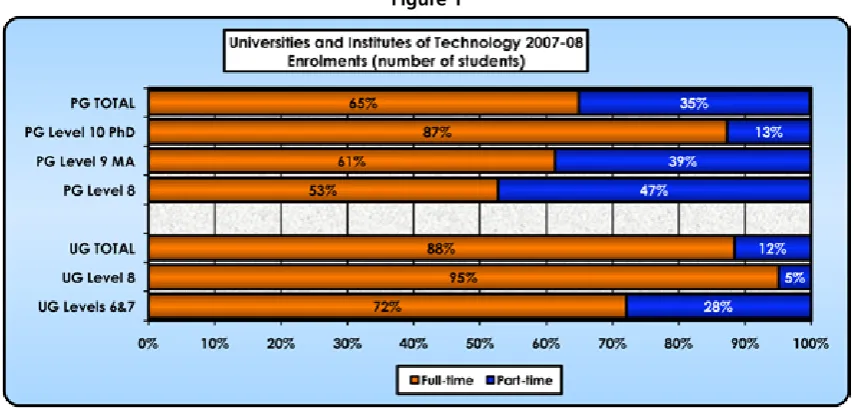
12 Notwithstanding Ireland’s keen appreciation of the importance of lifelong learning in the context of the knowledge society, as articulated in a wide range of reports since 2000, one of the major bottlenecks for Irish adults wishing to engage with higher education is the very limited provision and choice of part-time, flexible learning opportunities at undergraduate level (NFQ levels 6 to 8). This has left the system inflexible by international standards and less well equipped to address the evolving education and skills needs of the workforce. Figure 1 shows the proportion of students enrolled in full-time and part-time courses in universities and institutes of technology in 2007-8. Only 12 percent of undergraduate students are enrolled on part-time courses and the majority of these are enrolled on Level 6 and 7 courses in institutes of technology. The current low level of part-time study opportunities limits the accessibility of higher education for working adults and adults with caring responsibilities. It also limits the study options available to traditional school leavers, who may prefer to, or need to, combine work and part-time study. The availability of part-time and flexible
study opportunities is particularly poor at undergraduate level in the universities.10
7 Atkins, Dan; Seely Brown, John and Hammond, Allan A Review of the Open Educational Resources (OER) Movement: Achievement,
Challenges and New Opportunities The William and Flora Hewlett Foundation 2007, available at http://www.oerderves.org
8 Toru Iiyoshi and M.S. Vijay Kumar, Opening Up Education: The Collective Advancement of Education through Open Technology, Open
Content, and Open Knowledge (The Carnegie Foundation for the Advancement of Teaching and MIT Press, 2008).
9 Ireland is below the European average in terms of the participation of adults in education and training and far below the leading
performance of Scandinavia, Australia and New Zealand.
10 Only 3 per cent of the 72,600 undergraduate degree students (Level 8) in Irish universities are categorised as part-time. The situation is
Figure 1
13 The statistics presented above do not capture the considerable advances that are occurring within Irish higher education institutions in terms of the innovative use of technology and virtual learning
environments (VLEs) in teaching and research.11 Over recent years the development of e-learning
activity and strategy development within Irish institutions have tended towards reform and enhancement of mainstream provision rather than towards the development of distance-learning
as a separate activity. This is consistent with the OECD’s observation in 2005 that “fully online
provision at campus-based institutions will remain very much a minority in the short to medium term. Universities are more interested in improving their on-campus programmes using e-learning to offer increased flexibility and content”.12
14 Irish HEIs are investing significantly in supporting such activities through teaching and learning centres, educational technology units, appropriate technological infrastructure and virtual learning environments (VLEs) etc. The majority of staff and students in the university sector, and increasing
numbers in the institutes of technology are using VLEs13 to make available and to access learning
materials relating to their courses and programmes. While the commercial (i.e. private licence) VLEs–
Blackboard and WebCT14 – were originally the VLE of choice of Irish institutions, within the past few
years most HEIs in Ireland appear to have adopted the public domain VLE – Moodle. Some, but not all users avail of the interactive facilities of VLEs such as emails, messaging and online tutorials.
11 In the current classification system used by the HEA and the DES to record enrolment statistics, the designation “full-time” or “part-time”
tends to refer to courses – not to individual students/learners. The data presented above refer to students enrolled on ‘full-time programmes’ and ‘part-time programmes’. In the context of modularisation and transferable credit-based learning, this designation of courses will become increasingly irrelevant as the boundaries between full-time and part-time study become increasingly opaque, and the amount of learning undertaken per year is quantified in terms of modules and credits.
12 OECD (2005) Policy brief on E-learning in tertiary education, p.3, http://www.oecd.org/dataoecd/55/25/35961132.pdf
13 A VLE is a computer-based system that helps learning. VLEs are sometimes called learning management systems (LMS), course management
systems (CMS), learning content management systems (LCMS) or learning platforms (LP).
15 In conjunction with Moodle (or other VLEs) some teachers in Irish HEIs have begun to avail of
recently developed LAMs15– to design, manage and deliver collaborative learning activities. This
public-domain software, developed in Macquarie University in Australia, provides teachers with a highly intuitive visual authoring environment for creating sequences of learning activities. These activities can include a range of individual tasks, small group work, and whole class activities based on both content and collaboration.
16 A recent evaluation of VLEs in educational settings in the UK16 found that the common factor in
effective VLE use was the enthusiasm of the subject teacher for the subject and for teaching and learning as much as any competence in computing. Anecdotal evidence would suggest that the situation is similar in Ireland. The UK study also found that a good-quality induction and early use of the system were essential in ensuring a positive attitude to the VLE among learners. It also found that VLEs were used more effectively by more mature learners, particularly those taking higher level subjects or working remotely. VLEs were least effective when they had little content or were just a dumping-ground for rarely used files.
17 Teaching and Learning centres provide advice and support to teaching staff on integrating ICT into teaching and learning, and five of the seven universities and a number of institutes of technology have introduced certificated courses (Postgraduate Certificates, Diploma and Masters degrees) for staff in Teaching and Learning in Higher Education. These courses are particularly successful in institutions where they form part of an overall coherent strategic approach to recognising and rewarding innovative practice in teaching and learning.
18 However, the enthusiasm of individual teachers/lecturers and the availability of appropriate technological infrastructure and pedagogical support are not in themselves sufficient to drive the development of open and flexible learning in HEIs. At an institutional level issues such as innovative and creative timetabling, off-campus and workplace provision etc. need to be addressed. Institutional leadership is also a key component in the successful introduction of innovation. A recent survey in the U.S., funded by the Alfred P. Sloan Foundation and carried out by the National
Commission on Online Learning of the Association of Public and Land-Grant Universities,17
concluded, inter alia, that:
n Online learning programs work most effectively as a core component of institutional strategic
planning and implementation.
n Online learning initiatives benefit from ongoing institutional assessment and review due to their
evolving and dynamic nature.
n Online learning activities are strengthened by the centralisation of some organisational
structures and administrative functions that support and sustain the programs.
n Online learning programs need reliable financing for sustainability and growth.
15 http://www.lamsinternational.com
16 Ofsted Virtual Learning Environments: an evaluation of their development in a sample of educational settings January 09.
17 The report, published in August 2009 was based on responses from 45 public HEIs and 11,000 academic faculty nationwide. The report is
n Online learning programs have the capacity to change campus culture and become fully
integrated if presidents, chancellors, chief academic officers and other senior campus leaders are fully engaged in the delivery of ‘messages’ that tie online education to fundamental institutional mission and priorities.
The U.S. report emphasised the need for campus leaders to identify strategies to acknowledge and recognise the additional time and effort which academic staff invest in online as compared to face-to-face teaching and learning.
19 The current trend in Irish HEIs is to provide opportunities for blended learning within existing programmes, rather than to develop separate courses which are available only on an ODL basis. While Oscail was the only publicly-funded Irish provider of ODL courses in the 1980s and 1990s, in recent years most Irish HEIs now offer a blend of on-campus and online learning opportunities in some of their programmes.
20 International experience suggests that the greatest demand for e-learning is as a supplement for
on-campus provision delivered through self-contained units of study.18 Established private providers in
Ireland, notably the Open University (OU) and Hibernia College, have identified a growing demand for unitised learning where modules are offered as credit-bearing stand alone qualifications. The flexible learning platform (www.Bluebrick.ie ) also identified a demand for short flexible work-relevant education and training. Such an approach fits well within the Irish National Qualifications
Framework and national aspirations to enhance lifelong learning.19 As the Irish market develops,
it is likely that an increasing number of institutions will develop such provision, rather than full awards, particularly at undergraduate level. Current funding arrangements do not provide support for such developments. If open and distance learning is to be used increasingly by conventional institutions, funding for programmes of this type need to be harmonised with funding mechanisms for traditional/conventional programmes.
21 Under existing funding policy, the funding of institutions and of students promotes the delivery and take-up of full-time on-campus programmes over and above more flexible modes of delivery. The recurrent grant allocation model (RGAM), for what was previously referred to as the “block grant” to institutions, is based on student numbers and ‘weighted’ according to the level of education and the type of programme being taken. However, although part-time students at levels 8, 9 and 10 in the university sector are included for recurrent grant allocation purposes, part-time students in institutes of technology are not included at present. Therefore the public funding currently available in respect of part-time study is relatively low and there is no public funding available in respect of ODL students. As many part-time courses and all open and distance learning courses are not recognised and are not eligible for funding purposes, colleges must operate flexible learning programmes on a largely self-funded basis. The current ‘free fees’ scheme also discriminates against part-time undergraduate education as it is available only to students undertaking recognised full-time on-campus programmes.
22 In 2004, the OECD recommended that the numbers of part-time students as a percentage of the total in higher education in Ireland should be increased and that part-time and full-time students be treated on a similar basis in respect to fees and eligibility for maintenance grants. That report also advised
18 Centre for Education Research and Innovation, E-learning in Tertiary Education: Where Do We Stand? (OECD, 2005), 13
19 As the Expert Group on Future Skills Needs state in Tomorrow’s Skills – Towards a National Skills Strategy (2007) “Ireland’s relatively low
that institutions be reassured that all part-time students should count fully (on a pro-rata basis) in the calculation of recurrent grant. It recommended that similar considerations should apply to continuing education carried out in the evening so that such activities could be fully integrated into institutional life rather than being often regarded as a separate and distinct operation employing different staff.
The report stated: “Continuing education must be ‘mainstreamed’ if it is to feed into main stream
programmes and its priority in higher education programmes must be given due recognition”20 While
there has been no change since 2004 in the national treatment of part-time and full-time students from a grants and fees perspective, some progress has been made at institutional level in bringing continuing education courses into line with mainstream HE courses e.g. by designating them by NFQ level and by developing protocols to enable them to be recognised for transfer and progression purposes.
Mainstreaming Flexible Learning
At National Level:
23 Funding: The HEA proposes reform of the public funding allocation model to achieve parity for flexible learning. The achievement of parity for flexible learning is now becoming possible, thanks to our National Framework of Qualifications and Ireland’s active engagement with the wider Bologna Process. Parity for flexible learning will be a key part of the policy and funding ‘eco-system’ that is necessary for the future development of Irish higher education. This reform will assist greatly in shifting our mindset from inputs to outcomes and will signal system-level endorsement of innovation in the design and delivery of higher learning. The HEA proposes that we move from a ‘headcount’ allocation model to a ‘quantum of learning’ allocation model. This is a key recommendation of the HEA to the Higher Education Strategy Group.
24 Many of the elements and structures necessary to support such a scenario are already in place. The National Qualifications Authority of Ireland (NQAI) has developed a comprehensive framework of qualifications and has issued guidelines on the recognition and accreditation of prior learning. Modularisation of courses, using credit-based systems which are compatible with the ECTS has been completed in most public and private HEIs in Ireland, and courses and modules are described in terms of learning outcomes and in terms of their level on the National Framework of Qualifications (NFQ). Learners at all levels are becoming familiar with the terminology of the framework. The proposed new Quality Authority, which will incorporate NQAI, HETAC, FETAC and IUQB, will be well placed to provide a rigorous system of quality assurance for all nationally certificated courses, regardless of how or where they are accessed.
25 While traditional full-time on-campus provision is likely to remain a dominant form of provision in Irish higher education for the foreseeable future, it is envisaged that first-time higher education learners of any age will be supported on the same basis as full-time on-campus learners, to access
higher education in a flexible way – through a combination of on-campus learning and ODL21, on
a part-time or a full-time basis. National and institutional funding mechanisms will have to reflect this new scenario. In the short term it is envisaged that most learners will undertake their course of study in one higher education institution, as is currently the case. In the medium and longer term, however, some learners are likely to seek to take modules and accumulate credits from different
20 OECD Review of Higher Education in Ireland Paris: 2004. http://www.hea.ie/en/webfm_send/877
21 While it is envisaged that students will be able to access learning through open and flexible routes, this does not mean that a lecturer will be
institutions to cumulate a recognised personalised qualification at any one of the NQF Levels 6 through 10. Such a scenario will require a developed system of Recognition and/or Accreditation of Prior Learning (APL) and of Prior Experiential Learning (APEL).
26 This proposed reform of the funding model has implications for resources. Unless the system can draw upon additional public or private resources, the implementation of this funding reform will result in a dilution in the overall unit of resource in higher education institutions. As a first step, the HEA will undertake an evaluation of the potential funding implications of this proposed reform for funding allocations. In addition to the funding reforms, which should be implemented as a priority, there are a number of further issues and challenges that need to be resolved before the scenario described above can be fully realised. The following approaches to their resolution are recommended:
27 Leadership: Ireland’s underperformance in ODL and flexible learning up to now has been
characterised by fragmentation and a lack of co-ordination, where there are numerous ‘pockets of innovation’ without the desirable institutional and systemic change. The development of a coherent national approach to open and flexible delivery of higher education will require leadership and co-ordination. The Skilbeck Report called for the establishment of a National ODL Office within the HEA. While we recognise that this may not be possible in the current economic climate, it is clear that the HEA will have to take a leading role in this area, not least because of the centrality of funding reforms and the need to incorporate the concept of flexible learning into the accountability and performance funding metrics. The intention is to establish flexible learning as a mainstream concern of Irish higher education rather than as a supplementary reporting obligation.
28 Consolidation of National Resources for Flexible Learning: The objective of the Higher Education Authority is to build up the quality and capacity of the entire higher education system. Critical mass and scale can be difficult to achieve in a small country. Therefore, collaboration/co-operation and consolidation will be required to harness national expertise in particular disciplines and to build up the capacity and quality of the entire higher education system. The following steps are proposed to ensure efficiency, effectiveness and system-wide improvement in open and flexible learning:
I National Database of Courses and Modules: A co-ordinated database of courses and modules from levels 6 to 10 should be available to enable prospective learners to identify the courses and/or combination of modules which best meet their requirements. This database should identify pre-requisites and co-requisites for each module. One possible way to develop a comprehensive nationwide database of modules and courses available in all HEIs in Ireland would be to explore the synergies between the database currently run by Qualifax and the web-interface being used by Bluebrick.ie – the new flexible learning platform.
29 Consolidation of Infrastructural Investments in Flexible Learning
I Technical Infrastructure: There is a need for ongoing funding of technical infrastructure to support teaching and learning. This needs to be borne in mind when planning budgets at national and institutional level. As a general point, it is important that investments in Information Technology (IT) and Management Information Systems (MIS) should be planned as part of a coherent national approach and should become legitimate items of capital investment as well as recurrent expenditure for maintenance and upgrading. A positive step in this regard is the fact that the purchase of teaching equipment is now permissible under the ‘devolved grant’. All institutions should aim to ensure maximum accessibility to all technical infrastructures, such as video-conferencing facilities and IT labs, regardless of the specific line of public funding through which the resource was initially acquired.
II Compatibility of Delivery Systems: There needs to be more institutional collaboration in future in the delivery of courses and modules than has been the case in the past. From the point of view of the learner, it would be desirable if online delivery systems across the higher education sector were compatible. It is noted that an increasing number of HEIs in Ireland are using the public-domain VLE Moodle for course delivery. If the experience of these institutions proves to be satisfactory, all institutions might be encouraged to adopt this VLE.
III Management Information Systems: A more coordinated approach to management information systems across all higher education institutions would facilitate the development of a national database of courses and modules. The full implementation and operation of the reformed funding model will require an overhaul of our administrative data collections, such that the basic unit of analysis becomes ‘modules /credits taken’ rather than ‘students enrolled’. As an intermediary step, the HEA will record the total number of ECTS credits taken by each student from September 2010.
30 Institutional Issues
A recent US report on the development of online learning as a strategic asset, emphasised the central importance of what they called the institutional leadership imperative in online learning
initiatives: “For most institutions, launching online learning courses and programs represents
a significant cultural and operational challenge. Online learning has the capacity to alter an institution’s administrative decision-making processes and structures, as well as its methods and modes of teaching and learning. As with any large-scale change – especially one that requires the enthusiastic engagement of faculty – a critical and ongoing task for campus leaders is to provide effective leadership and communication of institutional plans and decisions”.22 This leadership
imperative should be accompanied by a range of practical steps to advance the flexible learning agenda at institutional level. Such steps would include the following developments:
I Policies and practices (including staff contracts) should ensure that courses and modules
delivered by staff on a part-time and/or ODL basis are recognised and rewarded on the same basis as full-time on-campus courses.
22 APLU/Sloan National Commission on Online Learning (August 2009) Online Learning as a Strategic Asset: Volume 1, p.41. Website: http://
II Academic regulations and practices (including marks and standards) should be reviewed to support maximum flexibility in relation to course and module provision and student access. This would include policies and practices relating to assessment and to RPL/APL.
III HEIs should ensure that policies and practices provide encouragement and technical and pedagogical support for staff in the development, provision, delivery and assessment of flexible courses and modules. Training in these areas should be incorporated into both initial staff training and CPD programmes.
IV Current access to facilities, resources and student services should be reviewed with a view to providing maximum feasible access for part-time and ODL students out of hours and out of term. Institutions should maximise access for staff and students to all publicly-funded technological infrastructures (such as video-conferencing and computer laboratories).
V As MIS systems are updated institutionally, institutions should ensure that they are compatible with the MIS system of other institutions on a national basis. They should also be compatible with relevant VLE software.
VI The parity for flexible learning that we aim to achieve in the public funding of institutions should also be reflected in the fees and charges set by institutions for part-time learning. Institutions should calculate fees and/or charges for part-time students on a pro rata basis that is related to the proportion of credits involved.
31 Staff Issues
I Staff workload models should recognise involvement in part-time courses and ODL on the same
basis as FT and on-campus courses.
II Staff should engage in training and support courses which help develop their pedagogical and
technical skills, bearing in mind that “the major change in teaching online in the coming period is
unlikely to be in the underlying technologies but rather creative and appropriate educational uses of the new teaching and learning technologies (including the Web 2.0 innovations) in a manner that builds on the subject matter and pedagogical expertise of the individual academic. The focus will also need to be on methods that aid rather than overburden the individual academic”.23
32 Student Issues
I Higher education institutional policies and practices should ensure that all students have equal
access to appropriate technology and software related to their learning.
II Technology and skills training should be provided for students to enable them to maximise the benefits from online and web-based learning technologies.
III Training in information literacies should be provided in all second-level and higher education institutions so that students are able to identify, search, locate, retrieve and above all, critically evaluate information from a range of appropriate sources.
APPENDIX 1
The Implications of new technologies for Higher Education
A1 A recent publication, The Edgeless University24, asks why and how technology is changing
universities. The author, Peter Bradwell, raises fundamental questions about the future of university
education, stating that “with an increasing diversity of students and student needs, fierce
competition, and a crunch on funding, it is not surprising that some commentators are predicting the end of the university as we have known it”. Bradwell continues:
Technology is at the heart of this story of institutional change. Universities are now just one source among many for ideas, knowledge and innovation, that seems to threaten their core position and role, but in this new world of learning and research, there are also great opportunities. The internet, social networks, collaborative online tools that allow people to work together more easily, and open access to content are both the cause of change for universities, and a tool with which they can respond.
A2 Another recent report in the U.K (May 2009), published by the independent Committee of Inquiry into the Changing Learner Experience chaired by Sir David Melville, looked into the impact on higher
education of students’ widespread use of Web 2.0 technologies. The ‘Higher Education in a Web
2.0 World’ report is available at www.clex.org.uk and draws on a comparative international review covering the USA, Australia, South Africa and the Netherlands. The committee was established to inquire into the strategic and policy implications for higher education of the changing experience and expectations of learners in the light of their increasing use of the newest technologies, such as Facebook, blogs, twitter, podcasting and YouTube. An independent committee, it was backed by all
of the principal bodies in UK post-compulsory education.25
A3 The report found that universities and colleges are generally falling behind their students in the use of Web 2.0 technologies. While recognizing that these technologies are being deployed across a broad spectrum of university activities, the report found that deployment is not systematic and that the drive is principally bottom-up, coming from the professional interest and enthusiasm of individual members of staff. The study reveals that students are very often more advanced than their tutors in their use of these technologies and the report urges the HE community to re-evaluate their role and their continuing professional development in the context of such fast-paced and fundamental change.
A4 The report makes key recommendations in four main areas: learner skills, staff skills, infrastructure, and inter-sectoral relationships. In relation to learner skills, HEIs are urged to ensure access to appropriate technology for all students and to treat information literacies as a priority area so that students are able to identify, search, locate, retrieve and above all, critically evaluate information from a range of appropriate sources. In relation to staff skills, the report recommended that HEIs should support staff to become proficient users of an appropriate range of technologies and skilled
24 Peter Bradwell The Edgeless University – Why Higher Education must Embrace Technology London: Demos 2009. http://www.jisc.ac.uk/
media/documents/publications/edgelessuniversity.pdf (p.8)
25 Namely: the Higher Education Academy (The Academy), Universities UK (UUK), the Joint Information Systems Committee (JISC), the Higher
practitioners of e-pedagogy, incorporating both into initial staff training and CPD programmes. As regards infrastructure, the report recommended that the HE funding bodies ensure that funding for investment in physical infrastructure and research at national level is maintained and strengthened with a view to embedding the flexible use of technology and supporting relevant research and development programmes.
Open Educational Resources (OER).
A5 There is an increasing array of open educational resources now available. In the U.S. MERLOT (http:// www.merlot.org) is one of the major open access repositories that includes almost 20,000 “Learning Materials”, and OER Commons (http://www.oercommons.org) has more than 14,000 resources in its post-secondary section. In the U.K. the website Intute (http://www.intute.ac.uk), supported by JISC, contains more than 80,000 resources. YouTube.edu.com, recently acquired by Google, also comprises a wide variety of academic resources including podcasts of lectures by internationally renowned professors from universities such as Harvard, Stanford, Yale, Duke and many others.
A6 In June 2009 the U.K. Higher Education Academy and JISC officially launched its Open Educational Resources (OER) programme, thus helping to drive innovation across the UK. OER is funded by HEFCE and run by the HEA and JISC. The programme aims to make a wide range of learning resources created by academics, freely available, easily discovered and routinely used by both educators and learners. It includes full courses, course materials, complete modules, notes, videos, assessments, tests, simulations, worked examples, software, and any other tools or materials or techniques used to support access to knowledge. These resources are released under an intellectual property license that permits open use and adaptation. (See http://www.jisc.ac.uk/ news/stories/2009/06/oer.aspx). There are three separate strands of the project: (1) subject area and individual strands of the project which will be overseen by the Higher Education Academy; (2) an institutional strand, managed by JISC; and (3) a Project strand which will be supported by advice and materials from a range of JISC services. OER will make the equivalent of 5,000 undergraduate modules of existing learning resources available free of charge online. Further details on the range
of new technologies and open educational resources are outlined in a paper entitled E-learning