SemEval 2014 Task 8:
Broad-Coverage Semantic Dependency Parsing
Stephan Oepen♣♠, Marco Kuhlmann♥, Yusuke Miyao♦, Daniel Zeman◦, Dan Flickinger•, Jan Hajiˇc◦, Angelina Ivanova♣, and Yi Zhang?
♣University of Oslo, Department of Informatics ♠Potsdam University, Department of Linguistics
♥Linköping University, Department of Computer and Information Science ♦National Institute of Informatics, Tokyo
◦Charles University in Prague, Faculty of Mathematics and Physics, Institute of Formal and Applied Linguistics •Stanford University, Center for the Study of Language and Information
?Nuance Communications Aachen GmbH
Abstract
Task 8 at SemEval 2014 defines Broad-Coverage Semantic Dependency Pars-ing (SDP) as the problem of recovering sentence-internal predicate–argument rela-tionships forall content words, i.e. the se-mantic structure constituting the relational core of sentence meaning. In this task description, we position the problem in comparison to other sub-tasks in compu-tational language analysis, introduce the se-mantic dependency target representations used, reflect on high-level commonalities and differences between these representa-tions, and summarize the task setup, partic-ipating systems, and main results.
1 Background and Motivation
Syntactic dependency parsing has seen great ad-vances in the past decade, in part owing to rela-tively broad consensus on target representations, and in part reflecting the successful execution of a series of shared tasks at the annual Conference for Natural Language Learning (CoNLL; Buchholz & Marsi, 2006; Nivre et al., 2007; inter alios). From this very active research area accurate and efficient syntactic parsers have developed for a wide range of natural languages. However, the predominant data structure in dependency parsing to date are
trees, in the formal sense that every node in the de-pendency graph is reachable from a distinguished root node by exactly one directed path.
This work is licenced under a Creative Commons At-tribution 4.0 International License. Page numbers and the proceedings footer are added by the organizers: http:// creativecommons.org/licenses/by/4.0/.
Unfortunately, tree-oriented parsers are ill-suited for producing meaning representations, i.e. mov-ing from the analysis of grammatical structure to sentence semantics. Even if syntactic parsing ar-guably can be limited to tree structures, this is not the case in semantic analysis, where a node will often be the argument of multiple predicates (i.e. have more than one incoming arc), and it will often be desirable to leave nodes corresponding to se-mantically vacuous word classes unattached (with no incoming arcs).
Thus, Task 8 at SemEval 2014,Broad-Coverage Semantic Dependency Parsing(SDP 2014),1seeks
to stimulate the dependency parsing community to move towards more general graph processing, to thus enable a more direct analysis ofWho did What to Whom? For English, there exist several independent annotations of sentence meaning over the venerable Wall Street Journal (WSJ) text of the Penn Treebank (PTB; Marcus et al., 1993). These resources constitute parallel semantic annotations over the same common text, but to date they have not been related to each other and, in fact, have hardly been applied for training and testing of data-driven parsers. In this task, we have used three different such target representations for bi-lexical semantic dependencies, as demonstrated in Figure 1 below for the WSJ sentence:
(1) A similar technique is almost impossible to apply to other crops, such as cotton, soybeans, and rice.
Semantically,techniquearguably is dependent on the determiner (the quantificational locus), the mod-ifiersimilar, and the predicateapply. Conversely, the predicative copula, infinitivalto, and the
vac-1See http://alt.qcri.org/semeval2014/ task8/for further technical details, information on how to obtain the data, and official results.
A similar technique is almost impossible to apply to other crops , such as cotton , soybeans and rice .
A1 A2
(a) Partial semantic dependencies in PropBank and NomBank.
A similar technique is almost impossible to apply to other crops, such as cotton, soybeans and rice.
top
ARG2 ARG3 ARG1
ARG2
mwe _and_c
ARG1 ARG1
BV
ARG1 ARG1 implicit_conj
(b) DELPH-IN Minimal Recursion Semantics–derived bi-lexical dependencies (DM).
A similar technique is almost impossible to apply to other crops , such as cotton , soybeans and rice
top
ARG1
ARG2 ARG1
ARG2 ARG2
ARG1
ARG1 ARG1 ARG1 ARG1
ARG1
ARG2 ARG1
ARG2
ARG1
ARG2
ARG1 ARG1 ARG1 ARG2
(c) Enju Predicate–Argument Structures (PAS).
A similar technique is almost impossible to apply to other crops , such as cotton , soybeans and rice .
RSTR
PAT
EXT PAT
ACT
RSTR ADDR
ADDR ADDR
ADDR
APPS.m APPS.m
CONJ.m
CONJ.m CONJ.m top
[image:2.595.79.531.118.163.2](d) Parts of the tectogrammatical layer of the Prague Czech-English Dependency Treebank (PCEDT).
Figure 1: Sample semantic dependency graphs for Example (1).
uous preposition marking the deep object of ap-ply can be argued to not have a semantic contri-bution of their own. Besides calling for node re-entrancies and partial connectivity, semantic depen-dency graphs may also exhibit higher degrees of non-projectivity than is typical of syntactic depen-dency trees.
In addition to its relation to syntactic dependency parsing, the task also has some overlap with Se-mantic Role Labeling (SRL; Gildea & Jurafsky, 2002). In much previous work, however, target representations typically draw on resources like PropBank and NomBank (Palmer et al., 2005; Mey-ers et al., 2004), which are limited to argument identification and labeling for verbal and nominal predicates. A plethora of semantic phenomena— for example negation and other scopal embedding, comparatives, possessives, various types of modi-fication, and even conjunction—typically remain unanalyzed in SRL. Thus, its target representations are partial to a degree that can prohibit seman-tic downstream processing, for example inference-based techniques. In contrast, we require parsers to identify all semantic dependencies, i.e. compute a representation that integrates all content words in one structure. Another difference to common inter-pretations of SRL is that the SDP 2014 task
defini-tion does not encompass predicate disambiguadefini-tion, a design decision in part owed to our goal to focus on parsing-oriented, i.e. structural, analysis, and in part to lacking consensus on sense inventories for all content words.
Finally, a third closely related area of much cur-rent interest is often dubbed ‘semantic parsing’, which Kate and Wong (2010) define as “the task of mapping natural language sentences into complete formal meaning representations which a computer can execute for some domain-specific application.” In contrast to most work in this tradition, our SDP target representations aim to be task- and domain-independent, though at least part of this general-ity comes at the expense of ‘completeness’ in the above sense; i.e. there are aspects of sentence mean-ing that arguably remain implicit.
2 Target Representations
we provide some background on the ‘pedigree’ and linguistic characterization of these representations.
DM: DELPH-IN MRS-Derived Bi-Lexical De-pendencies These semantic dependency graphs originate in a manual re-annotation of Sections 00– 21 of the WSJ Corpus with syntactico-semantic analyses derived from the LinGO English Re-source Grammar (ERG; Flickinger, 2000). Among other layers of linguistic annotation, this resource— dubbed DeepBank by Flickinger et al. (2012)— includes underspecified logical-form meaning rep-resentations in the framework of Minimal Recur-sion Semantics (MRS; Copestake et al., 2005). OurDMtarget representations are derived through a two-step ‘lossy’ conversion of MRSs, first to variable-free Elementary Dependency Structures (EDS; Oepen & Lønning, 2006), then to ‘pure’ bi-lexical form—projecting some construction se-mantics onto word-to-word dependencies (Ivanova et al., 2012). In preparing our gold-standard
DMgraphs from DeepBank, the same conversion pipeline was used as in the system submission of Miyao et al. (2014). For this target representa-tion, top nodes designate the highest-scoping (non-quantifier) predicate in the graph, e.g. the (scopal) degree adverbalmostin Figure 1.2
PAS: Enju Predicate-Argument Structures
The Enju parsing system is an HPSG-based parser for English.3 The grammar and the
disambigua-tion model of this parser are derived from the Enju HPSG treebank, which is automatically converted from the phrase structure and predicate–argument structure annotations of the PTB. The PAS data set is extracted from the WSJ portion of the Enju HPSG treebank. While the Enju treebank is an-notated with full HPSG-style structures, only its predicate–argument structures are converted into the SDP data format for use in this task. Top nodes in this representation denote semantic heads. Again, the system description of Miyao et al. (2014) provides more technical detail on the conversion.
PCEDT: Prague Tectogrammatical Bi-Lexical Dependencies The Prague Czech-English De-pendency Treebank (PCEDT; Hajiˇc et al., 2012)4
is a set of parallel dependency trees over the WSJ
2Note, however, that non-scopal adverbs act as mere in-tersective modifiers, e.g.loudlyis a predicate inDM, but the main verb provides the top node in structures likeAbrams sang loudly.
3Seehttp://kmcs.nii.ac.jp/enju/. 4Seehttp://ufal.mff.cuni.cz/pcedt2.0/.
id form lemma pos top pred arg1 arg2
#20200002
1 Ms. Ms. NNP − + _ _
2 Haag Haag NNP − − compound ARG1
3 plays play VBZ + + _ _
4 Elianti Elianti NNP − − _ ARG2
[image:3.595.314.519.64.151.2]5 . . . − − _ _
Table 1: Tabular SDP data format (showingDM).
texts from the PTB, and their Czech translations. Similarly to other treebanks in the Prague family, there are two layers of syntactic annotation: an-alytical (a-trees) and tectogrammatical (t-trees).
PCEDTbi-lexical dependencies in this task have been extracted from the t-trees. The specifics of thePCEDTrepresentations are best observed in the procedure that converts the original PCEDT data to the SDP data format; see Miyao et al. (2014). Top nodes are derived from t-tree roots; i.e. they mostly correspond to main verbs. In case of coordinate clauses, there are multiple top nodes per sentence.
3 Graph Representation
The SDP target representations can be character-ized as labeled, directed graphs. Formally, a se-mantic dependency graph for a sentence x =
x1, . . . , xnis a structureG= (V, E, `V, `E)where V = {1, . . . , n}is a set of nodes (which are in one-to-one correspondence with the tokens of the sentence);E ⊆V ×V is a set ofedges; and`V and`E are mappings that assignlabels(from some finite alphabet) to nodes and edges, respectively. More specifically for this task, the label`V(i)of a nodeiis a tuple consisting of four components: its word form, lemma, part of speech, and a Boolean flag indicating whether the corresponding token represents atoppredicate for the specific sentence. The label`E(i→j)of an edgei→jis a seman-tic relation that holds betweeniandj. The exact definition of what constitutes a top node and what semantic relations are available differs among our three target representations, but note that top nodes can have incoming edges.
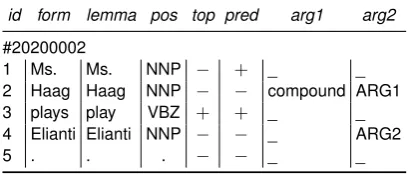
All data provided for the task uses a column-based file format (dubbed the SDP data format) similar to the one of the 2009 CoNLL Shared Task (Hajiˇc et al., 2009). As in that task, we assume gold-standard sentence and token segmentation. For ease of reference, each sentence is prefixed by a line with just a unique identifier, using the scheme
section), and three-digititemnumber (within each document). For example, identifier20200002 de-notes the second sentence in the first file of PTB Section 02, the classicMs. Haag plays Elianti.The annotation of this sentence is shown in Table 1.
With one exception, our fields (i.e. columns in the tab-separated matrix) are a subset of the CoNLL 2009 inventory: (1)id, (2)form, (3)lemma, and (4)poscharacterize the current token, with token identifiers starting from 1 within each sentence. Be-sides the lemma and part-of-speech information, in the closed track of our task, there is no explicit analysis of syntax. Across the three target represen-tations in the task, fields (1) and (2) are aligned and uniform, i.e. all representations annotate exactly the same text. On the other hand, fields (3) and (4) are representation-specific, i.e. there are different conventions for lemmatization, and part-of-speech assignments can vary (but all representations use the same PTB inventory of PoS tags).
The bi-lexical semantic dependency graph over tokens is represented by two or more columns start-ing with the obligatory, binary-valued fields (5)
topand (6)pred. A positive value in thetop
column indicates that the node corresponding to this token is atopnode (see Section 2 below). The
predcolumn is a simplification of the correspond-ing field in earlier tasks, indicatcorrespond-ing whether or not this token represents a predicate, i.e. a node with outgoing dependency edges. With these minor dif-ferences to the CoNLL tradition, our file format can represent general, directed graphs, with designated top nodes. For example, there can be singleton nodes not connected to other parts of the graph, and in principle there can be multiple tops, or a non-predicate top node.
To designate predicate–argument relations, there are as many additional columns as there are pred-icates in the graph (i.e. tokens marked + in the
predcolumn); these additional columns are called (7) arg1, (8)arg2, etc. These colums contain argument roles relative to thei-th predicate, i.e. a non-empty value in column arg1 indicates that the current token is an argument of the (linearly) first predicate in the sentence. In this format, graph reentrancies will lead to a token receiving argument roles for multiple predicates (i.e. non-emptyargi values in the same row). All tokens of the same sen-tence must always have all argument columns filled in, even on non-predicate words; in other words, all lines making up one block of tokens will have the same numbernof fields, butncan differ across
DM PAS PCEDT
(1) # labels 51 42 68
(2) % singletons 22.62 4.49 35.79 (3) # edge density 0.96 1.02 0.99
(4) %gtrees 2.35 1.30 56.58
(5) %gprojective 3.05 1.71 53.29 (6) %gfragmented 6.71 0.23 0.56 (7) %nreentrancies 27.35 29.40 9.27
(8) %gtopless 0.28 0.02 0.00
[image:4.595.312.521.63.194.2](9) # top nodes 0.9972 0.9998 1.1237 (10) %nnon-top roots 44.71 55.92 4.36
Table 2: Contrastive high-level graph statistics.
sentences, depending on the count of graph nodes. 4 Data Sets
All three target representations are annotations of the same text, Sections 00–21 of the WSJ Cor-pus. For this task, we have synchronized these resources at the sentence and tokenization levels and excluded from the SDP 2014 training and test-ing data any sentences for which (a) one or more of the treebanks lacked a gold-standard analysis; (b) a one-to-one alignment of tokens could not be estab-lished across all three representations; or (c) at least one of the graphs was cyclic. Of the 43,746 sen-tences in these 22 first sections of WSJ text, Deep-Bank lacks analyses for close to 15%, and the Enju Treebank has gaps for a little more than four per-cent. Some 500 sentences show tokenization mis-matches, most owing to DeepBank correcting PTB idiosyncrasies likehG.m.b, H.i,hS.p, A.i, and
hU.S., .i, and introducing a few new ones (Fares et al., 2013). Finally, 232 of the graphs obtained through the above conversions were cyclic. In total, we were left with 34,004 sentences (or 745,543 tokens) as training data (Sections 00–20), and 1348 testing sentences (29,808 tokens), from Section 21.
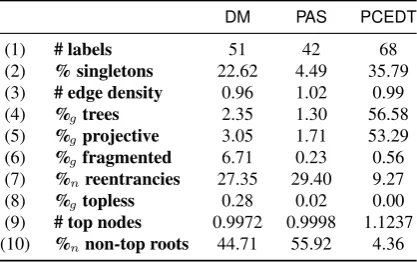
Quantitative Comparison As a first attempt at contrasting our three target representations, Table 2 shows some high-level statistics of the graphs com-prising the training data.5 In terms of distinctions
5These statistics are obtained using the ‘official’ SDP toolkit. We refer to nodes that have neither incoming nor outgoing edges and are not marked as top nodes assingletons; these nodes are ignored in subsequent statistics, e.g. when determining the proportion of edges per node (3) or the per-centages of rooted trees (4) and fragmented graphs (6). The notation ‘%n’ denotes (non-singleton) node percentages, and ‘%g’ percentages over all graphs. We consider arootnode any (non-singleton) node that has no incoming edges;reentrant
Directed Undirected
DM PAS PCEDT DM PAS PCEDT
DM − .6425 .2612 − .6719 .5675
PAS .6688 − .2963 .6993 − .5490
[image:5.595.74.289.63.136.2]PCEDT .2636 .2963 − .5743 .5630 −
Table 3: Pairwise F1similarities, including
punctu-ation (upper right diagonals) or not (lower left).
drawn in dependency labels (1), there are clear dif-ferences between the representations, withPCEDT
appearing linguistically most fine-grained, andPAS
showing the smallest label inventory. Unattached singleton nodes (2) in our setup correspond to tokens analyzed as semantically vacuous, which (as seen in Figure 1) include most punctuation marks inPCEDT andDM, but notPAS. Further-more,PCEDT(unlike the other two) analyzes some high-frequency determiners as semantically vacu-ous. Conversely,PASon average has more edges per (non-singleton) nodes than the other two (3), which likely reflects its approach to the analysis of functional words (see below).
Judging from both the percentage of actual trees (4), the proportions of projective graphs (5), and the proportions of reentrant nodes (7),PCEDTis much more ‘tree-oriented’ than the other two, which at least in part reflects its approach to the analysis of modifiers and determiners (again, see below). We view the small percentages of graphs without at least one top node (8) and of graphs with at least two non-singleton components that are not interconnected (6) as tentative indicators of general well-formedness. Intuitively, there should always be a ‘top’ predicate, and the whole graph should ‘hang together’. OnlyDMexhibits non-trivial (if small) degrees of topless and fragmented graphs, and these may indicate imperfections in the Deep-Bank annotations or room for improvement in the conversion from full MRSs to bi-lexical dependen-cies, but possibly also exceptions to our intuitions about semantic dependency graphs.
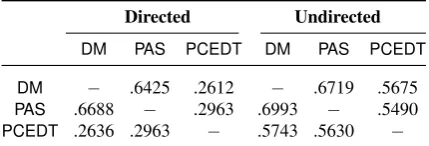
Finally, in Table 3 we seek to quantify pairwise structural similarity between the three representa-tions in terms of unlabeled dependency F1(dubbed
UFin Section 5 below). We provide four variants of this metric, (a) taking into account the direc-tionality of edges or not and (b) including edges involving punctuation marks or not. On this view,
DMandPASare structurally much closer to each other than either of the two is toPCEDT, even more
such thati < j < k.
so when discarding punctuation. While relaxing the comparison to ignore edge directionality also increases similarity scores for this pair, the effect is much more pronounced when comparing either toPCEDT. This suggests that directionality of se-mantic dependencies is a major source of diversion betweenDMandPASon the one hand, andPCEDT
on the other hand.
Linguistic Comparison Among other aspects, Ivanova et al. (2012) categorize a range of syntac-tic and semansyntac-tic dependency annotation schemes according to the role that functional elements take. In Figure 1 and the discussion of Table 2 above, we already observed thatPASdiffers from the other representations in integrating into the graph aux-iliaries, the infinitival marker, the case-marking preposition introducing the argument ofapply(to), and most punctuation marks;6 while these (and
other functional elements, e.g. complementizers) are analyzed as semantically vacuous inDMand
PCEDT, they function as predicates inPAS, though do not always serve as ‘local’ top nodes (i.e. the se-mantic head of the corresponding sub-graph): For example, the infinitival marker in Figure 1 takes the verb as its argument, but the ‘upstairs’ predicate
impossiblelinks directly to the verb, rather than to the infinitival marker as an intermediate.
At the same time, DM and PAS pattern alike in their approach to modifiers, e.g. attributive ad-jectives, adverbs, and prepositional phrases. Un-like inPCEDT(or common syntactic dependency schemes), these are analyzed as semantic predi-cates and, thus, contribute to higher degrees of node reentrancy and non-top (structural) roots. Roughly the same holds for determiners, but here ourPCEDTprojection of Prague tectogrammatical trees onto bi-lexical dependencies leaves ‘vanilla’ articles (likeaandthe) as singleton nodes.
The analysis of coordination is distinct in the three representations, as also evident in Figure 1. By design, DM opts for what is often called the Mel’ˇcukian analysis of coordinate structures (Mel’ˇcuk, 1988), with a chain of dependencies rooted at the first conjunct (which is thus consid-ered the head, ‘standing in’ for the structure at large); in theDMapproach, coordinating conjunc-tions are not integrated with the graph but rather contribute different types of dependencies. InPAS, the final coordinating conjunction is the head of the
employee stock investment plans
compound compound compound
employee stock investment plans
ARG1 ARG1
ARG1
employee stock investment plans
ACT
[image:6.595.92.506.62.107.2]PAT REG
Figure 2: Analysis of nominal compounding inDM,PAS, andPCEDT, respectively .
structure and each coordinating conjunction (or in-tervening punctuation mark that acts like one) is a two-place predicate, taking left and right conjuncts as its arguments. Conversely, inPCEDTthe last coordinating conjunction takes all conjuncts as its arguments (in case there is no overt conjunction, a punctuation mark is used instead); additional con-junctions or punctuation marks are not connected to the graph.7
A linguistic difference between our representa-tions that highlights variable granularities of anal-ysis and, relatedly, diverging views on the scope of the problem can be observed in Figure 2. Much noun phrase–internal structure is not made explicit in the PTB, and the Enju Treebank from which ourPASrepresentation derives predates the brack-eting work of Vadas and Curran (2007). In the four-way nominal compounding example of Fig-ure 2, thus,PASarrives at a strictly left-branching tree, and there is no attempt at interpreting seman-tic roles among the members of the compound ei-ther;PCEDT, on the other hand, annotates both the
actualcompound-internal bracketing and the as-signment of roles, e.g. makingstockthePAT(ient) ofinvestment. In this spirit, the PCEDT annota-tions could be directly paraphrased along the lines ofplans by employees for investment in stocks.In a middle position between the other two,DM dis-ambiguates the bracketing but, by design, merely assigns an underspecified, construction-specific de-pendency type; itscompounddependency, then, is to be interpreted as the most general type of de-pendency that can hold between the elements of this construction (i.e. to a first approximation either an argument role or a relation parallel to a prepo-sition, as in the above paraphrase). TheDMand
PCEDTannotations of this specific example hap-pen to diverge in their bracketing decisions, where the DManalysis corresponds to [...] investments in stock for employees, i.e. grouping the concept
7As detailed by Miyao et al. (2014), individual con-juncts can be (and usually are) arguments of other predicates, whereas the topmost conjunction only has incoming edges in nested coordinate structures. Similarly, a ‘shared’ modifier of the coordinate structure as a whole would take as its argument the local top node of the coordination inDMorPAS(i.e. the first conjunct or final conjunction, respectively), whereas it would depend as an argument on all conjuncts inPCEDT.
employee stock(in contrast to ‘common stock’). Without context and expert knowledge, these de-cisions are hard to call, and indeed there has been much previous work seeking to identify and anno-tate the relations that hold between members of a nominal compound (see Nakov, 2013, for a recent overview). To what degree the bracketing and role disambiguation in this example are determined by the linguistic signal (rather than by context and world knowledge, say) can be debated, and thus the observed differences among our representations in this example relate to the classic contrast between ‘sentence’ (or ‘conventional’) meaning, on the one hand, and ‘speaker’ (or ‘occasion’) meaning, on the other hand (Quine, 1960; Grice, 1968). In turn, we acknowledge different plausible points of view about which level of semantic representation should be the target representation for data-driven
parsing(i.e. structural analysis guided by the gram-matical system), and which refinements like the above could be construed as part of a subsequent task ofinterpretation.
5 Task Setup
DM PAS PCEDT
LF LP LR LF LM LP LR LF LM LP LR LF LM
Peking 85.91 90.27 88.54 89.40 26.71 93.44 90.69 92.04 38.13 78.75 73.96 76.28 11.05 Priberam 85.24 88.82 87.35 88.08 22.40 91.95 89.92 90.93 32.64 78.80 74.70 76.70 09.42 Copenhagen- 80.77 84.78 84.04 84.41 20.33 87.69 88.37 88.03 10.16 71.15 68.65 69.88 08.01Malmö Potsdam 77.34 79.36 79.34 79.35 07.57 88.15 81.60 84.75 06.53 69.68 66.25 67.92 05.19 Alpage 76.76 79.42 77.24 78.32 09.72 85.65 82.71 84.16 17.95 70.53 65.28 67.81 06.82 Linköping 72.20 78.54 78.05 78.29 06.08 76.16 75.55 75.85 01.19 60.66 64.35 62.45 04.01
DM PAS PCEDT
LF LP LR LF LM LP LR LF LM LP LR LF LM
[image:7.595.74.525.61.275.2]Priberam 86.27 90.23 88.11 89.16 26.85 92.56 90.97 91.76 37.83 80.14 75.79 77.90 10.68 CMU 82.42 84.46 83.48 83.97 08.75 90.78 88.51 89.63 26.04 76.81 70.72 73.64 07.12 Turku 80.49 80.94 82.14 81.53 08.23 87.33 87.76 87.54 17.21 72.42 72.37 72.40 06.82 Potsdam 78.60 81.32 80.91 81.11 09.05 89.41 82.61 85.88 07.49 70.35 67.33 68.80 05.42 Alpage 78.54 83.46 79.55 81.46 10.76 87.23 82.82 84.97 15.43 70.98 67.51 69.20 06.60 In-House 75.89 92.58 92.34 92.46 48.07 92.09 92.02 92.06 43.84 40.89 45.67 43.15 00.30
Table 4: Results of the closed (top) and open tracks (bottom). For each system, the second column (LF) indicates the averagedLFscore across all target representations), which was used to rank the systems.
Evaluation Systems participating in the task were evaluated based on the accuracy with which they can produce semantic dependency graphs for previously unseen text, measured relative to the gold-standard testing data. The key measures for this evaluation were labeled and unlabeled preci-sion and recall with respect to predicted dependen-cies (predicate–role–argument triples) and labeled and unlabeled exact match with respect to complete graphs. In both contexts, identification of the top node(s) of a graph was considered as the identifi-cation of additional, ‘virtual’ dependencies from an artificial root node (at position 0). Below we abbreviate these metrics as (a) labeled precision, recall, and F1:LP,LR,LF; (b) unlabeled precision,
recall, and F1: UP,UR, UF; and (c) labeled and
unlabeled exact match:LM,UM.
The ‘official’ ranking of participating systems, in both the closed and the open tracks, is determined based on the arithmetic mean of the labeled depen-dency F1scores (i.e. the geometric mean of labeled
precision and labeled recall) on the three target rep-resentations (DM,PAS, andPCEDT). Thus, to be considered for the final ranking, a system had to submit semantic dependencies for all three target representations.
Closed vs. Open Tracks The task was sub-divided into aclosedtrack and anopentrack, where systems in the closed track could only be trained on the gold-standard semantic dependencies dis-tributed for the task. Systems in the open track, on the other hand, could use additional resources, such
as a syntactic parser, for example—provided that they make sure to not use any tools or resources that encompass knowledge of the gold-standard syntactic or semantic analyses of the SDP 2014 test data, i.e. were directly or indirectly trained or otherwise derived from WSJ Section 21.
This restriction implies that typical off-the-shelf syntactic parsers had to be re-trained, as many data-driven parsers for English include this section of the PTB in their default training data. To simplify participation in the open track, the organizers pre-pared ready-to-use ‘companion’ syntactic analyses, sentence- and token-aligned to the SDP data, in two formats, viz. PTB-style phrase structure trees obtained from the parser of Petrov et al. (2006) and Stanford Basic syntactic dependencies (de Marn-effe et al., 2006) produced by the parser of Bohnet and Nivre (2012).
6 Submissions and Results
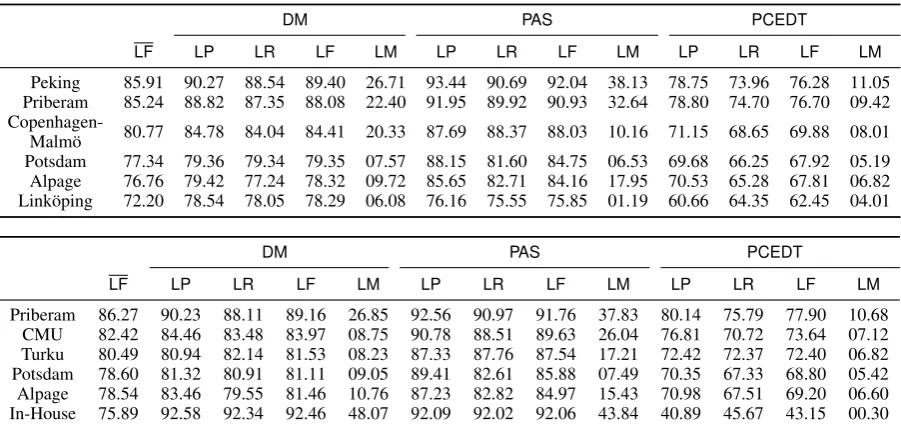
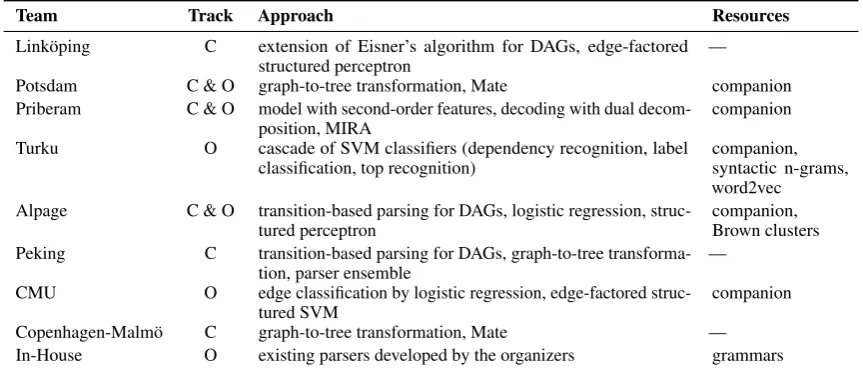
From 36 teams who had registered for the task, test runs were submitted for nine systems. Each team submitted one or two test runs per track. In total, there were ten runs submitted to the closed track and nine runs to the open track. Three teams submitted to both the closed and the open track. The main results are summarized and ranked in Table 4. The ranking is based on the averageLF
Team Track Approach Resources Linköping C extension of Eisner’s algorithm for DAGs, edge-factored
structured perceptron —
Potsdam C & O graph-to-tree transformation, Mate companion
Priberam C & O model with second-order features, decoding with dual
decom-position, MIRA companion
Turku O cascade of SVM classifiers (dependency recognition, label
classification, top recognition) companion,syntactic n-grams, word2vec Alpage C & O transition-based parsing for DAGs, logistic regression,
struc-tured perceptron companion,Brown clusters
Peking C transition-based parsing for DAGs, graph-to-tree
transforma-tion, parser ensemble —
CMU O edge classification by logistic regression, edge-factored
struc-tured SVM companion
Copenhagen-Malmö C graph-to-tree transformation, Mate —
[image:8.595.83.515.63.248.2]In-House O existing parsers developed by the organizers grammars
Table 5: Overview of submitted systems, high-level approaches, and additional resources used (if any).
In the closed track, the averageLFscores across target representations range from 85.91 to 72.20. Comparing the results for different target represen-tations, the averageLFscores across systems are 85.96 forPAS, 82.97 forDM, and 70.17 forPCEDT. The scores for labeled exact match show a much larger variation across both target representations and systems.8
In the open track, we see very similar trends. The averageLFscores across target representations range from 86.27 to 75.89 and the corresponding scores across systems are 88.64 for PAS, 84.95 forDM, and 67.52 forPCEDT. While these scores are consistently higher than in the closed track, the differences are small. In fact, for each of the three teams that submitted to both tracks (Alpage, Potsdam, and Priberam) improvements due to the use of additional resources in the open track do not exceed two pointsLF.
7 Overview of Approaches
Table 5 shows a summary of the systems that sub-mitted final results. Most of the systems took a strategy to use some algorithm to process (re-stricted types of) graph structures, and apply ma-chine learning like structured perceptrons. The methods for processing graph structures are clas-sified into three types. One is to transform graphs into trees in the preprocessing stage, and apply con-ventional dependency parsing systems (e.g. Mate; Bohnet, 2010) to the converted trees. Some sys-tems simply output the result of dependency pars-ing (which means they inherently lose some
depen-8Please see the task web page at the address indicated above for full labeled and unlabeled scores.
dencies), while the others apply post-processing to recover non-tree structures. The second strat-egy is to use a parsing algorithm that can directly generate graph structures (in the spirit of Sagae & Tsujii, 2008; Titov et al., 2009). In many cases such algorithms generate restricted types of graph structures, but these restrictions appear feasible for our target representations. The last approach is more machine learning–oriented; they apply classi-fiers or scoring methods (e.g. edge-factored scores), and find the highest-scoring structures by some de-coding method.
It is difficult to tell which approach is the best; actually, the top three systems in the closed and open tracks selected very different approaches. A possible conclusion is that exploiting existing sys-tems or techniques for dependency parsing was successful; for example, Peking built an ensemble of existing transition-based and graph-based depen-dency parsers, and Priberam extended an existing dependency parser. As we indicated in the task de-scription, a novel feature of this task is that we have to compute graph structures, and cannot assume well-known properties like projectivity and lack of reentrancies. However, many of the participants found that our representations are mostly tree-like, and this fact motivated them to apply methods that have been well studied in the field of syntactic de-pendency parsing.
with simple machine learning models. Pre-existing, tree-oriented dependency parsers are relatively ef-fective, especially when combined with graph-to-tree transformation. Comparing across our three target representations, system scores show a ten-dencyPAS>DM>PCEDT, which can be taken as a tentative indicator of relative levels of ‘parsabil-ity’. As suggested in Section 4, this variation most likely correlates at least in part with diverging de-sign decisions, e.g. the inclusion of relatively local and deterministic dependencies involving function words inPAS, or the decision to annotate contex-tually determined speaker meaning (rather than ‘mere’ sentence meaning) in at least some
construc-tions inPCEDT.
8 Conclusions and Outlook
We have described the motivation, design, and out-comes of the SDP 2014 task on semantic depen-dency parsing, i.e. retrieving bi-lexical predicate– argument relations between all content words within an English sentence. We have converted to a common format three existing annotations (DM,
PAS, andPCEDT) over the same text and have put this to use for the first time in training and testing data-driven semantic dependency parsers. Building on strong community interest already to date and our belief that graph-oriented dependency parsing will further gain importance in the years to come, we are preparing a similar (slightly modified) task for SemEval 2015. Candidate modifications and extensions will include cross-domain testing and evaluation at the level of ‘complete’ predications (in contrast to more lenient per-dependency F1used
this year). As optional new sub-tasks, we plan on offering cross-linguistic variation and predicate (i.e. semantic frame) disambiguation for at least some of the target representations. To further probe the role of syntax in the recovery of semantic dependency relations, we will make available to participants a wider selection of syntactic analyses, as well as add a third (idealized) ‘gold’ track, where syntactic dependencies are provided directly from available syntactic annotations of the underlying treebanks. Acknowledgements
We are grateful to Željko Agi´c and Bernd Bohnet for consultation and assistance in preparing our baseline and companion parses, to the Linguistic Data Consortium (LDC) for support in distributing the SDP data to participants, as well as to Emily M. Bender and two anonymous reviewers for feedback
on this manuscript. Data preparation was supported through access to theABELhigh-performance
com-puting facilities at the University of Oslo, and we acknowledge the Scientific Computing staff at UiO, the Norwegian Metacenter for Computational Sci-ence, and the Norwegian tax payers. Part of this work has been supported by the infrastructural fund-ing by the Ministry of Education, Youth and Sports of the Czech Republic (CEP ID LM2010013).
References
Bohnet, B. (2010). Top accuracy and fast depen-dency parsing is not a contradiction. InProceedings of the 23rd International Conference on Computa-tional Linguistics(p. 89 – 97). Beijing, China.
Bohnet, B., & Nivre, J. (2012). A transition-based system for joint part-of-speech tagging and labeled non-projective dependency parsing. InProceedings of the 2012 Joint Conference on Empirical Methods in Natural Language Processing and Conference on Natural Language Learning(p. 1455 – 1465). Jeju Island, Korea.
Buchholz, S., & Marsi, E. (2006). CoNLL-X shared task on multilingual dependency parsing. In Pro-ceedings of the 10th Conference on Natural Lan-guage Learning (p. 149 – 164). New York, NY, USA.
Copestake, A., Flickinger, D., Pollard, C., & Sag, I. A. (2005). Minimal Recursion Semantics. An introduc-tion. Research on Language and Computation,3(4), 281 – 332.
de Marneffe, M.-C., MacCartney, B., & Manning, C. D. (2006). Generating typed dependency parses from phrase structure parses. InProceedings of the 5th In-ternational Conference on Language Resources and Evaluation(p. 449 – 454). Genoa, Italy.
Fares, M., Oepen, S., & Zhang, Y. (2013). Machine learning for high-quality tokenization. Replicating variable tokenization schemes. InComputational lin-guistics and intelligent text processing(p. 231 – 244). Springer.
Flickinger, D. (2000). On building a more efficient grammar by exploiting types.Natural Language En-gineering,6 (1), 15 – 28.
Flickinger, D., Zhang, Y., & Kordoni, V. (2012). Deep-Bank. A dynamically annotated treebank of the Wall Street Journal. In Proceedings of the 11th Interna-tional Workshop on Treebanks and Linguistic Theo-ries(p. 85 – 96). Lisbon, Portugal: Edições Colibri.
245 – 288.
Grice, H. P. (1968). Utterer’s meaning, sentence-meaning, and word-meaning. Foundations of Lan-guage,4(3), 225 – 242.
Hajiˇc, J., Ciaramita, M., Johansson, R., Kawahara, D., Martí, M. A., Màrquez, L., . . . Zhang, Y. (2009). The CoNLL-2009 Shared Task. syntactic and seman-tic dependencies in multiple languages. In Proceed-ings of the 13th Conference on Natural Language Learning(p. 1 – 18). Boulder, CO, USA.
Hajiˇc, J., Hajiˇcová, E., Panevová, J., Sgall, P., Bojar, O., Cinková, S., . . . Žabokrtský, Z. (2012). An-nouncing Prague Czech-English Dependency Tree-bank 2.0. In Proceedings of the 8th International Conference on Language Resources and Evaluation
(p. 3153 – 3160). Istanbul, Turkey.
Ivanova, A., Oepen, S., Øvrelid, L., & Flickinger, D. (2012). Who did what to whom? A contrastive study of syntacto-semantic dependencies. InProceedings of the Sixth Linguistic Annotation Workshop(p. 2 – 11). Jeju, Republic of Korea.
Kate, R. J., & Wong, Y. W. (2010). Semantic pars-ing. The task, the state of the art and the future. In
Tutorial abstracts of the 20th Meeting of the Associ-ation for ComputAssoci-ational Linguistics(p. 6). Uppsala, Sweden.
Marcus, M., Santorini, B., & Marcinkiewicz, M. A. (1993). Building a large annotated corpora of En-glish: The Penn Treebank. Computational Linguis-tics,19, 313 – 330.
Mel’ˇcuk, I. (1988). Dependency syntax. Theory and practice. Albany, NY, USA: SUNY Press.
Meyers, A., Reeves, R., Macleod, C., Szekely, R., Zielinska, V., Young, B., & Grishman, R. (2004). Annotating noun argument structure for NomBank. In Proceedings of the 4th International Conference on Language Resources and Evaluation (p. 803 – 806). Lisbon, Portugal.
Miyao, Y., Oepen, S., & Zeman, D. (2014). In-house: An ensemble of pre-existing off-the-shelf parsers. In
Proceedings of the 8th International Workshop on Semantic Evaluation.Dublin, Ireland.
Nakov, P. (2013). On the interpretation of noun com-pounds: Syntax, semantics, and entailment. Natural Language Engineering,19(3), 291 – 330.
Nivre, J., Hall, J., Kübler, S., McDonald, R., Nilsson, J., Riedel, S., & Yuret, D. (2007). The CoNLL 2007 shared task on dependency parsing. InProceedings of the 2007 Joint Conference on Empirical Methods in Natural Language Processing and Conference on
Natural Language Learning(p. 915 – 932). Prague, Czech Republic.
Oepen, S., & Lønning, J. T. (2006). Discriminant-based MRS banking. InProceedings of the 5th In-ternational Conference on Language Resources and Evaluation(p. 1250 – 1255). Genoa, Italy.
Palmer, M., Gildea, D., & Kingsbury, P. (2005). The Proposition Bank. A corpus annotated with semantic roles.Computational Linguistics,31(1), 71 – 106.
Petrov, S., Barrett, L., Thibaux, R., & Klein, D. (2006). Learning accurate, compact, and interpretable tree annotation. InProceedings of the 21st International Conference on Computational Linguistics and the 44th Meeting of the Association for Computational Linguistics(p. 433 – 440). Sydney, Australia.
Quine, W. V. O. (1960).Word and object. Cambridge, MA, USA: MIT press.
Sagae, K., & Tsujii, J. (2008). Shift-reduce depen-dency DAG parsing. In Proceedings of the 22nd International Conference on Computational Linguis-tics(p. 753 – 760). Manchester, UK.
Titov, I., Henderson, J., Merlo, P., & Musillo, G. (2009). Online graph planarisation for synchronous parsing of semantic and syntactic dependencies. In
Proceedings of the 21st International Joint Confer-ence on Artifical IntelligConfer-ence(p. 1562 – 1567).