Coooolll: A Deep Learning System for Twitter Sentiment Classification
∗Duyu Tang†, Furu Wei‡, Bing Qin†, Ting Liu†, Ming Zhou‡ †Research Center for Social Computing and Information Retrieval
Harbin Institute of Technology, China ‡Microsoft Research, Beijing, China
{dytang, qinb, tliu}@ir.hit.edu.cn
{fuwei, mingzhou}@microsoft.com
Abstract
In this paper, we develop a deep learn-ing system for message-level Twitter sen-timent classification. Among the 45 sub-mitted systems including the SemEval 2013 participants, our system (Coooolll) is ranked 2nd on the Twitter2014 test set of SemEval 2014 Task 9. Coooolll is built in a supervised learning framework by concatenating the sentiment-specific word embedding (SSWE) features with the state-of-the-art hand-crafted features. We develop a neural network with hybrid loss function1to learn SSWE, which
en-codes the sentiment information of tweets in the continuous representation of words. To obtain large-scale training corpora, we train SSWE from 10M tweets collected by positive and negative emoticons, without any manual annotation. Our system can be easily re-implemented with the publicly available sentiment-specific word embed-ding.
1 Introduction
Twitter sentiment classification aims to classify the sentiment polarity of a tweet as positive, nega-tive or neutral (Jiang et al., 2011; Hu et al., 2013; Dong et al., 2014). The majority of existing ap-proaches follow Pang et al. (2002) and employ ma-chine learning algorithms to build classifiers from tweets with manually annotated sentiment polar-ity. Under this direction, most studies focus on
∗This work was partly done when the first author was
visiting Microsoft Research.
1This is one of the three sentiment-specific word
embed-ding learning algorithms proposed in Tang et al. (2014). This work is licensed under a Creative Commons At-tribution 4.0 International Licence. Page numbers and pro-ceedings footer are added by the organisers. Licence details: http://creativecommons.org/licenses/by/4.0/
designing effective features to obtain better clas-sification performance (Pang and Lee, 2008; Liu, 2012; Feldman, 2013). For example, Mohammad et al. (2013) implement diverse sentiment lexicons and a variety of hand-crafted features. To leverage massive tweets containing positive and negative e-moticons for automatically feature learning, Tang et al. (2014) propose to learn sentiment-specific word embedding and Kalchbrenner et al. (2014) model sentence representation with Dynamic Con-volutional Neural Network.
In this paper, we develop a deep learning sys-tem for Twitter sentiment classification. First-ly, we learn sentiment-specific word embedding (SSWE) (Tang et al., 2014), which encodes the sentiment information of text into the continuous representation of words (Mikolov et al., 2013; Sun et al., 2014). Afterwards, we concatenate the SS-WE features with the state-of-the-art hand-crafted features (Mohammad et al., 2013), and build the sentiment classifier with the benchmark dataset from SemEval 2013 (Nakov et al., 2013). To learn SSWE, we develop a tailored neural net-work, which incorporates the supervision from sentiment polarity of tweets in the hybrid loss function. We learn SSWE from tweets, lever-aging massive tweets with emoticons as distant-supervised corpora without any manual annota-tions.
We evaluate the deep learning system on the test set of Twitter Sentiment Analysis Track in Se-mEval 2014 2. Our system (Coooolll) is ranked
2nd on the Twitter2014 test set, along with the SemEval 2013 participants owning larger train-ing data than us. The performance of only us-ing SSWE as features is comparable to the state-of-the-art hand-crafted features (detailed in Ta-ble 3), which verifies the effectiveness of the sentiment-specific word embedding. We release the sentiment-specific word embedding learned
2http://alt.qcri.org/semeval2014/task9/
Training Data
Learning Algorithm
Feature Representation
Sentiment Classifier
1 2 ….
N
N+1 N+2 … N+K
STATE Feature
SSWE Feature
all-cap emoticon
… …. dimension 1 dimension 2
dimension N
elongated
Massive Tweets
[image:2.595.74.288.60.223.2]Embedding Learning
Figure 1: Our deep learning system (Coooolll) for Twitter sentiment classification.
from 10 million tweets, which can be easily used to re-implement our system and adopted off-the-shell in other sentiment analysis tasks.
2 A Deep Learning System
In this section, we present the details of our deep learning system for Twitter sentiment classifica-tion. As illustrated in Figure 1, Coooolll is a su-pervised learning method that builds the sentimen-t classifier from sentimen-tweesentimen-ts wisentimen-th manually annosentimen-tasentimen-ted sentiment polarity. In our system, the feature rep-resentation of tweet is composed of two parts, the sentiment-specific word embedding features (SS-WE features) and the state-of-the-art hand-crafted features (STATE features). In the following parts, we introduce the SSWE features and STATE fea-tures, respectively.
2.1 SSWE Features
In this part, we first describe the neural network for learning sentiment-specific word embedding. Then, we generate the SSWE features of a tweet from the embedding of words it contains.
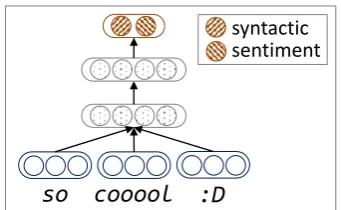
Our neural network is an extension of the tra-ditional C&W model (Collobert et al., 2011), as illustrated in Figure 2. Unlike C&W model that learns word embedding by only modeling syntac-tic contexts of words, we developSSWEu, which captures the sentiment information of sentences as well as the syntactic contexts of words. Given an original (or corrupted) ngram and the sentiment polarity of a sentence as the input, SSWEu
predict-s a two-dimenpredict-sional vector for each input ngram. The two scalars (fu
0,f1u) stand for language model
score and sentiment score of the input ngram,
re-so cooool :D
syntactic sentiment
Figure 2: Our neural network (SSWEu) for
learn-ing sentiment-specific word embeddlearn-ing.
spectively. The training objectives of SSWEu are
that (1) the original ngram should obtain a high-er language model scorefu
0(t)than the corrupted
ngramfu
0(tr), and (2) the sentiment score of
orig-inal ngram fu
1(t) should be more consistent with
the gold polarity annotation of sentence than cor-rupted ngramfu
1(tr). The loss function of SSWEu
is the linear combination of two hinge losses,
lossu(t, tr) =α·losscw(t, tr)+
(1−α)·lossus(t, tr) (1)
where wheretis the original ngram,tr is the
cor-rupted ngram which is generated fromtwith mid-dle word replaced by a randomly selected one, losscw(t, tr) is the syntactic loss as given in
E-quation 2, lossus(t, tr) is the sentiment loss as
described in Equation 3. The hyper-parameter α weighs the two parts.
losscw(t, tr) =max(0,1−fcw(t) +fcw(tr))
(2) lossus(t, tr) =max(0,1−δs(t)f1u(t)
+δs(t)f1u(tr) ) (3)
whereδs(t)is an indicator function reflecting the
sentiment polarity of a sentence, whose value is 1 if the sentiment polarity of tweettis positive and -1 ift’s polarity is negative. We train sentiment-specific word embedding from 10M tweets col-lected with positive and negative emoticons (Hu et al., 2013). The details of training phase are de-scribed in Tang et al. (2014).
[image:2.595.331.502.61.166.2]2.2 STATE Features
We re-implement the state-of-the-art hand-crafted features (Mohammad et al., 2013) for Twitter sen-timent classification. The STATE features are de-scribed below.
• All-Caps. The number of words with all char-acters in upper case.
• Emoticons. We use the presence of positive (or negative) emoticons and whether the last unit of a segmentation is emoticon3.
• Elongated Units. The number of elongated words (with one character repeated more than two times), such asgooood.
• Sentiment Lexicon. We utilize several senti-ment lexicons4to generate features. We
ex-plore the number of sentiment words, the s-core of last sentiment words, the total senti-ment score and the maximal sentisenti-ment score for each lexicon.
• Negation. The number of individual nega-tions5within a tweet.
• Punctuation. The number of contiguous se-quences of dot, question mark and exclama-tion mark.
• Cluster. The presence of words from each of the 1,000 clusters from the Twitter NLP tool (Gimpel et al., 2011).
• Ngrams. The presence of word ngrams (1-4) and character ngrams (3-5).
3 Experiments
We evaluate our deep learning system by applying it for Twitter sentiment classification within a su-pervised learning framework. We conduct exper-iments on both positive/negative/neutral and posi-tive/negative classification of tweets.
3We use the positive and negative emoticons from
Sen-tiStrength, available at http://sentistrength.wlv.ac.uk/.
4HL(Hu and Liu, 2004),MPQA(Wilson et al., 2005), N-RC Emotion(Mohammad and Turney, 2013),NRC Hashtag andSentiment140Lexicon(Mohammad et al., 2013).
5http://sentiment.christopherpotts.net/lingstruc.html
3.1 Dataset and Setting
We train the Twitter sentiment classifier on the benchmark dataset in SemEval 2013 (Nakov et al., 2013). The training and development sets were completely in full to task participants of SemEval 2013. However, we were unable to download al-l the training and deveal-lopment sets because some tweets were deleted or not available due to modi-fied authorization status. The distribution of our dataset is given in Table 1. We train sentimen-t classifiers wisentimen-th LibLinear (Fan esentimen-t al., 2008) on the training set and dev set, and tune parameter
−c,−wiof SVM on the test set of SemEval 2013. In both experiment settings, the evaluation met-ric is the macro-F1 of positive and negative class-es (Nakov et al., 2013).
Positive Negative Neutral Total
Train 2,642 994 3,436 7,072
Dev 408 219 493 1,120
[image:3.595.311.523.461.545.2]Test 1,570 601 1,639 3,810
Table 1: Statistics of our SemEval 2013 Twitter sentiment classification dataset.
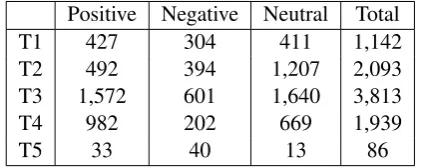
The test sets of SemEval 2014 is directly pro-vided to the participants, which is composed of five parts. The statistic of test sets in SemEval 2014 is given in Table 2.
Positive Negative Neutral Total
T1 427 304 411 1,142
T2 492 394 1,207 2,093
T3 1,572 601 1,640 3,813
T4 982 202 669 1,939
T5 33 40 13 86
Table 2: Statistics of SemEval 2014 Twitter senti-ment classification test set. T1 is LiveJournal2014, T2 is SMS2013, T3 is Twitter2013, T4 is Twit-ter2014, T5 is Twitter2014Sarcasm.
3.2 Results and Analysis
Method T1 Positive/Negative/NeutralT2 T3 T4 T5 T1 T2Positive/NegativeT3 T4 T5
SSWE 70.49 64.29 68.69 66.86 50.00 84.51 85.19 85.06 86.14 62.02
Coooolll 72.90 67.68 70.40 70.14 46.66 86.46 85.32 86.01 87.61 56.55
STATE 71.48 65.43 66.18 67.07 44.89 83.96 82.82 84.39 86.16 58.27
W2V 55.19 52.98 52.33 50.58 49.63 68.87 71.89 74.50 71.52 61.60
Top 74.84 70.28 72.12 70.96 58.16 - - -
-Average 63.52 55.63 59.78 60.41 45.44 - - -
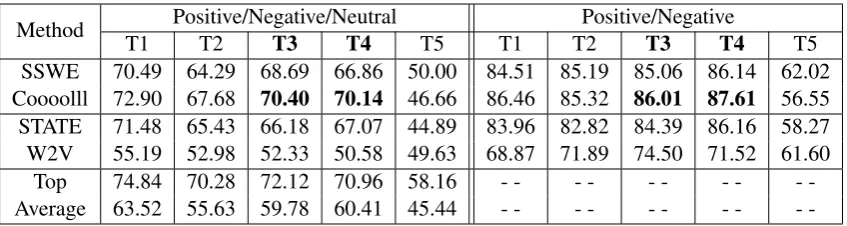
-Table 3: Macro-F1 of positive and negative classes in positive/negative/neutral and positive/negative Twitter sentiment classification on the test sets (T1-T5, detailed in Table 2) of SemEval 2014. The performances of Coooolll on the Twitter-relevant test sets arebold.
sentiment classifier. InCoooolll, we use the con-catenation of SSWE features and STATE features. InW2V, we only use the word embedding learned from word2vec6as features. TopandAverageare
the top and average performance of the 45 team-s of SemEval 2014, including the SemEval 2013 participants who owns larger training data.
On positive/negative/neutral classification of tweets as listed in Table 3 (left table), we find that the learned sentiment-specific word embed-ding features (SSWE) performs comparable with the state-of-the-art hand-crafted features (STATE), especially on the Twitter-relevant test sets (T3
and T4) 7. After feature combination, Coooolll
yields 4.22% and 3.07% improvement by macro-F1 on T3 and T4,which verifies the effective-ness of SSWE by learning discriminate features from massive data for Twitter sentiment classifi-cation. From the 45 teams,Coooolllgets the Rank
5/2/3/2on T1-T4 respectively, along with the Se-mEval 2013 participants owning larger training data. We also comparingSSWEwith the context-based word embedding (W2V), which don’t cap-ture the sentiment supervision of tweets. We find thatW2V is not effective enough for Twitter sen-timent classification as there is a big gap between W2VandSSWEon T1-T4. The reason is thatW2V does not capture the sentiment information of text, which is crucial for sentiment analysis tasks and effectively leveraged for learning the sentiment-specific word embedding.
We also conduct experiments on the
posi-6We utilize the Skip-gram model. The embedding is
trained from the 10M tweets collected by positive and neg-ative emoticons, as same as the training data of SSWE.
7The result ofSTATEon T3 is different from the results
reported in Mohammad et al. (2013) and Tang et al. (2014) because we have different training data with the former and different -wiof SVM with the latter.
tive/negative classification of tweets. The reason is that the sentiment-specific word embedding is learned from the positive/negative supervision of tweets through emoticons, which is tailored for positive/negative classification of tweets. From Table 3 (righttable), we find that the performance of positive/negative Twitter classification is con-sistent with the performance of 3-class classifica-tion.SSWEperforms comparable toSTATEon T3 and T4, and yields better performance (1.62% and 1.45% improvements on T3 and T4, respectively) through feature combination. SSWE outperform-s W2V by large margins (more than 10%) on T3 and T4, which further verifies the effectiveness of sentiment-specific word embedding.
4 Conclusion
We develop a deep learning system (Coooolll) for message-level Twitter sentiment classification in this paper. The feature representation of Cooool-ll is composed of two parts, a state-of-the-art hand-crafted features and the sentiment-specific word embedding (SSWE) features. The SSWE is learned from 10M tweets collected by posi-tive and negaposi-tive emoticons, without any manu-al annotation. The effectiveness ofCoooolll has been verified in both positive/negative/neutral and positive/negative classification of tweets. Among 45 systems of SemEval 2014 Task 9 subtask(b), Coooolllyields Rank 2 on the Twitter2014 test set, along with the SemEval 2013 participants owning larger training data.
Acknowledgments
[image:4.595.88.512.61.174.2]References
Ronan Collobert, Jason Weston, L´eon Bottou, Michael Karlen, Koray Kavukcuoglu, and Pavel Kuksa. 2011. Natural language processing (almost) from scratch. Journal of Machine Learning Research, 12:2493–2537.
Li Dong, Furu Wei, Chuanqi Tan, Duyu Tang, Ming Zhou, and Ke Xu. 2014. Adaptive recursive neural network for target-dependent twitter sentiment clas-sification. InProceedings of the 52nd Annual Meet-ing of the Association for Computational LMeet-inguistic- Linguistic-s, pages 49–54.
Rong-En Fan, Kai-Wei Chang, Cho-Jui Hsieh, Xiang-Rui Wang, and Chih-Jen Lin. 2008. Liblinear: A library for large linear classification. The Journal of Machine Learning Research, 9:1871–1874.
Ronen Feldman. 2013. Techniques and application-s for application-sentiment analyapplication-siapplication-s. Communications of the ACM, 56(4):82–89.
Kevin Gimpel, Nathan Schneider, Brendan O’Connor, Dipanjan Das, Daniel Mills, Jacob Eisenstein, Michael Heilman, Dani Yogatama, Jeffrey Flanigan, and Noah A. Smith. 2011. Part-of-speech tagging for twitter: Annotation, features, and experiments. InProceedings of the Annual Meeting of the Associ-ation for ComputAssoci-ational Linguistics, pages 42–47. Ming Hu and Bing Liu. 2004. Mining and
summa-rizing customer reviews. InProceedings of the tenth ACM SIGKDD Conference on Knowledge Discovery and Data Mining, pages 168–177.
Xia Hu, Jiliang Tang, Huiji Gao, and Huan Liu. 2013. Unsupervised sentiment analysis with emo-tional signals. In Proceedings of the International World Wide Web Conference, pages 607–618. Long Jiang, Mo Yu, Ming Zhou, Xiaohua Liu, and
Tiejun Zhao. 2011. Target-dependent twitter sen-timent classification. The Proceeding of Annual Meeting of the Association for Computational Lin-guistics, 1:151–160.
Nal Kalchbrenner, Edward Grefenstette, and Phil Blun-som. 2014. A convolutional neural network for modelling sentences. In Proceedings of the 52nd Annual Meeting of the Association for Computation-al Linguistics, pages 655–665.
Bing Liu. 2012. Sentiment analysis and opinion min-ing. Synthesis Lectures on Human Language Tech-nologies, 5(1):1–167.
Tomas Mikolov, Kai Chen, Greg Corrado, and Jef-frey Dean. 2013. Efficient estimation of word rep-resentations in vector space. arXiv preprint arX-iv:1301.3781.
Jeff Mitchell and Mirella Lapata. 2010. Composition in distributional models of semantics. Cognitive Sci-ence, 34(8):1388–1429.
Saif M Mohammad and Peter D Turney. 2013. Crowd-sourcing a word–emotion association lexicon. Com-putational Intelligence, 29(3):436–465.
Saif M Mohammad, Svetlana Kiritchenko, and Xiao-dan Zhu. 2013. Nrc-canada: Building the state-of-the-art in sentiment analysis of tweets. Proceedings of the International Workshop on Semantic Evalua-tion, pages 321–327.
Preslav Nakov, Sara Rosenthal, Zornitsa Kozareva, Veselin Stoyanov, Alan Ritter, and Theresa Wilson. 2013. Semeval-2013 task 2: Sentiment analysis in twitter. In Proceedings of the International Work-shop on Semantic Evaluation, volume 13, pages 312–320.
Bo Pang and Lillian Lee. 2008. Opinion mining and sentiment analysis. Foundations and trends in infor-mation retrieval, 2(1-2):1–135.
Bo Pang, Lillian Lee, and Shivakumar Vaithyanathan. 2002. Thumbs up?: sentiment classification using machine learning techniques. InProceedings of the Conference on Empirical Methods in Natural Lan-guage Processing, pages 79–86.
Richard Socher, Eric H Huang, Jeffrey Pennington, Andrew Y Ng, and Christopher D Manning. 2011. Dynamic pooling and unfolding recursive autoen-coders for paraphrase detection. The Conference on Neural Information Processing Systems, 24:801– 809.
Yaming Sun, Lei Lin, Duyu Tang, Nan Yang, Zhenzhou Ji, and Xiaolong Wang. 2014. Radical-enhanced chinese character embedding. arXiv preprint arX-iv:1404.4714.
Duyu Tang, Furu Wei, Nan Yang, Ming Zhou, Ting Liu, and Bing Qin. 2014. Learning sentiment-specific word embedding for twitter sentiment clas-sification. InProceedings of the 52nd Annual Meet-ing of the Association for Computational LMeet-inguistic- Linguistic-s, pages 1555–1565.