Proceedings of the 9th International Workshop on Semantic Evaluation (SemEval 2015), pages 647–651,
SeNTU: Sentiment Analysis of Tweets by Combining a Rule-based Classifier
with Supervised Learning
Prerna Chikersal, Soujanya Poria, and Erik Cambria
School of Computer Engineering Nanyang Technological University
Singapore - 639798
{prerna1,sporia,cambria}@ntu.edu.sg
Abstract
We describe a Twitter sentiment analysis sys-tem developed by combining a rule-based classifier with supervised learning. We mitted our results for the message-level sub-task in SemEval 2015 Task 10, and achieved a F1-score of 57.06%. The rule-based
classi-fier is based on rules that are dependent on the occurrences of emoticons and opinion words in tweets. Whereas, the Support Vector Ma-chine (SVM) is trained on semantic, depen-dency, and sentiment lexicon based features. The tweets are classified aspositive,negative
orunknownby the rule-based classifier, and as
positive,negativeorneutralby the SVM. The results we obtained show that rules can help refine the SVM’s predictions.
1 Introduction
Our opinions and the opinions of others play a very important role in our decision-making process and even influence our behaviour. In recent times, an increasing number of people have taken to ex-pressing their opinions on a wide variety of topics on microblogging websites such as Twitter. Be-ing able to analyse this data and extract opinions about a number of topics, can help us make informed choices and predictions regarding those topics. Due to this, sentiment analysis of tweets is gaining im-portance across a number of domains such as e-commerce (Wang and Cardie, 2014), politics (Tu-masjan et al., 2010; Johnson et al., 2012; Wang et
1We average the positive and negative F-measures to get the
F-score, which is the evaluation metric for this task.
al., 2012), health and psychology (Cambria et al., 2010; Harman, ; Harman, ), multimodality (Poria et al., 2015), crowd validation (Cambria et al., 2010), and even intelligence and surveillance (Jansen et al., 2009).
SemEval 2015 Task 10 (Rosenthal et al., 2015) is an international shared-task competition that aims to promote research in sentiment analysis of tweets by providing annotated tweets for training, devel-opment and testing. We created a sentiment anal-ysis system to participate in the message-level task of this competition. The objective of the system is to label the sentiment of each tweet as “positive”, “negative” or “neutral”.
In this paper, we describe our sentiment analysis system, which is a combined classifier created by in-tegrating a rule-based classification layer with a sup-port vector machine.
2 System Description
Our Sentiment Analysis System consists of two clas-sifiers – (i) Rule-based and (ii) Supervised, inte-grated together. This section describes both these classifiers and how we combine them.
During pre-processing, all the @<username>
references are changes to@USERand all theURLs
processed tweetswithout emoticonsas an input.
2.1 Supervised Learning
For the supervised classifier, we cast the sentiment analysis problem as a multi-class classification prob-lem, where each tweet has to be labeled as “pos-itive”, “negative” or “neutral”. We train a Sup-port Vector Machine (SVM) (Cortes and Vapnik, 1995) on the tweets provided for training. For all our experiments, we use a linear kernel and L1-regularisation. The C parameter is chosen by cross-validation. As mentioned above, emoticons have al-ready been removed from tweets given as input to the SVM.
Each tweet is represented as a feature vector, con-taining the following features:
• Word N-grams: Frequencies of contiguous
sequences of 1, 2 or 3 tokens. The TF-IDF weighting scheme is applied.
• Character N-grams: Frequencies of
contigu-ous sequences of 1, 2 or 3 characters inside each word’s boundary. The TF-IDF weighting scheme is applied.
• POS Tags: Using CMU Twitter Tagger
(Gim-pel et al., 2011) output, for each tweet we com-pute – (i)countAdj(number of adjectives), (ii)
countAdv(number of adverbs), (iii)countNoun
(number of nouns, proper nouns, and proper nouns+possessives), (iv)countVerb(number of verbs), and (v) countIntj (number of interjec-tions). The sum of these five counts, gives us thetotalPos. The POS features are: [countAdjtotalP os,
countAdv
totalP os, countNountotalP os , countV erbtotalP os , countIntjtotalP os ].
• @USER:A boolean feature that is set to 1 if
the tweet contains a@<username>reference.
• Hashtag: A boolean feature that is set to 1 if
the tweet contains a hashtag.
• URL:A boolean feature that is set to 1 if the tweet contains a URL.
• Discourse:A boolean feature that is set to 1 if
the tweet contains a “discourse marker”. Ex-amples of discourse markers would be a “RT” followed by a username to indicate that the
tweet is a re-tweet, news article headline fol-lowed by “...” folfol-lowed by a URL to the news article, etc. Basically, this feature indicates whether or not the tweet is a part of a discourse.
• Sentiment140 Lexicon: The Sentiment140
Lexicon (Mohammad et al., 2013) contains un-igrams and bun-igrams along with their polarity scores in the range of −5.00 to +5.00. Con-sidering all uni/bi-grams with polarity less than −1.0 to be negative and with polarity greater than+1.0to be positive, we count the number of negative (negativesCount) and the number of positive (positivesCount) uni/bi-gram occur-rences in every tweet. For each tweet,
– the polarityMeasure is based on the pos-itivesCount andnegativesCount, and cal-culated using Algorithm 1.
– the maximum polarity value ( maxPolari-tyValue) is the most positive or most nega-tive polarity value of all polar uni/bi-gram occurrences in the tweet.
Both these features are normalised to values be-tween−1 and+1.
Algorithm 1CalculatingpolarityMeasurebased on
positivesCountandnegativesCount
ifpositivesCount>negativesCountthen ifnegativesCount! =0then
polarityMeasure= positivesCount negativesCount
else
polarityMeasure=positivesCount end if
else ifnegativesCount>positivesCountthen ifpositivesCount! =0then
polarityMeasure=−1×negativesCount positivesCount
else
polarityMeasure=−1×negativesCount end if
end if
• Bing Liu Lexicon: The Bing Liu lexicon (Liu
• NRC Emotion Lexicon: The NRC Emotion Lexicon (Mohammad and Turney, 2013) con-tains a list of positive and negative words. The
polarityMeasureis calculated using the method used for the Bing Liu Lexicon.
• NRC Hashtag Lexicon: The NRC Hashtag
Lexicon (Mohammad et al., 2013) contains un-igrams and bun-igrams along with their polarity scores in the range of−5.00 to+5.00. Using the method used for the Sentiment140 Lexicon, we calculatepolarityMeasureand maxPolarity-Value, and append them to the feature vector.
• SentiWordNet: SentiWordNet (Esuli and
Se-bastiani, 2006) assigns to each synset of Word-Net (Fellbaum, 2010) 3 scores: positivity, neg-ativity, objectivity. A word whose positivity score is greater than negativity and objectiv-ity is positive, while a word whose negativobjectiv-ity score is greater than positivity and objectivity is negative. For each tweet, we calculate po-larityMeasureandmaxPolarityValueusing the method used for the Bing Liu Lexicon.
• SenticNet: SenticNet (Cambria et al., 2014)
contains polarity scores of single and multi-word phrases. We count the number of positive and negative words/phrases in each tweet, and calculate polarityMeasure using the method used for the Sentiment140 Lexicon.
• Negation: The Stanford Dependency
Parser (De Marneffe et al., 2006) is used to find negation in tweets. Negation is not a feature on its own. Rather, it affects the word n-grams and the lexicons related features. The negated word is appended with a “ NEG” in all n-grams, while the polarity of all negated words is inverted in the lexicon features.
2.2 Rule-based Classifier
For the rule-based classifier, we cast the problem as a multi-class classification problem, where each tweet is to be labeled as “positive”, “negative” or “unknown”. This is an unsupervised classifier, which applies the following rules for predictions:
• Emoticon-related Rules: If a tweet contains
only positive emoticons and no negative
emoti-cons, it is classified as positive. If a tweet con-tains only negative emoticons and no positive emoticons, it is classified as negative. If a tweet contains no emoticons, we apply the sentiment lexicon-related rules. The following emoticons are considered to be positive: :) , (: , ;) , :-) , (-: , :D , :-D , :P , :-P . While, the following emoticons are considered to be neg-ative: :( , ): , ;( , :-( , )-: , D: ,
D-: , :’( , :’-( , )’: , )-’: .
• Sentiment Lexicon-related Rules: The Bing
Liu lexicon, the NRC Emotion lexicon, and SentiWordNet are used as resources for posi-tive and negaposi-tive opinion words. If a tweet con-tains more than two positive words, and no negation or negative words from either of the lexicons, it is classified as positive. If a tweet contains more than two negative words, and no negation or positive words from either of the lexicons, it is classified as negative. If none of the above rules apply, the tweet is classified as unknown.
2.3 Combining the Classifiers
After developing the rule-based classifier and train-ing the SVM, we combine the them to refine the SVM’s predictions. Since, our goal is to maximise positive and negative precision and recall, we use the rule-based classifier to correct or verify the “neu-tral” SVM predictions. So, for every tweet labeled as neutral by the SVM, we consider the predictions of the rule-based layer as the final labels.
3 Experiments and Results
Features Positive Negative Neutral Fpn
P R F P R F P R F
All Features 0.824 0.629 0.713 0.612 0.607 0.610 0.679 0.831 0.748 0.662 w/o N-grams 0.671 0.597 0.632 0.430 0.574 0.491 0.645 0.637 0.641 0.562 w/o POS Tags 0.814 0.611 0.698 0.633 0.589 0.610 0.669 0.839 0.744 0.654 w/o @User,
Hashtag, URL,
Discourse 0.821 0.616 0.704 0.602 0.607 0.605 0.672 0.826 0.741 0.654 w/o Sentiment140 0.814 0.616 0.701 0.602 0.599 0.600 0.676 0.830 0.745 0.651 w/o Bing Liu 0.821 0.621 0.707 0.616 0.603 0.610 0.676 0.833 0.746 0.658 w/o NRC
[image:4.612.104.509.62.241.2]Emo-tion+Hashtag 0.816 0.619 0.705 0.609 0.597 0.603 0.676 0.832 0.746 0.654 w/o SentiWordNet 0.821 0.624 0.709 0.610 0.597 0.603 0.674 0.830 0.744 0.656 w/o SenticNet 0.820 0.615 0.703 0.610 0.597 0.603 0.674 0.837 0.747 0.653 w/o Negation 0.811 0.610 0.701 0.598 0.601 0.593 0.674 0.824 0.744 0.647
Table 1: Feature ablation study for the SVM classifier. Each row shows the precision, recall, and F-score for the positive, negative, and neutral classes respectively, followed by the average positive and negative F-score, which is the chosen evaluation metric. All values in the table are between 0 and 1, and are rounded off to 3 decimal places.
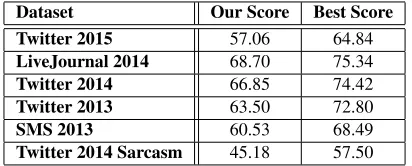
Dataset Our Score Best Score Twitter 2015 57.06 64.84 LiveJournal 2014 68.70 75.34 Twitter 2014 66.85 74.42 Twitter 2013 63.50 72.80 SMS 2013 60.53 68.49 Twitter 2014 Sarcasm 45.18 57.50
Table 2: Average positive and negative F-scores for sys-tem with all SVM features and only emoticon rules.
Table 1 reports the results of a feature abla-tion study carried out by testing the SVM classi-fier on 3204 development tweets (from SemEval 2013) not included in the training data. These are cross-validation results obtained using the hold-out method.This study helps us understand the impor-tance of different features. From the table, we can see that the word and character n-grams features are the most useful, followed by negation and then the rest. All sentiment lexicon related features appear to have similar importance, but we get the best F-score when we append them all to the feature vector.
Features Fpn Classification Rate (%)
[image:4.612.83.289.304.387.2]All Features 66.2 71.5 All Features and Rules 66.7 72.3
Table 3: Comparison between the results obtained using SVM alone, and using SVM with a rule-based layer.
Since, using all the previously described features gives the best SVM predictions, we add the
rule-based classification layer to a SVM trained on all features. Table 3 compares the results obtained us-ing the SVM alone with the results obtained usus-ing SVM along with all the rules (emoticon and lexicon-based) specified in section 2.2. We observe that the F-score further increases by around half a unit and the classification rate2increases by around 0.8.
4 Conclusion
In this paper, we described a sentiment analysis sys-tem developed by combining a SVM with a rule-based classification layer. Even though we do not get the best scores, we find that a rule-based clas-sification layer can indeed refine the SVM’s predic-tions. We also devise creative twitter-specific, nega-tion and lexicon-related features for the SVM, and demonstrate how they improve the sentiment analy-sis system. In future, we aim to use enriched senti-ment and emotion lists like the ones used by (Poria et al., 2012). We would also like to experiment with re-fining the SVM’s predictions using more rules based on complex semantics.
Acknowledgments
We wish to acknowledge the funding for this project from Nanyang Technological University under the Undergraduate Research Experience on CAmpus (URECA) programme.
[image:4.612.74.302.606.642.2]References
Erik Cambria, Amir Hussain, Catherine Havasi, Chris Eckl, and James Munro. 2010. Towards crowd val-idation of the uk national health service. WebSci10, pages 1–5.
Erik Cambria, Daniel Olsher, and Dheeraj Rajagopal. 2014. Senticnet 3: a common and common-sense knowledge base for cognition-driven sentiment anal-ysis. InTwenty-eighth AAAI conference on artificial intelligence, pages 1515–1521.
Corinna Cortes and Vladimir Vapnik. 1995. Support-vector networks. Machine learning, 20(3):273–297. Marie-Catherine De Marneffe, Bill MacCartney,
Christo-pher D Manning, et al. 2006. Generating typed de-pendency parses from phrase structure parses. In Pro-ceedings of LREC, volume 6, pages 449–454.
Andrea Esuli and Fabrizio Sebastiani. 2006. Sentiword-net: A publicly available lexical resource for opinion mining. In Proceedings of LREC, volume 6, pages 417–422.
Christiane Fellbaum. 2010. Wordnet: An electronic lexical database. 1998. WordNet is available from http://www. cogsci. princeton. edu/wn.
Kevin Gimpel, Nathan Schneider, Brendan O’Connor, Dipanjan Das, Daniel Mills, Jacob Eisenstein, Michael Heilman, Dani Yogatama, Jeffrey Flanigan, and Noah A Smith. 2011. Part-of-speech tagging for twit-ter: Annotation, features, and experiments. In Pro-ceedings of the 49th Annual Meeting of the Associa-tion for ComputaAssocia-tional Linguistics: Human Language Technologies: short papers-Volume 2, pages 42–47. Glen Coppersmith Mark Dredze Craig Harman.
Quanti-fying mental health signals in twitter.
Bernard J Jansen, Mimi Zhang, Kate Sobel, and Abdur Chowdury. 2009. Twitter power: Tweets as electronic word of mouth. Journal of the American society for in-formation science and technology, 60(11):2169–2188. Christopher Johnson, Parul Shukla, and Shilpa Shukla. 2012. On classifying the political sentiment of tweets.
cs. utexas. edu.
Bing Liu, Minqing Hu, and Junsheng Cheng. 2005. Opinion observer: analyzing and comparing opinions on the web. InProceedings of the 14th international conference on World Wide Web, pages 342–351. Saif M Mohammad and Peter D Turney. 2013.
Crowd-sourcing a word–emotion association lexicon. Com-putational Intelligence, 29(3):436–465.
Saif Mohammad, Svetlana Kiritchenko, and Xiaodan Zhu. 2013. Nrc-canada: Building the state-of-the-art in sentiment analysis of tweets. InProceedings of the seventh international workshop on Semantic Eval-uation Exercises (SemEval-2013), Atlanta, Georgia, USA, June.
Soujanya Poria, Alexander Gelbukh, Erik Cambria, Peipei Yang, Amir Hussain, and Tariq Durrani. 2012. Merging senticnet and wordnet-affect emotion lists for sentiment analysis. InSignal Processing (ICSP), 2012 IEEE 11th International Conference on, volume 2, pages 1251–1255.
Soujanya Poria, Erik Cambria, Amir Hussain, and Guang-Bin Huang. 2015. Towards an intelligent framework for multimodal affective data analysis.
Neural Networks, 63:104–116.
Sara Rosenthal, Preslav Nakov, Svetlana Kiritchenko, Saif M Mohammad, Alan Ritter, and Veselin Stoy-anov. 2015. Semeval-2015 task 10: Sentiment analy-sis in twitter. InProceedings of the 9th International Workshop on Semantic Evaluation, SemEval ’2015, Denver, Colorado, June.
Andranik Tumasjan, Timm Oliver Sprenger, Philipp G Sandner, and Isabell M Welpe. 2010. Predicting elec-tions with twitter: What 140 characters reveal about political sentiment.ICWSM, 10:178–185.
Lu Wang and Claire Cardie. 2014. A piece of my mind: A sentiment analysis approach for online dispute de-tection. InProceedings of the 52nd Annual Meeting of the Association for Computational Linguistics, vol-ume 2, pages 693–699.