WSD-games: a Game-Theoretic Algorithm for Unsupervised Word Sense
Disambiguation
Rocco Tripodi Marcello Pelillo
Ca’ Foscari University of Venice Via Torino 155
30172 Venezia, Italy
{rocco.tripodi, pelillo}@unive.it
Abstract
In this paper we present an unsupervised ap-proach to word sense disambiguation based on evolutionary game theory. In our algorithm each word to be disambiguated is represented as a node on a graph and each sense as a class. The algorithm performs a consistent class as-signment of senses according to the similarity information of each word with the others, so that similar words are constrained to similar classes. The dynamics of the system are for-mulated in terms of a non-cooperative multi-player game, where the multi-players are the data points to decide their class memberships and equilibria correspond to consistent labeling of the data.
1 Introduction
Word sense disambiguation (WSD) is the task to identify the intended sense of a word in a compu-tational manner based on the context in which it appears (Navigli, 2009). It has been studied since the beginning of NLP (Weaver, 1955) and also to-day it is a central topic of this discipline. Many algorithms have been proposed during the years, based on supervised (Zhong and Ng, 2010; Tratz et al., 2007), semi-supervised (Pham et al., 2005) and unsupervised (Mihalcea, 2005; McCarthy et al., 2007) learning models. Nowadays, even if super-vised methods perform better in general domains, unsupervised and semi-supervised models are gain-ing attention from the research community with per-formances close to the state of the art (Ponzetto and Navigli, 2010). In particular Knowledge-based and
graph based algorithms are emerging as interesting ways to face the problem (Agirre et al., 2009; Sinha and Mihalcea, 2007). The peculiarities of those al-gorithms are that they do not require any corpus evi-dence and use only the structural properties of a lex-ical database to perform the disambiguation task.
An unsupervised algorithm which has been im-plemented in different ways by the community (Mi-halcea et al., 2004; Haveliwala, 2002; Agirre et al., 2014; De Cao et al., 2010) is the PageRank (Page et al., 1999). This algorithm is similar in spirit to ours but we instead of using the graph to compute the most important nodes (senses) in it, we use the network to model the geometry of the data and the interactions among the data points. In our system the nodes of the graph are interpreted as players, in the game theoretic sense (see Section 2), which play a game in order to maximize their utility. The con-cept of utility has been used in different ways in the game theory (GT) literature and in general it refers to the satisfaction that a player derives from the out-come of a game (Szab´o and Fath, 2007). From our point of view increasing the utility of a word means increasing the textual coherence, in a distributional semantics perspective (Firth, 1957). In fact, in our framework a word always tries to chose a sense close to the senses which the other words in the text are likely to choose.
The starting point of our research is based on the assumption that the meaning of a sentence emerges from the interaction of the components which are in-volved in it. In our study we tried to model this inter-action and to develop a system in which it is possible to map lexical items onto concepts. For this reason
we decided to use a powerful tool, derived from Evo-lutionary Game Theory (EGT): the non-cooperative games (see Section 2). EGT and GT have been used in different ways to study the language use (Pietari-nen, 2007; Skyrms, 2010) and evolution (Nowak et al., 2001) but as far as we know, our is the first at-tempt to use it in a specific NLP task. This choice is motivated by the fact that GT models are able to perform a consistent labeling of the data (Hum-mel and Zucker, 1983; Pelillo, 1997), taking into ac-count the contextual information. These features are of great importance for an unsupervised algorithm which tries to perform a WSD task, because them can be obtained without any supervision and help the system to adapt to different contextual domains.
2 Game Theory
In this section we briefly introduce some concepts of GT and EGT, for detailed analysis of these top-ics we refer to (Weibull, 1997; Leyton-Brown and Shoham, 2008; Sandholm, 2010).
GT provides predictive power in interactive deci-sion situations. It has been introduced by Von Neu-mann and Morgenstern (1944) and in its normal form representation (which is the one we will use in our algorithm) it consists in: a finite set of play-ers I = (1, .., n), a set of pure strategies for each playerSi = (s1, ..., sn) and an utility functionui :
S1×...×Sn→Rwhich associates strategies to
pay-offs. The utility function depends on the combina-tion of two strategies played together, not just on the strategy of a single player. An important assumption in GT is that the players are rational and try to maxi-mize the value ofui; furthermore innon-cooperative
games the players choose their strategies indepen-dently. A strategy s∗
i is said to be dominantif and
only ifui(s∗i, s−i) > ui(si, s−i),∀s−i ∈ S−i. As
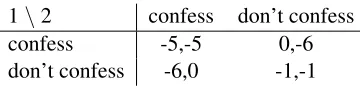
an example we can consider the famousPrisoner’s Dilemma(in Table 1) where the strategyconfessis adominant strategyfor both players and this strategy combination is the Nash equilibrium of the game. Nash equilibria are those strategy profiles which are best response to the strategy of the co-player and no player has the incentive to unilaterally deviate from his strategy, because there is no way to do better.
1\2 confess don’t confess
confess -5,-5 0,-6
[image:2.612.336.516.56.99.2]don’t confess -6,0 -1,-1
Table 1: The Prisoner’s Dilemma.
2.1 Evolutionary Game Theory
EGT has been introduce by Smith and Price (1973) overcoming some limitations of traditional GT such as the hyper-rationality imposed on the players, in fact in real life situations the players choose a strat-egy according to heuristics or social norms (Szab´o and Fath, 2007). Another important aspect of EGT is the introduction of aninductive learningprocess, in which the agents play the game repeatedly with their neighborhood, updating their believes on the state of the game and choosing their strategy accord-ingly. The strategy space of each player is defined as a probability distribution over its pure strategies. It is represented as a vector xi = (xi1, . . . , xim)
wherem is the number of pure strategies and each componentxihdenotes the probability that playeri
choose itshth pure strategy. The strategy space lies on them-dimensional standard simplex∆mwhere:
Pm
h=1xih = 1 and xih ≥ 0 for all h. The
ex-pected payoff of a pure strategyehin a single game
isu(eh, x) =eh·AxwhereAis them×mpayoff
matrix. The average payoff of all the player strate-gies isu(x, x) =Ph∈Sxhu(eh, x). In order to find
the Nash equilibria of the game it is used the repli-cator dynamic equation (Taylor and Jonker, 1978)
˙
x= [u(eh, x)−u(x, x)]·xh∀h∈S (1)
which allows better than average strategies (best replies) to grow. As in (Erdem and Pelillo, 2012) we used the discrete time version of the replicator dynamic equation:
xh(t+ 1) =xh(t)uu((ex, xh, x)) ∀h∈S (2)
where at each time step t the players update their strategies until the system converges and the Nash equilibria are found.
3 WSD Games
3.1 Graph Construction
We model the geometry of the data as a graph, with nodes corresponding to the words to be disam-biguated, denoted byI = {ij}Nj=1, where ij
corre-sponds to thej-th word andN is the number of tar-get words in a specific text. FromI we construct a N×N similarity matrixW where each elementwij
is the similarity value assigned for the words iand j. W can be exploited as an useful tool for graph-based algorithms since it is treatable as weighted ad-jacency matrix of a weighted graph.
A crucial factor for the graph construction is the choice of the similarity measure, sim(·,·) → R to weights the edges of the graph. For our ex-periments we used similarity measures which com-pute the strength of co-occurrence between any two wordsiiandij
wij =sim(ii, ij)∀i, j∈I :i6=j (3)
Specifically we used the modified Dice coheffi-cient (mDice) (Dice, 1945), the pointwise mu-tual information (P MI) (Church and Hanks, 1990) and the log likelihood ratio (D2) (Dunning, 1993)
These measure have been calculate using the Google Web1T corpus (Brants and Franz, 2006), a large col-lection of n-grams (with a window of max 5 words) occurring in one terabyte of Web documents as col-lected by Google.
At this point we have the similarity graph W, we recall that we will use this matrix in order to allow the words to play the games only with sim-ilar words. The higher the simsim-ilarity among two words, the higher the reciprocal influence and the possibility that they belong to a similar class. For this reason, at first we smooth the data in W and then choose only the most significant js for each j ∈ W. The first point is solved using a gaussian kernel on W, wij = exp (−w
2 ij
2σ2), where σ is the
kernel width parameter; the second point is solved applying ak−nearest neighboralgorithm toW, which allows us to remove the edges which are less significant for eachi ∈ I. In our experiments we used σ = 0.5 andk = 25. Moreover, this opera-tion reduces the computaopera-tional cost of the algorithm, which will focus only on relevant similarities.
3.2 The Strategy Space
In order to create the strategy space of the game, we first use WordNet (Mallery, 1995) to collect the sense inventories Mi = 1, . . . , m of each word,
wheremis the number of synsets associated to word i. Then we set all the sense inventories and obtain the list of all possible senses,C= 1, . . . , c.
We can now define the strategy space S of the game in matrix form as:
si1 si2 · · · sic
... ... · · · ...
sn1 sn2 · · · snc
where each row corresponds to the strategy space of a player and each column corresponds to a sense. Formally it is a c-dimensional space ∆c and each
mixed strategy profile lives in the mixed strategy space of the game, given by the Cartesian product
Θ =×i∈I∆i.
At this point the strategy space can be initialized with the following formula in order to follow the constraints described in Section 2.1
sij =
(
|Mi|−1, if sensejis inMi.
0, otherwise. (4)
for alli∈I andj ∈S.
3.3 The Payoff Matrix
We encoded the payoff matrix of a WSD game as a sense similarity matrix among all the senses in the strategy spaces of the game. In this way the higher the similarity among two sense candidates, the higher the incentive for a player to chose that sense, and play the strategy associated to it.
Thec×csense similarity matrixZ is defined as follows:
zij =ssim(si, sj)∀i, j∈C :i6=j (5)
run sim P R F1 math med. gen. 1 P MI 57.4 48.9 52.8 47.4 56.3 53.5
2 mDice 58.8 50.0 54.1 48.5 58.4 53.5
[image:4.612.77.295.58.105.2]3 D2 53.5 45.4 49.1 43.4 54.4 46.7
Table 2: The results of the WSD-games team at SemEval-2015 task 13. Precision, Recall and F1 in all domains and F1 in specific domains.
From Z we can obtain the partial semantic simi-larity matrix for each pair of player,Zij = m×n,
wheremandnare the senses ofiandjinZ. In a previous work (Tripodi et al., 2015) we did not use this information, instead we used labeled data points to propagate the class membership in-formation over the graph. In this new version the use of the semantic information made the algorithm completely unsupervised.
3.4 System Dynamics
Now that we have the topology of the data W, the strategy space of the gameS and the payoff matrix Z we can compute the Nash equilibria of the game according to equation (2). So in each iteration of the system each player gain its payoffs according to equation (6) which allows each payoff to be propor-tional to the similarity (wij) and to the affinity that
playerjhas to thehs strategy of playeri.
ui(eh, x) =
X
j∈Ni
((wijZij)xj)h (6)
When the system converges each player chooses the strategy with the highest value.
4 Results and Analysis
The dataset proposed by the organizers of SemEval-2015 Task 13 (Moro and Navigli, SemEval-2015) consists of five texts from three different domains: math and computer, biomedical and general. The english cor-pus is composed of 1426 instances to disambiguate and 1262 of them have been used in the evalua-tion. For our experiments we used only the instances whose lemma has an entry in WordNet 3.0 without looking up multi-words or trying to link the enti-ties to other sources such as Wikipedia or BabelNet (Navigli and Ponzetto, 2012)
We submitted three runs for our system with 1227 single words disambiguated for each run. The only
difference for each run is the similarity measure that we used to construct the graph W. For run-1 we used theP MImeasure, for run-2 themDice coef-ficient and for run-3 theD2. As we expected from
previous experiments on similar datasets, the best results have been achieved using the mDice coef-ficient (see Table 2). We obtained low recall values for all our runs and this because we did not search multi-words and did not use other sources of infor-mation for the named entities, in fact the number of named entities is limited in WordNet.
Looking more closely at the results, we noticed that we obtained a very low precision (48.5%) in the math and computer domain and this because even if the lexical entry of certain instances (eg. in text2: tab,dialog,script) have an entry in WordNet, their intended meaning is not present; it can only be ac-cessible to those systems which use BabelNet to col-lect the sense inventories. This unexpected problem affects the performances of the system because even if those instances will not be considered in the eval-uation, they have been used by other instances in our system to play the disambiguation games, compro-mising the dynamics of the system.
5 Conclusions and Future Works
We have presented an unsupervised system for WSD based on EGT which takes into account contextual similarity and semantic similarity information in or-der to perform a consistent labeling of the data. Its performances are below those of supervised systems and are comparable with unsupervised and semi-supervised systems even if on the Semeval-2015 task 13 dataset we did not use other source of infor-mation except WordNet, did not search multi-words and did not aspect that the intended meaning of some instances is not present in WordNet.
References
Eneko Agirre, Oier Lopez De Lacalle, Aitor Soroa, and Informatika Fakultatea. 2009. Knowledge-based WSD and Specific Domains: Performing Better than Generic Supervised WSD. In IJCAI, pages 1501– 1506.
Eneko Agirre, Oier Lopez de Lacalle, and Aitor Soroa. 2014. Random Walks for Knowledge-Based Word Sense Disambiguation. Computational Linguistics, 40(1):57–84.
Thorsten Brants and Alex Franz. 2006. {Web 1T 5-gram Version 1}.
Kenneth Ward Church and Patrick Hanks. 1990. Word Association Norms, Mutual Information, and Lexicog-raphy.Computational linguistics, 16(1):22–29. Diego De Cao, Roberto Basili, Matteo Luciani,
Francesco Mesiano, and Riccardo Rossi. 2010. Ro-bust and Efficient PageRank for Word Sense Disam-biguation. In Proceedings of the 2010 Workshop on Graph-based Methods for Natural Language Process-ing, pages 24–32.
Lee R. Dice. 1945. Measures of the amount of ecologic association between species. Ecology, 26(3):297–302. Ted Dunning. 1993. Accurate Methods for the Statistics of Surprise and Coincidence. Computational linguis-tics, 19(1):61–74.
Aykut Erdem and Marcello Pelillo. 2012. Graph Trans-duction as a Noncooperative Game. Neural Computa-tion, 24(3):700-723.
John R. Firth. 1957. A Synopsis of Linguistic The-ory 1930-1955. Studies in linguistic analysis. Oxford: Blackwell.
Taher H. Haveliwala. 2002. Topic-Sensitive PageRank. InProceedings of the 11th international conference on World Wide Web, pages 517–526.
Robert A. Hummel and Steven W. Zucker. 1983. On the Foundations of Relaxation Labeling Processes. Pat-tern Analysis and Machine Intelligence, IEEE Trans-actions on, (3):267–287.
Kevin Leyton-Brown and Yoav Shoham. 2008. Essen-tials of Game Theory: A Concise Multidisciplinary Introduction. Synthesis Lectures on Artificial Intelli-gence and Machine Learning, 2(1):1–88.
John C. Mallery. 1995. WordNet: a Lexical Database for English. Communications of the ACM, 38(11):39-41. Diana McCarthy, Rob Koeling, Julie Weeds, and John
Carroll. 2007. Unsupervised Acquisition of Pre-dominant Word Senses. Computational Linguistics, 33(4):553–590.
Rada Mihalcea, Paul Tarau, and Elizabeth Figa. 2004. PageRank on Semantic Networks, with Application to Word Sense Disambiguation. In Proceedings of the
20th international conference on Computational Lin-guistics, page 1126.
Rada Mihalcea. 2005. Unsupervised Large-Vocabulary Word Sense Disambiguation with Graph-Based Algo-rithms for Sequence Data Labeling. InProceedings of the conference on Human Language Technology and Empirical Methods in Natural Language Processing, pages 411–418.
Andrea Moro and Roberto Navigli. 2015. SemEval-2015 Task 13: Multilingual All-Words Sense Disambigua-tion and Entity Linking. InProceedings of SemEval-2015.
Roberto Navigli and Simone Paolo Ponzetto. 2012. Ba-belNet: The Automatic Construction, Evaluation and Application of a Wide-Coverage Multilingual Seman-tic Network.Artificial Intelligence, 193:217–250. Roberto Navigli. 2009. Word Sense Disambiguation: A
Survey.ACM Computing Surveys (CSUR), 41(2):10. Martin A. Nowak, Natalia L. Komarova, and Partha
Niyogi. 2001. Evolution of Universal Grammar. Sci-ence, 291(5501):114–118.
Lawrence Page, Sergey Brin, Rajeev Motwani, and Terry Winograd. 1999. The PageRank Citation Ranking: Bringing Order to the Web.
Siddharth Patwardhan and Ted Pedersen. 2006. Us-ing WordNet-Based Context Vectors to Estimate the Semantic Relatedness of Concepts. In Proceedings of the EACL 2006 Workshop Making Sense of Sense-Bringing Computational Linguistics and Psycholin-guistics Together, volume 1501, pages 1–8.
Marcello Pelillo. 1997. The Dynamics of Nonlinear Re-laxation Labeling Processes. Journal of Mathematical Imaging and Vision, 7(4):309–323.
Thanh Phong Pham, Hwee Tou Ng, and Wee Sun Lee. 2005. Word Sense Disambiguation with Semi-Supervised Learning. InProceedings of the National Conference on Artificial Intelligence, volume 20, page 1093.
Ahti-Veikko Pietarinen. 2007. Game theory and linguis-tic meaning.
Simone Paolo Ponzetto and Roberto Navigli. 2010. Knowledge-Rich Word Sense Disambiguation Rival-ing Supervised Systems. In Proceedings of the 48th annual meeting of the association for computational linguistics, pages 1522–1531.
William H. Sandholm. 2010.Population games and evo-lutionary dynamics.
Ravi Som Sinha and Rada Mihalcea. 2007. Unsuper-vised Graph-based Word Sense Disambiguation Using Measures of Word Semantic Similarity. InICSC, vol-ume 7, pages 363–369.
John M. Smith and George R. Price. 1973. The Logic of Animal Conflict. Nature, 246:15.
Gy¨orgy Szab´o and Gabor Fath. 2007. Evolutionary Games on Graphs. Physics Reports, 446(4):97-216. Peter D. Taylor and Leo B. Jonker. 1978. Evolutionary
Stable Strategies and Game Dynamics. Mathematical biosciences, 40(1):145–156.
Stephen Tratz, Antonio Sanfilippo, Michelle Gregory, Alan Chappell, Christian Posse, and Paul Whitney. 2007. PNNL: A Supervised Maximum Entropy Ap-proach to Word Sense Disambiguation. In Proceed-ings of the 4th International Workshop on Semantic Evaluations, pages 264–267.
Rocco Tripodi, Marcello Pelillo, and Rodolfo Delmonte. 2015. An Evolutionary Game Theoretic Approach to Word Sense Disambiguation. In Proceedings of NLPCS 2014.
John Von Neumann and Oskar Morgenstern. 1944. The-ory of Games and Economic Behavior (60th Anniver-sary Commemorative Edition).
Warren Weaver. 1955. Translation. Machine translation of languages, 14:15-23.
J¨orgen W. Weibull. 1997.Evolutionary game theory. Zhi Zhong and Hwee Tou Ng. 2010. It Makes Sense: A