Page 1 of 28
Name of Agency: Orchard Children’s Services Ltd.
Dates of inspection: 1-4 May 2018
No. of Fieldwork days: 4 days
Lead inspector: Tom Flanagan
Support inspector(s): Grace Lynam Sabine Buschmann
Type of inspection:
Announced Unannounced Full Themed
Inspection ID: 0023850
H
ealth Information and Quality Authority
Regulation Directorate
Monitoring Inspection Report -
Page 2 of 28
About monitoring
The purpose of monitoring is to safeguard vulnerable children of any age who are receiving foster care services. Monitoring provides assurance to the public that children are receiving a service that meets the requirements of quality Standards. This process also seeks to ensure that the wellbeing, welfare and safety of children is promoted and protected. Monitoring also has an important role in driving
continuous improvement so that children have better, safer lives.
The Health Information and Quality Authority (HIQA) is authorised by the Minister for Children and Youth Affairs under Section 69 of the Child Care Act, 1991 as amended by Section 26 of the Child Care (Amendment) Act 2011 to inspect services taking care of a child on behalf of the Child and Family Agency (Tusla) including non-statutory providers of foster care.
In order to drive quality and improve safety in the provision of foster care services to children, the HIQA carries out inspections to:
Assess if the service provider has all the elements in place to safeguard children
and young people and promote their well-being while placed with their service
Seek assurances from service providers that they are safeguarding children
through the mitigation of serious risks
Provide service providers with the findings of inspections so that service
providers develop action plans to implement safety and quality improvements
Inform the public and promote confidence through the publication of the
HIQA’s findings.
Monitoring inspections assess continuing compliance with the regulations and Standards, can be announced or unannounced.
This inspection report sets out the findings of a monitoring inspection against the following themes:
Theme 1: Child-centred Services Theme 2: Safe and Effective Services Theme 3: Health and Development
Theme 4: Leadership, Governance and Management Theme 5: Use of Resources
Page 3 of 28
1.
Inspection methodology
As part of this inspection, inspectors met with the relevant professionals involved in Orchard Children’s Services Limited and had discussions with foster carers.
Inspectors observed practices and reviewed documentation such as case files, foster carers’ assessment files, and relevant documentation relating to the areas covered by the theme.
During this inspection, the inspectors evaluated the:
assessment of foster carers,
safeguarding processes,
supervision, support and training of foster carers,
recruitment and retention of foster carers.
The key activities of this inspection involved:
the analysis of data,
interviews with a director of the company, the operations manager, and the
training officer,
interviews with the acting principal social worker, the acting team leader for
the support team, the team leader for the assessment team and the team leader for the social care team,
focus groups with foster carers, the assessment team and the support and
social care teams,
review of the relevant sections of foster carers’ files as they relate to the
theme.
Acknowledgements
Page 4 of 28
2.
Profile of the foster care service
The Service Provider1
Orchard Children Services Ltd. is an independent private provider of short-term, long-term and respite foster care services, and supported lodgings, which was established by social work and social care professionals in 2003. Its fostering service (Orchard Fostering Service) was developed in 2008 and became the main focus of the service in 2012. The service also carries out assessments of both relative and general foster carers for the Child and Family Agency.
The service is managed by a team that includes the operations manager, social work and social care professionals, which provides regular reports to the directors. Both the support and assessment teams are made up of professionally qualified and registered social workers. The social care team is made up of professionally qualified social care workers and provides support, therapeutic intervention and training to foster carers, their children, and children in foster care placements.
The service is based on the outskirts of Dublin City, and has foster carers in each of the four Tusla regions. A large majority of foster carers are based in the Dublin Mid-Leinster and Dublin North-East regions, with a small number of foster carers based in the South and West regions. Immediately prior to the inspection, data provided by the service showed that there were 105 children in foster placements.
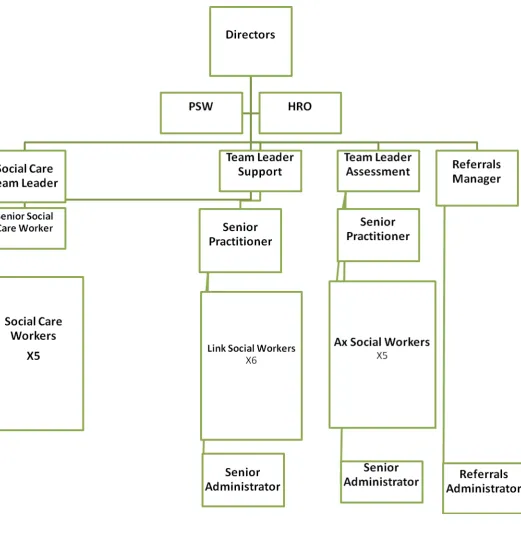
The organisational chart in Figure 1 on the following page describes the management and team structure as provided by the service.
Page 5 of 28
Figure 12 Organisational Chart:
Page 6 of 28
Summary of inspection findings
Child and family services in Ireland are delivered by a single dedicated State Agency – The Child and Family Agency (Tusla) – which is overseen by the Department of Children and Youth Affairs. The Child and Family Agency Act 2013 established the Child and Family Agency with effect from 1 January 2014.
Tusla have responsibility for a range of services, including the provision of a range of care placements for children such as statutory foster care services.
Children’s foster care services may also be provided by non-statutory foster care agencies following agreement with Tusla. Tusla retain their statutory responsibilities to children placed with these services and approve the foster carers through their foster care committees. The foster care agency is required to adhere to relevant standards and regulations when providing a service on behalf of Tusla. Both services are accountable for the care and wellbeing of children.
Private foster care services are monitored by the Child and Family Agency. Orchard fostering service provided annual data, reports on individual children in care, and updates on assessments being carried out on behalf of the Child and Family Agency. However, inspectors found that Orchard Fostering Service had not had a monitoring visit for several years. The most recent monitoring report was published in October 2013.
This report reflects the findings of the thematic inspection, relating to six standards including, safeguarding, assessment and approval, supervision and support, training, reviews, and recruitment and retention, which are set out in Section 5 of this
inspection report. The provider is required to address a number of recommendations in an action plan.
In this inspection, HIQA found that of the six national standards assessed:
• Three standards were compliant
• Three standards were substantially compliant.
This was the second inspection of Orchard fostering service by HIQA, the first having taken place in 2014. The service was well-resourced and well managed. There were systems in place to ensure that children were protected and that foster carers were well-supported.
Page 7 of 28
Foster carers could meet each other for support and were facilitated to become members of a national organisation for foster carers. There was also a dedicated out-of-hours service.
Foster carers were reviewed regularly in line with the standards and additional reviews took place, such as those following allegations or concerns. Reviews were thorough and review reports were comprehensive and well-written.
Recommendations arising from reviews were followed up in a timely way.
The service was committed to the recruitment and retention of foster carers. There were sufficient resources to deal with applications from prospective foster carers and the service demonstrated a willingness to learn from the experience of children in care and foster carers by seeking their views at the end of placements, and seeking the views of foster carers who left the service.
Safeguarding arrangements included regular An Garda Síochána (Irish police) (Garda) vetting for foster carers and adults who had significant contact with the children in care. Each foster care household had a safe care policy which was reviewed regularly. A system of unannounced visits to foster care households was also in place.
Allegations and concerns were well-managed and responded to appropriately. Appropriate action was taken to safeguard children. There were some delays in relation to the investigation of allegations and the foster care committee was not always notified in a timely manner. Not all foster carers were trained in Children First (2017) and the policies on child protection and complaints were not up to date. Assessments of prospective foster carers were comprehensive and there was good oversight by managers. There were delays in the completion of assessments but the reasons for this were recorded. The files of foster carers did not contain contracts between Tusla and the foster carers in respect of the particular children placed, as required by the regulations.
Page 8 of 28
3.
Summary of judgments under each standard and or
regulation
During this inspection, inspectors made judgments against the National Standards for Foster Care. They used four categories that describe how the national standards were met as follows. We will judge a provider to be compliant, substantially
compliant or non-compliant with the regulations and or national standards. These are defined as follows:
Compliant: a judgment of compliant means that no action is required as the
provider or person in charge (as appropriate) has fully met the standard and is in full compliance with the relevant regulation.
Substantially compliant: a judgment of substantially compliant means that
some action is required by the provider or person in charge (as appropriate) to fully meet a standard or to comply with a regulation.
Non-compliant: a judgment of non-compliance means that substantive
action is required by the provider or person in charge (as appropriate) to fully meet a standard or to comply with a regulation.
National Standards for Foster Care Judgment Theme 2: Safe and Effective Services
Standard 10: Safeguarding and child protection Substantially compliant
Standard 14a: Assessment and approval of foster
carers
Substantially compliant
Standard 15: Supervision and support Compliant
Standard 16: Training Substantially compliant
Standard 17: Reviews Compliant
Theme 5: Use of Resources
Standard 21: Recruitment and retention of an
appropriate range of foster carers
Page 9 of 28
4.
Findings and judgments
Theme 2: Safe and Effective Services
Services promote the safety of children by protecting them from abuse and neglect and following policy and procedure in reporting any concerns of abuse and or neglect to the relevant authorities. Effective services ensure that the systems are in place to promote children’s welfare. Assessment and planning is central to the identification of children’s care needs. In order to provide the care children require, foster carers are assessed, approved and supported. Each child receives the supports they require to maintain their wellbeing.
Standard 10: Safeguarding and child protection
Children and young people in foster care are protected from abuse and neglect.
Summary of inspection findings under Standard 10
Orchard fostering service had systems in place to ensure that allegations, concerns, and complaints about foster carers were categorised correctly and received the appropriate response. Their response was in line Tusla’s interim protocol for managing concerns and allegations of abuse or neglect against foster carers and Section 36 (relative) foster carers (2017).
Data provided by the service showed that there were seven allegations against foster carers in the 12 months prior to the inspection. During that time, there were also six serious concerns, a welfare concern and three other concerns that merited investigation. Inspectors reviewed five allegations and five concerns and found that all were correctly categorised. Allegations and concerns were well managed and the actions taken to ensure children were safe indicated that the children’s welfare was paramount. Orchard fostering service reported allegations and concerns to Tusla and strategy meetings were convened in a timely manner. There was evidence of good communication and collaboration between Orchard fostering service and the
Page 10 of 28
There were also delays in notifying the foster care committee and the monitoring officer of allegations and concerns. The notification forms were signed by social workers from both Orchard fostering service and social workers from Tusla and the delays in waiting for notification forms to be returned by Tusla social workers meant that some completed notification forms were not forwarded to the foster care
committee within the appropriate timeframes.
Inspectors found that Orchard fostering service took all actions necessary to safeguard children. Children’s views and concerns were taken seriously by the service. They ensured they spoke with and listened to the children and put safety plans in place.
The principal social worker was the designated liaison person for child protection. She maintained child protection files and had oversight of child protection
allegations, concerns and complaints. While she maintained a tracker for the
progress of allegations and concerns, this did not include details of all key elements of the process, including, for example, dates of notifications to the foster care committee. Furthermore, the policy on child protection had not been updated to include the changes in legislation and national guidance and recent changes in the management structures in Orchard fostering service.
Good safeguarding practices were in place. Orchard fostering service had prepared their own safeguarding statement in line with the Children First Act 2015 and
Children First: National Guidance on the Protection and Welfare of Children (Children First) (2017). Useful information and guidance to foster carers on keeping children safe was included in the foster carer handbook. Each foster care family had their own safe care policy, which was a detailed account of the family rules around keeping the children in care, the foster carers and their own children safe. The safe care policy was reviewed at foster carer reviews and when there was a new
placement of a child. In addition, in order to ensure that children were safeguarded and that foster carers were meeting their responsibilities, the service ensured that an experienced staff member, who was not the link worker, made three
unannounced visits to each foster care household during the year. Records showed that 46 such visits had been carried out in the first quarter of 2018.
Page 11 of 28
Data received prior to the inspection showed that no complaints had been made by or against foster carers in the 12 months prior to the inspection. The service had a complaints policy and the details of this were made available to foster carers in their foster carer handbook. However, the policy needed to be updated to reflect the changed structures in the service, the name and contact details of the complaints officer, the timelines for the investigation of complaints, and the arrangements for independent review should the complainant not be satisfied with the outcome. Staff and managers told inspectors that there was a culture of openness in the service and that staff felt confident in raising any concerns they might have. There was also a policy in place on whistle-blowing.
All foster carers received training on Children First (2011) as part of the foundational training before they were approved and foster carers told inspectors that training in Children First was mandatory. In October 2017, Orchard fostering service wrote to all foster carers advising them that the training in Children First (2017) was
mandatory and provided the foster carers with detailed information on the responsibilities they now had as mandated persons under the Children First Act 2015. However, while the service provided training on the new legislation and guidance, less than 50% of foster carers had attended the training at the time of inspection.
Managers were made aware promptly of all allegations and concerns, and of serious or adverse incidents. Reports, which detailed all issues of concern, were circulated to the management team and the directors each month. Minutes of the management meetings showed that these issues were a standing item on the agenda and that the principal social worker provided updates to the rest of team.
Page 12 of 28
Standard 14a: Assessment and approval of non-relative foster carers
Foster care applicants participate in a comprehensive assessment of their ability to
carry out the fostering task and are formally approved by the health board3 prior
to any child or young person being placed with them.
Summary of inspection findings under Standard 14a
There was a written policy on the assessment and approval of foster carers and there was detailed guidance for the social workers carrying out the assessments. Assessments were carried out by the assessment team, which comprised a team leader, a senior social work practitioner and six social workers.
Data provided by Orchard fostering service showed that 11 foster carers were assessed and approved in the 12 months prior to the inspection and inspectors reviewed a sample of four assessments of foster carers who had been approved during that time. Six assessments were in progress at the time of inspection. The assessments reviewed by inspectors followed the Tusla national assessment framework (2015). In general, they were comprehensive and of good quality and they contained good analysis. There was evidence that the assessing social workers visited the family homes and interviewed the applicants several times, including individual and joint interviews, and interviews with birth children or other family members where necessary. The files also showed that applicants had completed foundational training. However, although the foster care committee had approved one of these foster care houdeholds on the basis of the assessment, Orchard
fostering service were requested to re-submit the report as it was too long and some corrections needed to be made. The team leader told inspectors that the issue of lengthy reports had been discussed in assessment team meetings and that there was learning from the foster care committee feedback. However, the re-submission of the report had not taken place.
The files sampled showed that the assessing workers included all relevant information and up-to-date checks and reports in line with the guidance. This included Garda vetting, child protection checks, medical reports, references and health and safety checks.
3 These services were provided by former health boards at the time the standards were produced.
Page 13 of 28
None of the four assessments reviewed by inspectors were completed within the timeframes outlined in the national standards, with delays of between three to nine weeks evident. Explanations for the delays were recorded on the assessments and these related mainly to assessing workers being on leave or, in one case, a worker leaving the service.
There was good oversight of the assessment process by the team leader, who maintained a tracker for this purpose. The tracker was used mainly as a supervision tool, where the team leader and the assessing worker discussed the assessment, agreed timelines for various tasks and altered timelines if issues arose that may delay the assessment process. The team leader also conducted a joint visit to the applicants with the assessing worker prior to the conclusion of each assessment. There was a clear process for the approval of foster carers by the relevant local foster care committee. There was evidence that foster care applicants were given the opportunity of reading and commenting on their assessment reports prior to them being presented to the foster care committee. Assessment reports were then submitted to the foster care committee and the assessing social worker attended the meeting at which their assessments were discussed. The chair of the committee then wrote to the foster carers informing them of the decision of the committee and their approval status.
There was a due diligence process in place for foster carers transferring from another service into Orchard fostering service in line with the Tusla national policy but no such transfers had taken place in the 12 months prior to the inspection. Each file contained a copy of a generic foster care agreement between the foster carers and Orchard fostering service. However, the files did not contain contracts between Tusla and the foster carers in respect of the particular children placed, in accordance with the regulations.
Page 14 of 28
Standard 15: Support and Supervision
Approved foster carers are supervised by a professionally qualified social worker. This person, known as the link worker, ensures that foster carers have access to the information, advice and professional support necessary to enable them to provide high-quality care.
Summary of inspection findings under Standard 15
Orchard Fostering Service ensured that a variety of supports, including home visits, advice and training, respite breaks and opportunities to meet with other foster carers, were made available and foster carers were provided with good quality support and supervision.
Every foster care household had an allocated link worker, who was a professionally qualified social worker. Inspectors viewed a sample of 14 foster carers’ files and found that, while link workers did not always visit monthly in accordance with the service’s supervision policy, they visited frequently and, if monthly visits did not take place, the reasons for this, such as cancellation by the foster carers or the link worker being on leave, were clearly recorded. Formal carers’ supervision records were used to record the visits and these included sections on the needs of carers, their family and the children in care. The records were signed by the link worker and the foster carers. The supervision records seen by inspectors were of good quality. However, inspectors found that, while there were records of visits having taken place, the inclusion of typed supervision records of the most recent visits on foster carers’ files was not always timely. There was evidence that link workers knew the foster carers well and were in frequent contact with them by phone or email as well. Further supports to foster carers were provided by the social care team. This
included direct work with the children or foster carers, or both in response to identified needs. For example, life story work was undertaken with some children and trauma-informed parenting work with some foster carers. Social care workers also provided practical support for foster care households on occasion. This included the provision of transport for a variety of reasons, and support in the supervision of access. They also provided day respite for some foster care households, which
Page 15 of 28
Foster carers also received good support when caring for children with complex needs. Records showed that there was good communication between link workers and the children’s social workers and that link workers routinely attended the child in care reviews. They also carried out joint home visits with the children’s social
workers. In recognition of the importance of developing the attachment between foster carers and very young children, Orchard fostering service did not provide residential respite care to foster carers when children were under the age of three, although a case could be made for this in exceptional circumstances. Fulltime carers of children over three years of age had an entitlement to 14 days of residential respite care and a child’s needs were considered in relation to the need for further respite provision. A play therapy service was provided by a member of staff. When foster carers identified external training that was related to the needs of the children in their care, the service part-funded this training.
Due to the nature of the service, foster carers were located around the country. While there was no regular support group, the service provided a number of opportunities for foster carers to meet and support each other. Three social occasions were organised each year for foster carers and their families. Regular training events were organised and they included opportunities for foster carers to socialise and to discuss issues of interest and concern. Staff also told inspectors that the service paid the fees for all foster carers for membership of a national foster carers’ association and this provided foster carers with an additional source of information, training and support.
Twenty-four hour support was accessible to foster carers. This included a designated social worker during office hours and an on-call service, which was available to foster carers for advice and support when the office was closed, including at
weekends. The acting principal social worker told inspectors that senior members of staff, including the acting principal social worker, two team leaders and a senior social work practitioner, and the more experienced social workers were rostered to provide a back-up on call service to support social workers in the event of a serious incident or uncertainty. The service also had a weekly alert system. This was
updated by each Friday and ensured that the staff member on call was aware of issues in foster carer households that may require out-of-hours support. A foster carers’ handbook provided information on the on-call service and contained useful advice for foster carers on a range of issues, including what to do and not to do in the case of a child going missing.
Foster carers who spoke with inspectors confirmed that they received a high level of support and did not identify any deficits in this regard.
Page 16 of 28
Standard 16: Training
Foster carers participate in the training necessary to equip them with the skills and knowledge required to provide high-quality care.
Summary of inspection findings under Standard 16
Orchard fostering service was committed to the provision of good quality training for its foster carers. There was a policy on training and a training strategy. All foster carers received preparation training before approval and regular opportunities for training were provided.
The referrals manager was also the training officer. She coordinated training for foster carers and maintained oversight of the training records. She told inspectors that 12 staff members had undertaken ‘train the trainer’ courses and that, apart from bringing in external professionals to deliver training, staff also provided training to foster carers, and provided this in the foster carers’ homes when necessary. Following their approval, all foster carers had a training needs analysis carried out which identified the training that would be most helpful to them. Foster carer reviews considered the foster carers’ training history and the presenting needs in their household and made recommendations on further training. A training schedule was developed every six months, following consultation with foster carers, feedback from link workers, and a focus group of all staff. This programme was then sent to foster carers, who received text reminders of upcoming training.
Training events were held at different times, on weekdays, evenings and at weekends in order to facilitate attendance. The service had a large training room and kitchen/dining facilities in its premises. For certain training events, including preparation training, provision was made for foster carers to take their own children with them and social care workers facilitated a children’s group while their parents participated in the training. Inspectors viewed the training schedule and found that training topics for the first half of 2018 included Children First (2015), cardiac first responder, safe talk, cultural awareness, life story work, promoting children’s needs through yoga and play, grief and loss and understanding and working with children presenting with challenging behaviours. Foster carers were also supported to attend conferences and training events that they identified as meeting their particular needs.
Page 17 of 28
records were maintained in their files. There was a process of escalation in place to address the fact that some foster carers did not attend training. Initially, the link worker followed up and advised the foster carer of the requirement to attend training. The team leader then contacted the foster carers and provision was in place for a manager to meet with the foster carers and then to instigate a foster carer review which may result in no future placements until the required training was completed. However, not all foster carers attended training sessions during the 12 months prior to the inspection, which meant that the policy was not entirely effective.
Page 18 of 28
Standard 17: Reviews of foster carers
Foster carers participate in regular reviews of their continuing capacity to provide high-quality care and to assist with the identification of gaps in the fostering service.
Summary of inspection findings under Standard 17
Orchard fostering service had a system in place to ensure that good quality reviews of foster carers were carried out in line with the Standards. According to the
Standards, the first review should take place one year after the first placement and subsequent reviews should take place at three-yearly intervals. Provision should also be made for reviews to be carried out in other circumstances, such as following an allegation against foster carers. Data provided by the service showed that, of 64 foster care households in the area, 29 foster carers had a review in the 12 months prior to the inspection. Although reviews were sometimes delayed for a variety of reasons, there was a monitoring system which ensured that the reviews were carried out in as timely a manner as possible.
The team leader and administrator maintained a tracker for foster carer reviews. The tracker served to assist the team leader to ensure that foster carers had a review when required and that scheduled reviews were completed in a timely manner. The team leader received updates on preparation of reviews from the link workers in supervision. However, the tracker could be improved as it did not include the date the foster carers were approved, the date of first placement, the dates of previous reviews or of all aspects of the current review process, such as notifications to the foster care committee and submission of the final reports.
Page 19 of 28
concerns were considered, where relevant. The quality of reports in general was very good and the quality of some reports was excellent. Although the reviews of some foster carers had been carried out, the reports had not yet been finalised. Inspectors found that some reports did not include reports from the child in care social workers and managers told inspectors that, despite repeated requests to the social workers concerned, these were not forthcoming and that this delayed
submission of the review reports to the foster care committee. Inspectors viewed a tracker which contained the dates of initial and repeated requests for these reports. There was a system in place to escalate this issue with Tusla but having to do so meant that some review reports were delayed. Inspectors viewed correspondence from one foster care committee which acknowledged receipt of a review report but indicated that it would not be considered until the contribution of the child in care social worker was included.
Medical reports and health and safety assessments were updated for reviews. Garda vetting for foster carers and any adults in the foster care households was not
renewed specifically for the reviews as there was a separate system in place to ensure that Garda vetting was up to date. Foster carers were given the opportunity to contribute their views to the review, in writing and in person. The views of the children placed with the foster carers and those of the children in care social workers were sought and, when received, they were included as were the views of birth parents.
Recommendations arising from reviews were clearly set out and there was evidence that these were followed up by the link workers. For example, there were instances where particular training was recommended and evidence that the foster carers had attended this training following the review.
Page 20 of 28
Theme 5: Use of Resources
Services recruit sufficient foster carers to meet the needs of children in the area. Foster carers stay with the service and continue to offer placements to children.
Standard 21: Recruitment and retention of an appropriate range of foster carers
Health boards4 are actively involved in recruiting and retaining an appropriate
range of foster carers to meet the diverse needs of the children and young people in their care.
Summary of inspection findings under Standard 21
The recruitment of new foster carers was a central part of the work of Orchard fostering service and the recruitment strategy involved advertising regularly in a variety of media, the provision of a website which provided information to prospective foster carers, a system to ensure that enquiries were responded to quickly and sufficient staff to assess and prepare suitable candidates. Data provided to inspectors showed that seven recruitment campaigns were undertaken in the 12 months prior to the inspection. Advertisements were carried on radio, in newsletters, and on-line. From a large number of intial enquiries, the number of applicants
(including single and joint applicants) that progressed to the point of the first assessment visit was 35. Eleven foster carers were approved during the 12 months prior to the inspection.
There were sufficient resources to recruit, assess and train prospective foster carers. Initial enquiries were dealt with by the referrals administrator who was trained in this role. A social worker was assigned to carry out screening visits of potential foster carers in their homes. Guidance was provided for staff involved in this process and appropriate records were maintained. The operations manager told inspectors that the geographical location of some foster carers had presented a challenge for the service in its early years due to the distance link workers had to travel for home visits and that this was now taken into account when enquiries were dealt with. Prospective carers outside of a certain radius of the office were no longer considered and the current geographical spread of foster carers reflected this approach.
4 These services were provided by former health boards at the time the standards were produced.
Page 21 of 28
While there was evidence that the requests for placements by Tusla exceeded the number of placements available in the service, there was no legal requirement on the service to meet this demand. The referrals manager told inspectors that the service gave careful consideration to referrals/requests for placements and that a referrals meeting took place each Monday at which these requests were presented and potential matches were discussed. The service maintained a database of their foster carers and it was kept under review to ensure that staff members were aware of foster carers who had the capacity to offer placements to children. Data provided to inspectors showed that there were two placements available at the time of
inspection.
The referrals manager told inspectors that priorities for the service included getting sufficient information on the children in care so that foster carers could be well informed, arranging pre-placement meetings with the relevant professionals present, arranging appropriate transitions when possible, and assessment of risk in the cases of emergency placements.
The retention strategy of the service took the form of a commitment to support foster carers in the ways outlined under Standard 15 and an attitude of learning from the experiences of foster carers and children in care. Managers told inspectors that the caseloads of link workers were capped at a maximum of 15 foster care households in order that they could provide optimum levels of support. Data
provided to inspectors showed that, at the time of inspection, the maximum number of cases held by a link worker was thirteen, and that two newly-recruited link
workers has smaller, protected caseloads until they gained experience in the role. When placements of children came to an end, for whatever reason, the service sought the views of the children, their social workers and the foster carers.
Questionnaires were designed for this purpose and the child questionnaires viewed by inspectors were child-friendly and informative. When foster carers were leaving the service, they were offered exit interviews. Only one foster carer had taken up this offer during the 12 months prior to the inspection and inspectors viewed the record of their interview which assisted the service in understanding the experience of foster carers and in gauging the effectiveness of the support, supervision and training provided.
Page 22 of 28
Appendix 1 — Standards and regulations for statutory foster
care services
National Standards for Foster Care (April 2003) Theme 1: Child Centred Services
Standard 1: Positive sense of identity
Children and young people are provided with foster care services that promote a positive sense of identity for them.
Standard 2: Family and friends
Children and young people in foster care are encouraged and facilitated to maintain and develop family relationships and friendships.
Standard 3: Children’s Rights
Children and young people are treated with dignity, their privacy is
respected, they make choices based on information provided to them in an age-appropriate manner, and have their views, including complaints, heard when decisions are made which affect them or the care they receive.
Standard 4: Valuing diversity
Children and young people are provided with foster care services that take account of their age, stage of development, individual assessed needs, illness or disability, gender, family background, culture and ethnicity (including membership of the Traveller community), religion and sexual identity.
Child Care (Placement of Children in Foster Care) Regulations, 1995 Part III Article 8 Religion
Standard 25: Representations and complaints
Health boards5 have policies and procedures designed to ensure that children
and young people, their families, foster carers and others with a bona fide interest in their welfare can make effective representations, including complaints, about any aspect of the fostering service, whether provided
directly by a health board* or by a non-statutory agency.
5 These services were provided by former health boards at the time the standards were produced.
Page 23 of 28
Theme 2: Safe and Effective Services
Standard 5: The child and family social worker
There is a designated social worker for each child and young person in foster care.
Child Care (Placement of Children in Foster Care) Regulations, 1995 Part IV, Article 17(1) Supervision and visiting of children
Standard 6: Assessment of children and young people
An assessment of the child’s or young person’s needs is made prior to any placement or, in the case of emergencies, as soon as possible thereafter.
Child Care (Placement of Children in Foster Care) Regulations, 1995 Part III, Article 6: Assessment of circumstances of child
Standard 7: Care planning and review
Each child and young person in foster care has a written care plan. The child or young person and his or her family participate in the preparation of the care plan.
Child Care (Placement of Children in Foster Care) Regulations, 1995 Part III, Article 11: Care plans
Part IV, Article 18: Review of cases Part IV, Article 19: Special review
Standard 8: Matching carers with children and young people
Page 24 of 28
Child Care (Placement of Children in Foster Care) Regulations, 1995 Part III, Article 7: Capacity of foster parents to meet the needs of child
Child Care (Placement of Children w ith Relatives) Regulations, 1995 Part III, Article 7: Assessment of circumstances of the child
Standard 9: A safe and positive environment
Foster carers’ homes provide a safe, healthy and nurturing environment for the children or young people.
Standard 10: Safeguarding and child protection
Children and young people in foster care are protected from abuse and neglect.
Standard 13: Preparation for leaving care and adult life
Children and young people in foster care are helped to develop the skills, knowledge and competence necessary for adult living. They are given support and guidance to help them attain independence on leaving care.
Standard 14a — Assessment and approval of non-relative foster carers
Foster care applicants participate in a comprehensive assessment of their ability to carry out the fostering task and are formally approved by the health
board6 prior to any child or young person being placed with them.
Child Care (Placement of Children in Foster Care) Regulations, 1995 Part III, Article 5 Assessment of foster parents
Part III, Article 9 Contract
6 These services were provided by former health boards at the time the standards were produced.
Page 25 of 28
Standard 14b — Assessment and approval of relative foster carers
Relatives who apply, or are requested to apply, to care for a child or young person under Section 36(1) (d) of the Child Care Act, 1991 participate in a comprehensive assessment of their ability to care for the child or young person and are formally approved by the health board*.
Child Care (Placement of Children w ith Relatives) Regulations, 1995 Part III, Article 5 Assessment of relatives
Part III, Article 6 Emergency Placements Part III, Article 9 Contract
Standard 15: Supervision and support
Approved foster carers are supervised by a professionally qualified social worker. This person, known as the link worker, ensures that foster carers have access to the information, advice and professional support necessary to enable them to provide high-quality care.
Standard 16: Training
Foster carers participate in the training necessary to equip them with the skills and knowledge required to provide high-quality care.
Standard 17: Reviews of foster carers
Foster carers participate in regular reviews of their continuing capacity to provide high-quality care and to assist with the identification of gaps in the fostering service.
Standard 22: Special Foster care
Health boards7 provide for a special foster care service for children and
young people with serious behavioural difficulties.
7 These services were provided by former health boards at the time the standards were produced.
Page 26 of 28
Standard 23: The Foster Care Committee
Health boards* have foster care committees to make recommendations regarding foster care applications and to approve long-term placements. The committees contribute to the development of health boards’ policies,
procedures and practice.
Child Care (Placement of Children in Foster Care) Regulations, 1995 Part III, Article 5 (3) Assessment of foster carers
Child Care (Placement of Children w ith Relatives) Regulations, 1995 Part III, Article 5 (2) Assessment of relatives
Theme 3: Health and Development
Standard 11: Health and development
The health and developmental needs of children and young people in foster care are assessed and met. They are given information, guidance and support to make appropriate choices in relation to their health and development.
Child Care (Placement of Children in Foster Care) Regulations, 1995 Part III, Article 6 Assessment of circumstances of child
Part IV, Article 16 (2)(d) Duties of foster parents
Standard 12: Education
Page 27 of 28
Theme 4: Leadership, Governance and Management
Standard 18: Effective policies
Health boards* have up-to-date effective policies and plans in place to
promote the provision of high quality foster care for children and young people who require it.
Child Care (Placement of Children in Foster Care) Regulations, 1995 Part III, Article 5 (1) Assessment of foster carers
Standard 19: Management and monitoring of foster care agency
Health boards8 have effective structures in place for the management and
monitoring of foster care services.
Child Care (Placement of Children in Foster Care) Regulations, 1995 Part IV, Article 12 Maintenance of register
Part IV, Article 17 Supervision and visiting of children
Standard 24: Placement of children through non-statutory agencies
Health boards* placing children or young people with a foster carer through a non-statutory agency are responsible for satisfying themselves that the
statutory requirements are met and that the children or young people receive a high-quality service.
Child Care (Placement of Children in Foster Care) Regulations, 1995 Part VI, Article 24: Arrangements with voluntary bodies and other persons
Theme 5: Use of Resources
Standard 21: Recruitment and retention of an appropriate range of foster carers
Health boards*are actively involved in recruiting and retaining an appropriate
range of foster carers to meet the diverse needs of the children and young
8 These services were provided by former health boards at the time the standards were produced.
Page 28 of 28 people in their care.
Theme 6: Workforce
Standard 20: Training and Qualifications
Health boards∗ ensure that the staff employed to work with children and
young people, their families and foster carers are professionally qualified and suitably trained.
∗ These services were provided by former health boards at the time the standards were produced.
1
Action plan
Please note that this action plan has been completed by the provider and accepted by HIQA.
HIQA has not made any amendments to the provider’s comments and commitments in this action plan.
Provider’s response to
monitoring report number: 0023850
Name of Provider: Orchard Children’s Services Ltd.
Date of inspection:
1-4 May 2018
2
These requirements set out the actions that should be taken to meet the identified child care regulations and National Standards for Foster Care.
Theme 2: Safe and Effective Services Standard 10: Safeguarding and Child Protection
Judgment: Substantially compliant
The provider is failing to meet the national standards in the following respect:
There were delays in notifying allegations and serious concerns to the foster care committee.
The tracker for allegations and concerns did not include all elements of the process.
Not all foster carers were trained in Children First (2017). The policy on child protection was not up to date.
The policy and procedures on complaints was not up to date.
Action required:
Under Standard 10 you are required to ensure that:
Children and young people in foster care are protected from abuse and neglect.
Please state the actions you have taken or are planning to take:
1. All social workers will notify the Foster Care Committee within 5 days of
receipt of an allegation and serious concern.
2. The Serious Concern/Allegation register has been amended to include
specific sections on :
• When a notification is sent to the Foster Care Committee and if it is
within policy timeframe.
• Why there was a delay in sending a notification.
• An escalation section for staff to use if the reason for a delay in
notifying the Foster Care Committee falls to an outside organisation.
• The outcome and recommendations of any investigation carried out.
• What follow up is required and the person responsible for this.
3. All foster carers have been written to and are aware they all must complete
Childrens First (2017) by the 31st of August 2018 and submit their
3
4. The Child Protection policy has been updated. The policy reflects the
changes in legislation and organisational structure, it is stored alongside Orchards Safety Statement visible to all staff within the office.
5. The policy and procedures on complaints has been updated and the
“Information for you” received by every child in care has also been updated to reflect all changes made within the complaint policy.
Proposed timescale: Person responsible:
1. 23rd of July 2018
2. Completed 15th of June 2018
3. By the 31st of August 2018
4. Completed 15th of June 2018
A/PSW
Support team and A/PSW
4
Standard 14a — Assessment and approval of non-relative foster carers Judgment: Substantially compliant
The provider is failing to meet the national standards in the following respect:
One assessment report had not been re-submitted to the foster care committee as requested.
The files did not contain contracts between Tusla and the foster carers in respect of the particular children placed, in accordance with the regulations.
Action required:
Under Standard 14a you are required to ensure that:
Foster care applicants participate in a comprehensive assessment of their ability to
carry out the fostering task and are formally approved by the health board* prior
to any child or young person being placed with them.
Please state the actions you have taken or are planning to take:
1) The assessment report was re - submitted to the Foster Care Committee
on the 4th of May 2018.
2) Orchard Childrens Services will liase with Tusla regarding contracts and
plan to explore developing their own after consultation.
Proposed timescale: Person responsible:
1. Completed on the 4th of May
2018.
2. 31st of August 2018.
Assessment team leader
Assessment team leader and HROM
* These services were provided by former health boards at the time the standards were produced.
5
Standard 16: Training
Judgment: Substantially compliant
The provider is failing to meet the national standard in the following respect:
Not all foster carers attended training sessions during the 12 months prior to the inspection.
Action required:
Under Standard 16 you are required to ensure that:
Foster carers participate in the training necessary to equip them with the skills and knowledge required to provide high-quality care.
Please state the actions you have taken or are planning to take:
1. All training completed with carers during monthly supervisions by
Orchard staff will be logged in the carers training folder. Link social workers will notify their team leaders and training coordinator every 6 months of how much training the carers have and need to attend.
2. Orchard will continue to provide foster carers with 6 monthly training
schedules, support with child care and transport to training will continue.
3. Orchard aims to develop an incentive scheme to encourage carers to
attend training.
Proposed timescale: Person responsible:
1. To begin on the 31st of July and
reviewed every 6 months.
2. 10th of July 2018- training
calendar for the following 6 months sent to carers.
3. 31st of August 2018.
Training Coordinator, Support team leader and social workers
Training Coordinator and administrator