Semantic annotation to characterize contextual variation in
terminological noun compounds: a pilot study
Melania Cabezas-Garc´ıa LexiCon Research Group
University of Granada Granada, Spain
Antonio San Mart´ın LexiCon Research Group
Maynooth University Maynooth, Ireland
Abstract
Noun compounds (NCs) are semantically complex and not fully compositional, as is often assumed. This paper presents a pilot study regarding the semantic anno-tation of environmental NCs with a view to accessing their semantics and explor-ing their domain-based contextual varia-tion. Our results showed that the semantic annotation of NCs afforded important in-sights into how context impacts their con-ceptualization.
1 Introduction
In English, noun compounds (NCs) are the lexi-cal units that are most often used to convey expert knowledge (Daille et al., 2004; Nakov, 2013; Hen-drickx et al., 2013). Terminological NCs can be considered a type of multi-word term (MWT) be-cause they are non-idiomatic multi-word units that belong to a specialized domain and lie in the inter-section between terms and multi-word expressions (MWEs) (SanJuan et al., 2005; Frantzi et al., 2000; Ramisch, 2015). They are characterized by their semantic complexity since two or more concepts are juxtaposed without any explicit indication of the relation linking them ( ´O S´eaghdha and Copes-take, 2013). This relation is determined largely by the context and the frame (i.e. system of concepts related in such a way that one concept evokes the entire system (Fillmore, 1982)) to which the NC belongs. In other words, they are not fully compo-sitional and their conceptualization can differ de-pending on the context and the semantic frame in which it is embedded.
This paper describes the use of semantic anno-tation to explore how domain-based context mod-ulates the meaning of NCs. To this end, the anno-tated concordance lines were used to identify and
analyze the argument structure of the propositions underlying this kind of MWT. The micro-contexts (i.e. the relation of a predicate with its arguments and adjuncts) are directly related to the semantic load of the compound term, because they spec-ify the hidden relation between its components (Cabezas-Garc´ıa and Faber, 2016).
In the following section, a short account of the particularities of NCs and the phenomenon of con-textual variation is provided. Then, section 3 de-scribes the materials and methods used in this pilot study. Section 4 expounds the results of the study and discusses their significance. Finally, section 5 presents the conclusions derived from this re-search and mentions the issues that will be ad-dressed in future work.
2 Contextual Variation in Noun Compounds
2.1 Noun Compounds
NCs are very frequent in specialized texts writ-ten in English (Daille et al., 2004; Nakov, 2013; Hendrickx et al., 2013). They are a sequence of nouns that function as a single noun (Downing, 1977), e.g., water lossor population growth. In endocentric NCs, one term is the head and the other is its modifier (Nakov, 2013) (e.g., power generation). Alternatively, in exocentric NCs, the MWT is not a hyponym of one of its elements, and thus appears to lack a head (Bauer, 2008) (e.g. saber tooth). Endocentric NCs (the focus of this study) are characterized by their (i) headedness; (ii) transparency, (iii) syntactic ambiguity; and (iv) language-dependency (Nakov, 2013).
NCs have underlying propositions, which can be inferred by the term formation processes high-lighted in Levi (1978), involving predicate dele-tion (e.g. power system, instead of a system pro-duces power) and predicate nominalization (e.g.
heat transfer, instead of heat is transferred). These propositions underlying the NCs take the form of a predicate with its arguments, which are necessary for the meaning of the verb, and its ad-juncts (optional complements) (Tesni`ere, 1976). The relation of a predicate to its argument struc-ture is known as micro-context. This is a key fac-tor that provides access to the conceptual load of terms, since the predicate, which is the syntactic-semantic core of the sentence, can only be success-fully addressed through its complement structure (Cabezas-Garc´ıa and Faber, 2016).
2.2 Contextual Variation
The notion of context plays a crucial role in var-ious disciplines that employ it in different ways. In this paper, context refers to any factor that af-fects the interpretation of a sign or an expres-sion (Kecskes, 2014). This sense includes lin-guistic factors (different types of co-text), dis-cursive factors (channel, communicative purpose, degree of formality, topic, and level of special-ization), sociocultural factors (social activity in which communication is embedded, and the rela-tion between participants) as well as spatiotempo-ral factors (San Mart´ın, 2016).
Lexical units do not carry meaning in them-selves, but rather trigger the mental representation of meaning in context (Fauconnier, 1994). Mean-ing is construed in every usage event. Depend-ing on the context, certain segments of the knowl-edge conventionally associated with a lexical unit are activated and give rise to meaning. Therefore, meaning does not exist outside of context. With-out contextual restrictions, lexical units can be said to have semantic potential, which is all the con-ceptual content that a lexical unit is capable of in-voking (Evans, 2009). The semantic potential of a lexical unit constitutes a considerable amount of information, all of which is never fully activated in a single use event. It includes one or more con-cepts and their underlying conceptual frames.
Given that context is never identical, the mean-ing of a lexical unit is variable. This phenomenon by which the semantic potential of a lexical unit produces different meanings depending on the context is called contextual variation. Although in practice, it is sometimes difficult to distinguish between a high degree of contextual variation and polysemy, these two phenomena are theoretically different. Polysemy occurs when the semantic
po-tential of a lexical unit refers to more than one con-cept. For example,organismis a polysemic term because it designates two different concepts: OR -GANISM(living being) andORGANISM(system or
organization). In contrast,ozoneis an example of contextual variation because it designates a single concept (OZONE). Whenozoneappears in the
con-text of Atmospheric Science, it is conceptualized as an important allotropic form of oxygen that is present in the atmosphere. However, in the context of Water Treatment and Supply, it is conceived as a powerful virucidal agent used to disinfect water. In this paper, we focus on domain-based contex-tual variation because discourse topic is the con-textual factor that best predicts how the seman-tic potential of a term is restricted in actual usage events (San Mart´ın, 2016). In our analysis,domain is synonymous toknowledge field.
3 Materials and Methods
A corpus of English texts on environmental sci-ence was manually compiled. The corpus con-sisted of 4,743,025 tokens, and was composed of 16 subcorpora of specialized and semi-specialized texts. Each subcorpus had approximately 300,000 tokens and focused on a specific environmental domain (e.g. Agronomy, Hydrology, etc.).
Each subcorpus was uploaded separately to the term extractor TermoStat (Drouin, 2003) (http://termostat.ling.umontreal.ca/). The search was set to complex terms. The 16 resulting lists of terms were automatically compared. In order to ensure representativeness and significant con-textual variation, we only retained the two-term NCs designating processes that had a minimum of 10 occurrences in at least three subdomains (i.e. 10 NCs in total). The MWTs chosen were those designating processes because these units have un-derlying propositions with a clear argument struc-ture, thus enabling the analysis of micro-contexts (i.e. the relation between a predicate and its argu-ments and adjuncts), which are key factors in the conceptualization of this kind of MWT (Cabezas-Garc´ıa and Faber, 2016). This pilot study focuses solely on the analysis ofwater loss, with a view to developing an annotation protocol for the rest of MWTs.
gen-erate concordance lines, which were subsequently processed with an annotation tool. As previously mentioned, NCs designating processes all have underlying propositions. Nakov and Hearst (2006) confirmed that verb paraphrases are useful for disambiguating these compound terms and eliciting their meaning. Thus, in order to access the concordances that allude to the semantics of the MWT in question, we not only downloaded the concordance lines where the NC appeared but also the concordances where paraphrases had been used (see Figure 1).
allows you to record how much water is lost through evaporation over a ti of the unavoidable irrigation water losses percolating down into the und
ration. This is a combination of water lost by evaporation from the soil eption loss. In general, more water is lost from a forested catchment tha
of a stone mulch is to reduce water loss from the soil and to eliminat
Figure 1: Concordance lines ofwater loss and its verb paraphrases in the domain of Hydrology.
For example, in the case ofwater loss, concor-dance lines such as “...combination of water lost by evaporation from...” were analyzed, as well as those where the NC occurred. This made it pos-sible to access a larger number of examples of the process conveyed bywater loss (i.e. “aSOURCE
ceases to have [LOSE] aPATIENT[WATER]”). The
loss process is encoded by verbs conveying a sim-ilar meaning though from different perspectives (e.g.lose,evaporate,extract,release, etc.).
The next step was the annotation of the con-cordance lines, following the semantic annota-tion methodology in L’Homme (2012), which is based on FrameNet (Ruppenhofer et al., 2010). Two human annotators, who established a com-mon tagset and guidelines, annotated the concor-dance lines with the help of the UAM CorpusTool (O’Donnell, 2008) (http://www.corpustool.com/), an open-source environment for the annotation of text corpora. This tool also allows users to search the corpus, perform statistical studies, analyze file information, etc. The semantic labels1used were:
(i)PREDICATIVE TERM, (ii)ARGUMENT, and (iii) ADJUNCT. The predicative term was further
spec-ified as VERB or NOUN, and the arguments and 1It is well-known that the distinction between arguments and adjuncts and the choice of the number and types of se-mantic labels is problematic. Although this did not cause problems in this work (due to the limited coverage of this pilot study), it is an issue that will be carefully considered in further research.
adjuncts asAGENT,PATIENT,SOURCE,TIME,LO -CATION,RESULT,CAUSE, MANNER,QUANTITY, MEDIUM, DESTINATION, INSTRUMENT, or AIM.
The annotation was performed on all the concor-dance lines given the limited size of the study, but larger annotation tasks would benefit from a selec-tion of contexts, as proposed in L’Homme and Pi-mentel (2012). Once the texts were annotated, the UAM Corpus Tool software generated summaries of the linguistic designations that filled the argu-ments and adjuncts slots depending on the con-textual domain, and their frequency of occurrence, which were subsequently compared.
4 Results and Discussion
The analysis of the NCs by means of seman-tic annotation afforded insights into their specific conceptualization for each given contextual do-main. Thanks to the annotated concordances, it was possible to compare the conceptualization of the micro-contexts of the NCs in each contextual domain. Particularly, we made use of the auto-matic generation of lists of the linguistic instanti-ations that filled each argument and adjunct slots, depending on the contextual domain. This allowed the characterization and analysis of the argument structure of the predicate (see Figure 2).
In a hypertonic environment[AD:LOCATION], most
prokaryotes[AR:SOURCE] lose[PT:VERB] water[AR:PATIENT] and shrink
away from their wall (plasmolyze).
For example, marine fishes[AR:SOURCE], such as the cod in Figure
44.4a, constantly[AD:MANNER] lose[PT:VERB] water[AR:PATIENT] by
osmosis[AD:CAUSE].
Despite these and other adaptations, most terrestrial animals[AR:SOURCE] lose[PT:VERB] water[AR:PATIENT] through many
routes: in urine[AD:MEDIUM] and feces[AD:MEDIUM], across their
skin[AD:MEDIUM], and from the surfaces of gas exchange
organs[AD:MEDIUM].
Figure 2: Annotation of propositions underlying water lossin the domain of Biology.
Since the linguistic realizations of the argu-ments and adjuncts were summarized in the an-notation tool, it was possible to compare the con-ceptualization of the NC, thus allowing the char-acterization of contextual variation.
in NCs is reflected in their argument structure. In other words, the arguments and adjuncts of the predicate underlying a NC, such as water loss, were filled by different conceptual categories, de-pending on the contextual domain.
In regard to water loss, the contextual varia-tion was found to manifest itself in the SOURCE
of water loss, an argument that is not explicit in the compound. This means that the SOURCE(as
reflected in its linguistic designations and those of the adjuncts) varies, depending on the special-ized domain. When used in Agronomy, the wa-ter loss SOURCE was usually a plant entity (e.g.
plant, leaf, etc.). In contrast, in Hydrology, this
SOURCE was generally a waterbody (e.g. river,
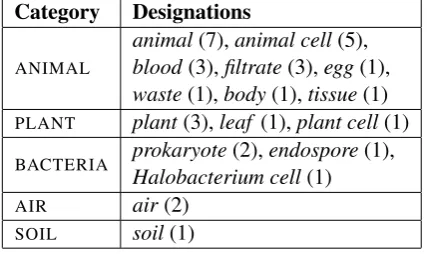
aquifer, lake, etc.). Finally, in Biology, the pref-erence was for animals (e.g. animal,animal cell, blood, etc.) or some type of living organism. Ta-ble 1 shows the linguistic instantiations of the wa-ter loss SOURCEin Biology, which highlight the
frequency of animal entities in this argument slot.
Category Designations
ANIMAL
animal(7),animal cell(5), blood(3),filtrate(3),egg(1), waste(1),body(1),tissue(1)
PLANT plant(3),leaf (1),plant cell(1) BACTERIA prokaryoteHalobacterium cell(2),endospore(1) (1),
AIR air(2)
[image:4.595.75.289.362.489.2]SOIL soil(1)
Table 1: Linguistic designations (with frequency of occurrence) filling theSOURCEargument in
Bi-ology forwater loss.
As previously noted, depending on the domain context (Biology, Agronomy or Hydrology), the argument slot (i.e. SOURCEofwater loss) is
des-ignated by a different set of semantically related units. Furthermore, this preference for a specific semantic category in the argument determining the variation (i.e. SOURCEofwater loss) is reflected
in the linguistic realizations of the adjuncts. For example, in Agronomy, theSOURCE argument is
filled by plant entities, and the most frequent ad-juncts wereMEDIUMorCAUSEwith linguistic
re-alizations that also belong to the vegetable king-dom: stomaandleaf, andtranspirationand evap-oration, respectively.
Moreover, even though the same NC (water loss) sometimes involved the same SOURCE
(wa-terbody), its conceptualization was found to have different nuances in each context. For instance, when comparing water loss from a waterbody in the domains of Agronomy and Hydrology, it was found that their conceptualizations differed. Whereas in Agronomy texts,water lossgenerally referred to the natural loss of water, in Hydrology texts, water loss referred to an artificial process with specific purposes.
This was reflected in the adjuncts and their lin-guistic realizations. For example, the INSTRU -MENTadjunct in Hydrology texts was mainly
des-ignated by manmade structures, such as canal, well, aqueduct, floodgate, etc. Contextual differ-ences were also evident in the verbs used in the paraphrases. More specifically in Agronomy, the most frequent predicates werelose,evaporate, re-move, transpire, absorb, draw, leave, and move, whereas in Hydrology, there was a preference for predicates with a human/instrument AGENT (e.g.
extract, release, transmit, transfer, draw, divert, andabstract).
The analysis of micro-contexts and of the lin-guistic realizations of the arguments and adjuncts was also found to be a useful method for frame-based terminological management (Faber, 2015; L’Homme, 2016). When the argument structure ofwater lossand its linguistic realizations are an-alyzed, a general picture of the conceptualization of the MWT in each subdomain can be obtained. For instance, this analysis reveals the type of enti-ties that can lose water, the medium in which water is lost, the causes and results of the water loss, etc. For this reason, the identification and annotation of the arguments and adjuncts of the verbs pro-vide insights into the conceptualization of terms and their relations with concepts in larger frames.
5 Conclusions
that the semantic annotation of micro-contexts is an effective technique to study the conceptualiza-tion of NCs, namely those representing special-ized processes.
In future work, a more in-depth research on the advantages of semantic annotation will be carried out with a view to identifying the role of micro-contexts in NC formation. For the characterization of the different phenomena arising from domain-based contextual variation in MWTs, we also plan to further refine our semantic annotation method-ology using WordNet synsets and combine them with the extraction of semantic relations by means of knowledge patterns.
We will also implement the semantic annotation of MWTs for the modeling of this kind of term in the environmental terminological knowledge base EcoLexicon (http://ecolexicon.ugr.es/). Since both endeavors will be multilingual, the results will ul-timately be applied to the development of transla-tion rules for MWTs.
Acknowledgements
This research was carried out as part of project FF2014-52740-P, Cognitive and Neurolog-ical Bases for Terminology-enhanced Translation (CONTENT), funded by the Spanish Ministry of Economy and Competitiveness. Funding was also provided by an FPU grant given by the Spanish Ministry of Education to the first author. Finally, we would like to thank the anonymous reviewers for their useful comments.
References
Laurie Bauer. 2008. Les compos´es exocentriques de l’anglais. In D. Amiot, editor,La composition dans une perspective typologique, pages 35–47. Artois Presses Universit´e, Arras.
Melania Cabezas-Garc´ıa and Pamela Faber. 2016. Exploring the Semantics of Multi-word Terms by Means of Paraphrases. InEnTRetextos International Conference on Specialized Translation, Valencia.
B´eatrice Daille, Samuel Dufour-Kowalski, and Em-manuel Morin. 2004. French-English multi-word term alignment based on lexical context analysis. In Proceedings of the Fourth International Conference on Language Resources and Evaluation (LREC’04), pages 919–922.
Pamela Downing. 1977. On the creation and use of English compound nouns. Language, (53):810–842.
Patrick Drouin. 2003. Term extraction using non-technical corpora as a point of leverage. Terminol-ogy, 9(1):99–115.
Vyvyan Evans. 2009.How Words Mean: Lexical Con-cepts, Cognitive Models, and Meaning Construc-tion. Oxford University Press, Oxford.
Pamela Faber. 2015. Frames as a framework for termi-nology. In Hendrik Kockaert and Frieda Steurs, ed-itors,Handbook of Terminology, pages 14–33. John Benjamins, Amsterdam / Philadelphia.
Gilles Fauconnier. 1994. Mental spaces: aspects of meaning construction in natural language. Cam-bridge University Press, CamCam-bridge, New York.
Charles Fillmore. 1982. Frame Semantics. In The Linguistic Society of Korea, editor, Linguistics in the morning calm. Selected papers from SICOL-1981, pages 111–137. Hanshin Publishing Com-pany, Seoul.
Katerina Frantzi, Sophia Ananiadou, and Hideki Mima. 2000. Automatic recognition of multi-word terms: The C-value/NC-value method. Interna-tional Journal on Digital Libraries, 3(2):115–130.
Iris Hendrickx, Zornitsa Kozareva, Preslav Nakov, Di-armuid ´O S´eaghdha, Stan Szpakowicz, and Tony Veale. 2013. SemEval-2013 Task 4: Free Para-phrases of Noun Compounds. InSecond Joint Con-ference on Lexical and Computational Semantics (*SEM), Volume 2: Proceedings of the Seventh In-ternational Workshop on Semantic Evaluation (Se-mEval 2013), volume 2, pages 138–143.
Istvan Kecskes. 2014. Intercultural Pragmatics. Ox-ford University Press, OxOx-ford, New York.
Adam Kilgarriff, V´ıt Baisa, Jan Buˇsta, Miloˇs Jakub´ıˇcek, Vojtˇech Kov´a, Jan Michelfeit, Pavel Rychl´y, and V´ıt Suchomel. 2014. The Sketch En-gine: ten years on. Lexicography, 1(1):7–36.
Judith Levi. 1978. The Syntax and Semantics of Com-plex Nominals. Academic Press, New York.
Marie-Claude L’Homme and Janine Pimentel. 2012. Capturing Syntactico-semantic Regularities among Terms : An Application of the FrameNet Methodol-ogy to TerminolMethodol-ogy. InProceedings of LREC 2012, pages 262–268, Istanbul.
Marie-Claude L’Homme. 2012. Adding syntactico-semantic information to specialized dictionaries: an application of the FrameNet methodology. Lexico-graphica, 28(1):233–252.
Preslav Nakov and Marti A. Hearst. 2006. Using Verbs to Characterize Noun-Noun Relations. Artificial In-telligence Methodology Systems and Applications, 4183:233–244.
Preslav Nakov. 2013. On the interpretation of noun compounds: Syntax, semantics, and entailment. Natural Language Engineering, 19(03):291–330. Diarmuid ´O S´eaghdha and Ann Copestake. 2013.
In-terpreting compound nouns with kernel methods. Natural Language Engineering, 19(3):331–356. Mick O’Donnell. 2008. Demonstration of the UAM
CorpusTool for text and image annotation. In Pro-ceedings of the ACL-08:HLT Demo Session, number June, pages 13–16, Columbus, Ohio.
Carlos Ramisch. 2015. Multiword Expressions Acqui-sition: A Generic and Open Framework. Springer, Cham.
Josef Ruppenhofer, Michael Ellsworth, Miriam R. L. Petruck, and Jan Johnson, Christopher R. Schef-fczyk. 2010. Framenet II: Extended theory and practice.
Antonio San Mart´ın. 2016. La representaci´on de la variaci´on contextual mediante definiciones ter-minol´ogicas flexibles. Ph.D. thesis, University of Granada.
Eric SanJuan, James Dowdall, Fidelia Ibekwe-SanJuan, and Fabio Rinaldi. 2005. A symbolic approach to automatic multiword term structuring. Computer Speech and Language, 19(4):524–542. Lucien Tesni`ere. 1976. El´ements de syntaxe