One Representation per Word —
Does it make Sense for Composition?
Thomas Kober, Julie Weeds, John Wilkie, Jeremy Reffin and David Weir TAG laboratory, Department of Informatics, University of Sussex
Brighton, BN1 9RH, UK
{t.kober, j.e.weeds, jw478, j.p.reffin, d.j.weir}@sussex.ac.uk
Abstract
In this paper, we investigate whether an
a prioridisambiguation of word senses is strictly necessary or whether the meaning of a word in context can be disambiguated through composition alone. We evaluate the performance of off-the-shelf single-vector and multi-sense single-vector models on a benchmark phrase similarity task and a novel task for word-sense discrimination. We find that single-sense vector models perform as well or better than multi-sense vector models despite arguably less clean elementary representations. Our findings furthermore show that simple composition functions such as pointwise addition are able to recover sense specific information from a single-sense vector model remark-ably well.
1 Introduction
Distributional word representations based on counting co-occurrences have a long history in natural language processing and have successfully been applied to numerous tasks such as sentiment analysis, recognising textual entailment, word-sense disambiguation and many other important problems. More recently low-dimensional and dense neural word embeddings have received a considerable amount of attention in the research community and have become ubiquitous in numer-ous NLP pipelines in academia and industry. One fundamental simplifying assumption commonly made in distributional semantic models, however, is that every word can be encoded by a single rep-resentation. Combining polysemous lexemes into a single vector has the consequence of essentially creating a weighted average of all observed mean-ings of a lexeme in a given text corpus.
Therefore a number of proposals have been made to overcome the issue of conflating several different senses of an individual lexeme into a single representation. One approach (Reisinger and Mooney, 2010; Huang et al., 2012) is to try directly inferring a predefined number of senses from data and subsequently label any occurrences of a polysemous lexeme with the inferred inven-tory. Similar approaches are proposed by Reddy et al. (2011) and Kartsaklis et al. (2013) who show that appropriate sense selection or disambigua-tion typically improves performance for compo-sition of noun phrases (Reddy et al., 2011) and verb phrases (Kartsaklis et al., 2013). Dinu and Lapata (2010) proposed a model that represents the meaning of a word as a probability distribu-tion over latent senses which is modulated based on contextualisation, and report improved perfor-mance on a word similarity task and the lexi-cal substitution task. Other approaches leverage an existing lexical resource such as BabelNet or WordNet to obtain sense labelsa priori to creat-ing word representations (Iacobacci et al., 2015), or as a postprocessing step after obtaining initial word representations (Chen et al., 2014; Pilehvar and Collier, 2016). While these approaches have exhibited strong performance on benchmark word similarity tasks (Huang et al., 2012; Iacobacci et al., 2015) and some downstream processing tasks such as part-of-speech tagging and relation identi-fication (Li and Jurafsky, 2015), they have been weaker than the single-vector representations at predicting the compositionality of multi-word ex-pressions (Salehi et al., 2015), and at tasks which require the meaning of a word to be considered in context; e.g, word sense disambiguation (Ia-cobacci et al., 2016) and word similarity in con-text (Iacobacci et al., 2015).
In this paper we consider what happens when distributional representations are composed to
form representations for larger units of meaning. In a compositional phrase, the meaning of the whole can be inferred from the meaning of its parts. Thus, assuming compositionality, the rep-resentation of a phrase such asblack mood, should be directly inferable from the representations for
black and for mood. Further, one might suppose that composing the correct senses of the individ-ual lexemes would result in a more accurate repre-sentation of that phrase. However, our counter-hypothesis is that the act of composition con-textualises or disambiguates each of the lexemes thereby making the representations of individual senses redundant. We investigate this hypothe-sis by evaluating the performance of single-vector representations and multi-sense representations at both a benchmark phrase similarity task and at a novel word-sense discrimination task.
Our contributions in this work are thus as fol-lows. First, we provide quantitative and qualita-tive evidence that even simple composition func-tions have the ability to recover sense-specific in-formation from a single-vector representation of a polysemous lexeme in context. Second, we in-troduce a novel word-sense discrimination task1, which can be seen as the first stage of word-sense disambiguation. The goal is to find whether the occurrences of a lexeme in two or more senten-tial contexts belong to the same sense or not, with-out necessarily labelling the senses. While it has received relatively little attention in recent years, it is an important natural language understanding problem and can provide important insights into the process of semantic composition.
2 Evaluating Distributional Models of Composition
For evaluation we use several readily available off-the-shelf word embeddings, that have al-ready been shown to work well for a number of different NLP applications. We compare the 300-dimensional skip-gramword2vec(Mikolov et al., 2013) word embeddings2 to the depen-dency based version ofword2vec— henceforth dep2vec3(Levy and Goldberg, 2014) — and the
1Our task is available fromhttps://github.com/ tttthomasssss/sense2017
2Available from:https://code.google.com/p/ word2vec/
3Available from: https://levyomer. wordpress.com/2014/04/25/
dependency-based-word-embeddings/
SENSEMBED model4 by Iacobacci et al. (2015), which creates word-sense embeddings by per-forming word-sense disambiguation prior to run-ningword2vec.
We note that word2vec and dep2vec use a single vector per word approach and therefore conflate the different senses of a polysemous lex-eme. On the other hand, SENSEMBEDutilises Ba-belfy (Moro et al., 2014) as an external knowledge source to perform word-sense disambiguation and subsequently creates one vector representation per word sense.
For composition we use pointwise addition for all models as this has been shown to be a strong baseline in a number of studies (Hashimoto et al., 2014; Hill et al., 2016). We also experi-mented with pointwise multiplication as compo-sition function but, similar to Hill et al. (2016), found its performance to be very poor (results not reported). We model any out-of-vocabulary items as a vector consisting of all zeros and determine proximity of composed meaning representations in terms of cosine similarity. We lowercase and lemmatise the data in our task but do not perform number or date normalisation, or removal of rare words.
3 Phrase Similarity
Our first evaluation task is the benchmark phrase similarity task of Mitchell and Lapata (2010). This dataset consists of 108 adjective-noun (AN), 108 noun-noun (NN) and 108 verb-object (VO) pairs. The task is to compare a compositional model’s similarity estimates with human judgements by computing Spearman’sρ. An averageρ of 0.47-0.48 represents the current state-of-the-art perfor-mance on this task (Hashimoto et al., 2014; Kober et al., 2016; Wieting et al., 2015).
For single-sense representations, the strategy for carrying out this task is simple. For each phrase in each pair, we compose the constituent representations and then compute the similarity of each pair of phrases using the cosine similar-ity. For multi-sense representations, we adapted the strategy which has been used successfully in various word similarity experiments (Huang et al., 2012; Iacobacci et al., 2015). Typically, for each word pair, all pairs of senses are considered and the similarity of the word pair is considered to be
the similarity of the closest pair of senses. The fact that this strategy works well suggests that when humans are asked to judge word similar-ity, the pairing automatically primes them to se-lect the closest senses. Extending this to phrase similarity requires us to compose each possible pair of senses for each phrase and then select the sense configuration which results in maximal phrase similarity. For comparison, we also give results for the configuration which results in mini-mal phrase similarity and the arithmetic mean5of all sense configurations.
3.1 Results
Model AN NN VO Average
word2vec 0.47 0.46 0.45 0.46
dep2vec 0.48 0.46 0.45 0.46
SENSEMBED:max 0.39 0.39 0.32 0.37
SENSEMBED:min 0.24 0.12 0.22 0.19
SENSEMBED:mean 0.46 0.35 0.37 0.39 Table 1
Results for the Mitchell and Laptata (2010) dataset.
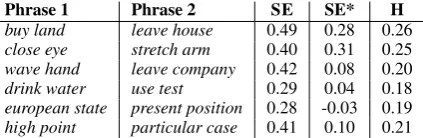
Table 1 shows that the simple strategy of adding high quality single-vector representations is very competitive with the state-of-the-art for this task. None of the strategies for selecting a sense config-uration for the multi-sense representations could compete with the single sense representations on this task. One possible explanation is that the com-monly adopted closest sense strategy is not effec-tive for composition since the composition of in-correct senses may lead to spuriously high similar-ities (for two “implausible” sense configurations). Table 2 lists a number of example phrase pairs with low average human similarity scores in the Mitchell and Lapata (2010) test set. The results show the tendency of the closest sense strategy with SENSEMBED (SE) to overestimate the sim-ilarity of dissimilar phrase pairs. For a compari-son we manually labelled the lexemes in the sam-ple phrases with the appropriate BabelNet senses prior to composition (SE*). Human (H) similar-ity scores are normalised and averaged for an eas-ier comparison, model estimates represent cosine similarities.
4 Word Sense Discrimination
Word-sense discrimination can be seen as the first stage of word-sense disambiguation, where the
5We also tried the geometric mean and the median but these performed comparably with the arithmetic mean.
Phrase 1 Phrase 2 SE SE* H
[image:3.595.313.525.62.131.2]buy land leave house 0.49 0.28 0.26 close eye stretch arm 0.40 0.31 0.25 wave hand leave company 0.42 0.08 0.20 drink water use test 0.29 0.04 0.18 european state present position 0.28 -0.03 0.19 high point particular case 0.41 0.10 0.21 Table 2
Tendency of SENSEMBED(SE) to overestimate the similarity on phrase pairs with low average human similarity when the closest sense strategy is used.
goal is to find whether two or more occurrences of the same lexeme express identical senses, without necessarily labelling the senses yet. It has received relatively little attention despite its potential for providing important insights into semantic com-position, focusing in particular on to the ability of compositional distributional semantic models to appropriately contextualise a polysemous lexeme. Work on word-sense discrimination has suf-fered from the absence of a benchmark task as well as a clear evaluation methodology. For example Sch¨utze (1998) evaluated his model on a dataset consisting of 20 polysemous words (10 naturally ambiguous lexemes and 10 artificially ambiguous “pseudo-lexemes”) in terms of accuracy for coarse grained sense distinctions, and an information re-trieval task. Pantel and Lin (2002), and Van de Cruys (2008) used automatically extracted words from various newswire sources and evaluated the output of their models in comparison to WordNet and EuroWordNet, respectively. Purandare and Pedersen (2004) used a subset of the words from the SENSEVAL-2 task and evaluated their models in terms of precision, recall and F1-score of how well available sense tags match with clusters dis-covered by their algorithms. Akkaya et al. (2012) used the concatenation of the SENSEVAL-2 and SENSEVAL-3 tasks and evaluated their models in terms of cluster purity and accuracy. Finally, Moen et al. (2013) used the semantic textual sim-ilarity (STS) 2012 task, which is based on human judgements of the similarity between two sen-tences.
that is expressing the same sense of that lexeme as the given target sentence. These two sentences — the target and the “correct answer” — can ex-hibit any degree of semantic similarity as long as they convey the same sense of the target lexeme. Table 3 shows an example of the polysemous ad-jectiveblack in our task. The goal of any model would be to determine that the expressed sense of
black in the sentence She was going to set him free from all of the evil and black hatred he had brought to the world is identical to the expressed sense ofblackin the target sentenceOr should they rebut the Democrats’ black smear campaign with the evidence at hand.
Our task assesses the ability of a model to dis-criminate a particular sense in a sentential context from any other senses and thus provides an excel-lent testbed for evaluating multi-sense word vec-tor models as well as compositional distributional semantic models. By composing the representa-tion of a target lexeme with its surrounding con-text, it should be possible to determine its sense. For example, composing black smear campaign
should lead to a compositional representation that is closer to the composed representation ofblack hatredthan toblack mood,black sense of humour
orblack coffee. This essentially uses the similarity of the compositional representation of a lexeme’s context to determine its sense. Similar approaches to word-sense disambiguation have already been successfully used in past works (Akkaya et al., 2012; Basile et al., 2014).
4.1 Task Construction
For the construction of our dataset we made use of data from two english dictionaries (Oxford Dictio-nary and Collins DictioDictio-nary), accessible via their respective web APIs6, as well as examples from the sense annotated corpus SemCor (Miller et al., 1993). Our use of dictionary data is motivated by a number of favourable properties which make it a very suitable data source for our proposed task:
• The content is of very high-quality and cu-rated by expert lexicographers.
• All example sentences are carefully crafted in order to unambiguously illustrate the usage
6https://developer.
oxforddictionaries.comfor the Oxford Dictionary, https://www.collinsdictionary.com/api/for the Collins Dictionary. We use NLTK 3.2 to access SemCor.
of a particular sense for a given polysemous lexeme.
• The granularity of the sense inventory reflects common language use7.
• The example sentences are typically free of any domain bias wherever possible.
• The data is easily accessible via a web API.
By using the data from curated resources we were able to avoid a setup as a sentence similarity task and any potentially noisy crowd-sourced human similarity judgements.
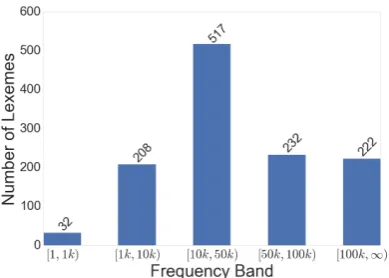
We were furthermore able to collect data from varying frequency bands, enabling an assessment of the impact of frequency on any model. Fig-ure 1 shows the number of target lexemes per fre-quency band. While the majority of lexemes, with reference to a cleaned October 2013 Wikipedia dump8, is in the middle band, there is a consid-erable amount of less frequent lexemes. The most frequent target lexeme in our task is the verb be
with ≈1.8m occurrences in Wikipedia, and the least frequent lexeme is the verb ruffle with only
[image:4.595.313.508.465.604.2]57 occurrences. The average target lexeme fre-quency is≈95k for adjectives, and≈45k−46k for nouns and verbs9.
Figure 1: Binned frequency distribution of the polysemous target lexemes in our task.
7The Oxford dictionary lists 5 different senses for the noun “bank”, whereas WordNet 3.0 lists 10 synsets, for ex-ample distinguishing “bank” as the concept for a financial institution and “bank” as a reference to the building where financial transactions take place.
Sense Definition Sentence
Target full of anger or hatred Or should they rebut the Democrats’blacksmear campaign with the evidence at hand?
Option 1 full of anger or hatred She was going to set him free from all of the evil andblackhatred he had brought to the world.
Option 2 (of a person’s state of mind) I’ve been in ablackmood since September 2001, it’s hanging over full of gloom or misery; very depressed me like a penumbra.
Option 3 (of humour) presenting tragic or harrowing Over the years I have come to believe that fate either hates me, or situations in comic terms has one hell of ablacksense of humour.
[image:5.595.74.525.62.174.2]Option 4 (of coffee or tea) served without milk The young man was reading a paperback novel and sipping a steaming mug of hot,blackcoffee.
Table 3: Example of the polysemous adjectiveblackin our task. The goal for any model is to predict option 1 as expressing the same sense ofblackas the target sentence.
4.2 Task Setup Details
We collected data for 3 different parts-of-speech: adjectives, nouns and verbs. We furthermore cre-ated task setups with varying numbers of senses to distinguish (2-5 senses) for a given target lex-eme. This is to evaluate how well a model is able to discriminate different degrees of polysemy of any lexeme. For any task setup evaluating for n senses, we included all lexemes with> n senses and randomly samplednsenses from its inventory. For each lexeme, we furthermore ensured that it had at least 2 example sentences per sense. For the available senses of any given lexeme, we ran-domly chose a sense as the target sense, and from its list of example sentences randomly sampled 2 sentences, one as the target example and one as the “correct answer” for the list of candidate sen-tences. Finally we once again randomly sampled the required number of other senses and example sentences to complete the task setup. Using ran-dom sampling of word senses and targets aims to avoid a predominant sense bias.
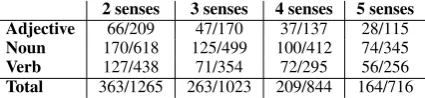
For each part-of-speech we created a develop-ment split for parameter tuning and a test split for the final evaluation. Table 4 shows the number of examples for each setup variant of our task. The biggest category are polysemous nouns, represent-ing roughly half of the data, followed by verbs representing another third, and the smallest cate-gory are adjectives taking up the remaining≈17%. We measure performance in terms of accuracy of
2 senses 3 senses 4 senses 5 senses Adjective 66/209 47/170 37/137 28/115
Noun 170/618 125/499 100/412 74/345
Verb 127/438 71/354 72/295 56/256
Total 363/1265 263/1023 209/844 164/716
Table 4: Number of examples per part-of-speech and number of senses (#dev examples/#train examples).
correctly predicting which two sentences share the
same sense of a given target lexeme. Accuracy has the advantage of being much easier to interpret — in absolute terms as well as in the relative differ-ence between models — in comparison to other commonly used evaluation metrics such as clus-ter purity measures or correlation metrics such as Spearmanρand Pearsonr.
4.3 Experimental Setup
In this paper we compare the compositional mod-els outlined earlier with two baselines, a random baseline and a word-overlap baseline of the ex-tracted contexts. For the single-vector represen-tations, we composed the target lexeme with all of the words in the context window and compared it with the equivalent representation of each of the options (lexeme plus context words). The option with the highest cosine similarity was deemed to be the selected sense. For SENSEMBED, we com-posed all sense vectors of a target lexeme with the given context and then used the closest sense strat-egy (Iacobacci et al., 2015) on composed represen-tations to choose the predicted sense10. The word-overlap baseline is simply the number of words in common between the context window for the tar-get and each of the options.
We experimented with symmetric linear bag-of-words contexts of size 1, 2 and 4 around the target lexeme. We also experimented with de-pendency contexts, where first-order dede-pendency contexts performed almost identical to using a 2-word bag-of-2-words context window (results not reported). We excluded stop words prior to ex-tracting the context window in order to maximise the number of content words. We break ties for any of the methods — including the baselines — by randomly picking one of the options with the
[image:5.595.77.290.660.709.2]highest similarity to the composed representation of the target lexeme with its context. Statistical significance between the best performing model and the word overlap baseline is computed by us-ing a randomised pairwise permutation test (Efron and Tibshirani, 1994).
4.4 Results
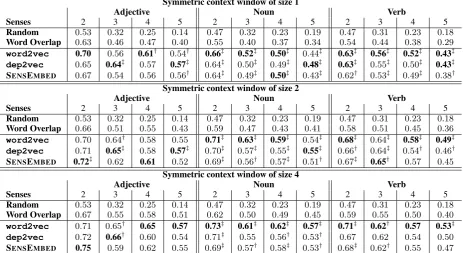
Table 5 shows the results for all context window sizes across all parts-of-speech and number of senses. All models substantially outperform the random baseline for any number of senses. In-terestingly the word overlap baseline is compet-itive for all context window sizes. While it is a very simple method, it has already been found to be a strong baseline for paraphrase detection and semantic textual similarity (Dinu and Thater, 2012). One possible explanation for its robust performance on our task is an occurrence of the one-sense-per-collocation hypothesis (Yarowsky, 1993). The performance of all other models is roughly in the same ballpark for all parts-of-speech and number of senses, suggesting that they form robust baselines for future models. While the results are relatively mixed for adjectives, word2vecappears to be the strongest model for polysemous nouns and verbs.
The perhaps most interesting observation in Ta-ble 5 is that word2vecand dep2vec are per-forming as well or better than SENSEMBED de-spite the fact that the former conflate the senses of a polysemous lexeme in a single vector represen-tation. Figure 2 shows the average performance of all models across parts-of-speech per number of senses and for all context window sizes.
SENSEMBEDand Babelfy
One possible explanation for SENSEMBED not outperforming the other methods despite its cleaner encoding of different word senses in the above experiments is that at train time, it had ac-cess to sense labels from Babelfy. At test time on our task however, it did not have any sense labels available. We therefore sense tagged the 5-sense noun subtask with Babelfy and re-ran SENSEMBED. As Table 6 shows, access to sense labels at test time did not give a substantive perfor-mance boost, representing further support for our hypothesis that composition in single-sense vector models might be sufficient to recover sense spe-cific information.
Frequency Range
We chose the 2-sense noun subtask to estimate the degree sensitivity of target lexeme frequency on our task we merged the[1,1k)and[1k,10k), and
[50k,100k)and[100k,∞)frequency bands from Figure 1, and sampled an equal number of target words from each band. Table 7 reports the results for this experiment. All methods outperform the random and word overlap baseline and appear to be working better for less frequent lexemes. One possible explanation for this behaviour is that less frequent lexemes have fewer senses and poten-tially less subtle sense differences than more fre-quent lexemes, which would make them easier to discriminate by distributional semantic methods.
5 Discussion
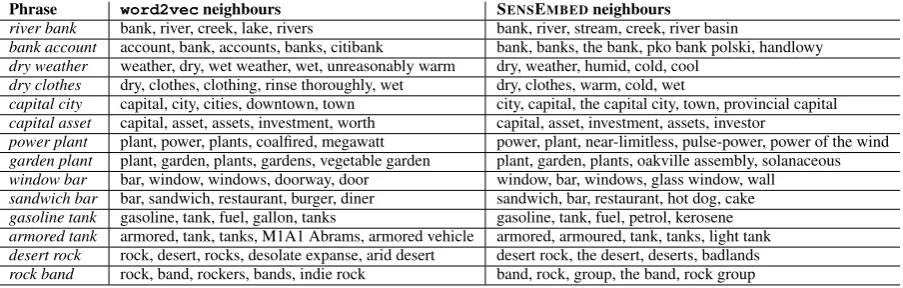
Our results suggest that pointwise addition in a single-sense vector model such asword2vecis able to discriminate the sense of a polysemous lexeme in context in a surprisingly effective way and represents a strong baseline for future work. Distributional composition can therefore be inter-preted as a process of contextualising the mean-ing of a lexeme. This way, composition does not only act as a way to represent the meaning of a phrase as a whole, but also as a local discrimina-tor for any lexemes in the phrase. For example the composed representation ofdry clothesshould only keep contexts that dry shares with clothes
while suppressing contexts it shares withweather
orwine. Hence, one would expect the same to hap-pen with a polysemous lexeme such asbankin the context ofriverandaccount, respectively.
Recent work by Arora et al. (2016) has shown that the different senses of a polysemous lexeme reside in a linear substructure within a single vec-tor and are recoverable by sparse coding. There is furthermore evidence that additive composition in low-dimensional word embeddings approximates an intersection of the contexts of two distributional word vectors (Tian et al., 2015). It therefore seems plausible that an intersective composition function should be able to recover sense specific informa-tion.
Symmetric context window of size 1
Adjective Noun Verb
Senses 2 3 4 5 2 3 4 5 2 3 4 5
Random 0.53 0.32 0.25 0.14 0.47 0.32 0.23 0.19 0.47 0.31 0.23 0.18 Word Overlap 0.63 0.46 0.47 0.40 0.55 0.40 0.37 0.34 0.54 0.44 0.38 0.29 word2vec 0.70 0.56 0.61† 0.54† 0.66‡ 0.52‡ 0.50‡ 0.44‡ 0.63‡ 0.56‡ 0.52‡ 0.43‡
dep2vec 0.65 0.64‡ 0.57 0.57‡ 0.64‡ 0.50‡ 0.49‡ 0.48‡ 0.63‡ 0.55‡ 0.50‡ 0.43‡ SENSEMBED 0.67 0.54 0.56 0.56† 0.64‡ 0.49‡ 0.50‡ 0.43‡ 0.62† 0.53‡ 0.49‡ 0.38†
Symmetric context window of size 2
Adjective Noun Verb
Senses 2 3 4 5 2 3 4 5 2 3 4 5
Random 0.53 0.32 0.25 0.14 0.47 0.32 0.23 0.19 0.47 0.31 0.23 0.18 Word Overlap 0.66 0.51 0.55 0.43 0.59 0.47 0.43 0.41 0.58 0.51 0.45 0.36 word2vec 0.70 0.64† 0.58 0.55 0.71‡ 0.63‡ 0.59‡ 0.54‡ 0.68‡ 0.64‡ 0.58‡ 0.49‡
dep2vec 0.71 0.65‡ 0.58 0.57‡ 0.70‡ 0.57‡ 0.55‡ 0.55‡ 0.66† 0.64‡ 0.54† 0.46† SENSEMBED 0.72‡ 0.62 0.61 0.52 0.69‡ 0.56† 0.57‡ 0.51† 0.67‡ 0.65† 0.57 0.45
Symmetric context window of size 4
Adjective Noun Verb
Senses 2 3 4 5 2 3 4 5 2 3 4 5
Random 0.53 0.32 0.25 0.14 0.47 0.32 0.23 0.19 0.47 0.31 0.23 0.18 Word Overlap 0.67 0.55 0.58 0.51 0.62 0.50 0.49 0.45 0.59 0.55 0.50 0.40 word2vec 0.71 0.65† 0.65 0.57 0.73‡ 0.61‡ 0.62‡ 0.57‡ 0.71‡ 0.62† 0.57 0.53‡
[image:7.595.72.536.65.318.2] [image:7.595.85.524.382.537.2]dep2vec 0.72 0.66† 0.60 0.54 0.71‡ 0.55 0.56† 0.53† 0.67 0.62 0.54 0.50 SENSEMBED 0.75 0.59 0.62 0.55 0.69‡ 0.57† 0.58‡ 0.53† 0.68‡ 0.62† 0.55 0.47
Table 5
[image:7.595.91.275.591.653.2]Performance overview for all parts-of-speech and number of senses,‡statistically significant at thep < 0.01level in com-parison to the Word Overlap baseline;†statistically significant at the p < 0.05level in comparison to the Word Overlap baseline.
Figure 2: Average performance across parts-of-speech per number of senses and context window.
Noun - 5 Senses
Context Window Size 1 2 4
word2vec 0.44 0.54 0.57
dep2vec 0.48 0.55 0.53
SENSEMBED 0.43 0.51 0.53
[image:7.595.323.515.592.663.2]SENSEMBED& Babelfy 0.45 0.49 0.54 Table 6
Results on the 5-sense noun subtask with SENSEMBED
hav-ing access to Babelfy sense labels at test time.
phrases with the appropriate BabelNet sense la-bels prior to composition. We omitted the Babel-Net sense labels in the neighbour list for brevity,
Noun - 2 Senses, context window size = 2 Frequency Band <10k 10k–50k ≥50k
Random 0.51 0.51 0.51
Word Overlap 0.66 0.60 0.56
word2vec 0.81 0.64 0.66
dep2vec 0.77 0.67 0.66
SENSEMBED 0.74 0.68 0.60
Table 7
Results on a subsample of the 2-sense noun subtask across frequency bands.
mean-ing of a lexeme. In all cases in our example the word2vecneighbours reflect the intended sense of the polysemous lexeme, providing evidence for the linear substructure of word senses in a single vector as discovered by Arora et al. (2016), and suggesting that distributional composition is able to recover sense specific information from a poly-semous lexeme. The very fine-grained sense-level vector space of SENSEMBED is giving rise to a very focused neighbourhood, however there does not seem to be any advantage over word2vec from a qualitative point of view when using simple additive composition.
6 Related Work
The perhaps most popular tasks for evaluating the ability of a model to capture or encode the differ-ent senses of a polysemous lexeme in a given con-text are the english lexical substitution task (Mc-Carthy and Navigli, 2007) and the Microsoft sen-tence completion challenge (Zweig and Burges, 2011). Both tasks require any model to fill an ap-propriate word into a pre-defined slot in a given sentential context. The sentence completion chal-lenge provides a list of candidate words while the english lexical substitution task does not. How-ever, neither task focuses on polysemy and the en-glish lexical substitution task conflates the prob-lems of discriminating word senses and finding meaning preserving substitutes.
Dictionary definitions have previously been used to evaluate compositional distributional se-mantic models where the goal is to match a dictio-nary entry with its corresponding definition (Kart-saklis et al., 2012; Polajnar and Clark, 2014). These datasets are commonly set up as retrieval tasks, but generally do not test the ability of a model to disambiguate a polysemous word in con-text, or discriminate multiple definitions of the same word.
Our task also provides a novel evaluation for compositional distributional semantic models, where the predominant strategy is to estimate the similarity of two short phrases (Bernardi et al., 2013; Grefenstette and Sadrzadeh, 2011; Kart-saklis and Sadrzadeh, 2014; Mitchell and Lap-ata, 2008; Mitchell and LapLap-ata, 2010) or sen-tences (Agirre et al., 2016; Huang et al., 2012; Marelli et al., 2014) in comparison to human pro-vided gold-standard judgements. One problem with these similarity tasks is that the similarity
or relatedness of two sentences is very difficult to judge — especially on a fine-grained scale — even for humans. This frequently results in a rel-atively high variance of judgements and low inter-annotator agreement (Batchkarov et al., 2016). The short phrase datasets typically have a fixed structure that only test a very small fraction of the possible grammatical constructions in which a lex-eme can occur, and furthermore provide very little context. The use of full sentences remedies the lack of context and grammatical variation, how-ever can still contain a significant level of noise due to the automatic construction of the dataset or the variance in human ratings. In contrast, our task is not set up as a sentence similarity task and therefore avoids the use of human similarity judgements.
Our task is similar to word-sense induction (WSI), however we only focus on discriminating the sense of a polysemous lexeme in context rather than inducing a set of senses from raw data and appropriately tagging subsequent occurrences of polysemous instances with the inferred inventory. Separating the sense discrimination task from the problem of sense induction has the advantage of making our task applicable to evaluating composi-tional distribucomposi-tional semantic models in order to test their ability to appropriately contextualise a polysemous lexeme. Due to not requiring any models to perform an extra step for sense induc-tion, our task is easier to evaluate as no matching between sense clusters identified by a model and some gold standard sense classes needs to be per-formed, as typically proposed in the WSI litera-ture (Agirre and Soroa, 2007; Manandhar et al., 2010).
Most closely related to our task are the Stan-ford Contextual Word Similarity (SCWS) dataset by Huang et al. (2012) and the Usage Similar-ity (USim) task by Erk et al. (2009). The goal in both tasks is to estimate the similarity of two polysemous words in context in comparison to human provided gold standard judgements. In the SCWS dataset typically two different lexemes are considered whereas in USim and our task the same lexemes with different contexts are com-pared. Instead of relying on crowd-sourced hu-man gold-standard similarity judgements, which can be prone to a considerable amount of noise11,
Phrase word2vecneighbours SENSEMBEDneighbours
river bank bank, river, creek, lake, rivers bank, river, stream, creek, river basin
bank account account, bank, accounts, banks, citibank bank, banks, the bank, pko bank polski, handlowy
dry weather weather, dry, wet weather, wet, unreasonably warm dry, weather, humid, cold, cool
dry clothes dry, clothes, clothing, rinse thoroughly, wet dry, clothes, warm, cold, wet
capital city capital, city, cities, downtown, town city, capital, the capital city, town, provincial capital
capital asset capital, asset, assets, investment, worth capital, asset, investment, assets, investor
power plant plant, power, plants, coalfired, megawatt power, plant, near-limitless, pulse-power, power of the wind
garden plant plant, garden, plants, gardens, vegetable garden plant, garden, plants, oakville assembly, solanaceous
window bar bar, window, windows, doorway, door window, bar, windows, glass window, wall
sandwich bar bar, sandwich, restaurant, burger, diner sandwich, bar, restaurant, hot dog, cake
gasoline tank gasoline, tank, fuel, gallon, tanks gasoline, tank, fuel, petrol, kerosene
armored tank armored, tank, tanks, M1A1 Abrams, armored vehicle armored, armoured, tank, tanks, light tank
desert rock rock, desert, rocks, desolate expanse, arid desert desert rock, the desert, deserts, badlands
[image:9.595.75.527.62.206.2]rock band rock, band, rockers, bands, indie rock band, rock, group, the band, rock group
Table 8
Nearest neighbours of composed phrases forword2vecand SENSEMBED. Distributional composition inword2vecis able to recover sense specific information remarkably well. Some neighbours are phrases because they have been encoded as a single token in the original vector space.
we leverage the high-quality content of available english dictionaries. Furthermore, our task is not formulated as estimating the similarity between two lexemes in context, but identifying the sen-tences that use the same sense of a given polyse-mous lexeme.
7 Conclusion
While elementary multi-sense representations of words might capture a more fine grained semantic picture of a polysemous word, that advantage does not appear to transfer to distributional composi-tion in a straightforward way. Our experiments on a popular phrase similarity benchmark and our novel word-sense discrimination task have demon-strated that semantic composition does not appear to benefit from a fine grained sense inventory, but that the ability to contextualise a polysemous lex-eme in single-sense vector models is sufficient for superior performance. We furthermore have pro-vided qualitative and quantitative evidence that an intersective composition function such as point-wise addition for neural word embeddings is able to discriminate the meaning of a word in context, and is able to recover sense specific information remarkably well.
Lastly, our experiments have uncovered an im-portant question for multi-sense vector models, namely how to exploit the fine-grained sense level representations for distributional composi-tion. Our novel word-sense discrimination task provides an excellent testbed for compositional distributional semantic models, both following a single-sense or multi-sense vector modelling
can be up to 4–5 in some cases.
paradigm, due to its focus on assessing the abil-ity of a model to appropriately contextualise the meaning of a word. Our task furthermore pro-vides another evaluation option away from intrin-sic evaluations which are based on often noisy hu-man similarity judgements, while also not being embedded in a downstream task.
In future work we aim to extend our eval-uation to more complex compositional distribu-tional semantic models such as the lexical func-tion model (Paperno et al., 2014) or the Anchored Packed Dependency Tree framework (Weir et al., 2016). We furthermore want to investigate how far the sense-discriminating ability of composition can be leveraged for other tasks.
Acknowledgments
We would like to thank our anonymous reviewers for their helpful comments.
References
Eneko Agirre and Aitor Soroa. 2007. Semeval-2007 task 02: Evaluating word sense induction and dis-crimination systems. InProceedings of the Fourth International Workshop on Semantic Evaluations (SemEval-2007), pages 7–12, Prague, Czech Repub-lic, June. Association for Computational Linguis-tics.
Cem Akkaya, Janyce Wiebe, and Rada Mihalcea. 2012. Utilizing semantic composition in distribu-tional semantic models for word sense discrimina-tion and word sense disambiguadiscrimina-tion. InProceedings of ICSC, pages 45–51.
Sanjeev Arora, Yuanzhi Li, Yingyu Liang, Tengyu Ma, and Andrej Risteski. 2016. Linear algebraic struc-ture of word senses, with applications to polysemy.
CoRR, abs/1601.03764.
Pierpaolo Basile, Annalina Caputo, and Giovanni Se-meraro. 2014. An enhanced lesk word sense dis-ambiguation algorithm through a distributional se-mantic model. In Proceedings of COLING 2014, the 25th International Conference on Computational Linguistics: Technical Papers, pages 1591–1600, Dublin, Ireland, August. Dublin City University and Association for Computational Linguistics.
Miroslav Batchkarov, Thomas Kober, Jeremy Reffin, Julie Weeds, and David Weir. 2016. A critique of word similarity as a method of evaluating distribu-tional semantic models. In Proceedings of the 1st Workshop on Evaluating Vector-Space Representa-tions for NLP, pages 7–12. Association for Compu-tational Linguistics.
Raffaella Bernardi, Georgiana Dinu, Marco Marelli, and Marco Baroni. 2013. A relatedness benchmark to test the role of determiners in compositional dis-tributional semantics. InProceedings of the 51st An-nual Meeting of the Association for Computational Linguistics (Volume 2: Short Papers), pages 53–57, Sofia, Bulgaria, August. Association for Computa-tional Linguistics.
Xinxiong Chen, Zhiyuan Liu, and Maosong Sun. 2014. A unified model for word sense represen-tation and disambiguation. In Proceedings of the 2014 Conference on Empirical Methods in Natu-ral Language Processing (EMNLP), pages 1025– 1035, Doha, Qatar, October. Association for Com-putational Linguistics.
Georgiana Dinu and Mirella Lapata. 2010. Measur-ing distributional similarity in context. In Proceed-ings of the 2010 Conference on Empirical Methods in Natural Language Processing, pages 1162–1172, Cambridge, MA, October. Association for Compu-tational Linguistics.
Georgiana Dinu and Stefan Thater. 2012. Saarland: Vector-based models of semantic textual similarity. In*SEM 2012: The First Joint Conference on Lexi-cal and Computational Semantics – Volume 1: Pro-ceedings of the main conference and the shared task, and Volume 2: Proceedings of the Sixth Interna-tional Workshop on Semantic Evaluation (SemEval 2012), pages 603–607, Montr´eal, Canada, 7-8 June. Association for Computational Linguistics.
Bradley Efron and Robert Tibshirani. 1994. An Intro-duction to the Bootstrap. CRC press.
Katrin Erk, Diana McCarthy, and Nicholas Gaylord. 2009. Investigations on word senses and word us-ages. InProceedings of the Joint Conference of the 47th Annual Meeting of the ACL and the 4th In-ternational Joint Conference on Natural Language Processing of the AFNLP, pages 10–18, Suntec, Sin-gapore, August. Association for Computational Lin-guistics.
Edward Grefenstette and Mehrnoosh Sadrzadeh. 2011. Experimental support for a categorical composi-tional distribucomposi-tional model of meaning. In Proceed-ings of the 2011 Conference on Empirical Meth-ods in Natural Language Processing, pages 1394– 1404, Edinburgh, Scotland, UK., July. Association for Computational Linguistics.
Kazuma Hashimoto, Pontus Stenetorp, Makoto Miwa, and Yoshimasa Tsuruoka. 2014. Jointly learn-ing word representations and composition functions using predicate-argument structures. In Proceed-ings of the 2014 Conference on Empirical Methods in Natural Language Processing (EMNLP), pages 1544–1555, Doha, Qatar, October. Association for Computational Linguistics.
Felix Hill, KyungHyun Cho, Anna Korhonen, and Yoshua Bengio. 2016. Learning to understand phrases by embedding the dictionary. Transactions of the Association for Computational Linguistics, 4:17–30.
Eric Huang, Richard Socher, Christopher Manning, and Andrew Ng. 2012. Improving word represen-tations via global context and multiple word proto-types. InProceedings of the 50th Annual Meeting of the Association for Computational Linguistics (Vol-ume 1: Long Papers), pages 873–882, Jeju Island, Korea, July. Association for Computational Linguis-tics.
Ignacio Iacobacci, Mohammad Taher Pilehvar, and Roberto Navigli. 2015. Sensembed: Learning sense embeddings for word and relational similarity. In Proceedings of the 53rd Annual Meeting of the Association for Computational Linguistics and the 7th International Joint Conference on Natural Lan-guage Processing (Volume 1: Long Papers), pages 95–105, Beijing, China, July. Association for Com-putational Linguistics.
Ignacio Iacobacci, Mohammad Taher Pilehvar, and Roberto Navigli. 2016. Embeddings for word sense disambiguation: An evaluation study. In Proceed-ings of the 54th Annual Meeting of the Association for Computational Linguistics (Volume 1: Long Pa-pers), pages 897–907, Berlin, Germany, August. As-sociation for Computational Linguistics.
Dimitri Kartsaklis and Mehrnoosh Sadrzadeh. 2014. A study of entanglement in a categorical framework of natural language. InProceedings of the 11th Work-shop on Quantum Physics and Logic (QPL). Dimitri Kartsaklis, Mehrnoosh Sadrzadeh, and Stephen
categorical distributional-compositional semantics: Theory and experiments. In Proceedings of COL-ING 2012: Posters, pages 549–558, Mumbai, India, December. The COLING 2012 Organizing Commit-tee.
Dimitri Kartsaklis, Mehrnoosh Sadrzadeh, and Stephen Pulman. 2013. Separating disambiguation from composition in distributional semantics. In Pro-ceedings of the Seventeenth Conference on Com-putational Natural Language Learning, pages 114– 123, Sofia, Bulgaria, August. Association for Com-putational Linguistics.
Thomas Kober, Julie Weeds, Jeremy Reffin, and David Weir. 2016. Improving sparse word representations with distributional inference for semantic composi-tion. InProceedings of the 2016 Conference on Em-pirical Methods in Natural Language Processing, pages 1691–1702, Austin, Texas, November. Asso-ciation for Computational Linguistics.
Omer Levy and Yoav Goldberg. 2014. Dependency-based word embeddings. InProceedings of the 52nd Annual Meeting of the Association for Computa-tional Linguistics (Volume 2: Short Papers), pages 302–308, Baltimore, Maryland, June. Association for Computational Linguistics.
Jiwei Li and Dan Jurafsky. 2015. Do multi-sense em-beddings improve natural language understanding? In Proceedings of the 2015 Conference on Empiri-cal Methods in Natural Language Processing, pages 1722–1732, Lisbon, Portugal, September. Associa-tion for ComputaAssocia-tional Linguistics.
Suresh Manandhar, Ioannis Klapaftis, Dmitriy Dligach, and Sameer Pradhan. 2010. Semeval-2010 task 14: Word sense induction & disambiguation. In Pro-ceedings of the 5th International Workshop on Se-mantic Evaluation, pages 63–68, Uppsala, Sweden, July. Association for Computational Linguistics. Marco Marelli, Stefano Menini, Marco Baroni, Luisa
Bentivogli, Raffaella bernardi, and Roberto Zam-parelli. 2014. A sick cure for the evaluation of compositional distributional semantic models. In Nicoletta Calzolari, Khalid Choukri, Thierry De-clerck, Hrafn Loftsson, Bente Maegaard, Joseph Mariani, Asuncion Moreno, Jan Odijk, and Stelios Piperidis, editors,Proceedings of the Ninth Interna-tional Conference on Language Resources and Eval-uation (LREC’14), pages 216–223, Reykjavik, Ice-land, May. European Language Resources Associa-tion (ELRA). ACL Anthology Identifier: L14-1314. Diana McCarthy and Roberto Navigli. 2007. Semeval-2007 task 10: English lexical substitution task. In
Proceedings of the Fourth International Workshop on Semantic Evaluations (SemEval-2007), pages 48–53, Prague, Czech Republic, June. Association for Computational Linguistics.
Tomas Mikolov, Ilya Sutskever, Kai Chen, Greg S Cor-rado, and Jeff Dean. 2013. Distributed
representa-tions of words and phrases and their composition-ality. In C.J.C. Burges, L. Bottou, M. Welling, Z. Ghahramani, and K.Q. Weinberger, editors, Ad-vances in Neural Information Processing Systems 26, pages 3111–3119. Curran Associates, Inc.
George A. Miller, Claudia Leacock, Randee Tengi, and Ross T. Bunker. 1993. A semantic concordance. In
Proceedings of the Arpa Workshop on Human Lan-guage Technology, pages 303–308.
Jeff Mitchell and Mirella Lapata. 2008. Vector-based models of semantic composition. InProceedings of the 46th Annual Meeting of the Association for Com-putational Linguistics: Human Language Technol-ogy Conference, pages 236–244, Columbus, Ohio, June. Association for Computational Linguistics.
Jeff Mitchell and Mirella Lapata. 2010. Composition in distributional models of semantics. Cognitive Sci-ence, 34(8):1388–1429.
Hans Moen, Erwin Marsi, and Bj¨orn Gamb¨ack. 2013. Towards dynamic word sense discrimination with random indexing. InProceedings of the Workshop on Continuous Vector Space Models and their Com-positionality, pages 83–90, Sofia, Bulgaria, August. Association for Computational Linguistics.
Andrea Moro, Alessandro Raganato, and Roberto Nav-igli. 2014. Entity linking meets word sense disam-biguation: A unified approach. Transactions of the Association for Computational Linguistics, 2:231– 244.
Patrick Pantel and Dekang Lin. 2002. Discovering word senses from text. InProceedings of the Eighth ACM SIGKDD International Conference on Knowl-edge Discovery and Data Mining, KDD ’02, pages 613–619, New York, NY, USA. ACM.
Denis Paperno, Nghia The Pham, and Marco Baroni. 2014. A practical and linguistically-motivated ap-proach to compositional distributional semantics. In
Proceedings of the 52nd Annual Meeting of the As-sociation for Computational Linguistics (Volume 1: Long Papers), pages 90–99, Baltimore, Maryland, June. Association for Computational Linguistics.
Mohammad Taher Pilehvar and Nigel Collier. 2016. De-conflated semantic representations. In Proceed-ings of the 2016 Conference on Empirical Methods in Natural Language Processing, pages 1680–1690, Austin, Texas, November. Association for Computa-tional Linguistics.
Amruta Purandare and Ted Pedersen. 2004. Word sense discrimination by clustering contexts in vec-tor and similarity spaces. In Hwee Tou Ng and Ellen Riloff, editors, HLT-NAACL 2004 Work-shop: Eighth Conference on Computational Natu-ral Language Learning (CoNLL-2004), pages 41– 48, Boston, Massachusetts, USA, May 6 - May 7. Association for Computational Linguistics.
Siva Reddy, Ioannis Klapaftis, Diana McCarthy, and Suresh Manandhar. 2011. Dynamic and static pro-totype vectors for semantic composition. In Pro-ceedings of 5th International Joint Conference on Natural Language Processing, pages 705–713, Chi-ang Mai, Thailand, November. Asian Federation of Natural Language Processing.
Joseph Reisinger and Raymond J. Mooney. 2010. Multi-prototype vector-space models of word mean-ing. InHuman Language Technologies: The 2010 Annual Conference of the North American Chap-ter of the Association for Computational Linguistics, pages 109–117, Los Angeles, California, June. As-sociation for Computational Linguistics.
Bahar Salehi, Paul Cook, and Timothy Baldwin. 2015. A word embedding approach to predicting the com-positionality of multiword expressions. In Proceed-ings of the 2015 Conference of the North Ameri-can Chapter of the Association for Computational Linguistics: Human Language Technologies, pages 977–983, Denver, Colorado, May–June. Association for Computational Linguistics.
Hinrich Sch¨utze. 1998. Automatic word sense dis-crimination. Computational Linguistics, 24(1):97– 123, mar.
Ran Tian, Naoaki Okazaki, and Kentaro Inui. 2015. The mechanism of additive composition. CoRR, abs/1511.08407.
Tim Van de Cruys. 2008. Using three way data for word sense discrimination. In Proceedings of the 22nd International Conference on Computational Linguistics (Coling 2008), pages 929–936, Manch-ester, UK, August. Coling 2008 Organizing Com-mittee.
David Weir, Julie Weeds, Jeremy Reffin, and Thomas Kober. 2016. Aligning packed dependency trees: a theory of composition for distributional semantics.
Computational Linguistics, special issue on Formal Distributional Semantics, 42(4):727–761, Decem-ber.
John Wieting, Mohit Bansal, Kevin Gimpel, and Karen Livescu. 2015. From paraphrase database to com-positional paraphrase model and back.Transactions of the Association for Computational Linguistics, 3:345–358.
David Yarowsky. 1993. One sense per collocation. In
Proceedings of the Workshop on Human Language Technology, HLT ’93, pages 266–271, Stroudsburg,
PA, USA. Association for Computational Linguis-tics.