Building a Motivational Interviewing Dataset
Ver´onica P´erez-Rosas1, Rada Mihalcea1, Kenneth Resnicow2 Satinder Singh1, Lawrence An3
1Computer Science and Engineering, University of Michigan 2School of Public Health, University of Michigan
3Center for Health Communications Research, University of Michigan
{vrncapr,mihalcea,kresnic,baveja,lcan}@umich.edu
Abstract
This paper contributes a novel psychologi-cal dataset consisting of counselors’ behav-iors during Motivational Interviewing encoun-ters. Annotations were conducted using the Motivational Interviewing Integrity Treatment (MITI). We describe relevant aspects associ-ated with the construction of a dataset that re-lies on behavioral coding such as data acqui-sition, transcription, expert data annotations, and reliability assessments. The dataset con-tains a total of 22,719 counselor utterances extracted from 277 motivational interview-ing sessions that are annotated with 10 coun-selor behavioral codes. The reliability anal-ysis showed that annotators achieved excel-lent agreement at session level, with Intra-class Correlation Coefficient (ICC) scores in the range of 0.75 to 1, and fair to good agree-ment at utterance level, with Cohen’s Kappa scores ranging from 0.31 to 0.64.
Behavioral interventions are a promising ap-proach to address public health issues such as smok-ing cessation, increassmok-ing physical activity, and re-ducing substance abuse, among others (Resnicow et al., 2002). In particular, Motivational Interviewing (MI), a client centered psychotherapy style, has been receiving increasing attention from the clinical psy-chology community due to its established efficacy for treating addiction and other behaviors (Moyers et al., 2009; Apodaca et al., 2014; Barnett et al., 2014; Catley et al., 2012).
Despite its potential benefits in combating addic-tion and in providing broader disease prevenaddic-tion and management, implementing MI counseling at larger
scale or in other domains is limited by the need for human-based evaluations. Currently, this requires a human either watching or listening to video-tapes and then providing evaluative feedback.
Recently, computational approaches have been proposed to aid the MI evaluation process (Atkins et al., 2014; Xiao et al., 2014; Klonek et al., 2015). However, learning resources for this task are not readily available. Having such resources will enable the application of data-driven strategies for the auto-matic coding of counseling behaviors, thus provid-ing researchers with automatic means for the eval-uation of MI. Moreover, this can also be useful to explore how MI works by relating MI behaviors to health outcomes, and to provide counselors with evaluative feedback that helps them improve their MI skills.
In this paper, we present the construction and val-idation of a dataset annotated with counselor ver-bal behaviours using the Motivational Interviewing Treatment Integrity 4.0 (MITI), which is the cur-rent gold standard for MI-based psychology inter-ventions. The dataset is derived from 277 MI ses-sions containing a total of 22,719 coded utterances.
1 Motivational Interviewing
Miller and Rollnick define MI as a collaborative, goal-oriented style of psychotherapy with particu-lar attention to the language of change (Miller and Rollnick, 2013). MI has been widely used as a treat-ment method in clinical trials on psychotherapy re-search to address addictive behaviors such as alco-hol, tobacco and drug use; promote healthier habits such as nutrition and fitness; and help clients with
psychological problems such as depression and anx-iety disorders (Rollnick et al., 2008; Lundahl et al., 2010). In addition, MI has been successfully applied in different practice settings including social work in behavioral health centers, education, and criminal justice (Wahab, 2005; McMurran, 2009).
The competence of the counselor in MI delivery is measured using systematic observational meth-ods to assess verbal behavior in MI by either focus-ing on therapist behaviors, client behaviors, or both (Jelsma et al., 2015). Current coding instruments for MI include the Behavior Change Counselor Index (BECCI) (Lane et al., 2005), the Client Evaluation of Motivational Interview (CEMI) (Madson et al., 2009), the Independent Tape Rating Scale (ITRS) (Martino et al., 2009), the MI Skills Code (MISC) (Moyers et al., 2003), the Stimulated Client Inter-view Rating Scale (SCIRS) (Arthur, 1999), the One Pass (McMaster and Resnicow, 2015), and the Mo-tivational Interviewing Treatment Integrity (MITI) (Moyers et al., 2005).
1.1 Motivational Interviewing Treatment Integrity
The MITI coding system is currently the most fre-quently used instrument for assessing MI fidelity (Moyers et al., 2003). The MITI is derived from the MISC coding system and focuses exclusively on the verbal behavior of the counselor. It measures how well or poorly the clinician is using MI. The cod-ing system evaluates MI processes related to change talk such as engagement, focus, evocation, and plan-ning. MITI has two components: global scores and behavior counts. The global scores aim to charac-terize the overall quality of the interaction and in-clude four dimensions, namely Cultivating Change Talk, Softening Sustain Talk, Partnership, and Em-pathy. Behavior counts are evaluated by tallying in-stances of particular interviewing behaviors, which can be grouped into five broad categories: questions, reflections, MI adherent behavior (MIA), MI non-adherent behavior (MINA), and neutral behaviors.
Reflections capture reflective listening statements made by the clinician in response to client state-ments and can be categorized as simple or complex. MIA behaviors summarize counselor adherence to core aspects of the MI strategy such as seeking col-laboration, affirming, and emphasizing autonomy.
MINA includes aspects that indicate counselor de-ficiencies while delivering MI, such as confronting and persuading without permission. The neutral be-haviors include counselor actions such as providing information and persuading with permission.
MITI evaluation is conducted by trained coders who assess the overall session scores and the occur-rence of behaviors by using pen and paper. During the coding process, coders rely on audio recordings and their corresponding transcriptions. The evalua-tion is usually performed as a two-step process by first evaluating overall scores and next focusing on behavior counts.
MITI coding is a very time consuming and expen-sive process, as it requires accurate transcriptions and human expertise. The quality of the transcrip-tions is affected by the recoding quality and their preparation is time consuming as it might take about three times the duration of the recording (Klonek et al., 2015). Thus, estimates for a 30 min session might add up to 2.5 hours of transcriber time and about one hour of coder time.
1.2 MI reliability assessment
2 Related work
Current approaches for MI coding and evaluation entail extensive human involvement. Recently, there have been a number of efforts on building com-putational tools that assist researchers during the coding process. (Can et al., 2012) proposed a lin-guistic based approach to automatically detect and code counselor reflections that is based on analyz-ing n-grams patterns, similarity features between counselor and client speech, and contextual meta-features, which aim to represent the dialog sequence between the client and counselor. A method based on topic models is presented in (Atkins et al., 2012; Atkins et al., 2014), where authors focus on auto-matically identifying topics related to MI behaviors such as reflections, questions, support, and empa-thy, among others. Text and speech based methods have also been proposed to evaluate overall MI qual-ity. (Lord et al., 2015b) analyzed the language style synchrony between therapist and client during MI encounters. In this work, authors relied in the psy-cholinguistic categories from the Linguistic Inquiry and Word Count lexicon to measure the degree in which counselor matches the client language. (Xiao et al., 2014) presents a study on the automatic eval-uation of counselor empathy by analyzing correla-tions between prosody patterns and empathy showed by the therapist during the counseling interaction.
Although most of the work on coding of MI within session language has focused on modeling the counselor language, there is also work that ad-dresses the client language. (Tanana et al., 2015) used recursive neural networks (RNN) to identify client change and sustain talk in MI transcripts, i.e., language that indicates commitment towards and away behavioral change. In this work, authors com-bined both therapist and client utterances in a single sequence model using Maximum Entropy Markov Models, NRR, and n-grams features. (Gupta et al., 2014) analyzed the valence of client’s attitude to-wards the target behavior by using n-grams and con-ditional maximum entropy models. In this paper au-thors also present an exploration of the role laugh-ter of both counselor and client’s during the MI en-counter and attempts to incorporate its occurrence as an additional source of information in the prediction model.
Research findings have shown that natural lan-guage processing approaches can be successfully applied to behavioral data for the automatic annota-tion of therapists’ and clients’ behaviors. This moti-vates our interest in building resources for this task as an initial step for the construction of improved coding tools. There has been work on creating anno-tated resources that facilitate advances in natural lan-guage processing of clinical text, including semantic and syntactic annotation of pathology reports, oncol-ogy reports, and biomedical journals (Roberts et al., 2007; Albright et al., 2013; Verspoor et al., 2012). However, to our knowledge, there are just a few psy-chotherapy corpora available. One of them is the “Alexander Street Press”, 1 which is a large
col-lection of transcripts and video recordings of ther-apy sessions on different subjects such as anxiety, depression, family conflicts, and others. There are also some other psychology datasets available under limited access from the National Institute of Mental Health (NIMH).2 These datasets provide recorded
interactions among clinicians and patients on a num-ber of psychology styles. However, they are not annotated and validated to be used in the computa-tional psychology domain.
In this paper, we present the development of a clinical narratives dataset that can be used to imple-ment data-driven methods for the automatic evalua-tion of MI sessions.
3 Motivational Interviewing Dataset
3.1 Data collection
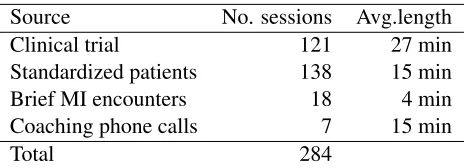
The dataset is derived from a collection of 284 video recordings of counseling encounters using MI. The recordings were collected from various sources, in-cluding two clinical trials, students’ counseling ses-sions from a graduate level MI course, wellness coaching phone calls, and demonstrations of MI strategies in brief medical encounters.
The clinical trials sessions consist of interven-tions for smoking cessation and antiretroviral ther-apy adherence with electronic drug monitoring. Psy-chology students’ sessions are conducted on stan-dardized patients and aim at weight loss and smoke
1
http://alexanderstreet.com/products/counseling-and-psychotherapy-transcripts-series
Source No. sessions Avg.length Clinical trial 121 27 min Standardized patients 138 15 min Brief MI encounters 18 4 min Coaching phone calls 7 15 min
[image:4.612.73.305.53.137.2]Total 284
Table 1:Data sources for the MI sessions
cessation. Wellness coaching phone calls inquired about patient health and medication adherence after surgery. The demonstration sessions are collected from online sources, i.e., YouTube and Vimeo, and present brief MI encounters on several scenarios such as dental practice, emergency room counseling, and student counseling. Table 1 presents a summary of the data sources used in the dataset collection.
All the sessions are manually anonymized to re-move identifiable information such as counselor and patient names and references to counseling sites’ lo-cation. Each recording is assigned a new identifier that does not include any information related to the original recording. The resulting recordings are then processed to remove the visual data stream to fur-ther prevent counselor/patient identification. After this process, we obtained a set of 277 sessions due to the exclusion of some sessions with recording errors. The final dataset comprises a total of 97.8 hours of audio with average session duration of 20.8 minutes and a standard deviation of 11.4 minutes.
3.2 Transcriptions
The sessions from clinical trials include full tran-scripts. However, this was not the case for the remaining set of sessions, and for these we ob-tained manual transcriptions via crowdsourcing us-ing Amazon Mechanical Turk. This resource has proved to be a fast and reliable method to obtain speech transcriptions (Marge et al., 2010).
Mechanical Turk workers were provided with transcription guidelines that include clearly identify-ing the speaker (client or counselor), and transcrib-ing speech disfluencies such as false starts, repeti-tions of whole words or parts of words, prolonga-tions of sounds, fillers, and long pauses. Resulting transcriptions were manually verified to avoid spam and to ensure their quality. The transcriptions con-sist of approximately 22,719 utterances, with an
av-erage of 83 utterances per session.
3.3 MITI Annotations
Three counselors, with previous MI experience, were trained on the use of the MITI 4.1 by expert trainers from the Motivational Interviewing Net-work of Trainers3(MINT) to conduct the annotation
task. Prior to the annotation phase, annotators par-ticipated in a coding calibration phase where they had discussions regarding the criteria for sentence parsing, the correct assignment of behavior codes, and conducted team coding of sample sessions.
Annotators used both audio recordings and verba-tim transcriptions to conduct the annotations.
Annotators were instructed to parse the inter-viewer speech following the guidelines defined by MITI 4.1. The annotation was conducted at utter-ance level, by selecting and labeling utterutter-ances in each counselor turn that contain a specific MI be-havior.
Following this strategy allowed us to obtain more accurate examples of each behavior code for cases where a turn contains multiple utterances and thus more than one behavior code. In addition, given possible inaccuracies and interruptions in the turn by turn segmentation, annotators were allowed to select the text that they considered belonging to a coded ut-terance, even if it spanned more than one counselor-client turn, to avoid utterance breaking.
In order to facilitate this process, annotators used a software based coding system instead of the tra-ditional paper and pen system. Annotators were trained to code using the Nvivo software,4 a
quan-titative analysis suite that allows to select and assign text segments to a given codebook. The codebook contains the following behavior codes:
Question (QUEST) All questioning statements spoken by clinicians.
Simple reflection (SR) Clinician statements that convey understanding or facilitate client-clinician exchanges.
Complex reflection (CR) Reflective statements that add substantial meaning or emphasis to what the client has said.
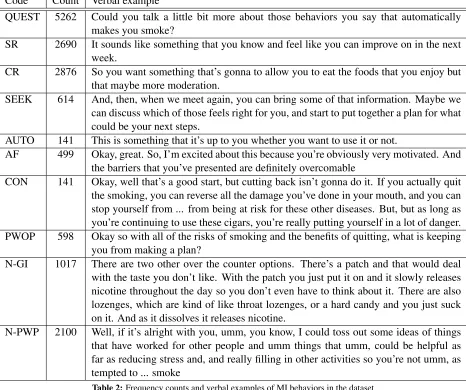
Code Count Verbal example
QUEST 5262 Could you talk a little bit more about those behaviors you say that automatically makes you smoke?
SR 2690 It sounds like something that you know and feel like you can improve on in the next week.
CR 2876 So you want something that’s gonna to allow you to eat the foods that you enjoy but that maybe more moderation.
SEEK 614 And, then, when we meet again, you can bring some of that information. Maybe we can discuss which of those feels right for you, and start to put together a plan for what could be your next steps.
AUTO 141 This is something that it’s up to you whether you want to use it or not.
AF 499 Okay, great. So, I’m excited about this because you’re obviously very motivated. And the barriers that you’ve presented are definitely overcomable
CON 141 Okay, well that’s a good start, but cutting back isn’t gonna do it. If you actually quit the smoking, you can reverse all the damage you’ve done in your mouth, and you can stop yourself from ... from being at risk for these other diseases. But, but as long as you’re continuing to use these cigars, you’re really putting yourself in a lot of danger. PWOP 598 Okay so with all of the risks of smoking and the benefits of quitting, what is keeping
you from making a plan?
N-GI 1017 There are two other over the counter options. There’s a patch and that would deal with the taste you don’t like. With the patch you just put it on and it slowly releases nicotine throughout the day so you don’t even have to think about it. There are also lozenges, which are kind of like throat lozenges, or a hard candy and you just suck on it. And as it dissolves it releases nicotine.
[image:5.612.73.539.61.451.2]N-PWP 2100 Well, if it’s alright with you, umm, you know, I could toss out some ideas of things that have worked for other people and umm things that umm, could be helpful as far as reducing stress and, and really filling in other activities so you’re not umm, as tempted to ... smoke
Table 2:Frequency counts and verbal examples of MI behaviors in the dataset
Seeking collaboration (SEEK) The clinician at-tempts to share power or acknowledge the ex-pertise of the client.
Emphasizing autonomy (AUTO) The clinician focus the responsibility on the client for the decision and actions pertaining to change.
Affirm (AF) Clinician utterances that accentuates something positive about the client.
Persuading without permission (PWOP) The clinician attempts to change the client’s opin-ions, attitudes, or behaviors, using tools such as logic, compelling arguments, self-disclosure or facts.
Confront (CON) Statements where the clinician
confronts the client by directly disagreeing, ar-guing, correcting, shaming, criticizing, moral-izing or questioning client’s honesty.
Persuading with permission (N-PWP) Clinician statements that make emphasis on collabora-tion or autonomy support while persuading.
Giving information (N-GI) The clinician give in-formation, educates, or expresses a profes-sional opinion without persuading, advising, or warning.
Annotator 1 Annotator 2 Method So you’re getting back to your old
self. SR So you’re getting back to your oldself. SR Exact match So it sounds like you kinda
struggle with that a little bit in that sometimes
SR So it sounds like you kindastruggle with that a little bit in that sometimes it’s hard I imag-ine, it is sometimes hard to be fi-nancially independent I mean I, But it something it sounds like you respect in yourself that you are able to do it.
SR Split utterances it’s hard I imagine, it is sometimes
hard to be financially independent I mean I,
NL
But it something it sounds like you respect in yourself that you are able to do it.
SR
OK. But even though it’s something that you really don’t like, it’s some-thing that’s not terribly bothersome.
SR So you mentioned that one side ef-fect of the Sustiva was that it makes you dizzy. OK. But even though it is something that you really don’t like, it something that,it’s not terri-bly bothersome.
[image:6.612.74.538.52.330.2]SR Partial match
Table 3:Sample utterance alignment for coding comparisons
After the annotation phase, transcripts were pro-cessed to extract the verbal content of each MITI an-notation; non-coded utterances were also extracted and labeled as neutral. Sample annotations are pre-sented in Table 2. The final set contains 15,886 an-notations distributed among the ten codes and 6,833 neutral utterances. Table 2 shows the frequency dis-tribution for each behavior count and neutral utter-ances.
4 Dataset Validation
In order to validate the annotator reliability, a sample of 10 sessions was randomly selected to be double coded by two members of the coding team.
The total amount of recoding material for this sample is about 4.5 hours. Each session has an av-erage duration of 26 minutes, with an avav-erage of 115 counselor-client conversation turns per session, comprising a total of 1,160 utterances.
4.1 Inter-rater Reliability Analysis
Because we conducted the MITI annotation at ut-terance level without any pre-parsing, annotations across coders showed noticeable parsing variations. These variations consisted of differences in
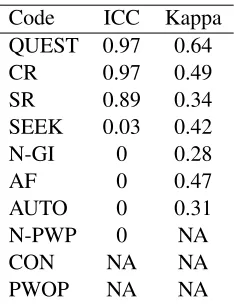
utter-Code ICC Kappa QUEST 0.97 0.64 CR 0.97 0.49 SR 0.89 0.34 SEEK 0.03 0.42 N-GI 0 0.28
AF 0 0.47
AUTO 0 0.31 N-PWP 0 NA CON NA NA PWOP NA NA
Table 4: ICC at session level and Kappa scores at utterance level for 10 double coded sessions. NA indicates that the MI behavior was not present in any session
[image:6.612.369.486.360.512.2]dis-agree in utterance boundaries, thus resulting in an-notations from one annotator partially matching the others, i.e., some degree of overlap. The third case also deals with differences due to utterance bound-aries but focuses on split utterances, i.e., an anno-tated utterance from one coder was split into two different annotations by the other, and cases where utterances with different annotations show some de-gree of overlapping. Table 3 presents sample utter-ances.
Using the transcript from each session, we first identified those utterances who were assigned a be-havior code by either of the two annotators. Then, we compared their verbal content by applying the ut-terance matching methods described above. We as-signed a match when both annotators agreed on their evaluations. We considered both split utterances and partial matches as a single match. Those utterances for which we were unable to find a matching pair or differed on the assigned codes were regarded as disagreements.
Table 4 presents the Intra Class Coefficient (ICC) measured at session level. Reported scores were ob-tained using a two-way mixed model with absolute agreement (Jelsma et al., 2015). Overall, we ob-serve excellent ICC scores for Complex Reflections CR (CR), Simple Reflections (SR), and Questions, based on ICC reference values, where values rang-ing from 0.75 to 1 are considered as excellent agree-ment (Jelsma et al., 2015).
ICC scores suggest that annotators did not show significant variations on most of the coded be-haviours, except for Seeking collaboration (SEEK), which showed considerable disagreement. We be-lieve that this is caused by the higher variability on the frequency counts for this code across the 10 ses-sions.
Wanting to evaluate how well did the annotators agree while coding the same annotation, we calcu-lated the pairwise agreement among coders using Cohen’s Kappa. Results are also reported in Table 4. The Kappa values suggest fair to good levels of agreement among the different behavior codes.
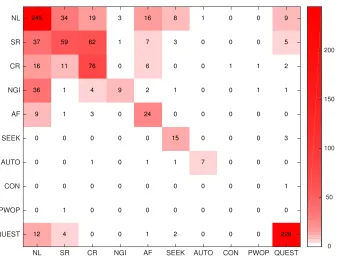
In addition, we evaluate the ability of coders to distinguish the occurrence of a particular behavior code versus any other code. This allow us to an-swer question such as, how well did the annotators agree on what is considered a reflection as compared
to what is not a reflection? This analysis provides further insights about the validity of the coding. In these comparisons, utterances coded with a differ-ent behavior than the target behavior were consid-ered as the negative case. For instance, if the target behavior was Simple Reflection (SR), then we eval-uated the identification of Simple Reflection vs non-Simple Reflection. In order to more accurately rep-resent the human coding process, we also included non coded utterances (NL) as negatives cases. Fig-ure 1 shows the annotation agreement between the two annotators for 10 sessions coded at utterance level in heatmap representation, where the color in-tensity represents the agreement distribution. In the shown matrix, the xaxis indicates the MI code as-signed by the first annotator and they axis the MI code assigned by the second annotator. Each cell indicates the observed frequency of a coding pair.
245 37 16 36 9 0 0 0 0 12 34 59 11 1 1 0 0 0 1 4 19 62 76 4 3 0 1 0 0 0 3 1 0 9 0 0 0 0 0 0 16 7 6 2 24 0 1 0 0 1 8 3 0 1 0 15 1 0 0 2 1 0 0 0 0 0 7 0 0 0 0 0 1 0 0 0 0 0 0 0 0 0 1 1 0 0 0 0 0 0 9 5 2 1 0 3 0 1 0 228
[image:8.612.133.471.70.334.2]NL SR CR NGI AF SEEK AUTO CON PWOP QUEST NL SR CR NGI AF SEEK AUTO CON PWOP QUEST 0 50 100 150 200
Figure 1:Annotator agreement on non-coded utterances (NL) and MI behaviors. Thexaxis indicates the MI code assigned by the first annotator and theyaxis the MI code assigned by the second annotator.
5 Conclusion
In this paper, we introduced a new clinical narratives dataset derived from MI interventions. The dataset consists of annotations for ten verbal behaviors dis-played by the counselor while conducting MI coun-seling. We presented a detailed description of the dataset collection and annotation process. We con-ducted a reliability analysis where we showed that annotators achieved excellent agreement at session level, with ICC scores in the range of 0.75 to 1, and fair to good agreement at utterance level, with Cohen’s Kappa scores ranging from 0.31 to 0.64. The paper reports our initial efforts towards building accurate tools for the automatic coding of MI en-counters. Our future work includes developing data-driven methods for the prediction of MI behaviors.
Acknowledgments
This material is based in part upon work supported by the University of Michigan under the MCubed program, by the National Science Foundation award
#1344257, and by grant #48503 from the John Tem-pleton Foundation. Any opinions, findings, and con-clusions or recommendations expressed in this ma-terial are those of the authors and do not necessarily reflect the views of the University of Michigan, the National Science Foundation, or the John Templeton Foundation.
References
Daniel Albright, Arrick Lanfranchi, Anwen Fredrik-sen, William F Styler, Colin Warner, Jena D Hwang, Jinho D Choi, Dmitriy Dligach, Rodney D Nielsen, James Martin, et al. 2013. Towards comprehensive syntactic and semantic annotations of the clinical nar-rative.
Timothy R Apodaca, Brian Borsari, Kristina M Jackson, Molly Magill, Richard Longabaugh, Nadine R Mas-troleo, and Nancy P Barnett. 2014. Sustain talk pre-dicts poorer outcomes among mandated college stu-dent drinkers receiving a brief motivational interven-tion. Psychology of Addictive Behaviors, 28(3):631. David Arthur. 1999. Assessing nursing students’ basic
develop-ment and testing of a rating scale. Journal of Advanced Nursing, 29(3):658–665.
David C Atkins, Timothy N Rubin, Mark Steyvers, Michelle A Doeden, Brian R Baucom, and Andrew Christensen. 2012. Topic models: A novel method for modeling couple and family text data. Journal of family psychology, 26(5):816.
David C Atkins, Mark Steyvers, Zac E Imel, and Padhraic Smyth. 2014. Scaling up the evaluation of psy-chotherapy: evaluating motivational interviewing fi-delity via statistical text classification.Implementation Science, 9(1):49.
Elizabeth Barnett, Theresa B Moyers, Steve Sussman, Caitlin Smith, Louise A Rohrbach, Ping Sun, and Donna Spruijt-Metz. 2014. From counselor skill to decreased marijuana use: Does change talk matter?
Journal of substance abuse treatment, 46(4):498–505. Dogan Can, Panayiotis G. Georgiou, David C. Atkins, and Shrikanth S. Narayanan. 2012. A case study: De-tecting counselor reflections in psychotherapy for ad-dictions using linguistic features. InINTERSPEECH, pages 2254–2257. ISCA.
Delwyn Catley, Kari J Harris, Kathy Goggin, Kim-ber Richter, Karen Williams, Christi Patten, Ken Resnicow, Edward Ellerbeck, Andrea Bradley-Ewing, Domonique Malomo, et al. 2012. Motivational inter-viewing for encouraging quit attempts among unmoti-vated smokers: study protocol of a randomized, con-trolled, efficacy trial.BMC public health, 12(1):456. Chris Dunn, Doyanne Darnell, Sheng Kung Michael Yi,
Mark Steyvers, Kristin Bumgardner, Sarah Peregrine Lord, Zac Imel, and David C Atkins. 2015. Should we trust our judgments about the proficiency of moti-vational interviewing counselors? a glimpse at the im-pact of low inter-rater reliability. Motivational Inter-viewing: Training, Research, Implementation, Prac-tice, 1(3):38–41.
R Gupta, P G Georgiou, D C Atkins, and S Narayanan. 2014. Predicting client’s inclination towards tar-get behavior change in motivational interviewing and investigating the role of laughter. Proceed-ings of the Annual Conference of the International Speech Communication Association, INTERSPEECH, (September):208–212.
Judith GM Jelsma, Vera-Christina Mertens, Lisa Fors-berg, and Lars Forsberg. 2015. How to measure motivational interviewing fidelity in randomized con-trolled trials: Practical recommendations. Contempo-rary clinical trials, 43:93–99.
Florian E Klonek, Vicenc¸ Quera, and Simone Kauffeld. 2015. Coding interactions in motivational interview-ing with computer-software: What are the advantages for process researchers? Computers in Human Behav-ior, 44:284–292.
Claire Lane, Michelle Huws-Thomas, Kerenza Hood, Stephen Rollnick, Karen Edwards, and Michael Rob-ling. 2005. Measuring adaptations of motivational interviewing: the development and validation of the behavior change counseling index (becci). Patient ed-ucation and counseling, 56(2):166–173.
Sarah Peregrine Lord, Do˘gan Can, Michael Yi, Rebeca Marin, Christopher W Dunn, Zac E Imel, Panayiotis Georgiou, Shrikanth Narayanan, Mark Steyvers, and David C Atkins. 2015a. Advancing methods for reli-ably assessing motivational interviewing fidelity using the motivational interviewing skills code. Journal of substance abuse treatment, 49:50–57.
Sarah Peregrine Lord, Elisa Sheng, Zac E Imel, John Baer, and David C Atkins. 2015b. More than reflec-tions: empathy in motivational interviewing includes language style synchrony between therapist and client.
Behavior therapy, 46(3):296–303.
Brad W Lundahl, Chelsea Kunz, Cynthia Brownell, Der-rik Tollefson, and Brian L Burke. 2010. A meta-analysis of motivational interviewing: Twenty-five years of empirical studies. Research on Social Work Practice.
Michael B Madson, E Bullock, A Speed, and S Hodges. 2009. Development of the client evaluation of moti-vational interviewing. Motivational Interveiwing Net-work of Trainers Bulletin, 15:6–8.
Matthew Marge, Satanjeev Banerjee, Alexander Rud-nicky, et al. 2010. Using the amazon mechanical turk for transcription of spoken language. InAcoustics Speech and Signal Processing (ICASSP), 2010 IEEE International Conference on, pages 5270–5273. IEEE. Steve Martino, Samuel A Ball, Charla Nich, Tami L Frankforter, and Kathleen M Carroll. 2009. Infor-mal discussions in substance abuse treatment sessions.
Journal of substance abuse treatment, 36(4):366–375. Fiona McMaster and Ken Resnicow. 2015. Validation of the one pass measure for motivational interview-ing competence. Patient education and counseling, 98(4):499–505.
Mary McMurran. 2009. Motivational interviewing with offenders: A systematic review. Legal and Crimino-logical Psychology, 14(1):83–100.
William R Miller and Stephen Rollnick. 2013. Moti-vational interviewing: Helping people change, Third edition. The Guilford Press.
Theresa Moyers, Tim Martin, Delwyn Catley, Kari Jo Harris, and Jasjit S Ahluwalia. 2003. Assess-ing the integrity of motivational interviewAssess-ing inter-ventions: Reliability of the motivational interviewing skills code. Behavioural and Cognitive Psychother-apy, 31(02):177–184.
Assessing competence in the use of motivational in-terviewing. Journal of substance abuse treatment, 28(1):19–26.
Theresa B Moyers, Tim Martin, Jon M Houck, Paulette J Christopher, and J Scott Tonigan. 2009. From in-session behaviors to drinking outcomes: a causal chain for motivational interviewing. Journal of consulting and clinical psychology, 77(6):1113.
Ken Resnicow, Colleen DiIorio, Johana E Soet, Be-linda Borrelli, Denise Ernst, Jacki Hecht, and Angelica Thevos. 2002. Motivational interviewing in medical and public health settings. Motivational interviewing: Preparing people for change, 2:251–269.
Angus Roberts, Robert Gaizauskas, Mark Hepple, Neil Davis, George Demetriou, Yikun Guo, Jay Kola, Ian Roberts, Andrea Setzer, Archana Tapuria, and Bill Wheeldin. 2007. The CLEF corpus: semantic annota-tion of clinical text. AMIA ... Annual Symposium pro-ceedings / AMIA Symposium. AMIA Symposium, pages 625–629.
Stephen Rollnick, William R Miller, Christopher C But-ler, and Mark S Aloia. 2008. Motivational inter-viewing in health care: helping patients change be-havior. COPD: Journal of Chronic Obstructive Pul-monary Disease, 5(3):203–203.
Michael Tanana, Kevin Hallgren, Zac Imel, David Atkins, Padhraic Smyth, and Vivek Srikumar. 2015. Recursive Neural Networks for Coding Therapist and Patient Behavior in Motivational Interviewing. 2nd Workshop on Computational Linguistics and Clinical Psychology: From Linguistic Signal to Clinical Real-ity, pages 71–79.
Karin Verspoor, Kevin Bretonnel Cohen, Arrick Lan-franchi, Colin Warner, Helen L Johnson, Christophe Roeder, Jinho D Choi, Christopher Funk, Yuriy Malenkiy, Miriam Eckert, et al. 2012. A corpus of full-text journal articles is a robust evaluation tool for revealing differences in performance of biomedical natural language processing tools. BMC bioinformat-ics, 13(1):1.
St ´Ephanie Wahab. 2005. Motivational interviewing and social work practice. Journal of Social Work, 5(1):45– 60.