The GW/UMD CLPsych 2016 Shared Task System
Ayah Zirikly
George Washington University Washington, DC [email protected]
Varun Kumar University of Maryland
College Park, MD [email protected]
Philip Resnik University of Maryland
College Park, MD [email protected]
1 Introduction
Suicide is the third leading cause for death for young people, and in an average U.S. high school classroom, 30% have experienced a long period of feeling hopeless, 20% have been bullied, 16.7% have seriously considered suicide, and 6.7% of students have actually made a suicide attempt.1 The 2016 ACL Workshop on Computational Lguistics and Clinical Psychology (CLPsych) in-cluded a shared task focusing on classification of posts to ReachOut, an online information and sup-port service that provides help to teens and young adults (aged 15-24) who are struggling with men-tal health issues.2 The primary goal of the shared task is to identify posts that require urgent at-tention and review from the ReachOut team (i.e. moderators).
2 System Overview
We use Stanford CoreNLP (Manning et al., 2014) for preprocessing (tokenization, lemmatization, POS tagging) and a supervised learning approach for classification. Section 2.1 describes the fea-tures we use, and Section 2.2 describes our classi-fiers.
2.1 Features
The features used in our model range from simple unigrams to more complex features such as syn-tactic, sentiment, psychological, and other data-driven features.
• Unigram features: We choose thenmost im-portant unigrams based on their TF-IDF val-ues, restricting attention to unigrams appear-ing in between 2 and 60% of documents.
1http://us.reachout.com/about-us/what-we-do/; see also
Centers for Disease Control and Prevention 2015
2http://us.reachout.com
• Part-of-speech features: We use part-of-speech (POS) tag counts for adverbs, pro-nouns, and modal auxiliaries (e.g. can, can-not, couldn’t, might).
• Sentiment features: For every post we gen-erate three sentiment features, calculated as follows: i) split the post into sentences; ii) tag each sentence as one of {positive, neg-ative, neutral}using Stanford CoreNLP; iii) as three document-level features, include the number of sentences that are tagged as nega-tive,positive, andneutral.
• ReachOut meta-data features: From the meta-data of the posts, we use: number of views, time of day of the post, and the board on which the post appeared. The time feature is bucketed into eight cate-gories, where each category represents a three hour window. (This feature is based on observations in the literature showing that depressed users tend to be more ac-tive on social media at night (Choudhury et al., 2013).) The board is represented as six binary features, one each for Ev-eryday life stuff,Feedback Suggestion, Get-ting Help,Intros, Something Not Right, and mancave. For any post in the test set where the board is not among these, the six board features is set to zero.
• Emotion features: We use the count of emo-tion words occurring in the post, based on the NRC Word-Emotion Association Lexi-con (Mohammad and Turney, 2013). The emotions included are anger, anticipation, disgust, fear, joy, sadness, surprise, and trust. To expand the number of matches, we do lookups in the NRC for words, tokens, and lemmas and use the maximum value.
• Linguistic Inquiry and Word Count (LIWC): We include the category for each LIWC cate-gory (Tausczik and Pennebaker, 2010) using the post’s lemmas.
• Positive/negative counts: In non-green posts, some users list “positives” and “negatives” associated with the issue or situation the user is facing. For example, a user might say Neg-ative: Everything is going wrong in my life, I feel so depressed and worthless. Positive: I need to appreciate small things and be grate-ful to what I have.We include the total num-ber of such positive or negative lists as a sin-gle feature whose value is the frequency of any of the following tokens: (positive:, neg-ative:, pos:, neg:). In the above example the value of the feature would be 2.
• Mention features: As thementionfeature, we use the count of explicit user mentions (iden-tified using@) within the post.
• The word count feature is the number of words in the post.
In work after the the shared task was completed, we also experimented with additional features that were not part of our official submission.3
• ReachOut author: This binary feature is en-abled when the user is ReachOut-affiliated (e.g. moderator, staff). This feature is a cue that the post isgreen(no further follow-up is needed).
• Mental Disease LexiconmentalDisLex: This feature is a count tokens in the post that match entries in a mental disease lexicon.4 • Word shape: We include two binary features
that reflect the occurrence of words that either have character repetitions like “hmmm” or all capitalized letters like “DIE”.
• Word embeddings: We use word2vec to generate word embeddings as described in (Mikolov et al., 2013).5 The post’s document-level embedding is calculated as the average of all the words’ vectors.
3For the rest of the document, when we mention features,
we mean the above features that were used in the official runs, unless otherwise stated.
4
http://mental-health-matters.com/psychological-disorders/alphabetical-list-of-disorders
5http://word2vec.googlecode.com/svn/trunk/
2.2 Framework
We experimented with a diverse set of multi-class balanced supervised classifiers.
2.2.1 Lexically based classifier
In this setup we used both the SVM(uniSVM)and logistic regression(uniLR)classifiers. We use un-igrams as binary features. We pick the topn uni-grams based on their TF-IDF weighting scores and combine them with the other features.
2.2.2 Non-lexical classifier
In this setup(nonLexLR), we incorporate all fea-tures (Section 2.1) except the unigram feafea-tures and classify using the logistic regression classifier.
2.2.3 Two-stage classifier
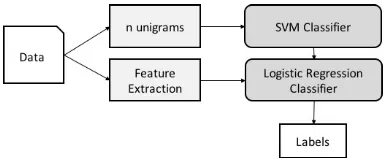
[image:2.612.320.512.382.464.2]This setup(2stage)is based on an ensemble super-vised learning approach as depicted in Figure 1. The first stage is a support vector machine clasi-fier (Cortes and Vapnik, 1995) using lexical fea-tures with TF-IDF weighting. The second stage is a logistic regression classifier which uses the out-put probabilities of the SVM classifier, along with the features described in Section 2.1.
Figure 1: Two-stage classifier
Ensemble methods have proven to be more effec-tive than individual classifiers when the training data is significantly small (as shown in Table 1) and not a good representative of the classes (Po-likar, 2006).
2.2.4 Majority vote classifier:
In this setting (maj1), we use the majority vote based on theuniSVM,uniLR, andnonLexLR clas-sifiers.
3 Experiments
3.1 Dataset
that belong to the last three classes. Table 1 shows the number of posts per class.
Subset green amber red crisis total Train 549 249 110 39 947
Test 166 47 27 1 241
Table 1: Dataset Train-Test Stats
3.2 Metrics
For evaluation, we used the script provided by the shared task organizers, which does not in-clude the green labels.6 The evaluation metrics are precision, recall, and F1-score for each of the three classes (amber, red, crisis), in addition to the macro F1 (official score).
3.3 Results & Discussion
During the system building phase, we experi-mented with the models in Section 2.2 using 5-fold cross validation (CV) on the training data, making use of all the features mentioned in Section 2.1 ex-cept word shape, author ranking, mental disease lexicon, and word embedding features. For the uniLR, uniSVM, and2stageclassifiers, we empir-ically choose n = 300 as the number of most-important unigrams based on best results of the 5-fold CV.
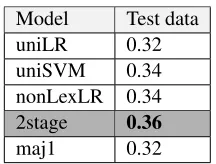
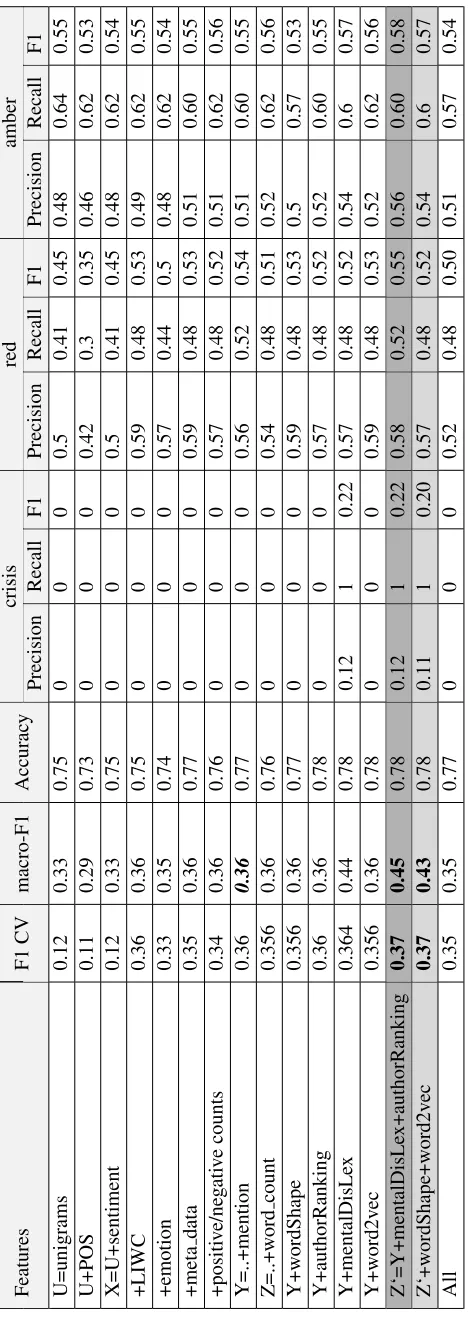
Table 2 depicts the models’ performance on the test data. Although they were not included in the official submissions, Table 4 also includes the ex-tra features we explored.
Model Test data uniLR 0.32 uniSVM 0.34 nonLexLR 0.34 2stage 0.36
[image:3.612.144.252.472.554.2]maj1 0.32
Table 2: Macro F1-Scores on Test Data
Two key challenges in this shared task turned out to be the highly imbalanced data and the ex-tremely small number ofcrisisandredposts, with just 39 crisis posts in the training data and one (!) crisis post in the test set. We addressed the imbalanced dataset problem by using multi-class balanced multi-classifiers, and using five-fold cross validation on training data (941 posts) helped to
6
https://github.com/clpsych-2016-shared-task/ro-evaluation
avoid design choices based on a particularly lucky or unlucky training/test split (Khoshgoftaar et al., 2007). However, in order to tackle the second is-sue, we need a feature set that is capable of cap-turing red and crisis posts, which are the most im-portant classes since they require immediate ac-tion from ReachOut’s moderators and/or adminis-trators.
From Table 4, we observe that the mental dis-ease lexicon feature set was the one capable of capturing the single instance of crisisin the test data; additionally, it improved the recall ofredand precision ofamber. This results in our best sys-tem performance, an unofficial post-shared-task macro-F1 score of 0.45, which improves on the best shared-task official score of 0.42. The LIWC features also provide a major boost in performance (on both CV and test data) which aligns with the results in Table 2; there a feature set that does not include any lexical features (0.34) performs equally to a single classifier using a combination of lexical and non-lexical features.
4 Conclusion & Future Work
We have presented a collaborative effort be-tween George Washington University (GW) and University of Maryland (UMD) to tackle the CLPsych 2016 ReachOut shared task. Using a 2-stage ensemble classification approach, our best official submission yielded0.36%macro-F1, which is6% short of the best system. However, further feature experimentation after the conclu-sion of the shared task yielded a macro F1 score
of0.45%. In future work, we plan to experiment
References
Munmun De Choudhury, Scott Counts, Eric Horvitz, and Michael Gamon. 2013. Predicting depression via social media. AAAI, July.
Corinna Cortes and Vladimir Vapnik. 1995. Support-vector networks. Mach. Learn., 20(3):273–297, September.
T. M. Khoshgoftaar, M. Golawala, and J. V. Hulse. 2007. An empirical study of learning from imbal-anced data using random forest. InTools with Ar-tificial Intelligence, 2007. ICTAI 2007. 19th IEEE International Conference on, volume 2, pages 310– 317, Oct.
Christopher D. Manning, Mihai Surdeanu, John Bauer, Jenny Finkel, Steven J. Bethard, and David Mc-Closky. 2014. The Stanford CoreNLP natural lan-guage processing toolkit. InAssociation for Compu-tational Linguistics (ACL) System Demonstrations, pages 55–60.
Tomas Mikolov, Ilya Sutskever, Kai Chen, Greg S Cor-rado, and Jeff Dean. 2013. Distributed representa-tions of words and phrases and their compositional-ity. InAdvances in neural information processing systems, pages 3111–3119.
Saif M. Mohammad and Peter D. Turney. 2013. Crowdsourcing a word-emotion association lexicon. 29(3):436–465.
Robi Polikar. 2006. Ensemble based systems in deci-sion making. Circuits and systems magazine, IEEE, 6(3):21–45.