Distributed Prediction of Relations for Entities:
The Easy, The Difficult, and The Impossible
Abhijeet Gupta* and Gemma Boleda† and Sebastian Pad´o* *Stuttgart University, Germany
{abhijeet.gupta,pado}@ims.uni-stuttgart.de †Universitat Pompeu Fabra, Barcelona, Spain
Abstract
Word embeddings are supposed to provide easy access tosemantic relationssuch as “male of” (man–woman). While this claim has been investigated forconcepts, little is known about the distributional behavior of relations of(Named) Entities. We de-scribe two word embedding-based models that predict values for relational attributes of entities, and analyse them. The task is challenging, with major performance dif-ferences between relations. Contrary to many NLP tasks, high difficulty for a re-lation doesnotresult from low frequency, but from (a) one-to-many mappings; and (b) lack of context patterns expressing the relation that are easy to pick up by word embeddings.
1 Introduction
A central claim about distributed models of word meaning (e.g.,Mikolov et al.(2013)) is that word embedding space provides easy access tosemantic relations. E.g., Mikolov et al.’s space was shown to encode the “male-female relation” linearly, as a vector(man# »−woman# »=king# »−queen# »).
The accessibility of semantic relations was sub-sequently examined in more detail.Rei and Briscoe
(2014) andMelamud et al.(2014) reported success-ful modeling of lexical relations such as hyper-nymy and synohyper-nymy. K¨oper et al.(2015) consid-ered a broader range of relationships,with mixed results.Levy and Goldberg(2014b) developed an improved, nonlinear relation extraction method.
These studies were conducted primarily on
concepts and their semantic relations, like
hypernym(politician) = person. Mean-while,entitiesand the relations they partake in are
much less well understood.1Entities are instances of concepts, i.e., they refer to specific individual ob-jects in the real world, for example,Donald Trump
is an instance of the concept politician. Conse-quently, entities are generally associated with a rich set of numeric and relational attributes (for
politicianinstances: size, office, etc.). In contrast to concepts, the values of these attributes tend to be discrete (Herbelot, 2015): while the
sizeofpoliticianis best described by a prob-ability distribution, the size ofDonald Trump
is 1.88m. Since distributional representations are notoriously bad at handling discrete knowl-edge (Fodor and Lepore,1999;Smolensky,1990), this raises the question of how well such models can capture entity-related knowledge.
In our previous work (Gupta et al.,2015), we analysed distributional prediction of numeric at-tributes of entities, found a large variance in quality among attributes, and identified factors determin-ing prediction difficulty. A corresponddetermin-ing analysis forrelational (categorial) attributesof entities is still missing, even though entities are highly rele-vant for NLP. This is evident from the highly ac-tive area ofknowledge base completion(KBC), the task of extending incomplete entity information in knowledge bases such as Yago or Wikidata (e.g.,
Bordes et al.,2013;Freitas et al.,2014;
Neelakan-tan and Chang,2015;Guu et al.,2015;
Krishna-murthy and Mitchell,2015).
In this paper, we assess to what extent re-lational attributes of entities are easily acces-sible from word embedding space. To this end, we define two models that predict, given a target entity (Star Wars) and a relation (director), a distributed representation for the relatum (George Lucas). We carry out a detailed per-relation analyses of their performance on seven 1The original dataset by Mikolov et al. (2013) did contain
a small number of entity-entity relations.
Target Vector
Hidden Relatum Vector
Relation
n-dimensional word embedding input
m-dimensional one-hot vector input
n-dimensional word embedding prediction
k-dimensional vector Relatum
Name NN
Win W
r
[image:2.595.70.288.62.158.2]Wout
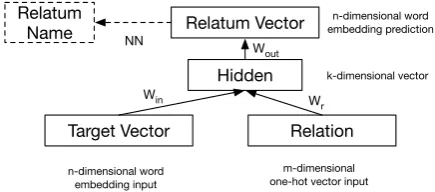
Figure 1: Nonlinear model (NonLinM) structure
major FreeBase domains and identify what makes a relation difficult by correlating performance with properties of the relations. We find that, contrary to many other NLP tasks, relations arenotdifficult if they are infrequent or sparse, but instead (a) if they relate one target to multiple relata; (b) if they do not give rise to linguistic patterns that can be picked up by bag-of-words distributional models.
2 Two Relatum Prediction Models
Both models predict a vector for arelatumr(plural:
relata) given atarget entityvectortand a symbolic
relationρ.
The Linear Model (LinM) is inspired by Mikolov et al.’s “phrase analogy” evaluation of word embeddings (man# »− woman# » = king# » −
# »
queen). However, instead of looking at individ-ual words, we extract representations of semantic relations from sets of pairs Tρ = {(ti, ρ, ri)}
in-stantiating the relationρ. For each relationρ, LinM computes the average (or centroid) difference vec-tor over the set of training pairs:
ˆ
r(t, ρ) =t+ X
(r,ρ,t)∈Tρ
(r−t)/N (1)
That is, the predicted ˆr for an input(t, ρ) is the sum of the target vector and the relation’s proto-type. This model should work well if relations are represented additively in the embedding space.
The Nonlinear Model (NonLinM) is a feed-forward network (Figure1) introducing a nonlin-earity, inspired byLevy and Goldberg(2014b) and similar to models used in KBC, e.g.,Socher et al.
(2013). The relatum vector is predicted as
ˆ
rθ(t, ρ) =σ(σ(t·Win+vρ·Wr)·Wout) (2)
where vρ is the relation encoded as an m
-dimensional one-hot vector and the three matrices
Win, Wr, Woutform the model parametersθ. For
the nonlinearityσ, we usetanh.
In this model, the hidden layer represents a non-linearly transformed composition of target and re-lation from which the relatum can be predicted. NonLinM can theoretically make accurate predic-tions even if relapredic-tions are not additive in embedding space. Also, its sharing of training data among re-lations should lead to more reliable learning for infrequent relations. As objective function, we use
L(θ) =X
(t,r)
[ cos(ˆrθ(t, ρ), r)
−α·cos(ˆrθ(t, ρ), nc(ˆrθ(t, ρ)))]
(3) wherenc(v)is thenearest confounderofv, i.e., the next neighbor ofvthat is not a relatum for the cur-rent target-relation pair. Thus, we minimize the co-sine distance between the predicted vector and the gold vector for the relatum while maximizing the cosine distance of the prediction to the closest nega-tive example. We introduce a weightα∈[0,1]for the negative sampling term as a hyper-parameter optimized on the development set. During train-ing, we apply gradient descent with the adaptive learning rate method AdaDelta (Zeiler,2012). 3 Experiments
Data. We extract relation data from FreeBase. We follow our earlier workGupta et al.(2015), but go beyond its limitation to two domains (country,
citytown). We experiment with seven major FreeBase domains: animal, book, citytown,
country, employer, organization, people. We limit the number of datapoints of very large relation types to 3000 with random sampling for efficiency reasons. We only remove relation types with fewer than 3 datapoints. This results in a quite challenging dataset that demonstrates the general-izability of our models and is roughly comparable, in variety and size, to the FB15Kdataset (Bordes
et al.,2013).
The distributed representations for all entities come from the 1000-dimensional “Google News” skip-gram model (Mikolov et al.,2013) for Free-Base entities2trained on a 100G token news corpus. We only retain relation datapoints where both tar-get and relatum are covered in the Google News vectors. Table1 shows the numbers of relations and unique objects (target plus relata).
Size Performance Relation-level statistics
Domain #R #Ts+Ra. BL LM NLM %R>0.3 %R<0.1 ρ(NLM, #In) ρ(NLM, #RpT)
animal 24 3,428 0.11 0.16 0.29 38% 42% .07 -.34
book 22 7,014 0.11 0.24 0.26 9% 68% .09 -.15
citytown 46 86,551 0.05 0.13 0.26 28% 39% -.12 -.22
country 89 191,196 0.04 0.08 0.18 20% 52% -.32 -.23
employer 76 14,658 0.05 0.15 0.23 30% 45% .01 -.35
organization 53 8,989 0.07 0.17 0.26 34% 42% -.24 -.29
people 91 11,397 0.09 0.19 0.27 34% 23% .23 -.25
Micro average 0.06 0.14 0.22 25% 45% -.12 -.25
[image:3.595.83.519.65.190.2]Macro average 0.08 0.16 0.23 28% 44% -.05 -.26
Table 1: Test set statistics and results. #R: relations; #Ts+Ra: unique targets and relata; BL/LM/NLM: Baseline, linear and nonlinear model (macro-average MRR); %R≶x: percent of relations with MRR≶x;
ρ: Spearman correlation; #In: instances; #RpT: relata per target
We split all domains into training, validation, and test sets (60%–20%–20%). The split applies to each relation type: in test, we face no unseen rela-tion types, but unseen datapoints for each relarela-tion.3
Hyperparameter settings. The NonLinM model uses an L2 norm constraint of s=3. We
adopt the best AdaDelta parameters from Zeiler
(2012), viz.ρ= 0.95and= 10−6. We optimize
the negative sampling weight α (cf. Eq. 3) by line search with a step size of 0.1 on the largest domain,country, and find0.6to be the optimal value, which we reuse for all domains. Due to the varying dimensionality m of the relation vector per domain, we set the size of the hidden layer to k = 2n+m/10 (n is the dimensionality of the word embeddings, cf. Figure1). We train all models for a maximum of 1000 epochs with early stopping.
Evaluation. Models that predict vectors in a con-tinuous vector space, like ours, cannot expect to predict the output vector precisely. Thus, we ap-plynearest neighbor mappingusing the set of all unique targets and relata in each domain (cf. Ta-ble 1) to identify the correct relatum name. We then perform an Information Retrieval-style rank-ing evaluation: We compute the rank of the correct relatumr, given the targettand the relationρ, in the test setT and aggregate these ranks to compute themean reciprocal rank(MRR):
MRR= ||T1|| X
(t,ρ,r)∈T
1
rankt,ρ(r) (4)
where rank is the nearest neighbor rank of the relatum vectorrgiven the prediction of the model 3The dataset are available at:
http://www.ims.uni-stuttgart.de/data/RelationPrediction.html
for the inputt, ρ. We report results at the relation level as well as macro- and micro-averaged MRR for the complete dataset.
Frequency Baseline (BL). Our baseline model ignores the target. For each relation, it predicts the frequency-ordered list of all training set relata.
4 Results and Discussion
Overall results. Table1shows that the nonlinear model NonLinM consistently gives the best results and statistically outperforms the linear model on all domains according to a Wilcoxon test (α=0.05). Both LinM and NonLinM clearly outclass the base-line. Most MRRs are around 0.25 (micro average 0.22), with one outlier, at 0.18, forcountry, the largest domain. Overall, the numbers may appear disappointing at first glance: these MRRs mean that the correct relatum is typically around the fourth nearest neighbor of the prediction vector. This in-dicates that open-vocabulary relatum prediction in a space of tens of thousands of words is a chal-lenging task that warrants more detailed analysis. We observe that the nonlinear model achieves rea-sonable results even for sparse domains (cf. the low baseline), which we take as evidence for its generalization capabilities.
Analysis at relation level. Table 1 shows the number of relations with good MRRs (greater than 0.3) and bad MRRs (smaller than 0.1) for each rela-tion. While the numbers vary across domains, the models tend to do badly on around 40-50% of all relations, and obtain good scores for less than one third of all relations.
rel-5 10 15 20 0.0 0.2 0.4 0.6 0.8 1.0
relation index (sorted by NonLinM performance)
MRR f or animal ● ● ● ● ● ● ● ● ● ● ● ● ● ● ● ● ● ● ● ● ● ● ● ● ● NonLinM LinM
0 20 40 60 80
0.0 0.2 0.4 0.6 0.8 1.0
relation index (sorted by NonLinM performance)
[image:4.595.72.290.59.264.2]MRR f or countr y ● ● ● ● ● ● ● ● ●●●●● ● ●● ● ●●● ● ●●● ●●● ● ●● ● ● ●●● ● ●●● ● ●●●●●●●●●●●●●●●●●●●●●●●●●●●●●●●●●●●●●●●●●●●●●●●●● ● NonLinM LinM
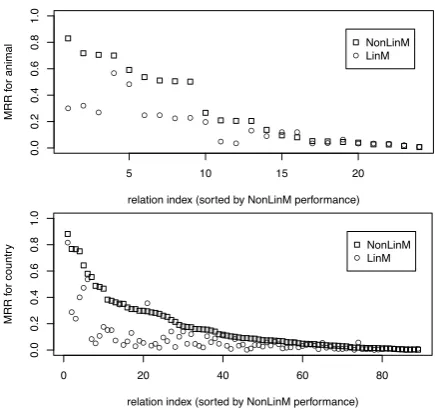
Figure 2: Results by relation for best and worst domains (animal, above;people, below), sorted by NonLinM performance
Target Correct LinM NonLinM
Japan Asia Japan Asia
Kazakhstan Asia Central Asia Asia
continent
Nicaragua North Latin Americas America America
Nepal Kathmandu Nepal Dhaka
Qatar Doha Qatar Riyadh
capital Venezuela Caracas Caracas Quito
Table 2: Example predictions for two country
relations (correct answer in boldface)
atively small set of well-modelled relations and a long tail of poorly modelled ones. NonLinM does better or as well as LinM for almost all relations. The performances of the two models are very tighly correlated for difficult relations; they only differ for the easier ones, where NonLinM’s evidently captures the data better.
Qualitatively, the two models differ substantially with regard to prediction patterns at the level of targets. Table2shows the first predictions for three targets from two relations: continent, where NonLinM outperforms LinM, andcapital, where it is the other way around. NonLinM’s errors con-sist almost exclusively in predicting semantically similar entities of the correct relatum type, e.g., predicting Quito (the capital of Ecuador) as capi-tal of Venezuela. In contrast, the LinM model has a harder time capturing the correct type, predict-ing country entities as capitals (e.g., Nepal as the capital of Nepal).
● ● ● ● ● ● ● ● ● ● ● ● ● ● ● ● ● ● ● ● ● ● ● ●
1 2 5 10 20 50 100 200
0.0
0.2
0.4
0.6
0.8
Avg. # of relata per target
MRR of NonLinM on animal
● ●● ● ● ● ● ● ● ● ● ● ● ● ● ● ● ● ● ● ● ● ● ● ● ● ● ● ● ● ● ● ●● ● ● ● ● ● ● ● ●● ● ● ● ● ● ● ● ● ● ● ● ● ● ● ● ● ● ● ● ● ● ● ● ● ● ● ● ●● ●● ● ● ● ● ● ● ● ● ● ● ● ● ● ● ●
1 2 5 10 20 50 100 200 500
0.0
0.2
0.4
0.6
0.8
Avg. # of relata per target
MRR of NonLinM on countr
[image:4.595.306.526.62.234.2]y
Figure 3: Scatterplot: MRR vs. number of relata per target (above:animal, below:country)
Analysis of Difficulty. So what makes many FreeBase relations hard to model? To test for spar-sity problems, we first computed the correlation between model performance and the “usual sus-pect” relation frequency (number of instances for each relation). In NLP applications, this typically yields a high positive correlation. The second-to-last column of Table1shows that this is not true for our dataset. We find a substantial positive cor-relation only forpeople, correlations around zero for most domains, and substantial negative ones for
organizationandcountry. For these domains, therefore, frequent relations are actuallyharderto model. Further analysis revealed two main sources of difficulty:
(1) One-to-many relations. Relations with many datapoints tend to be one-to-many. We assume this to be a major source of difficulty, since the model is presented with multiple re-lata for the same target during training and will typically learn to predict a centroid of these re-lata. As an extreme case, consider a relation like
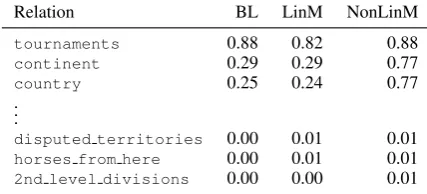
Qualitatively, Table 3shows examples for the three most easy and difficult relations forcountry. The list suggests that relations tend to be easy when they associate targets with single relata: the rela-tioncountrymaps territories and colonies onto their motherlands, and thetournamentsrelation is only populated with a few Commonwealth games (cf. the high baseline). In contrast, relations that map targets on many relata are difficult, such as administrativedivisions of countries, or a list of
disputed territories. Note that this is not an evaluation issue, since MRR can deal with multiple correct answers. Our models do badly because they lack strategies to address these cases.
(2) Lack of contextual support. One-to-many relations are not the only culprit. Strikingly, Fig-ure 2 shows that a low target-relatum ratio is a
necessary condition for good performance (the upper right corners are empty), but not a suffi-cient one (the lower left corners are not empty). Some relations are not modelled well even though they are (almost) one-to-one. Examples include
currency formerly usedornamed afterfor
country and place of origin for animal. Further analysis indicated that these relations suf-fer from whatGupta et al. (2015) calledlack of contextual support: Although they are expressed overtly in the linguistic context of the target and relatum (and often even frequently so), their real-izations cannot be tied to individual words or topics. Instead, they are expressed by relatively specific linguistic patterns, often predicate-argument struc-tures (X used to pay with Y, X is named in the honor of Y). Such structures are hard to pick up by word embedding models that make the bag-of-words in-dependence assumption among context words. 5 Conclusion
This paper considers the prediction of related enti-ties (“relata”) given a pair of a target Named Entity and a relation (Star Wars, director, ?) on the basis of distributional information. This task is challenging due to the more discrete behavior of attributes of entities as compared to concepts. We provide an analysis based on two models that use vector representations for both the targets and the relata.
Our results yield new insights into how embed-ding spaces represent entity relations: they are gen-erally not represented additively, and nonlinearity helps. They also complement insights on the
be-Relation BL LinM NonLinM
tournaments 0.88 0.82 0.88
continent 0.29 0.29 0.77
country 0.25 0.24 0.77
.. .
disputed territories 0.00 0.01 0.01
horses from here 0.00 0.01 0.01
[image:5.595.307.521.61.158.2]2nd level divisions 0.00 0.00 0.01
Table 3: The three most easy and most difficult relations for thecountrydomain
havior of numeric attributes of entities (Gupta et al.,
2015): Relations, like numeric attributes, are diffi-cult to model if they are not specifically expressed in the lingusitic context of target and relatum. A new challenge specific to relations are situations where a single target maps onto many relata. If none of the two problems applies, relations are
easyto model. If one applies, they are difficult. And if both apply, they are essentiallyimpossible.
Among the two challenges, the problem of one-to-many relations appears easier to address, since a continuous output vector is, at least in principle, able to be similar to many relata. In the future, we will extend the model to deal better with one-to-many relations. While the lack of contextual support seems more fundamental, it could be ad-dressed by either using syntax-based embeddings
(Levy and Goldberg,2014a) that can better pick up
the specific context patterns characteristic for these relations, or by optimizing the input word embed-dings for the task. This becomes a similar problem to joint training of representations from knowledge base structure and textual evidence (Perozzi et al.,
2014;Toutanova et al.,2015). Acknowledgements
This project has received funding from the Euro-pean Research Council (ERC) under the EuroEuro-pean Union’s Horizon 2020 research and innovation pro-gramme (grant agreement No 715154) and the DFG (SFB 732, Project D10). This paper reflects the au-thors’ view only, and the EU is not responsible for any use that may be made of the information it contains.
References
2013. Translating embeddings for modeling multi-relational data. InProceedings of Neural Informa-tion Processing Systems 26. pages 2787–2795.
Jerry Fodor and Ernie Lepore. 1999. All at Sea in Se-mantic Space: Churchland on Meaning Similarity.
Journal of Philosophy96(8):381–403.
Andr´e Freitas, Joao Carlos Pereira da Silva, Ed-ward Curry, and Paul Buitelaar. 2014. A distribu-tional semantics approach for selective reasoning on commonsense graph knowledge bases. In Nat-ural Language Processing and Information Systems, Springer, pages 21–32.
Abhijeet Gupta, Gemma Boleda, Marco Baroni, and Sebastian Pad´o. 2015. Distributional vectors encode referential attributes. In Proceedings of the 2015 Conference on Empirical Methods in Natural Lan-guage Processing. Lisbon, Portugal, pages 12–21.
Kelvin Guu, John Miller, and Percy Liang. 2015. Traversing knowledge graphs in vector space. In
Proceedings of the 2015 Conference on Empirical Methods in Natural Language Processing. Lisbon, Portugal, pages 318–327.
Aur´elie Herbelot. 2015. Mr Darcy and Mr Toad, gen-tlemen: Distributional names and their kinds. Pro-ceedings of the 11th International Conference on Computational Semanticspages 151–161.
Maximilian K¨oper, Christian Scheible, and Sabine Schulte im Walde. 2015. Multilingual Reliabil-ity and ”Semantic” Structure of Continuous Word Spaces. In Proceedings of the 11th Conference on Computational Semantics. London, UK, pages 40– 45.
Jayant Krishnamurthy and Tom M Mitchell. 2015. Learning a compositional semantics for freebase with an open predicate vocabulary. Transactions of the Association for Computational Linguistics
3:257–270.
Omer Levy and Yoav Goldberg. 2014a. Dependency-based word embeddings. In Proceedings of the 52nd Annual Meeting of the Association for Com-putational Linguistics. Baltimore, Maryland, pages 302–308.
Omer Levy and Yoav Goldberg. 2014b. Linguistic regularities in sparse and explicit word representa-tions. InProceedings of the Eighteenth Conference on Computational Natural Language Learning. Ann Arbor, Michigan, pages 171–180.
Oren Melamud, Ido Dagan, Jacob Goldberger, Idan Szpektor, and Deniz Yuret. 2014. Probabilistic mod-eling of joint-context in distributional similarity. In
Proceedings of the Eighteenth Conference on Com-putational Natural Language Learning. Ann Arbor, Michigan, pages 181–190.
Tomas Mikolov, Ilya Sutskever, Kai Chen, Greg S Cor-rado, and Jeff Dean. 2013. Distributed representa-tions of words and phrases and their compositional-ity. InAdvances in Neural Information Processing Systems. Lake Tahoe, NV, pages 3111–3119. Arvind Neelakantan and Ming-Wei Chang. 2015.
In-ferring missing entity type instances for knowledge base completion: New dataset and methods. In Pro-ceedings of the North American Chapter of the Asso-ciation for Computational Linguistics. Denver, CO, pages 515–525.
Bryan Perozzi, Rami Al-Rfou, and Steven Skiena. 2014. Deepwalk: Online learning of social represen-tations. In Proceedings of the 20th ACM SIGKDD international conference on Knowledge discovery and data mining. ACM, New York City, NY, pages 701–710.
Marek Rei and Ted Briscoe. 2014. Looking for hy-ponyms in vector space. InProceedings of the Eigh-teenth Conference on Computational Natural Lan-guage Learning. Ann Arbor, Michigan, pages 68– 77.
Paul Smolensky. 1990. Tensor product variable bind-ing and the representation of symbolic structures in connectionist systems. Artificial Intelligence 46(1-2):159–216.
Richard Socher, Danqi Chen, Christopher D Manning, and Andrew Ng. 2013. Reasoning with neural ten-sor networks for knowledge base completion. In
Advances in Neural Information Processing Systems. Lake Tahoe, CA, pages 926–934.
Kristina Toutanova, Danqi Chen, Patrick Pantel, Pallavi Choudhury, and Michael Gamon. 2015. Represent-ing text for joint embeddRepresent-ing of text and knowledge bases. InProceedings of EMNLP. Lisbon, Portugal, pages 1499–1509.