LIMSI Submission for WMT’17 Shared Task on Bandit Learning
Guillaume Wisniewski
LIMSI, CNRS, Univ. Paris-Sud, Universit´e Paris-Saclay, 91 405 Orsay, France [email protected]
Abstract
This paper describes LIMSI participation to the WMT’17 shared task on Bandit Learning. The method we propose to adapt a seed system trained on out-domain data to a new, unknown domain relies on two components. First, we use a linear regression model to exploit the weak and partial feedback the system receives by learning to predict the reward a translation hypothesis will get. This model can then be used to score hypotheses in the search space and translate source sentences while taking into account the specificities of the in-domain data. Second, we use the UCB1 algorithm to choose which of the ‘adapted’ or ‘seed’ system must be used to translate a given source sentence in order to maxi-mize the cumulative reward.
Results on the development and train sets show that the proposed method does not succeed in improving the seed system. We explore several hypotheses to explain this negative result.
1 Introduction
The first Bandit Learning for Machine Translation shared task (Sokolov et al.,2017) aims at adapting a ‘seed’ MT system trained on out-domain corpora to a new domain considering only a ‘weak’ signal, namely a translation quality judgment rather than a reference translation or a post-edition. Such a situation arises when the user is not a skilled lator but can nevertheless decide whether a trans-lation is useful or not. The signal is qualified as ‘weak’ as only the score of the translation pro-duced by a system can be known, the same sen-tence can not be translated twice and no reference is ever revealed.
Adapting a MT system from a weak signal raises three main challenges. First, the parame-ters of the MT system must be estimated without knowing the reference translation which rules out most of the usual optimization methods for MT such as MERT, MIRA or the computation of like-lihood at the heart of NMT systems (Neubig and Watanabe, 2016). Second, the system must be trained in a ‘one-shot’ way as each source sen-tence can only be translated once and will result in a single reward. Third, no information about the target domain is available and its specificities must be discovered ‘on-the-fly’.
To address these challenges, we propose an adaptation method that relies on two components. First, we use a linear regression model to exploit the weak and partial feedback the system receives by learning to predict the reward a translation hy-pothesis will get. This model can then be used to score hypotheses of the search space and trans-late source sentences while taking into account the specificities of the in-domain data. Second, we use the UCB1 algorithm to choose which of the ‘adapted’ or ‘seed’ system must be used to trans-late a given source sentence in order to maximize the cumulative reward.
The rest of this article is organized as follows: we will first describe the shared task and the differ-ent challenges it raises (§2). Then we will describe
the proposed method (§3–4) and discuss their re-sults in§5.
2 Task Description
Bandit learning for MT follows an online learning protocol: at the i-th iteration, a new source
sen-tencexi is received; the learner translates it and gets a reward ri ∈ [0,1] (a smoothed sentence-level BLEU score in this shared task). The higher the reward, the better the translation but no
mation about the actual reference is available. The goal of the task is to maximize the cumulative re-ward overT rounds:PTi=1ri.
Maximizing the cumulative reward faces an ex-ploration/exploitation dilemma: if all the sen-tences are translated using the seed system (i.e. a system trained on out-domain data), the specifici-ties of the domain will never be taken into account and only ‘average’ translations will be predicted (assuming the seed system is ‘good enough’). However, training a new MT system from scratch is also not a good strategy as, at the beginning the system will predict many bad translations which i) will have a negative impact on the cumulative re-ward ii) might hinder training as the system will only see bad hypotheses (i.e. only a small part of the search space of a MT system will be explored). Moreover, as no information about the target do-main is available, the seed system may be, in fact, very good for some input sentences and the best strategy will simply be not to do any adaptation.
3 System Overview
We will now describes the two components of our system: the first one (§3.1) will allow us to exploit the weak and partial feedback we receive and the second one (§3.2) will allow to discover the MT system that translates in-domain data the best.
3.1 Optimizing a MT System from Weak Feedback
Estimating the parameters of a MT system from the rewards can not be done with the usual MT op-timization methods: as the reference is not known, it is impossible to score a n-best list as required
by methods optimizing a classification criterion such as MERT or MIRA (Neubig and Watanabe, 2016). Moreover, as only one translation hypoth-esis is scored, methods optimizing a ranking crite-rion, such as PRO, can also not be used.
Instead we propose to simply learn a linear re-gression to predict the reward a translation hy-pothesis will get based on a joint feature represen-tation φ(hi, xi) of the hypothesis and the source sentence. Using a linear model allows us to eas-ily integrate it into the decoder to score transla-tion hypotheses: given a weight vectorw,
translat-ing a source sentencexconsists in looking, in the
search space, for the hypothesis that maximizes the predicted reward, which amounts to finding the longest path in a weighted directed acyclic
graph (Wisniewski et al., 2010; Wisniewski and Yvon,2013).
More precisely the weights of the MT system are chosen by optimizing the regularized mean squared error (MSE):
min
w X
i
(ri−w·φ(hi, xi))2+λ2·||w||22+λ1·||w||1
(1) whereλ1andλ2are hyper-parameters controlling the strength of the regularization. Solving Equa-tion (1) with a stochastic gradient descent allows us to update the weight vector each time a new re-ward is received and to integrate learning in the bandit protocol. Features and optimization meth-ods are detailed in Section4.2.
It is important to note that in the context of Bandit MT, examples are not independently dis-tributed: the score of thei-th observation depends on the current value of the weight vector that, in turn, depends on all the examples that have been previously observed. This is a second aspect of the exploration/exploitation dilemma described in Section2as we have to trade off exploration of the search space (to ensure that we correctly predict the reward of any ‘kind’ of hypotheses and even-tually discover better translations) while focusing on the part of the search space that contains, ac-cording to our current knowledge (i.e. value of the weight vector), the best hypotheses.
In the following, we will denote ADAPTEDthe
MT system that uses the predicted reward to trans-late a source sentence.
3.2 Trading off Exploration and Exploitation Our system relies on the observation that each new source sentence can be translated by different systems: either the SEED system, the parameters
of which have been estimated on an out-domain data set or the ADAPTEDsystem the parameters of
which are continuously updated from the rewards. The bandit learning task aims at deciding, for a given input sentence, which system must be used to translate it in order to maximizes the cumulative reward.
The quality of a translation predicted by a given systemican be modeled by a[0,1]-valued random
variableXi distributed with an unknown distribu-tion and possessing an unknown expected value
µiis unknown and can change over time.
This framework corresponds to the multi-armed bandit scenario (Bubeck and Cesa-Bianchi,2012). Many algorithms have been proposed to find the best policy.1 In this shared task, we consid-ered the UCB1 algorithm (Auer et al.,2002), that consists in choosing the system that maximizes
¯
xj + q
2 lognt
j, wherenj represents the number of times system j was chosen so far, t the
num-ber of rounds andx¯jthe empirical mean reward of thej-th system. After each decision, a reward is
observed and used to i) update the estimated em-pirical mean reward of the system that has just been chosen and ii) update the weight vector of the ADAPTEDsystem by doing one SGD step.
In-tuitively, this strategy selects a decision that has either a ‘good’ expected reward or has not been played for long. Importantly it never permanently rules out a system no matter how poorly it per-forms.
It can be proven (Auer et al., 2002) that the UCB1 expected cumulative regret afterT rounds
is at most O √K·T·logT where K is the
number of decisions that can be made. This means that the difference between the cumulative reward achieved by the UCB1 strategy and the cumulative reward that would have been achieved by always making the best decision is upper-bounded, i.e. the UCB1 will allow us to discover which was the best decision to make without making too many bad decisions.
In the following, we denote UCB1 the strat-egy that consists in using the UCB1 algorithm to choose between the SEED and ADAPTED
transla-tion systems. 3.3 Variants
After analyzing our results on the development set (see §5), we decide to consider two more strate-gies:
• UCB1-SELECTthat considers the same
sys-tems as the UCB1 strategy but only the trans-lation hypothesis associated to a rewardr in
[0.1,1[are considered to estimate the weights
of the ADAPTEDsystem (other observations
are discarded);
• UCB1-SAMPLING in which two more MT
systems are considered (in addition to the
1A policy is a randomized algorithm which makes a de-cision in each round based on the history of dede-cisions and observed rewards so far
ADAPTEDand SEEDsystems): the first one,
SAMPLE-SEED samples translations from
the search space according to their score predicted by the SEED system (the higher
its predicted score, the higher the probabil-ity to select this hypothesis); the other one, SAMPLE-UNIFORM samples translation
hy-potheses uniformly from the search space.
The latter strategy allows us to increase the di-versity of translation hypotheses seen when es-timating the weights of the ADAPTED system.
The former is motivated by our observations that many good translation hypotheses have very low rewards because the references used to compute them are not a direct translation that can be pro-duced by the MT system (i.e. the references are unreachable) or that many source sentence do not actually need to be translated (i.e. the source and the reference are the same). Table1 shows such examples. We assume that these observations hin-der the estimation of the model used to predict the rewards has its gold value is completely unrelated to the features describing the hypothesis.
source einfach genial und absolut cool ! hyp. simply brilliant and totally cool ! score 0.008633400213704501
[image:3.595.321.515.398.537.2]source schwarz gr.xxl / xxxl hyp. black gr.xxl / xxxl score 0.0360645288 source 00603.117 , bt . hyp. 00603.117 , bt . score 1.0
Table 1: Example of a ‘good’ translation with very bad rewards and of a perfect translation.
4 Experimental Details 4.1 The SEEDSystem
We consider as our SEED system a
phrase-based system trained using the standard Moses pipeline (Koehn et al., 2007): all corpora are cleaned2 and tokenized; compounds are split on the German side using our re-implementation of (Koehn and Knight, 2003). Parallel data are
aligned using FASTALIGN (Dyer et al., 2013)
and 5-gram language models is estimated using KENLM (Heafield et al.,2013).
The language model is estimated on the mono-lingual corpus resulting from the concatenation of the EUROPARL(v7), NEWSCOMMENTARY(v12)
and NEWSDISCUSS(2015–2016) corpora. At the
end, our monolingual corpus contain 193,292,548 sentences. The translation model is estimated from theCommonCrawl, NewsCo, Europarl
andRapidcorpora, resulting in a parallel corpus made of 5,919,142 sentences.
Weights of the MT systems are estimated with MERT onnewstest-2016.
4.2 Training the Regression Model
We use Wowpal Wabbit (Agarwal et al., 2014) to efficiently train a regressor to predict the re-wards by optimizing the Mean Squared Error with a stochastic gradient descent. We consider 32 fea-tures: the 15 features of a baseline Moses system3 as well the score of the SEED system. We also
consider the logarithm of these features.
To account for the different feature ranges and the mix of continuous and discrete features, we en-hance the standard SGD by adding the following three additional factors affecting the weight up-dates when optimizing the MSE objective func-tion:
• normalized updates to adjust for the scale of each feature (Ross et al.,2013);
• adaptive, individual learning rate for each
feature (Duchi et al.,2011);
• importance aware update (Karampatziakis
and Langford,2011).
The value of the hyper-parametersλ1andλ2are chosen by maximizing prediction performance on the 5,000 first examples on the development set.
5 Results
Performance of the proposed methods have been evaluated on the two corpora provided by the shared task organizers: a development set contain-ing about 40,000 sentences and an official traincontain-ing set containing 1,300,000 sentences, which will be use to rank the participants. Unfortunately, given
31 language model score, 4 translation model scores, 6 scores describing lexical reordering, one distortion score, as well as word, phrase and unknown word penalty
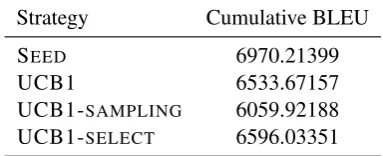
Strategy Cumulative BLEU
SEED 6970.21399
UCB1 6533.67157
UCB1-SAMPLING 6059.92188
[image:4.595.305.497.64.142.2]UCB1-SELECT 6596.03351
Table 2: Results on the Development data set
its size, we were not able to translate all the train-ing set.
The quality of the systems is evaluated both by the cumulative reward (see§2) and by computing
the BLEU score on a specific corpus at different ‘checkpoints’.
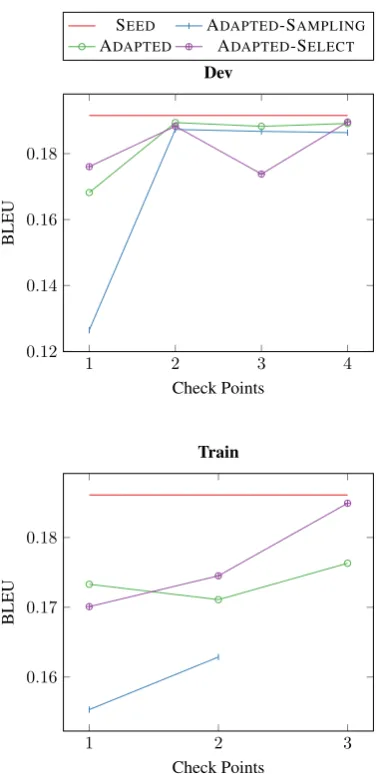
Table 2shows the cumulative reward achieved by our systems on the development set. It ap-pears that all the methods we proposed are outper-formed by the seed system. Looking at the num-ber of times each system was used by the different strategies (Table3), shows that, most of the time, the seed system is selected, which confirms that it achieves the best translation performance. Results of the off-line evaluation, reported in Figure1and on the training set confirm these observations.
Several hypotheses can be formulated to explain these negative results:
• trying to adapt an MT system by changing only the scores of a few models and without additional resources or knowledge of the tar-get domain may not offer enough flexibility;
• the estimation error of regressor may be too large to discriminate the best translation hy-pothesis of the search space. In practice the mean squared error on the training data is around0.06.
• Our exploration strategy is not efficient enough, and the learners never learns to score ‘good’ hypotheses. Indeed, as shown in Fig-ure 2, most of the hypotheses seen during training are of very low quality or correspond to very short sentences that can be translated trivially. In both cases, extracting useful in-formation is difficult.
Strategy Out-Domain In-Domain Sample Moses Sample Uniform
SEED 100% — — —
UCB1 90.77% 9.23% — —
UCB1-SAMPLING 78.04% 7.67% 7.36% 6.94%
[image:5.595.306.526.212.350.2]UCB1-SELECT 90.15% 9.85% — —
Table 3: Number of times each translation system is chosen by the UCB1 strategy on the development set. ‘Out-Domain’ refers to the seed system, In-Domain to the system trained on the rewards and the last two systems to systems sampling randomly hypotheses from the search space.
1 2 3 4
0.12 0.14 0.16 0.18
Check Points
BLEU
Dev
SEED ADAPTED-SAMPLING
ADAPTED ADAPTED-SELECT
1 2 3
0.16 0.17 0.18
Check Points
BLEU
[image:5.595.74.264.262.650.2]Train
Figure 1: Evolution of the BLEU score at the different ‘check-points’ of the development and training datasets.
0.0 0.2 0.4 0.6 0.8 1.0 0.0
2.5 5.0 7.5 10.0 12.5 15.0 17.5 20.0
Figure 2: Distributions of the rewards the SEED
system got on the development dataset.
Acknowledgments
This work has been partially funded by theAgence Nationale de la Recherche(ParSiTi project, ANR-16-CE33-0021). Warm thanks to Franc¸ois Yvon for his feedback on this work.
References
Alekh Agarwal, Olivier Chapelle, Miroslav Dud´ık, and
John Langford. 2014. A reliable effective
teras-cale linear learning system. J. Mach. Learn. Res., 15(1):1111–1133.
Peter Auer, Nicol`o Cesa-Bianchi, and Paul Fischer.
2002. Finite-time analysis of the multiarmed
ban-dit problem.Machine Learning, 47(2-3):235–256.
S´ebastien Bubeck and Nicol`o Cesa-Bianchi. 2012.
Re-gret analysis of stochastic and nonstochastic multi-armed bandit problems. Foundations and Trends in Machine Learning, 5(1):1–122.
John Duchi, Elad Hazan, and Yoram Singer. 2011. Adaptive subgradient methods for online learning and stochastic optimization. J. Mach. Learn. Res., 12:2121–2159.
Conference of the North American Chapter of the Association for Computational Linguistics: Human Language Technologies, pages 644–648, Atlanta, Georgia. Association for Computational Linguistics. Kenneth Heafield, Ivan Pouzyrevsky, Jonathan H.
Clark, and Philipp Koehn. 2013. Scalable
modi-fied Kneser-Ney language model estimation. In Pro-ceedings of the 51st Annual Meeting of the Associa-tion for ComputaAssocia-tional Linguistics, pages 690–696, Sofia, Bulgaria.
Nikos Karampatziakis and John Langford. 2011.
On-line importance weight aware updates. InUAI 2011,
Proceedings of the Twenty-Seventh Conference on Uncertainty in Artificial Intelligence, Barcelona, Spain, July 14-17, 2011, pages 392–399. AUAI Press.
Philipp Koehn, Hieu Hoang, Alexandra Birch, Chris Callison-Burch, Marcello Federico, Nicola Bertoldi, Brooke Cowan, Wade Shen, Christine Moran, Richard Zens, Chris Dyer, Ondrej Bojar, Alexandra
Constantin, and Evan Herbst. 2007. Moses: Open
source toolkit for statistical machine translation. In
Proceedings of the 45th Annual Meeting of the As-sociation for Computational Linguistics Companion Volume Proceedings of the Demo and Poster Ses-sions, pages 177–180, Prague, Czech Republic. As-sociation for Computational Linguistics.
Philipp Koehn and Kevin Knight. 2003. Empirical
methods for compound splitting. In Proceedings of the Tenth Conference on European Chapter of the Association for Computational Linguistics - Vol-ume 1, EACL ’03, pages 187–193, Stroudsburg, PA, USA. Association for Computational Linguistics. Graham Neubig and Taro Watanabe. 2016.
Optimiza-tion for statistical machine translaOptimiza-tion: A survey.
Computational Linguistics, 42(1):1–54.
St´ephane Ross, Paul Mineiro, and John Langford.
2013. Normalized online learning. In
Proceed-ings of the Twenty-Ninth Conference on Uncertainty in Artificial Intelligence, UAI 2013, Bellevue, WA, USA, August 11-15, 2013. AUAI Press.
Artem Sokolov, Julia Kreutzer, Kellen Sunder-land, Pavel Danchenko, Witold Szymaniak, Hagen
F¨urstenau, and Stefan Riezler. 2017. A shared
task on bandit learning for machine translation. In
Proceedings of the Second Conference on Machine Translation (WMT).
Guillaume Wisniewski, Alexandre Allauzen, and Franc¸ois Yvon. 2010. Assessing phrase-based trans-lation models with oracle decoding. In Proceed-ings of the 2010 Conference on Empirical Meth-ods in Natural Language Processing, pages 933– 943, Cambridge, MA. Association for Computa-tional Linguistics.
Guillaume Wisniewski and Franois Yvon. 2013. Fast large-margin learning for statistical machine
trans-lation. In International Conference on Intelligent