Using Derivation Trees for Informative Treebank Inter-Annotator
Agreement Evaluation
Seth Kulick and Ann Bies and Justin Mott and Mohamed Maamouri
Linguistic Data Consortium University of Pennsylvania
{skulick,bies,jmott,maamouri} @ldc.upenn.edu
Beatrice Santorini and Anthony Kroch
Department of Linguistics University of Pennsylvania
{beatrice,kroch} @ling.upenn.edu
Abstract
This paper discusses the extension of a sys-tem developed for automatic discovery of tree-bank annotation inconsistencies over an entire corpus to the particular case of evaluation of inter-annotator agreement. This system makes for a more informative IAA evaluation than other systems because it pinpoints the incon-sistencies and groups them by their structural types. We evaluate the system on two corpora - (1) a corpus of English web text, and (2) a corpus of Modern British English.
1 Introduction
This paper discusses the extension of a system de-veloped for automatic discovery of treebank annota-tion inconsistencies over an entire corpus to the par-ticular case of evaluation of inter-annotator agree-ment (IAA). In IAA, two or more annotators anno-tate the same sentences, and a comparison identi-fies areas in which the annotators might need more training, or the annotation guidelines some refine-ment. Unlike other IAA evaluation systems, this system application results in a precise pinpointing of inconsistencies and the grouping of inconsistencies by their structural types, making for a more infor-mative IAA evaluation.
Treebank annotation, consisting of syntactic structure with words as the terminals, is by its na-ture more complex and therefore more prone to error than many other annotation tasks. However, high an-notation consistency is crucial to providing reliable training and testing data for parsers and linguistic research. Error detection is therefore an important
area of research, and the importance of work such as Dickinson and Meurers (2003) is that errors and an-notation inconsistencies might be automatically dis-covered, and once disdis-covered, be targeted for subse-quent quality control.
A recent approach to this problem (Kulick et al., 2011; Kulick et al., 2012) (which we will call the KBM system) improves upon Dickinson and Meur-ers (2003) by decomposing the full syntactic tree into smaller units, using ideas from Tree Adjoining Grammar (TAG) (Joshi and Schabes, 1997). This al-lows the comparison to be based on small syntactic units instead of string n-grams, improving the detec-tion of inconsistent annotadetec-tion.
The KBM system, like that of Dickinson and Meurers (2003) before it, is based on the notion of comparing identical strings. In the general case, this is a problematic assumption, since annotation in-consistencies are missed because of superficial word differences between strings which one would want to compare.1 However, this limitation is not present for IAA evaluation, since the strings to compare are, by definition, identical.2 The same is also true of parser evaluation, since the parser output and the gold standard are based on the same sentences.
We therefore take the logical step of applying the KBM system developed for automatic discovery of annotation inconsistency to the special case of IAA.3
1Boyd et al. (2007) and other current work tackles this prob-lem. However, that is not the focus of this paper.
2Aside from possible tokenization differences by annotators. 3
In this paper, we do not yet apply the system to parser eval-uation, although it is conceptually the same problem as IAA evaluation. We wanted to first refine the system using annota-tor input for the IAA application before applying it to parser
(1) a. NP-SBJ
NP
NP
The word NP
renaissance
NP
-LRB- NP
Rinascimento PP
in NP
Italian
-RRB-b. NP-SBJ
The word renaissance PRN
-LRB- FRAG
NP
Rinascimento PP
in NP
Italian
-RRB-Figure 1: Two example trees showing a difference in IAA
To our knowledge, this work is the first to utilize such a general system for this special case.
The advantages of the KBM system play out somewhat differently in the context of IAA evalu-ation than in the more general case. In this con-text, the comparison of word sequences based on syntactic units allows for a precise pinpointing of differences. The system also retains the ability to group inconsistencies together by their structural type, which we have found to be useful for the more general case. Together, these two properties make for a useful and informative system for IAA evalua-tion.
In Section 2 we describe the basic working of our system. In Section 3 we discuss in more detail the advantages of this approach. In Section 4 we evalu-ate the system on two treebanks, a corpus of English web text and a corpus of Modern British English. Section 5 discusses future work.
2 System Overview
The basic idea of the KBM system is to detect word sequences that are annotated in inconsistent ways by
evaluation.
word NP
The
Rinascimento NP
-RRB-
-LRB-renaissance NP
renaissance NP
b1 The
-RRB-
-LRB-Rinascimento FRAG word
PRN a1
a2
a3
a4
a5
a8
b2 b3
b5
b4 b8
in PP a6
Italian NP a7
in PP
b6
Italian NP
b7 NP
A
A
A A
A A
A A
M
M M
M M
A ( 2 ) a .
[image:2.612.301.526.57.312.2]b .
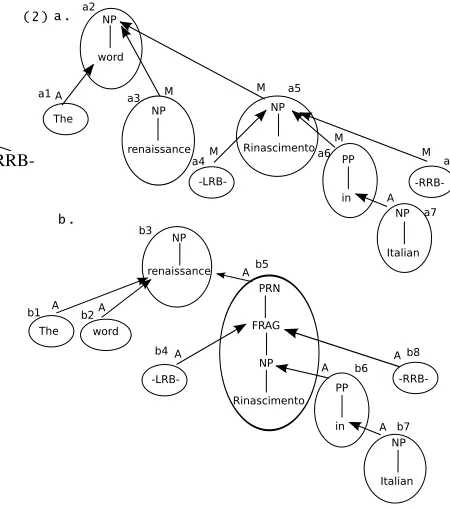
Figure 2: E-trees and derivation trees corresponding to (1ab)
comparing local syntactic units. Following Dickin-son and Meurers (2003), we refer to sequences ex-amined for inconsistent annotation as nuclei. The sentence excerpts (1ab) in Figure 1, from the test corpora used in this work, illustrate an inconsistency in the annotation of corresponding strings. We fo-cus here on the difference in the annotation of the nucleusThe word renaissance, which in (1a) is an-notated as an appositive structure, while in (1b) it is flat.
Following the TAG approach, KBM decomposes the full phrase structure into smaller chunks called elementary trees (henceforth, e-trees). The relation-ship of the e-trees underlying a full phrase struc-ture to each other is recorded in a derivation tree, in which each node is an e-tree, related to its par-ent node by a composition operation, as shown in (2ab).4
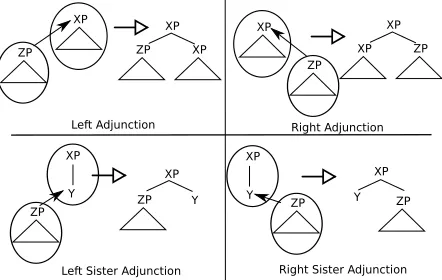
KBM uses two composition operations, each with left and right variants, shown in Figure 3: (1)
ad-4
[image:2.612.87.336.58.326.2]XP
ZP XP
XP
ZP
Right Adjunction
XP
Y
XP
Left Sister Adjunction
ZP Y ZP
Left Adjunction
XP
Y
XP
Right Sister Adjunction
ZP ZP Y
XP
ZP ZP
XP
[image:3.612.76.297.59.199.2]XP
Figure 3: Composition operations (left and right)
junction, which attaches one tree to a target node in another tree by creating a copy of the target node, and (2) sister adjunction, which attaches one tree as a sister to a target node in another tree. Each arc in Figure 2 is labeled by an “M” for adjunction and “A” for sister-adjunction.5
The system uses the tree decomposition and re-sulting derivation tree for the comparison of differ-ent instances of the same nucleus. The full deriva-tion tree for a sentence is not used, but rather only that slice of it having e-trees with words that are in the nucleus being examined, which we call a deriva-tion tree fragment. That is, for a given nucleus with a set of instances, we compare the derivation frag-ments for each instance.
For example, for the nucleus The word
renais-sance, the derivation tree fragment for the instance
in (1a) consists of the e-trees a1, a2, a3 (and their arcs) in (2a), and likewise the derivation tree from the instance in (1b) consists of the e-trees b1, b2, b3 in (2b). These derivation fragments have a differ-ent structure, and so the two instances ofThe word
renaissanceare recognized as inconsistent.
Two important aspects of the overall system re-quire mention here: (1) Nuclei are identified by us-ing sequences that occur as a constituent anywhere
5KBM is based on a variant of Spinal TAG (Shen et al., 2008), and uses sister adjunction without substitution. Space prohibits full discussion, but multiple adjunction to a single node (e.g., a4, a6, a8 to a5 in (2a)) does not create multiple levels of recursion, while a special specification handles the ex-tra NP recursion for the apposition with a2, a3, and a5. For reasons of space, we also leave aside a precise comparison to Tree Insertion Grammar (Chiang, 2003) and Spinal TAG (Shen et al., 2008).
in the corpus, even if other instances of the same sequence are not constituents. Both instances of
The word renaissance are compared, because the
sequence occurs at least once as a constituent. (2) We partition each comparison of the instances of a nucleus by the lowest nonterminal in the derivation tree fragment that covers the sequence. The two in-stances ofThe word renaissanceare compared be-cause the lowest nonterminal is an NP in both in-stances.
3 Advantages of this approach
As Kulick et al. (2012) stressed, using derivation tree fragments allows the comparison to abstract away from interference by irrelevant modifiers, an issue with Dickinson and Meurers (2003). However, in the context of IAA, this advantage of KBM plays out in a different way, in that it allows for a pre-cise pinpointing of the inconsistencies. For IAA, the concern is not whether an inconsistent annota-tion will be reported, since at some level higher in the tree every difference will be found, even if the context is the entire tree. KBM, however, will find the inconsistencies in a more informative way, for example reporting just The word renaissance, not some larger unit. Likewise, it reportsRinascimento
in Italianas an inconsistently annotated sequence.6
A critical desirable property of KBM that carries over from the more general case is that it allows for different nuclei to be grouped together in the sys-tem’s output if they have the same annotation in-consistency type. As in Kulick et al. (2011), each nucleus found to be inconsistent is categorized by an inconsistency type, which is simply the collec-tion of different derivacollec-tion tree fragments used for the comparison of its instances, including POS tags but not the words. For example, the inconsistency type of the nucleusThe word renaissancein (1ab) is the pair of derivation tree fragments (a1,a2,a3) and (b1,b2,b3) from (2ab), with the POS tags. This
nu-6
Inconsistency type # Found # Accurate
Function tags only 53 53
POS tags only 18 13
[image:4.612.92.287.57.115.2]Structural 129 122
Table 1: Inconsistency types found for system evaluation
cleus is then reported together with other nuclei that use the same derivation fragments. In this case, it therefore also reports the nucleusThe term
renais-sance, which appears elsewhere in the corpus with
the two annotations from the different annotators as in (3):
(3) a. NP
NP
The term
NP
renaissance
b. NP
The term renaissance
KBM reportsThe word renaissanceandThe term
renaissancetogether because they are inconsistently
annotated in exactly the same way, in spite of the dif-ference in words. This grouping together of incon-sistencies based on structural characteristics of the inconsistency is critically important for understand-ing the nature of the annotation inconsistencies.
It is the combination of these two characteristics -(1) pinpointing of errors and (2) grouping by struc-ture - that makes the system so useful for IAA. This is an improvement over alternatives such as using evalb (Sekine and Collins, 2008) for IAA. No other system to our knowledge groups inconsistencies by structural type, as KBM does. The use of the deriva-tion tree fragments greatly lessens the multiple re-porting of a single annotation difference, which is a difficulty for using evalb (Manning and Schuetze, 1999, p. 436) or Dickinson and Meurers (2003).
4 Evaluation
4.1 English web text
We applied our approach to pre-release subset of (Bies et al., 2012), dually annotated and used for annotator training, from which the examples in Sec-tions 2 and 3 are taken. It is a small section of the corpus, with 4,270 words dually annotated.
For this work, we also took the further step of characterizing the inconsistency types themselves,
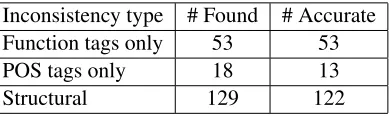
allowing for an even higher-level view of the incon-sistencies found. In addition to grouping together different strings as having the same inconsistent an-notation, the types can also be grouped together for comparison at a higher level. For this IAA sample, we separated the inconsistency types into the three groups in Table 1, with the derivation tree fragments differing (1) only on function tags, (2) only on POS tags7, and (3) on structural differences. We man-ually examined each inconsistency group to deter-mine if it was an actual inconsistency found, or a spurious false positive. As shown in Table 1, the pre-cision of the reported inconsistencies is very high. It is in fact even higher than it appears, because the seven (out of 129) instances incorrectly listed as structural problems were actually either POS or function tag inconsistencies, that were discovered by the system only by a difference in the derivation tree fragment, and so were categorized as structural problems instead of POS or function tag inconsis-tencies.8
Because of the small size of the corpus, there are relatively few nuclei grouped into inconsistency types. The 129 structural inconsistency types in-clude 130 nuclei, with the only inconsistency type with more than one nucleus being the type withThe
word renaissanceandThe term renaissance, as
dis-cussed above. There is more grouping together in the “POS tags only” case (37 nuclei included in the 18 inconsistency types), and the “function tags only” case (56 nuclei included in the 53 inconsis-tency types).
4.2 Modern British English corpus
We also applied our approach to a supplemental sec-tion (Kroch and Santorini, in preparasec-tion) to a cor-pus of modern British English (Kroch et al., 2010), part of a series of corpora used for research into lan-guage change. The annotation style is similar to that of the Penn Treebank, although with some differ-ences. In this case, because neither the function tags nor part-of-speech tags were part of the IAA work,
7
As mentioned in footnote 4, although POS tags were left out of Figure 2 for readability, they are included in the actual e-trees. This allows POS differences in a similar syntactic context to be naturally captured within the overall KBM framework.
we do not separate out the inconsistency types, as done in Section 4.1.
The supplement section consisted of 82,701 words dually annotated. The larger size, as com-pared with the corpus in Section 4.1, results in some differences in the system output. Because of the larger size, there are more substantial cases of dif-ferent nuclei grouped together as the same tency type than in Section 4.1. The first inconsis-tency type (sorted by number of nuclei) has 88 nu-clei, and the second has 37 nuclei. In total, there are 1,532 inconsistency types found, consisting of 2,194 nuclei in total. We manually examined the first 20 inconsistency types (sorted by number of nuclei), consisting in total of 375 nuclei. All were found to be true instances of inconsistent annotation.
(4) a. NP
the ADJP
only true thing
b. NP
the only true thing
(5) a. NP
their ADJP
only actual argument
b. NP
their only actual argument
The trees in (4) and (5) show two of the 88 nu-clei grouped into the first inconsistency type. As
with The word renaissance and The term
renais-sancein the English web corpus, nuclei with similar
(although not identical) words are often grouped into the same inconsistency type. To repeat the point, this is not because of any search for similarity of the words in the nuclei. It arises from the fact that the nuclei are annotated inconstantly in the same way. Of course not all nuclei in an inconsistency type have the same words. Nuclei found in this in-consistency type include only trueand only actual
as shown above, and also nuclei such as new En-glish,greatest possible,thin square,only necessary. Taken together, they clearly indicate an issue with the annotation of multi-word adjective phrases.9
9
Note that the inconsistencies discussed throughout this pa-per are not taken from the the published corpora. These results are only from internal annotator training files.
5 Future work
There are several ways in which we plan to improve the current approach. As mentioned above, there is a certain class of inconsistencies which KBM will not pinpoint precisely, which requires adopting the “external check” from Kulick et al. (2012). The ab-straction on inconsistency types described in Sec-tion 4 can also be taken further. For example, one might want to examine in particular inconsistency types that arise from PP attachment or that have to do with the PRN function tag.
One main area for future work is the application of this work to parser evaluation as well as IAA. For this area, there is some connection to the work of Goldberg and Elhadad (2010) and Dickinson (2010), which are both concerned with examining depen-dency structures of more than one edge. The con-nection is that those works are focused on depen-dency representations, and ithe KBM system does phrase structure analysis using a TAG-like deriva-tion tree, which strongly resembles a dependency tree (Rambow and Joshi, 1997). There is much in this area of common concern that is worth examin-ing further.
Acknowledgments
References
Ann Bies, Justin Mott, Colin Warner, and Seth Kulick. 2012. English Web Treebank. LDC2012T13. Lin-guistic Data Consortium.
Adriane Boyd, Markus Dickinson, and Detmar Meurers. 2007. Increasing the recall of corpus annotation er-ror detection. InProceedings of the Sixth Workshop on Treebanks and Linguistic Theories (TLT 2007), Bergen, Norway.
David Chiang. 2003. Statistical parsing with an auto-matically extracted Tree Adjoining Grammar. InData Oriented Parsing. CSLI.
Markus Dickinson and Detmar Meurers. 2003. Detect-ing inconsistencies in treebanks. InProceedings of the Second Workshop on Treebanks and Linguistic The-ories (TLT 2003), Sweden. Treebanks and Linguistic Theories.
Markus Dickinson. 2010. Detecting errors in automatically-parsed dependency relations. In Pro-ceedings of the 48th Annual Meeting of the Associ-ation for ComputAssoci-ational Linguistics, pages 729–738, Uppsala, Sweden, July. Association for Computational Linguistics.
Yoav Goldberg and Michael Elhadad. 2010. Inspecting the structural biases of dependency parsing algorithms. InProceedings of the Fourteenth Conference on Com-putational Natural Language Learning, pages 234– 242, Uppsala, Sweden, July. Association for Compu-tational Linguistics.
A.K. Joshi and Y. Schabes. 1997. Tree-adjoining gram-mars. In G. Rozenberg and A. Salomaa, editors,
Handbook of Formal Languages, Volume 3: Beyond Words, pages 69–124. Springer, New York.
Anthony Kroch and Beatrice Santorini. in preparation. Supplement to the Penn Parsed Corpus of Modern British English.
Anthony Kroch, Beatrice Santorini, and Ariel Dier-tani. 2010. Penn Parsed Corpus of Mod-ern British English. http://www.ling.upenn.edu/hist-corpora/PPCMBE-RELEASE-1/index.html.
Seth Kulick, Ann Bies, and Justin Mott. 2011. Using derivation trees for treebank error detection. In Pro-ceedings of the 49th Annual Meeting of the Associa-tion for ComputaAssocia-tional Linguistics: Human Language Technologies, pages 693–698, Portland, Oregon, USA, June. Association for Computational Linguistics. Seth Kulick, Ann Bies, and Justin Mott. 2012. Further
developments in treebank error detection using deriva-tion trees. InLREC 2012: 8th International Confer-ence on Language Resources and Evaluation, Istanbul. Christopher Manning and Hinrich Schuetze. 1999.
Foundations of Statistical Natural Language Process-ing. MIT Press.
Owen Rambow and Aravind Joshi. 1997. A formal look at dependency grammars and phrase-structure grammars, with special consideration of word-order phenomena. In L. Wanner, editor, Recent Trends in Meaning-Text Theory, pages 167–190. John Ben-jamins, Amsterdam and Philadelphia.
Satoshi Sekine and Michael Collins. 2008. Evalb. http://nlp.cs.nyu.edu/evalb/.