A Comparison of Update Strategies for
Large-Scale Maximum Expected B
LEUTraining
Joern Wuebker, Sebastian Muehr, Patrick Lehnen, Stephan Peitz and Hermann Ney Human Language Technology and Pattern Recognition Group
RWTH Aachen University Aachen, Germany
{surname}@cs.rwth-aachen.de
Abstract
This work presents a flexible and efficient discriminative training approach for statisti-cal machine translation. We propose to use the RPROP algorithm for optimizing a max-imum expected BLEU objective and experi-mentally compare it to several other updat-ing schemes. It proves to be more effi-cient and effective than the previously pro-posed growth transformation technique and also yields better results than stochastic gra-dient descent and AdaGrad. We also report strong empirical results on two large scale tasks, namely BOLT Chinese→English and WMT German→English, where our final sys-tems outperform results reported by Setiawan and Zhou (2013) and on matrix.statmt.org. On the WMT task, discriminative training is per-formed on the full training data of 4M sen-tence pairs, which is unsurpassed in the litera-ture.
1 Introduction
The main advantage of learning parameters in a dis-criminative fashion is the possibility to directly opti-mize towards a quality or error measure on the task that is being performed. This stands in contrast to the generative approach, where parameters are cho-sen to maximize likelihood under a generative story, which often bears little correspondence with the ac-tual application of the model.
In statistical machine translation (SMT), ex-tending the generative noisy-channel formulation (Brown et al., 1993) as a discriminative, log-linear
combination of multiple models (Och, 2003) has be-come the state of the art. However, most of the component models are still estimated by heuristics or generative training. In this paper, a flexible, effi-cient and easy to implement discriminative training scheme for SMT is presented. It can be applied to any kind and any number of features. We use the RPROP algorithm to optimize a maximum expected BLEUobjective. n-best lists approximate the infea-sibly large space of translation hypotheses. They are generated with the application of leave-one-out to make them more representative with respect to un-seen data.
We make the following main contributions: 1. We propose to apply the RPROP algorithm
for maximum expected BLEUtraining and per-form an experimental comparison with growth transformation (GT) (He and Deng, 2012; Setiawan and Zhou, 2013), stochastic gradi-ent descgradi-ent (Auli et al., 2014) and AdaGrad (Green et al., 2013). RPROP yields supe-rior performance, reaching a total improve-ment of 1.2 BLEU points over our IWSLT German→English baseline using 5.22M fea-tures.
2. In terms of time and memory efficiency, RPROP clearly outperforms GT. The latter needs to update a much larger number of fea-tures due to its renormalization component. On the IWSLT data, RPROP is 6.4 times faster than GT and requires a third of the memory.
3. On the WMT German→English task, we per-form discriminative training on 4M sentence
pairs, which, to the best of our knowledge, is 2.4 times the size of the largest training set re-ported in previous work (1.66M sentences in (Simianer et al., 2012)). This proves the scala-bility of our approach.
4. On two large scale tasks our experiments show good improvements over strong base-lines which include recurrent language mod-eling components. On the Chinese→English DARPA BOLT task, we achieve nearly twice the improvement reported in (Setiawan and Zhou, 2013) on the same test sets which re-sults in a superior final system. Finally, the best single system reported on matrix.statmt.org is outperformed by 0.8 BLEUpoints on the WMT German→Englishnewstest2013set.
Our experiments also prove that leave-one-out im-pacts translation quality.
This paper is organized as follows. We review re-lated work in Section 2 and present the translation system in Section 3. In Section 4 we describe the different discriminative update strategies applied in this work and Section 5 derives the complete max-imum expected BLEU training algorithm. Finally, experimental results are given in Section 6 and we conclude with Section 7.
2 Related Work
Discriminative training is one of the most active re-search areas in SMT and it can be integrated into the pipeline at various stages.
Och (2003) proposed to apply minimum error rate training (MERT) to optimize the different feature weights in the log-linear model combination on a small development data set. This is still considered to be the state of the art, but is only capable of opti-mizing a handful of features. More recently, MIRA (Watanabe et al., 2007; Chiang et al., 2008) and PRO (Hopkins and May, 2011) have been presented as optimization procedures that can replace MERT and scale to thousands of parameters.
In a different line of work, Liang et al. (2006) de-scribe a fully discriminative training pipeline, where more than one million features are tuned on the training data using a perceptron-style update algo-rithm. The Direct Translation Model 2 introduced
by Ittycheriah and Roukos (2007) is similar in that it also trains millions of features on the training data. However, the weights are estimated based on a maximum entropy model and the underlying trans-lation paradigm differs from the standard phrase-based model. Gao and He (2013) use gradient as-cent to train Markov random field models for phrase translation. These models are interpreted as undi-rected phrase compatibility scores rather than trans-lation probabilities. Thus, as in our work, they are not subject to a sum-to-one constraint. Simianer et al. (2012) propose a distributed setup for large-scale discriminative training with joint feature selection. The training corpus is divided into several shards, on which features are updated via perceptron-style gradient descent. The authors present results show-ing that trainshow-ing on large data sets improves results over just using a small development corpus. Another approach based on the AdaGrad method that scales to large numbers of sparse features is proposed in (Green et al., 2013; Green et al., 2014). Different from our work, the authors use either the tuning sets or a small subsample of the training data (15k sen-tences) for discriminative training.
A notably different idea is pursued by Yu et al. (2013), who present a large-scale training proce-dure that explicitly minimizes search errors. This is achieved by force-decoding the training data and up-dating at the point where the correct derivation drops off the beam.
In (Blunsom et al., 2008), conditional random fields (CRFs) are trained within a hierarchical phrase-based translation framework. The hierar-chical phrase-based paradigm is used to model the search space in model estimation and search, leav-ing the hypothesis weightleav-ing to CRF features. They constrain search by a beam width for gradient es-timation and update the model with the help of L-BFGS. In a similar way Lavergne et al. (2011) use then-gram based approach (Casacuberta and Vidal, 2004; Mari˜no et al., 2006) to model the reordering, phrase alignment, and the language model. A CRF is applied to estimate the phrase weights. Model up-dates are carried out by the RPROP algorithm (Ried-miller and Braun, 1993). However, both approaches only improve over constrained baselines.
train the standard phrasal and lexical channel mod-els with the growth transformation (GT) algorithm. They use n-best lists on the training data and op-timize a maximum expected BLEU objective, that provides a clear training criterion, which is missing e.g. in MIRA estimation. Auli et al. (2014) report good results by applying the same objective func-tion to reordering features, which are trained with stochastic gradient descent (SGD).
Our work differs in several key aspects: (i) We propose to apply the RPROP algorithm, which yields superior results to GT, SGD and AdaGrad in our experimental comparison. (ii) For the first time, we apply maximum expected BLEU training on a data set as large as four million sentence pairs. (iii) We apply a leave-one-out heuristic (Wuebker et al., 2010) to make better use of the training data. (iv) We apply phrasal, lexical, reordering and triplet fea-tures. (v) Finally, we do not run MERT after each training iteration, which is expensive for large trans-lation systems.
3 Statistical Translation System
Our work can be applied to any statistical machine translation paradigm and we will present results on a standard phrase-based translation system (Koehn et al., 2003) and a hierarchical phrase-based trans-lation system (Chiang, 2005). The transtrans-lation pro-cess is implemented as a weighted log-linear com-bination of several modelshm,Θ(E, F), whereE=
e1, . . . , eI denotes the translation hypothesis, F = f1, . . . , fJ the source sentence, m a model index,
andΘthe model parameters. These models include the phrase translation and lexical smoothing scores in both directions, language model (LM) score, dis-tortion penalty, word penalty and phrase penalty (Och and Ney, 2004). Given a source sentenceF, the modelshm,Θ(E, F)and the corresponding
log-linear feature weights λm, the translation decoder
searches for the best scoring translationEˆ:
ˆ
E= arg max
E {fΘ(E, F)} (1) fΘ(E, F) =
X
m∈M
λmhm,Θ(E, F) (2)
where. . . , λm, . . .are the model weighting
param-eters. In practice, the Viterbi approximation is
ap-plied and for simplicity, in the following we will as-sume the particular derivation for a translation hy-pothesis to be included in the variableE. The log-linear feature weights are optimized with minimum error rate training (MERT) (Och, 2003).
4 Update Strategies
4.1 Previously Proposed Algorithms
The Growth Transformation (GT) or Extended Baum-Welch Algorithm was proposed by He and Deng (2012) for maximum expected BLEUtraining of the standard phrasal and lexical channel models. It is an algorithm to iteratively optimize polynomials of random variables that are subject to sum-to-one contraints and is therefore suitable for training prob-ability distributions. The disadvantage is that each parameter update requires a renormalization step, which artificially blows up the number of features that need to be changed and has a significant impact on time and memory efficiency. The update formu-las are derived in (He and Deng, 2012).
Stochastic Gradient Descent (SGD) is a well-known and frequently applied training scheme, which is used for maximum expected BLEU train-ing of reordertrain-ing models by (Auli et al., 2014). It performs the following update:
ϑ(t+1) =ϑ(t)+η· ∇(ϑt) (3)
Here, the disadvantage is its high sensitivity to the fixed learning rateη. However, as it does not subject the features to sum-to-one-contraints, it is consider-ably more time and memory efficient than GT.
As an improvement to SGD,AdaGrad(Duchi et al., 2011) is designed for large, sparse feature sets and makes use of an adaptive learning rate. It was proposed for MT training by (Green et al., 2013). Although its main area of application are online al-gorithms, it is also applicable in our offline setting and is more robust than SGD due to the adaptive learning rate. Following (Green et al., 2013), we ap-ply the approximation with a diagonal outer product matrix, which is computationally cheap. This results in the update equations
ϑ(t+1) =ϑ(t)+η·G−12
4.2 RPROP
The resilient backpropagation algorithm (RPROP) proposed by Riedmiller and Braun (1993) is a gradient-based optimization algorithm that emprir-ically learns the step size without taking the slope into account, making it highly robust and avoiding the need for a learning rate. If the gradient switches algebraic sign compared to the previous iteration, the last step is reverted and the step size reduced. If the sign remains the same, the step size is increased. Formally, given a set of parameters Θ and an ob-jective functionO(Θ), in iterationteach parameter
ϑ∈Θis updated according to
ϑ(t+1) =
ϑ(t−1) ,if ∇(t−1)
ϑ · ∇(ϑt)<0 ϑ(t)+ ∆ϑ(t) ,else if ∇(t)
ϑ >0 ϑ(t)−∆ϑ(t) ,else if ∇(t)
ϑ <0
ϑ(t) ,else
where∇(ϑt):= δO(Θδϑ(t))denotes the derivative of the objective function. The step size∆ϑ(t) > 0 grows
or decreases depending on the sign of the gradient:
∆ϑ(t)=
η+·∆ϑ(t−1) ,if ∇(t−1)
ϑ · ∇(ϑt)>0 η−·∆ϑ(t−1) ,if ∇(t−1)
ϑ · ∇(ϑt)<0 ∆ϑ(t−1) ,else
The strength parameters 0< η−<1≤η+ usually
have little impact and are fixed to η− = 0.5 and η+ = 1.2throughout this work. The RPROP
algo-rithm is simple and easy to implement. It has proven effective for a number of tasks, e.g. in (Wiesler et al., 2013; Heigold et al., 2011; Lavergne et al., 2011; Hahn et al., 2011). Different from growth transfor-mation (cf. Sec. 4.1), it does not assume a proba-bility distribution and performs its updates without a sum-to-one constraint.
Compared to SGD and AdaGrad, RPROP’s prac-tical advantage is the absence of a learning rate that needs to be tuned. Further, we see its theoreti-cal advantage in the empiritheoreti-cally learned step size. In the first iterations, RPROP’s updates are con-siderably smaller than with the other strategies, re-sulting in a more careful exploration of the search space. In higher iterations, the update steps for good features keep growing and we observe an ex-ponential increase of the objective function. In con-trast, GT, SGD, and AdaGrad determine the size of
their update step based on the slope of the gradient, which we believe to be misleading given the com-plex topology of the feature space in MT.
5 Training
5.1 Maximum Expected BLEU
Following (He and Deng, 2012), we want to opti-mize a maximum expected BLEUobjective. We de-note the universe of possible sentences in the source language asFand in the target language asE. The expected BLEU score under parameter set Θ with respect to the joint probability distributionpΘ(·,·)is
defined as hβiΘ=
X
F∈F X
E∈E
pΘ(E, F)β(E) (6)
Here,β(E)is the BLEUscore for target sentenceE (assuming the reference translation to be part of the mapping β) and we use the notation h·i to denote the expectation. Enumerating all possible source and target sentencesF, E is infeasible. Therefore, we estimate the empirical expectation on a corpus C ⊂ E×F. We denote the source sentences inC asCF and the size of the corpus asN = |C|. The
joint probabilitypΘ(E, F)is decomposed with the
help of the Bayes Theorem, resulting in:
hβiΘ=
X
F∈CF
p(F) X
E∈EΘ(F)
pΘ(E|F)β(E) (7)
For p(F) = NFN we assume the empirical distri-bution within the training corpus, where NF is the
count of sentenceF. The summation over allE ∈E is sampled with a subsetEΘ(F)of the most likely
hypotheses with respect to the parameterized proba-bilitypΘ(E, F), which in practice is ann-best list
generated by the decoder. Iterating over the cor-pusC = {(E1, F1), . . . ,(En, Fn), . . . ,(EN, FN)}
finally results in
hβiΘ= N1
N
X
n=1
X
E∈EΘ(Fn)
pΘ(E|Fn)β(E)
We use the same unclipped sentence-level BLEU-4 score with smoothed 3-gram and 4-gram precisions as in (He and Deng, 2012), which we denote as
β(E) =BLEU(E, En∗)with respect to the reference translationE∗
The normalized posterior translation probability
pΘ(E|F)from source sentenceF to target sentence
Eapproximates a maximum entropy model normal-ized on sentence level:
pΘ(E|F) = e
−fΘ(E,F)
P
E0∈EΘ(F)e−fΘ(E0,F) (8)
The denominator of this probability does not depend on the output sentence. Thus, thearg maxof Equa-tion 8 is equal to thearg maxof the translation score in Equation 1.
Maximum Entropy models tend to generalize poorly, which can be circumvented by regulariza-tion. He and Deng (2012) use Kullback-Leibler reg-ularization, raising the need of having normalized models hm,Θ(E, F). We employ the more general
L2-regularization and the objective function is
de-fined as
O(Θ) =loghβiΘ−τ·
X
ϑ∈Θ
ϑ2 (9)
including the hyper parameterτ controlling the de-gree of regularization. The derivative of the objec-tive function, which is needed for the gradient-based training methods, directly follows:
δO(Θ)
δϑ =−τ ·2ϑ+ 1 hβiΘ ·
δhβiΘ
δϑ (10)
With ∂hm,Θ(E,F)
∂ϑ = #ϑ(E, F)the number of times
feature ϑfires in the derivation for translation hy-pothesis E given source sentence F, the deriva-tive ofpΘ(E|F)is defined as (for ease of notation
EΘ(Fn)is represented byEn)
∂pΘ(E|F)
∂ϑ =−pΘ(E|F)· (11)
#ϑ(E, F)−
X
E0∈En
pΘ(E0|F)#ϑ(E0, F)
And the derivative of the expected BLEUis
δhβiΘ
δϑ =
1 N
N
X
n=1
X
E∈En
β(E)∂pΘ(E∂ϑ|Fn)
=−1 N
N
X
n=1
X
E∈En
pΘ(E|F)β(E)#ϑ(E, F)
− X
E∈En
pΘ(E|F)β(E)
·
X
E∈En
pΘ(E|F)#ϑ(E, F)
!
(12)
This can be more compactly expressed by local ex-pectations h·in of the BLEU score and the feature
count#ϑ:
δhβiΘ
δϑ =−
1 N
N
X
n=1
(hβ#ϑin− hβinh#ϑin)
In our implementation,#ϑis moved to the front of
the equation to obtain common factors that can be used by all parameter updates:
δhβiΘ
δϑ =
1 N
N
X
n=1
X
E∈En
#ϑ(E, F)·
pΘ(E|F)(hβin−β(E)) (13)
5.2 Leave-one-out
Although He and Deng (2012) claim that it is not necessary, we apply a leave-one-out heuristic similar to (Wuebker et al., 2010) when generating then-best lists on the training data. The authors have shown this to effectively counteract over-fitting effects and we argue that it helps to bring out the full potential of our discriminative training procedure.
above mentioned rare phrases are penalized and the decoder is encouraged to use more general phrases taken from the remainder of the training data. Sin-gleton phrases are given a fixed penalty. In this work, we apply leave-one-out with all update strate-gies.
5.3 Features
Maximum expected BLEU training facilitates train-ing of arbitrary features. In this work we apply four types of features. (a) A discriminative phrase table, i.e. one feature for each phrase pair. (b) Lexical fea-tures, i.e. one feature for each source-target word pair that appear within the same phrase. (c) Source and target triplet features (Hasan et al., 2008), i.e. triples of one source and two target words or one tar-get and two source words appearing within a single phrase pair. (d) The hierarchical lexicalized reorder-ing model (Galley and Mannreorder-ing, 2008), i.e. one feature for each combination of phrase pair, orienta-tion (monotone (M), swap (S) or discontinuous (D)) and orientation direction (forward or backward). GT is only applied with feature set (a), where we re-estimate the two phrasal channel models as was done in (He and Deng, 2012). With the other update algo-rithms we follow the approach taken in (Auli et al., 2014) and condense each feature type into a small number of models for the log-linear combination, which is afterwards tuned with MERT. (a) and (b) result in a single additional model, (c) in two mod-els (source and target triplets) and (d) in six modmod-els ({forward,backward}×{M,S,D}).
5.4 Efficient Implementation
The expected BLEUhβiΘis efficiently computed in one iteration over the full n-best list. As can be seen from Equation 13, the derivative δhδϑβiΘ is ad-ditive with respect to each firing instance of feature
ϑ in the n-best list. The additive factor only de-pends on the current sentence pair. Therefore, for each sentence of the training data we iterate through itsn-best list once to compute the expectation of the sentence-level BLEU scorehβin and then a second time to update the current derivative for each time the feature fires. The only thing that needs to be kept in memory is a list of the current derivatives for each parameterϑ.
1. Create the baseline system and run MERT 2. Generaten-best list on training corpus 3. Compute sentence-level BLEUβ(En)
for each hypothesisEnin the list
4. Initialize parameters withϑ= 0,∀ϑ∈Θ
5. Iterate:
a) Compute the derivatives δOδϑ(Θ) b) Perform update and outputΘ(t)
6. Run MERT ondevwith each tableΘ(t)
7. Select bestΘ(t)ondev
8. Evaluate on test sets
Figure 1: The complete training algorithm.
5.5 Complete Training Algorithm
The complete training and evaluation procedure is shown in Figure 1. We start by building a base-line translation system with MERT-optimized model weightsλ. With the baseline system we generaten -best lists on the training data. Now, for each trans-lation hypothesisEn of then-best list, we compute
the sentence-level BLEUscoreβ(En)and initialize the parameter set for training with the count model. Next, we run the training algorithm for a fixed num-ber of iterations1and output the updated feature
val-uesΘ(t)after each iterationt. Finally, we run MERT
with eachΘ(t), select the best table ondevand
eval-uate on our test sets.
6 Experiments 6.1 Setup
The experiments are carried out on the IWSLT 2013 German→English shared translation task.2
For rapid experimentation, the translation model is trained on the in-domain TED portion of the bilin-gual data, which is also used for maximum expected BLEUtraining. However, we use a large 4-gram LM with modified Kneser-Ney smoothing (Kneser and Ney, 1995; Chen and Goodman, 1998), trained with the SRILM toolkit (Stolcke, 2002). As additional data sources for the LM we use the complete News Commentary, Europarl v7 and Common Crawl cor-pora as well as selected parts of the Shuffled News
1Note that we keep theλweights fixed throughout all
itera-tions of maximum expected BLEUtraining.
IWSLT BOLT WMT German English Chinese English German English
Sentences 138K 4.08M 4.09M
Run. Words 2.63M 2.70M 78.3M 85.9M 105M 104M
Vocabulary 75.4K 50.2K 384K 817K 659K 649K
Table 1: Statistics for the bilingual training data of the IWSLT 2013 German→English, the DARPA BOLT Chinese→English and the WMT 2014 German→English tasks.
and LDC English Gigaword corpora. The selec-tion is based on cross-entropy difference (Moore and Lewis, 2010). This makes for a total of 1.7 billion running words for LM training. The base-line further contains a hierarchical reordering model (HRM) (Galley and Manning, 2008) and a 7-gram word class language model (Wuebker et al., 2013). On IWSLT, all results are averages over three inde-pendent MERT runs, and we evaluate statistical sig-nificance withMultEval(Clark et al., 2011).
To confirm our findings, additional experiments are run on two large-scale tasks over strong baselines including recurrent neural language models. On the DARPA BOLT Chinese→English task we use our internal evaluation system as a baseline. It is a pow-erful hierarchical phrase-based SMT engine with 19 dense features, including an LSTM recurrent neu-ral language model (Sundermeyer et al., 2012) and a hierarchical reordering model (Huck et al., 2013). The 5-gram backoff LM is in total trained on 2.9 bil-lion running words. We use the same data for tuning and testing as Setiawan and Zhou (2013), namely 1275 (tune) and 12393sentences of web data taken
from LDC2010E30, the NIST MT06 evaluation set and an additional single-reference test set from the discussion forum (df) domain containing 1124 sen-tence pairs. Maximum expected BLEU training is performed on the discussion forum portion of the training data, consisting of 67.8K sentence pairs. On the German→English task of the9th Workshop on Statistical Machine Translation4, both translation
model and maximum expected BLEUtraining is per-formed on all available bilingual data. Our base-line is a phrase-based translation engine with a 4-gram backoff LM trained on 2.5 billion words with
lmplz (Heafield et al., 2013), a recurrent neural
3nameddevin (Setiawan and Zhou, 2013)
4http://statmt.org/wmt14/
IWSLT de-en # feat. test
baseline 18 30.4
GT (He and Deng, 2012) 6.08M 30.9 SGD (Auli et al., 2014) 921K 30.8 AdaGrad (Green et al., 2013) 921K 31.1 RPROP (this work) 921K 31.3 RPROP w/o leave-one-out 921K 30.7 RPROP all features 5.22M 31.6
Table 2: Results for the IWSLT 2013 German→English task in BLEU [%]. The comparison between update strategies is done with feature set (a) andRPROP all fea-turesuses feature sets (a)-(d). GT, SGD, AdaGrad and RPROP are trained with leave-one-out, unless otherwise specified.
LM, a 7-gram word class LM and the HRM. Bilingual data statistics for all tasks are given in Table 1. We use the machine translation toolkitJane (Vilar et al., 2010; Wuebker et al., 2012) and evalu-ate with case-insensitive BLEU[%] (Papineni et al., 2002) in all experiments.
6.2 Experimental Results
[image:7.612.140.473.57.130.2]41.5 41.6 41.7 41.8 41.9 42 42.1
5 10 15 20 25 30 35 40
expected BLEU [%]
Iteration
RPROP SGD AdaGrad GT
Figure 2: Expected BLEU value on IWSLT German→English for the different update strate-gies. Note that growth transformation (GT) applies a different regularization term and is therefore not directly comparable with the other techniques.
expected, we found that in all cases regularization is not strictly necessary - results are barely affected as long asτ is sufficiently small - and that SGD is much more sensitive to η than AdaGrad. Further, SGD and RPROP need around 25 iterations to reach good results, where 5-10 iterations are sufficient for GT and AdaGrad. For a fair comparison, however, we run all algorithms for 40 iterations and select the best one on a seletion set, namely iterations 19 (Ada-Grad), 23 (GT), 29 (RPROP) and 35 (SGD). Figure 2 shows how the expected BLEUfunction evolves in training with different update strategies. Although the value for GT is not directly comparable to the others due to a different regularization term, the re-spective characteristics are clearly visible. SGD ex-hibits a linear growth pattern, GT resembles a loga-rithmic and RPROP an exponential function. After initially overshooting and then retracting as the reg-ularization kicks in, AdaGrad also displays logarith-mic characteristics.
In terms of BLEURPROP performs best, followed by AdaGrad, GT and SGD, where the RPROP-AdaGrad and RPROP-AdaGrad-GT differences are small (0.2% BLEUabsolute) but statistically significant on the 95% level. Altogether, RPROP improves over the baseline by 0.9 BLEU points, which is statisti-cally significant at the 99% level. In an additional experiment we verified that leave-one-out has a clear
BOLT zh-en # feat. df web MT06
baseline 19 18.0 34.1 39.7
SGD 12.4M 18.0 34.3 39.8
AdaGrad 12.4M 18.3 34.7 40.1
RPROP 12.4M 18.7 34.8 40.5
[image:8.612.76.302.57.227.2]Setiawan&Zhou (GT) 150M - 32.7 40.3
Table 3: Results for the BOLT Chinese→English task in BLEU [%] on the discussion forum test set (df), the mixed web test set and NIST MT06. The baseline is our BOLT evaluation system and contains a recurrent neural LM. We compare with (Setiawan and Zhou, 2013) who applied maximum expected BLEUtraining with growth transformation (GT). Note that the number of features re-ported by Setiawan and Zhou (2013) is artificially blown up due to renormalization.
impact on the results. The BLEUdifference between RPROP with and without leave-one-out is 0.6% ab-solute. By adding lexical, triplet and reordering fea-tures, we get an additional gain and observe a total improvement of 1.2 BLEU points over the baseline system.
Efficiency comparison. 921K discriminative phrase table features are active in our training data. Due to the renormalization component, this results in a total of 6.08M features that are updated with GT using the same data. Consequently, it is less time and space efficient than the other algorithms. With our implementation, GT needed around 16 hours and 6.7G memory for 40 iterations, where RPROP, AdaGrad and SGD finished after less than 2.5 hours and required 2.1G memory.
For theBOLTtask, we directly compare with the GT-trained system in (Setiawan and Zhou, 2013) using the same tune set for MERT and reporting results on the same test sets, see Table 3. With RPROP we achieve nearly twice the improvement reported by Setiawan on both web and MT06 us-ing feature sets (a)-(c)5. Our baseline on web is
already much stronger and RPROP training yields +0.7 BLEUpoints, as opposed to +0.44 reported by Setiawan. OnMT06our baseline system is slightly worse, but with the larger gain received by RPROP our final system outperforms the one reported by
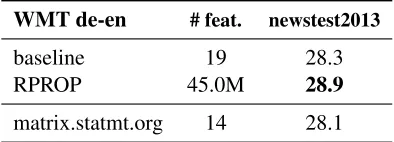
WMT de-en # feat. newstest2013
baseline 19 28.3
RPROP 45.0M 28.9
matrix.statmt.org 14 28.1
Table 4: Results for the WMT German→English task in BLEU[%]. The baseline contains a recurrent neural LM. We compare with the best single system that is reported onmatrix.statmt.org, which was submitted by the Unversity of Edinburgh.
[image:9.612.87.284.58.129.2]tiawan by 0.2 BLEUpoints. We would like to stress that this is not a domain adaptation effect, as maxi-mum expected BLEUtraining was performed on dis-cussion forum (df) data. On the df test set, on the other hand, we probably can observe domain adap-tation via RPROP training. The improvement here is 0.7% BLEU absolute with a single reference, as opposed to four references onweb andMT06. We also report results training the same feature sets with SGD and AdaGrad, confirming results we observed on IWSLT. Here, SGD yields only minor improve-ments. AdaGrad performs better, but still 0.1 - 0.4 BLEUpoints worse than RPROP. Running GT is in-feasible in our hierarchical phrase-based setup.
Table 4 shows the results on theWMTtask. This is our largest setting, where max. exp. BLEU train-ing is performed on the full traintrain-ing data with more than 4M sentence pairs which, to the best of our knowledge, is unsurpassed in the literature. Alto-gether, training took more than one month, about 3/4 of which were for generatingn-best lists by de-coding the training data. The triplet features did not finish in time, so we applied the feature sets (a), (b) and (d), 45M features in total. With a renormaliza-tion step as in GT, this number would grow to 309M. Onnewstest2013, our baseline already outperforms the best single system reported on matrix.statmt.org by 0.2 BLEU points. The discriminatively trained features yield an additional improvement of 0.6% BLEUabsolute on this high-end system.
7 Conclusion
We have experimentally compared several update strategies for maximum expected BLEU training. The RPROP algorithm proposed in this work shows
superior performance compared to AdaGrad, growth transformation (GT) and stochastic gradient descent. In terms of time and memory efficiency, GT is clearly inferior to the other algorithms due to renor-malization. Applying phrasal, lexical, triplet and re-ordering features, the baseline is improved by 1.2% BLEU absolute on the IWSLT German→English task. On two large scale tasks we achieve clearly superior performance compared to results reported in the literature. On BOLT Chinese→English our discriminative training yields nearly twice the im-provement reported by Setiawan and Zhou (2013), resulting in a superior final system. On WMT German→English, we outperform the best single system reported on matrix.statmt.org by 0.8% BLEU absolute. Here, we perform maximum expexted BLEU training on more than 4M sentence pairs, which is the largest number reported in the literature to date.
Acknowledgments
The research leading to these results has received funding from the European Union Seventh Frame-work Programme (FP7/2007-2013) under grant agreement no287658. This material is also partially
based upon work supported by the DARPA BOLT project under Contract No. HR0011- 12-C-0015. Any opinions, findings and conclusions or recom-mendations expressed in this material are those of the authors and do not necessarily reflect the views of DARPA. We further thank the anonymous review-ers for valuable comments.
References
Michael Auli, Michel Galley, and Jianfeng Gao. 2014. Large-scale Expected BLEU Training of Phrase-based Reordering ModelsI. InProceedings of the 2014 Con-ference on Empirical Methods in Natural Language Processing (EMNLP), pages 1250–1260, Doha, Qatar, October.
Phil Blunsom, Trevor Cohn, and Miles Osborne. 2008. A discriminative latent variable model for statistical machine translation. InProc. of ACL-HLT.
Francisco Casacuberta and Enrique Vidal. 2004. Ma-chine translation with inferred stochastic finite-state transducers. Computational Linguistics, 30(2):205– 225.
Stanley F. Chen and Joshuo Goodman. 1998. An Em-pirical Study of Smoothing Techniques for Language Modeling. Technical Report TR-10-98, Computer Science Group, Harvard University, Cambridge, MA, August.
D. Chiang, Y. Marton, and P. Resnik. 2008. Online large-margin training of syntactic and structural translation features. InConference on Empirical Methods in Nat-ural Language Processing, pages 224–233, Honolulu, Hawaii.
David Chiang. 2005. A Hierarchical Phrase-Based Model for Statistical Machine Translation. In Pro-ceedings of the 43rd Annual Meeting on Association for Computational Linguistics, pages 263–270, Ann Arbor, Michigan, USA, June.
Jonathan H. Clark, Chris Dyer, Alon Lavie, and Noah A. Smith. 2011. Better hypothesis testing for statis-tical machine translation: Controlling for optimizer instability. In 49th Annual Meeting of the Associa-tion for ComputaAssocia-tional Linguistics:shortpapers, pages 176–181, Portland, Oregon, June.
John Duchi and Yoram Singer. 2009. Efficient online and batch learning using forward backward splitting. Jour-nal of Machine Learning Research, 10:2899–2934, December.
John Duchi, Elad Hazan, and Yoram Singer. 2011. Adaptive subgradient methods for online learning and stochastic optimization. Journal of Machine Learning Research, 12:2121–2159, July.
Michel Galley and Christopher D. Manning. 2008. A simple and effective hierarchical phrase reordering model. InProceedings of the Conference on Empirical Methods in Natural Language Processing, EMNLP ’08, pages 848–856, Stroudsburg, PA, USA. Associ-ation for ComputAssoci-ational Linguistics.
Jianfeng Gao and Xiaodong He. 2013. Training MRF-Based Phrase Translation Models using Gradient As-cent. In Proceedings of the North American Chap-ter of the Association for Computational Linguistics - Human Language Technologies conference (NAACL HLT), pages 450–459, Atlanta, Georgia, USA, Jun. Spence Green, Sida Wang, Daniel Cer, and
Christo-pher D. Manning. 2013. Fast and adaptive online training of feature-rich translation models. In 51st Annual Meeting of the Association for Computational Linguistics, pages 311–321, Sofia, Bulgaria, August. Spence Green, Daniel Cer, and Christopher D. Manning.
2014. An empirical comparison of features and tunign for phrase-based machine translation. InProceedings
of the Ninth Workshop on Statistical Machine Trans-lation, pages 466–476, Baltimore, Maryland, USA, June.
Stefan Hahn, Marco Dinarelli, Christian Raymond, Fabrice Lefevre, Patrick Lehnen, Renato De Mori, Alessandro Moschitti, Hermann Ney, and Giuseppe Riccardi. 2011. Comparing Stochastic Approaches to Spoken Language Understanding in Multiple Lan-guages. IEEE Transactions on Audio, Speech, and Language Processing, 19(6):1569–1583, August. Saˇsa Hasan, Juri Ganitkevitch, Hermann Ney, and Jes´us
Andr´es-Ferrer. 2008. Triplet lexicon models for sta-tistical machine translation. InConference on Empir-ical Methods in Natural Language Processing, pages 372–381, Honolulu, Hawaii, October. Association for Computational Linguistics.
Xiaodong He and Li Deng. 2012. Maximum Expected BLEU Training of Phrase and Lexicon Translation Models. InProceedings of the 50th Annual Meeting of the Association for Computational Linguistics (ACL), pages 292–301, Jeju, Republic of Korea, Jul.
Kenneth Heafield, Ivan Pouzyrevsky, Jonathan H. Clark, and Philipp Koehn. 2013. Scalable modified Kneser-Ney language model estimation. InProceedings of the 51st Annual Meeting of the Association for Compu-tational Linguistics, pages 690–696, Sofia, Bulgaria, August.
Georg Heigold, Stefan Hahn, Patrick Lehnen, and Her-mann Ney. 2011. EM-Style Optimization of Hid-den Conditional Random Fields for Grapheme-to-Phoneme Conversion. In IEEE International Con-ference on Acoustics, Speech, and Signal Processing, pages 4920–4923, Prague, Czech Republic, May. Mark Hopkins and Jonathan May. 2011. Tuning as
rank-ing. In In Proceedings of the 2011 Conference on Empirical Methods in Natural Language Processing, pages 1352–1362, Edinburgh, Scotland, July.
Matthias Huck, Joern Wuebker, Felix Rietig, and Her-mann Ney. 2013. A phrase orientation model for hi-erarchical machine translation. InWorkshop on Statis-tical Machine Translation, pages 452–463, Sofia, Bul-garia, August.
Abraham Ittycheriah and Salim Roukos. 2007. Direct Translation Model 2. In Proceedings of the North American Chapter of the Association for Computa-tional Linguistics - Human Language Technologies conference (NAACL HLT), pages 57–64, Rochester, NY, USA, Apr.
P. Koehn, F. J. Och, and D. Marcu. 2003. Statistical Phrase-Based Translation. InProceedings of the 2003 Meeting of the North American chapter of the Associa-tion for ComputaAssocia-tional Linguistics (NAACL-03), pages 127–133, Edmonton, Alberta.
Thomas Lavergne, Alexandre Allauzen, Josep Maria Crego, and Franc¸ois Yvon. 2011. From n-gram-based to crf-n-gram-based translation models. InProceedings of the Sixth Workshop on Statistical Machine Transla-tion, pages 542–553, Edinburgh, Scotland, July. Asso-ciation for Computational Linguistics.
Percy Liang, Alexandre Buchard-Cˆot´e, Dan Klein, and Ben Taskar. 2006. An End-to-End Discriminative Ap-proach to Machine Translation. InProceedings of the 21st International Conference on Computational Lin-guistics and the 44th annual meeting of the Associ-ation for ComputAssoci-ational Linguistics, pages 761–768, Sydney, Australia.
Jos´e B Mari˜no, Rafael E Banchs, Josep M Crego, Adri`a de Gispert, Patrik Lambert, Jos´e A R Fonollosa, and Marta R Costa-juss`a. 2006. N-gram-based Machine Translation. Comput. Linguist., 32(4):527–549, De-cember.
R.C. Moore and W. Lewis. 2010. Intelligent Selection of Language Model Training Data. InACL (Short Pa-pers), pages 220–224, Uppsala, Sweden, July. Franz Josef Och and Hermann Ney. 2004. The
align-ment template approach to statistical machine transla-tion. Computational Linguistics, 30(4):417–449, De-cember.
Franz Josef Och. 2003. Minimum Error Rate Train-ing in Statistical Machine Translation. InProc. of the 41th Annual Meeting of the Association for Compu-tational Linguistics (ACL), pages 160–167, Sapporo, Japan, July.
Kishore Papineni, Salim Roukos, Todd Ward, and Wei-Jing Zhu. 2002. Bleu: a Method for Automatic Eval-uation of Machine Translation. InProceedings of the 41st Annual Meeting of the Association for Computa-tional Linguistics, pages 311–318, Philadelphia, Penn-sylvania, USA, July.
Martin Riedmiller and Heinrich Braun. 1993. A direct adaptive method for faster backpropagation learning: The rprop algorithm. InIEEE International Confer-ence on Neural Networks, pages 586–591.
Hendra Setiawan and Bowen Zhou. 2013. Discrimina-tive training of 150 million translation parameters and its application to pruning. InNAACL-HLT 2013, pages 335–341, Atlanta, Georgia, June.
Patrick Simianer, Stefan Riezler, and Chris Dyer. 2012. Joint Feature Selection in Distributed Stochastic Learning for Large-Scale Discriminative Training in SMT. In Proceedings of the 50th Annual Meeting
of the Association for Computational Linguistics (Vol-ume 1: Long Papers), pages 11–21, Jeju Island, Korea, July. Association for Computational Linguistics. Andreas Stolcke. 2002. SRILM – An Extensible
Lan-guage Modeling Toolkit. InProc. of the Int. Conf. on Speech and Language Processing (ICSLP), volume 2, pages 901–904, Denver, CO, September.
Martin Sundermeyer, Ralf Schl¨uter, and Hermann Ney. 2012. Lstm neural networks for language modeling. InInterspeech, Portland, OR, USA, September. David Vilar, Daniel Stein, Matthias Huck, and Hermann
Ney. 2010. Jane: Open source hierarchical transla-tion, extended with reordering and lexicon models. In ACL 2010 Joint Fifth Workshop on Statistical Machine Translation and Metrics MATR, pages 262–270, Upp-sala, Sweden, July.
Taro Watanabe, Jun Suzuki, Hajime Tsukada, and Hideki Isozaki. 2007. Online large-margin training for statis-tical machine translation. InProceedings of the 2007 Conference on Empirical Methods in Natural Lan-guage Processing, pages 764–773, Prague, Czech Re-public, June.
Simon Wiesler, Alexander Richard, Ralf Schl¨uter, and Hermann Ney. 2013. A Critical Evaluation of Stochastic Algorithms for Convex Optimization. In IEEE International Conference on Acoustics, Speech, and Signal Processing, pages 6955–6959, Vancouver, Canada, May.
Joern Wuebker, Arne Mauser, and Hermann Ney. 2010. Training phrase translation models with leaving-one-out. InProceedings of the 48th Annual Meeting of the Assoc. for Computational Linguistics, pages 475–484, Uppsala, Sweden, July.
Joern Wuebker, Matthias Huck, Stephan Peitz, Malte Nuhn, Markus Freitag, Jan-Thorsten Peter, Saab Man-sour, and Hermann Ney. 2012. Jane 2: Open source phrase-based and hierarchical statistical ma-chine translation. In International Conference on Computational Linguistics, pages 483–491, Mumbai, India, December.
Joern Wuebker, Stephan Peitz, Felix Rietig, and Hermann Ney. 2013. Improving statistical machine translation with word class models. In Conference on Empiri-cal Methods in Natural Language Processing, pages 1377–1381, Seattle, USA, October.

![Table 3: Results for the BOLT Chinese→English taskin BLEU [%] on the discussion forum test set (df), themixed web test set and NIST MT06](https://thumb-us.123doks.com/thumbv2/123dok_us/1406202.675867/8.612.76.302.57.227/table-results-bolt-chinese-english-taskin-discussion-themixed.webp)